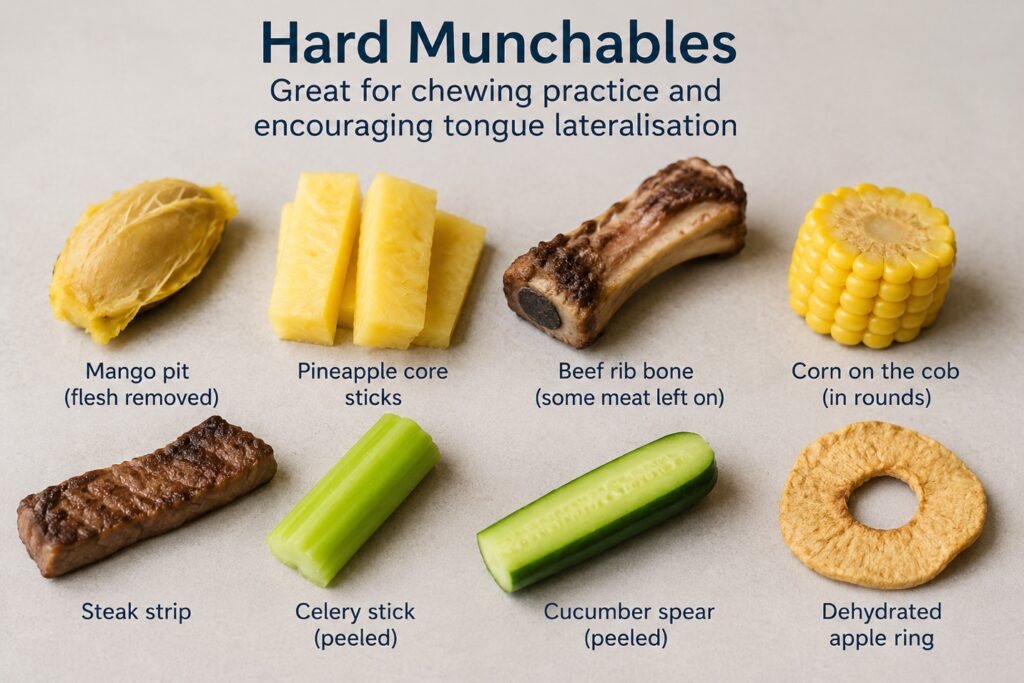
Hard munchables: Chewing through the weaning journey
· ·

Hard munchables: Chewing through the weaning journey

As a Speech and Language Therapist with a specialism in paediatric feeding, I’m constantly looking for ways to support families in developing their little ones’ oral motor skills and fostering a positive relationship with food. While Baby-Led Weaning (BLW) has revolutionised how many families introduce solids, (see my previous blog in July 25) a concept that often sparks discussion and curiosity is the use of ‘hard munchables.’

What are hard munchables?

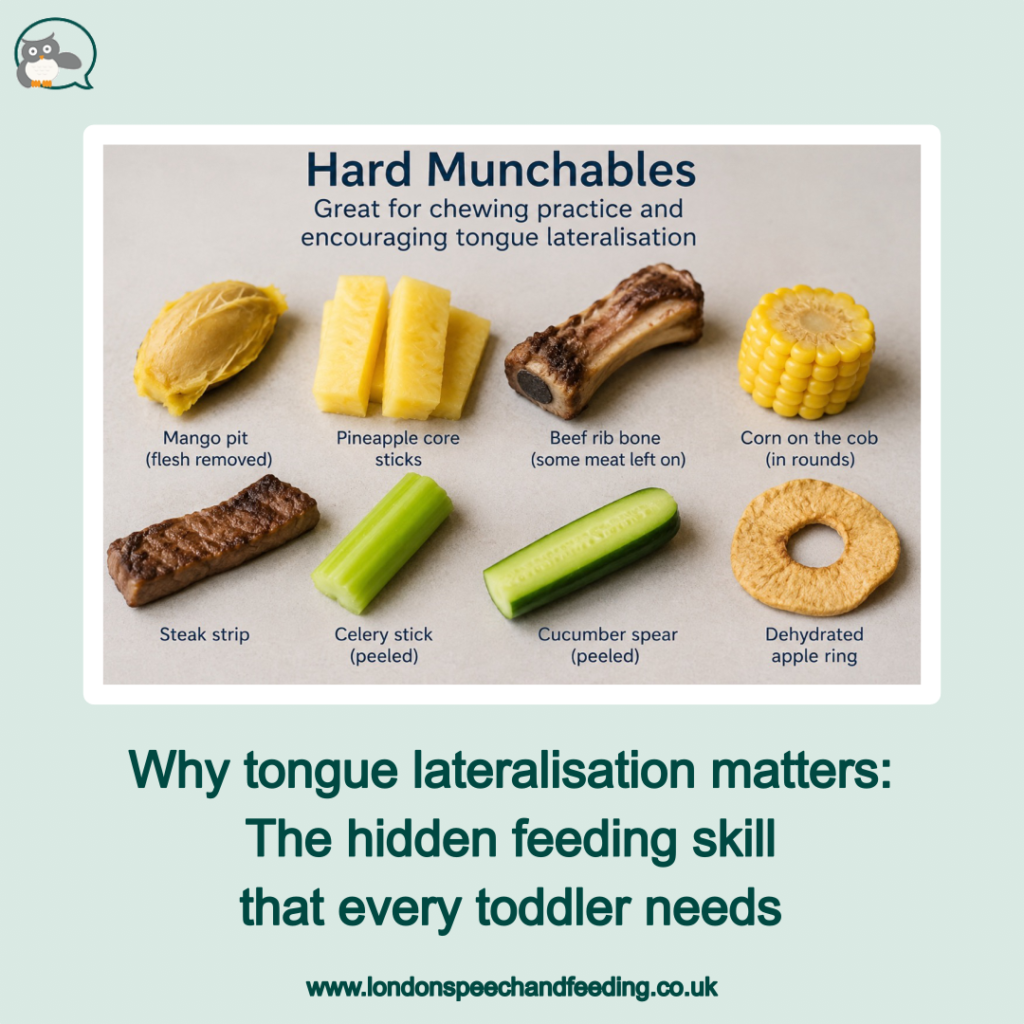
The term ‘hard munchables’ refers to specific types of firm non-digestible food items that are offered to babies for oral exploration and skill development, not for nutrition. These are typically foods that babies cannot bite off or swallow in large pieces due to their texture, but which provide resistance for chewing practice.

The phrase was coined by Marsha Dunn Klein, M.Ed., OTR/L, Occupational Therapist and feeding therapist. Well known for her work in paediatric feeding she introduced and advocated for the concept of hard munchables as part of a therapeutic feeding approach, particularly for infants learning to manage textures and develop crucial oral motor skills.

Common examples of hard munchables include:

  • Large, raw carrot sticks: Too hard to bite through, but great for gnawing.
  • Celery sticks: Like carrots, offering firm resistance.
  • Large, raw apple slices (peeled chunks): A firm, slightly sweet option.
  • A firm, uncut pear core: With the seeds removed.
  • Dried mango cheeks (hard, unsweetened varieties): These offer a fibrous texture.
  • A large, fully cooked but firm piece of meat (like a steak bone with some meat attached): The meat provides flavour and a bit of shreddable texture, while the bone is for gnawing.
  • Hard crusts of bread or breadsticks (very firm, without soft inner crumb): These can soften slightly with saliva but offer significant resistance.
Image by Freepik

It’s crucial to emphasise that hard munchables are not for consumption or nutrition. They are tools for oral motor development and should always be offered under strict, active supervision.

How do hard munchables fit into weaning?

While weaning (traditional or Baby-Led Weaning) introduces solid foods that a baby can eventually bite and swallow, hard munchables are complementary to the weaning phase. They enhance that phase by helping a child to develop hand dexterity, hand to mouth movement, and oral development.

It’s important to differentiate: Weaning provides the digestible food for eating, while hard munchables provide the tool for skill practice. They are not substitutes for each other but can be used together under careful guidance.

Pros and cons from a speech therapy perspective

As an SLT, I see both the potential benefits and the necessary precautions when incorporating hard munchables.

Pros:

  • Enhanced oral motor development: Hard munchables provide excellent resistance training for the jaw, helping to develop the strength, endurance, and coordination needed for efficient chewing. This is foundational for moving beyond purées and very soft textures.
  • Promotes lateralisation of the tongue: The act of moving the hard item from side to side in the mouth encourages the tongue to move independently of the jaw, a crucial skill for managing food and for speech sound production.
  • Preparation for more complex textures: By strengthening the oral musculature and refining chewing patterns, hard munchables can help babies transition more smoothly to lumpy and mixed textures.
  • Sensory exploration: They offer rich sensory input (tactile, proprioceptive) that can be beneficial for oral mapping and awareness, especially for babies who might be orally sensitive.

Cons:

  • Choking risk: While the intention is for the baby not to bite off pieces, there is always a risk. Small pieces can break off, or a baby might accidentally bite off a larger chunk than he or she can manage. Active, vigilant supervision is non-negotiable.
  • Not a replacement for digestible solids: It’s vital to remember that hard munchables are for practice, not nutrition. They should complement, not replace, the introduction of varied, digestible solid foods.
  • Not suitable for all babies: Babies with certain developmental delays, oral motor deficits, or medical conditions might not be appropriate candidates for hard munchables without highly specialised guidance. For instance, babies with an exaggerated gag reflex might find them overwhelming.

Key Considerations for Parents

Here are my top recommendations:

  1. Consult with a professional: Always discuss this with your Paediatric Feeding SLT first before you introduce hard munchables. We can assess your baby’s individual readiness and guide you on safe practices.
  2. Strict supervision: Never leave your baby unsupervised with a hard munchable, even for a second. Your full attention is required.
  3. Appropriate size: Ensure the item is large enough that the baby cannot fit the whole thing in their mouth. It should extend well beyond their fist.
  4. No biting off: The goal is gnawing and scraping, not biting off pieces. If your baby is consistently breaking off chunks, stop using them.
  5. Focus on skill, not consumption: Reiterate to yourself that this is for practice, not for eating.

In conclusion, hard munchables, when used appropriately and under guidance, can be a very valuable tool to support oral motor development during the weaning journey. However, always be safe and consult with a specialist to ensure your little one develops his or her feeding skills effectively and joyfully.

Sonja McGeachie

Highly Specialist Speech and Language Therapist

Owner of The London Speech and Feeding Practice.


Health Professions Council registered
Royal College of Speech & Language Therapists Member
Member of ASLTIP

Find a speech and language therapist for your child in London. Are you concerned about your child’s speech, feeding or communication skills and don’t know where to turn? Please contact me and we can discuss how I can help you or visit my services page.


References:

Rapley, G., & Murkett, T. (2008). Baby-Led Weaning: The Essential Guide to Introducing Solid Foods. Vermilion.

Morris, S. E., & Klein, M. D. (2000). Pre-feeding skills: A comprehensive resource for feeding development. Pro-Ed.

1
Baby-led weaning: Empowering little eaters from the start
· ·

Baby-led weaning: Empowering little eaters from the start

I had a mum ask me about Baby Led Weaning the other day. So I thought I would write a blog on all the useful questions she had and what we discussed as it may help lots of mums and dads out there.

As a Paediatric Feeding SLT, one of the exciting developments in recent years is the growing interest in baby-led weaning (BLW). This approach to introducing solids has gained significant traction, and for good reason. It empowers infants to take the lead in their feeding journey, fostering a positive relationship with food and supporting important developmental milestones.

What exactly is baby-led weaning?

At its core, baby-led weaning is about offering your baby appropriately sized and textured solid foods from the very beginning, allowing him or her to self-feed. Instead of spoon-feeding purées, you present whole, soft foods that your baby can grasp, bring to his or her mouth, and explore at his or her own pace. This means no mashing, no blending, and no forcing spoons into reluctant mouths. It’s a fun, messy, and intuitive process that is led by your baby’s natural instincts.

The genesis of baby-led weaning

‘Baby-led weaning’ was popularised by British health visitor Gill Rapley. In the early 2000s, Rapley observed that babies naturally develop the skills needed to self-feed and that traditional spoon-feeding might actually hinder this development. Her work, particularly her book Baby-Led Weaning: The Essential Guide to Introducing Solid Foods (co-authored with Tracey Murkett), published in 2008, brought BLW into the mainstream and provided a structured framework for parents. Her research and observations highlighted the benefits of trusting a baby’s innate ability to regulate his or her intake and explore different textures.

What’s the deal?

Implementing BLW is simpler than you might think, though it does require a shift in mindset. Here’s a breakdown of what it typically involves:

  • Readiness is key: The golden rule of BLW is to wait until your baby shows clear signs of readiness. This isn’t about age alone, but rather developmental milestones. Your baby should be at least six months old, able to sit unassisted, have good head and neck control, show an interest in food (e.g., reaching for yours), and have lost his or her tongue-thrust reflex (which pushes solids out of his or her mouth).
  • Offer finger foods: Start with soft, easily graspable foods cut into finger-sized sticks or spears. Think cooked sweet potato fries, steamed broccoli florets (soft enough to mash with gentle pressure), banana sticks, or avocado slices. The goal is for babies to be able to pick it up and get some into their mouth.
  • Embrace the mess: BLW is inherently messy, especially in the beginning. Food will be squished, dropped, and smeared. This is a crucial part of the learning process as babies explore textures, smells, and the properties of food. A wipeable mat under the highchair and a good bib are your best friends!
  • Observe, don’t interfere: Allow your baby to lead. He or she will decide what to eat, how much, and how quickly. Avoid putting food into his or her mouth or pressuring him or her to eat more. This respects his or her hunger and fullness cues, laying the foundation for healthy eating habits.
  • Continue breastmilk or formula: Until your baby is well-established on solids, breastmilk or formula remains his or her primary source of nutrition. Solids are for exploration, taste, and developing skills, gradually increasing in quantity over time.

The benefits of baby-led weaning

The advantages of BLW extend far beyond simply getting food into your baby. From a speech and feeding perspective, the benefits are compelling:

  • Develops oral motor skills: Chewing, gnawing, and manipulating various food textures are crucial for developing the muscles in the mouth, jaw, and tongue. This strengthens the oral motor skills necessary for speech development.
  • Enhances fine motor skills and hand-eye coordination: The act of grasping food, bringing it to the mouth, and coordinating these movements significantly refines fine motor skills and hand-eye coordination.
  • Promotes self-regulation and intuitive eating: By allowing babies to control their intake, BLW helps them tune into their own hunger and fullness cues, fostering a healthy relationship with food and reducing the likelihood of overeating.
  • Encourages adventurous eating: Exposure to a wide variety of tastes and textures from the outset can lead to less picky eating later. Babies are more likely to accept new foods when they have been in control of their exploration.
  • Facilitates family mealtimes: BLW integrates babies into family mealtimes from an early age, promoting social interaction and making mealtime a shared, enjoyable experience.

When is baby-led weaning appropriate, and when not?

While BLW offers numerous benefits, it’s not a one-size-fits-all approach.

When BLW is appropriate:

  • When your baby meets all the developmental readiness signs: This is paramount for safety and success.
  • When you are comfortable with the mess and the learning curve: It requires patience and a relaxed attitude.
  • When you are committed to offering a variety of safe, appropriate foods.
  • When you are willing to learn about and practise safe food preparation to minimise choking hazards.

When BLW might not be appropriate (or requires extra caution and professional guidance):

  • If your baby has a history of prematurity or significant developmental delays: His or her oral motor skills might not be sufficiently developed.
  • If your baby has certain medical conditions or anatomical differences (e.g., cleft palate, severe reflux, swallowing difficulties): These may necessitate a modified approach to feeding.
  • If there are significant feeding difficulties, aversion, or a history of choking incidents.
  • If you feel overly anxious about choking: While BLW, when done correctly, is not associated with a higher choking risk than traditional weaning, parental anxiety can impact the feeding experience. Education and consultation with a professional can help alleviate these concerns.

A note on safety: Choking hazards

It’s crucial to understand the difference between gagging and choking. Gagging is a natural reflex that helps prevent choking and is very common in BLW as babies learn to manage food in their mouths. Choking is silent and serious. To minimise choking risks:

  • Always supervise your baby closely during mealtimes.
  • Offer appropriately sized and textured foods. Avoid small, round, hard foods like whole grapes, nuts, popcorn, and large chunks of meat.
  • Ensure your baby is sitting upright and calm.
  • Educate yourself on infant CPR.

Final thoughts

Baby-led weaning is a wonderfully empowering approach that celebrates a baby’s natural abilities and fosters a positive and independent relationship with food. As Speech and Language Therapists we often see the positive impact it has on oral motor development, self-regulation, and overall feeding confidence. By understanding what it entails, when it’s appropriate, and prioritising safety, you can embark on this exciting journey with your little one, helping him or her become a confident and capable eater from the very first bite.

If you would like help and support with weaning your baby whilst continuing to breastfeed then please get in touch!

Sonja McGeachie

Highly Specialist Speech and Language Therapist

Owner of The London Speech and Feeding Practice.

Health Professions Council registered
Royal College of Speech & Language Therapists Member
Member of ASLTIP

Find a speech and language therapist for your child in London. Are you concerned about your child’s speech, feeding or communication skills and don’t know where to turn? Please contact me and we can discuss how I can help you or visit my services page.
1
Baby-Led Weaning: A Speech and Language Therapist's Take
·

Baby-Led Weaning: A Speech and Language Therapist’s Take

Let’s face it, introducing solids is a rollercoaster for parents. You’re bombarded with advice (solicited and otherwise) on purees, spoon-feeding, and the much-discussed ‘baby-led weaning’ (BLW). As a speech-language/feeding therapist I see the world through the lens of communication and development, as well as safe munching and swallowing. BLW can be a fantastic option for many little foodies. But is it right for yours? Let’s take a dive into the messy, hilarious world of toddler feeding.

BLW in a nutshell

Your baby, perched in their highchair, eyes wide with excitement and curiosity reaches out for a platter of food. He/She grabs a fat avocado slice, and curiously explore it with his/her lips, gums and tongue. He/She spits some of it out, mashes bits of it into his/her hair, there was a tiny swallow and the rest is smeared onto the high chair tray. Now he/she grabs a bit of the banana and rinse and repeat as before, except this one he/she keeps in his/her mouth for bit longer and takes a tiny bit more before the rest gets deposited into his/her bib.

This, in a nutshell, is BLW! It’s all about letting your little one take the lead in exploring new foods, textures, and tastes. No spoon-feeding, just pure, messy, self-directed feeding fun.

The pros of letting your little one loose on solids:

  • Motor Skills: BLW is a sensory party for developing motor skills. Picking up that slippery banana or gumming a chewy piece of toast strengthens those tiny hands and mouth muscles. These are the very skills they’ll need for future talking and chewing.
  • Texture Time: BLW exposes your baby to a variety of textures right from the start. Think soft, steamed broccoli florets or smooth, banana half-slices. This sensory exploration helps them develop an understanding of different textures in the world, which can translate to better oral motor skills needed for speech development.
  • Independence: BLW fosters a sense of self-feeding independence. Your toddler learns to control how much he/she eats and the pace of his/her meal. This can lead to better self-regulation later on, not just with food, but in other areas of his/her development too.
  • A wider variety of flavours: BLW encourages exposure to a wider variety of tastes and smells. Let your baby discover the sweetness of roasted sweet potato or the tang of mashed avocado! This early exploration can lead to less picky eating down the road.

There are some valid concerns:

  • Gagging vs. Choking: One of the biggest concerns parents have about BLW is choking. However, gagging is a natural reflex that helps babies learn to move food safely around their mouths. Choking is much rarer, and with proper food selection and supervision, the risk is very low. The con here really is parental anxiety more than anything else and if you can overcome this then a bit of gagging is just fine and part of the process. Choking, again most children do choke occasionally a bit! Of course, close supervision and common sense is very important here.
  • It’s ever so messy!: Be prepared for mashed banana on the highchair tray, rogue peas flung across the room, and a general sense of chaos. But then again, this is an important part of the learning process! I would encourage you to embrace the mess (within reason and your personal tolerance level) and focus on the fun of exploration.
  • Nutritional Concerns: Some parents worry that babies won’t get enough nutrients with BLW. While it might take a while for them to master the art of self-feeding, a healthy child’s body is pretty good at self-regulating. Offer a variety of healthy options, and he/she will eventually get the hang of it.

BLW: Is it right for your Little One?

BLW isn’t a one-size-fits-all approach. Here are some things to consider:

  • Developmental Milestones: Babies should be able to sit up with good head control and show an interest in food before starting BLW.
  • General good health and absence of food intolerances, allergies, or other significant health issues which might dictatea more controlled feeding regime.
  • Gag Reflex: A strong gag reflex is a good sign. It shows your baby’s natural ability to move food safely around their mouth. If, however, your baby’s gag is overly sensitive and causes frequent bouts of vomiting please consult your health care professional for an assessment (GP, Paediatrician, Dietician, Speech and Language – Feeding Therapist).
  • Your Comfort Level: BLW requires a relaxed and patient approach. If you’re feeling stressed about the mess or potential choking hazards, it might not be the right fit for you.

A final mouthful:

BLW can be a fantastic way to introduce your baby to solids. It promotes exploration, independence, and a love for food. Remember, there’s no pressure to go all-in on BLW. You can always combine it with spoon-feeding or purees to find an approach that works for your family and your child. The most important thing is to create a positive and relaxed mealtime environment where your little one can explore the wonderful world of food at their own pace.

P.S. As an SLT, I always recommend chatting with your health care professional. This way you can address any concerns you might have and ensure your baby is developmentally and physically on track for this exciting new chapter.

Don’t hesitate to contact me!

Sonja McGeachie

Early Intervention Speech and Language Therapist

Feeding and Dysphagia (Swallowing) Specialist The London Speech and Feeding Practice

The London Speech and Feeding Practice


Find a speech and language therapist for your child in London. Are you concerned about your child’s speech, feeding or communication skills and don’t know where to turn? Please contact me and we can discuss how I can help you or visit my services page.

1