How parent coaching turns story time into a communication success
· · ·

How parent coaching turns story time into a communication success

We often hear from parents who are trying their best to connect with their child, especially when reading books, but are met with frustration. They’ll say, ‘I read the book exactly as it’s written, but my child can’t focus for very long and just runs off!’ or ‘my child just flicks through the pages then turns it upside down and runs off with it’ or similar.

It’s a common story. Traditional reading—going through the text from cover-to-cover—has its place of course, but for little ones with a language delay or autism it can move too quickly and place all the focus on the book’s words, not on the interaction.

But what if I told you that story time could become one of the most fun and productive times for your child’s communication development?

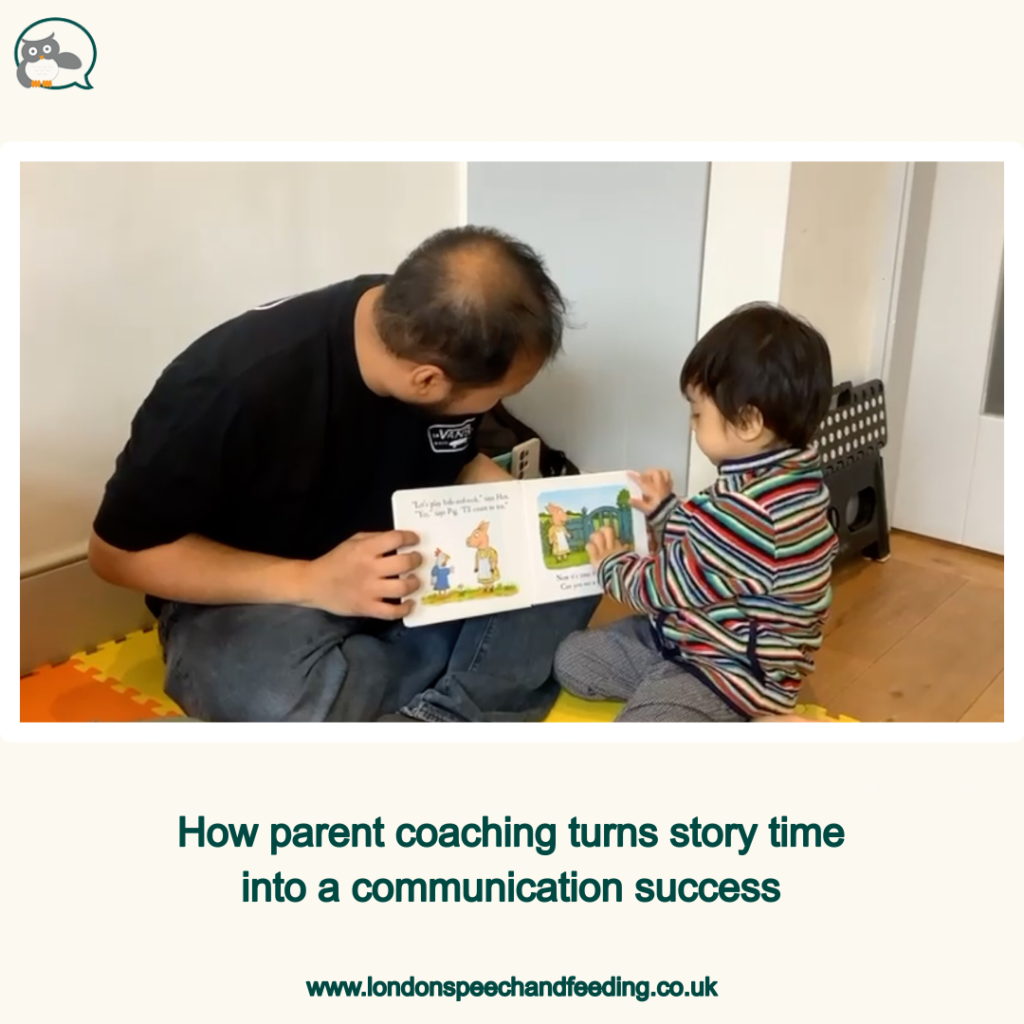
Watch the fantastic little video clip above! You can see the pure joy and connection between this dad and his son. This is the same family who, just a few weeks ago, felt defeated when trying to read a book, with their child quickly losing interest and leaving the reading/book corner.

What changed?

The power of parent coaching and Hanen principles

The difference you see in the video is the direct result of parent interaction therapy, or parent coaching, based on the internationally recognised Hanen principles.

I didn’t ‘fix’ the child. Instead, I coached the parents in a few simple, powerful strategies that completely changed the dynamic of their interaction. Instead of being a time for teaching and instruction, story time became a back-and-forth conversation.

Here are the four major transformations that coaching helped this family achieve:

1. From reader to play partner

Before coaching, the parents felt their job was to read the text and to teach the words in it to their child. Now, their job is to follow their child’s lead. They learned to Observe, Wait, and Listen (OWL). If the child points to the tree or the badger on the page, the parent talks about the tree or the badger.

The result

The child is now initiating and leading the conversation! He is sharing what he finds interesting, which makes him feel powerful and keeps him deeply engaged.

2. Building connection and attention

When parents focus solely on reading, they often forget to make frequent eye contact and use animated facial expressions. The principles taught them to put the text aside and prioritise connection.

The result

Our little boy is looking at his dad more frequently, making great eye contact, and clearly having fun! When the interaction is fun, the child’s attention span naturally lengthens, allowing him to attend to the book and the interaction for a much longer time.

3. Creating opportunities for communication

The parents learned simple ways to prompt communication without pressure. They stopped asking knowledge-based questions (‘What colour is that? Or point to the pig!’), which can feel like a test.

Instead, they learned to use techniques like ‘Saying less and pausing’ or ‘copying their little one’s echolalia ‘, signalling that they are very interested in what he is saying and that his communication matters!

The result

The child is now spontaneously using strings of sounds and gestures to communicate his needs and interests, knowing and enjoying his parents’ enthusiastic responses.

This video is a testament to the fact that you are your child’s best therapist. With the right tools and coaching, you can transform everyday routines, like reading a book, into the most joyful and effective communication sessions.

4. Acknowledging and interpreting echolalia

In the video, you may hear the little boy repeat a phrase from the book or from what his dad just said. This is called echolalia, and for a long time, it was often dismissed or discouraged.

However, a core principle of our parent coaching is that echolalia is communication. For children who are ‘Gestalt Language Processors,’ these memorised phrases (or ‘gestalts’) are their building blocks of language.

The key is not to stop the repetition, but to become a ‘language detective’ and ‘interpreter’!

By modelling the correct, first-person phrase right after the echo, parents/caregivers are teaching a child how to break down the ‘chunk’ and use the individual words functionally. They are showing their child: ‘I heard you. Your communication makes sense to me.’

This strategy is a game-changer because it:

  1. Validates the child’s communication: It honours the child’s natural way of learning language, which boosts their confidence and willingness to communicate.
  2. Facilitates language development: It provides the child with the next step—a meaningful, functional phrase—to move them from repeating language to generating their own spontaneous sentences.

Look at the child’s face again in the video. When his dad acknowledges and interprets his communication, you see that spark of joy and connection—that’s the moment when true, functional language learning happens!

Ready to unlock the potential in your family’s story time? Contact me to learn more about our parent coaching programs.

Sonja McGeachie

Highly Specialist Speech and Language Therapist

Owner of The London Speech and Feeding Practice.


Health Professions Council registered
Royal College of Speech & Language Therapists Member
Member of ASLTIP

Find a speech and language therapist for your child in London. Are you concerned about your child’s speech, feeding or communication skills and don’t know where to turn? Please contact me and we can discuss how I can help you or visit my services page.

2
The power of imitation in supporting children with autism
· ·

The power of imitation in supporting children with autism

Image by Freepik

Imitation, the act of mirroring someone else’s actions, gestures, sounds, or words, is a fundamental skill that plays a crucial role in human development. It’s how babies learn to wave ‘bye-bye’, how toddlers pick up new words, and how children acquire social skills. But for children with autism imitation can be a significant challenge and understanding why it’s important and how to foster it becomes a key focus for parents, educators, and speech and language therapists.

Why is imitation important?

Imitation is a building block for a wide range of developmental skills:

  • Social interaction: Imitation is the foundation of social reciprocity. When a child imitates, he or she is engaging in a shared experience, connecting with another person, and learning to take turns in social exchanges.
  • Communication development: Imitation is closely linked to language acquisition. Children often imitate sounds and words before they can produce them independently. Imitation also helps them understand the meaning of gestures and facial expressions, which are vital for nonverbal communication.
  • Cognitive development: Imitation plays a role in problem-solving, learning new skills, and understanding cause and effect. By imitating actions, children explore their environment and learn how things work.
  • Emotional development: Imitation helps children understand and share emotions. When a child imitates a smile, he or she may begin to understand the feeling of happiness.

Imitation challenges in autism

Many children with autism face challenges with imitation, which can affect their development in these key areas. These challenges can manifest in different ways:

  • Difficulty imitating motor actions: Children with autism may struggle to imitate simple motor movements, such as clapping hands, waving, or playing ‘peek-a-boo’.
  • Limited vocal imitation: Imitating sounds, words, and phrases can be difficult for some children with autism, which can impact their speech development.
  • Challenges with social imitation: Imitating social cues, such as facial expressions, gestures, and body language, can be particularly challenging for children with autism, affecting their ability to engage in social interactions.

Why do children with autism struggle with imitation?

The exact reasons for imitation difficulties in autism are complex and not fully understood. However, several factors may contribute:

  • Neurological differences: Research suggests that differences in brain structure and function, particularly in areas involved in social perception and motor control, may play a role.
  • Sensory processing differences: Some children with autism may have sensory differences that make it difficult to attend to and process the movements or sounds they are expected to imitate.
  • Attention and motivation: Challenges with attention, focus, and social motivation can also affect a child’s ability to engage in imitation.

How to foster imitation in children with autism

Fortunately, imitation skills can be developed and improved through targeted interventions and strategies. Here are some approaches that I use in my practice as a speech and language therapist working with autistic children and their families:

  • Create a playful and engaging environment: Children are more likely to imitate when they are having fun and feel motivated. I use toys, games, and activities that the child enjoys.
  • Start with simple imitation: Begin by imitating simple motor movements that the child is already capable of and gradually introduce more complex actions.
  • Imitate the child first: As the Hanen Program emphasises, imitating the child’s actions, sounds, and words can encourage him or her to interact and communicate more.
  • Use visual supports: Visual aids, such as pictures, photos or videos, can help children with autism understand what is expected of them and make imitation easier.
  • Break down complex actions: Divide complex actions into smaller, more manageable steps. For example, to teach a child to brush their teeth, break it down into steps like ‘pick up toothbrush’, ‘put toothpaste on brush’, and ‘move brush on teeth’.
  • Reinforce imitation attempts: Provide positive reinforcement, such as praise, smiles, or preferred activities, when the child attempts to imitate, even if the imitation is not perfect.
  • Integrate imitation into daily routines: Incorporate imitation into everyday activities, such as imitating sounds during playtime, imitating gestures during songs, or imitating actions during self-care routines.

The role of speech therapy

Speech-language therapists play a crucial role in helping children with autism develop imitation skills, particularly in the areas of vocal and verbal imitation. As part of my therapeutic role, I offer the following:

  • Assessing a child’s imitation abilities.
  • Developing individualised therapy plans to target specific imitation goals.
  • Using a variety of techniques to encourage vocal imitation.
  • Working with parents and caregivers to provide strategies and support for promoting imitation at home.

Summary

Imitation is a fundamental skill that is essential for social, communication, cognitive, and emotional development. While children with autism may face challenges with imitation, it is a skill that can be developed and improved with targeted interventions and support. By understanding the importance of imitation and using effective strategies to foster it, parents, educators, and therapists can make a significant difference in the lives of children with autism, helping them to connect with others, learn new skills, and reach their full potential.

Do get in touch via my contact form if you have any question or need help with supporting your little one.

Sonja McGeachie

Highly Specialist Speech and Language Therapist

Owner of The London Speech and Feeding Practice.

Health Professions Council registered
Royal College of Speech & Language Therapists Member
Member of ASLTIP

Find a speech and language therapist for your child in London. Are you concerned about your child’s speech, feeding or communication skills and don’t know where to turn? Please contact me and we can discuss how I can help you or visit my services page.

1
The Hanen Program® – The beauty of the ‘4 S’
· ·

The Hanen Program® – The beauty of the ‘4 S’

One of my favourite pieces of advice I give to parents is the ‘4 S’, a strategy coined by the Hanen Program® which I teach, particularly the ‘More than Words’ programme which is designed for and aimed at parents of children with Social Communication Difficulties or Autism. It is honestly one of those golden nuggets that I use myself in my practice and I highly recommend it to all my parents. There is something about terms like the ‘4 S’ that is easy to recall and therefore use.

Introduction

The ‘4 S’ is a strategy that helps to clarify the words we use with our children so that they can notice us, hear us and understand what we are saying.

Research shows that we use on average 120-200 words per minute during everyday conversation. That’s a lot! And our children who are still learning to communicate are often bombarded with endless speech coming at them all day long. If we take into account that many of our students are Gestalt Language Processors, we can see that picking out relevant chunks of what we are saying is not at all easy, and this contributes to our children’s delays.

So let’s look at the ‘4 S’

1. The first one is SAY LESS

This means we should use shorter, simpler sentences with good grammar, for example, something like: ‘let’s get ready, time to put our shoes on’ instead of what we might be saying: ‘come on then darling, let’s put your shoes on we need to get going it’s dark outside’ or similar.

Good grammar helps to give clues about what words mean and how they are used in sentences. So, instead of ‘shoes on’ say ‘let’s put our shoes on’.

2. The second one is STRESS

I hear you think ‘I am stressed!‘. – NO! here it means ‘highlight’. We use our voice to highlight the important words in our sentence or phrase. For example, when you say ‘this banana is so yummy’ you can stress the word ‘yummy’ by saying it a bit louder and you can make a gesture, like rubbing your tummy as you say it.

3. The third one is GO SLOW

This means to speak a bit slower than you normally would and add pauses. By slowing down the pace of our speaking we give our child time to think and understand what we are saying. When we allow for pauses after we have spoken, we are inviting our child to say something in response.

4. The last one is SHOW

Always remember to show actions, gestures, objects, and point to pictures while speaking to help support your child’s understanding. We can show our child what words mean by pointing to things or holding up objects whilst describing or talking about them.

At this point I would also like to recommend the use of Core Boards, and particularly Electronic AAC devices, such as LAMP Words for Life or PODD. I have written about this in other blogs but can always be persuaded to say a bit more on the matter… 😊 It is such a big help to have an AAC talker available for both the child and the adult so we can find words and pictures to help support the words we are saying.

For example, today when reading a book like The Hungry Caterpillar (so good!) I used my LAMP AAC talker to make comments as we were looking at the pages together with my student. Example: ‘Look! He is eating more cake he is very hungry’ using my AAC talker I was able to supplement my speech and at the same time I was inviting my minimally speaking child to press a button or two and reply with ‘cake!’ which they would not have said with their mouth otherwise.

5. It does say ‘4 S’ but really it should be ‘5’ except the fifth is not an ‘S’

The fifth is REPEAT.

Repeat words and phrases often throughout the day. When learning a language we all need to hear words and phrases several times and in different situations before we can understand, remember, and then eventually use them. Our children are ‘new language learners’ and so we can apply the same principles that we would when learning a new foreign language ourselves.

Any questions or need help with supporting your little one’s language please contact me via my contact form, or you could also check out www.hanen.org for advice and lots of inspiration.

Sonja McGeachie

Early Intervention Speech and Language Therapist

Feeding and Dysphagia (Swallowing) Specialist The London Speech and Feeding Practice

The London Speech and Feeding Practice


Find a speech and language therapist for your child in London. Are you concerned about your child’s speech, feeding or communication skills and don’t know where to turn? Please contact me and we can discuss how I can help you or visit my services page.

1
Following your child's lead: A playful path to AAC success
· · ·

Following your child’s lead: A playful path to AAC success

Unlocking playtime: A guide to child-led learning

Does your child struggle to focus on toys or activities? Do they dart away as soon as you approach? You’re not alone!

The key to unlocking your child’s potential lies in following their lead. Let them guide the play session, and watch their engagement and focus soar.

Why Child-Led Play Works:

  • Empowerment: Children feel in control, sparking their curiosity and motivation.
  • Focused attention: They’ll stay engaged with activities for longer periods.
  • Reduced frustration: By stepping back and observing, you eliminate the pressure and stress that often comes with directed play.

How to Implement Child-Led Play:

  1. Prepare the environment: Set out a limited selection of engaging toys.
  2. Observe and wait: Sit back, watch, and listen to your child’s interests.
  3. Embrace the moment: Resist the urge to direct or question; simply enjoy the process.

Remember: This simple approach can transform playtime and support your child’s development. Give it a try for a week and see the difference!

#OWLing #hanenmorethanwords

Observe, Wait, Listen. It’s a powerful formula for unlocking your child’s potential.

You will likely see:

  • Your child will stay put with any toy for longer whilst you are near them.
  • Your child will tolerate you being nearby and he/she won’t move away.
  • Your child will start giving you brief glances of enjoyment, or perhaps they will hand things to you, or they might take your hand and lead it to something that needs opening etc.
  • In other words, you will see that there suddenly is JOINT PLAY. Yes, granted it may not be according to your adult agenda, but there will be more togetherness than there was before. And this is the START of communication and social engagement.

USE Core words and a coreboard — to help your child understand the power of words

Core words are the building blocks of communication. Try using a coreboard like the one below, they are versatile and can be used in countless ways. By modelling these words naturally during play, you expose your child to their meaning and function in context. This approach is far more effective than isolated drill and practice, more powerful than flashcards!

Using AAC coreboard
Photo by lemonlenz

A Winning Combination

Combining child-led play and AAC modelling creates a magic effect. To summarise:

  • Increased engagement: When you follow your child’s lead, they are more likely to be engaged and receptive to learning. This creates optimal conditions for introducing AAC core words.
  • Natural learning: By modelling AAC core words in the context of play, you help your child understand their meaning and purpose naturally. This fosters generalisation and spontaneous use.
  • Building relationships: Shared play experiences strengthen the bond between you and your child. This trust and connection are essential for successful communication.
  • Reduced pressure: Modelling AAC core words without expectation removes the pressure to produce language. This allows your child to explore communication at their own pace.
  • Expanded vocabulary: As your child becomes more comfortable with AAC, they will begin to incorporate core words into their own communication. This leads to vocabulary growth and increased independence.

Practical Tips

  • Observe and respond: Pay close attention to your child’s interests and actions. Respond to their cues with enthusiasm and support.
  • Keep it simple: Start with a few core words and gradually introduce new ones as your child’s skills develop.
  • Be patient: Language learning takes time. Celebrate small successes and avoid frustration.
  • Have fun: Remember, play is supposed to be enjoyable for both you and your child. Relax and have fun together!

Example:

Photo by lemonlenz

Let’s say your child is playing with a pop-up toy like you see me do in the above photograph. Here, I followed my child’s lead by waiting to see what she wanted to do with the toy. You are now OWLING! (Observe Wait and Listen)

Once I noticed that there was repetitive opening of the flaps going on I then pointed to OPEN and MORE on the board, as I said: ‘let’s OPEN this one’ / let’s see MORE animals’ / ‘MORE cow! it says moo!’ ‘OPEN another one’ and so on.

Important to know, we are not expecting our child to respond verbally or with AAC, but we are providing language input and demonstrating how these words can be used with enthusiasm.

Naturally in time your child will look at the board and at your pointing and they will eventually want to copy you!

By incorporating these strategies into your daily interactions, you can create a supportive environment that fosters language development and communication growth.  If you would like more guidance please get in touch and book in for a consultation, some individual therapy and/ or some parent coaching.

I look forward to supporting you. Please contact me and let’s see how.

Sonja McGeachie

Early Intervention Speech and Language Therapist

Feeding and Dysphagia (Swallowing) Specialist The London Speech and Feeding Practice

The London Speech and Feeding Practice


Find a speech and language therapist for your child in London. Are you concerned about your child’s speech, feeding or communication skills and don’t know where to turn? Please contact me and we can discuss how I can help you or visit my services page.

1
Quick Overview Of How To Implement Those Early Hanen Speech And Language Strategies

Quick Overview Of How To Implement Those Early Hanen Speech And Language Strategies

Quick Overview Of How To Implement Those Early Hanen Speech And Language Strategies

First up try and get down at eye level or Face-to-Face with your child

Try to sit so that your child can see you easily, i. e. your child does not have to look up to make eye contact with you. We call that Face to Face: try and sit opposite your child. This makes it easier for you to see facial expressions and therefore pick up nonverbal /pre-verbal communication. Now you can connect and share the moment with your child.

OWL (Observe, Wait and Listen)

Never skip this step as it prepares us for what happens next !

Observe

First, try and simply watch your child quietly and listen and observe what he/she says or does; you need to know what your little one is interested in. For example with this toy (pictured below) we could observe that your child loves the actual spinning of the marble, perhaps more than that noisy click-clacking down the run. Or perhaps he loves collecting the marble at the end and feeling it in his hand.

You could start off with showing once how the marble goes down and say:“ look it goes round and round !” Then hold back and observe, without speaking, so that your child has time to explore the toy.

Wait

Just sit and avoid telling or showing your child what he or she could do with the toy. This gives your child an opportunity to explore and experiment.

Listen

Listen to what your child says, or look at your child’s non-verbal communication without interrupting. Your child will now feel and know that you are really present and that what they have to say is important. It’s best to avoid questions like, “What are you doing or “What’s this?” as that might be a lot of pressure when they don’t know what to say about that yet.

Respond immediately by showing interest

Once you have all the information from OWLing you can respond in the right way, for example: if she catches the marble at the end of the run and looks up with a smile or a sound you could respond with: you’ve got it! One marble in your hand! Nice playing!

Now how to join in the play:

First you can copy what your child is doing

If your child puts the first marble at the top of the run you can take a turn and do exactly the same once his marble is done. Ideally you might have another marble run, perhaps a similar one, it does not have to be exactly the same! Once your child has put the first marble in you can do the exact same with your own marble on your run. Your child is likely to look at what you are doing and you might well see a smile on their face or perhaps she might say: look at mine!

Next you can build on that

You can respond with simple comments like: “Wow! Yes I am looking at yours now! It’s spinning on the red one lots! I love the noise!” Now wait once more to see what your child says or does.

To summarise

We are signalling to our child that we are really interested in what they are doing and saying so we can “collect” our child, i.e. bring him/her back into a joint interaction.

Important

We want to try and not direct our child but respond with interest and fun! This creates a lovely stage for interaction and joint play! And this leads in turn to practising conversation and ever more opportunities for great speech and language skills to emerge.

Great activities we use in Speech and Language Therapy:

  • Any cause and effect toys like this Marble Run
  • Creative activities, such as mark making with crayons
  • Train tracks (building and running the trains)

Find a speech and language therapist for your child in London. Are you concerned about your child’s speech, feeding or communication skills and don’t know where to turn? Please contact me and we can discuss how I can help you or visit my services page.

Tele-therapy – What Is that And how does it work With Speech And Language Therapy?

Tele-therapy – What Is that And how does it work With Speech And Language Therapy?

Tele-Therapy – What Is That And How Does It Work With Speech And Language Therapy?

How can I help you assess and support your child when you live outside London or just can’t come to see me for any reason? The short answer is: YES I CAN and we can do it virtually! There are separate areas I can target using Teletherapy.

Here is one of them:

Parent – Child Interaction / Attunement

Through the pandemic and lock-down I have had opportunity to re-think how I can help people virtually and what I can do to ensure that parents continue to feel empowered and help their children make good progress even when I cannot personally come to their home or they cannot visit me.

My training with the HANEN METHOD came in so handy as of course in the US and Canada therapists and families traditionally cover huge areas and often are too far away from each other. They have been practising on-line/virtual or now known TELE-THERAPY for decades and are very advanced with research, materials and support in this area. I skilled up at the beginning of the pandemic early 2020 and by around April I was up and running! Nobody was able to see anyone in lockdown and of course parents were still desperate for help with their children.

The basic premise when supporting young children under the age of 5 years is that a NATURALISTIC approach is the best and very well researched to be highly effective. This means that the parents or caregivers are the most important and consistent key people in every child’s life and they are the best therapists and AGENTS FOR CHANGE.

Parents spent the most time with their child, even when they are working parents! – they are still most likely to spend many hours in the evenings and weekends with their child. When we are looking at how Social Communication develops we know that it emerges from birth through daily interaction and daily activities: playing, snuggling, running, eating, getting dressed, shopping with mum, sitting in the car with dad, playground, dinner around the table, bath time, story time, teeth brushing, bed time. These are the consistent areas where interaction takes place and where social communication can develop/be supported/ be enhanced. – do check out my other blog as well on this topic “What is Speech and Language Therapy”.

Parents Are The Agents Of Change

What do I mean by that? Parent-Child Interaction work focuses on helping the parent to tune in with their child and therefore enabling the child to tune in with the parent, in turn. Its about TUNING IN. This is often missing when children have social communication difficulties: they do not tune in. And parents end up tuning less into their children as time goes on, because the interaction is always so one-sided. Parents tell me again and again how hard it is to engage with their child as there seems to be so little “come-back”.

I teach your really powerful strategies that you can implement quite easily during your normal daily activities! You will not need to do any “home work”, i.e anything extra on top of what you normally do with your child anyway! How good is that!?

Each week I will teach you one or two new strategies to try out and together we will workshop exactly how you could do this. So you will walk away knowing what activities to target and how. Over a short period of time you will see positive changes, because you , the parent, have changed! PARENTS ARE THE AGENTS OF CHANGE. This is incredibly empowering for the parent as in the end you won’t need a therapist because you have become the ideal, consistent, expert therapist for your own child. The strategies will stay with you for life and over time you will be using them without even thinking about it. And your child will learn – over time – to tune in with you. TADAAAH! You’re welcome!

So give Tele-Therapy a try! I would really recommend it:

  • Convenient as you do not need to travel, and therefore cost and time saving.
  • It takes just one hour out of your busy day, not 3 hours with travel in London etc.
  • You will be fully supported with on-line video clips, slides, my write-ups and other materials I often make for you to support your journey.
  • You will feel empowered to help your child develop the very day you start the therapy.
  • You can have weekly support, fortnightly or monthly. You can contact me for brief hand-holds in between and most importantly your child will make progress.

If you would like to discuss this a bit more, get in touch with me! I would love to help. Check out my google reviews of clients who have done Tele-therapy with me, some of them live abroad, as far away as Australia and Tanzania or Germany. You will see it can work so very well.

Find a speech and language therapist for your child in London. Are you concerned about your child’s speech, feeding or communication skills and don’t know where to turn? Please contact me and we can discuss how I can help you or visit my services page.

Joint attention for children with autism
·

Joint attention for children with autism

Kids Speech Therapist London

Why is joint engagement important for communication development?

It has been well-documented that the development of joint attention is impaired in children who have social communication difficulties or autism. It is, in fact, this impairment which distinguishes children with ASD from children who have other developmental delays.

A lack of joint attention in very young children is an early sign of autism as it is a signal that there is a disruption in the motivation to connect socially with others. Since this is a crucial element, I thought I would outline what we mean by Joint Attention as supported by the research undertaken at Hanen.org.

In typically developing children, the ability to shift attention between a person and an object for the purposes of connecting socially or for requesting develops around the same time. However, for children with ASD, these components emerge one at a time and in a linear fashion. Children with ASD usually start with requesting something and later they may learn to share attention for social sharing. (see pattern below as a general guide).

As with typical development, there is variation in the order that these skills emerge but the following patterns of development is commonly seen:

  • Reaching, taking adult’s arm/hand or pointing to ask for something — but without looking at the adult
  • Gradually alternating looking between person and object of desire
  • Then learning to follow the point of another — which is responding to joint attention initiated by another
  • Directing attention to share interests — without looking at the adult: pointing to a truck on the road/ helicopter circling above
  • Then directing attention to share interest by alternating gaze shift between person and object — here the child is now initiating joint attention.

What is important to note is that in order to fulfil the criteria for true joint attention, the purpose of directing the attention of another person must be social in nature. In other words, it must not be exclusively to obtain a desirable object or event/action. True Joint Attention is seen verbally or non-verbally; we want to share a thought with another person and direct them to something we are interested or excited or spooked by.

For example: we can see an amazing firework display in the distance and we want to quickly direct our friend’s attention to this. In order to do this we might be tugging their sleeve/arm whilst pointing to the display in the distance, and perhaps we might add “wow look over there!” We are doing so simply to share an interest without obtaining anything, we are just being social with each other. So True Joint Attention is not just looking at what we want to have, then look at the person who can get this for us and then point to the item. We can say that this is the precursor to true joint attention, which is purely social in nature.

Because true joint attention is an essential precursor to typical language development, the absence of joint attention in children with ASD contributes to difficulties with language learning. Beuker, K., Rommelse, N., Donders, R. & Buitelaar, J. (2013).

The Hanen programme for Parent Child Interaction teaches parents of children with Social Communication Difficulties step by step how to enable their children to learn to pay attention to an object and the parent at the same time.

We learn how to enable a child to:

  • engage take turns
  • shift eye gaze between toy and adult
  • copy adult’s actions, gestures and then words
  • play with toys in different, new ways
  • interact and for longer periods of time
  • have fun whilst playing

If you would like to know more about the Hanen programme please get in touch. I look forward to exploring the topic with you and help guide you forward if this is something your child is struggling with.


Find a speech and language therapist for your child in London. Are you concerned about your child’s speech, feeding or communication skills and don’t know where to turn? Please contact me and we can discuss how I can help you or visit my services page.