Oral Motor Therapy

  • · ·

    From ‘Nailed it!’ in therapy to ‘Whoops!’ at home: Why generalising speech sounds is tricky

    As a parent, you’ve likely experienced the triumphant feeling when your child, who’s been working so hard on his or her /S/ sound, produces it perfectly in a therapy session. He or she is rocking those ‘sun’ and ‘socks’ words, his or her lisp seemingly a distant memory. You leave feeling elated, confident that all that hard work is finally paying off.

    Then you get home. And within minutes, you hear it: ‘Thooper!’ instead of ‘Super!’ Or maybe the clear /R/ in ‘rabbit’ from therapy reverts to a ‘wabbit’ when his or she is playing with his or her toys. It’s frustrating, confusing, and can feel like you’re back to square one.

    So, what’s going on? Why is it so difficult for children to take those amazing skills learned in a focused therapy session and seamlessly apply them to their everyday conversations? You’re not alone in wondering this. It’s a common challenge in speech therapy and understanding the ‘why’ can help both parents and children navigate this crucial stage.

    The brain’s habits: Old pathways are strong pathways

    Think of your child’s brain as having established ‘pathways’ for how he or she produces certain sounds. If he or she has been lisping his or her /S/ sound for years, that neural pathway is deeply ingrained. It’s like a well-worn path through a field: easy to follow because it’s always been there.

    In therapy, we’re essentially trying to forge a new path. We’re teaching him or her a new, more accurate way to make the sound. This new path is initially faint, like a barely visible trail. It takes conscious effort and repeated practice to strengthen it. Outside of the structured therapy environment, his or her brain often defaults to the old, comfortable, and well-established pathway, even if it’s not the most accurate.

    The demands of daily conversation: A multitasking challenge

    Therapy sessions are designed to be focused and controlled. We isolate sounds, practice them in specific words, and provide immediate feedback. There are minimal distractions, and your child’s full attention is on his or her speech production.

    Now, consider daily conversation:

    • Speed: We speak much faster in natural conversation than we do during structured practice. There is less time to think about individual sounds.
    • Cognitive load: Children are simultaneously thinking about what they want to say, understanding what others are saying, processing social cues, and managing their emotions. Adding the conscious effort of producing a new speech sound correctly on top of all that is a huge cognitive demand.
    • Variety of contexts: In therapy, we might practise ‘sun’ and ‘socks’. In real life, the /S/ sound appears in countless words, in different positions within words, and alongside a vast array of other sounds. Each new word and phonetic context present a fresh challenge.
    • Lack of immediate feedback: In therapy, the speech therapist is right there to provide instant correction and reinforcement. In a playground, during a family dinner, or while playing with friends, that immediate, consistent feedback isn’t present.

    The role of automaticity: Making it second nature

    The ultimate goal of speech therapy isn’t just correct sound production; it’s automaticity. This means producing the sound correctly without having to consciously think about it. It’s like learning to ride a bike. Initially, every pedal stroke and steering adjustment is deliberate. Eventually, it becomes second nature.

    Generalisation is the process of moving from conscious, controlled production to unconscious, automatic production. This takes time, consistent practice, and exposure to a wide variety of real-life speaking situations.

    How can we help? Bridging the gap

    So, what can parents do to help their children bridge this gap between therapy success and everyday speech?

    1. Be patient and positive: This is a marathon, not a sprint. Celebrate the small victories and avoid getting discouraged by setbacks. Your positive reinforcement is crucial.
    2. Practise little and often: Instead of long, infrequent practice sessions, aim for short, consistent bursts throughout the day. ‘Sprinkle’ in opportunities to practise their target sounds in natural conversations.
    3. Create ‘sound awareness’ moments: Gently draw your child’s attention to his or her target sounds in everyday words. For example, if he or she is working on /R/, you might say, ‘Oh, you said ‘wabbit.’ Can you try to make your /RRR/ sound for ‘rabbit’?’
    4. Model correct production: Continue to model the correct production of their target sounds in your own speech.
    5. Collaborate with your speech therapist: Your therapist is your best resource! Ask them for specific strategies and activities you can do at home to support generalisation. They can also provide guidance on when and how to gently correct your child.

    Tips and tricks

    Below I have listed a few good tips and tricks that can help the transition from therapy room to daily life:

    Empowering your child as the ‘sound detective’:

    • ‘Secret sound listener’: Instead of you doing the correcting, make your child the detective. When you’re having a conversation, say ‘your /S/ sounds are sometimes a bit “slippery”’ (or whatever fun, non-judgmental term you like). Ask your child to quietly listen for your /S/ sounds. You can even purposely make a few ‘slippery’ ones (or correct yourself immediately after) and see if they notice. This shifts the focus from being corrected to actively listening and identifying the sound in a non-threatening way.
    • ‘Sound scorecard’: For a short period (maybe 10–15 minutes during a specific activity, like dinner or a game), provide a small notepad and pencil. Explain that your child is going to listen for his or her /S/ sounds and gently mark a tally every time he or she uses it correctly. The goal isn’t perfection, but awareness. This gives your child agency and a visual representation of progress. You can even make it a game: ‘Let’s see how many /S/ sounds we can catch in five minutes!’
    • /S/ sound song/rhyme creation: Work together to create silly songs or rhymes that are packed with /S/ sounds. The sillier, the better! You can sing them in the car, while doing chores, etc.
    • /S/ sound superpower: Frame the new sound skill as a ‘superpower’. ‘You’re getting so good at using your /S/ superpower! It’s going to help you speak so clearly and confidently.’
    • Highlighting successes: Always go out of your way to acknowledge and praise successful /S/ productions in natural conversation. ‘I really understood you clearly when you said ”s_top”.’ or ‘That /S/ sound was perfect when you told me about the “s_tory”!’

    Important considerations:

    • Keep it low-pressure: The goal is generalisation, not perfection. If your child is feeling pressured, he or she will likely revert to old patterns.
    • Focus on awareness, not just correction: Help your child become aware of his or her own speech rather than relying on you for corrections.
    • Short, frequent bursts: A few minutes of subtle focus multiple times a day is more effective than one long, forced session.
    • Acknowledge feelings: If your child expresses frustration about ‘being corrected’, validate these feelings. ‘I understand it can feel like a lot of listening, but we’re just trying to help you use that super /S/ sound all the time!’

    By incorporating these strategies, you can help your child naturally integrate the new /S/ sound into daily speech, fostering independence and confidence without it feeling like constant ‘testing’ or ‘correction’. Generalising new speech sounds is arguably the hardest part of speech therapy, but it’s also the most rewarding. With patience, consistent effort, and a collaborative approach between parents and therapists, children can successfully integrate their new, clearer speech sounds into every aspect of their daily lives.

    Any comments or if you need help and support with your child’s speech please do not hesitate to get in touch with me: simply fill out the contact form here on the website. I endeavour to reply within 48 hours.

    Sonja McGeachie

    Highly Specialist Speech and Language Therapist

    Owner of The London Speech and Feeding Practice.


    Health Professions Council registered
    Royal College of Speech & Language Therapists Member
    Member of ASLTIP

    Find a speech and language therapist for your child in London. Are you concerned about your child’s speech, feeding or communication skills and don’t know where to turn? Please contact me and we can discuss how I can help you or visit my services page.


    1
  • ·

    A bite-sized guide to Speech and Language Therapy: feeding and swallowing

    What is a Speech and Language – Feeding Therapist?

    You’ve probably heard of speech therapists helping people who stutter or struggle to pronounce words. But did you know that they also work with children and adults who have problems with eating and swallowing? This specialised area is called Speech and Language Therapy: Feeding and Swallowing, or Dysphagia Therapy.

    Why does a Speech Therapist help with eating and swallowing?

    The mouth, tongue, and throat are all involved in both speech and swallowing. When there’s a problem with any of these parts, it can affect both your ability to talk and to eat. For example:

    • Weak tongue muscles: Can make it hard to chew food and to form sounds.
    • Difficulty coordinating swallowing: Can lead to choking or aspiration (when food or liquid goes into the lungs).
    • Sensory issues: Can make certain textures or tastes feel unpleasant or overwhelming.
    • Communication: If we are not able to express ourselves we are likely to have difficulties during daily mealtimes: how do we ask for ‘more’ of something, how do we say we have had enough or we don’t like a particular food?

    How does a Speech and Language Therapist help?

    Our work involves a combination of assessment and therapy. We carefully observe how your child feeds, eats and swallows, and we look into your child’s mouth to help us see what the cause of the difficulties are: could be a very highly-arched palate, it could be a very flaccid/low tone tongue, it could be poor dentition. Then, we create a personalised treatment plan to address your specific needs.

    Here are some of the things we might do:

    • Teach swallowing techniques: We can help your child learn strategies to improve or facilitate a safe swallow.
    • Recommend dietary modifications: We may suggest changes to your child’s diet to make it easier to eat and swallow.
    • Provide sensory therapy: If your child has sensory needs we can help your child become more comfortable with different textures, tastes, and smells.
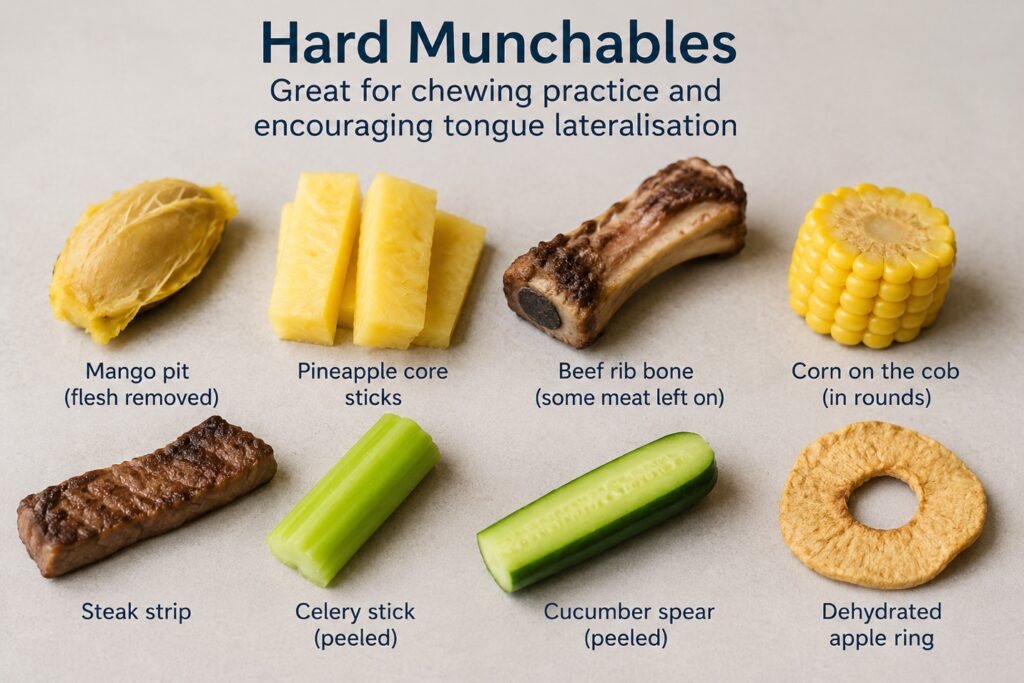
    • Work on oral motor skills: We can help to encourage more effective chewing, or drinking skills, or we can help your child to close his/her mouth more during chewing or drinking from a straw.
    • Collaborate with other professionals: We often work closely with doctors, nurses, occupational therapists, and dietitians to provide comprehensive care.

    What kinds of problems do Speech and Language Therapists help with?

    We see a wide range of feeding and swallowing difficulties, including:

    • Delayed feeding: Children who are slow to develop feeding skills or who have difficulty transitioning to solid foods.
    • Tongue-ties: Babies can have significant difficulties with feeding when the tongue is very tightly tethered to the floor of the mouth.
    • Refusal to eat: Children who refuse to eat certain foods or textures.
    • Aspiration: When food or liquid goes into the lungs, which can lead to pneumonia and other serious complications.
    • Chewing difficulties: Problems with chewing food, such as difficulty breaking down food or keeping food in the mouth.
    • Swallowing difficulties: Problems with swallowing, such as feeling like food is stuck or choking.
    • Neurological conditions: Conditions like cerebral palsy, down syndrome or other genetic syndromes can affect feeding and swallowing.
    • Developmental delays: Children with developmental delays may have difficulties with feeding and swallowing.

    Is there hope?

    If your child is struggling with feeding or swallowing, know that there is help available. Speech and Language Therapy can make a significant difference in your and your child’s quality of life. We’re here to support you every step of the way.

    Remember, you don’t have to suffer in silence. If you’re concerned about your child feeding or swallowing, please reach out. You can find a Speech and Language Therapist with a Feeding/dysphagia qualification near you via www.asltip.co.uk or contact me.

    Sonja McGeachie

    Early Intervention Speech and Language Therapist

    Feeding and Dysphagia (Swallowing) Specialist The London Speech and Feeding Practice

    The London Speech and Feeding Practice


    Find a speech and language therapist for your child in London. Are you concerned about your child’s speech, feeding or communication skills and don’t know where to turn? Please contact me and we can discuss how I can help you or visit my services page.

    1
  • ·

    Discover more about Verbal Dyspraxia

    What is Verbal Dyspraxia?

    Apraxia or dyspraxia is a difficulty in motor planning, which sometimes can be seen in both gross and fine motor skills, as well as speech. Gross motor refers to difficulties in coordinating the whole body (e.g., bumping into things frequently, often falling over hurting themselves or others through being “clumsy” or unsteady). Fine motor movements refer to smaller, more precise movements (e.g., difficulties doing anything with their hands such as holding a spoon or pen).

    Verbal dyspraxia

    In Dyspraxia of Speech, instead of seeing a coordinated smooth way of talking, we see the articulators (tongue, lips, cheeks) and voice coordinating very smoothly. The voice can be very quiet or very loud. Muscle tone can be weaker at times. Speech sounds are very unintelligible, with a flat voice that can sound forced. It may be that the timings of verbalisation appear random and that children can say a certain word once and never again. This is often what we hear from parents.

    It is interesting to note that many of our autistic clients are either non-speaking or are reluctant speakers. Sometimes they say a word once and then never again. Others say lots of words but the words are very hard to make out. Did you know that about 40% of autistic people have verbal dyspraxia? (Richard, 1997). Because the problem is one of motor planning, not of automatic motor execution, once a plan has become automatic, it is easier to get back to it and this is why we often see repetitive patterns that can be called ‘stims’ (Marge Blanc, 2004).

    How can Speech and Language Therapy help?

    Children with verbal dyspraxia can make great progress!

    We provide frequent and appropriate speech movement opportunities and with time and the right support, children will move forward and begin to speak more fluently and with greater intelligibility. It is important to know this can take time.

    We provide Oral Motor Therapy using a variety of approaches to practise breathing, vocalising on the outbreath, and sequencing our speech movements.

    We design carefully tailored programmes focusing on words that have a lot of power (e.g., NO, GO, UP, IN, OUT, LET’S GO, STOP).

    We offer shared enjoyment, and laughter. This helps a child find their voice. Other ways of finding our voices include singing or humming, or even yelling/shouting!

    The most difficult phase of verbal dyspraxia is initiation, that is to start talking, to start producing a word. Frequent “automatic” repetition supports children with initiation because it removes the element of “thinking to start”. I often ask a child to repeat a word 5-10 times (with rewards at the end. A little game works well). You can see that with repetition the act of initiating is taken out of the equation as you are “on a roll “as it were.

    Once a child starts to find their voice, we will be able to hear them talk lot… And if we give them credit and presume that what they are saying has meaning, we will find in time that their words become clearer and more intelligible. If we listen carefully, we can detect real words and phrases.

    For more tips and support, please get in touch!


    Find a speech and language therapist for your child in London. Are you concerned about your child’s speech, feeding or communication skills and don’t know where to turn? Please contact me and we can discuss how I can help you or visit my services page.

    0