We use powerful motor learning principles to help children with CAS (Childhood Apraxia of Speech) learn how to produce better, clearer speech sounds in words, phrases and sentences.
What are these principles?
Principle 1: MASSED PRACTICE
This is where you see a child for lots of sessions in a shorter period of time, so for instance six weeks of three times weekly for 30 minutes.
This leads to motor performance or automaticity.
Principle 2. DISTRIBUTED PRACTICE
This is what I use, as most of my clients are not able to come and see me that often on a weekly basis. It is hard to travel in London and life is hectic. So I favour one session a week over say a term or two terms and a session is usually 45 minutes long.
This leads to improved Motor Learning and good generalisation.
During either Massed or Distributed Practice, we choose between 4 variables:
Principle 3: Constant vs Variable
Principle 4: Blocked vs Random
To explain:
Constant Practice is where we repeat the practice of a small handful of target words.
We practise the same target sound in the same word position, e.g. at the beginning of a word: ‘bee’, ‘bye’, ‘bow’, ‘baa’ or ‘key’, ‘car’, ‘cow’, ‘Kaye’ etc.
We keep the rate, pitch and intonation constant.
Variable Practice is where we vary the rate, volume, pitch and intonation of the targets
We use a larger number of sounds, and words that are motivating to say for the child.
For example, if a child loves Peppa Pig then I might choose the words: ‘Peppa’, ‘Daddy Pig’, ‘George’, ‘Mummy Pig’ and a couple of other favourite characters. My child might struggle with a number of sound sequences there but we will target them one by one.
We can also select simpler words like ‘cape’ and ‘cake’ or ‘tick’ and ‘tip’.
Blocked Practice is where we practise one target word for say five minutes then we move to another target word for the next five minutes and then we revert back to the first target word again and so on, so blocks of practice.
RandomPractice means we practise several target words at the same time.
How do I decide on what to use?
Good question!
I always opt for distributed practice (weekly for up to 45 minutes).
Within that, I tend to find it most successful to start out with constant practice when a child is finding a certain sound sequence really hard and we need to just ‘nail it’. Bearing in mind I only pick sounds that my student can actually make in isolation, so we are not working on articulation! (where we focus on trying to elicit single sounds correctly – or even at all sometimes) Here in CAS work, we are working with sounds the student can make but is having trouble to add together, into a sequence that is needed to make a word sound right.
As soon as I feel we have some traction I will go to variable practice, i.e. I pick words that are either funny or interesting for the child and it can be a slightly larger number.
I tend to use blocked practice in the beginning or when working on vowels. That’s because it is more important we get our vowels right. They carry a word and are very important for overall speech intelligibility. Once we are on a roll, I tend to go more for random practice.
Example
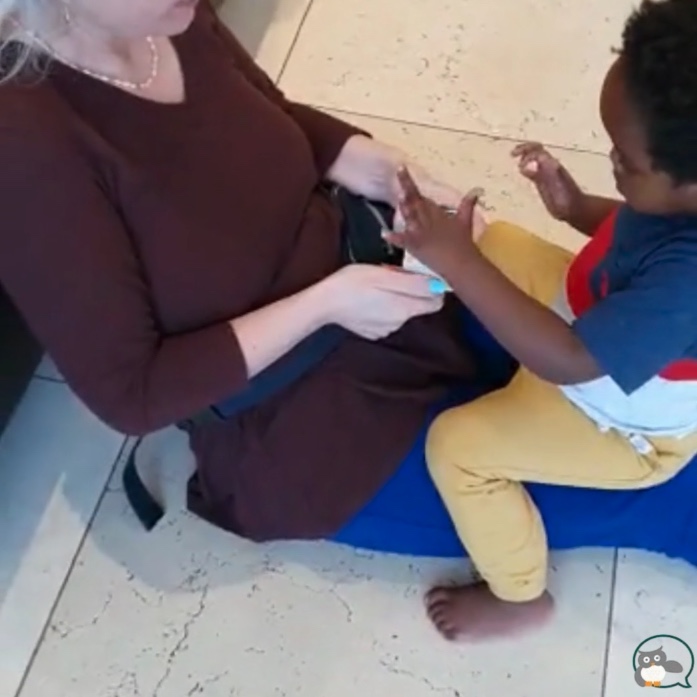
Here in the video clip, we try and work the /e/ vowel in short words likes ‘bell’, ’fell’, ‘dell’, ‘sell’, ‘smell’ and I am using an AAC device to give a child’s voice as auditory feedback as well as using the PROMPT approach to help my student shape his vowels.
So this is:
Distributed (1 x week for 45 minutes)
Constant – we are practising the /e/ vowel in the same position in six different words
Blocked – we did this: several repetitions of each word and after the sixth we moved to another sound, and then later we came back to this.
Please feel free to contact me if your child has speech sound difficulties. It is my passion. I love supporting children with apraxia.
Sonja McGeachie
Early Intervention Speech and Language Therapist
Feeding and Dysphagia (Swallowing) Specialist The London Speech and Feeding Practice
The London Speech and Feeding Practice
Find a speech and language therapist for your child in London. Are you concerned about your child’s speech, feeding or communication skills and don’t know where to turn? Please contact me and we can discuss how I can help you or visit my services page.
As an AAC speech and language therapist who uses the Saltillo 88 Core board every day, I can tell you it’s more than just a communication tool. It’s a doorway to independence, connection, and expressing my students’ unique voice.
What is the Saltillo 88 and why do I use this one?
In this blog post, I want to share practical, real-world examples of how I integrate the Saltillo 88 into various daily activities, empowering my students and parents to learn to communicate.
There are literally hundreds of core boards out there and I have tried many different ones over the years. Which one should I use with this particular client? Should I make up my own? (I have made up tons!) or should I use a ready-made one like the one below which is what this blog is about.
For me the best ones are boards with a good number of core words (at least 60) so that the board is versatile and can be used across a range of activities. The board needs to have a range of pronouns, verbs, descriptors, prepositions and question words to be useful and to stimulate not just requesting but commenting and asking questions. Another consideration is: can the board easily be transferred to a more robust AAC system. Once my student is used to the symbols and where they are could we move to an electronic talker/device. And if this answer is ’yes’ then we have a great board to get started with.
It has 88 words and I find it really does suit most activities. The same board and design is also then found on the TOUCHCHAT AAC device which can be a seamless transition for our learner.
Let me dive into how core words/board or AAC can be used daily:
1. Getting dressed
Whilst choosing clothes for your little one and getting them ready for the day you can use the following words: want, like, get, finish. Always pack the words into little phrases you can speak naturally when using a board. I have tried to show you phrases that you could use below.
The words in bold are the core words on the board and the other words are just words you say whilst pointing to the core word.
Goal: Express choices, needs, and preferences about clothing.
Ideas:
‘I want this one [specific item of clothing: ‘shirt’, ‘pants’]’
‘I like that one [colour/type of clothing]’
‘Help me [put/get it on/take off]’
‘let’s get your socks now’
‘finished let’s go’ (when dressed)
2. Having a shower/bath
Goal: Bath time tends to happen daily and so it lends itself to using the same useful phrases and words to chat about temperature preferences, to ask for toys or for washing routines.
Ideas:
‘let’s go have a bath/shower’
‘let’s turn on the tap/water’
‘now turn it off’
‘let’s get/have more toys/water/bubbles/tickles’
‘all gone, what’s next?’
‘how about washing your hands/feet’
‘let’s do that again’
‘need some help?’
‘Stop it now, let’s do something different’
3. Mealtimes
Goal: Mealtimes can be (or should be) enjoyable and motivating to ask for specific things we like, and commenting about our eating experiences.
Ideas:
‘I want/give me [food item: ‘apple’, ‘bread’]/[drink item: ‘water’, ‘juice’]’
‘More foods/drinks/snacks’
‘All done’
‘that’s messy we like that (not)’
‘Like’/‘Don’t like’
‘Big’/‘Little’
‘this is so nice!’
4. Playing
Goal: This is where it’s at for children of course and we can use our core words to chat and engage with our little learners.
Ideas:
‘I want play’
‘Go’/‘Stop’
‘More/again’
‘not it’s my My turn’/’it’s Your turn’
‘that’s a Big one!’/‘let’s do Little bubbles’ (describing toys)
‘let me Open it for you’ (for boxes, doors in play)
‘I See it’ (to draw attention)
‘Help me’ (with a tricky toy)
5. Opening boxes/doors/etc
Goal: Most kids love opening boxes, doors and cabinets to see what there is to play with. Help your child to ask for what they want.
Ideas:
‘let’s Open that box/bag/zip/door’
‘get me a (toy) out of here’
‘Let’s Take it out and see what it is?’
‘finished’ (when finished with the task)
‘I want [what’s inside]’
‘What’s next? Let’s see’
Tips for using AAC effectively
Consistency is key: Emphasise using it regularly, even for small things.
Modelling: this is crucial, the adults need to use the board for all situations first and foremost before we can expect our child to be interested.
Patience: Communication takes time and practice.
Celebrate successes: Acknowledge every communicative attempt.
Make it accessible: Keep the board within easy reach at all times.
Conclusion
If you’re considering the Saltillo 88, or TouchChat, or are already using it, I hope these examples inspire you. It’s a journey of discovery, and every word communicated is a step towards a more connected and independent life. What are your favourite ways to use the Saltillo 88 or which core board do you love using? I would love to hear your comments and stories.
Sonja McGeachie
Highly Specialist Speech and Language Therapist
Owner of The London Speech and Feeding Practice.
Find a speech and language therapist for your child in London. Are you concerned about your child’s speech, feeding or communication skills and don’t know where to turn? Please contact me and we can discuss how I can help you or visit my services page.
What is Speech and Language Therapy (SLT) and what does a Speech Therapist do?
Speech and language therapists provide treatment, support and care for children and adults who have difficulties with communication, eating, drinking and swallowing. We help children and adults who have problems speaking and communicating.
How to find the perfect therapist for my child/client:
There are a huge number of speech and language difficulties, or feeding and swallowing problems that we can help with and the first thing to think about is what age group the person is you are seeking help for. Most SLT’s specialise in a range of disorders and treatments and they often treat specific age ranges. This could be, for instance, very young children up to 3 years, or school aged children, adolescents or just adults. Once you have narrowed it down to age and general area of difficulty you can then go and seek your perfect SLT match.
Generally it is my view that SLT’s with a narrow area of specialist interest are most likely to help you better if the problem you or your child/adult is having is significant and/or profound. For example, if your child has a very severe stutter/stammer but is otherwise developing fine and has good skills all round, then I would recommend to look for an SLT who only specialises in stammering/stuttering, or has only a small range of other specialist areas related to stammering , such as speech and language delay.
The reason is that it is a tall order for any professional to stay up to date with latest research, latest clinical developments and training for more than, say, five distinct areas of interest.
However, a more generalist Speech therapist who has lots of experience in many different areas could be a very good option for your child or adult who has more general speech and language delay in a number of areas, perhaps a global delay or a syndrome which means that their learning is delayed in general. It also means that your child might benefit from a Generalist SLT because they have many more tools in their SLT bag and your child might need a variety of approaches for several areas.
A good place to start is www.asltip.com which is the Association for Independent Speech and Language Therapists in the UK. Any SLT registered with ASLTIP will also be registered with the HCPC (Health Care Professionals Council), as well as RCSLT (Royal College of Speech and Language Therapists). These two important UK professional regulatory bodies ensure all its members are fully qualified, and are fully up to date with latest developments within their areas of work.
Here you can enter your post code and look for a therapist near you and you can look for specific problems such as stammering for example and narrow down your search. Most therapists have a website which you can then access too. I would recommend you speak to a few therapists on your list and then go with the person you had the best rapport with. You and the therapist will be spending a lot of time together and you will need to feel that you trust them and that you can relax into the process.
How I can help you:
I have 3 main areas of specialism:
Parent Child Interaction Coaching
This is an amazing way to help children with the following difficulties:
Social Communication Difficulties, Autistic Spectrum Disordersand
Speech and Language Delay – for children under the age of 4 years old, this is my preferred way of working because it is so very effective and proven to work. If your child is not developing words or not interacting, has reduced attention and listening and you feel is not progressing or, in fact even regressing, then this way of working is the best. For anyone wanting to read a bit more about the efficacy of this method, below are some research articles. You may also like to check out www.hanen.org which is the mainstay of my work and method when it comes to Parent-Interaction Coaching. You can also look at my latest blog, entitled: Tele-therapy, does it work?
In brief, what’s so great about Parent Coaching is that it empowers you the parent to help your child in daily life! This is where speech, language and social communication develop typically, in a naturalistic way and environment. Simple steps and strategies are discussed and demonstrated every week and you are encouraged to use these strategies with your child in daily routines: getting dressed, having breakfast, on the school run, whilst out in the park or shopping or simply playing at home or having dinner or bath time. Whatever your family routine happens to be, every strategy I teach you will help create a responsive communication environment; generally, if your child is able to develop speech then they will do so in direct response to your changed interaction style.
Speech Sound Disorders, Verbal Dyspraxia, Phonology and Articulation
I love working with children of all ages on developing their speech sounds. Whether your child has a lisp, or a couple of tricky sounds they simply cannot produce quite right, or perhaps your child is really unintelligible because he/she is having lots of different sound errors, making it really hard to understand them. I typically work on getting “most bang for your buck” , meaning I address the sounds that cause the most problems and, therefore, when they are fixed your child/person’s speech becomes that much clearer fairly quickly.
Feeding and Swallowing Difficulties
Having worked for over 20 years in NHS Child Development Clinics and Special Needs Schools I trained and worked with feeding and swallowing difficulties early on in my SLT career. I later trained as a Lactation Consultant and so I am well placed helping and support all types of Infant feeding, both breast or bottle, as well as toddler weaning. I aim to ensure that your little one swallows the right kind of foods and drinks for their abilities. I am experienced in managing and supporting children with physical needs and mobility problems, Cerebral Palsy, Down Syndrome or any other type of syndrome or presentation.
What does a speech therapy session look like?
All sessions differ slightly depending on the age of the child and the nature of the difficulties.
However, mostly our sessions look like FUN! After arrival and washing hands we tend to start off with the tricky work straight away whilst our child still has energy and the will to engage. So, for speech work we will focus on the target sounds first: this could be sitting at a table doing work sheets together, playing games using the target sound and really any type of activity that gives us around 70-100 repeats of the target pattern. For example, a child who is working towards saying a ‘K’ at the end of the word I will try and get around 100 productions of words like: pack/sack/lick/ pick/bike/lake and so on.
Then we often play a fun game where I might try for a ‘rhyming’ activity or other sound awareness type activities, for perhaps 10 minutes and within that time I aim to trial the next sound pattern we need to improve on; I will test which sound your child can do with help from me. During he last 10 minutes we might look at a book, again listening to and producing whatever sound we are working on. If I did not get 100 sounds earlier on in the session I will try and practice them now as part of the story. In total I aim to have about 40-45 minutes of activities, all aimed at the target sound we are working on.
What does a Coaching session look like?
During a Parent Coaching Session we meet online for about an hour and we discuss how the week has been for you trying out the strategies. Typically parents start off recalling what went well, what progress was made and what had been more tricky. We work through it all, and then follow on to the next strategies: I will show you examples and demonstrations of each strategy and I will get you to think about how you can use this with your child and in what situation you might use it. I will explain what we are doing and what the purpose is. You might want to write down what you are going to work on for the week. Over the course of about sessions we can cover all the major strategies that are proven to help kickstart spoken language and/or help your child to connect more with you. Through that connection spoken words most often develop.
Research Papers on the Efficacy of Parent Child Interaction Coaching
The It Takes Two to Talk Program has been shown to be effective in changing how parents interact with their children, and that children’s communication and language skills improve as a result.
Baumwell, L.B., Tamis-LeMonda, C.S. & Bornstein, M.H. (1997). Maternal verbal sensitivity and child language comprehension. Infant Behavior and Development, 20(2), 247-258.
Beckwith, L. & Cohen, S.E. (1989). Maternal responsiveness with preterm infants and later competency. In M.H. Bornstein (Ed.). Maternal responsiveness: Characteristics and consequences: New directions for child development (pp. 75-87). San Francisco: Jossey Bass.
Bronfenbrenner, U. (1974). Is early intervention effective? (Publication No. (CDH) 74-25). Washington, DC: Department of Health, Education, and Welfare, Office of Child Development.
Girolametto, L. (1988). Improving the social-conversational skills of developmentally delayed children: An intervention study. Journal of Speech and Hearing Disorders, 53, 156-167.
Sonja has been a real help for my 5 year old daughter. Due to her support, my daughter is now able to clearly and correctly enunciate ‘th’ ‘f’ and ’s’. She was also helpful in making positional changes to her seating to help her concentrate better and kept her engaged throughout all the lessons which is a feat in itself on zoom!
Helen, Mother of Catherine Age 5.
Find a speech and language therapist for your child in London. Are you concerned about your child’s speech, feeding or communication skills and don’t know where to turn? Please contact me and we can discuss how I can help you or visit my services page.
I think my child might be autistic – how can we help? Image by macrovector on Freepik
Consulting a Specialist Speech and Language Therapist can help you in several ways: assessment, informal and formal observation, discussion and advice, onward referrals, direct intervention, parent coaching, educational support and much more, all geared towards supporting you the parents, and helping your child to flourish and thrive.
First up, we can help you with assessment and advice: with a wealth of expertise in observing childrens’ play and communication, as well as knowledge of the latest research we can see a child’s strengths and areas of struggle very quickly indeed.
Within a short space of time, we can identify the areas we need to focus on and start guiding you towards helping your child to connect, respond, react and feel better.
Early detection is key
If autism is detected in infancy, then therapy can take full advantage of the brain’s plasticity. It is hard to diagnose Autism before 18 months but there are early signs we know to look out for. Let’s have a brief look at the sorts of things we look at.
The earliest signs of Autism involve more of an absence of typical behaviours and not the presence of atypical ones.
Often the earliest signs are that a baby is very quiet and undemanding. Some babies don’t respond to being cuddled or spoken to. Baby is being described as a ‘good baby, so quiet, no trouble at all’.
Baby is very object focused: he/she may look for long periods of time at a red spot/twinkly item further away, at the corner of the room for example.
Baby does not make eye contact: we can often see that a baby looks at your glasses for example instead of ‘connecting’ with your eyes.
At around 4 months we should see a baby copying adults’ facial expressions and some body movements, gestures and then increasingly cooing sounds we make; babies who were later diagnosed with autism were not seen to be doing this.
Baby does not respond with smiles by about 6 months.
By about 9 months, baby does not share sounds in a back-and-forth fashion.
By about 12 months baby does not respond/turn their heads when their name is called.
By around 16 months we have no spoken words; perhaps we hear sounds that sound like ‘speech’ but we cannot make out what the sounds are.
By about 24 months we see no meaningful two-word combinations that are self-generated by the toddler. We might see some copying of single words.
24 months plus:
Our child is not interested in other children or people and seems unaware of others in the same room/play area.
Our child prefers to play alone, and dislikes being touched, held or cuddled.
He/she does not share an interest or draw attention to their own achievements e.g., ‘daddy look I got a dog’.
We can see our child not being aware that others are talking to them.
We see very little creative pretend play.
In the nursery our child might be rough with other children, pushing, pinching or scratching, biting sometimes; or our child might simply not interact with others and be unable to sit in a circle when asked to.
What sort of speech and language difficulties might we see?
Our child might do any of the following:
have no speech at all, but uses body movements to request things, takes adults by the hand
repeat the same word or phrase over and over; sometimes straight away after we have said it or sometimes hours later
repeat phrases and songs from adverts or videos, nursery rhymes or what dad says every day when he gets back from work etc.
copy our way of intonation
not understand questions – and respond by repeating the question just asked:
adult: Do you want apple? child: do you want apple?
not understand directions or only high frequency directions in daily life
avoid eye contact or sometimes ‘stares’
lack of pointing or other gestures
Common behaviours:
Hand flapping
Rocking back-and-forth
Finger flicking or wriggling/moving
Lining up items/toys
Wheel spinning, spinning around self
Flicking lights on and off, or other switches
Running back-and-forth in the room, needing to touch each wall/door
Loud screaming when excited
Bashing ears when frustrated or excited
Atypical postures or walking, tip toeing, can be falling over easily, uncoordinated
Can be hyper sensitive to noises, smells, textures, foods, clothing, hair cutting, washing etc.
Being rigid and inflexible, needing to stick to routines, unable to transition into new environments
Food sensitivity, food avoidance, food phobias
I mentioned this to be a ‘brief’ look at the areas and it is: each topic is looked at very deeply and each area is multi-facetted therefore a diagnosis is rarely arrived at very quickly. We want to make sure we have covered all aspects and have got to know your child very well before coming to conclusions.
Early detection is key, because we want to start helping your child to make progress as quickly as is possible. If you feel /know that your child is delayed in their speech and language development and you would like a professional opinion then please do contact me, I look forward to supporting you. It is important to know at this point, that if your child only has one or two of the above aspects it may mean that your child is simply delayed for reasons other than Autism and if that is the case, we will be able to help you iron out a few areas of need so that your child can go on thriving.
Find a speech and language therapist for your child in London. Are you concerned about your child’s speech, feeding or communication skills and don’t know where to turn? Please contact me and we can discuss how I can help you or visit my services page.
Why imitation is so important and how can speech and language therapy help children who struggle to imitate?
Imitation or copying starts in early infancy. When we observe a young baby and his parent or familiar adult we can see clearly and frequently that the baby will be intently looking at adult’s face and try to copy their facial expressions, smiles and all those funny baby sounds we often make with young babies.
These sounds are called “motherese” and are the beginnings of a little conversation between the parent and the baby. The “conversation can go back and forth for a long time and include sounds, as well as facial expressions.
A little later on, once the baby can crawl and sit up unaided the copying then goes on to include toys and objects. Mum or Dad will show their toddler how to use a drum or how to put a little train on the wooden tracks and the toddler will try and copy this. They may not succeed and be a little clumsy perhaps but the act of copying anything and everything their favourite adult does is typically seen throughout the day.
We all know and have laughed at mums or dads saying; ssshhh don’t say that in front of the baby he/she will copy you, watch your mouth! (as dad is swearing at the broken radiator….)
This imitation goes on for years and includes eventually of course little words, more words, putting words together and then creating sentences, all the while our toddler is listening to how their adults speak, not only what they say but how they say it. This is how dialects and accents can be transmitted easily from parent /family to child.
Copying in Children with Autism
We know that children with autism often struggle to imitate. We see children on the spectrum typically having great difficulty to copy adults or children; this can be seen in very reduced play with their peers in nursery for example.
Children with autism tend to have reduced joint attention and engagement with others and need to develop the ability and awareness to copy others in order to then engage more jointly with others.
Speech and Language Therapy can help with Parent Child Interaction work and Coaching, here is how:
During my coaching work with parents I teach step by step how to help a child who struggles to imitate:
We look at all the researched skills and actions that adults can take to help their little one to copy, starting with close observation of their child’s interests, then following and including their child’s play and copying/imitating their child in how they play. I teach steps in a graduated way so that it is easy to see the progress and joyful to have the results at the end.
The results are clear to see over time: our children on the spectrum learn to imitate actions, with objects and gestures, then sounds and words. Alongside this increased imitation skill the child can then develop more joint attention and engagement.
Find a speech and language therapist for your child in London. Are you concerned about your child’s speech, feeding or communication skills and don’t know where to turn? Please contact me and we can discuss how I can help you or visit my services page.
Have you ever wondered why children may pronounce a word correctly one minute and in the next breath they struggle to say the same word? It’s equally as frustrating for you as it is for your child. The biggest question of all is WHY? Why does this happen and what causes it? Whilst there are many explanations. When it persists, it might be a condition called verbal dyspraxia.
What is verbal dyspraxia
Verbal dyspraxia is a neurological motor speech disorder that affects the coordination and planning of muscle movements that are needed for speech production. A child may have difficulty making the precise movements needed for speech, which may result in inconsistent and unintelligible speech. Children may also have trouble sequencing sounds and syllables, producing speech sounds accurately, and coordinating the movements of their articulators (e.g., lips, tongue, teeth, jaw). This can lead to a range of speech errors (including sound distortions, substitutions, omissions, and difficulty with rhythm and prosody).
We know that these speech errors, and not being able to get a message across, can be frustrating for children with speech difficulties. Can you imagine talking and limited people understanding you? It’s so tough on children and the people trying to communicate with them.
Creating a person-centred therapy plan is vital. This allows your child to stay motivated, as intervention is likely to be long term. This planning may include favourite words to use during their hobby or favourite activity, or person-centred goals such as ‘giving Alexa an instruction’.
Children with verbal dyspraxia can have several different ways of producing words, which often makes it trickier for them as there’s no consistent pattern to work with. So, we’ve put together some top tips to support their communication and make their (and your) lives a little easier in the process.
Ten ways to make communication easier for your child with verbal dyspraxia
Have a list of frequently used words and practise this set. Little and often is best!
Use cued articulation to support speech production (ask your Speech and Language Therapist for the gestures)
Give time and use active listening. This means showing interest and trying not to think about what is on your never ending ‘to do’ list
Reduce frustration in any way that you can. This might mean allowing your child to demonstrate using gestures rather than speech. You might also give top tips for other adults or children who communicate with your child when out and about
Talk about the structure of words with your child (i.e., there are two beats/syllables in this word)
Show the written form of the word to go alongside their production
Split down tasks, so that your child only has to respond to one question at a time, reducing their motor capacity
Recognise when your child is working well and when they may need support of an Alternative and Augmentative Communication device
Allow all environments to have the same training and equipment (i.e., at school, home, out and about)
Have regular periods in the day where your child can practise their specific words in different environments. This can be effective for children with verbal dyspraxia
Find a speech and language therapist for your child in London. Are you concerned about your child’s speech, feeding or communication skills and don’t know where to turn? Please contact me and we can discuss how I can help you or visit my services page.
Watching your child’s confidence grow as their language develops is something you dream of. You feel helpless, you watch your child repeat language over and over and this concerns you. You know you should be supporting their communication development, but you feel stuck. You’ve reached the point where you don’t know where to turn to for support. Accessing the knowledge of a Speech and Language Therapist is a great place to start.
Here are four ways to support your child’s language:
1. Provide great communication models that include scripts or “gestalts”
Instead of commenting with single words like “apple” or two word phrases e.g., “want apple”, it is more beneficial to comment with small sentences or scripts such as “let’s eat an apple”, “I want an apple mummy”, “I want more apple please” or “I’m hungry daddy.”
These are phrases that include more intonation and rhythm (top tip: ensure you do use appropriate intonation and rhythm), and your child is likely to pick up those phrases and copy them much more easily than single words or two-word phrases.
2. Offer a robust Alternative and Augmentative Communication (AAC) device
There are many examples of AAC devices such as ‘Lamp for Life’ or ‘Grid Smartbox’. It’s vital that you consult a Speech and Language Therapist with a specialism within this area of communication. You want your child to be able to communicate their wants and needs. Furthermore, their communication buttons need to be tailored to your child’s interests so they are motivated to use them (e.g. if your child likes Thomas the Tank Engine, you may wish to program in specific phrases such as “I want to watch Thomas the Tank Engine”. It is also important that the devices are suitable for your child’s physical and emotional stage of development.
3. Learn to be a word detective
Listen to your child’s echolalia (or repetitions) and try to understand what they mean. Their communication is often meaningful around a previous experience. For example, one of my students says, “bang my head” and that actually means “I want to play that tickling game again” (where I banged my head the other day).
4. Take turns with your child and copy their scripts
This shows you are listening actively and value their attempts at language. We all love it when someone is actively listening and trying to decode what we are saying.
Take heart and try not to worry. You’re doing the best you can. Your child is more than likely a Gestalt Processing Learner and so they are moving through very defined stages. Echolalia (repetition) is the first of many, so you have an exciting journey ahead watching your little one’s language grow and develop.
Reduce your child’s frustration and build their confidence today.
Find a speech and language therapist for your child in London. Are you concerned about your child’s speech, feeding or communication skills and don’t know where to turn? Please contact me and we can discuss how I can help you or visit my services page.