There are various great ways to treat speech sound disorders and I use all the approaches available selectively; I decide what works with each individual child and I also vary the approach depending on the child’s frame of mind at any given time during my session.
Some of the approaches are more “drill-based” and require a child to be able to pay attention and really participate actively in the therapy, and this is what I am showing you today with this video clip.
My little student here has been working with me for some time and from only saying a handful of words which were not very easy to understand he has come a long way. He does have some features of Verbal Dyspraxia which I shall briefly outline here:
Making sounds in general is a struggle, especially when asked to copy certain sounds, example: ‘can you say: a ee ou oo?”
Repeating sound sequences or words sequences is hard, for example: “say p-t-k in sequence” or “say fish chips fish chips fish chips
When saying the same word again and again, different mistakes can be heard
Intonation difficulties: speech sounds monotonous
Vocabulary is very limited
Some therapy approaches are more play based, for example the Core Word method: here we pick a few words at a time which are very significant to the child and therefore highly motivating to try and say. These could be characters of Pokemon or Minecraft for example, or simple words like “GO!”
When you watch the video you will see that I use a lot of visual prompting, such as showing him where the tongue is moving to or from. I do this with my index finger and this approach is called Tactile Cueing or “Cued Articulation”. Part of the approach is to give a visual prompt and then reduce the prompt as the learner is more able to produce the correct sounds. Once he can produce the sound on its own, we quickly move to the sound within a word.
I do mix and match my approaches and in fact here I am drilling but I also use the Core Word which for him (YELLOW) — it’s his favourite colour and I happen to have quite a few good games where a YELLOW something or other can be asked for….. WHO KNEW!? 🙂
Find a speech and language therapist for your child in London. Are you concerned about your child’s speech, feeding or communication skills and don’t know where to turn? Please contact me and we can discuss how I can help you or visit my services page.
As parents and caregivers, our natural instinct when interacting with a child, especially one who struggles with communication, is often to fill every silence. We might ask lots of questions, offer constant commentary, or try to prompt him or her to speak. Our hearts are in the right place. We want to help him or her communicate! However, for children with language delays or those on the autism spectrum, this well-intentioned approach can sometimes inadvertently create more pressure and fewer opportunities for them to truly initiate and develop their own communication skills.
What if I told you that one of the most powerful tools in your communication toolkit is often silence? And that responding to your child, rather than always initiating, can unlock incredible potential?
Let’s explore why these seemingly simple strategies are so profoundly beneficial.
The unspoken benefits of silence
In our fast-paced world, silence can feel awkward, but for a child who is processing language differently, it’s a gift:
Time to process: Children with language delays often need more time to process what they hear and to formulate their own thoughts or responses. When we bombard them with words, we don’t give their brains the crucial milliseconds they need to catch up. A pause of 5–10 seconds can make all the difference.
Reduces pressure: Constant questioning or prompting can feel like a test. Silence removes this pressure, creating a more relaxed environment where the child feels safe to communicate without fear of being ‘wrong’ or rushed.
Creates opportunity to initiate: If you’re always talking, when does your child get a turn to start the conversation? Silence opens up a space for him or her to initiate, whether it’s through a sound, a gesture, eye contact, or a word. This is vital for developing spontaneous communication.
Encourages independent thinking: When a child is given space, he or she is more likely to try to figure things out himself or herself. This fosters problem-solving skills and reduces reliance on adult prompts.
Prevents overwhelm (especially for ASD): Many children on the autism spectrum can be sensitive to auditory input. A constant stream of language can be overwhelming, leading to withdrawal or challenging behaviours. Strategic pauses can help them regulate and engage more effectively.
The power of responding (not just initiating)
Think of a tennis match: if only one person serves, it’s not a game. Communication is a rally, a back-and-forth exchange. When you primarily respond to your child’s communication attempts, you’re teaching him or her the rhythm of conversation:
Follow the child’s lead: This is a cornerstone of effective language intervention, famously championed by programs like Hanen’s ‘It Takes Two to Talk’. When you respond to what your child is already interested in or doing, the interaction becomes immediately relevant and motivating for him or her.
Validates his or her attempts: Every sound, gesture, glance, or partial word your child offers is a communication attempt. By responding to it, you’re telling him or her, ‘I see you. I hear you. Your communication matters.’ This builds immense confidence and encourages him or her to try again.
Builds confidence and motivation: When a child feels understood and successful in his or her communication, he or she are more likely to communicate more often. It’s a positive feedback loop.
Teaches turn-taking naturally: By taking your turn after his or hers, you model the natural flow of conversation. He or she learns that communication is a shared activity, not a one-sided lecture.
Makes interactions meaningful: When you respond to his or her interests, you’re talking about things that are inherently motivating to him or her. This makes the language you use more easily understood and remembered.
Practical strategies for parents: Observe, Wait, Listen (OWL)
Observe: Watch your child closely. What is he or she looking at? What is he or she doing? What sounds is he or she making? What gestures is he or she using?
Wait: After you’ve observed, wait. Give him or her time. Resist the urge to jump in with a question or comment immediately. Count to five (or even ten) in your head. This silence is an invitation for him or her to communicate.
Listen: When he or she does communicate (in any way!), listen intently. Try to understand his or her message or intent.
Beyond OWL – More tips:
Reduce questions, increase comments: Instead of ‘What’s that?’ try ‘Oh, a big red ball!’ or ‘The car is going fast!’ Comments provide language models without demanding a verbal response.
Expand, don’t just prompt: If your child says ‘Car’, you could respond with ‘Yes, That’s a big car!’ or ‘It’s really fast!’ You’re building on his or her communication with a slightly richer language model.
Create opportunities for communication: Place desired items slightly out of reach. This creates a natural reason for your child to communicate his or her wants (e.g., reaching, pointing, vocalising).
Respond to all communication: Don’t just wait for words. If your child points, look where he or she is pointing and comment. If he or she makes a sound, imitate it or respond with a related word.
In summary
Embracing silence and prioritising responsiveness might feel counterintuitive at first, especially when you’re eager for your child to talk. However, these powerful strategies create a nurturing, low-pressure environment that encourages spontaneous communication, builds confidence, and truly meets your child where he or she is. By giving your child the space and the meaningful responses he or she needs, you’re laying a strong foundation for his or her communication journey.
Try incorporating these ‘quiet powers’ into your daily interactions and watch your child’s communication blossom.
Sonja McGeachie
Highly Specialist Speech and Language Therapist
Owner of The London Speech and Feeding Practice.
Find a speech and language therapist for your child in London. Are you concerned about your child’s speech, feeding or communication skills and don’t know where to turn? Please contact me and we can discuss how I can help you or visit my services page.
For many families, Halloween is an exciting time filled with costumes, decorations, and sweets. But for children who are sensory sensitive, whether they’re autistic, have sensory processing differences, or simply find new experiences overwhelming, Halloween can feel like a night of chaos rather than fun.
The bright lights, unexpected noises, strange textures, and social pressure to ‘join in’ can quickly become too much. The good news? With some thoughtful planning and gentle support, you can make Halloween a positive and manageable experience for your child.
Understanding sensory overload
Sensory overload happens when a child’s brain receives more sensory input than it can process. This might mean:
Costumes that itch, squeeze, or feel strange on the skin.
Loud sounds like doorbells, fireworks, or shrieking decorations.
Crowds and unpredictability during trick-or-treating.
Strong smells or tastes from face paint or unfamiliar sweets.
When overloaded, children may cry, cover their ears, hide, run away, or ‘shut down.’ These reactions aren’t ‘bad behaviour’, they’re signs of distress. The goal isn’t to eliminate Halloween fun, but to adjust it to your child’s comfort level.
Step 1: Choose costumes wisely
Costumes are often the biggest trigger. Scratchy fabrics, tight seams, or masks that restrict breathing can be unbearable for some children.
Try these tips:
Go sensory-friendly: Use soft, breathable fabrics and remove tags. Many retailers now sell sensory-safe costumes.
Test it early: Let your child wear the outfit around the house before Halloween. If it’s too much, simplify — maybe themed pyjamas or a favourite T-shirt with Halloween accessories.
Skip the mask: Face paint can be equally challenging, always test on a small patch of skin first. A comfortable headband or hat might be enough to feel ‘in costume.’
Remember, participation doesn’t require perfection. Your child can still ‘be’ their favourite character without a full costume.
Step 2: Plan your Halloween environment
Before the big day, think about what parts of Halloween your child enjoys — and what might overwhelm them.
At home:
Keep decorations minimal and predictable. Avoid motion-activated sounds or flashing lights.
Practise knocking at your own front door or saying ‘trick or treat’ with a trusted adult.
Have a ‘quiet space’ ready, a cosy corner or room where your child can retreat if things get too intense.
If you’re going out:
Choose earlier, quieter times for trick-or-treating.
Visit a few familiar houses instead of the whole street.
Bring ear defenders or noise-cancelling headphones.
Have a clear exit plan if your child needs a break.
Sometimes, watching from the window and handing out sweets can be just as enjoyable! it still offers social participation without sensory overload.
Step 3: Prepare socially and emotionally
Halloween involves a lot of unexpected social interaction: strangers at the door, unfamiliar greetings, and different rules.
Help your child by:
Using visuals or stories: Read picture books about Halloween or make a short social story about what will happen.
Role-playing: Practise saying ‘Trick or treat!’ or handing out sweets in a fun, low-pressure way.
Labelling feelings: Explain that it’s okay to feel nervous or to take a break if something feels ‘too loud’ or ‘too much.’
Children feel safer when they know what to expect. Predictability reduces anxiety and makes participation more enjoyable.
Step 4: Rethink the treats
Not every child enjoys sweets; some dislike sticky textures or strong flavours. Offer non-food alternatives like stickers, glow sticks, or small toys.
If your child has feeding difficulties or oral sensitivities, it’s okay to opt out of the traditional treats entirely. They can still join in by giving treats or decorating treat bags instead.
Halloween doesn’t have to look like anyone else’s version. Maybe your family watches a ‘not-too-scary’ film, carves pumpkins, or does a flashlight treasure hunt indoors. The goal is joyful connection, not conformity.
A calm, happy experience, even if it looks simple from the outside builds positive associations your child will carry into future celebrations.
In summary
Halloween can be full of sensory surprises, but with empathy, planning, and flexibility, it doesn’t have to end in tears.
The more you adapt to your child’s sensory needs, the more they learn that they are safe, understood, and included not just at Halloween, but in every celebration.
As with all things in speech and feeding development, progress starts with connection. When children feel regulated and supported, communication and confidence follow.
HAPPY HALLOWEEN!
Sonja McGeachie
Highly Specialist Speech and Language Therapist
Owner of The London Speech and Feeding Practice.
Find a speech and language therapist for your child in London. Are you concerned about your child’s speech, feeding or communication skills and don’t know where to turn? Please contact me and we can discuss how I can help you or visit my services page.
Mealtimes can be a battleground for parents of picky eaters, especially toddlers with Avoidant/Restrictive Food Intake Disorder (ARFID). I see a great number of toddlers with Autism traits and many of my clients are picky eaters from mild to severe. Take a look at my blog for an outline of what the issues are and how to try and help.
ARFID goes beyond typical ‘picky eating’ and can significantly impact a child’s growth, nutrition, and social-emotional well-being. If your toddler is resistant to trying new foods or has a very limited diet, here are some strategies to navigate the introduction of solids:
1. Understand ARFID:
ARFID is a diagnosable eating disorder characterised by:
Limited food variety: Eating only a small range of foods, often with specific textures or colours.
Fear of new foods: Intense anxiety or aversion to trying unfamiliar foods.
Sensory sensitivities: Heightened sensitivity to taste, smell, texture, or appearance of food.
Lack of interest in eating: May show little interest in food or mealtimes.
2. Seek professional guidance:
Paediatrician and/or gastroenterologist: Rule out any underlying medical conditions.
Registered dietitian: Assess nutritional needs and create a balanced meal plan.
Speech and language therapist (SLT): If oral-motor skills or sensory sensitivities are contributing to feeding difficulties.
Occupational therapist (OT): If sensory processing challenges are affecting mealtime behaviours.
Child psychologist: If anxiety or emotional factors are contributing to ARFID.
3. Strategies for introducing solids:
Start small: Introduce one new food at a time, in small amounts, alongside familiar favourites.
Patience is key: It can take multiple exposures (up to 10–15 times!) for a child to accept a new food. Don’t give up!
Positive reinforcement: Praise and encouragement for any interaction with the new food, even just touching or smelling it.
No pressure: Avoid forcing or pressuring the child to eat. This can create negative associations with food.
Make it fun: Present food in playful ways, use cookie cutters for fun shapes, or involve the child in food preparation.
Sensory exploration: Encourage exploration of food through touch, smell, and sight before tasting.
Role modelling: Show the child that you enjoy eating a variety of foods.
Use fun utensils: your child might like characters from ‘Frozen’ or ‘Dinosaurs’ or ‘Diggers’ there are a host of character-based cutlery and cups/plates to be had. Also, I really rate these two items very highly they are so good so I want to share these with you. Both are available online. But warning: the cup is outrageously expensive as it comes from the United States and is sold by a small scale company. But I feel this is cup very worth trying, I have had good results with this.
Gradual desensitisation: Start with foods that are similar in texture or taste to accepted foods, then gradually introduce more challenging options.
Food chaining: Introduce new foods that are similar in taste, texture, or appearance to accepted foods.
4. Mealtime Environment:
Positive and relaxed: Create a calm and enjoyable mealtime atmosphere.
No distractions: Minimise distractions like TV or toys.
Consistent schedule: Offer meals and snacks at regular times.
Child-sized portions: Offer small, manageable portions to avoid overwhelming the child.
Involve the child: Let the child choose their utensils, plate, or cup.
5. Remember:
Every child is different: What works for one child may not work for another.
Progress takes time: Be patient and celebrate small victories.
Focus on the positive: Praise any positive interaction with food.
Seek support: Connect with other parents or support groups.
Introducing solids to toddlers with ARFID can be challenging, but with patience, persistence, and professional guidance, you can help your child develop a healthier relationship with food.
Feeding and Dysphagia (Swallowing) Specialist The London Speech and Feeding Practice
The London Speech and Feeding Practice
Find a speech and language therapist for your child in London. Are you concerned about your child’s speech, feeding or communication skills and don’t know where to turn? Please contact me and we can discuss how I can help you or visit my services page.
What is Speech and Language Therapy (SLT) and what does a Speech Therapist do?
Speech and language therapists provide treatment, support and care for children and adults who have difficulties with communication, eating, drinking and swallowing. We help children and adults who have problems speaking and communicating.
How to find the perfect therapist for my child/client:
There are a huge number of speech and language difficulties, or feeding and swallowing problems that we can help with and the first thing to think about is what age group the person is you are seeking help for. Most SLT’s specialise in a range of disorders and treatments and they often treat specific age ranges. This could be, for instance, very young children up to 3 years, or school aged children, adolescents or just adults. Once you have narrowed it down to age and general area of difficulty you can then go and seek your perfect SLT match.
Generally it is my view that SLT’s with a narrow area of specialist interest are most likely to help you better if the problem you or your child/adult is having is significant and/or profound. For example, if your child has a very severe stutter/stammer but is otherwise developing fine and has good skills all round, then I would recommend to look for an SLT who only specialises in stammering/stuttering, or has only a small range of other specialist areas related to stammering , such as speech and language delay.
The reason is that it is a tall order for any professional to stay up to date with latest research, latest clinical developments and training for more than, say, five distinct areas of interest.
However, a more generalist Speech therapist who has lots of experience in many different areas could be a very good option for your child or adult who has more general speech and language delay in a number of areas, perhaps a global delay or a syndrome which means that their learning is delayed in general. It also means that your child might benefit from a Generalist SLT because they have many more tools in their SLT bag and your child might need a variety of approaches for several areas.
A good place to start is www.asltip.com which is the Association for Independent Speech and Language Therapists in the UK. Any SLT registered with ASLTIP will also be registered with the HCPC (Health Care Professionals Council), as well as RCSLT (Royal College of Speech and Language Therapists). These two important UK professional regulatory bodies ensure all its members are fully qualified, and are fully up to date with latest developments within their areas of work.
Here you can enter your post code and look for a therapist near you and you can look for specific problems such as stammering for example and narrow down your search. Most therapists have a website which you can then access too. I would recommend you speak to a few therapists on your list and then go with the person you had the best rapport with. You and the therapist will be spending a lot of time together and you will need to feel that you trust them and that you can relax into the process.
How I can help you:
I have 3 main areas of specialism:
Parent Child Interaction Coaching
This is an amazing way to help children with the following difficulties:
Social Communication Difficulties, Autistic Spectrum Disordersand
Speech and Language Delay – for children under the age of 4 years old, this is my preferred way of working because it is so very effective and proven to work. If your child is not developing words or not interacting, has reduced attention and listening and you feel is not progressing or, in fact even regressing, then this way of working is the best. For anyone wanting to read a bit more about the efficacy of this method, below are some research articles. You may also like to check out www.hanen.org which is the mainstay of my work and method when it comes to Parent-Interaction Coaching. You can also look at my latest blog, entitled: Tele-therapy, does it work?
In brief, what’s so great about Parent Coaching is that it empowers you the parent to help your child in daily life! This is where speech, language and social communication develop typically, in a naturalistic way and environment. Simple steps and strategies are discussed and demonstrated every week and you are encouraged to use these strategies with your child in daily routines: getting dressed, having breakfast, on the school run, whilst out in the park or shopping or simply playing at home or having dinner or bath time. Whatever your family routine happens to be, every strategy I teach you will help create a responsive communication environment; generally, if your child is able to develop speech then they will do so in direct response to your changed interaction style.
Speech Sound Disorders, Verbal Dyspraxia, Phonology and Articulation
I love working with children of all ages on developing their speech sounds. Whether your child has a lisp, or a couple of tricky sounds they simply cannot produce quite right, or perhaps your child is really unintelligible because he/she is having lots of different sound errors, making it really hard to understand them. I typically work on getting “most bang for your buck” , meaning I address the sounds that cause the most problems and, therefore, when they are fixed your child/person’s speech becomes that much clearer fairly quickly.
Feeding and Swallowing Difficulties
Having worked for over 20 years in NHS Child Development Clinics and Special Needs Schools I trained and worked with feeding and swallowing difficulties early on in my SLT career. I later trained as a Lactation Consultant and so I am well placed helping and support all types of Infant feeding, both breast or bottle, as well as toddler weaning. I aim to ensure that your little one swallows the right kind of foods and drinks for their abilities. I am experienced in managing and supporting children with physical needs and mobility problems, Cerebral Palsy, Down Syndrome or any other type of syndrome or presentation.
What does a speech therapy session look like?
All sessions differ slightly depending on the age of the child and the nature of the difficulties.
However, mostly our sessions look like FUN! After arrival and washing hands we tend to start off with the tricky work straight away whilst our child still has energy and the will to engage. So, for speech work we will focus on the target sounds first: this could be sitting at a table doing work sheets together, playing games using the target sound and really any type of activity that gives us around 70-100 repeats of the target pattern. For example, a child who is working towards saying a ‘K’ at the end of the word I will try and get around 100 productions of words like: pack/sack/lick/ pick/bike/lake and so on.
Then we often play a fun game where I might try for a ‘rhyming’ activity or other sound awareness type activities, for perhaps 10 minutes and within that time I aim to trial the next sound pattern we need to improve on; I will test which sound your child can do with help from me. During he last 10 minutes we might look at a book, again listening to and producing whatever sound we are working on. If I did not get 100 sounds earlier on in the session I will try and practice them now as part of the story. In total I aim to have about 40-45 minutes of activities, all aimed at the target sound we are working on.
What does a Coaching session look like?
During a Parent Coaching Session we meet online for about an hour and we discuss how the week has been for you trying out the strategies. Typically parents start off recalling what went well, what progress was made and what had been more tricky. We work through it all, and then follow on to the next strategies: I will show you examples and demonstrations of each strategy and I will get you to think about how you can use this with your child and in what situation you might use it. I will explain what we are doing and what the purpose is. You might want to write down what you are going to work on for the week. Over the course of about sessions we can cover all the major strategies that are proven to help kickstart spoken language and/or help your child to connect more with you. Through that connection spoken words most often develop.
Research Papers on the Efficacy of Parent Child Interaction Coaching
The It Takes Two to Talk Program has been shown to be effective in changing how parents interact with their children, and that children’s communication and language skills improve as a result.
Baumwell, L.B., Tamis-LeMonda, C.S. & Bornstein, M.H. (1997). Maternal verbal sensitivity and child language comprehension. Infant Behavior and Development, 20(2), 247-258.
Beckwith, L. & Cohen, S.E. (1989). Maternal responsiveness with preterm infants and later competency. In M.H. Bornstein (Ed.). Maternal responsiveness: Characteristics and consequences: New directions for child development (pp. 75-87). San Francisco: Jossey Bass.
Bronfenbrenner, U. (1974). Is early intervention effective? (Publication No. (CDH) 74-25). Washington, DC: Department of Health, Education, and Welfare, Office of Child Development.
Girolametto, L. (1988). Improving the social-conversational skills of developmentally delayed children: An intervention study. Journal of Speech and Hearing Disorders, 53, 156-167.
Sonja has been a real help for my 5 year old daughter. Due to her support, my daughter is now able to clearly and correctly enunciate ‘th’ ‘f’ and ’s’. She was also helpful in making positional changes to her seating to help her concentrate better and kept her engaged throughout all the lessons which is a feat in itself on zoom!
Helen, Mother of Catherine Age 5.
Find a speech and language therapist for your child in London. Are you concerned about your child’s speech, feeding or communication skills and don’t know where to turn? Please contact me and we can discuss how I can help you or visit my services page.
Picture this. A small dinosaur is stomping across a wooden floor. A tiny teacup is being filled with imaginary juice. Someone, probably you, has just been told very firmly that you are the baby and you must go to sleep now.
To the outside world, this is just play. Joyful, chaotic, completely ordinary toddler play.
But for a child with Childhood Apraxia of Speech (CAS), also known as verbal dyspraxia, what is happening inside a well-designed pretend play session is anything but ordinary. It is, in fact, some of the most powerful motor speech therapy we have.
Let me explain why.
First, a quick reminder: what is dyspraxia?
Childhood Apraxia of Speech is a motor speech disorder. The difficulty does not lie in the muscles of the mouth, those are perfectly capable. The difficulty lies in the brain’s ability to plan and sequence the precise movements needed to produce speech sounds consistently and accurately.
A child with CAS knows what they want to say. The message is there. But somewhere between the intention and the execution, the plan breaks down. Words come out differently each time, or not at all. It is effortful, unpredictable, and for many children, deeply frustrating.
What this means for therapy is important: CAS requires motor learning, not just language stimulation. And motor learning has very specific conditions under which it thrives.
Repetition is the medicine and pretend play delivers it without the child noticing
One of the most well-established principles of motor learning is that new movement patterns need to be practised many, many times before they become reliable. Think of learning to ride a bike, or to touch-type. Repetition is how the motor system builds consistency.
For speech, this means a child needs many opportunities to attempt a target word or phrase within a single session. In a formal drilling exercise, this quickly becomes tedious and dysregulating, especially for young children. After five attempts at ‘go’, most three-year-olds have mentally left the building.
But inside a pretend play scenario? The word ‘go’ appears naturally and meaningfully dozens of times. The car goes. The train goes. Ready, steady, go. Go to sleep. Go there doggie. Every repetition is embedded in a moment that makes sense to the child, which means they are motivated to keep going, and the practice is accumulating without any sense of effort or demand.
A relaxed brain learns better
There is a reason I tend not to sit a dyspraxic child at a table with flashcards and ask them to repeat after me. It is not because I lack structure. Every session I run has clear targets and intentional design. It is because we know that anxiety and pressure actively interfere with motor learning.
When a child feels observed, corrected, or under pressure to perform, the cognitive load increases and the very motor planning system we are trying to support becomes less accessible. The errors increase. The frustration escalates. The session unravels.
Pretend play, by contrast, creates a state of engaged, relaxed absorption. The child is leading. They are safe. They are having fun. In this state, the brain is far more receptive to new motor patterns being laid down. I am not asking the child to perform speech. I am simply being present, following their lead, and slipping in carefully chosen models at exactly the right moments.
Child-led play gives us the child’s own words to target
Another reason pretend play works so beautifully for children with dyspraxia is that it tells us exactly which words matter most to this particular child, right now, today. When a child reaches for the toy telephone and hands it to me with enormous expectation, I know that ‘hello’ is a word worth targeting in this moment. When they are clearly trying to tell me that the baby needs feeding, ‘more’ and ‘eat’ have instant, genuine relevance.
Targeting words a child is already motivated to say means the communication attempt is coming from them. And a self-initiated attempt, even an approximation, is neurologically far more valuable than a prompted imitation.
What this looks like in practice
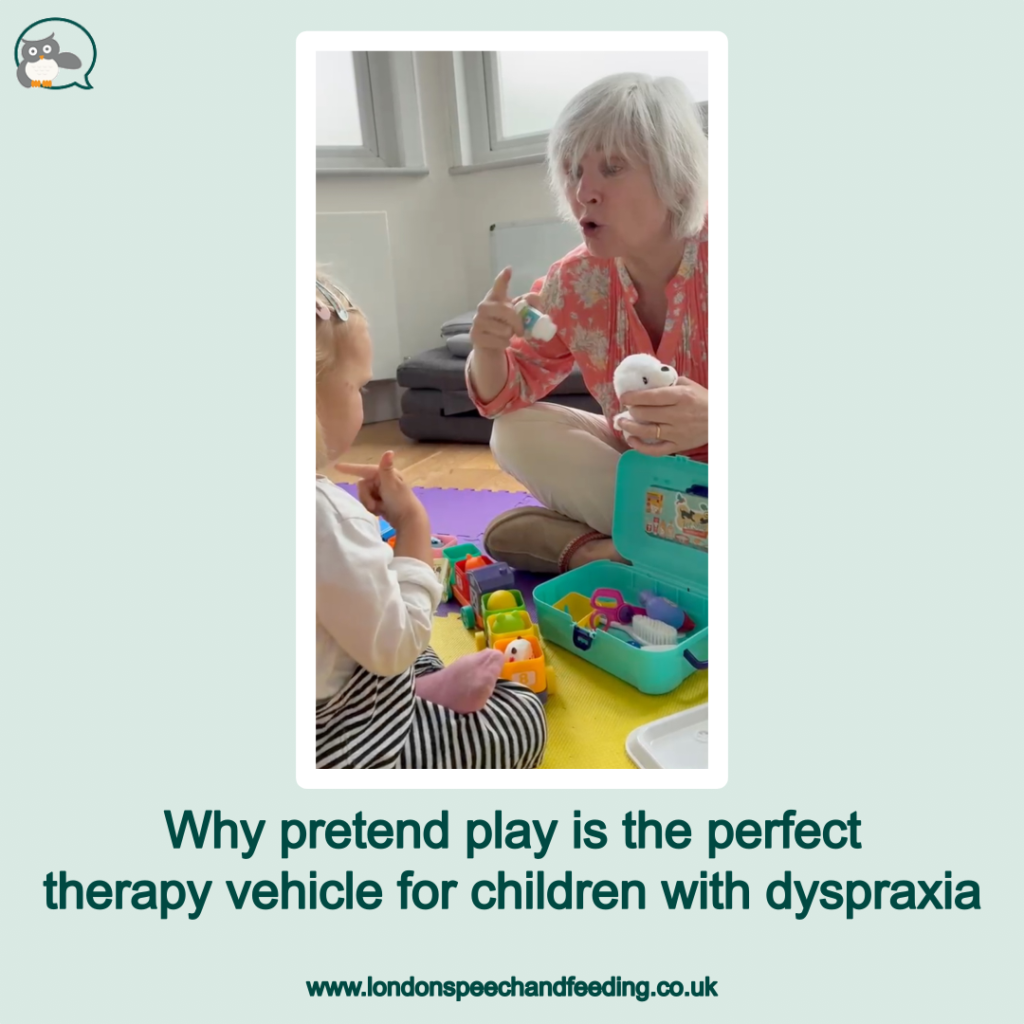
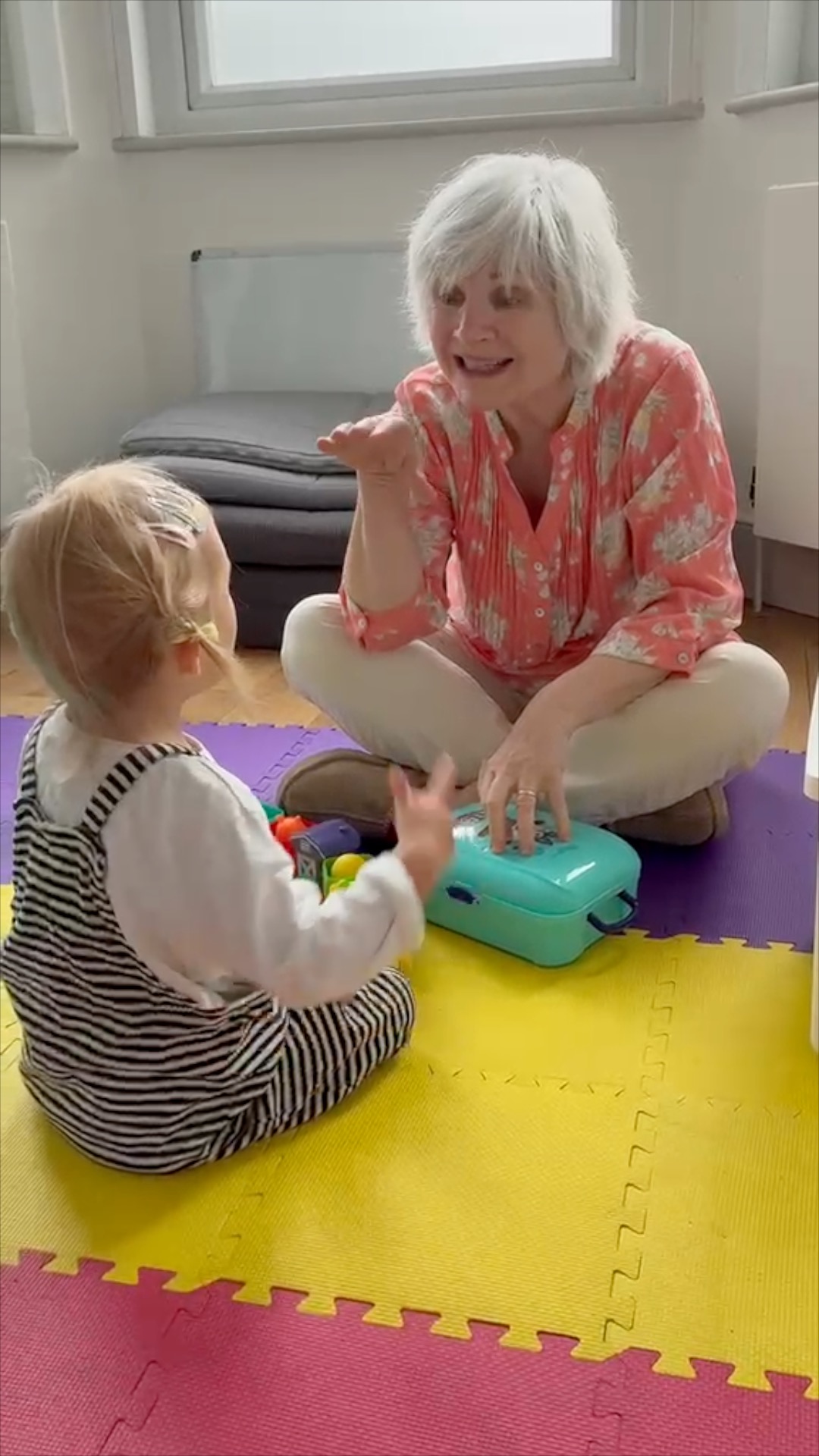
In the short video clip below you can see this dynamic in action. Notice how the session looks relaxed and playful on the surface. The child is absorbed in the pretend play scenario we have created together.
Notice, though, what is happening underneath:
the consistent, gentle modelling of target words
the use of Makaton signs alongside speech to provide an additional sensory pathway
the visual mouth cues that give the child a roadmap for how a sound is shaped
and running through all of it, the repetition. The same words, again and again, wrapped in play.
This is not therapy disguised as play. It is therapy that is play, because for a child with dyspraxia, those two things are not in opposition. They are, in fact, perfectly aligned.
If you are concerned about your child’s speech and wondering whether verbal dyspraxia might be a factor, please do not hesitate to get in touch. I would love to help you find some answers.
Sonja McGeachie
Highly Specialist Speech and Language Therapist
Owner of The London Speech and Feeding Practice.
Find a speech and language therapist for your child in London. Are you concerned about your child’s speech, feeding or communication skills and don’t know where to turn? Please contact me and we can discuss how I can help you or visit my services page.
December is often presented as a time of perfect, reciprocal play. Children are supposed to be unwrapping toys, sharing, and engaging in imaginative scenarios with family. But for parents of young autistic children, this high-pressure, socially demanding period can often feel like a battleground.
If you’ve been told to interrupt your child’s stimming, push for eye contact, or force them to play ‘functionally’ with toys, it’s time to take a deep breath. Those traditional approaches are not only stressful—they often miss the point of your child’s communication.
As a neurodiversity-affirming Speech and Language Therapist, I want to encourage you this December: You are allowed to follow your child’s lead, validate his or her unique interests, and trust that his or her play and movement are profoundly meaningful.
1. Stimming: not a distraction, but a regulator 💡
Stimming is short for self-stimulatory behaviour and includes repetitive movements or sounds like hand flapping, humming, rocking, finger flicking, or repeating phrases (called echolalia).
For years, parents were incorrectly advised to block or eliminate these behaviours. The neurodiversity-affirming view tells us the exact opposite: Stimming is a vital and essential tool for your child’s self-regulation.
Think of stimming as an internal volume dial:
Too loud/overwhelmed: Your child may stim to reduce incoming sensory input (e.g., rocking to ground himself or herself in a busy room).
Too quiet/under-stimulated: Your child may stim to increase sensory input and focus (e.g., running back and forth to maintain alertness).
The shift: validate, don’t block
Instead of saying, ‘Stop flapping your hands’, try to understand the message behind the movement.
Observe: When does the stimming happen? Is it before a meltdown? When your child excited? When your child is bored?
Validate: Name the need, not just the behaviour. You might say, ‘I see your body needs to move fast right now. That helps you calm down!’
Co-regulate: If the stim is unsafe (e.g., head-banging), help your child find a safer, alternative stim that meets the same sensory need (e.g., pushing hard against a wall, squeezing a stress ball).
By validating your child’s need to regulate, you are building trust, reducing anxiety, and teaching him or her critical self-awareness.
2. Autistic play: Meaningful, even if it’s monologue
The traditional idea of ‘good play’ often involves turn-taking, pretending, and specific toy functions (e.g., pushing a train around a track). When an autistic child spends 30 minutes lining up cars, spinning their wheels, or scripting whole scenes from a favourite movie, it can often be dismissed as non-functional or repetitive.
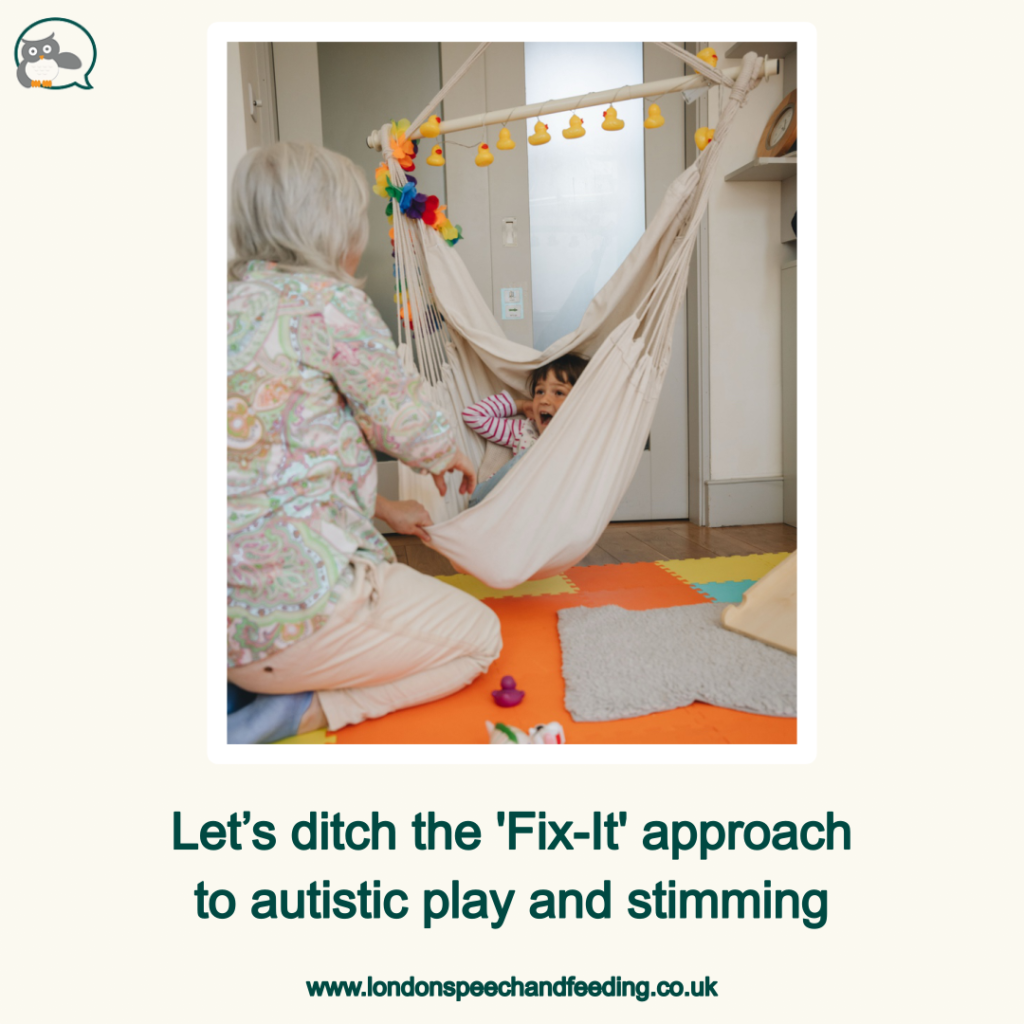
In neurodiversity-affirming practice, we recognise that autistic play is authentic play. These activities are crucial for learning, deep focus, and imaginative development.
Lining up toys may be an exploration of patterns, visual organisation, and order.
Spinning wheels may be a deep interest in cause-and-effect and visual sensory input.
Scripting is often a way to process language, regulate emotions, and practise complex social situations in a safe, controlled way.
Make a change: Join your child’s world, don’t drag them to yours.
Stop trying to force the ‘right’ way to play. Instead, try these neuro-affirming strategies:
Be a co-regulator, not a director: If your child is lining up cars, sit down next to him or her. Instead of moving a car, try handing him or her another car to line up. Focus on the shared interest rather than forcing interaction.
Narrate (don’t question): Avoid constantly asking, ‘What are you doing?’ or ‘What does this car say?’ This puts pressure on your child to perform. Instead, narrate your observations using his or her interest: ‘I see you made a long, straight line of red cars. Look at all the wheels spinning!’
Validate the interest: Show genuine appreciation for your child’s focus. ‘Wow, you know so much about how magnets stick together! That’s incredible.’
3. The communication revolution: Honouring gestalt language processing
Many young autistic children communicate in ways that don’t fit the traditional model of building language word-by-word. Many use Gestalt Language Processing (GLP).
A gestalt language processor learns language in chunks or scripts (e.g., ‘what’s-in-there?’ or ‘ready-go!’). These chunks (or gestalts) are not random; they are often tied to an emotional memory or meaning. Over time, the child breaks down these big chunks into individual words then learns to recombine those words creatively.
If your child repeats movie phrases or whole sentences that seem unrelated, he or she is likely a gestalt language processor!
Affirm the script, then model something useful.
Affirm the script: When your child says a script, respond to the meaning or emotion behind it, not the literal words. If he or she says, ‘We’re going to need a bigger boat’, and he or she is looking at a messy toy pile, he or she may be trying to express overwhelm or a need for help. You can affirm: ‘That pile is too big! I can help you move it.’
Model new ‘mix and match’ scripts: To help your child move from whole scripts to single words, you can model shorter, slightly changed versions of the script, also called ‘mitigated gestalts’. If they say, ‘I want to go home now’, you might model, ‘Let’s go home, now’ or ‘I wanna go home’.
By honouring your child’s communication style, you validate his or her experience and naturally support his or her path to language development—a core part of neurodiversity-affirming SLT.
Your December gift to your little one:
This December, stop trying to make your child fit into a neurotypical box. Instead, make your home a safe space where he or she can be his or her authentic selves.
Prioritise regulation and connection over compliance.
Trust that when your child is regulated, his or her communication, learning, and engagement will flourish naturally. This is the true gift of neurodiversity-affirming practice.
Find a speech and language therapist for your child in London. Are you concerned about your child’s speech, feeding or communication skills and don’t know where to turn? Please contact me and we can discuss how I can help you or visit my services page.