Ten games to support communication in primary school aged children

| |

When parents visit me with their child, their stress is palpable. Often parents don’t relish or even expect to be asked to practise strategies at home with their child between sessions. Let alone to practise whilst on holiday. I understand that you don’t necessarily want anything extra added to your daily ‘to do’ lists. This is why we try our best to incorporate all speech and language therapy practice into children’s daily activities.

For example:

  1. during bath time;
  2. mealtimes;
  3. getting ready for bedtime;
  4. story time
  5. yes, playtime!

These are activities that all parents will engage with anyway, so it seems to make sense to incorporate both. This is to avoid adding extra pressure on parents’ already stressful and time-poor daily lives. I am hoping my blog will come in handy, especially for the summer holidays.

On holiday you are unlikely to have your usual games and toys with you – so here is a nice little list of things you can use instead of traditional games and toys:
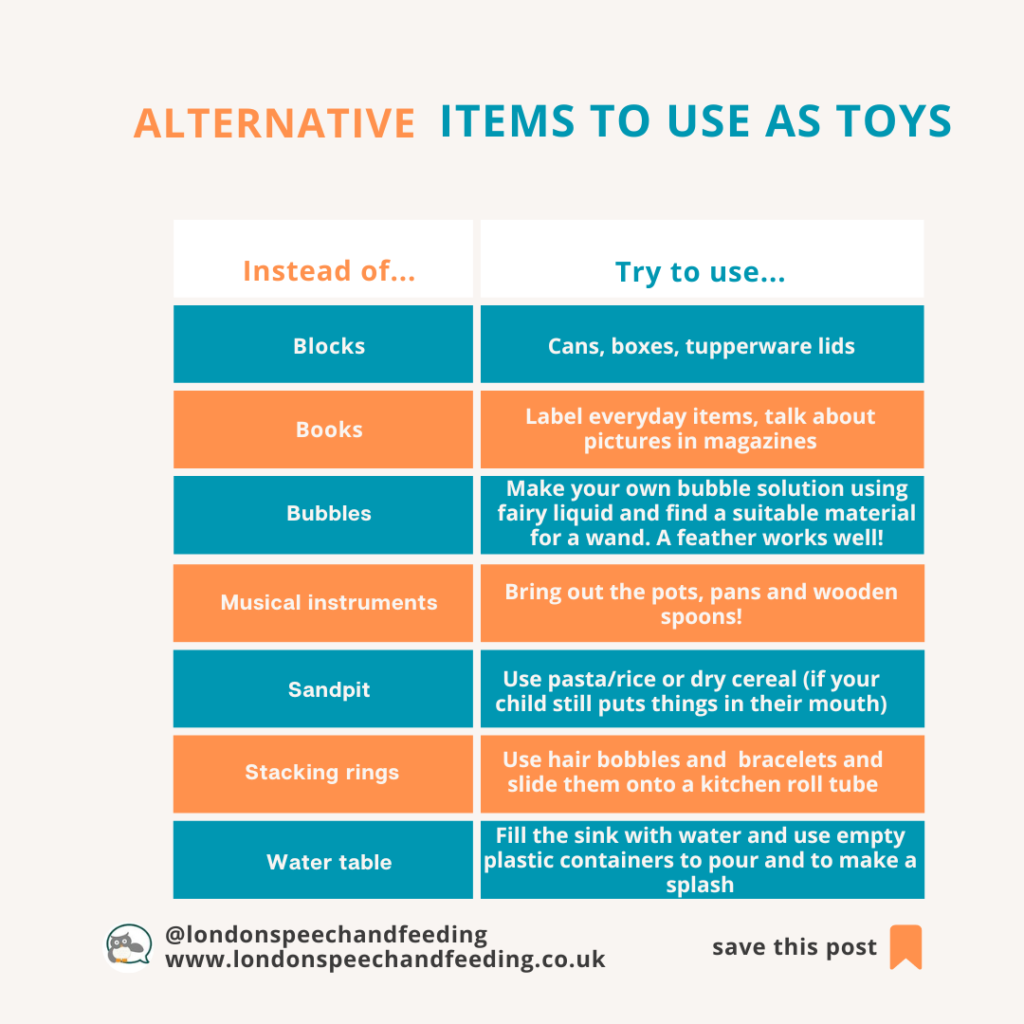
If you can think of any other alternatives on holiday and would like to tell me about them, I would love to see your comments below. We can never have too many holiday games!!

If you are at home over the summer and you do have some games in the cupboard you might want to dust these ones down or buy one or two new ones (if you want to).

Most games have multiple uses, and it’s always best to adapt a game to match your child’s interests and what motivates them.

So let’s start…

  1. Pop up pirate: pop a sword into the barrel and watch the pirate pop up randomly. Practise social skills, speech sounds, expressive language (e.g., put a sword on a picture, say the word/sentence then pick up the sword and push it into the barrel).
  2. Word games such as ‘ISpy’, ‘I went to the shop and I bought…’, ‘describe a person and guess who they are’: perfect for when you’re on the move, whether travelling or walking. You can play this anywhere and still support speech, language and communication. You could play ISpy using your child’s special sound, or ‘I went to the shop and bought all things beginning with [insert special sound here]’.
  3. Shopping list: Orchard game is a game to practise categorising. We explain the analogy of the brain being like a filing cabinet. If information is all in the correct place, it’s easier to find, retrieve and use. You can also practise specific speech sounds in this activity. You could also put the words in a sentence to add more of an expressive language element.
  4. Wiggly worms: this Orchard game is all about phonological (awareness of sounds) awareness. Matching a letter with the word. You can also practise the sounds in the words (e.g, g-o-l-d = gold; m-a-ke = make). Talk about the elements, e.g., ‘g-o-l-d’ has 4 sounds, 1 syllable; ‘m-a-ke has 3 sounds, one syllable. You can talk about what words rhyme with the different words and what makes a rhyming word (i.e., the middle and end sounds remain the same).
  5. Sound detectives: this Orchard game allows children to identify sounds. It also has an app (if your child prefers a tech-way of learning). Children identify the sound then they can add the picture card to their path and become closer to being a successful detective. This game can also support memory skills.
  6. Conversation cubes: throw the dice and start building a story. You can also create and use ‘colourful semantics’ sentence strips to support expressive (spoken) language as support to build the narrative.
  7. Think words: ‘name it, press it, pass it’. A great game to expand word knowledge. You can talk about the words at the end of each round exploring semantic (meanings) and phonemic (sounds) links. Your child can also develop social skills (such as attention, listening and turn-taking).
  8. Poo bingo: this is perfectly disgusting but equally fun for kids of about 3.5 years plus – if your child’s target is to practise /p/ sound this is the one for you. You can also learn all about the different animal’s poo, which I am sure you have always wanted to do!! The more we know about a word, the easier it is to store, retrieve and use. Yes, even talking about poo can help!! Also, it’s great for our visual learners.
  9. Simon says: a game that can be played indoors or outdoors. Parents can take turns being “Simon” and give various commands that your child must follow. This means that your child can practise their receptive (understanding of) language as well as their expressive language, speech sounds and social skills (such as turn-taking and initiating).
  10. Ker-plunk: this is perfect for practising your child’s special sound. Repetition is very important, but also can be monotonous, so finding a game that they enjoy is vital. Take turns to pull out a stick. Next, your child can either say their special sound or word (depending on what stage they are at) or hear a good model from other players.

Do you still have questions? Contact Sonja for support.


Find a speech and language therapist for your child in London. Are you concerned about your child’s speech, feeding or communication skills and don’t know where to turn? Please contact me and we can discuss how I can help you or visit my services page.

0

Similar Posts

  • ·

    Let’s live and breathe AAC

    We all have the right and want to express thoughts, feelings, and needs. For non-speaking or minimally speaking children, finding an avenue to communicate effectively can be a challenging journey. Parents are often at a loss as to where to start. Sometimes a little bit of Makaton signing has been used here and there but we mostly find that gradually signing fades as parents feel that it just doesn’t seem to get copied and used by the children.

    They live and breathe their system

    This is where we need to pick up the pieces and start again: because all successful families where children start using their boards or their electronic AAC (Augmentative and Alternative Communication) systems do this one thing: THEY LIVE AND BREATHE THEIR SYSTEM.

    • They have boards in every single room of the house;
    • They have a board in the car, attached to the side of car door so their child can point to it as they need to;
    • They have a smaller board in their handbag/rucksack when out and about;
    • They have a board for shopping and attach it to the shopping trolley;
    • They are never ever without their board.

    Because they realise that a child should never be without their mouths to speak, should never be without a means to speak. They use their own board to model and the child has always access to their board to model back or to just look.

    This is where success begins

    Success begins at consistent and joyful use of the board/AAC system throughout the entire day. If we think about it, doesn’t it make sense? Of course, it does! We talk to our child for the first two years of their life continuously wherever we are and our child is continuously encouraged to use their mouths for talking in all situations.

    Same goes for Signing: Makaton or any other sign system is a very powerful means to aid communication and I certainly advocate and use it in practice. Though much like words, signs are very elusive and temporary—as soon as the sign has been made it is gone and no longer present. Same with words of course. This can be difficult for people who need longer to process information.

    The beauty of symbols or photographs is that they are permanent: they don’t vanish, they stay and with the core board they stay in the same place! This is very reassuring. We can learn where a symbol is and we can be assured that it will still be there the next time we look at the board.

    AAC core board

    Here is a picture of a core board:

    AAC board

    You can download this and other boards for free on the Saltillo Word Power website.

    It has 48 cells and we can see the most frequently used core words on here, words that we use 80% of the day when talking with our non-speaking/minimally speaking children, younger children and children with cognitive delay. We keep our sentences short and we say phrases pertaining to their daily lives;

    • Let’s GET your toy
    • PUT it here, PUT it away, PUT it IN
    • Let’s READ a book
    • UP you get
    • WANT some MORE?
    • That’s GOOD isn’t it?
    • Let’s OPEN the box and LOOK

    And so on… All these phrases can be aided with the above board. Your child will learn OVER TIME and OVER CONTINUOUS USE where GET/PUT/MORE/WANT/IN—where these symbols are. For children who are slow to process this is so helpful, to have a visual representation of what has just been said. It aids understanding in the first place. Gradually as a child starts to copy they will point to powerful symbols themselves and if they want to speak they can also speak of course:

    A child might point to WANT + MORE and then say with their mouths: BANANA!

    Board examples

    Here are some other boards I have made specifically for daily situations and preferences of some of my students. Here is one for toileting:

    AAC toileting board

    And another one:

    These boards incorporate high-frequency and versatile words, enabling us to make little sentences.

    Building Language and Literacy Skills

    AAC Core Boards are not just tools for immediate communication. They also play a pivotal role in language and literacy development. By using these boards, non-speaking children engage with words and symbols, reinforcing their understanding of language structure and grammar.

    Over time they naturally absorb language patterns, laying the foundation for improved literacy skills.

    Customisation for Individual Needs

    Every non-speaking child is unique, and their communication needs can vary significantly. AAC Core Boards are designed with this diversity in mind. The boards can be adapted to include specific vocabulary relevant to the child’s daily life, interests, and activities. This personalisation ensures that the AAC Core Board is a true reflection of the child’s personality and needs, making communication more engaging and effective.

    Collaboration between AAC Core Boards and Speech Therapy

    While AAC Core Boards are an incredible tool, they are only used effectively by the non-speaking child when the board is used BY ALL COMMUNICATION PARTNERS around the child.

    Again, I know I am being repetitive here, but the board needs to be used and modelled by the adults constantly in the first place and for a period of time before we can expect our children to take an interest and use the boards themselves. Think how long it typically takes for a child to learn their first word: around a year! During that time the adults talk constantly to their child without hesitation or expectation! The same goes for introducing this new way of communicating.

    Collaborating with your child’s speech-language therapist (SLT) ensures that your child receives the right guidance in using the AAC system. SLTs can assess your child’s communication abilities, recommend appropriate boards and provide guidance on how to best implement them.

    Conclusion

    For non-speaking children, AAC Core Boards are bridges to their world.

    These boards foster language development, social interaction, and personal expression. AAC Core Boards offer a beacon of hope, helping non-speaking children break through communication barriers and thrive in a world that is waiting to hear their voices. Boards are simple for anyone to use and understand. Have a go! You will be surprised how lovely it is to use a board with ease and once your child sees you do this, you have a chance for your child to start copying you…and express something! HOW ABOUT THAT! I look forward to hearing your stories!

    The London Speech and Feeding Practice


    Find a speech and language therapist for your child in London. Are you concerned about your child’s speech, feeding or communication skills and don’t know where to turn? Please contact me and we can discuss how I can help you or visit my services page.

    1
  • · ·

    The power of imitation in supporting children with autism

    Image by Freepik

    Imitation, the act of mirroring someone else’s actions, gestures, sounds, or words, is a fundamental skill that plays a crucial role in human development. It’s how babies learn to wave ‘bye-bye’, how toddlers pick up new words, and how children acquire social skills. But for children with autism imitation can be a significant challenge and understanding why it’s important and how to foster it becomes a key focus for parents, educators, and speech and language therapists.

    Why is imitation important?

    Imitation is a building block for a wide range of developmental skills:

    • Social interaction: Imitation is the foundation of social reciprocity. When a child imitates, he or she is engaging in a shared experience, connecting with another person, and learning to take turns in social exchanges.
    • Communication development: Imitation is closely linked to language acquisition. Children often imitate sounds and words before they can produce them independently. Imitation also helps them understand the meaning of gestures and facial expressions, which are vital for nonverbal communication.
    • Cognitive development: Imitation plays a role in problem-solving, learning new skills, and understanding cause and effect. By imitating actions, children explore their environment and learn how things work.
    • Emotional development: Imitation helps children understand and share emotions. When a child imitates a smile, he or she may begin to understand the feeling of happiness.

    Imitation challenges in autism

    Many children with autism face challenges with imitation, which can affect their development in these key areas. These challenges can manifest in different ways:

    • Difficulty imitating motor actions: Children with autism may struggle to imitate simple motor movements, such as clapping hands, waving, or playing ‘peek-a-boo’.
    • Limited vocal imitation: Imitating sounds, words, and phrases can be difficult for some children with autism, which can impact their speech development.
    • Challenges with social imitation: Imitating social cues, such as facial expressions, gestures, and body language, can be particularly challenging for children with autism, affecting their ability to engage in social interactions.

    Why do children with autism struggle with imitation?

    The exact reasons for imitation difficulties in autism are complex and not fully understood. However, several factors may contribute:

    • Neurological differences: Research suggests that differences in brain structure and function, particularly in areas involved in social perception and motor control, may play a role.
    • Sensory processing differences: Some children with autism may have sensory differences that make it difficult to attend to and process the movements or sounds they are expected to imitate.
    • Attention and motivation: Challenges with attention, focus, and social motivation can also affect a child’s ability to engage in imitation.

    How to foster imitation in children with autism

    Fortunately, imitation skills can be developed and improved through targeted interventions and strategies. Here are some approaches that I use in my practice as a speech and language therapist working with autistic children and their families:

    • Create a playful and engaging environment: Children are more likely to imitate when they are having fun and feel motivated. I use toys, games, and activities that the child enjoys.
    • Start with simple imitation: Begin by imitating simple motor movements that the child is already capable of and gradually introduce more complex actions.
    • Imitate the child first: As the Hanen Program emphasises, imitating the child’s actions, sounds, and words can encourage him or her to interact and communicate more.
    • Use visual supports: Visual aids, such as pictures, photos or videos, can help children with autism understand what is expected of them and make imitation easier.
    • Break down complex actions: Divide complex actions into smaller, more manageable steps. For example, to teach a child to brush their teeth, break it down into steps like ‘pick up toothbrush’, ‘put toothpaste on brush’, and ‘move brush on teeth’.
    • Reinforce imitation attempts: Provide positive reinforcement, such as praise, smiles, or preferred activities, when the child attempts to imitate, even if the imitation is not perfect.
    • Integrate imitation into daily routines: Incorporate imitation into everyday activities, such as imitating sounds during playtime, imitating gestures during songs, or imitating actions during self-care routines.

    The role of speech therapy

    Speech-language therapists play a crucial role in helping children with autism develop imitation skills, particularly in the areas of vocal and verbal imitation. As part of my therapeutic role, I offer the following:

    • Assessing a child’s imitation abilities.
    • Developing individualised therapy plans to target specific imitation goals.
    • Using a variety of techniques to encourage vocal imitation.
    • Working with parents and caregivers to provide strategies and support for promoting imitation at home.

    Summary

    Imitation is a fundamental skill that is essential for social, communication, cognitive, and emotional development. While children with autism may face challenges with imitation, it is a skill that can be developed and improved with targeted interventions and support. By understanding the importance of imitation and using effective strategies to foster it, parents, educators, and therapists can make a significant difference in the lives of children with autism, helping them to connect with others, learn new skills, and reach their full potential.

    Do get in touch via my contact form if you have any question or need help with supporting your little one.

    Sonja McGeachie

    Highly Specialist Speech and Language Therapist

    Owner of The London Speech and Feeding Practice.


    Health Professions Council registered
    Royal College of Speech & Language Therapists Member
    Member of ASLTIP

    Find a speech and language therapist for your child in London. Are you concerned about your child’s speech, feeding or communication skills and don’t know where to turn? Please contact me and we can discuss how I can help you or visit my services page.

    1
  • Empty Set and Phonology approaches

    I have been avoiding the use of the Empty Set approach for the longest time as I was not sure if it would work seeing that I am challenging two sounds my student struggles with at the same time. But I decided to give it a go and it works a treat!

    With this approach, we use two sounds that our student is struggling with. For example, in my video this student cannot produce /sh/ and /r/. Both sounds have different rules, so I decided to contrast them with each other.

    • The rules of /sh/ are: no voice, air is pushed out through teeth, produced at the front.
    • The rules for /r/ are: use your voice, produce the sound in the middle of the mouth by shaping your tongue in a particular way.

    So I chose the words ‘shoes’ and ‘ruse’ as their rules are quite different. Contrasting two sounds the student does not know has been shown to lead to greater change in the child’s articulation. And I can certainly vouch for this as my student is making the best progress with this approach.

    Phonology Therapy – what is it, why and how?

    Phonology is the study of the sound system of a language. It’s distinct from articulation therapy which focuses on the physical production of sounds.

    Phonology therapy focuses on rules. For example, sounds that are produced at the front of the mouth, in contrast to sounds that are produced at the back of the mouth, or sounds that are produced with a long air stream: /s/ or /f/ versus short sounds like /p/ or /t/; sounds are produced with voice or without voice.

    Many children, and sometimes adults, are unaware of some of the speech rules and confuse and replace individual sounds. They might say TAT instead of CAT or SIP instead of SHIP.

    A quick overview of phonology approaches I use:

    Minimal Pairs:

    This approach is good for single sound substitutions. We offer word pairs that differ by only one sound, like ‘ship’ and ‘sip.’ One of our first goal in therapy is to highlight the difference between the target sound (e.g., /sh/) and the sound the child uses (e.g., /s/). This helps discriminate and eventually produce the correct sound.

    Multiple Oppositions:

    A child might replace lots of sounds with a single sound like a /d/. So instead of ‘four’, ‘chore’ and ‘store’ our child says ‘door’, making speech very unintelligible.

    The approach is typically geared towards shaking up the phonological system. Our goal is to choose two to four targets that are different from each other, and different from the substituted sound. If our child’s favourite sound is /d/ they can use their voice and make a short sound by stopping their airflow. So I will choose a different target sound to change up the speech system. For example I might choose an /f/, a /m/ and a /k/ sound. So I would contrast: ‘door’ with ‘four’, ‘more’ and ‘core’.

    Maximal Oppositions:

    In the Maximal Oppositions approach the treatment sets consists of words that are minimally contrasted and that have maximal or near maximal feature differences between each word pair. One word in a pair represents a sound the child ‘knows’ (can say at word level) and the other represents a sound the child does not know (cannot say).

    For example, a child may ‘know’ /m/ and be able to say words like ‘man’, ‘mat’ and ‘mine’. However, the same child may be unable to say /f/ as in ‘fan’, ‘fat’ and ‘fine’. The consonants /f/ and /m/ are maximally opposed as follows.

    I am always delighted to work on speech sound disorders, I love the challenge and the successes we can celebrate together. Get in touch with me!

    Sonja McGeachie

    Early Intervention Speech and Language Therapist

    Feeding and Dysphagia (Swallowing) Specialist The London Speech and Feeding Practice

    The London Speech and Feeding Practice


    Find a speech and language therapist for your child in London. Are you concerned about your child’s speech, feeding or communication skills and don’t know where to turn? Please contact me and we can discuss how I can help you or visit my services page.
    1
  • ·

    Bilingualism – should I speak only English with my speech delayed child?

    Introduction

    Bilingualism is a beautiful aspect of our diverse world. Growing up in a bi- or multi-lingual household is a wonderful gift, allowing children to communicate with a broader range of people and access many cultures.

    My own two children grew up in a bilingual German-English speaking household. They have both been so enriched by this experience, not only language- and learning-wise but of course also culturally: their world has always been so open and colourful. Growing up in inner London and having their German family and mum’s friends as well, this has been a wonderful experience. Both my boys speak German well (not quite like native speakers but like very good second language speakers) and both have very easily learned 3rd and 4th languages additionally when in secondary school.

    Whilst bilingualism has untold benefits, it’s not uncommon for bilingual children to take slightly longer to reach certain speech milestones. This should not be automatically mistaken for speech disorders but rather seen as a natural part of bilingual language development.

    Bilingualism and speech delays

    Sometimes, of course, we do see speech delays or disorders where a child’s speech development lags significantly behind their peers. We often see a delay in both languages equally, making it extra hard for to communicate effectively. BUT PLEASE KNOW the family speaking in multi-lingual languages never caused the delay/disorder!

    If there is a delay or a disorder any number of other reasons could have caused it, such as:

    • hearing impairments,
    • reduced phonological awareness,
    • sensory processing issues,
    • reduced attention and reduced joint attention,
    • neuro-developmental delays or difficulties,
    • general or specific learning difficulties
    • or sometimes other genetic factors.

    So, to say that the difficulty is due to a child being exposed to several languages is a red herring. (no offence to herrings!)

    Speech therapy

    Speech therapy can be powerful to help bilingual /multilingual children with speech delays unlock their full linguistic potential. By providing individualised assessments, targeted interventions, and involving families, speech therapy can bridge the gap between speech delays and bilingualism. It’s essential for the therapist and parents to work together to support the children in their unique linguistic journeys, helping them communicate effectively and thrive in both of their languages.

    Happy Islamic family sitting on the floor
    Image by Freepik

    Speak your home language at home

    Many parents report that they worry about speaking their home language at home and instead they have been focusing on just speaking English at home. They now rarely use their home language with their child. They fear that speaking a language other than English with their child will cause further delay and hinder their progress. All parents want the best for their child and often parents fear that their child won’t fit in or will be seen as ‘different’. So we can understand why parents feel that the English language is the only one worth having.

    But the opposite is the case: it is crucial to speak in both languages freely, both at home and outside the home! Both languages will benefit your child, no matter what the delay or difficulty is. Acquiring a ‘mother tongue’ or native language is absolutely vital for children to have a good, solid linguistic grounding on which to build other languages. Bilingual children may mix languages during speaking and parents may equally mix their languages. This does not hinder language development and is a natural part of linguistic development.

    Speak freely and naturally

    What is far more important than the question: ‘which language should I say this in?’ Instead think: ‘let me speak freely and naturally, let me respond naturally, in good intonation and let communication flow freely to the child.’

    Speech therapy can be a crucial resource for bilingual or multilingual children and their families.

    We work on targeted interventions to address speech and language difficulties, helping your child develop essential communication skills. For home practice between therapy sessions, we can recommend tailored treatment plans to help you help your child in daily life. Our input could be focusing on articulation, phonological awareness, attention and listening, vocabulary development and grammar.

    Family support is crucial in speech therapy. We like to work closely with parents to provide guidance and strategies for fostering language development in both languages at home.

    If you have any worries about your child being delayed in a bilingual or multilingual household do get in touch and we will be happy to support you in your journey.


    Find a speech and language therapist for your child in London. Are you concerned about your child’s speech, feeding or communication skills and don’t know where to turn? Please contact me and we can discuss how I can help you or visit my services page.

    1
  • · ·

    Understanding phonological processes in 3–7-year-olds: What’s typical and when to seek help

    As a speech and language therapist, one of the most common questions I hear from parents is:

    ‘They can talk, but their speech still sounds immature. Is this normal?’

    Many children between the ages of three and seven use speech patterns that make their words sound different from adult speech. These patterns are known as phonological processes, and for younger children, they are a normal part of speech development.

    However, when these processes persist beyond the expected age, they can start to affect clarity, confidence and learning, especially once children enter school.

    This blog will help you understand:

    • what phonological processes are
    • which patterns are typical at different ages
    • and when it might be time to seek speech therapy support

    What are phonological processes?

    Phonological processes are patterns of sound simplification that children use while their speech system is developing.

    Instead of learning each sound one by one, children initially organise sounds into patterns that make speech easier to produce. This is a normal and efficient strategy for a developing brain.

    For example:

    • saying ‘tar’ instead of ‘car’
    • saying ‘poon’ instead of ‘spoon’
    • saying ‘bud’ instead of ‘bus’

    These are not ‘bad habits’. They are part of how speech develops.

    The key question is how long these patterns last.

    Common phonological processes (and when they usually disappear)

    Below are some of the most common processes parents notice in 3–7-year-olds.

    1. Final consonant deletion

    Leaving off the last sound in a word

    • ‘ca’ for cat, ‘da’ for dog
    • Typically resolved by 3–3½ years

    2. Fronting

    Replacing back sounds (k, g) with front sounds (t, d)

    • ‘tar’ for car, ‘do’ for go
    • Typically resolved by 3½–4 years

    3. Cluster reduction

    Omitting one sound in a consonant cluster

    • ‘poon’ for spoon, ‘top’ for stop
    • Typically resolves by 4–5 years (some clusters slightly later)

    4. Gliding

    Replacing /R/ or /L/ with /W/ or /Y/

    • ‘wabbit’ for rabbit, ‘yion’ for lion
    • Can be typical up to 5–6 years

    5. Weak syllable deletion

    Leaving out unstressed syllables

    • ‘nana’ for banana
    • Usually resolved by 4 years

    If these patterns continue past the expected age, speech can remain difficult to understand particularly for unfamiliar listeners such as teachers, peers, and also Auntie Karen or grandparents who visit once in a while.

    Why phonological processes matter in school-age children

    By the time children reach reception and Year 1, speech clarity becomes increasingly important.

    Persistent phonological difficulties can affect:

    • being understood by teachers and peers
    • phonics and early reading
    • spelling
    • confidence in speaking
    • willingness to participate in class

    Some children become aware that they ‘sound different’ and may speak less, avoid longer words, or become frustrated when misunderstood.

    What’s the difference between a delay and a disorder?

    This is an important distinction.

    • A phonological delay means a child is following the normal pattern of development, just more slowly.
    • A phonological disorder means the child is using atypical patterns, or continuing age-expected patterns well beyond when they should have resolved.

    A speech and language assessment helps identify:

    • which processes are present
    • how many are affecting speech
    • how consistent the errors are
    • and whether intervention is needed

    Signs it may be time to seek speech therapy

    You may want to seek professional advice if your child:

    • is 3½ years or older and still hard to understand
    • is understood well by family but not by others
    • becomes frustrated or avoids talking
    • has difficulty with phonics or spelling
    • uses several phonological processes at once
    • has not made progress despite time and encouragement

    Early support does not mean something is ‘wrong’. It simply helps speech development move forward more efficiently.Research consistently shows that unresolved phonological processes beyond the expected age can impact intelligibility, literacy and confidence (Dodd, 2014; Bowen, 2015).

    How speech therapy helps phonological development

    Phonological therapy is not about drilling individual sounds endlessly.

    Instead, therapy focuses on:

    • helping children recognise sound patterns
    • building awareness of contrasts (e.g. ‘tar’ vs ‘car’)
    • practising speech in meaningful, playful ways
    • supporting generalisation so progress carries into everyday speech

    For school-aged children, therapy is usually structured, motivating and highly targeted and progress can be very encouraging.

    A final reassurance

    Many children with phonological difficulties go on to develop clear, confident speech with the right support.

    If you’re unsure whether your child’s speech is ‘just a phase’ or something that needs attention, a professional assessment can give clarity and peace of mind.

    If you’d like support or advice, please contact me and I can help guide the next steps.

    Sonja McGeachie

    Highly Specialist Speech and Language Therapist

    Owner of The London Speech and Feeding Practice.

    Research references


    Health Professions Council registered
    Royal College of Speech & Language Therapists Member
    Member of ASLTIP

    Find a speech and language therapist for your child in London. Are you concerned about your child’s speech, feeding or communication skills and don’t know where to turn? Please contact me and we can discuss how I can help you or visit my services page.

    3
  • ·

    Explore activities for Gestalt Language Processors to aid communication

    Speech Therpaist in London

    When you have a child who uses Gestalts it is often difficult to think and adapt clinic activities into those to use at home. More importantly, you find that individualising your activities for your child who uses Gestalt are time-consuming. But you value its importance for their communication development.

    You feel so busy, you are taking them to other appointments, or trying to get through your daily activities, all whilst still ensuring your child’s emotional needs are met. You know life should not get in the way of your child’s therapy activities at home, but it does. We know your spare time is precious and limited, so let us achieve your child’s or young person’s goals in the allotted time you have which meets their way of learning (using Gestalts).

    We wanted to support you by exploring items which you may have at home, and we will give you some key phrases which you can start to model with your child. Whereas our last blog introduced the idea of gestalt language processors, we are now developing ideas to give you the tools to implement activities at home. We recognise how overwhelming it may feel, and this is one of the reasons to make activities as straight forward as possible. Therapy does not need to be complicated; it just needs to be carried out on a regular basis.

    Explore the samples I’ve created to give you an idea of how this might look but please consult with a Speech and Language Therapist who knows about Gestalt Language Processing so that you can work together to develop great home activities for your child.

    Want to learn more about gestalt language processing?

    Please contact me for help.


    Find a speech and language therapist for your child in London. Are you concerned about your child’s speech, feeding or communication skills and don’t know where to turn? Please contact me and we can discuss how I can help you or visit my services page.

    1

Leave a Reply

Your email address will not be published. Required fields are marked *