What is Speech and Language Therapy (SLT) and what does a Speech Therapist do?

Kids Speech Therapist London
What is Speech and Language Therapy (SLT) and what does a Speech Therapist do?

Speech and language therapists provide treatment, support and care for children and adults who have difficulties with communication, eating, drinking and swallowing. We help children and adults who have problems speaking and communicating.

How to find the perfect therapist for my child/client:

There are a huge number of speech and language difficulties, or feeding and swallowing problems that we can help with and the first thing to think about is what age group the person is you are seeking help for. Most SLT’s specialise in a range of disorders and treatments and they often treat specific age ranges. This could be, for instance, very young children up to 3 years, or school aged children, adolescents or just adults. Once you have narrowed it down to age and general area of difficulty you can then go and seek your perfect SLT match.

Generally it is my view that SLT’s with a narrow area of specialist interest are most likely to help you better if the problem you or your child/adult is having is significant and/or profound. For example, if your child has a very severe stutter/stammer but is otherwise developing fine and has good skills all round, then I would recommend to look for an SLT who only specialises in stammering/stuttering, or has only a small range of other specialist areas related to stammering , such as speech and language delay.

The reason is that it is a tall order for any professional to stay up to date with latest research, latest clinical developments and training for more than, say, five distinct areas of interest.

However, a more generalist Speech therapist who has lots of experience in many different areas could be a very good option for your child or adult who has more general speech and language delay in a number of areas, perhaps a global delay or a syndrome which means that their learning is delayed in general. It also means that your child might benefit from a Generalist SLT because they have many more tools in their SLT bag and your child might need a variety of approaches for several areas.

A good place to start is www.asltip.com which is the Association for Independent Speech and Language Therapists in the UK. Any SLT registered with ASLTIP will also be registered with the HCPC (Health Care Professionals Council), as well as RCSLT (Royal College of Speech and Language Therapists). These two important UK professional regulatory bodies ensure all its members are fully qualified, and are fully up to date with latest developments within their areas of work.

Here you can enter your post code and look for a therapist near you and you can look for specific problems such as stammering for example and narrow down your search. Most therapists have a website which you can then access too. I would recommend you speak to a few therapists on your list and then go with the person you had the best rapport with. You and the therapist will be spending a lot of time together and you will need to feel that you trust them and that you can relax into the process.

How I can help you:

I have 3 main areas of specialism:

Parent Child Interaction Coaching

Parent Child Interaction Coaching

This is an amazing way to help children with the following difficulties:

  • Social Communication Difficulties, Autistic Spectrum Disorders and
  • Speech and Language Delay – for children under the age of 4 years old, this is my preferred way of working because it is so very effective and proven to work. If your child is not developing words or not interacting, has reduced attention and listening and you feel is not progressing or, in fact even regressing, then this way of working is the best. For anyone wanting to read a bit more about the efficacy of this method, below are some research articles. You may also like to check out www.hanen.org which is the mainstay of my work and method when it comes to Parent-Interaction Coaching. You can also look at my latest blog, entitled: Tele-therapy, does it work?

In brief, what’s so great about Parent Coaching is that it empowers you the parent to help your child in daily life! This is where speech, language and social communication develop typically, in a naturalistic way and environment. Simple steps and strategies are discussed and demonstrated every week and you are encouraged to use these strategies with your child in daily routines: getting dressed, having breakfast, on the school run, whilst out in the park or shopping or simply playing at home or having dinner or bath time. Whatever your family routine happens to be, every strategy I teach you will help create a responsive communication environment; generally, if your child is able to develop speech then they will do so in direct response to your changed interaction style.

Speech Sound Disorders, Verbal Dyspraxia, Phonology and Articulation

Speech Sound Disorders, Verbal Dyspraxia, Phonology and Articulation

I love working with children of all ages on developing their speech sounds. Whether your child has a lisp, or a couple of tricky sounds they simply cannot produce quite right, or perhaps your child is really unintelligible because he/she is having lots of different sound errors, making it really hard to understand them. I typically work on getting “most bang for your buck” , meaning I address the sounds that cause the most problems and, therefore, when they are fixed your child/person’s speech becomes that much clearer fairly quickly.

Feeding and Swallowing Difficulties

Feeding and Swallowing Difficulties

Having worked for over 20 years in NHS Child Development Clinics and Special Needs Schools I trained and worked with feeding and swallowing difficulties early on in my SLT career. I later trained as a Lactation Consultant and so I am well placed helping and support all types of Infant feeding, both breast or bottle, as well as toddler weaning. I aim to ensure that your little one swallows the right kind of foods and drinks for their abilities. I am experienced in managing and supporting children with physical needs and mobility problems, Cerebral Palsy, Down Syndrome or any other type of syndrome or presentation.

What does a speech therapy session look like?

All sessions differ slightly depending on the age of the child and the nature of the difficulties.

However, mostly our sessions look like FUN! After arrival and washing hands we tend to start off with the tricky work straight away whilst our child still has energy and the will to engage. So, for speech work we will focus on the target sounds first: this could be sitting at a table doing work sheets together, playing games using the target sound and really any type of activity that gives us around 70-100 repeats of the target pattern. For example, a child who is working towards saying a ‘K’ at the end of the word I will try and get around 100 productions of words like: pack/sack/lick/ pick/bike/lake and so on.

Then we often play a fun game where I might try for a ‘rhyming’ activity or other sound awareness type activities, for perhaps 10 minutes and within that time I aim to trial the next sound pattern we need to improve on; I will test which sound your child can do with help from me. During he last 10 minutes we might look at a book, again listening to and producing whatever sound we are working on. If I did not get 100 sounds earlier on in the session I will try and practice them now as part of the story. In total I aim to have about 40-45 minutes of activities, all aimed at the target sound we are working on.

What does a Coaching session look like?

During a Parent Coaching Session we meet online for about an hour and we discuss how the week has been for you trying out the strategies. Typically parents start off recalling what went well, what progress was made and what had been more tricky. We work through it all, and then follow on to the next strategies: I will show you examples and demonstrations of each strategy and I will get you to think about how you can use this with your child and in what situation you might use it. I will explain what we are doing and what the purpose is. You might want to write down what you are going to work on for the week. Over the course of about sessions we can cover all the major strategies that are proven to help kickstart spoken language and/or help your child to connect more with you. Through that connection spoken words most often develop.

Research Papers on the Efficacy of Parent Child Interaction Coaching

Research Papers on the Efficacy of Parent Child Interaction Coaching

  • The It Takes Two to Talk Program has been shown to be effective in changing how parents interact with their children, and that children’s communication and language skills improve as a result.
  • Baumwell, L.B., Tamis-LeMonda, C.S. & Bornstein, M.H. (1997). Maternal verbal sensitivity and child language comprehension. Infant Behavior and Development, 20(2), 247-258.
  • Beckwith, L. & Cohen, S.E. (1989). Maternal responsiveness with preterm infants and later competency. In M.H. Bornstein (Ed.). Maternal responsiveness: Characteristics and consequences: New directions for child development (pp. 75-87). San Francisco: Jossey Bass.
  • Bronfenbrenner, U. (1974). Is early intervention effective? (Publication No. (CDH) 74-25). Washington, DC: Department of Health, Education, and Welfare, Office of Child Development.
  • Girolametto, L. (1988). Improving the social-conversational skills of developmentally delayed children: An intervention study. Journal of Speech and Hearing Disorders, 53, 156-167.

Sonja has been a real help for my 5 year old daughter. Due to her support, my daughter is now able to clearly and correctly enunciate ‘th’ ‘f’ and ’s’. She was also helpful in making positional changes to her seating to help her concentrate better and kept her engaged throughout all the lessons which is a feat in itself on zoom!

Helen, Mother of Catherine Age 5.

Find a speech and language therapist for your child in London. Are you concerned about your child’s speech, feeding or communication skills and don’t know where to turn? Please contact me and we can discuss how I can help you or visit my services page.
Similar Posts

  • · ·

    The power of imitation in supporting children with autism

    Image by Freepik

    Imitation, the act of mirroring someone else’s actions, gestures, sounds, or words, is a fundamental skill that plays a crucial role in human development. It’s how babies learn to wave ‘bye-bye’, how toddlers pick up new words, and how children acquire social skills. But for children with autism imitation can be a significant challenge and understanding why it’s important and how to foster it becomes a key focus for parents, educators, and speech and language therapists.

    Why is imitation important?

    Imitation is a building block for a wide range of developmental skills:

    • Social interaction: Imitation is the foundation of social reciprocity. When a child imitates, he or she is engaging in a shared experience, connecting with another person, and learning to take turns in social exchanges.
    • Communication development: Imitation is closely linked to language acquisition. Children often imitate sounds and words before they can produce them independently. Imitation also helps them understand the meaning of gestures and facial expressions, which are vital for nonverbal communication.
    • Cognitive development: Imitation plays a role in problem-solving, learning new skills, and understanding cause and effect. By imitating actions, children explore their environment and learn how things work.
    • Emotional development: Imitation helps children understand and share emotions. When a child imitates a smile, he or she may begin to understand the feeling of happiness.

    Imitation challenges in autism

    Many children with autism face challenges with imitation, which can affect their development in these key areas. These challenges can manifest in different ways:

    • Difficulty imitating motor actions: Children with autism may struggle to imitate simple motor movements, such as clapping hands, waving, or playing ‘peek-a-boo’.
    • Limited vocal imitation: Imitating sounds, words, and phrases can be difficult for some children with autism, which can impact their speech development.
    • Challenges with social imitation: Imitating social cues, such as facial expressions, gestures, and body language, can be particularly challenging for children with autism, affecting their ability to engage in social interactions.

    Why do children with autism struggle with imitation?

    The exact reasons for imitation difficulties in autism are complex and not fully understood. However, several factors may contribute:

    • Neurological differences: Research suggests that differences in brain structure and function, particularly in areas involved in social perception and motor control, may play a role.
    • Sensory processing differences: Some children with autism may have sensory differences that make it difficult to attend to and process the movements or sounds they are expected to imitate.
    • Attention and motivation: Challenges with attention, focus, and social motivation can also affect a child’s ability to engage in imitation.

    How to foster imitation in children with autism

    Fortunately, imitation skills can be developed and improved through targeted interventions and strategies. Here are some approaches that I use in my practice as a speech and language therapist working with autistic children and their families:

    • Create a playful and engaging environment: Children are more likely to imitate when they are having fun and feel motivated. I use toys, games, and activities that the child enjoys.
    • Start with simple imitation: Begin by imitating simple motor movements that the child is already capable of and gradually introduce more complex actions.
    • Imitate the child first: As the Hanen Program emphasises, imitating the child’s actions, sounds, and words can encourage him or her to interact and communicate more.
    • Use visual supports: Visual aids, such as pictures, photos or videos, can help children with autism understand what is expected of them and make imitation easier.
    • Break down complex actions: Divide complex actions into smaller, more manageable steps. For example, to teach a child to brush their teeth, break it down into steps like ‘pick up toothbrush’, ‘put toothpaste on brush’, and ‘move brush on teeth’.
    • Reinforce imitation attempts: Provide positive reinforcement, such as praise, smiles, or preferred activities, when the child attempts to imitate, even if the imitation is not perfect.
    • Integrate imitation into daily routines: Incorporate imitation into everyday activities, such as imitating sounds during playtime, imitating gestures during songs, or imitating actions during self-care routines.

    The role of speech therapy

    Speech-language therapists play a crucial role in helping children with autism develop imitation skills, particularly in the areas of vocal and verbal imitation. As part of my therapeutic role, I offer the following:

    • Assessing a child’s imitation abilities.
    • Developing individualised therapy plans to target specific imitation goals.
    • Using a variety of techniques to encourage vocal imitation.
    • Working with parents and caregivers to provide strategies and support for promoting imitation at home.

    Summary

    Imitation is a fundamental skill that is essential for social, communication, cognitive, and emotional development. While children with autism may face challenges with imitation, it is a skill that can be developed and improved with targeted interventions and support. By understanding the importance of imitation and using effective strategies to foster it, parents, educators, and therapists can make a significant difference in the lives of children with autism, helping them to connect with others, learn new skills, and reach their full potential.

    Do get in touch via my contact form if you have any question or need help with supporting your little one.

    Sonja McGeachie

    Highly Specialist Speech and Language Therapist

    Owner of The London Speech and Feeding Practice.


    Health Professions Council registered
    Royal College of Speech & Language Therapists Member
    Member of ASLTIP

    Find a speech and language therapist for your child in London. Are you concerned about your child’s speech, feeding or communication skills and don’t know where to turn? Please contact me and we can discuss how I can help you or visit my services page.

    1
  • · ·

    Your child’s communication journey

    Understanding our neurodiversity-affirming, child-led approach

    Welcome to a different kind of therapy!

    Your child’s communication journey

    The start of a new year often brings fresh hope, and sometimes fresh worries, for parents supporting their child’s communication. I am always genuinely excited to begin a new journey with children and their families, and I know that, for many parents, this kind of therapy may look very different from what they were expecting.

    Parents (and children!) are often surprised to discover that our sessions are playful, joyful, and intentionally low-pressure. You won’t see demands for eye contact, sitting still, or being told to ‘do it this way’ or ‘put the red square there’. Instead, you’ll see your child being met exactly where they are.

    For families who have previously experienced more adult-led or behaviour-based approaches including Applied Behaviour Therapy, this difference can feel unfamiliar at first. Because of that, I want to take a moment to prepare you for what child-led, neurodiversity-affirming therapy looks like, so you can feel confident, comfortable, and reassured from day one.

    Why doesn’t child-led therapy look like ‘traditional’ therapy?

    Many people picture speech and language therapy as sitting at a table, using flashcards, or practising words through repetition. While those approaches can work well for some children, they are often not effective or appropriate for many neurodivergent children—including children with autistic profiles, ADHD, or demand-sensitive nervous systems.

    Our approach is grounded in a simple and powerful truth:

    Children learn best when they feel safe, motivated, and emotionally connected.

    When a child’s nervous system feels calm and secure, learning becomes possible. When a child feels pressured or controlled, communication often shuts down, even if they can speak.

    🎯 Our purpose: Communication through connection

    Our goal is not simply to help your child say more words. Our goals go deeper and are built on strong foundations:

    • Trust and regulation: We focus on building a trusting relationship where your child feels safe, understood, and emotionally regulated. A calm nervous system is the starting point for all communication.
    • Motivation: We follow your child’s intrinsic motivation, the things they naturally enjoy to make communication meaningful, joyful, and purposeful.
    • Spontaneous communication: We create opportunities for your child to communicate because they want to, not because they are asked or instructed to.

    🧸 What to expect in a session

    Our sessions are intentionally child-led and often look very much like play.

    FeatureWhat it looks likeWhy we do this
    Minimal toysWe usually offer just 3–4 carefully chosen activities (such as bubbles, blocks, or sensory play).Less is more. Fewer choices reduce overwhelm and help children focus on what genuinely interests them.
    Child choosesYour child decides what to play with and how to engage.This immediately establishes us as a safe, non-demanding partner and increases motivation.
    The therapist’s roleWe join your child’s play, observing closely and responding naturally.We model language, share attention, and reflect your child’s experiences in a way that feels natural and supportive.
    No pressure or demandsThere are no ‘must-do’ tasks. If your child wants to spin, crash, line up toys, or repeat an activity, we follow.Reducing demands lowers anxiety and supports communication, particularly for children with demand-sensitive profiles.

    Is this really effective?

    It’s completely natural to wonder, ‘Are they just playing?’ The answer is yes, and very intentionally so.

    Our sessions are guided by nearly 30 years of speech and language therapy experience, alongside clear, achievable goals tailored to each individual child. Play is a child’s natural language and their most powerful learning tool.

    Within play, we are constantly creating opportunities to:

    • Build joint attention (sharing focus and interest)
    • Model language at the right level
    • Encourage back-and-forth communication
    • Develop a deep, authentic connection

    If your child has struggled to engage or communicate in more structured or demand-heavy settings, this child-led approach is often the key to unlocking their potential.

    💛 What this might look like at home

    You may notice that when pressure is reduced:

    • Your child begins communicating more during everyday routines
    • Language emerges through play, movement, or shared enjoyment
    • Communication feels more natural and less forced

    Small moments could be a shared smile, a look, a sound, a gesture. All matter. These are the building blocks of meaningful communication.

    📚 Resources for parents

    If you’d like to explore these ideas further, you may find the following helpful:

    I look forward to meeting you and your child. Please bring any questions, uncertainties, or curiosities to our first session, there is no such thing as a silly question. This is a journey we take together. Contact me via my contact form.

    Sonja McGeachie

    Highly Specialist Speech and Language Therapist

    Owner of The London Speech and Feeding Practice.


    Health Professions Council registered
    Royal College of Speech & Language Therapists Member
    Member of ASLTIP

    Find a speech and language therapist for your child in London. Are you concerned about your child’s speech, feeding or communication skills and don’t know where to turn? Please contact me and we can discuss how I can help you or visit my services page.
    3
  • ·

    Principles of motor learning in Childhood Apraxia of Speech (CAS)

    We use powerful motor learning principles to help children with CAS (Childhood Apraxia of Speech) learn how to produce better, clearer speech sounds in words, phrases and sentences.

    What are these principles?

    Principle 1: MASSED PRACTICE

    This is where you see a child for lots of sessions in a shorter period of time, so for instance six weeks of three times weekly for 30 minutes.

    This leads to motor performance or automaticity.

    Principle 2. DISTRIBUTED PRACTICE

    This is what I use, as most of my clients are not able to come and see me that often on a weekly basis. It is hard to travel in London and life is hectic. So I favour one session a week over say a term or two terms and a session is usually 45 minutes long.

    This leads to improved Motor Learning and good generalisation.

    During either Massed or Distributed Practice, we choose between 4 variables:

    Principle 3: Constant vs Variable

    Principle 4: Blocked vs Random

    To explain:

    Constant Practice is where we repeat the practice of a small handful of target words.

    We practise the same target sound in the same word position, e.g. at the beginning of a word: ‘bee’, ‘bye’, ‘bow’, ‘baa’ or ‘key’, ‘car’, ‘cow’, ‘Kaye’ etc.

    We keep the rate, pitch and intonation constant.

    Variable Practice is where we vary the rate, volume, pitch and intonation of the targets

    We use a larger number of sounds, and words that are motivating to say for the child.

    For example, if a child loves Peppa Pig then I might choose the words: ‘Peppa’, ‘Daddy Pig’, ‘George’, ‘Mummy Pig’ and a couple of other favourite characters. My child might struggle with a number of sound sequences there but we will target them one by one.

    We can also select simpler words like ‘cape’ and ‘cake’ or ‘tick’ and ‘tip’.

    Blocked Practice is where we practise one target word for say five minutes then we move to another target word for the next five minutes and then we revert back to the first target word again and so on, so blocks of practice.

    Random Practice means we practise several target words at the same time.

    How do I decide on what to use?

    Good question!

    I always opt for distributed practice (weekly for up to 45 minutes).

    Within that, I tend to find it most successful to start out with constant practice when a child is finding a certain sound sequence really hard and we need to just ‘nail it’. Bearing in mind I only pick sounds that my student can actually make in isolation, so we are not working on articulation! (where we focus on trying to elicit single sounds correctly – or even at all sometimes) Here in CAS work, we are working with sounds the student can make but is having trouble to add together, into a sequence that is needed to make a word sound right.

    As soon as I feel we have some traction I will go to variable practice, i.e. I pick words that are either funny or interesting for the child and it can be a slightly larger number.

    I tend to use blocked practice in the beginning or when working on vowels. That’s because it is more important we get our vowels right. They carry a word and are very important for overall speech intelligibility. Once we are on a roll, I tend to go more for random practice.

    Example

    Here in the video clip, we try and work the /e/ vowel in short words likes ‘bell’, ’fell’, ‘dell’, ‘sell’, ‘smell’ and I am using an AAC device to give a child’s voice as auditory feedback as well as using the PROMPT approach to help my student shape his vowels.

    So this is:

    1. Distributed (1 x week for 45 minutes)
    2. Constant – we are practising the /e/ vowel in the same position in six different words
    3. Blocked – we did this: several repetitions of each word and after the sixth we moved to another sound, and then later we came back to this.

    Please feel free to contact me if your child has speech sound difficulties. It is my passion. I love supporting children with apraxia.

    Sonja McGeachie

    Early Intervention Speech and Language Therapist

    Feeding and Dysphagia (Swallowing) Specialist The London Speech and Feeding Practice

    The London Speech and Feeding Practice


    Find a speech and language therapist for your child in London. Are you concerned about your child’s speech, feeding or communication skills and don’t know where to turn? Please contact me and we can discuss how I can help you or visit my services page.

    1
  • ·

    The great air debate: How different swallowing patterns impact breastfeeding and reflux

    The great air debate

    As a Speech and Language Therapist specialising in infant feeding, I often hear from worried mums describing their breastfed baby’s fussiness. ‘My baby is so burpy and gassy,’ ‘might it be reflux?’ or ‘she just seems uncomfortable after every feed’. While these concerns are incredibly valid and distressing for both baby and mum (and dads!), the underlying cause isn’t always what you might think. Often, the culprit isn’t primarily a digestive issue, but rather a mechanical one: how effectively your baby is managing air during feeding.

    Many parents are told their baby has ‘colic’ or ‘reflux’ and are offered solutions that don’t quite hit the mark because they overlook a fundamental aspect of feeding: the suck-swallow-breathe sequence. Understanding this intricate dance can be the key to unlocking a calmer, happier feeding experience for your baby and you.

    Understanding the suck-swallow-breathe sequence

    Your baby’s mouth, tongue, jaw, and throat muscles work together in a precise rhythm like a beautifully orchestrated symphony. First your baby draws milk, then swallows it, and then takes a breath, all without interruption. This is the ideal suck-swallow-breathe (SSB) sequence.

    When the SSB sequence functions optimally, a baby latches deeply, creates good suction, draws milk, swallows efficiently, and then pauses just long enough to take a gentle breath before the next suck. This smooth, coordinated process minimises the amount of air swallowed.

    However, for various reasons (it could be a shallow latch, oral motor challenges, an uncoordinated suck, or even an overly fast milk flow) this sequence can get a bit out of sync. Instead of a smooth rhythm, you might see:

    • Suck-suck-swallow-gasp!: Too much air pulled in with the swallow.
    • Rapid, shallow sucking followed by gulping: Inefficient milk transfer and air intake.
    • Clicking noises during feeding: Loss of suction, indicating air entry.
    • Frequent detaching and re-latching: Often to ‘catch a breath’ or because of discomfort.

    Each of these patterns can lead to increased air intake.

    The root cause: Air trapping leading to a gassy breastfed baby

    When a baby swallows too much air during a feed, that air must go somewhere. It builds up in the stomach, causing bloating, discomfort, and often leads to the familiar reflux-like symptoms parents describe: arching, spitting up, burping excessively, or simply appearing distressed.

    It’s a common misconception that all gassiness or reflux symptoms in a breastfed baby are due to something in the mother’s diet or a genuine digestive disorder. While these can be factors, as an SLT, we first look at the mechanics of the feed. If a baby is constantly struggling to maintain a seal, sucking inefficiently, or having to gulp to keep up with flow, he or she is inevitably swallowing air. This air then creates pressure, which can push milk back up (silent reflux) or out (visible reflux).

    Think of it like trying to drink through a straw with a hole in it. You’re sucking, but you’re also pulling in air, making it harder to get the liquid and leaving you with more bubbles in your stomach.

    Why mechanical speech therapy assessment is key

    This is where the distinction between a medical diagnosis (true gastro oesophageal reflux disease or GORD) and a functional feeding challenge becomes critical. A paediatrician will assess for medical causes and may prescribe medication to reduce stomach acid. This can be appropriate for severe cases of GORD.

    However, if the primary issue is air being trapped due to a suboptimal suck-swallow pattern, medication only treats the symptom (acid burning) and not the root cause (air intake). This is precisely where a Speech and Language Therapist specialising in infant feeding comes in.

    My role is to meticulously observe and assess your baby’s oral motor skills, latch, tongue function, and the efficiency of their SSB sequence. I look for subtle signs of inefficiency that contribute to excessive air swallowing.

    • Is the tongue elevating correctly to create suction?
    • Is the jaw stable, or is it excessively moving?
    • Is the latch deep enough to prevent air leaks?
    • Can the baby coordinate suck, swallow, and breathe without gasping?

    By identifying these mechanical challenges, I can then implement targeted strategies to improve feeding efficiency and reduce air intake, often leading to a significant reduction in reflux-like symptoms and overall discomfort.

    Strategies to optimise air management during breastfeeding

    The good news is that many babies can learn to feed more efficiently with the right support. Here are some general strategies we might explore:

    1. Optimise latch and position: A deep, asymmetric latch is crucial. Experiment with different positions that allow for a deeper latch and better head/neck alignment, such as laid-back feeding or upright positions.
    2. Paced feeding (even at the breast): If your milk flow is very fast, consider removing your baby from the breast briefly if you hear excessive gulping or see him or her struggling to breathe. This allows him or her to catch up and manage the flow.
    3. Support the jaw and cheeks: Sometimes, gentle support to the baby’s jaw or cheeks can help them maintain a more stable, efficient suck. I can demonstrate specific techniques for this.
    4. Burping effectively: While burping won’t get rid of all swallowed air, upright burping positions and gentle back rubs can help release some of it.
    5. Pre-feed oral preparation: Gentle oral massage or stretches before a feed can sometimes ‘wake up’ the oral muscles and improve coordination.

    Addressing the ‘Great Air Debate’ isn’t about blaming anyone; it’s about empowering parents with a deeper understanding of their baby’s feeding mechanics. By focusing on the how, not just the what, we can often resolve persistent feeding challenges, reduce discomfort, and make breastfeeding a more joyful, peaceful experience for both you and your little one.

    If you suspect your baby’s gassiness or reflux symptoms are related to how they are managing air during feeds, don’t hesitate to reach out for a specialist assessment.

    Sonja McGeachie

    Highly Specialist Speech and Language Therapist

    Owner of The London Speech and Feeding Practice.


    Health Professions Council registered
    Royal College of Speech & Language Therapists Member
    Member of ASLTIP

    Find a speech and language therapist for your child in London. Are you concerned about your child’s speech, feeding or communication skills and don’t know where to turn? Please contact me and we can discuss how I can help you or visit my services page.

    2
  • ·

    Discover how Attention Autism can support your Autistic child’s communication

    “I’ve got something in my bag, in my bag, in my bag,

    I’ve got something in my bag,

    what it is”

    You might be wondering why your Speech and Language Therapist is singing this song and then presenting items from a zipped-up bag. Let me take you through stage one of this evidence-based approach.

    There are many aims of ‘bucket or bag time’. During stage one, you are simply engaging your child’s attention (whilst also exposing them to language). It’s important to remember that you are not forcing your child to say or do anything. The idea is that the items in the bag or bucket ‘offers an irresistible invitation to learn’ (Gina Davies, 2020).

    You don’t need ‘special’ expensive toys. Use what you have at home. It might be that you have some bubbles, a wind-up toy. You might have some foil that you can roll up into a ball, or a balloon. Keep these items for ‘bucket time’. This means that your child is likely to be excited and motivated for the activity. The only stipulation is that these items must be highly motivating and must be the most exciting thing in the room. You’ll want to cover up any distractions.

    So, you have your items and your opaque zipped bag, next you’ll want to put the items into the bag ensuring the zip is closed. The zip is important as it increases suspense and excitement as your child cannot see inside. You can also comment when unzipping ‘open bag’ using the signs ‘open’ + ‘bag’ to support your child’s understanding. Your Speech and Language Therapist can help with any Makaton signs that are unknown. The idea of this activity is that the item isn’t touched by your child. This can seem a little odd or feel “mean” but there is a reason for this: we want our child to look at us as well as the object or toy. As soon as we allow our child to touch and play with that toy their attention will go to the toy alone and we won’t get JOINT attention or engagement. This is the reason why we SHOW interesting things for a brief moment and then put these items back into the bag or bucket and out comes the next item. If your child wants to grab the toy and gets upset, then they may not be quite ready for this approach.

    Next, we sing the song (as above) and unzip the bag taking out one of the items. The use of pausing is important. Pause after the song: does your child try to use gesture or sound? You can also use this opportunity to model short phrases, ideally one or two words such “it’s a spinner! Wow… so many colours”. After a couple of turns, repeat the process and pull out a different item. We tend not to sing the song each time for the next item. Just sing it at the beginning and then get on with producing the amazing, wonderful things in your bag. No hard and fast rules though, apart from “don’t let the child touch the toys”.

    The biggest factor here is that you and your child enjoy the activity together. Have lots of fun!!

    Keep up to date with our latest blogs to explore more stages of Attention Autism.

    If you need speech, language or communication support or advice, I am always here to help.


    Find a speech and language therapist for your child in London. Are you concerned about your child’s speech, feeding or communication skills and don’t know where to turn? Please contact me and we can discuss how I can help you or visit my services page.

    0
  • · ·

    The Hanen Program® – The beauty of the ‘4 S’

    One of my favourite pieces of advice I give to parents is the ‘4 S’, a strategy coined by the Hanen Program® which I teach, particularly the ‘More than Words’ programme which is designed for and aimed at parents of children with Social Communication Difficulties or Autism. It is honestly one of those golden nuggets that I use myself in my practice and I highly recommend it to all my parents. There is something about terms like the ‘4 S’ that is easy to recall and therefore use.

    Introduction

    The ‘4 S’ is a strategy that helps to clarify the words we use with our children so that they can notice us, hear us and understand what we are saying.

    Research shows that we use on average 120-200 words per minute during everyday conversation. That’s a lot! And our children who are still learning to communicate are often bombarded with endless speech coming at them all day long. If we take into account that many of our students are Gestalt Language Processors, we can see that picking out relevant chunks of what we are saying is not at all easy, and this contributes to our children’s delays.

    So let’s look at the ‘4 S’

    1. The first one is SAY LESS

    This means we should use shorter, simpler sentences with good grammar, for example, something like: ‘let’s get ready, time to put our shoes on’ instead of what we might be saying: ‘come on then darling, let’s put your shoes on we need to get going it’s dark outside’ or similar.

    Good grammar helps to give clues about what words mean and how they are used in sentences. So, instead of ‘shoes on’ say ‘let’s put our shoes on’.

    2. The second one is STRESS

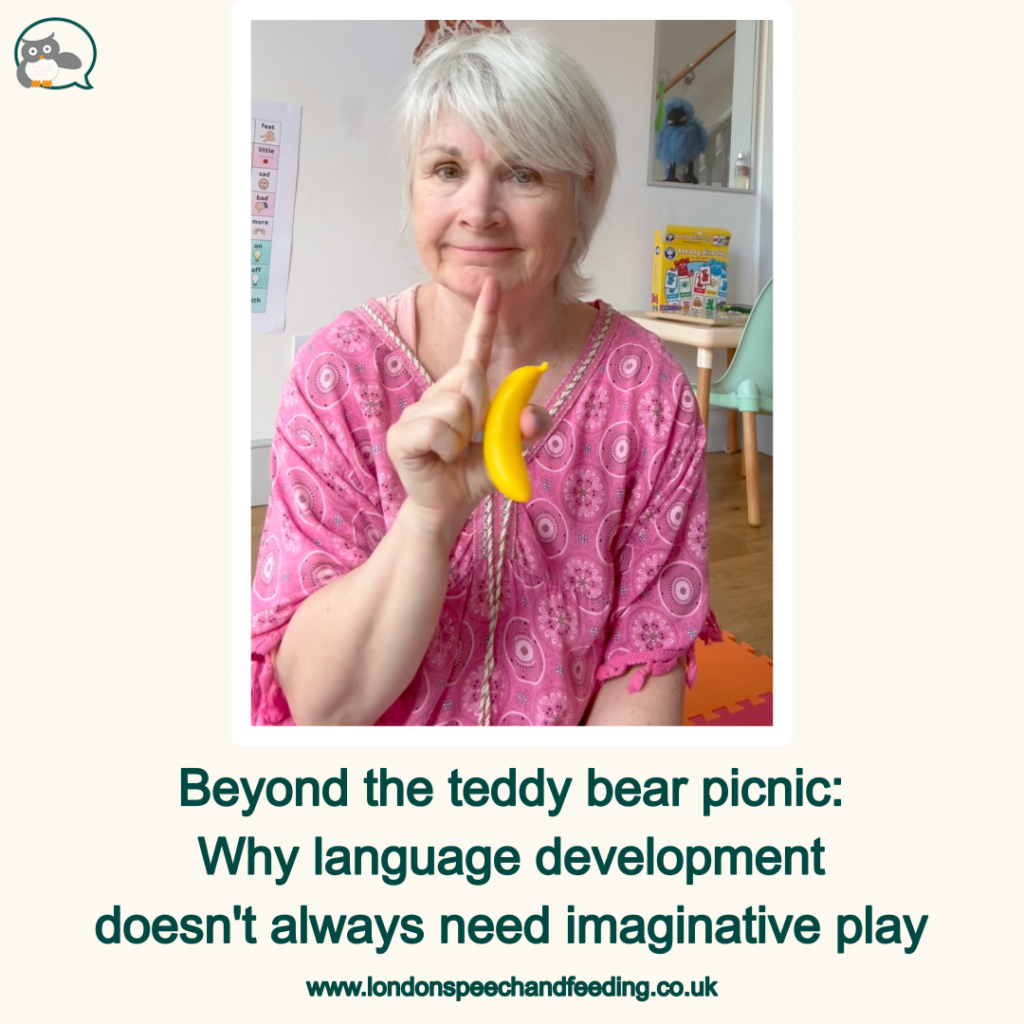
    I hear you think ‘I am stressed!‘. – NO! here it means ‘highlight’. We use our voice to highlight the important words in our sentence or phrase. For example, when you say ‘this banana is so yummy’ you can stress the word ‘yummy’ by saying it a bit louder and you can make a gesture, like rubbing your tummy as you say it.

    3. The third one is GO SLOW

    This means to speak a bit slower than you normally would and add pauses. By slowing down the pace of our speaking we give our child time to think and understand what we are saying. When we allow for pauses after we have spoken, we are inviting our child to say something in response.

    4. The last one is SHOW

    Always remember to show actions, gestures, objects, and point to pictures while speaking to help support your child’s understanding. We can show our child what words mean by pointing to things or holding up objects whilst describing or talking about them.

    At this point I would also like to recommend the use of Core Boards, and particularly Electronic AAC devices, such as LAMP Words for Life or PODD. I have written about this in other blogs but can always be persuaded to say a bit more on the matter… 😊 It is such a big help to have an AAC talker available for both the child and the adult so we can find words and pictures to help support the words we are saying.

    For example, today when reading a book like The Hungry Caterpillar (so good!) I used my LAMP AAC talker to make comments as we were looking at the pages together with my student. Example: ‘Look! He is eating more cake he is very hungry’ using my AAC talker I was able to supplement my speech and at the same time I was inviting my minimally speaking child to press a button or two and reply with ‘cake!’ which they would not have said with their mouth otherwise.

    5. It does say ‘4 S’ but really it should be ‘5’ except the fifth is not an ‘S’

    The fifth is REPEAT.

    Repeat words and phrases often throughout the day. When learning a language we all need to hear words and phrases several times and in different situations before we can understand, remember, and then eventually use them. Our children are ‘new language learners’ and so we can apply the same principles that we would when learning a new foreign language ourselves.

    Any questions or need help with supporting your little one’s language please contact me via my contact form, or you could also check out www.hanen.org for advice and lots of inspiration.

    Sonja McGeachie

    Early Intervention Speech and Language Therapist

    Feeding and Dysphagia (Swallowing) Specialist The London Speech and Feeding Practice

    The London Speech and Feeding Practice


    Find a speech and language therapist for your child in London. Are you concerned about your child’s speech, feeding or communication skills and don’t know where to turn? Please contact me and we can discuss how I can help you or visit my services page.

    1