Why auditory memory matters (especially for little ones!)

| |
Why auditory memory matters (especially for little ones!)

Have you ever stopped to think about how we learn to speak, understand, and communicate effectively? It’s a complex dance of various cognitive skills, and one often overlooked but absolutely crucial player in this orchestra is auditory memory. It’s not just about remembering sounds. It’s about remembering sequences of sounds, which is fundamental to language development.

What exactly is auditory memory?

At its core, auditory memory is our ability to take in, process, store, and recall information that we hear. Think of it as your brain’s internal recording studio. When someone speaks to you, your auditory memory is busy at work, capturing the individual sounds, the order in which they appear, and the rhythm and intonation of the words. This isn’t just for long-term recall; it’s also vital for working auditory memory, which allows us to hold onto a small amount of auditory information for a short period, just long enough to make sense of it.

For speech and language, auditory memory is essential for:

  • Understanding spoken language: To comprehend a sentence, we need to remember the beginning of the sentence by the time we hear the end.
  • Following instructions: Remembering a sequence of commands relies heavily on auditory memory.
  • Learning new words: We hear a word, remember its sound, and connect it to its meaning.
  • Developing phonological awareness: This is the ability to recognise and manipulate the sounds in spoken language, a critical precursor to reading. Auditory memory helps children distinguish between similar-sounding words (e.g., ‘cat’ vs. ‘bat’) and segment words into individual sounds.
  • Producing clear speech: To articulate words correctly, we need to recall the precise sequence of sounds that make up that word.
  • Developing conversational skills: Remembering what was just said helps us formulate appropriate responses.

When auditory memory falls short: The impact on speech

When auditory memory is poor, particularly in young children, the ripple effects on speech and language development can be significant. Children might struggle with:

  • Following multi-step directions: ‘Put on your shoes, get your coat, and meet me at the door’ can become an overwhelming jumble of sounds.
  • Learning new vocabulary: They might hear a new word repeatedly but struggle to retain its sound pattern, making it difficult to recognise or use later.
  • Understanding stories or conversations: Missing key details or losing the thread of a narrative because they can’t hold enough information in their working memory.
  • Developing phonological skills: Difficulty with rhyming, identifying initial sounds in words, or blending sounds together to form words, which can impact early literacy.
  • Speech production: They might mispronounce words, omit sounds, or struggle with the correct sequencing of sounds within words.
  • Social communication: Difficulty participating in group discussions, remembering names, or recalling what their peers have said.
  • Academic performance: Auditory memory challenges can impact a child’s ability to learn in a classroom setting, where much of the instruction is delivered verbally.

It’s important to note that poor auditory memory isn’t a sign of low intelligence, but rather a specific processing challenge that can be addressed with targeted support.

Nurturing auditory memory in under 5s: Preparing for schooling

The good news is that auditory memory is a skill that can be strengthened and developed, especially during the crucial early years. For children under five, laying a strong foundation in auditory memory is an invaluable gift as they prepare for the demands of formal schooling. Here’s what we can do to help:

  1. Read aloud regularly: This is perhaps one of the most powerful tools. As you read, encourage your child to listen for specific words, predict what happens next, and retell parts of the story. Vary your voice, use different intonations, and pause to emphasise key words.
  2. Play auditory memory games:
    • ‘Simon says’: This classic game is fantastic for following multi-step instructions. Start with one command and gradually increase the number.
    • ‘I Spy’ with sounds: Instead of colours, describe sounds. ‘I spy with my little ear something that goes “moo”.’
    • Rhyming games: Sing rhyming songs, read rhyming books, and encourage your child to come up with words that rhyme.
    • Sound matching: Use everyday objects to make sounds (e.g., shaking keys, tapping a spoon) and have your child identify or match them.
    • ‘Memory chain’: Start a sentence and have your child add to it, remembering everything that came before: ‘I went to the market and bought an apple.’ ‘I went to the market and bought an apple and a banana.’
  3. Sing songs and nursery rhymes: Repetitive songs and nursery rhymes are excellent for developing auditory memory, rhythm, and phonological awareness. The predictable patterns help children anticipate and remember sequences of sounds and words.
  4. Give multi-step instructions (and praise!): Start with two-step instructions and gradually increase the complexity as your child’s skills improve. Always give positive reinforcement when they succeed. ‘Please pick up the red block and put it in the box.’
  5. Engage in active listening: Model good listening skills yourself. When your child is speaking, give them your full attention. Ask clarifying questions to encourage them to elaborate and organise their thoughts.
  6. Reduce background noise: A quiet environment makes it easier for young children to focus on auditory information. Minimise distractions like TV or loud music during activities that require listening.
  7. Use visual cues: While we’re focusing on auditory memory, sometimes pairing auditory information with visual cues can be helpful, especially initially. For example, when giving instructions, demonstrate the action as you say it.
  8. Be patient and consistent: Developing auditory memory takes time and consistent practice. Celebrate small victories and create a playful, supportive environment for learning.

By actively engaging in these strategies, we can empower our youngest learners to build robust auditory memory skills, setting them up for success not only in speech and language development but also in their overall academic journey. It’s an investment that truly pays dividends in their future communication and learning abilities.

Any comments or if you need help and support with your child’s speech please do not hesitate to get in touch with me: simply fill out the contact form here on the website. I endeavour to reply within 48 hours.

Sonja McGeachie

Highly Specialist Speech and Language Therapist

Owner of The London Speech and Feeding Practice.


Health Professions Council registered
Royal College of Speech & Language Therapists Member
Member of ASLTIP

Find a speech and language therapist for your child in London. Are you concerned about your child’s speech, feeding or communication skills and don’t know where to turn? Please contact me and we can discuss how I can help you or visit my services page.

1

Similar Posts

  • Why I love ‘Colourful Semantics’ in speech therapy

    One of the most common concerns parents bring to speech and language therapy is:
    ‘My child understands so much… but they struggle to put sentences together’.

    Some children use only single words.
    Others miss out key parts of sentences.
    Some mix up word order.
    Others find it difficult to answer questions or explain their ideas clearly.

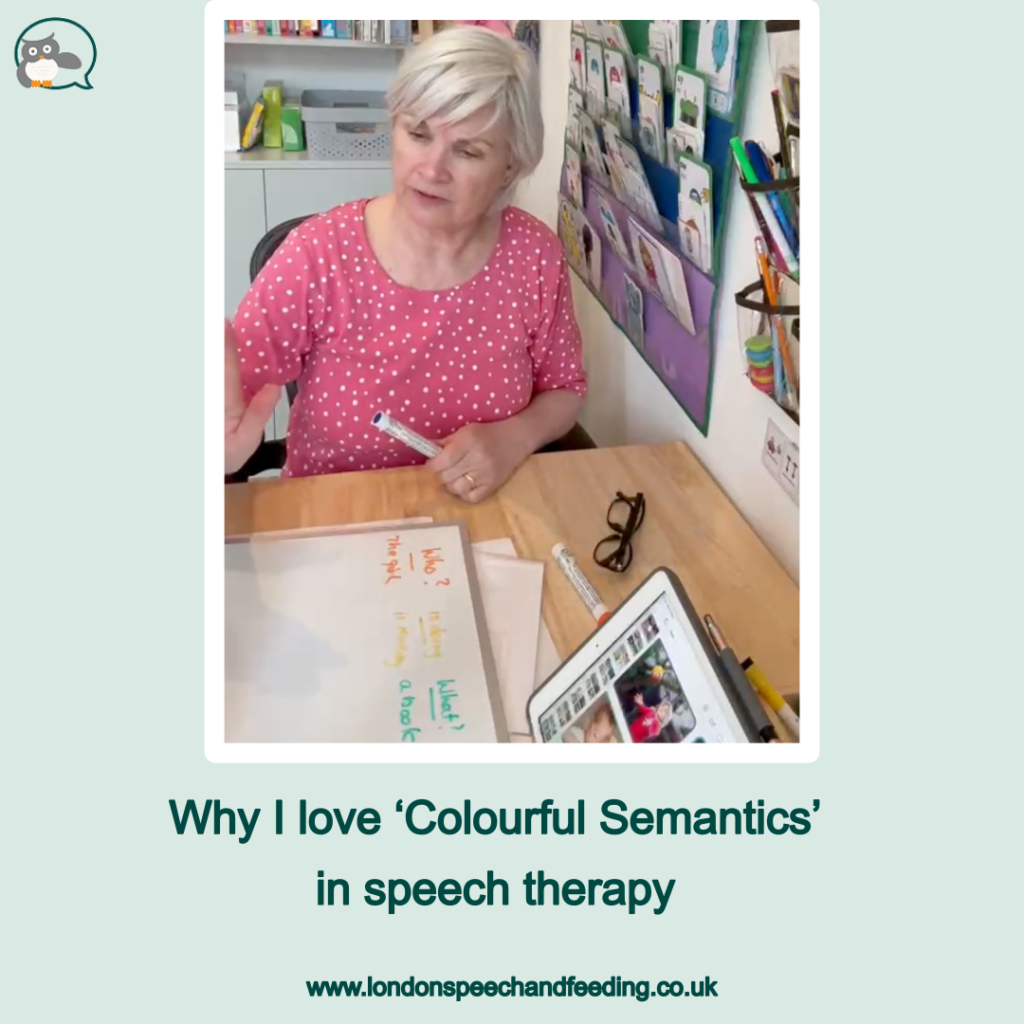
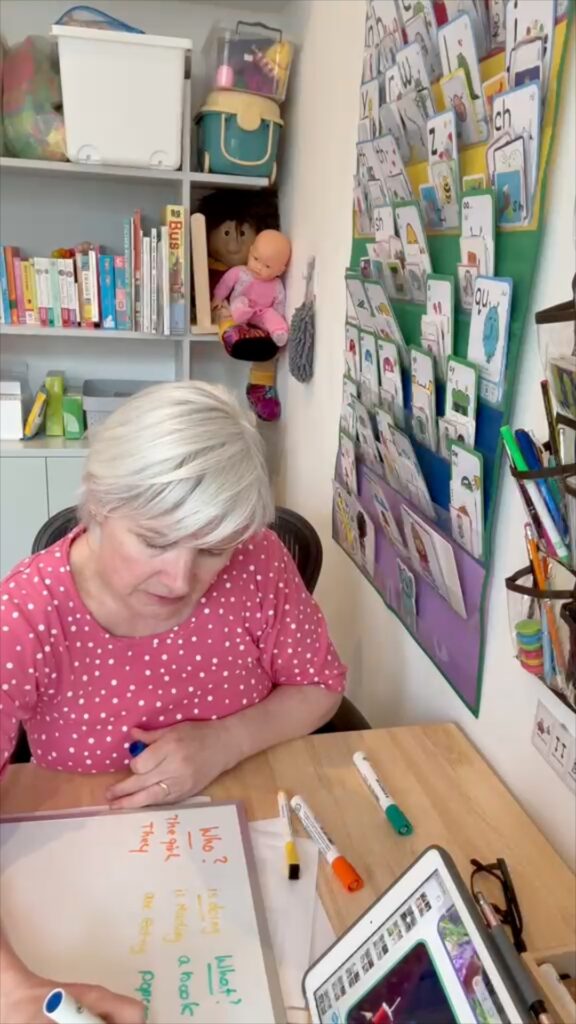
    This is where one of my favourite therapy approaches can be incredibly powerful: Colourful Semantics.

    Colourful Semantics is a highly effective and evidence-informed way of supporting children to build stronger sentence structure, grammar, understanding, and expressive language skills.

    It is a visual approach to language development originally created by a UK Speech and Language Therapist, Alyson Bryan in 1997 to help children understand how sentences are organised.

    Different parts of a sentence are represented by different colours.

    For example:

    • Who? is orange.
    • What doing? is yellow.
    • What? is green.
    • Where? is blue.

    As children progress more colours are added:

    • To Whom? Is pink.
    • Adjectives (what like) is purple.
    • Time Phrase is brown.

    Using colours gives children a visual framework for building sentences in a way that feels structured, predictable, and achievable.

    Instead of language feeling abstract and overwhelming, children can see how sentences fit together.

    For many children, this is massively helpful as it gives structure and predictability.

    Why some children struggle with sentences

    Language development is incredibly complex.

    To build a sentence, we need to:

    • think of vocabulary
    • organise grammar
    • sequence words
    • understand meaning
    • remember sentence structure
    • physically say the words clearly enough to communicate

    That is a huge amount happening all at once.

    Some children may:

    • leave out verbs
    • miss pronouns
    • use immature grammar
    • struggle with word order
    • rely on very short phrases
    • find it difficult to expand beyond single words.

    For example:

    • ‘Boy jump’
    • ‘Him eating’
    • ‘Dog there’
    • ‘Want juice’.

    These children often know more than they can express.

    Colourful Semantics helps bridge that gap.

    Why visual supports matter

    Many children—especially those with language delays, developmental language disorder (DLD), autism, or social communication difficulties—benefit enormously from visual support.

    Visual systems reduce the processing load.

    Instead of relying only on spoken language, children are given an additional way to organise information.

    The colours act almost like ‘anchors’ for language.

    A child may begin to understand:

    • orange = who
    • yellow = action
    • green = object
    • blue = place.

    This makes sentence building more concrete and less overwhelming.

    It also supports children who struggle with:

    • attention
    • auditory memory
    • processing spoken language
    • sequencing
    • confidence using language independently.

    Supporting sentence expansion naturally

    One of the things I love most about Colourful Semantics is how flexible it is.

    It can be used:

    • in play
    • with books
    • during conversation
    • with picture scenes
    • in storytelling
    • during movement activities
    • within everyday routines.

    Therapy does not need to feel rigid or worksheet-heavy.

    Many children who usually avoid talking become much more willing to attempt longer sentences when they feel successful.

    Children often begin to use:

    • verbs more accurately
    • pronouns more consistently
    • better word order
    • improved sentence organisation
    • and more complete ideas.

    For example, instead of:

    • ‘Him running’

    A child may gradually move toward:

    • ‘He is running.’

    The colours help children understand the ‘jobs’ words have within a sentence.

    This is particularly useful for children who need explicit teaching of language structure rather than simply learning through exposure alone.

    Supporting children with speech difficulties too

    One thing I particularly value in therapy is approaches that support multiple communication areas at once.

    Colourful Semantics is excellent for this.

    While building sentences, we can also naturally target:

    • speech sounds
    • intelligibility
    • vocabulary
    • social communication
    • turn-taking
    • attention and listening
    • confidence speaking.

    For example, if a child is working on the /K/ sound, we might intentionally build sentences containing target words:

    • ‘The cat is coming.’
    • ‘The boy is kicking.’
    • ‘The duck is in the box.’

    This allows speech and language goals to work together rather than separately.

    Therapy becomes more functional, meaningful, and engaging.

    Building confidence through success

    One of the biggest barriers many children experience is not simply language difficulty. It is the emotional impact of struggling to communicate.

    Some children become frustrated.
    Others withdraw.
    Some stop attempting longer sentences altogether because communication feels too hard.

    Colourful Semantics can help rebuild confidence because it gives children a clear structure for success. That feeling matters enormously.

    When children feel successful, they participate more.
    They attempt more.
    They communicate more.

    And communication grows through communication.

    Why I use colourful semantics

    There is no single ‘magic’ therapy approach for every child.

    But Colourful Semantics remains one of the most versatile and effective tools I use because it can be adapted so beautifully to individual children.

    It supports:

    • early language
    • grammar
    • sentence structure
    • comprehension
    • expressive language
    • storytelling
    • confidence
    • functional communication.

    Most importantly, it helps children organise language in a way that finally starts to make sense to them.

    And when language starts to make sense, communication can truly begin to flourish.

    Contact me via my contact form if you would like me to work with your child.

    Sonja McGeachie

    Highly Specialist Speech and Language Therapist

    Owner of The London Speech and Feeding Practice.
    Reference

    Bryan A (1997) Colourful semantics. In: Chiat S, Law J, and Marshall J (eds) Language disorders in children and adults: psycholinguistic approaches to therapy. London: Whurr, 143–61.


    Health Professions Council registered
    Royal College of Speech & Language Therapists Member
    Member of ASLTIP

    Find a speech and language therapist for your child in London. Are you concerned about your child’s speech, feeding or communication skills and don’t know where to turn? Please contact me and we can discuss how I can help you or visit my services page.

    3
  • · ·

    Creating your calm: containment strategies for Sensory Processing Difficulties

    The world can be a beautiful and stimulating place, but for individuals with Sensory Processing difficulties (SPD), it can also be overwhelming and even painful. Everyday sights, sounds, smells, touches, and tastes can be amplified to uncomfortable or even unbearable levels. This can lead to anxiety, meltdowns, and a constant feeling of being on edge.

    One important coping mechanism for SPD is containment. Containment strategies are techniques that help individuals manage their sensory experiences and create a sense of calm and safety.

    Understanding containment needs:

    Containment needs vary greatly from person to person. Some individuals might find comfort in deep pressure, while others might crave quiet and solitude.

    Common containment strategies:

    Here are some examples of containment strategies that can be helpful for individuals with SPD:

    • Deep pressure: This can involve activities like wearing weighted vests, using weighted blankets, getting firm hugs, or applying deep pressure massage.
    • Movement: Engaging in rhythmic movements like rocking, swinging, or jumping can be calming for some individuals.
    • Proprioceptive input: Activities that involve proprioception, the sense of body awareness, can be grounding. Examples include yoga, stretching, and proprioceptive toys like chewy necklaces or fidget spinners.
    • Visual calming: Utilising calming visuals like nature scenes, dimmed lights, or fidget toys with visual patterns can provide a sense of peace.
    • Auditory modifications: Noise-blocking headphones, earplugs, or white noise machines can help block out distracting or overwhelming sounds.
    • Oral motor activities: Chewing gum, crunchy snacks, or chewy toys can provide sensory input and help regulate emotions.
    • Sensory bottles: Watching calming visuals move within a liquid-filled bottle can be visually stimulating and promote focus.
    • Creating a safe space: Having a designated quiet area at home or school where individuals can retreat to self-regulate can be invaluable. This space should be free from clutter and overwhelming stimuli and can include calming sensory items.

    Additional tips:

    • Be patient and understanding: It takes time and practice to find what works best for each individual. Be patient with yourself or your child as you explore different strategies.
    • Consistency is key: Once you find effective strategies, use them consistently in different settings to create a sense of predictability and comfort.
    • Communicate openly: Talk to teachers, caregivers, and others about individual needs and how they can support containment strategies.
    • Celebrate progress: No matter how small, acknowledge and celebrate successes in managing sensory experiences.

    Remember:

    Containment is not about suppressing sensory experiences altogether. It’s about creating a sense of control and reducing overwhelming sensations to a manageable level. By exploring different strategies and working with a qualified professional, individuals with SPD can develop the tools they need to navigate the world and experience life to the fullest.

    Do get in touch if you would like some in-person or on-line 1:1 support with this. It can be overwhelming to figure it all out alone.


    Find a speech and language therapist for your child in London. Are you concerned about your child’s speech, feeding or communication skills and don’t know where to turn? Please contact me and we can discuss how I can help you or visit my services page.

    1
  • · · ·

    Seeing sounds: How visual gestures boost speech sound learning

    Learning to produce new speech sounds can be a complex process for young children, especially those facing challenges with speech sound disorders or motor planning difficulties. It’s not just about knowing what a sound ‘should’ sound like; it’s about figuring out where to put your tongue, how to shape your lips, and how much air to push out. This is where the power of visual gestures comes in – literally helping children see how to make sounds.

    As speech and language therapists, we frequently use visual cues and hand gestures to teach articulation. These techniques are incredibly effective, particularly when a child is struggling with the motor planning aspect of speech production.

    In the video clip above you see me teaching

    • the /SH/ sound: the hand makes a C-shape and moves forward showing both how the lips are positioned and the air flowing forward
    • the /S/ sound: the index finger shows a snake like movement going forward- also showing the air flow again
    • the /W/ sound: my right hand moves forward and fingers splay out showing that the lips open up at the end of the sound
    • the /K/ sound: my finger points to the back of my throat where the tongue needs to raise.

    An overview of motor planning for speech – what do we mean by that?

    Think about learning to ride a bike or play a musical instrument. You don’t just know how to do it instantly. You have to plan the movements, practise them, and make adjustments. Speaking is similar! Our brains must:

    1. Plan the sequence of movements needed for each sound and word (e.g., /B/ requires lips together, then release, while /T/ requires the tongue tip behind the top teeth, then release).
    2. Execute those plans rapidly and precisely.

    For some children, especially those with conditions like Childhood Apraxia of Speech (CAS) or other severe articulation disorders, this motor planning process is disrupted. They know what they want to say, but their brain struggles to send the correct, consistent messages to their articulators (lips, tongue, jaw, velum). This can make speech sound learning incredibly frustrating.

    Why use visual gestures?

    Visual gestures provide an additional, powerful sensory input that can help bridge the gap between knowing a sound and producing it. Here’s how and why they are so beneficial:

    1.      Providing a visual map:

    • How it helps: Many speech sounds are ‘hidden’ inside the mouth. It’s hard for a child to see where their tongue needs to go for a /K/ sound (back of the tongue to the roof of the mouth) or a /T/ sound (tongue tip behind teeth). A simple hand gesture can visually represent this mouth movement. For example, a hand gesture for /K/ might involve sweeping the hand back towards the throat, while for /T/, it might be a tap on the chin.
    • Why it works: Children are highly visual learners. Seeing a physical representation of an abstract mouth movement gives them a concrete ‘map’ to follow, making the process less mysterious and more manageable.

    2.      Enhancing motor planning and memory:

    • How it helps: When a child simultaneously moves their hand (the visual gesture) and attempts to make the sound, they are engaging multiple sensory systems (visual, tactile, proprioceptive – body awareness). This multi-sensory input strengthens the neural pathways associated with that speech sound.
    • Why it works: This multi-modal learning helps to solidify the motor plan for the sound in the brain. It’s like having more ‘hooks’ to hang the information on, making the sound easier to recall and produce consistently. The gesture becomes a built-in reminder.

    3.      Reducing cognitive load:

    • How it helps: Instead of just hearing the sound and trying to figure out the complex motor sequence, the child has a visual cue to guide them. This reduces the mental effort required to decode the sound production.
    • Why it works: When cognitive load is lower, the child can focus more effectively on the specific motor execution of the sound, leading to faster progress and less frustration.

    4.      Increasing engagement and success:

    • How it helps: Gestures can make therapy more interactive and fun! When a child successfully produces a sound with the help of a gesture, it’s a tangible victory.
    • Why it works: Success is a powerful motivator. When children experience success, they are more likely to stay engaged, participate actively, and feel more confident in their ability to learn new sounds.

    5.      Supporting self-correction:

    • How it helps: Once a child learns the gesture associated with a sound, he or she can use it as a self-monitoring tool. If he or she makes an error, he or she can use the gesture to remind himself or herself of the correct mouth position or movement.
    • Why it works: This promotes independent learning and reduces reliance on constant adult prompting.

    Conclusion

    The journey of speech development can be challenging, but visual gestures offer a powerful and effective tool for teaching new sounds, especially when motor planning is a factor. By providing a clear visual map, strengthening motor memory, reducing cognitive load, and fostering engagement, these gestures pave the way for clearer communication and greater confidence. If your child is struggling with speech sounds, consider talking to a Speech and Language Therapist to get guidance on how visual gestures might be incorporated into the therapy plan. Because sometimes, seeing truly is believing (and speaking!).

    Sonja McGeachie

    Highly Specialist Speech and Language Therapist

    Owner of The London Speech and Feeding Practice.


    Health Professions Council registered
    Royal College of Speech & Language Therapists Member
    Member of ASLTIP

    Find a speech and language therapist for your child in London. Are you concerned about your child’s speech, feeding or communication skills and don’t know where to turn? Please contact me and we can discuss how I can help you or visit my services page.
    1
  • Speech sound disorders

    Kids Speech Therapist London
    Speech Sound Disorders

    Treatment Approaches – A Typical Session

    There are various great ways to treat speech sound disorders and I use all the approaches available selectively; I decide what works with each individual child and I also vary the approach depending on the child’s frame of mind at any given time during my session.

    Some of the approaches are more “drill-based” and require a child to be able to pay attention and really participate actively in the therapy, and this is what I am showing you today with this video clip.

    My little student here has been working with me for some time and from only saying a handful of words which were not very easy to understand he has come a long way. He does have some features of Verbal Dyspraxia which I shall briefly outline here:

    • Making sounds in general is a struggle, especially when asked to copy certain sounds, example: ‘can you say: a ee ou oo?”
    • Repeating sound sequences or words sequences is hard, for example: “say p-t-k in sequence” or “say fish chips fish chips fish chips
    • When saying the same word again and again, different mistakes can be heard
    • Intonation difficulties: speech sounds monotonous
    • Vocabulary is very limited

    Some therapy approaches are more play based, for example the Core Word method: here we pick a few words at a time which are very significant to the child and therefore highly motivating to try and say. These could be characters of Pokemon or Minecraft for example, or simple words like “GO!”

    When you watch the video you will see that I use a lot of visual prompting, such as showing him where the tongue is moving to or from. I do this with my index finger and this approach is called Tactile Cueing or “Cued Articulation”. Part of the approach is to give a visual prompt and then reduce the prompt as the learner is more able to produce the correct sounds. Once he can produce the sound on its own, we quickly move to the sound within a word.

    I do mix and match my approaches and in fact here I am drilling but I also use the Core Word which for him (YELLOW) — it’s his favourite colour and I happen to have quite a few good games where a YELLOW something or other can be asked for….. WHO KNEW!? 🙂


    Find a speech and language therapist for your child in London. Are you concerned about your child’s speech, feeding or communication skills and don’t know where to turn? Please contact me and we can discuss how I can help you or visit my services page.

  • · ·

    Your child’s communication journey

    Understanding our neurodiversity-affirming, child-led approach

    Welcome to a different kind of therapy!

    Your child’s communication journey

    The start of a new year often brings fresh hope, and sometimes fresh worries, for parents supporting their child’s communication. I am always genuinely excited to begin a new journey with children and their families, and I know that, for many parents, this kind of therapy may look very different from what they were expecting.

    Parents (and children!) are often surprised to discover that our sessions are playful, joyful, and intentionally low-pressure. You won’t see demands for eye contact, sitting still, or being told to ‘do it this way’ or ‘put the red square there’. Instead, you’ll see your child being met exactly where they are.

    For families who have previously experienced more adult-led or behaviour-based approaches including Applied Behaviour Therapy, this difference can feel unfamiliar at first. Because of that, I want to take a moment to prepare you for what child-led, neurodiversity-affirming therapy looks like, so you can feel confident, comfortable, and reassured from day one.

    Why doesn’t child-led therapy look like ‘traditional’ therapy?

    Many people picture speech and language therapy as sitting at a table, using flashcards, or practising words through repetition. While those approaches can work well for some children, they are often not effective or appropriate for many neurodivergent children—including children with autistic profiles, ADHD, or demand-sensitive nervous systems.

    Our approach is grounded in a simple and powerful truth:

    Children learn best when they feel safe, motivated, and emotionally connected.

    When a child’s nervous system feels calm and secure, learning becomes possible. When a child feels pressured or controlled, communication often shuts down, even if they can speak.

    🎯 Our purpose: Communication through connection

    Our goal is not simply to help your child say more words. Our goals go deeper and are built on strong foundations:

    • Trust and regulation: We focus on building a trusting relationship where your child feels safe, understood, and emotionally regulated. A calm nervous system is the starting point for all communication.
    • Motivation: We follow your child’s intrinsic motivation, the things they naturally enjoy to make communication meaningful, joyful, and purposeful.
    • Spontaneous communication: We create opportunities for your child to communicate because they want to, not because they are asked or instructed to.

    🧸 What to expect in a session

    Our sessions are intentionally child-led and often look very much like play.

    FeatureWhat it looks likeWhy we do this
    Minimal toysWe usually offer just 3–4 carefully chosen activities (such as bubbles, blocks, or sensory play).Less is more. Fewer choices reduce overwhelm and help children focus on what genuinely interests them.
    Child choosesYour child decides what to play with and how to engage.This immediately establishes us as a safe, non-demanding partner and increases motivation.
    The therapist’s roleWe join your child’s play, observing closely and responding naturally.We model language, share attention, and reflect your child’s experiences in a way that feels natural and supportive.
    No pressure or demandsThere are no ‘must-do’ tasks. If your child wants to spin, crash, line up toys, or repeat an activity, we follow.Reducing demands lowers anxiety and supports communication, particularly for children with demand-sensitive profiles.

    Is this really effective?

    It’s completely natural to wonder, ‘Are they just playing?’ The answer is yes, and very intentionally so.

    Our sessions are guided by nearly 30 years of speech and language therapy experience, alongside clear, achievable goals tailored to each individual child. Play is a child’s natural language and their most powerful learning tool.

    Within play, we are constantly creating opportunities to:

    • Build joint attention (sharing focus and interest)
    • Model language at the right level
    • Encourage back-and-forth communication
    • Develop a deep, authentic connection

    If your child has struggled to engage or communicate in more structured or demand-heavy settings, this child-led approach is often the key to unlocking their potential.

    💛 What this might look like at home

    You may notice that when pressure is reduced:

    • Your child begins communicating more during everyday routines
    • Language emerges through play, movement, or shared enjoyment
    • Communication feels more natural and less forced

    Small moments could be a shared smile, a look, a sound, a gesture. All matter. These are the building blocks of meaningful communication.

    📚 Resources for parents

    If you’d like to explore these ideas further, you may find the following helpful:

    I look forward to meeting you and your child. Please bring any questions, uncertainties, or curiosities to our first session, there is no such thing as a silly question. This is a journey we take together. Contact me via my contact form.

    Sonja McGeachie

    Highly Specialist Speech and Language Therapist

    Owner of The London Speech and Feeding Practice.


    Health Professions Council registered
    Royal College of Speech & Language Therapists Member
    Member of ASLTIP

    Find a speech and language therapist for your child in London. Are you concerned about your child’s speech, feeding or communication skills and don’t know where to turn? Please contact me and we can discuss how I can help you or visit my services page.

    3
  • ·

    Why Imitation is so Important

    Target Activities and Games For Kids

    Why imitation is so important and how can speech and language therapy help children who struggle to imitate?

    Imitation or copying starts in early infancy. When we observe a young baby and his parent or familiar adult we can see clearly and frequently that the baby will be intently looking at adult’s face and try to copy their facial expressions, smiles and all those funny baby sounds we often make with young babies.

    These sounds are called “motherese” and are the beginnings of a little conversation between the parent and the baby. The “conversation can go back and forth for a long time and include sounds, as well as facial expressions.

    A little later on, once the baby can crawl and sit up unaided the copying then goes on to include toys and objects. Mum or Dad will show their toddler how to use a drum or how to put a little train on the wooden tracks and the toddler will try and copy this. They may not succeed and be a little clumsy perhaps but the act of copying anything and everything their favourite adult does is typically seen throughout the day.

    We all know and have laughed at mums or dads saying; ssshhh don’t say that in front of the baby he/she will copy you, watch your mouth! (as dad is swearing at the broken radiator….)

    This imitation goes on for years and includes eventually of course little words, more words, putting words together and then creating sentences, all the while our toddler is listening to how their adults speak, not only what they say but how they say it. This is how dialects and accents can be transmitted easily from parent /family to child.

    Copying in Children with Autism

    We know that children with autism often struggle to imitate. We see children on the spectrum typically having great difficulty to copy adults or children; this can be seen in very reduced play with their peers in nursery for example.

    Children with autism tend to have reduced joint attention and engagement with others and need to develop the ability and awareness to copy others in order to then engage more jointly with others.

    Speech and Language Therapy can help with Parent Child Interaction work and Coaching, here is how:

    During my coaching work with parents I teach step by step how to help a child who struggles to imitate:

    We look at all the researched skills and actions that adults can take to help their little one to copy, starting with close observation of their child’s interests, then following and including their child’s play and copying/imitating their child in how they play. I teach steps in a graduated way so that it is easy to see the progress and joyful to have the results at the end.

    The results are clear to see over time: our children on the spectrum learn to imitate actions, with objects and gestures, then sounds and words. Alongside this increased imitation skill the child can then develop more joint attention and engagement.

    I would always recommend Parent Child Interaction Training as a first port of call as we learn so many great techniques which are well researched by the Hanen Programme, www.hanen.org. Do drop me a line if you would like to find out more.


    Find a speech and language therapist for your child in London. Are you concerned about your child’s speech, feeding or communication skills and don’t know where to turn? Please contact me and we can discuss how I can help you or visit my services page.

Leave a Reply

Your email address will not be published. Required fields are marked *