Feeding Specialist

  • ·

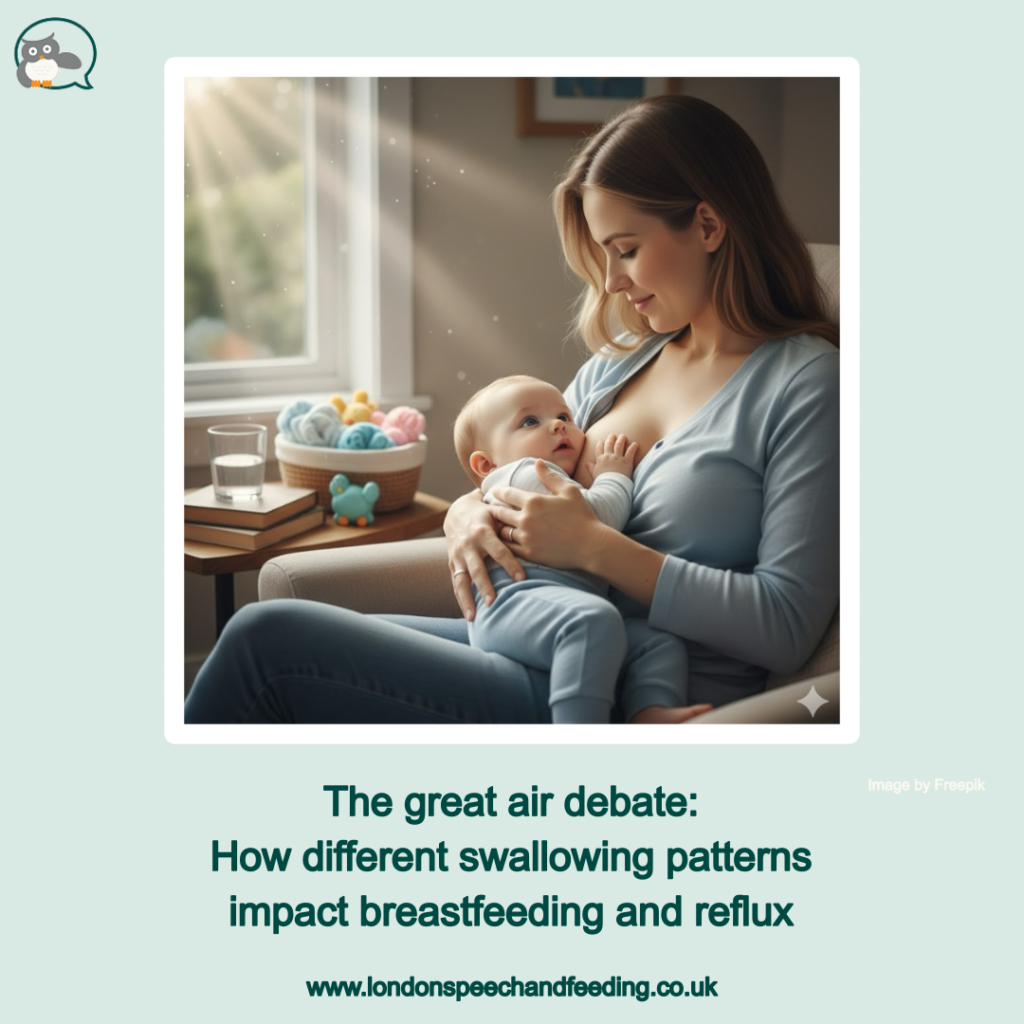
    The great air debate: How different swallowing patterns impact breastfeeding and reflux

    The great air debate

    As a Speech and Language Therapist specialising in infant feeding, I often hear from worried mums describing their breastfed baby’s fussiness. ‘My baby is so burpy and gassy,’ ‘might it be reflux?’ or ‘she just seems uncomfortable after every feed’. While these concerns are incredibly valid and distressing for both baby and mum (and dads!), the underlying cause isn’t always what you might think. Often, the culprit isn’t primarily a digestive issue, but rather a mechanical one: how effectively your baby is managing air during feeding.

    Many parents are told their baby has ‘colic’ or ‘reflux’ and are offered solutions that don’t quite hit the mark because they overlook a fundamental aspect of feeding: the suck-swallow-breathe sequence. Understanding this intricate dance can be the key to unlocking a calmer, happier feeding experience for your baby and you.

    Understanding the suck-swallow-breathe sequence

    Your baby’s mouth, tongue, jaw, and throat muscles work together in a precise rhythm like a beautifully orchestrated symphony. First your baby draws milk, then swallows it, and then takes a breath, all without interruption. This is the ideal suck-swallow-breathe (SSB) sequence.

    When the SSB sequence functions optimally, a baby latches deeply, creates good suction, draws milk, swallows efficiently, and then pauses just long enough to take a gentle breath before the next suck. This smooth, coordinated process minimises the amount of air swallowed.

    However, for various reasons (it could be a shallow latch, oral motor challenges, an uncoordinated suck, or even an overly fast milk flow) this sequence can get a bit out of sync. Instead of a smooth rhythm, you might see:

    • Suck-suck-swallow-gasp!: Too much air pulled in with the swallow.
    • Rapid, shallow sucking followed by gulping: Inefficient milk transfer and air intake.
    • Clicking noises during feeding: Loss of suction, indicating air entry.
    • Frequent detaching and re-latching: Often to ‘catch a breath’ or because of discomfort.

    Each of these patterns can lead to increased air intake.

    The root cause: Air trapping leading to a gassy breastfed baby

    When a baby swallows too much air during a feed, that air must go somewhere. It builds up in the stomach, causing bloating, discomfort, and often leads to the familiar reflux-like symptoms parents describe: arching, spitting up, burping excessively, or simply appearing distressed.

    It’s a common misconception that all gassiness or reflux symptoms in a breastfed baby are due to something in the mother’s diet or a genuine digestive disorder. While these can be factors, as an SLT, we first look at the mechanics of the feed. If a baby is constantly struggling to maintain a seal, sucking inefficiently, or having to gulp to keep up with flow, he or she is inevitably swallowing air. This air then creates pressure, which can push milk back up (silent reflux) or out (visible reflux).

    Think of it like trying to drink through a straw with a hole in it. You’re sucking, but you’re also pulling in air, making it harder to get the liquid and leaving you with more bubbles in your stomach.

    Why mechanical speech therapy assessment is key

    This is where the distinction between a medical diagnosis (true gastro oesophageal reflux disease or GORD) and a functional feeding challenge becomes critical. A paediatrician will assess for medical causes and may prescribe medication to reduce stomach acid. This can be appropriate for severe cases of GORD.

    However, if the primary issue is air being trapped due to a suboptimal suck-swallow pattern, medication only treats the symptom (acid burning) and not the root cause (air intake). This is precisely where a Speech and Language Therapist specialising in infant feeding comes in.

    My role is to meticulously observe and assess your baby’s oral motor skills, latch, tongue function, and the efficiency of their SSB sequence. I look for subtle signs of inefficiency that contribute to excessive air swallowing.

    • Is the tongue elevating correctly to create suction?
    • Is the jaw stable, or is it excessively moving?
    • Is the latch deep enough to prevent air leaks?
    • Can the baby coordinate suck, swallow, and breathe without gasping?

    By identifying these mechanical challenges, I can then implement targeted strategies to improve feeding efficiency and reduce air intake, often leading to a significant reduction in reflux-like symptoms and overall discomfort.

    Strategies to optimise air management during breastfeeding

    The good news is that many babies can learn to feed more efficiently with the right support. Here are some general strategies we might explore:

    1. Optimise latch and position: A deep, asymmetric latch is crucial. Experiment with different positions that allow for a deeper latch and better head/neck alignment, such as laid-back feeding or upright positions.
    2. Paced feeding (even at the breast): If your milk flow is very fast, consider removing your baby from the breast briefly if you hear excessive gulping or see him or her struggling to breathe. This allows him or her to catch up and manage the flow.
    3. Support the jaw and cheeks: Sometimes, gentle support to the baby’s jaw or cheeks can help them maintain a more stable, efficient suck. I can demonstrate specific techniques for this.
    4. Burping effectively: While burping won’t get rid of all swallowed air, upright burping positions and gentle back rubs can help release some of it.
    5. Pre-feed oral preparation: Gentle oral massage or stretches before a feed can sometimes ‘wake up’ the oral muscles and improve coordination.

    Addressing the ‘Great Air Debate’ isn’t about blaming anyone; it’s about empowering parents with a deeper understanding of their baby’s feeding mechanics. By focusing on the how, not just the what, we can often resolve persistent feeding challenges, reduce discomfort, and make breastfeeding a more joyful, peaceful experience for both you and your little one.

    If you suspect your baby’s gassiness or reflux symptoms are related to how they are managing air during feeds, don’t hesitate to reach out for a specialist assessment.

    Sonja McGeachie

    Highly Specialist Speech and Language Therapist

    Owner of The London Speech and Feeding Practice.


    Health Professions Council registered
    Royal College of Speech & Language Therapists Member
    Member of ASLTIP

    Find a speech and language therapist for your child in London. Are you concerned about your child’s speech, feeding or communication skills and don’t know where to turn? Please contact me and we can discuss how I can help you or visit my services page.

    2
  • · ·

    Baby-led weaning: Empowering little eaters from the start

    I had a mum ask me about Baby Led Weaning the other day. So I thought I would write a blog on all the useful questions she had and what we discussed as it may help lots of mums and dads out there.

    As a Paediatric Feeding SLT, one of the exciting developments in recent years is the growing interest in baby-led weaning (BLW). This approach to introducing solids has gained significant traction, and for good reason. It empowers infants to take the lead in their feeding journey, fostering a positive relationship with food and supporting important developmental milestones.

    What exactly is baby-led weaning?

    At its core, baby-led weaning is about offering your baby appropriately sized and textured solid foods from the very beginning, allowing him or her to self-feed. Instead of spoon-feeding purées, you present whole, soft foods that your baby can grasp, bring to his or her mouth, and explore at his or her own pace. This means no mashing, no blending, and no forcing spoons into reluctant mouths. It’s a fun, messy, and intuitive process that is led by your baby’s natural instincts.

    The genesis of baby-led weaning

    ‘Baby-led weaning’ was popularised by British health visitor Gill Rapley. In the early 2000s, Rapley observed that babies naturally develop the skills needed to self-feed and that traditional spoon-feeding might actually hinder this development. Her work, particularly her book Baby-Led Weaning: The Essential Guide to Introducing Solid Foods (co-authored with Tracey Murkett), published in 2008, brought BLW into the mainstream and provided a structured framework for parents. Her research and observations highlighted the benefits of trusting a baby’s innate ability to regulate his or her intake and explore different textures.

    What’s the deal?

    Implementing BLW is simpler than you might think, though it does require a shift in mindset. Here’s a breakdown of what it typically involves:

    • Readiness is key: The golden rule of BLW is to wait until your baby shows clear signs of readiness. This isn’t about age alone, but rather developmental milestones. Your baby should be at least six months old, able to sit unassisted, have good head and neck control, show an interest in food (e.g., reaching for yours), and have lost his or her tongue-thrust reflex (which pushes solids out of his or her mouth).
    • Offer finger foods: Start with soft, easily graspable foods cut into finger-sized sticks or spears. Think cooked sweet potato fries, steamed broccoli florets (soft enough to mash with gentle pressure), banana sticks, or avocado slices. The goal is for babies to be able to pick it up and get some into their mouth.
    • Embrace the mess: BLW is inherently messy, especially in the beginning. Food will be squished, dropped, and smeared. This is a crucial part of the learning process as babies explore textures, smells, and the properties of food. A wipeable mat under the highchair and a good bib are your best friends!
    • Observe, don’t interfere: Allow your baby to lead. He or she will decide what to eat, how much, and how quickly. Avoid putting food into his or her mouth or pressuring him or her to eat more. This respects his or her hunger and fullness cues, laying the foundation for healthy eating habits.
    • Continue breastmilk or formula: Until your baby is well-established on solids, breastmilk or formula remains his or her primary source of nutrition. Solids are for exploration, taste, and developing skills, gradually increasing in quantity over time.

    The benefits of baby-led weaning

    The advantages of BLW extend far beyond simply getting food into your baby. From a speech and feeding perspective, the benefits are compelling:

    • Develops oral motor skills: Chewing, gnawing, and manipulating various food textures are crucial for developing the muscles in the mouth, jaw, and tongue. This strengthens the oral motor skills necessary for speech development.
    • Enhances fine motor skills and hand-eye coordination: The act of grasping food, bringing it to the mouth, and coordinating these movements significantly refines fine motor skills and hand-eye coordination.
    • Promotes self-regulation and intuitive eating: By allowing babies to control their intake, BLW helps them tune into their own hunger and fullness cues, fostering a healthy relationship with food and reducing the likelihood of overeating.
    • Encourages adventurous eating: Exposure to a wide variety of tastes and textures from the outset can lead to less picky eating later. Babies are more likely to accept new foods when they have been in control of their exploration.
    • Facilitates family mealtimes: BLW integrates babies into family mealtimes from an early age, promoting social interaction and making mealtime a shared, enjoyable experience.

    When is baby-led weaning appropriate, and when not?

    While BLW offers numerous benefits, it’s not a one-size-fits-all approach.

    When BLW is appropriate:

    • When your baby meets all the developmental readiness signs: This is paramount for safety and success.
    • When you are comfortable with the mess and the learning curve: It requires patience and a relaxed attitude.
    • When you are committed to offering a variety of safe, appropriate foods.
    • When you are willing to learn about and practise safe food preparation to minimise choking hazards.

    When BLW might not be appropriate (or requires extra caution and professional guidance):

    • If your baby has a history of prematurity or significant developmental delays: His or her oral motor skills might not be sufficiently developed.
    • If your baby has certain medical conditions or anatomical differences (e.g., cleft palate, severe reflux, swallowing difficulties): These may necessitate a modified approach to feeding.
    • If there are significant feeding difficulties, aversion, or a history of choking incidents.
    • If you feel overly anxious about choking: While BLW, when done correctly, is not associated with a higher choking risk than traditional weaning, parental anxiety can impact the feeding experience. Education and consultation with a professional can help alleviate these concerns.

    A note on safety: Choking hazards

    It’s crucial to understand the difference between gagging and choking. Gagging is a natural reflex that helps prevent choking and is very common in BLW as babies learn to manage food in their mouths. Choking is silent and serious. To minimise choking risks:

    • Always supervise your baby closely during mealtimes.
    • Offer appropriately sized and textured foods. Avoid small, round, hard foods like whole grapes, nuts, popcorn, and large chunks of meat.
    • Ensure your baby is sitting upright and calm.
    • Educate yourself on infant CPR.

    Final thoughts

    Baby-led weaning is a wonderfully empowering approach that celebrates a baby’s natural abilities and fosters a positive and independent relationship with food. As Speech and Language Therapists we often see the positive impact it has on oral motor development, self-regulation, and overall feeding confidence. By understanding what it entails, when it’s appropriate, and prioritising safety, you can embark on this exciting journey with your little one, helping him or her become a confident and capable eater from the very first bite.

    If you would like help and support with weaning your baby whilst continuing to breastfeed then please get in touch!

    Sonja McGeachie

    Highly Specialist Speech and Language Therapist

    Owner of The London Speech and Feeding Practice.


    Health Professions Council registered
    Royal College of Speech & Language Therapists Member
    Member of ASLTIP

    Find a speech and language therapist for your child in London. Are you concerned about your child’s speech, feeding or communication skills and don’t know where to turn? Please contact me and we can discuss how I can help you or visit my services page.

    1