Speech Impediment

  • Submucous cleft palate: What is it and how does it impact on speech?
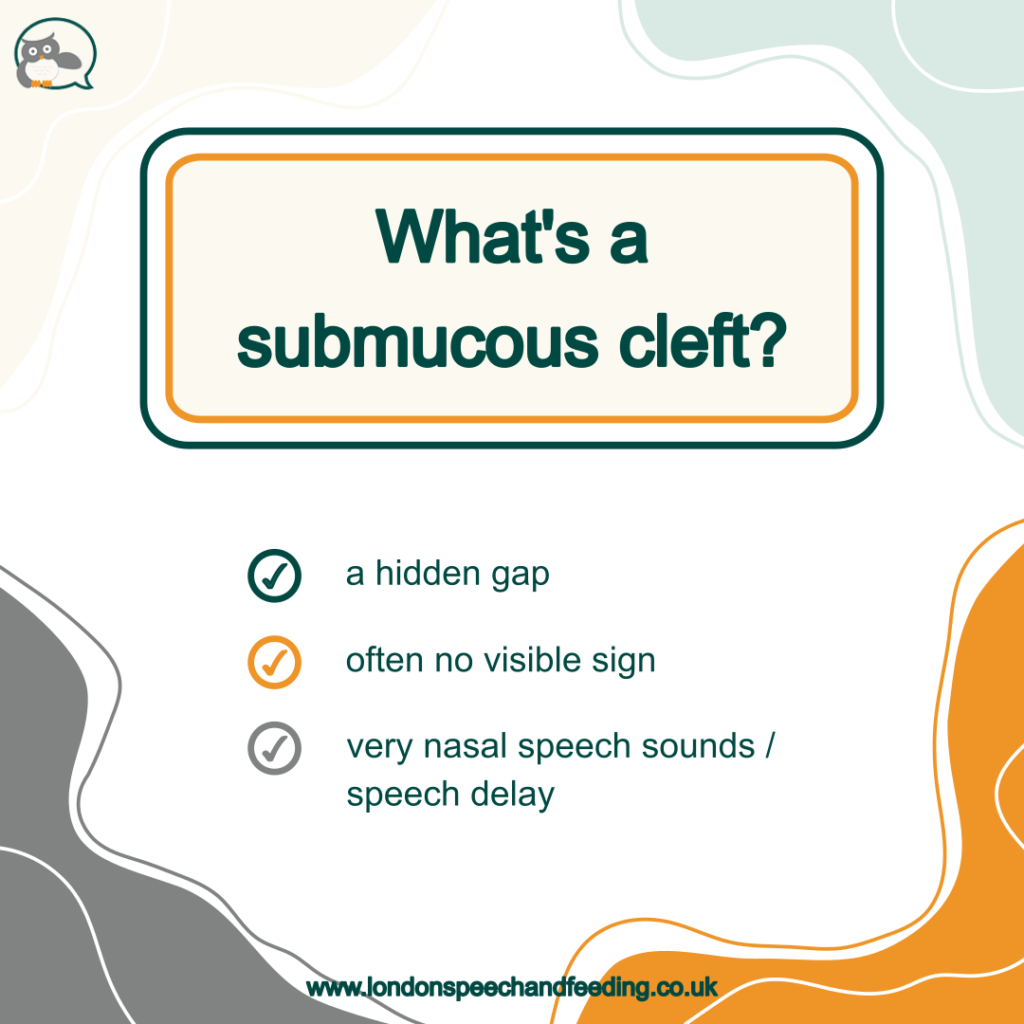
    Submucous cleft palate: What is it and how does it impact on speech?

    What exactly is a submucous cleft palate?

    A submucous cleft palate (SMCP) is much less obvious than its counterparts, cleft of lip and/or palate, and can profoundly impact a child’s speech development. It leads to often extreme hyper nasal speech and difficulty with producing many sounds (/K/ /G/ /T/ /D/ /P/ /B/ /S/ /Z/ /F/ /V/).

    In short, the muscles and bone of the soft palate, and sometimes the hard palate, do not fuse completely during foetal development and the mucous membrane that lines the roof of the mouth remains intact, effectively camouflaging the underlying muscular and bony deficit.

    So, while the surface of the palate appears normal, the essential muscle and functions responsible for sealing off the nasal cavity from the oral cavity during speech are compromised. This cleft (or lack of muscle) can be seen as a bluish midline discoloration of the soft palate, often a bifid (split) uvula, and at times a notch in the posterior border of the hard palate can be felt upon palpation. However, these signs aren’t always present or easily discernible, contributing to the difficulty arriving at a diagnosis.

    Diagnosing a submucous cleft palate is often akin to searching for a needle in a haystack, especially for the untrained eye. Unlike overt clefts that are visually apparent at birth, an SMCP can go undiagnosed for years, sometimes well into childhood or even adolescence. Paediatricians and even ENT surgeons have been known to miss it during routine checks due to the intact mucosal lining. Parents might notice their child’s speech sounds ‘different’ or ‘nasal’ but struggle to pinpoint the cause. Children might undergo extensive speech therapy without a proper diagnosis, as the underlying structural issue continues to hinder progress.

    My experience as a speech therapist in private practice:

    Over my years of practice, I have encountered several children presenting with persistent hyper-nasal speech and significant difficulties producing plosive and fricative sounds.

    It has been incredibly rewarding, though at times challenging, to successfully diagnose SMCP in a number of these children. My approach often involves:

    • a meticulous oral motor examination,
    • careful listening for the specific qualities of hypernasality,
    • and a deep understanding of the physiological requirements for clear speech sound production.

    When I suspect an SMCP, I refer these children to Great Ormond Street Hospital where a fantastic multidisciplinary team, typically including ENT surgeons and a specialist speech-language therapist can conduct more definitive assessments. These assessments often involve instrumental analyses such as videofluoroscopy or nasoendoscopy, which provide objective measures of velopharyngeal function and visual confirmation of the anatomical deficit.

    The path to resolution: surgery, therapy, and successful outcomes

    Surgery

    The journey for these children, once diagnosed, often involves surgical intervention. It’s not uncommon for children with SMCP to undergo multiple operations to achieve optimal velopharyngeal closure. These procedures aim to reconstruct or augment the velopharyngeal mechanism, enabling it to effectively separate the oral and nasal cavities during speech. The specific surgical approach depends on the individual child’s anatomy and the severity of the velopharyngeal insufficiency. It’s a testament to the skill of these specialised surgeons that such intricate repairs can be performed with remarkable success.

    Speech therapy

    Following surgery these children embark on the crucial phase of speech therapy. While surgery addresses the structural problem, speech therapy helps a child learn to utilise their newly improved anatomy. It involves intensive work on developing oral airflow, establishing correct articulatory placement, and reducing learned compensatory strategies that have developed due to the original structural deficit. It is immensely gratifying to witness the transformation. Children who once struggled to produce basic sounds, whose speech was difficult to understand, gradually develop clear speech.

    Next steps?

    If you’re a parent concerned about your child’s speech and feeding, you’re not alone. The journey can feel confusing, but professional guidance can make all the difference. Never hesitate to have a second opinion when you have that niggling feeling that there is something that has not yet been explored. At London Speech and Feeding I specialise in being thorough and thinking outside the box.

    I am here to provide the support you need. Reach out to schedule a consultation and take the first step towards helping your child communicate and thrive.

    Sonja McGeachie

    Highly Specialist Speech and Language Therapist

    Owner of The London Speech and Feeding Practice.


    Health Professions Council registered
    Royal College of Speech & Language Therapists Member
    Member of ASLTIP

    Find a speech and language therapist for your child in London. Are you concerned about your child’s speech, feeding or communication skills and don’t know where to turn? Please contact me and we can discuss how I can help you or visit my services page.

    1
  • · ·

    Conquering the ‘slushy’ /S/: Your guide to treating lateral lisps

    Conquering the ‘slushy’ /S/: Your guide to treating lateral lisps

    As a speech therapist, few things are as rewarding as helping a child find their clear, confident voice. Among the various speech sound disorders, the ‘lateral lisp’ – often described as a ‘slushy’ or ‘wet’ /S/ sound – presents a unique challenge. While it can be tricky to treat, I’m thrilled to share that I’ve had significant success in helping children overcome this particular hurdle.

    What is a lateral lisp?

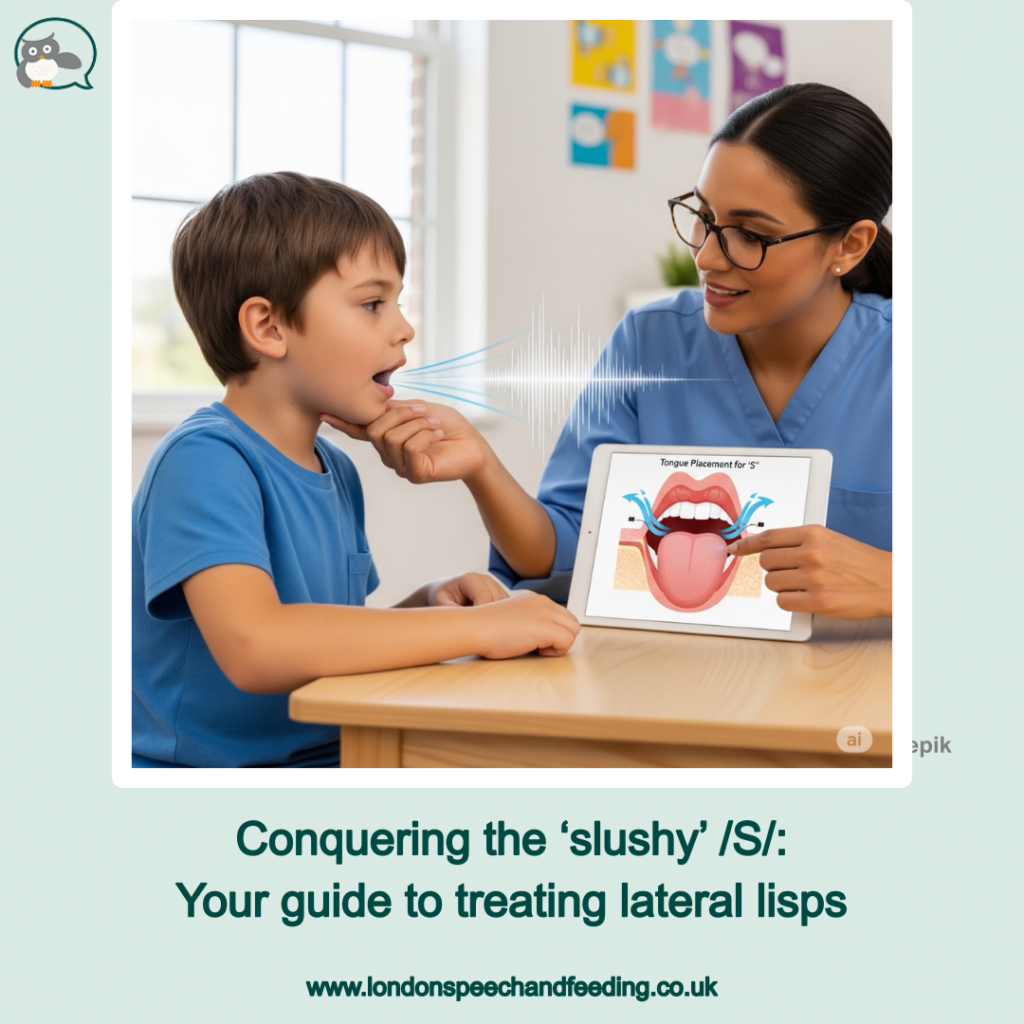
    Most people are familiar with a frontal lisp, where the tongue protrudes between the front teeth, resulting in a /TH/ sound for an /S/ (e.g., ‘thun’ for ‘sun’). A lateral lisp, however, is different. Instead of the air escaping over the front of the tongue, it escapes over the sides, often giving the /S/ and /Z/ sounds a distinct, muffled, or ‘slushy’ quality. This happens because the tongue is not forming the correct central groove, allowing air to spill out laterally.

    The science behind a perfect /S/ vs. a slushy one

    To understand how to fix a lateral lisp, it’s helpful to understand how a ‘perfect’ /S/ sound is made. Imagine a narrow, focused stream of air. For a clear /S/ sound, your tongue forms a shallow groove down its centre, directing a precise, thin stream of air right down the middle, over the tip of your tongue, and out through a tiny opening between your tongue and the roof of your mouth, just behind your front teeth. This focused airflow creates that crisp, sharp /SSSS/ sound we recognise.

    Now, picture what happens with a lateral lisp. Instead of that neat, central channel, the tongue is often flatter or positioned in a way that allows the air to escape over one or both sides. Think of it like a river overflowing its banks – the air, instead of flowing in a controlled stream, spills out sideways, creating that characteristic ‘slushy’ sound. This lateral airflow is what we need to retrain.

    Why is it tricky to treat?

    Treating a lateral lisp can be challenging for a few reasons:

    • Habitual muscle memory: The way the tongue moves and positions itself for a lateral lisp is deeply ingrained. It’s a motor habit that needs to be unlearned and replaced with a new, more precise movement.
    • Subtle differences: The difference between a lateral lisp and a correct /S/ sound can be quite subtle to perceive, both for the child and sometimes even for parents. This makes it harder for the child to self-monitor and correct.
    • Oral motor control: It requires fine motor control of the tongue muscles to create and maintain that central groove for airflow.

    My success with children aged six years and over

    I’ve found great success in treating lateral lisps, particularly with children aged six years and older. Why this age group? By this age, children typically have:

    • Increased awareness: They are more aware of their speech and often more motivated to make changes. They can better perceive the difference between their ‘slushy’ /S/ and a clear one.
    • Improved cognitive skills: They can understand and follow more complex instructions and strategies.
    • Better self-monitoring: Their ability to listen to themselves and correct their own speech improves significantly.
    • Enhanced oral motor control: Their fine motor skills, including those of the tongue, are more developed, allowing for greater precision.

    My approach focuses on a combination of auditory discrimination, tactile cues, and targeted myofunctional exercises to help children ‘feel’ the correct airflow and tongue placement. We use a variety of engaging activities to make the process fun and effective.

    It is crucial to understand tongue functioning and focusing on correcting improper oral resting posture and muscle function, which are often significant contributors to a lateral lisp. For example, if the tongue rests low and wide in the mouth consistently, or if there’s a tongue thrust during swallowing, these habits can prevent the tongue from achieving the precise, midline placement necessary for a clear /S/ or /Z/ sound. Through targeted exercises I aim to re-educate the oral and facial muscles, promoting correct tongue posture at rest, during swallowing, and, ultimately, during speech production. By strengthening the muscles responsible for tongue lifting and encouraging a more appropriate swallowing pattern we can establish the correct oral motor skills needed to overcome a lateral lisp and achieve clearer articulation.

    The recipe for success: Little and often

    The single most crucial ingredient for success in treating a lateral lisp is daily home practice of all the strategies given. This isn’t about long, arduous sessions; it’s about consistency. Think of it like building a muscle: short, frequent workouts yield better results than sporadic, intense ones.

    My recommended formula is ‘little and often’. This means:

    • Short, focused sessions: Aim for 5-10 minutes of practice, 2-3 times a day. This prevents fatigue and keeps the child engaged.
    • Integrate into daily routines: Practise while waiting for dinner, during a car ride, or before bedtime. Make it a natural part of their day.
    • Positive reinforcement: Celebrate every small success! Encouragement goes a long way in building confidence and motivation.
    • Parental involvement: Parents play a vital role in providing consistent cues and encouragement at home. I equip families with clear, easy-to-follow strategies.

    Overcoming a lateral lisp requires dedication, but with the right guidance and consistent practice, a clear, confident /S/ sound is achievable. If your child is struggling with a ‘slushy’ /S/, please don’t hesitate to reach out. Together, we can achieve success!

    Sonja McGeachie

    Highly Specialist Speech and Language Therapist

    Owner of The London Speech and Feeding Practice.


    Health Professions Council registered
    Royal College of Speech & Language Therapists Member
    Member of ASLTIP

    Find a speech and language therapist for your child in London. Are you concerned about your child’s speech, feeding or communication skills and don’t know where to turn? Please contact me and we can discuss how I can help you or visit my services page.

    1
  • ·

    Tongue training: Why tongue placement matters for clear speech

    As speech and Language therapists (SLTs), we know that where your tongue goes, so goes your sound. This blog post will explore why tongue placement is so vital for speech correction and how we use tools and techniques to help our clients find their ‘sweet spot’ for sound production.

    Let me show you here a little video clip where I am using my dentist’s mouth/teeth model to help my clients navigate their tongue movements.

    The tongue: A tiny muscle with a big job

    The tongue is a small but mighty muscle. It’s incredibly versatile, playing a key role in eating, swallowing, and, of course, speaking. For each speech sound, the tongue, along with the lips and jaw, needs to move to a very specific spot. Think of it like a dance: every part of your mouth has a choreographed movement to produce the correct sound. If the tongue is out of sync, the sound comes out muffled, distorted, or just plain wrong.

    The trouble with our tongue movements is that most of us never think about how the tongue has to move and what it does to: swallow, chew, drink, suck and speak. Most parents when asked to think about their own tongue placement for say the /S/ sound are completely lost as to what their tongue is doing. Yet, of course, they produce a perfect /S/ and perfect speech in general. The same goes for swallowing. When did you last think about what happens in your mouth when you swallow? I bet you have not thought about it. We ‘just do it’, right?

    Why is tongue placement so important?

    Accurate tongue placement is the foundation of clear articulation. When a child struggles with a particular sound, it’s often because his or her tongue isn’t quite reaching the right spot or moving in the correct way. For example, the /S/ sound requires the tongue to be slightly raised and positioned behind the top teeth, creating a narrow channel for air to flow through. If the tongue is too far forward, you might get a /TH/ sound instead. If it’s too far back, the /S/ can sound muffled.

    Visual aids: Our secret weapon

    We SLTs love our visual aids! They’re incredibly helpful for showing clients exactly where their tongue needs to be. Here are some of our favourite tools:

    • Mirrors: Mirrors provide instant feedback. Clients can see their tongue’s position and make adjustments in real-time. We often use hand mirrors or even the mirror on a compact for quick checks.
    • Tongue depressors: These simple tools can gently guide the tongue to the correct position. We might use them to show where the tongue tip should rest for the /L/ sound or how the sides of the tongue should touch the molars for the /K/ and /G/ sounds.
    • Diagrams and models: Pictures and models of the mouth can help clients visualise the tongue’s movements. We might use a cross-section diagram of the mouth to show how the tongue forms different sounds.

    Beyond the tongue: The jaw’s role

    While the tongue takes centre stage, the jaw plays a supporting role. It provides a stable base for the tongue and helps control the opening and closing of the mouth. Sometimes, jaw stability is an issue, and we might use techniques to help clients find a comfortable and stable jaw position.

    Making it fun and engaging

    Learning correct tongue placement can be challenging, but we make it fun! We use games, stories, and playful activities to keep clients motivated. For younger children, we might use silly voices or pretend to be animals. For older children, we might incorporate their interests, like using a car analogy for tongue movements.

    The takeaway

    Correct tongue placement is essential for clear speech. By using visual aids, interactive techniques, and a bit of creativity, we can help our clients master their speech sounds and communicate with confidence.

    If you have any concerns about your child’s speech, don’t hesitate to reach out to a qualified speech and language therapist, we are here to help! Contact me via my contact form.

    Sonja McGeachie

    Early Intervention Speech and Language Therapist

    Feeding and Dysphagia (Swallowing) Specialist The London Speech and Feeding Practice

    The London Speech and Feeding Practice


    Find a speech and language therapist for your child in London. Are you concerned about your child’s speech, feeding or communication skills and don’t know where to turn? Please contact me and we can discuss how I can help you or visit my services page.

    2
  • ·

    Correcting a lisp

    Correcting A Lisp

    This is a surprisingly common speech error and it can be corrected really well in my experience. I have helped lots of children of all ages learn how to control their tongue movements and produce clear, sharp /S/ sounds and good /SH/ sounds.

    Initial consideration

    There are some factors which need to be considered before we can dive into therapy proper and these are they, in a nutshell:

    1. The student is not currently displaying negative oral habits such as thumb sucking or excessive sucking on clothing. This is because thumb sucking exerts pressure on the teeth and therefore can, over time, push teeth out of their natural order/position.
    2. The student does not have a restricted lingual frenulum or tongue tie which can cause at times restricted movements of the tongue (pending on how tight the frenulum is attaching the tongue to the base of the oral cavity); equally a labial frenulum or lip-tie can restrict lip movement and therefore physically restrict good speech sound production.
    3. The student does not have enlarged tonsils as they can sometimes push a tongue forward and also cause open mouth posture and open mouth breathing.
    4. The student’s motivation to change their speech pattern is high. (this is an important factor though with younger students I can get round this with a lot of fun games and good parental involvement!)

    When I do an Oral Assessment of my student these are the first factors I want to look at and consider. Often I will refer to other agencies such as Orthodontists, dentists or ENT specialists to advise and help with some of these factors before we can get going. However, there are strategies that we can work on almost straight away.

    Most of my Lisp students present with an open mouth posture: that is where the student has their mouth always slightly open for breathing. Over time the tongue starts to fall forward and rests on the front teeth or the bottom lip instead of finding a comfortable resting place either at the alveolar ridge (the bumpy spot behind the upper front teeth) or, alternatively, resting at the bottom of the mouth behind the lower front teeth.

    Another common problem is that the tongue is not moving independently from the jaw and so is reluctant to pull back or lift up inside the mouth as the tongue is guided in movement by the jaw.

    Combine those two factors and your tongue is not pulling back, or lifting up or doing very much at all without the jaw moving as well. This makes for unclear speech sounds, especially all the sounds we make at the front with our tongue or with our lips: /B/ /P/ /L/ /N/ and of course /S/ and /SH/ are particularly hard to make. We often also struggle with the /Y/ sound so ‘LELLOW’ instead of ‘yellow’.

    Do not fear!

    But no fear, these problems can be treated over time for sure! We often start with lip, tongue, and jaw exercises that help to move the tongue independently from the Jaw, our student learns that the tongue is a muscle and can be trained to do amazing acrobatic things in the mouth! WOW! It can actually pull back, lift up, and come down again all on its own!

    We work on breathing, holding our breath for a bit then pushing it out and then holding it again.

    And when it comes to the actual /S/ sound I often try and go a NEW route bypassing the Snake-Sound route if that is what had previously been tried and failed so that we can create completely new sound patterns in our brain and think about our sounds in a completely new way.

    We then work on producing the sound /S/ on its own for a bit, at the end of words, then on either side of complimentary sounds, for instance : ‘EASY” – the sound patterns here are EEE-S–EE : the /EEE/ sound is complimentary to the /S/ sound as the tongue is at the right hight for the /S/ already once you have it in place for /EEE/ -……see?! EASY!

    And gradually we work towards saying the /S/ sound clearly at the front of short words, then phrases and then sentences.

    The process takes some time and it depends on how ready the student is. This varies of course hugely so I can never promise the exact number of sessions we will take to get that Lisp fixed. A lot depends on home practice in between sessions, and this is of course crucial to all therapy! Every day 15-20 mins practice is a good average time to aim for and when this is done it shortens the therapy block drastically.

    I always give plenty of home work so there is never a chance of it getting boring or there being “nothing to do”!

    Do contact me. I really enjoy working with this type of student and get a great kick out of FIXING THAT LISP!


    Find a speech and language therapist for your child in London. Are you concerned about your child’s speech, feeding or communication skills and don’t know where to turn? Please contact me and we can discuss how I can help you or visit my services page.