Using AAC – Augmentative and Alternative Communication for non-verbal and early verbal children
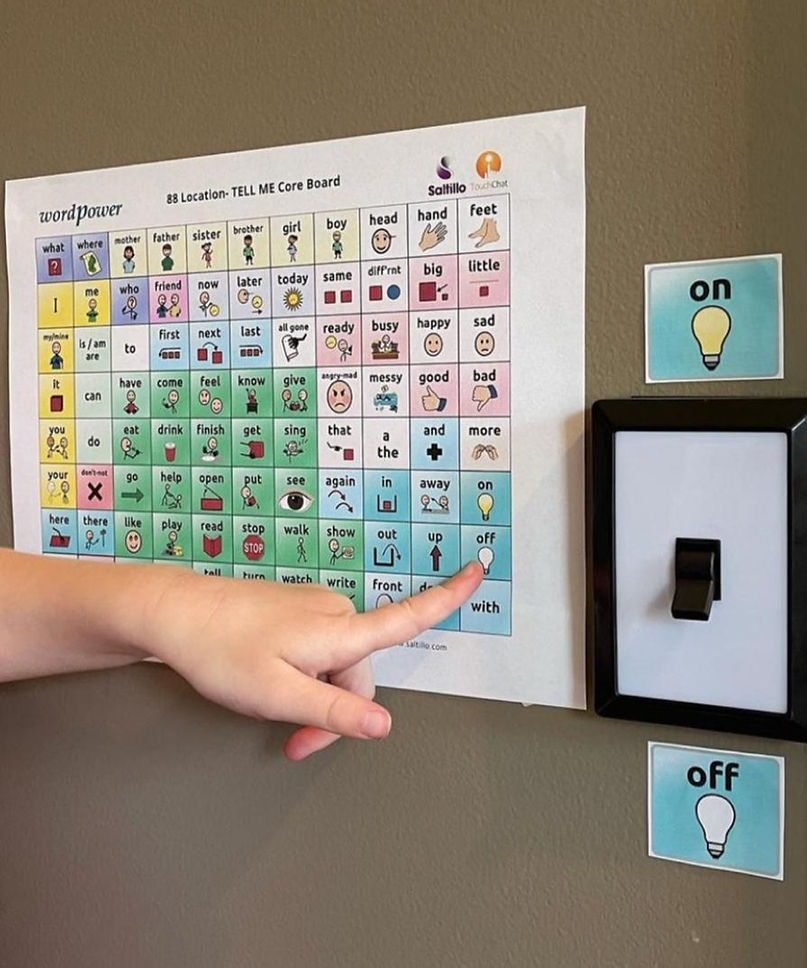
Using a Core Vocabulary Board

Your Speech Therapist might have been advising you to introduce words to your child with the help of a CORE BOARD. What on earth is she talking about and why would we want to do this, I hear you think – and in fact this is what I get asked a lot, as I often do recommend using Core Boards.

Core boards belong to the category of Augmentative and Alternative Communication (AAC ) and they can be really useful for:

  • Children or adults who cannot speak at all or who are very hard to understand.
  • Children who are slow to speak and have difficulty expressing themselves verbally, due to genetic conditions as Down Syndrome, Verbal dyspraxia, Autism or any other learning difficulty that means a child is slow to develop speech.

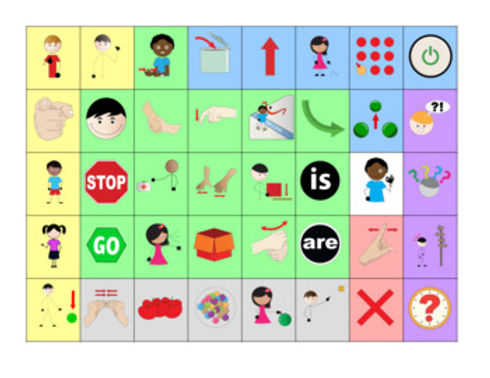
Here is what a Core board might look like, in fact this is one that I love to use. It is made by Beautiful Speech Life, there are a ton of similar boards out there for free. I have also made my own, you can check it out on my Instagram feed.
Using a Core Vocabulary Board

What is Core Vocabulary/ Core words?

Core vocabulary consists of the most common words used by children throughout a day. In 2003 Banajee and Dicarlo et al found that 50 % of pre-schoolers in their project used nine words consistently across their daily play and meal routines. These words are Core words and are typically the ones you can see on a board, like the one above.

How To Use It

Adults always first need to consistently model and show their child how to use a board. This is key! For example: Adult can point to “YOU” “WANT” ‘MORE” and then point to the cup of Water on the counter. Child could then reply either by shaking his/her head and/or pointing to “NOT” which also stands for “NO”. Then adult can point to “NOT” “MORE” and do an OK sign as well. Eventually Child can initiate a request and point to “I” “ WANT” “MORE” and then point to the cup on the counter.

This is not as cumbersome or limited as it first sounds or appears. Here’s why: As adult you can talk normally and, of course, many words you are using will not be on this board. But some will be, and you will be surprised how many you can find when you start using it. So you could say quite normally: Hey lovely (name of your child) would YOU LIKE some MORE water? The words in capital are on the board which you can point to as you speak normally. Basically, you are showing/saying to your child: “We can speak and these are the pictures we can use to help us; We call this TOTAL COMMUNICATION, as communication is so much more than just words! Great communication can be silent, where we use our facial expression, our smile, our eyes, our hand gestures, body movements and yes, of course, words. But when words fail us, these boards are so helpful.

This still does not answer your original question of: why would I want to do this, I want my child to talk!? You are a SPEECH Therapist, please help my child TALK, not point to pictures, that is not what I had in mind.

Let Me Explain

When speech is difficult for a child it doesn’t mean that there is nothing to talk about! Of course, we want all our children and all people to speak because it is the easiest and most effective way of communicating, no doubt! However, sometimes this is very hard for some children and whilst we are always working towards speech where possible, we also want to make sure that whilst figuring out how to speak, your child has a MEANS TO COMMUNICATE. Using a board like this might well be a temporary strategy but whilst you are using it and working on their speech you will find a reduction in tantrums and frustration as you child is able to express themselves more effectively.

Often we find that as soon as we offer a CORE VOCABULARY like the above sample a child who has had no or very few words suddenly blossoms and starts to point to new words on the board and starts to PRACTICE USING THESE WORDS!! Practice makes perfect, right? Yes it totally does! There is lots of evidence that tells us that using Core Vocabulary Boards ENHANCE AND SUPPORT SPEECH PRODUCTION AND NOT HINDER IT. Using a board like this will only ever be helpful to your child and will never make your child “lazy” – too lazy to speak? NO SUCH THING!

Here is what one of my parents says about the core board we use with her little boy:

“the board has been a game changer, my son is a visual learner so it really helps to have the board as he associates communication so much easier this way. We have incorporated his twin sister who models it’s use and have definitely seen improvement in speech through its support and his frustration around being unable to verbally communicate at times has definitely lessened”

K Connolly, Mother of Tom (aged 3.5 years).

Reading and hearing this makes me so happy!

In addition to general core board above I also sometimes use a Core Board that is specific to an activity, such as for example BLOWING BUBBLES. Below is an example of such a board, which you can use very nicely during a bubble blowing activity and sometimes it is a nice place to start for newcomers, this can be an easy introduction. You can download this and many similar boards on www.widgit.com for free!

Using a Core Vocabulary Board

There is so much more to say about AAC and using Coreboards, visit my Instagram you can find a bit more information on how I use them.


Find a speech and language therapist for your child in London. Are you concerned about your child’s speech, feeding or communication skills and don’t know where to turn? Please contact me and we can discuss how I can help you or visit my services page.
Similar Posts

  • A Day In The Life Of An Independent Speech And Language Therapist

    A Day In The Life Of An Independent Speech And Language Therapist

    A Day In The Life Of An Independent Speech And Language Therapist

    I often get asked how many clients/children I see per working day or what my working day/life looks like. I always reply that every day is different, which is true, but there is a sort of average working day which looks a bit like this:

    I usually start preparing for my first client of the day at around 9.30 am: I clean the room, wipe down all the toys and materials (that’s if they are coming to my clinic room) and then it takes me about 30 minutes to select and sometimes make suitable materials, games and activities for the child’s therapy programme. Client arrives at 10.30 am and the fun begins. They leave around 11.30am, and the cleaning and wiping down starts again – yes it’s the pandemic but to be fair I would do this anyway. I quickly write up my notes and send home work to the client via email. Now it’s 12 noon and I start preparing for the next client at 12.30 pm. This might be online parent-child interaction coaching and so I need different materials and activities that are suitable for teletherapy. We finish around 1.30 pm and I will write up my notes before having some lunch.

    Lunch tends to not be around 30 minutes. Around 2.00 pm I start prepping again for the next client: selecting activities, going over their last session, making sure I have everything I need to start at 2.45pm – we finish at 3.45pm, I write up my notes and then have a cuppa. The next client might be more on-line coaching or a child coming to see me: room cleaned and tidy, materials and activities prepared: client arrives at 4.30 pm and we finish at 5.30 pm. I clean the toys again, write up my notes and it is 6.00 pm ready for dinner. So that was four clients between 9 am and 6pm allowing for preparation, aftercare, cleaning and coffee and lunch.

    Other days I might see three clients and do more admin like ordering toys or books or teletherapy activities, or making materials (we therapist make tons of materials, we’d put Blue Peter to shame!) Sometimes I do two home visits, one in the morning and one in the afternoon – the travelling/parking in London is so time consuming that it really reduces the number of clients I can see which is why I don’t do many of those.

    I hand pick my clients to make sure that we are a good fit, and my service is bespoke: no one client gets the same treatment as another; each client is unique, usually very well-known and always highly valued. That takes time and means that in reality each client gets about 2 hours of my time, that is the actual session plus all the preparation and aftercare.

    I love this way of working and would not ever want to return to seeing tons of clients each day, not knowing any of them really well, due to high caseload numbers, staff shortages and an overload of administration.

    My way of working affords all my lovely clients the help they need to be able to feel empowered and to then support their children to make progress; when working with children they make the best progress they can make, fulfilling their potential. My lovely reviews and testimonials tell me that my clients appreciate the extra attention.


    Find a speech and language therapist for your child in London. Are you concerned about your child’s speech, feeding or communication skills and don’t know where to turn? Please contact me and we can discuss how I can help you or visit my services page.

  • What is Speech and Language Therapy (SLT) and what does a Speech Therapist do?

    Kids Speech Therapist London
    What is Speech and Language Therapy (SLT) and what does a Speech Therapist do?

    Speech and language therapists provide treatment, support and care for children and adults who have difficulties with communication, eating, drinking and swallowing. We help children and adults who have problems speaking and communicating.

    How to find the perfect therapist for my child/client:

    There are a huge number of speech and language difficulties, or feeding and swallowing problems that we can help with and the first thing to think about is what age group the person is you are seeking help for. Most SLT’s specialise in a range of disorders and treatments and they often treat specific age ranges. This could be, for instance, very young children up to 3 years, or school aged children, adolescents or just adults. Once you have narrowed it down to age and general area of difficulty you can then go and seek your perfect SLT match.

    Generally it is my view that SLT’s with a narrow area of specialist interest are most likely to help you better if the problem you or your child/adult is having is significant and/or profound. For example, if your child has a very severe stutter/stammer but is otherwise developing fine and has good skills all round, then I would recommend to look for an SLT who only specialises in stammering/stuttering, or has only a small range of other specialist areas related to stammering , such as speech and language delay.

    The reason is that it is a tall order for any professional to stay up to date with latest research, latest clinical developments and training for more than, say, five distinct areas of interest.

    However, a more generalist Speech therapist who has lots of experience in many different areas could be a very good option for your child or adult who has more general speech and language delay in a number of areas, perhaps a global delay or a syndrome which means that their learning is delayed in general. It also means that your child might benefit from a Generalist SLT because they have many more tools in their SLT bag and your child might need a variety of approaches for several areas.

    A good place to start is www.asltip.com which is the Association for Independent Speech and Language Therapists in the UK. Any SLT registered with ASLTIP will also be registered with the HCPC (Health Care Professionals Council), as well as RCSLT (Royal College of Speech and Language Therapists). These two important UK professional regulatory bodies ensure all its members are fully qualified, and are fully up to date with latest developments within their areas of work.

    Here you can enter your post code and look for a therapist near you and you can look for specific problems such as stammering for example and narrow down your search. Most therapists have a website which you can then access too. I would recommend you speak to a few therapists on your list and then go with the person you had the best rapport with. You and the therapist will be spending a lot of time together and you will need to feel that you trust them and that you can relax into the process.

    How I can help you:

    I have 3 main areas of specialism:

    Parent Child Interaction Coaching

    Parent Child Interaction Coaching

    This is an amazing way to help children with the following difficulties:

    • Social Communication Difficulties, Autistic Spectrum Disorders and
    • Speech and Language Delay – for children under the age of 4 years old, this is my preferred way of working because it is so very effective and proven to work. If your child is not developing words or not interacting, has reduced attention and listening and you feel is not progressing or, in fact even regressing, then this way of working is the best. For anyone wanting to read a bit more about the efficacy of this method, below are some research articles. You may also like to check out www.hanen.org which is the mainstay of my work and method when it comes to Parent-Interaction Coaching. You can also look at my latest blog, entitled: Tele-therapy, does it work?

    In brief, what’s so great about Parent Coaching is that it empowers you the parent to help your child in daily life! This is where speech, language and social communication develop typically, in a naturalistic way and environment. Simple steps and strategies are discussed and demonstrated every week and you are encouraged to use these strategies with your child in daily routines: getting dressed, having breakfast, on the school run, whilst out in the park or shopping or simply playing at home or having dinner or bath time. Whatever your family routine happens to be, every strategy I teach you will help create a responsive communication environment; generally, if your child is able to develop speech then they will do so in direct response to your changed interaction style.

    Speech Sound Disorders, Verbal Dyspraxia, Phonology and Articulation

    Speech Sound Disorders, Verbal Dyspraxia, Phonology and Articulation

    I love working with children of all ages on developing their speech sounds. Whether your child has a lisp, or a couple of tricky sounds they simply cannot produce quite right, or perhaps your child is really unintelligible because he/she is having lots of different sound errors, making it really hard to understand them. I typically work on getting “most bang for your buck” , meaning I address the sounds that cause the most problems and, therefore, when they are fixed your child/person’s speech becomes that much clearer fairly quickly.

    Feeding and Swallowing Difficulties

    Feeding and Swallowing Difficulties

    Having worked for over 20 years in NHS Child Development Clinics and Special Needs Schools I trained and worked with feeding and swallowing difficulties early on in my SLT career. I later trained as a Lactation Consultant and so I am well placed helping and support all types of Infant feeding, both breast or bottle, as well as toddler weaning. I aim to ensure that your little one swallows the right kind of foods and drinks for their abilities. I am experienced in managing and supporting children with physical needs and mobility problems, Cerebral Palsy, Down Syndrome or any other type of syndrome or presentation.

    What does a speech therapy session look like?

    All sessions differ slightly depending on the age of the child and the nature of the difficulties.

    However, mostly our sessions look like FUN! After arrival and washing hands we tend to start off with the tricky work straight away whilst our child still has energy and the will to engage. So, for speech work we will focus on the target sounds first: this could be sitting at a table doing work sheets together, playing games using the target sound and really any type of activity that gives us around 70-100 repeats of the target pattern. For example, a child who is working towards saying a ‘K’ at the end of the word I will try and get around 100 productions of words like: pack/sack/lick/ pick/bike/lake and so on.

    Then we often play a fun game where I might try for a ‘rhyming’ activity or other sound awareness type activities, for perhaps 10 minutes and within that time I aim to trial the next sound pattern we need to improve on; I will test which sound your child can do with help from me. During he last 10 minutes we might look at a book, again listening to and producing whatever sound we are working on. If I did not get 100 sounds earlier on in the session I will try and practice them now as part of the story. In total I aim to have about 40-45 minutes of activities, all aimed at the target sound we are working on.

    What does a Coaching session look like?

    During a Parent Coaching Session we meet online for about an hour and we discuss how the week has been for you trying out the strategies. Typically parents start off recalling what went well, what progress was made and what had been more tricky. We work through it all, and then follow on to the next strategies: I will show you examples and demonstrations of each strategy and I will get you to think about how you can use this with your child and in what situation you might use it. I will explain what we are doing and what the purpose is. You might want to write down what you are going to work on for the week. Over the course of about sessions we can cover all the major strategies that are proven to help kickstart spoken language and/or help your child to connect more with you. Through that connection spoken words most often develop.

    Research Papers on the Efficacy of Parent Child Interaction Coaching

    Research Papers on the Efficacy of Parent Child Interaction Coaching

    • The It Takes Two to Talk Program has been shown to be effective in changing how parents interact with their children, and that children’s communication and language skills improve as a result.
    • Baumwell, L.B., Tamis-LeMonda, C.S. & Bornstein, M.H. (1997). Maternal verbal sensitivity and child language comprehension. Infant Behavior and Development, 20(2), 247-258.
    • Beckwith, L. & Cohen, S.E. (1989). Maternal responsiveness with preterm infants and later competency. In M.H. Bornstein (Ed.). Maternal responsiveness: Characteristics and consequences: New directions for child development (pp. 75-87). San Francisco: Jossey Bass.
    • Bronfenbrenner, U. (1974). Is early intervention effective? (Publication No. (CDH) 74-25). Washington, DC: Department of Health, Education, and Welfare, Office of Child Development.
    • Girolametto, L. (1988). Improving the social-conversational skills of developmentally delayed children: An intervention study. Journal of Speech and Hearing Disorders, 53, 156-167.

    Sonja has been a real help for my 5 year old daughter. Due to her support, my daughter is now able to clearly and correctly enunciate ‘th’ ‘f’ and ’s’. She was also helpful in making positional changes to her seating to help her concentrate better and kept her engaged throughout all the lessons which is a feat in itself on zoom!

    Helen, Mother of Catherine Age 5.

    Find a speech and language therapist for your child in London. Are you concerned about your child’s speech, feeding or communication skills and don’t know where to turn? Please contact me and we can discuss how I can help you or visit my services page.

  • · ·

    Chaining: A powerful tool for phonological development

    Understanding chaining

    Chaining is a therapeutic technique I like to use in my speech therapy work with children who have Childhood Apraxia of Speech (CAS) or phonological speech sound difficulties. It helps to break down a complex target behaviour into smaller, more manageable steps. By systematically teaching and reinforcing each step, I can help my students achieve their communication goals.

    There are two types of chaining: Forward and backward chaining

    Today I am going to show and talk about backward chaining. This technique involves starting with the last step and working backward to the first. This approach can be particularly effective for children with persistent speech sound difficulties where combining consonants into clusters, such as /BL/ or /FR/ or /SHR/ is very difficult.

    Backward chaining allows my student to experience immediate success and build his confidence.

    In my video I show you how I applied backward chaining to the words ‘Shriek’, ‘Shrub’, ‘Shrimp’ etc

    My student struggles with both the /SH/ and the /R/ sounds and we have been working on both sounds for some weeks now. He has mild Childhood Apraxia of Speech and he has difficulties with coordinating his tongue movements, breathing and using his jaw effectively to make words. His sound repertoire has grown a lot since we started working together last year. Today in this session I show you how we pulled both the sound /SH/ together with /REEK/ to make ‘SHRIEK’. I love using the pictures and therapy materials from Adventures in Speech Pathology.

    This is also part of the Complexity approach which I will explain in a separate blog post.

    • Step 1 (not shown in the video): I explain what the word means; I find that when my student understands what a word means he is much better at saying it. It increases his confidence and motivation to say a word that he knows the meaning of. Often this student does not tell me that he does not know what a word means, so I always remind myself to check that out first.
    • Step 2 (not shown in the video): We do a little rhyming game and think about what any one word rhymes with: ‘Shriek’ – ‘meek’, ‘weak’, ‘seek’.
    • Step 3: I show my student that there are two parts to this word /reek/ and the sound /SH/.
    • Step 3: We practise the easier part: /reek/ /reek/ /reek/.
    • Step 4: We add the /SH/ sound and pull it together to make our target word ‘Shriek’.

    /REEK/ /REEK/ /REEK/ + /SH/ = ‘SHRIEK’
    /RUB/ /RUB/ /RUB/ + /SH/ = ‘SHRUB’
    /RUG/ /RUG/ /RUG/ + /SH/ = ‘SHRUG’

    By breaking down the word into smaller, manageable steps, my student can focus on each syllable individually, get that right and then gradually build up to the full word. This approach can help to reduce frustration and increase motivation.

    Forward chaining

    Forward chaining is the same process but in reverse: we start with the front sound or syllable and work forward towards the next/last part of the word:

    /SH/ + /REEK/ = ‘SHRIEK’
    /SH/ + /RUB/ = ‘SHRUB’
    /SH/ + /RUG/ = ‘SHRUG’

    Benefits of chaining

    • Increased motivation: By starting with the last step, my student experiences success, which boosts his motivation to continue trying to say the word and trying other words.
    • Reduced frustration: Breaking down the target behaviour into smaller steps can make the task less overwhelming, reducing frustration and anxiety.
    • Improved confidence: As the little learner masters each of the step, his confidence and self-esteem increases. Again, this leads to increased motivation.
    • Faster learning: By focusing on the final step first, and practising lots of chaining (forward and backward), a student can quickly learn to generalise to other words.

    Backward chaining (and forward chaining) is a really great tool for teaching complex speech sounds and words to children with phonological disorders.

    Watch out for my next blog which is all about the complexity approach in Phonology.

    Do get in touch if your child has a speech sound disorder, I would love to help.

    Any questions or need help with supporting your little one’s language please contact me via my contact form, or you could also check out www.hanen.org for advice and lots of inspiration.

    Sonja McGeachie

    Early Intervention Speech and Language Therapist

    Feeding and Dysphagia (Swallowing) Specialist The London Speech and Feeding Practice

    The London Speech and Feeding Practice


    Find a speech and language therapist for your child in London. Are you concerned about your child’s speech, feeding or communication skills and don’t know where to turn? Please contact me and we can discuss how I can help you or visit my services page.

    1
  • ·

    Discover how Attention Autism can support your Autistic child’s communication

    “I’ve got something in my bag, in my bag, in my bag,

    I’ve got something in my bag,

    what it is”

    You might be wondering why your Speech and Language Therapist is singing this song and then presenting items from a zipped-up bag. Let me take you through stage one of this evidence-based approach.

    There are many aims of ‘bucket or bag time’. During stage one, you are simply engaging your child’s attention (whilst also exposing them to language). It’s important to remember that you are not forcing your child to say or do anything. The idea is that the items in the bag or bucket ‘offers an irresistible invitation to learn’ (Gina Davies, 2020).

    You don’t need ‘special’ expensive toys. Use what you have at home. It might be that you have some bubbles, a wind-up toy. You might have some foil that you can roll up into a ball, or a balloon. Keep these items for ‘bucket time’. This means that your child is likely to be excited and motivated for the activity. The only stipulation is that these items must be highly motivating and must be the most exciting thing in the room. You’ll want to cover up any distractions.

    So, you have your items and your opaque zipped bag, next you’ll want to put the items into the bag ensuring the zip is closed. The zip is important as it increases suspense and excitement as your child cannot see inside. You can also comment when unzipping ‘open bag’ using the signs ‘open’ + ‘bag’ to support your child’s understanding. Your Speech and Language Therapist can help with any Makaton signs that are unknown. The idea of this activity is that the item isn’t touched by your child. This can seem a little odd or feel “mean” but there is a reason for this: we want our child to look at us as well as the object or toy. As soon as we allow our child to touch and play with that toy their attention will go to the toy alone and we won’t get JOINT attention or engagement. This is the reason why we SHOW interesting things for a brief moment and then put these items back into the bag or bucket and out comes the next item. If your child wants to grab the toy and gets upset, then they may not be quite ready for this approach.

    Next, we sing the song (as above) and unzip the bag taking out one of the items. The use of pausing is important. Pause after the song: does your child try to use gesture or sound? You can also use this opportunity to model short phrases, ideally one or two words such “it’s a spinner! Wow… so many colours”. After a couple of turns, repeat the process and pull out a different item. We tend not to sing the song each time for the next item. Just sing it at the beginning and then get on with producing the amazing, wonderful things in your bag. No hard and fast rules though, apart from “don’t let the child touch the toys”.

    The biggest factor here is that you and your child enjoy the activity together. Have lots of fun!!

    Keep up to date with our latest blogs to explore more stages of Attention Autism.

    If you need speech, language or communication support or advice, I am always here to help.


    Find a speech and language therapist for your child in London. Are you concerned about your child’s speech, feeding or communication skills and don’t know where to turn? Please contact me and we can discuss how I can help you or visit my services page.
    0
  • · ·

    How can we support babbling and early speech development? SLT tricks and tips

    My baby isn’t babbling and developing speech – what can I do to support?

    While every baby develops at their own pace, if your child isn’t babbling by nine months, it’s worth seeking help from an Early Intervention Health Professional, such as a doctor and a speech therapist. Don’t panic! There are many reasons for delayed babbling, and early intervention is key.

    In the meantime, it is highly recommended that we talk, sing, and read to our baby often. Exaggerate sounds and expressions, and respond to their coos and smiles. This playful interaction helps stimulate their communication skills.

    Below are some tips and tricks from my experience of working with babies and toddlers who need a little bit of help and support to develop.

    The benefits of imitating your baby

    Copying your baby’s sounds and gestures isn’t just silly fun, it’s a powerful learning tool! By mimicking their babbles and actions, you activate “mirror neurons” in their brain that help them connect sounds with meaning. This playful back-and-forth teaches turn-taking, a foundation for conversation. Plus, it encourages them to copy you, building their own language skills and social interaction abilities.

    This is a nice clip on youtube showing how copying/imitating your baby looks like:

    Here are some fun ways to imitate your baby:

    • Matchmaker: Grab two of the same, or two similar toys your child loves, like rainmakers or shakers. Give one to your baby and keep the other for yourself. When your child plays with his/her toy, mirror his/her actions with yours! This creates a fun, interactive game.
    • Face Time: Get down to your baby’s level, sitting opposite him/her on the floor or kneeling. This makes eye contact easy and encourages him/her to look at you during your playful imitation.
    • Be the Funniest You: Go all out with silly faces, exaggerated sounds, and big gestures. The goal is to capture your baby’s attention and make you irresistible to watch. This playful energy encourages him/her to interact and potentially imitate you back!

    By incorporating these tips, you can turn imitation into a fun and engaging way to boost your baby’s communication skills. I have seen this happen numerous times over the past decades. It is very powerful, go ahead and try it! You cannot be silly and goofy enough!

    Great toy ideas:

    Did you know that speech and language development starts with how we talk to our babies?

    Adults naturally use a special way of speaking called motherese. It involves a higher pitch, slower pace, and exaggerated sounds compared to regular conversation. Sentences are simpler, with shorter words and repetition. This grabs babies’ attention, helps them distinguish sounds, and reinforces word meaning.

    Imitation is a key part of motherese. We wait for our baby to make a sound or gesture, then playfully imitate it with exaggeration. Babies notice this right away and often respond with more vocalisations, creating a mini conversation. This back-and-forth teaches turn-taking, a foundation for future conversations.

    By responding warmly and engaging in these playful interactions, we encourage our babies to keep exploring the world of communication. Talking, singing, reading and, of course, imitating, these simple actions can have a big impact on a baby’s language development.

    Once your conversation is underway then try and keep it going for as long as possible. It’s a beautiful dance of turn-taking, even without words!

    A last word on oxytocin

    There’s evidence suggesting early non-verbal communication with your baby can increase a mother’s oxytocin levels, often called the ‘love hormone’. This hormone plays a key role in bonding and social connection. Positive interactions, touch, and stress reduction all contribute to oxytocin release, strengthening the mother–baby bond.

    For parents of babies with extra needs

    The stress of caring for a child with medical needs or developmental delays can be difficult. Stress can lower oxytocin levels, creating a cycle of sadness for both parent and child.

    Breaking the cycle:

    1. Knowledge is Power: Understanding the importance of communication can empower parents.
    2. Seek Support: Speech therapists and other healthcare professionals can provide valuable guidance on communication strategies.
    3. Start Small, Celebrate Big: Even small interactions can boost oxytocin. Focus on playful imitation and positive reinforcement. Remember, friends, family and healthcare professionals are there to encourage you.

    This approach can help reverse the negative cycle and create a more positive and connected relationship between parent and child.

    I hope this is helpful! Don’t hesitate to reach out with any questions.

    Kind regards

    Sonja McGeachie

    Early Intervention Speech and Language Therapist

    Feeding and Dysphagia (Swallowing) Specialist The London Speech and Feeding Practice

    The London Speech and Feeding Practice


    Find a speech and language therapist for your child in London. Are you concerned about your child’s speech, feeding or communication skills and don’t know where to turn? Please contact me and we can discuss how I can help you or visit my services page.

    2
  • Empty Set and Phonology approaches

    I have been avoiding the use of the Empty Set approach for the longest time as I was not sure if it would work seeing that I am challenging two sounds my student struggles with at the same time. But I decided to give it a go and it works a treat!

    With this approach, we use two sounds that our student is struggling with. For example, in my video this student cannot produce /sh/ and /r/. Both sounds have different rules, so I decided to contrast them with each other.

    • The rules of /sh/ are: no voice, air is pushed out through teeth, produced at the front.
    • The rules for /r/ are: use your voice, produce the sound in the middle of the mouth by shaping your tongue in a particular way.

    So I chose the words ‘shoes’ and ‘ruse’ as their rules are quite different. Contrasting two sounds the student does not know has been shown to lead to greater change in the child’s articulation. And I can certainly vouch for this as my student is making the best progress with this approach.

    Phonology Therapy – what is it, why and how?

    Phonology is the study of the sound system of a language. It’s distinct from articulation therapy which focuses on the physical production of sounds.

    Phonology therapy focuses on rules. For example, sounds that are produced at the front of the mouth, in contrast to sounds that are produced at the back of the mouth, or sounds that are produced with a long air stream: /s/ or /f/ versus short sounds like /p/ or /t/; sounds are produced with voice or without voice.

    Many children, and sometimes adults, are unaware of some of the speech rules and confuse and replace individual sounds. They might say TAT instead of CAT or SIP instead of SHIP.

    A quick overview of phonology approaches I use:

    Minimal Pairs:

    This approach is good for single sound substitutions. We offer word pairs that differ by only one sound, like ‘ship’ and ‘sip.’ One of our first goal in therapy is to highlight the difference between the target sound (e.g., /sh/) and the sound the child uses (e.g., /s/). This helps discriminate and eventually produce the correct sound.

    Multiple Oppositions:

    A child might replace lots of sounds with a single sound like a /d/. So instead of ‘four’, ‘chore’ and ‘store’ our child says ‘door’, making speech very unintelligible.

    The approach is typically geared towards shaking up the phonological system. Our goal is to choose two to four targets that are different from each other, and different from the substituted sound. If our child’s favourite sound is /d/ they can use their voice and make a short sound by stopping their airflow. So I will choose a different target sound to change up the speech system. For example I might choose an /f/, a /m/ and a /k/ sound. So I would contrast: ‘door’ with ‘four’, ‘more’ and ‘core’.

    Maximal Oppositions:

    In the Maximal Oppositions approach the treatment sets consists of words that are minimally contrasted and that have maximal or near maximal feature differences between each word pair. One word in a pair represents a sound the child ‘knows’ (can say at word level) and the other represents a sound the child does not know (cannot say).

    For example, a child may ‘know’ /m/ and be able to say words like ‘man’, ‘mat’ and ‘mine’. However, the same child may be unable to say /f/ as in ‘fan’, ‘fat’ and ‘fine’. The consonants /f/ and /m/ are maximally opposed as follows.

    I am always delighted to work on speech sound disorders, I love the challenge and the successes we can celebrate together. Get in touch with me!

    Sonja McGeachie

    Early Intervention Speech and Language Therapist

    Feeding and Dysphagia (Swallowing) Specialist The London Speech and Feeding Practice

    The London Speech and Feeding Practice


    Find a speech and language therapist for your child in London. Are you concerned about your child’s speech, feeding or communication skills and don’t know where to turn? Please contact me and we can discuss how I can help you or visit my services page.
    1