Echolalia is Communication

  • · · ·

    Beyond the teddy bear picnic: Why language development doesn’t always need imaginative play

    As Speech and Language Therapists (SLTs), we are taught from day one that developmental milestones follow a predictable, linear path: first comes functional play, then symbolic and imaginative play (like pretending to feed a teddy bear or talking on a toy phone), and then comes conversational speech.

    But when working with language delayed children, I have seen something that completely contradicts those textbook charts.

    Many of my students have absolutely no interest in doll play, tea parties, or imaginary scenarios. Yet, as they mature, they still manage to develop robust, meaningful, and conversational language.

    How is this possible? And what does it mean for how we approach therapy?

    Redefining the ‘rules’ of play and language

    The idea that imaginative play is a strict prerequisite for language was built entirely on neurotypical developmental data. But neurodivergent brains don’t follow neurotypical roadmaps. That is not a deficit; it’s simply a different processing style.

    When Gestalt Language Processors bypass traditional imaginative play, they aren’t ‘missing’ a step. They are often using entirely different cognitive vehicles to build their language skills.

    The power of monotropic deep interests

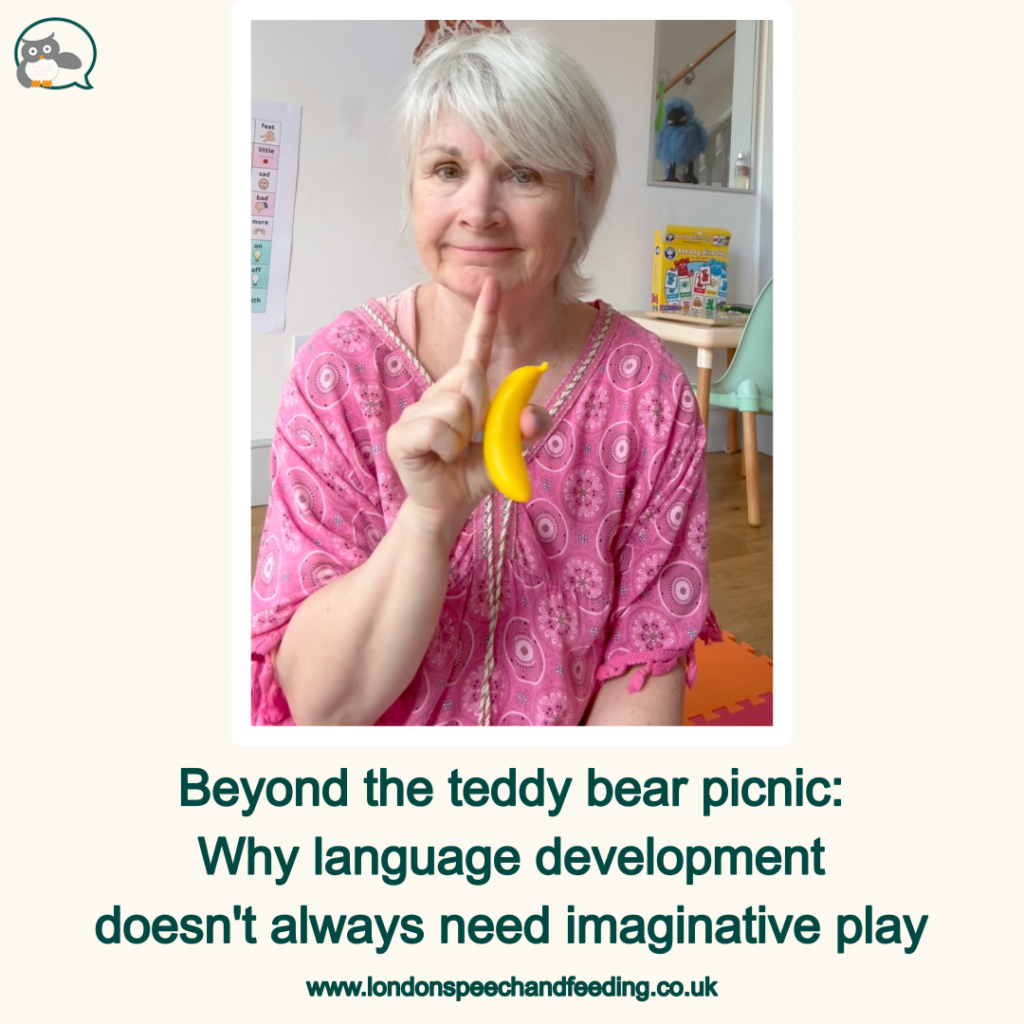
    Video clip 2 lining up dinosaurs

    Many autistic individuals have a monotropic cognitive style, meaning they process the world through deep, single-focused passions (think trains, space, dinosaurs or ocean creatures).

    While a neurotypical child might practise social roles by pretending a doll is going to school, a neuro-diverse child practises language by categorising, analysing, and sharing facts about their deep interest. Their language is anchored in the concrete, fascinating reality of their passion, rather than fictional symbolic play.

    Gestalt Language Processing (GLP)

    A significant number of neuro-diverse children learn language in large ‘chunks’ or ‘gestalts’ (such as movie scripts, songs, or favourite phrases) rather than building sentences word-by-word.

    When a child scripts or uses echolalia, they are storing and mapping vast amounts of conversational data. They don’t need to pretend-feed a teddy bear to practise dialogue; they are actively processing the rhythm, intonation, and structural rules of speech through the media and phrases they love. As they grow, they learn to break these scripts apart to form original sentences.

    Structural play is learning play

    Just because a child is lining up dinosaurs or cars, stacking blocks, or spinning wheels instead of making them ‘talk’ doesn’t mean they aren’t learning. This functional and structural play builds crucial foundational skills like pattern recognition, cause-and-effect, and spatial awareness, all of which directly support cognitive and language development.

    Shifting Our Goals

    Meeting our children on their home turf: if that’s dinosaurs, let’s be creative with dinosaurs!

    If imaginative play isn’t the engine driving language, forcing it in the therapy room can quickly turn into an exercise in compliance rather than connection. Instead of trying to pull a child out of their world and into a neurotypical play model, we can meet them exactly where they are!

    Here are three affirming ways to turn deep interests into conversations:

    • Swap questions for comments (declarative language): Instead of interrogating a child about their play (‘What colour is that train? Where is it going?’) make pressure-free observations (‘Wow, that train is moving fast. Look at those wheels spin.’). This lowers conversational anxiety and models natural communication.
    • Bridge and expand: Use their favourite topic to introduce new ideas and concepts. If we love dinosaurs let’s see if dinos can climb up a ladder, slide down a half pipe into some water, then need drying before making footprints across a piece of paper…
    • Validate any scripts or echolalia and find out the EMOTION underlying it: If your child uses a quote from a favourite cartoon clip, let’s try and figure out in what context this phrase was said in the movie; what is the emotion in the movie when the character says this line? Is it upset? Is it joyful? Is it big surprise or a shock? Don’t dismiss it as meaningless. Acknowledge the emotion behind the script ‘You feel worried right now.’ This way we are showing our child that their unique way of communicating is heard and valued.

    So, to sum up:

    Imaginative play is just one way to learn language, not the only way.

    Let’s stop viewing a lack of pretend play as a barrier to communication, and free ourselves to see our children’s true strengths. By embracing their deep passions, we don’t just help them find their voice. We build a real connection that makes communication possible.

    Are you looking for neurodiversity-affirming speech and language support? Contact my clinic today to learn more about how I tailor my therapy to your child’s unique strengths.

    Sonja McGeachie

    Highly Specialist Speech and Language Therapist

    Owner of The London Speech and Feeding Practice.


    Health Professions Council registered
    Royal College of Speech & Language Therapists Member
    Member of ASLTIP

    Find a speech and language therapist for your child in London. Are you concerned about your child’s speech, feeding or communication skills and don’t know where to turn? Please contact me and we can discuss how I can help you or visit my services page.

    3
  • · · ·

    How parent coaching turns story time into a communication success

    We often hear from parents who are trying their best to connect with their child, especially when reading books, but are met with frustration. They’ll say, ‘I read the book exactly as it’s written, but my child can’t focus for very long and just runs off!’ or ‘my child just flicks through the pages then turns it upside down and runs off with it’ or similar.

    It’s a common story. Traditional reading—going through the text from cover-to-cover—has its place of course, but for little ones with a language delay or autism it can move too quickly and place all the focus on the book’s words, not on the interaction.

    But what if I told you that story time could become one of the most fun and productive times for your child’s communication development?

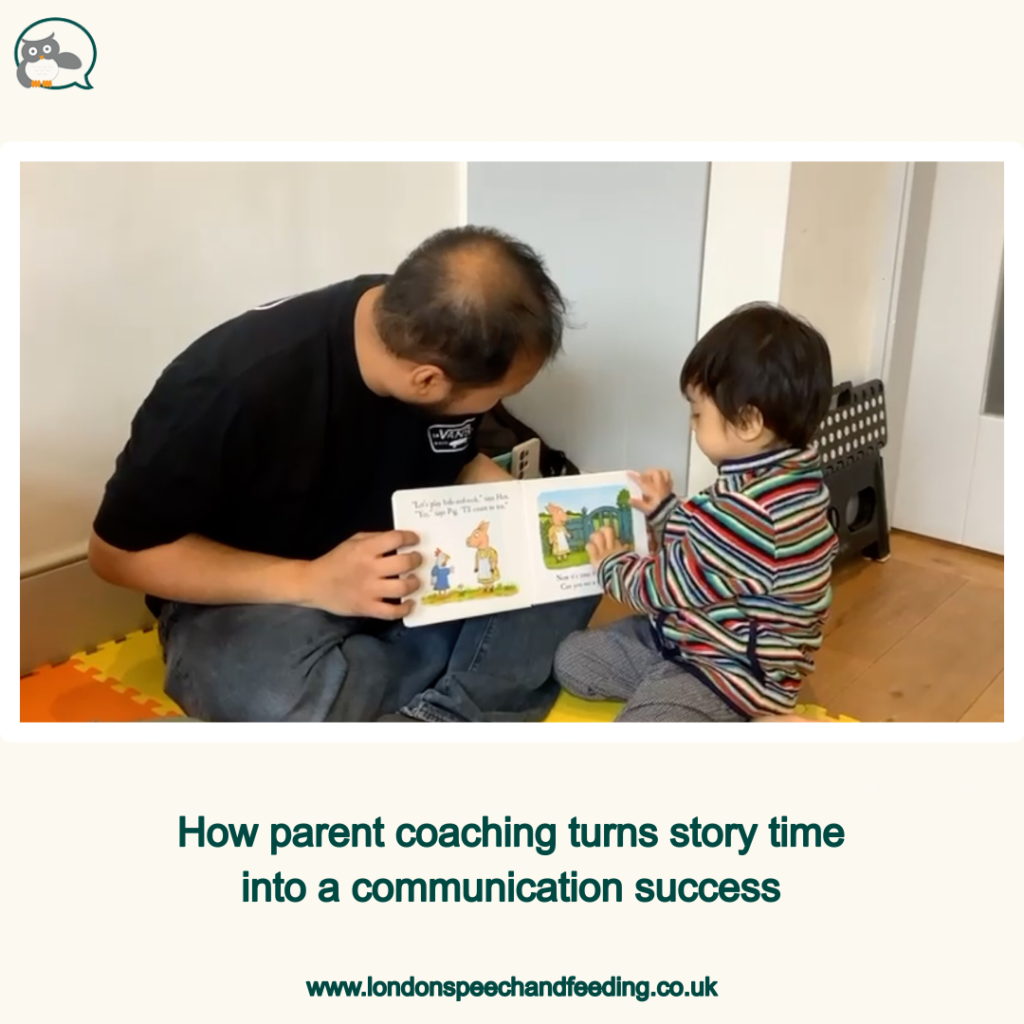
    Watch the fantastic little video clip above! You can see the pure joy and connection between this dad and his son. This is the same family who, just a few weeks ago, felt defeated when trying to read a book, with their child quickly losing interest and leaving the reading/book corner.

    What changed?

    The power of parent coaching and Hanen principles

    The difference you see in the video is the direct result of parent interaction therapy, or parent coaching, based on the internationally recognised Hanen principles.

    I didn’t ‘fix’ the child. Instead, I coached the parents in a few simple, powerful strategies that completely changed the dynamic of their interaction. Instead of being a time for teaching and instruction, story time became a back-and-forth conversation.

    Here are the four major transformations that coaching helped this family achieve:

    1. From reader to play partner

    Before coaching, the parents felt their job was to read the text and to teach the words in it to their child. Now, their job is to follow their child’s lead. They learned to Observe, Wait, and Listen (OWL). If the child points to the tree or the badger on the page, the parent talks about the tree or the badger.

    The result

    The child is now initiating and leading the conversation! He is sharing what he finds interesting, which makes him feel powerful and keeps him deeply engaged.

    2. Building connection and attention

    When parents focus solely on reading, they often forget to make frequent eye contact and use animated facial expressions. The principles taught them to put the text aside and prioritise connection.

    The result

    Our little boy is looking at his dad more frequently, making great eye contact, and clearly having fun! When the interaction is fun, the child’s attention span naturally lengthens, allowing him to attend to the book and the interaction for a much longer time.

    3. Creating opportunities for communication

    The parents learned simple ways to prompt communication without pressure. They stopped asking knowledge-based questions (‘What colour is that? Or point to the pig!’), which can feel like a test.

    Instead, they learned to use techniques like ‘Saying less and pausing’ or ‘copying their little one’s echolalia ‘, signalling that they are very interested in what he is saying and that his communication matters!

    The result

    The child is now spontaneously using strings of sounds and gestures to communicate his needs and interests, knowing and enjoying his parents’ enthusiastic responses.

    This video is a testament to the fact that you are your child’s best therapist. With the right tools and coaching, you can transform everyday routines, like reading a book, into the most joyful and effective communication sessions.

    4. Acknowledging and interpreting echolalia

    In the video, you may hear the little boy repeat a phrase from the book or from what his dad just said. This is called echolalia, and for a long time, it was often dismissed or discouraged.

    However, a core principle of our parent coaching is that echolalia is communication. For children who are ‘Gestalt Language Processors,’ these memorised phrases (or ‘gestalts’) are their building blocks of language.

    The key is not to stop the repetition, but to become a ‘language detective’ and ‘interpreter’!

    By modelling the correct, first-person phrase right after the echo, parents/caregivers are teaching a child how to break down the ‘chunk’ and use the individual words functionally. They are showing their child: ‘I heard you. Your communication makes sense to me.’

    This strategy is a game-changer because it:

    1. Validates the child’s communication: It honours the child’s natural way of learning language, which boosts their confidence and willingness to communicate.
    2. Facilitates language development: It provides the child with the next step—a meaningful, functional phrase—to move them from repeating language to generating their own spontaneous sentences.

    Look at the child’s face again in the video. When his dad acknowledges and interprets his communication, you see that spark of joy and connection—that’s the moment when true, functional language learning happens!

    Ready to unlock the potential in your family’s story time? Contact me to learn more about our parent coaching programs.

    Sonja McGeachie

    Highly Specialist Speech and Language Therapist

    Owner of The London Speech and Feeding Practice.

    Health Professions Council registered
    Royal College of Speech & Language Therapists Member
    Member of ASLTIP

    Find a speech and language therapist for your child in London. Are you concerned about your child’s speech, feeding or communication skills and don’t know where to turn? Please contact me and we can discuss how I can help you or visit my services page.
    2