
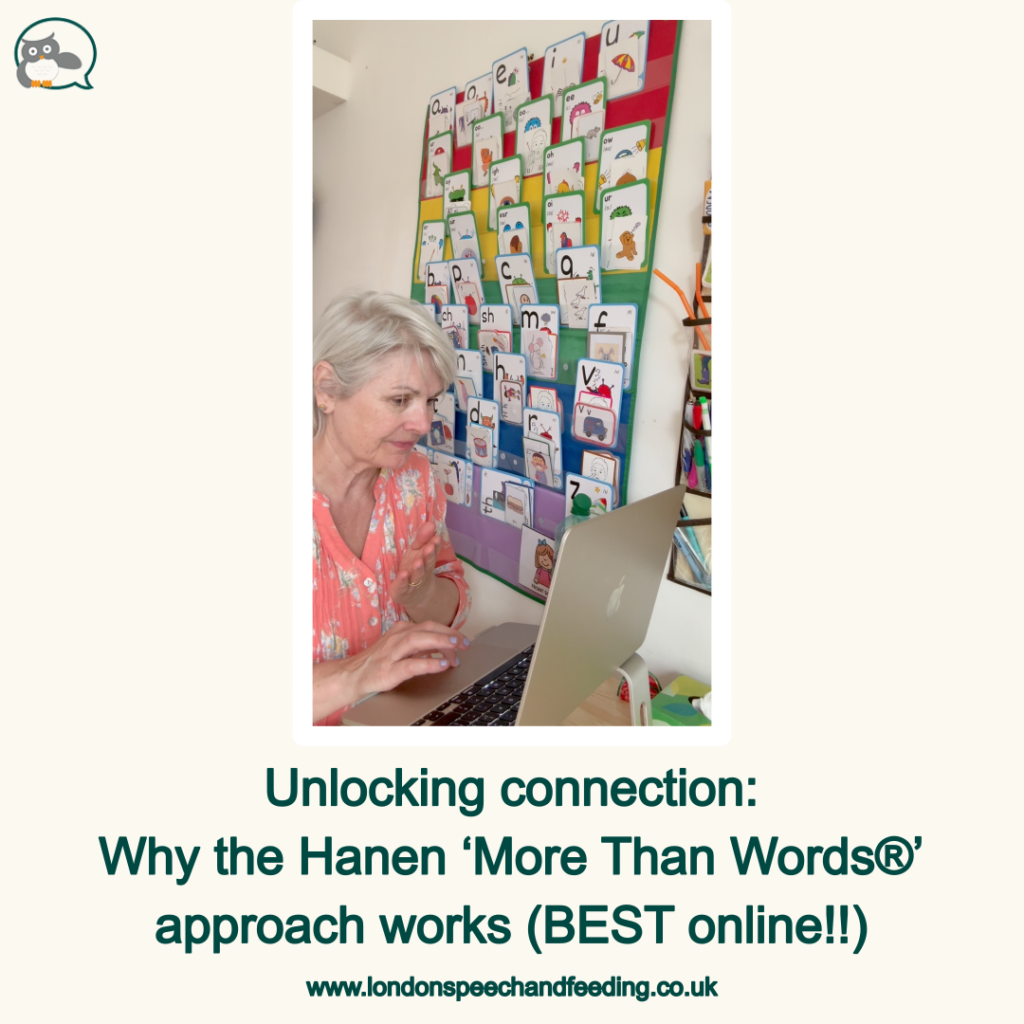
Unlocking connection: Why the Hanen ‘More Than Words®’ approach works (BEST online!!)
As a Speech and Language Therapist, one of the most rewarding parts of my job isn’t just working on speech sounds or vocabulary lists. It’s helping parents truly connect with their autistic children.
Recently, I had a 1-hour initial online session with the parent of a 7-year-old boy. In just 75 minutes, we achieved a massive breakthrough in perspective, all without parents setting foot into my traditional clinic setting or me visiting them at home.
I had been sent some video footage of their child along with detailed parent questionnaire and both gave me so much information from which I then worked online with the parent.
Here is a glimpse into what the Hanen More Than Words® approach is, how I structure my initial sessions, and why doing this work online with parents is often far more powerful than traditional therapy.
What is the Hanen More Than Words® approach?
The Hanen More Than Words® programme is an evidence-based framework designed specifically for parents of autistic children or children with social communication difficulties. Rather than treating communication as a clinical ‘lesson’ taught by a therapist, Hanen empowers parents to become their child’s primary communication partner. It focuses on turning everyday interactions, routines, and play into natural opportunities for a child to build connection, express themselves, and initiate communication at their own pace.
How I structure the first session: Reframing expectations
When parents first come to speech therapy, they often arrive with understandable anxiety and big, sometimes overwhelming, expectations. My primary goal in session one is to take those expectations, reframe them into realistic, hopeful goals, and establish a clear baseline of where we are right now.
To do this, I use the Hanen Social Communication Checklist.
In my session with any parent this tool is always a game-changer. Today, for example, it allowed us to celebrate every single achievement our child has already made, while highlighting the specific micro-skills we want to consolidate next. Instead of focusing on ‘fixing’ speech, our baseline focused on three functional social goals:
- Responding to comments from others.
- Initiating his own comments, requests, or questions (in whatever way he can).
- Taking a single, natural conversational turn, even if that turn takes time to come.
Why online therapy for Hanen works so well
People often ask me: ‘Can speech therapy really be effective over Zoom?’
My answer is an emphatic yes. And for Hanen, online is often superior to a clinic.
In a clinic, a child is in an unfamiliar environment with a new adult, which can feel demanding or artificial. Online, the child stays in their safe, natural home environment. I get to coach the parent directly in real time, giving them immediate tools they can use every single day. In just one hour online today with one parent, for example, we got a massive amount of foundational work done without causing a single moment of stress for the child.
Key takeaways: The power of silence, OWL, and agenda-free fun
If you are looking to support an autistic child’s social communication at home, here are the core principles we put into home practice after our first session:
1. Embrace the power of O.W.L. (Observe, Wait, Listen)
We live in a fast-paced world where adults feel compelled to fill every quiet moment with questions (‘What’s that?’, ‘What colour is the car?’). Hanen flips this script.
- Observe: Step back and see what truly captures your child’s interest.
- Wait: Be comfortable with silence. Give your child the extra time they need to process their thoughts and formulate a response.
- Listen: Pay attention to every sound, gesture, or attempt at communication.
2. Become a buddy, not a teacher
Try to play alongside your child the way another 5-to-7-year-old peer would. A peer doesn’t quiz, direct, or lecture; they do their own thing nearby, make occasional fun comments, and signal that they simply enjoy being together. Shift your role from communication director to play buddy.
3. Comment naturally. Don’t ‘state the obvious’
Once you master silence, narration should feel natural, spontaneous, and genuine.
- Avoid: Pointing out things they already know just to test them (e.g., ‘That’s a blue car!’).
- Try: Generic, enthusiastic reactions that invite connection without demanding a answer (e.g., ‘Whoa, look at that!’, ‘Goodness!’, ‘Hey, that’s cool!’).
4. Have fun with no agenda
School and daily routines carry a lot of demands for a 7-year-old. Take time every day to simply join your child’s world and have fun with zero clinical agenda. Laughter and genuine connection are the ultimate foundations for all communication.
Interested in learning how the Hanen programme can support your family? Get in touch today to learn more about our online parent coaching sessions.

Sonja McGeachie
Highly Specialist Speech and Language Therapist
Owner of The London Speech and Feeding Practice.


Find a speech and language therapist for your child in London. Are you concerned about your child’s speech, feeding or communication skills and don’t know where to turn? Please contact me and we can discuss how I can help you or visit my services page.