Toddler Life

  • · · · ·

    How we assess speech sound difficulties

    If your child is hard to understand, mixes up sounds, or says ‘tat’ instead of ‘cat’, you might be wondering what actually happens at a speech sound assessment. It is a really common question, so I want to walk you through what I do in clinic.
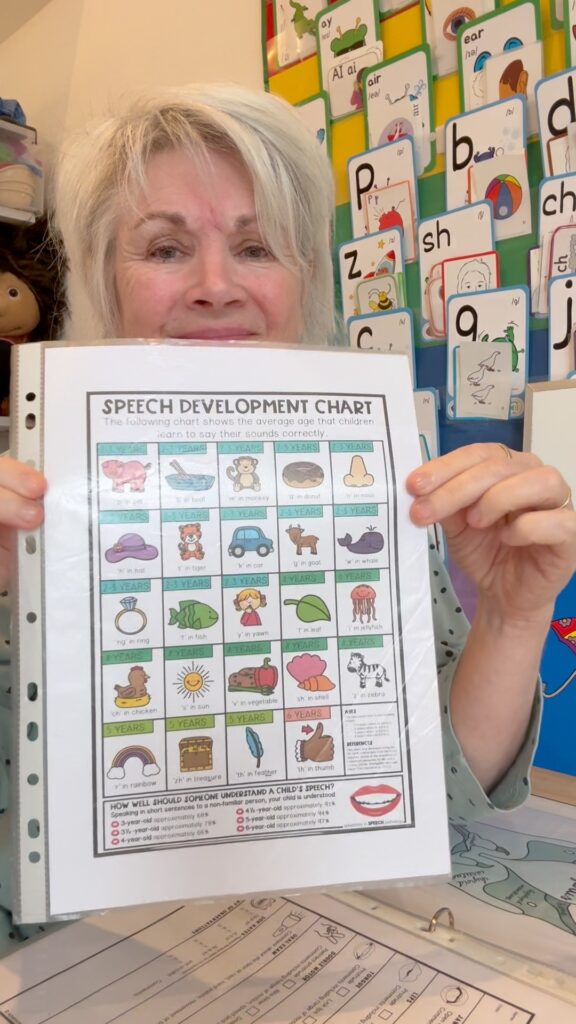
    Speech sound difficulties look different in every child. Two children can both struggle with the /K/ sound for completely different reasons. The assessment is how I find out the why, so that therapy targets the right thing from the start. For your child, it mostly feels like playing games and looking at pictures.

    Step 1: Listening to sounds

    I usually begin with sound awareness. This is your child’s ability to hear, notice and play with the sounds in words.

    We might do some rhyming (‘Does cat rhyme with hat?’) or clap out the beats in words, like ba-na-na or el-e-phant. Children usually enjoy this part, and it helps them settle in.

    Why start here? Being able to hear and think about sounds is the foundation for saying them clearly. It also supports reading and spelling later on. If a child finds it hard to hear the difference between sounds, that tells me a lot about where their speech difficulties may be coming from.

    Step 2: How the mouth moves

    Next, I look at oro-motor skills. That simply means how the lips, tongue and jaw look and move.

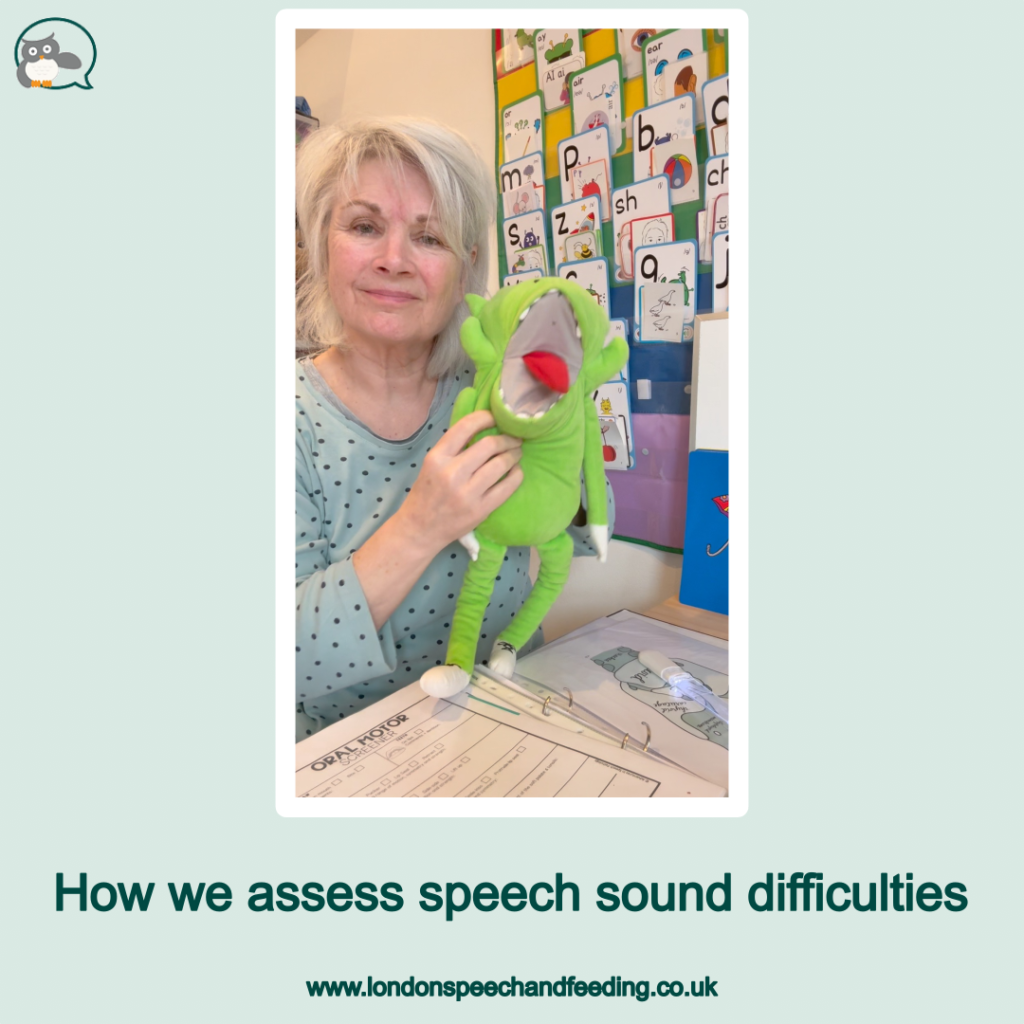
    I might ask your child to copy some movements: a big smile, a kiss, poking their tongue out, or moving it from side to side. I also watch how they manage these movements one after another. I often use my puppet and show how its tongue can move. Before I go and look into a child’s mouth I demonstrate on my puppet how we do this.

    This helps me check whether the muscles and movements needed for speech are working as they should. It is one piece of the puzzle, not the whole answer, but it helps me rule things in or out.

    Step 3: Vowels

    Vowels are the ‘open’ sounds in words, like the sounds in cat, bed, sheep, moon and boat. They are easy to overlook, but they make a huge difference to how clear speech sounds.

    I use vowel picture sheets and vowel pictures, and I listen carefully as your child names them. Most children get their vowels right quite early. If vowels are tricky, it can point towards particular types of speech difficulty, so this step really matters.

    Step 4: Choosing the right next assessment

    By this point I have a good idea of what might be going on. I then choose the assessment that fits your child best.

    The CLEAR Phonology Screen (or an informal phonology screen).

    Your child names a set of pictures, and I write down exactly how they say each word. This shows me which sounds they can say, which ones they swap, and any patterns. For example, some children leave off the ends of words (‘ca’ for ‘cat’). Others replace all back sounds with front sounds (‘tar’ for ‘car’). It also picks up difficulties with single sounds, such as a lisp on /S/.

    The Nuffield Dyspraxia Programme assessment.

    If I think your child might have difficulty planning and sequencing the movements for speech, I use this instead or as well as. This can be the case with childhood apraxia of speech, sometimes called verbal dyspraxia. Your child names pictures and copies words that gradually get longer. I am looking at how well they can link sounds and syllables together smoothly, and how consistent their speech is.

    I do not use every test with every child. Choosing the right one means the assessment is focused, and it does not tire your child out.

    What happens afterwards

    Once the assessment is done, I look closely at everything I have noted. I then talk you through what I found, in plain language. Together we agree clear goals for therapy and the order in which to work on them.

    You will also get ideas for simple games and activities to do at home. Short, regular practice at home makes a real difference to progress.

    A few things parents often ask

    Does my child need to prepare? No. Just come as you are. I adapt everything to your child’s age and mood on the day.

    What if my child is shy or will not join in? That is completely normal. I take things at your child’s pace, and we can always finish another time.

    Can I stay in the room? Yes. Many children feel more relaxed with a parent nearby, and it helps you see what we do. Some children do better on their own and we can discuss this as we go and I get to know you and your child.

    Will we need to do homework in between speech sessions? Yes, this is very important. Each week I will give you a couple of activities to do with your child which will help you practise what we do in the therapy room daily, and this is where progress is made!

    Worried about your child’s speech?

    If you have concerns about how your child is speaking, and assessment gives you clear answers and a plan. Get in touch with me to book an assessment or to ask any questions via my contact form. I look forward to hearing from you.

    Sonja McGeachie

    Sonja McGeachie

    Highly Specialist Speech and Language Therapist

    Owner of The London Speech and Feeding Practice.


    Health Professions Council registered
    Royal College of Speech & Language Therapists Member
    Member of ASLTIP

    Find a speech and language therapist for your child in London. Are you concerned about your child’s speech, feeding or communication skills and don’t know where to turn? Please contact me and we can discuss how I can help you or visit my services page.

    3
  • · ·

    Baby-led weaning: Empowering little eaters from the start

    I had a mum ask me about Baby Led Weaning the other day. So I thought I would write a blog on all the useful questions she had and what we discussed as it may help lots of mums and dads out there.

    As a Paediatric Feeding SLT, one of the exciting developments in recent years is the growing interest in baby-led weaning (BLW). This approach to introducing solids has gained significant traction, and for good reason. It empowers infants to take the lead in their feeding journey, fostering a positive relationship with food and supporting important developmental milestones.

    What exactly is baby-led weaning?

    At its core, baby-led weaning is about offering your baby appropriately sized and textured solid foods from the very beginning, allowing him or her to self-feed. Instead of spoon-feeding purées, you present whole, soft foods that your baby can grasp, bring to his or her mouth, and explore at his or her own pace. This means no mashing, no blending, and no forcing spoons into reluctant mouths. It’s a fun, messy, and intuitive process that is led by your baby’s natural instincts.

    The genesis of baby-led weaning

    ‘Baby-led weaning’ was popularised by British health visitor Gill Rapley. In the early 2000s, Rapley observed that babies naturally develop the skills needed to self-feed and that traditional spoon-feeding might actually hinder this development. Her work, particularly her book Baby-Led Weaning: The Essential Guide to Introducing Solid Foods (co-authored with Tracey Murkett), published in 2008, brought BLW into the mainstream and provided a structured framework for parents. Her research and observations highlighted the benefits of trusting a baby’s innate ability to regulate his or her intake and explore different textures.

    What’s the deal?

    Implementing BLW is simpler than you might think, though it does require a shift in mindset. Here’s a breakdown of what it typically involves:

    • Readiness is key: The golden rule of BLW is to wait until your baby shows clear signs of readiness. This isn’t about age alone, but rather developmental milestones. Your baby should be at least six months old, able to sit unassisted, have good head and neck control, show an interest in food (e.g., reaching for yours), and have lost his or her tongue-thrust reflex (which pushes solids out of his or her mouth).
    • Offer finger foods: Start with soft, easily graspable foods cut into finger-sized sticks or spears. Think cooked sweet potato fries, steamed broccoli florets (soft enough to mash with gentle pressure), banana sticks, or avocado slices. The goal is for babies to be able to pick it up and get some into their mouth.
    • Embrace the mess: BLW is inherently messy, especially in the beginning. Food will be squished, dropped, and smeared. This is a crucial part of the learning process as babies explore textures, smells, and the properties of food. A wipeable mat under the highchair and a good bib are your best friends!
    • Observe, don’t interfere: Allow your baby to lead. He or she will decide what to eat, how much, and how quickly. Avoid putting food into his or her mouth or pressuring him or her to eat more. This respects his or her hunger and fullness cues, laying the foundation for healthy eating habits.
    • Continue breastmilk or formula: Until your baby is well-established on solids, breastmilk or formula remains his or her primary source of nutrition. Solids are for exploration, taste, and developing skills, gradually increasing in quantity over time.

    The benefits of baby-led weaning

    The advantages of BLW extend far beyond simply getting food into your baby. From a speech and feeding perspective, the benefits are compelling:

    • Develops oral motor skills: Chewing, gnawing, and manipulating various food textures are crucial for developing the muscles in the mouth, jaw, and tongue. This strengthens the oral motor skills necessary for speech development.
    • Enhances fine motor skills and hand-eye coordination: The act of grasping food, bringing it to the mouth, and coordinating these movements significantly refines fine motor skills and hand-eye coordination.
    • Promotes self-regulation and intuitive eating: By allowing babies to control their intake, BLW helps them tune into their own hunger and fullness cues, fostering a healthy relationship with food and reducing the likelihood of overeating.
    • Encourages adventurous eating: Exposure to a wide variety of tastes and textures from the outset can lead to less picky eating later. Babies are more likely to accept new foods when they have been in control of their exploration.
    • Facilitates family mealtimes: BLW integrates babies into family mealtimes from an early age, promoting social interaction and making mealtime a shared, enjoyable experience.

    When is baby-led weaning appropriate, and when not?

    While BLW offers numerous benefits, it’s not a one-size-fits-all approach.

    When BLW is appropriate:

    • When your baby meets all the developmental readiness signs: This is paramount for safety and success.
    • When you are comfortable with the mess and the learning curve: It requires patience and a relaxed attitude.
    • When you are committed to offering a variety of safe, appropriate foods.
    • When you are willing to learn about and practise safe food preparation to minimise choking hazards.

    When BLW might not be appropriate (or requires extra caution and professional guidance):

    • If your baby has a history of prematurity or significant developmental delays: His or her oral motor skills might not be sufficiently developed.
    • If your baby has certain medical conditions or anatomical differences (e.g., cleft palate, severe reflux, swallowing difficulties): These may necessitate a modified approach to feeding.
    • If there are significant feeding difficulties, aversion, or a history of choking incidents.
    • If you feel overly anxious about choking: While BLW, when done correctly, is not associated with a higher choking risk than traditional weaning, parental anxiety can impact the feeding experience. Education and consultation with a professional can help alleviate these concerns.

    A note on safety: Choking hazards

    It’s crucial to understand the difference between gagging and choking. Gagging is a natural reflex that helps prevent choking and is very common in BLW as babies learn to manage food in their mouths. Choking is silent and serious. To minimise choking risks:

    • Always supervise your baby closely during mealtimes.
    • Offer appropriately sized and textured foods. Avoid small, round, hard foods like whole grapes, nuts, popcorn, and large chunks of meat.
    • Ensure your baby is sitting upright and calm.
    • Educate yourself on infant CPR.

    Final thoughts

    Baby-led weaning is a wonderfully empowering approach that celebrates a baby’s natural abilities and fosters a positive and independent relationship with food. As Speech and Language Therapists we often see the positive impact it has on oral motor development, self-regulation, and overall feeding confidence. By understanding what it entails, when it’s appropriate, and prioritising safety, you can embark on this exciting journey with your little one, helping him or her become a confident and capable eater from the very first bite.

    If you would like help and support with weaning your baby whilst continuing to breastfeed then please get in touch!

    Sonja McGeachie

    Highly Specialist Speech and Language Therapist

    Owner of The London Speech and Feeding Practice.

    Health Professions Council registered
    Royal College of Speech & Language Therapists Member
    Member of ASLTIP

    Find a speech and language therapist for your child in London. Are you concerned about your child’s speech, feeding or communication skills and don’t know where to turn? Please contact me and we can discuss how I can help you or visit my services page.

    1