How we assess speech sound difficulties

| | | |

If your child is hard to understand, mixes up sounds, or says ‘tat’ instead of ‘cat’, you might be wondering what actually happens at a speech sound assessment. It is a really common question, so I want to walk you through what I do in clinic.
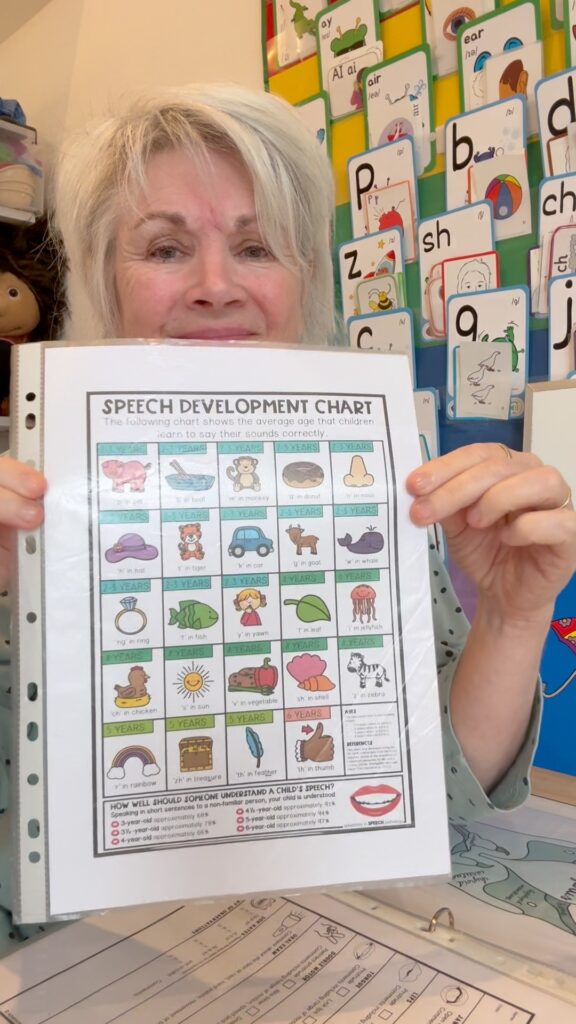
Speech sound difficulties look different in every child. Two children can both struggle with the /K/ sound for completely different reasons. The assessment is how I find out the why, so that therapy targets the right thing from the start. For your child, it mostly feels like playing games and looking at pictures.

Step 1: Listening to sounds

I usually begin with sound awareness. This is your child’s ability to hear, notice and play with the sounds in words.

We might do some rhyming (‘Does cat rhyme with hat?’) or clap out the beats in words, like ba-na-na or el-e-phant. Children usually enjoy this part, and it helps them settle in.

Why start here? Being able to hear and think about sounds is the foundation for saying them clearly. It also supports reading and spelling later on. If a child finds it hard to hear the difference between sounds, that tells me a lot about where their speech difficulties may be coming from.

Step 2: How the mouth moves

Next, I look at oro-motor skills. That simply means how the lips, tongue and jaw look and move.

I might ask your child to copy some movements: a big smile, a kiss, poking their tongue out, or moving it from side to side. I also watch how they manage these movements one after another. I often use my puppet and show how its tongue can move. Before I go and look into a child’s mouth I demonstrate on my puppet how we do this.

This helps me check whether the muscles and movements needed for speech are working as they should. It is one piece of the puzzle, not the whole answer, but it helps me rule things in or out.

Step 3: Vowels

Vowels are the ‘open’ sounds in words, like the sounds in cat, bed, sheep, moon and boat. They are easy to overlook, but they make a huge difference to how clear speech sounds.

I use vowel picture sheets and vowel pictures, and I listen carefully as your child names them. Most children get their vowels right quite early. If vowels are tricky, it can point towards particular types of speech difficulty, so this step really matters.

Step 4: Choosing the right next assessment

By this point I have a good idea of what might be going on. I then choose the assessment that fits your child best.

The CLEAR Phonology Screen (or an informal phonology screen).

Your child names a set of pictures, and I write down exactly how they say each word. This shows me which sounds they can say, which ones they swap, and any patterns. For example, some children leave off the ends of words (‘ca’ for ‘cat’). Others replace all back sounds with front sounds (‘tar’ for ‘car’). It also picks up difficulties with single sounds, such as a lisp on /S/.

The Nuffield Dyspraxia Programme assessment.

If I think your child might have difficulty planning and sequencing the movements for speech, I use this instead or as well as. This can be the case with childhood apraxia of speech, sometimes called verbal dyspraxia. Your child names pictures and copies words that gradually get longer. I am looking at how well they can link sounds and syllables together smoothly, and how consistent their speech is.

I do not use every test with every child. Choosing the right one means the assessment is focused, and it does not tire your child out.

What happens afterwards

Once the assessment is done, I look closely at everything I have noted. I then talk you through what I found, in plain language. Together we agree clear goals for therapy and the order in which to work on them.

You will also get ideas for simple games and activities to do at home. Short, regular practice at home makes a real difference to progress.

A few things parents often ask

Does my child need to prepare? No. Just come as you are. I adapt everything to your child’s age and mood on the day.

What if my child is shy or will not join in? That is completely normal. I take things at your child’s pace, and we can always finish another time.

Can I stay in the room? Yes. Many children feel more relaxed with a parent nearby, and it helps you see what we do. Some children do better on their own and we can discuss this as we go and I get to know you and your child.

Will we need to do homework in between speech sessions? Yes, this is very important. Each week I will give you a couple of activities to do with your child which will help you practise what we do in the therapy room daily, and this is where progress is made!

Worried about your child’s speech?

If you have concerns about how your child is speaking, and assessment gives you clear answers and a plan. Get in touch with me to book an assessment or to ask any questions via my contact form. I look forward to hearing from you.

Sonja McGeachie

Sonja McGeachie

Highly Specialist Speech and Language Therapist

Owner of The London Speech and Feeding Practice.


Health Professions Council registered
Royal College of Speech & Language Therapists Member
Member of ASLTIP

Find a speech and language therapist for your child in London. Are you concerned about your child’s speech, feeding or communication skills and don’t know where to turn? Please contact me and we can discuss how I can help you or visit my services page.

3

Similar Posts

  • ·

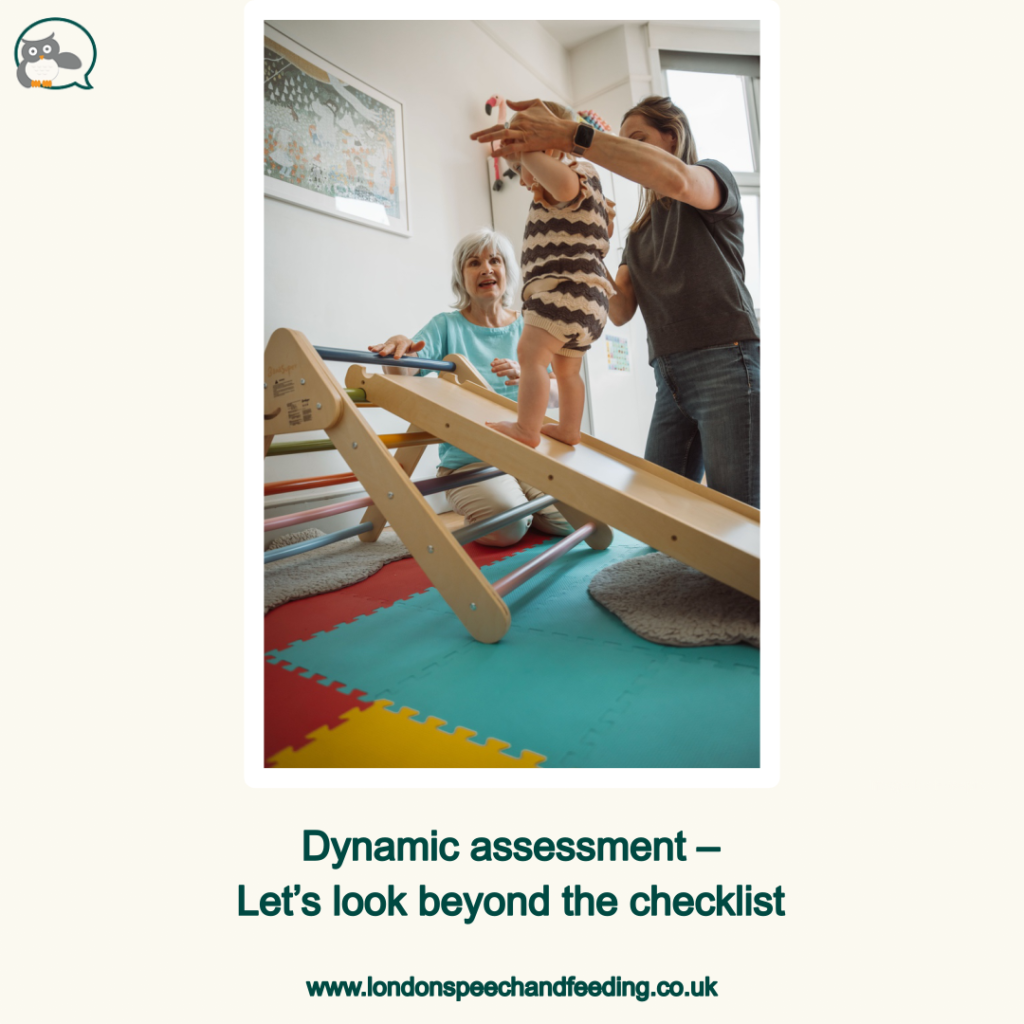
    Dynamic assessment – Let’s look beyond the checklist

    Dynamic assessment – Let’s look beyond the checklist

    As a parent, you’re always observing your child, celebrating his or her milestones, and sometimes, wondering if he or she is quite on track. When it comes to speech, language, play, attention, and listening, these early years are a whirlwind of development! It’s natural to seek guidance if you have concerns, and that’s where a truly comprehensive assessment comes in.

    But what exactly does ‘comprehensive’ mean, especially when it goes beyond a typical checklist? You can find any number of check lists online these days but whilst they can give you an overall idea of what a child is typically expected to do at any given age, it can also start leading you into a rabbit hole of anxiety of ‘what-iffery’.

    At The London Speech and Feeding Practice I believe in something far more insightful than a static evaluation: Dynamic Assessment. Think of it as an in-depth, interactive investigation into your child’s unique communication landscape, exploring not just what he or she can do, but how he or she learns and why he or she might be facing challenges. This is so important.

    What makes an assessment ‘dynamic’?

    Imagine trying to understand a child’s personality by just looking at a single photograph. It gives you a glimpse, but it hardly tells the whole story. Traditional, formal assessments, while valuable, can sometimes be like that photograph – a snapshot of skills at one specific moment.

    Dynamic assessment, on the other hand, is a living, breathing process. It’s called ‘dynamic’ because:

    • It’s interactive and responsive: It adapts to your child’s needs in real-time. It’s not about sticking rigidly to a pre-set schedule of tests. Instead, it’s about observing, gently prompting, and providing support to see how your child responds and learns. This allows me to understand his or her learning potential, not just his or her current performance.
    • It’s holistic and multi-faceted: I look at the whole child. We delve deep into not just speech and language, but also his or her play skills (a crucial window into cognitive and social development), attention and listening abilities, and his or her social engagement. These areas are intricately linked, and a delay in one can often impact others.
    • It integrates multiple perspectives: Your insights as a parent are invaluable! Before we even meet, my comprehensive onboarding questionnaire gathers essential background. During the assessment, your feedback, observations, and comments are woven into the fabric of our session. You are the expert on your child, and your voice is central to forming a complete picture.
    Dynamic assessment – Let’s look beyond the checklist

    More than just ‘speech’: A deep dive into development

    You might initially be concerned about your child’s speech sounds, or perhaps his or her ability to form sentences. These are vital areas, but my approach goes much further. I’m keen to understand:

    • The ‘why’ behind the ‘what’: Is a child struggling with language because of difficulties with understanding instructions (receptive language), or with expressing themselves (expressive language)? Are his or her attention skills impacting his or her ability to follow a conversation? Is his or her play demonstrating imaginative thought, or does he or she prefer more structured, repetitive activities? These nuances are critical.
    • Differential diagnosis: This is where the skill of an experienced clinician truly comes into its own. Through dynamic assessment, I can differentiate between a developmental delay (where a child is following a typical progression but at a slower pace) and a disorder (where his or her development is following an atypical pattern). This distinction is vital because it guides the type of support and intervention that will be most effective. Understanding the cause of the delay or disorder is paramount to creating a targeted, impactful therapy plan.

    The art of observation

    While I draw upon evidence-based practice as well as a formal, standardised assessment as well as my extensive clinical knowledge, I also rely heavily on the art of observation. From the moment your child walks into the room, I’m establishing rapport, engaging them in play, and creating a safe, fun environment. It’s through this genuine interaction – often without them even realising they’re being ‘assessed’ – that the most authentic insights emerge.

    This is where the magic happens:

    • Building rapport: A child who feels comfortable and connected will show you so much more of his or her true abilities and personality. I pride myself on creating an atmosphere where children can relax and simply be themselves.
    • Play as a window: Play isn’t just fun; it’s a child’s natural language. It reveals his or her understanding of the world, his or her problem-solving skills, his or her social engagement, and his or her ability to use symbols and language.
    • Skilled interpretation: My years of experience allow me to see beyond surface-level behaviours and interpret the subtle cues that might indicate underlying strengths or challenges. This goes far beyond what any standardised test alone can capture.

    Why choose a clinician who offers dynamic assessment?

    In essence, a dynamic assessment provides a rich, nuanced, and truly personalised understanding of your child. It’s an investment in:

    • Accuracy: Leading to a more precise diagnosis and understanding of his or her unique profile.
    • Tailored support: Enabling the creation of highly individualised therapy goals that truly meet your child where he or she is and gently guide him or her forward.
    • Empowerment: You’ll leave with not just answers, but also practical strategies and a clear path forward, feeling confident and informed.

    If you’re seeking a thorough, empathetic, and truly insightful assessment for your child’s communication development in London, I invite you to get in touch. Let’s work together to unlock your child’s full potential.

    Sonja McGeachie

    Highly Specialist Speech and Language Therapist

    Owner of The London Speech and Feeding Practice.

    Health Professions Council registered
    Royal College of Speech & Language Therapists Member
    Member of ASLTIP

    Find a speech and language therapist for your child in London. Are you concerned about your child’s speech, feeding or communication skills and don’t know where to turn? Please contact me and we can discuss how I can help you or visit my services page.

    1
  • · ·

    Explore how to improve communication skills for a Gestalt Language Processor

    Let’s break it down into steps to make these complicated words easier to understand. Once you have a deeper understanding, you will then be able to support your child or young person develop their communication skills in the best way as a Gestalt Language Processor. Remember not every child will be a Gestalt Language Processor; if your child uses echolalia and/or has a diagnosis of autism then your child’s way of processing language is most likely different to the classic way children typically learn language.

    Let’s start with understanding what each of these words “Gestalt Language Processors” mean.

    Gestalt: “the way a thing has been placed or put together”

    Language: “a system of human communication”

    Processors: “responds to and processes basic instruction”

    So, let’s put those meanings together. “Gestalt Language Processors are children who process early language in strings of sounds or chunks.” They tend not to process single words.

    It is important to understand this way of processing communication because between 75-90% of children with Autistic Spectrum Conditions process language in this way (Blanc, 2012). We know that it’s important for young people to have their voice heard and to be able to express themselves. So, it’s vital that they move from echolalia to self-generated communication to be able to do this. This means that our children’s communication partners play a vital role in supporting their child’s language. We can support our children by modelling phrases until the child has learnt the process themselves.

    Speech Therpaist in London

    Let’s explore an example together

    X (who is a gestalt language processor) and his family love to feed the ducks in their spare time; this is an activity that takes place regularly. Let’s look at how you, as the adults, could support X in his communication. Look at the phrases that are used. They are meaningful to the activity with repetition used throughout.

    Top tip: You could think of an activity you and your child or young person take part in on a regular basis and brainstorm some key phrases that you could use.

    Need a boost in confidence to support your child’s gestalt language processing?

    Contact me.


    Find a speech and language therapist for your child in London. Are you concerned about your child’s speech, feeding or communication skills and don’t know where to turn? Please contact me and we can discuss how I can help you or visit my services page.

    6
  • ·

    Four struggles parents face when out and about with children with speech, language, and communication difficulties

    A man and a woman hug a young girl at a table
    Hug

    You (as parents) often describe yourselves as being under constant pressure and stress when looking after your children and young people with Special Educational Needs and Disabilities (SEND). You may find going out to do the simplest of tasks a challenge. And you will try to avoid social situations out of fear and anxiety. One of the most important factors to you is having like-minded people who understand your position as a parent with a young person with additional needs. Let’s look at some of the challenges you face and how I can support you and your family.

    1. Challenging behaviour and going out to the shops

    When your child displays challenging behaviour and won’t go into a shop without buying a toy that they insist on having, it can be tough on your family. You see people around you staring as you try to manage the situation. They do not understand the pressures you face, or that the simplest of tasks are a huge challenge.

    I can support you by giving strategies to use when out and about. I know that using visuals is important for your child. They may not understand or take in language when they are in a heightened state of anxiety or feeling overwhelmed. You could print pictures of the places you’re going to and put them on an easily accessible chain. Then you could use that chain when out and about at the shops. You may want to introduce a visual timetable at home. That way your child or young person understands where they are going. This may lessen their anxiety and subsequent behaviour.

    2. Your child is not able to communicate their needs to an unfamiliar communication partner

    When your child has difficulty communicating to an unfamiliar person it can be hard to manage. You feel yourself explaining your situation repeatedly. I can provide your child with individualised strategies or communication aids which support your child to communicate with both familiar and unfamiliar communication partners. We’ll work together to find which communication methods work in different situations and how your child will use these to help their independence.

    3. Being overwhelmed

    Your child or young person may easily be overwhelmed which may contribute to behaviour changes. I’ll work with your family to understand what the behaviour means, looking at what happened before and what happened afterwards. We’ll not only look at the behaviour but at the environment as well. This can inform how you can support your child or young person in the future, to reduce sensory stimuli (if needed) and for them to feel emotionally regulated.

    4. People avoid engaging with you

    One of the hardest things as a parent is for others to avoid you. You see them crossing the street because they don’t know what to say to you. All you want is them to accept you, to maintain your identity as a person and not as a SEND parent. I can support you emotionally. I can give you advice on local support networks where you can find other parents in a similar situation.

    We know the stresses that being a parent with a child with SEND comes with. Please know I am always here to support you, to find solutions so that when you’re next out and about. Your experience will be a little easier and you’ll feel less isolated.

    Improve your child’s communication, confidence, reduce overwhelm and feel supported here.


    Find a speech and language therapist for your child in London. Are you concerned about your child’s speech, feeding or communication skills and don’t know where to turn? Please contact me and we can discuss how I can help you or visit my services page.

    1
  • A day in my speech clinic: Mastering the /SP/ cluster

    I very often work on /S/ Blends (/SP/ /ST/ /SM/ /SK/ /SN/ and /SL/). When we work on these sound blends (like SPider, STop, or SMile), we are using a clever speech therapy ruse! Because these blends are complex, teaching a child how to master them naturally helps them clear up simpler single sounds (like just /S/ or just /P/) at the same time. Plus, because S-blend words are so common in everyday language think spoon, spy, spot, and spin, practising them gives your child an immediate confidence boost when they are understood much more easily.

    Good news: high-repetition motor practice doesn’t have to be a chore. In fact, the more sensory input we can provide, the faster those new neural pathways are built. Recently, I recorded a series of seven short clips to demonstrate how we can weave intense speech practice into the fabric of play.

    Here is a look at a typical day in the clinic focusing on /SP/ blends.

    1. The sensory sandbox:

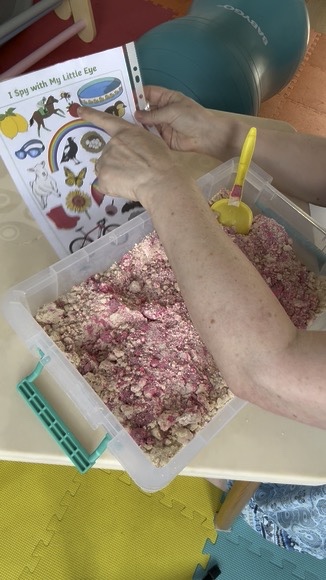
    We started our session at the sensory table. Sensory bins can often work well because they provide tactile feedback that grounds the child’s focus (of course they are usually messy, so one needs to have the physical space and energy for it to be fair!).

    • The Activity: I pointed to our ‘I Spy’ board before we dove into the sand. Using a toy spade we dug for hidden objects and named them each time we found one.
    • Every time we scooped, we practised Spade. Every discovery was a spider, a spoon or a spotty animal. By pairing the physical effort of digging with the speech sound, we help the brain synchronise motor planning and vocal execution.

    2. Bingo dabbers rock!

    Next, we moved to making ink marks on paper.

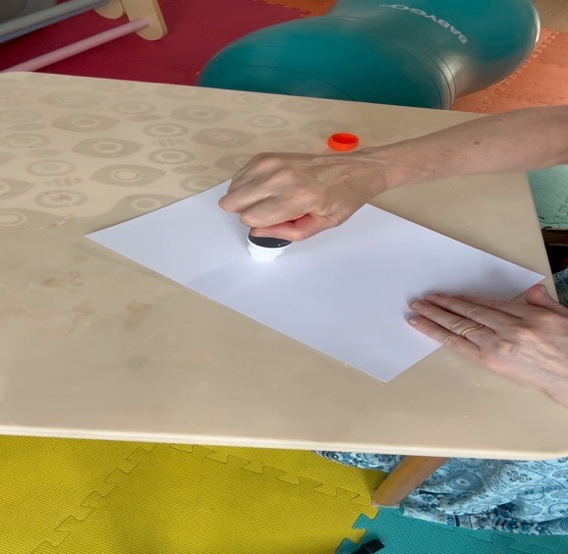
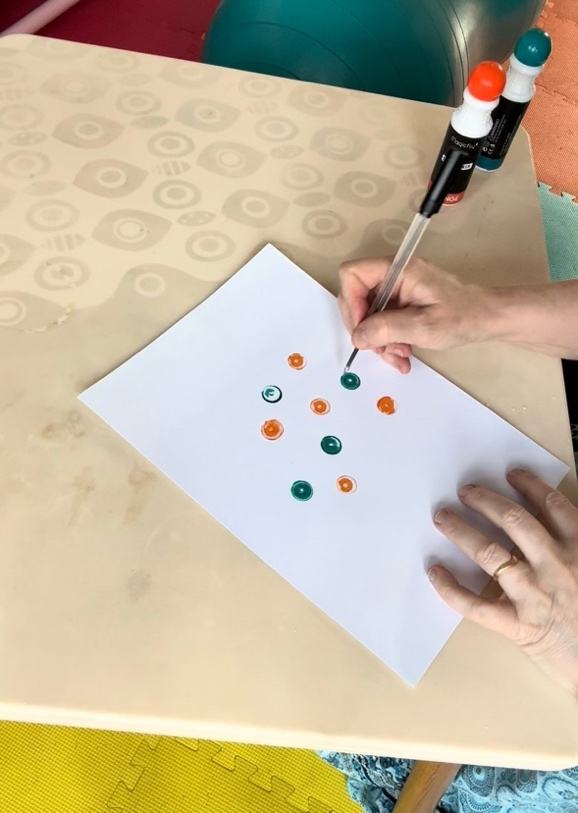
    • The Activity: I demonstrated making spots with coloured bingo dabbers.
    • We treated each ink spot as a visual anchor. Stamp –Spot Stamp –Spot. This creates a rhythmic pacing that prevents the child from rushing. It’s a wonderful way to get 50+ repetitions in under five minutes without the child even realising they are ‘working’.

    3. Drawing spiders

    Building on the previous activity, we took those spots and turned them into something more complex.

    • The Activity: I drew spiders out of the spots we had just made.
    • Drawing the legs provided a perfect opportunity for ‘stretch’ sounds. As we drew a long leg, we practise a long, hissy ‘Sssssssss’, snapping into the /P/ as the pen hits the spot.

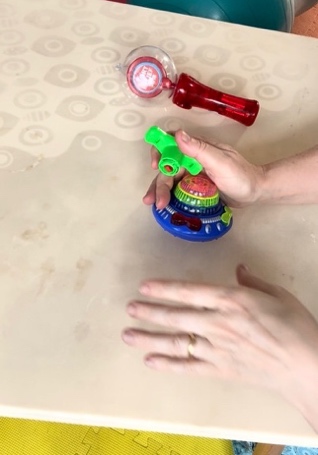
    4. Wind-up spinners

    High-energy toys are excellent for eliciting ‘power’ sounds.

    • The Activity: I brought out two mechanical wind-up spinners.
    • Method: The child says Spin or Spinner to get me to wind them up. The anticipation of the toy moving acts as a natural reinforcer.

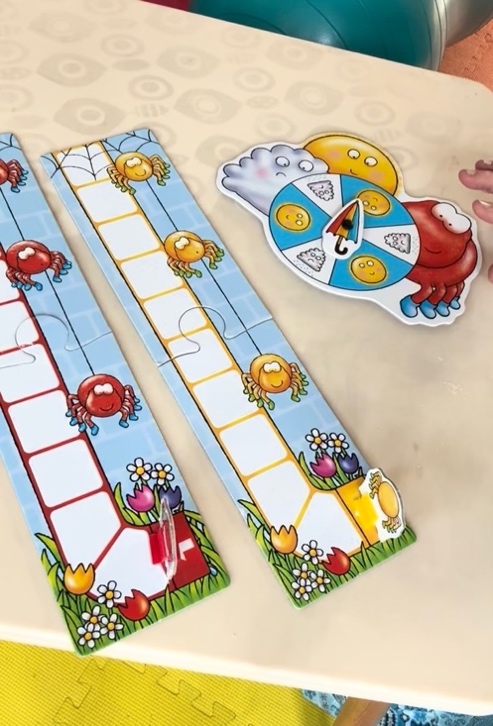
    5. The Incy Wincy spider game

    • The Activity: I spun a game spinner to determine how many steps our toy spiders would take up the spout.
    • This activity is a triple threat. We practised ‘Spin’, ‘Spider’, and ‘Spout’ all in one go. The visual of the spider moving up the spout also helps with the concept of UP and DOWN of course.

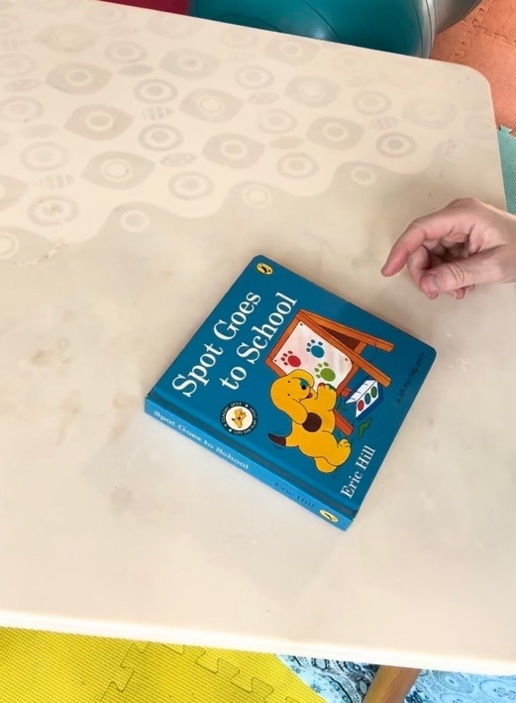
    6. Searching for Spot

    Books are a great tool for generalisation, taking a sound from a single word and moving it into phrases and sentences.

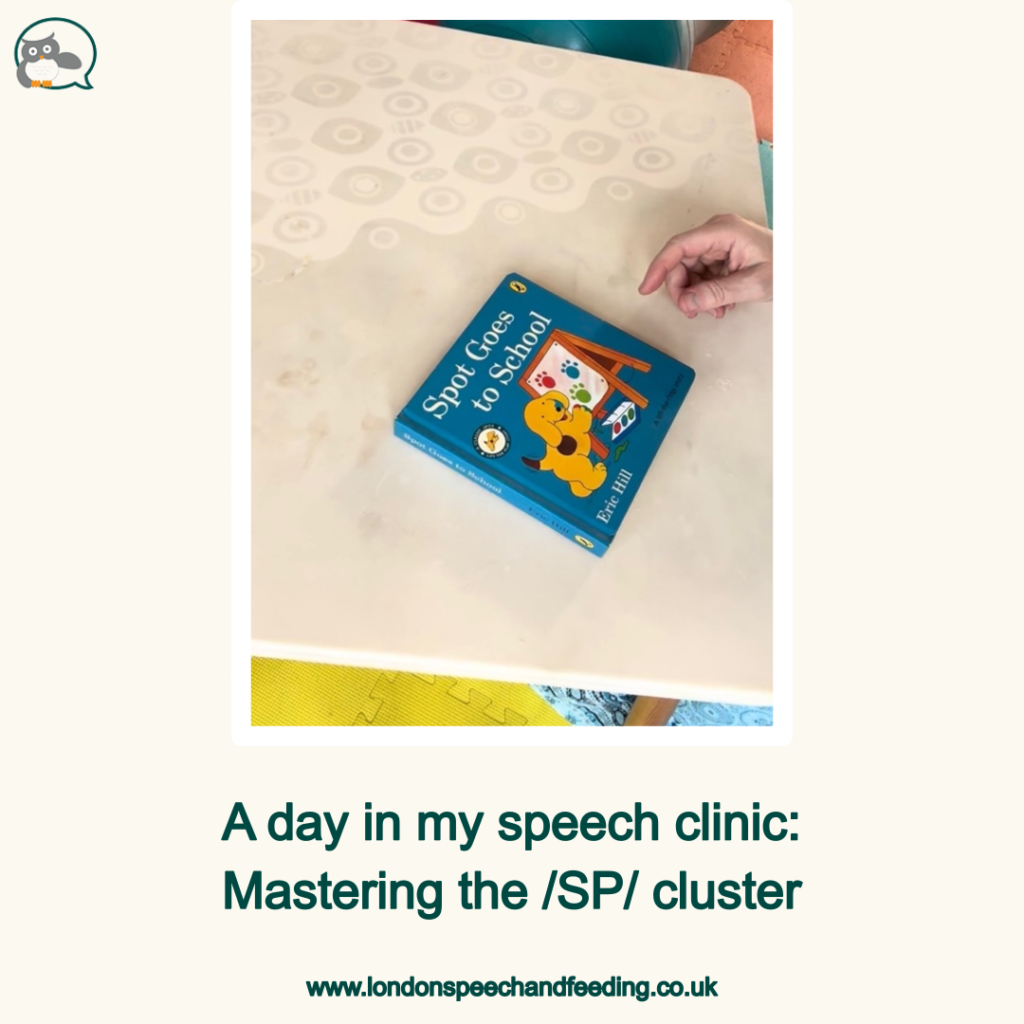
    • The Activity: We went through a ‘Spot the Dog’ book.
    • Instead of just reading, we used the ‘I Spy’ strategy. ‘I spy Spot! He has a big spot on his back!’ This encourages the child to use the target word in a functional, communicative way rather than just repeating it after me.

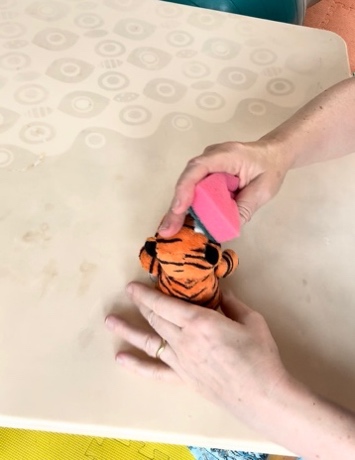
    7. Finally, sponging off some sand

    We ended the session with some ‘heavy work’ and cleaning.

    • The Activity: We took a soft toy that had gotten a bit ‘dusty’ in the sandbox and used a sponge to clean it down.
    • The action of squeezing the sponge provides proprioceptive input (pressure), which can be very calming and help a child focus on their articulatory placement for those final repetitions of the day.
    A day in my speech clinic: Mastering the /SP/ cluster

    Speech therapy works on motor learning. Just like learning to ride a bike or play the piano, the brain needs thousands of correct repetitions to make a movement automatic. By using /SP/ words in these seven distinct, sensory-rich ways, we:

    1. Reduce frustration: The focus is on the play, not the correction.
    2. Increase engagement: A child who is having fun will stay in the learning zone longer.
    3. Provide context: The child learns that saying /SP/ correctly helps them get the spade, spin the spinner, and find the spider.

    Next time I will show you some more activities for /ST/ and /SM/ words. If you have any super ideas for /S/ cluster words please leave me your suggestions in the comments on instagram, I would appreciate it thank you! 😊

    If you are concerned about your child’s speech, please do not hesitate to get in touch. I would love to help you find some answers.

    Sonja McGeachie

    Highly Specialist Speech and Language Therapist

    Owner of The London Speech and Feeding Practice.


    Health Professions Council registered
    Royal College of Speech & Language Therapists Member
    Member of ASLTIP

    Find a speech and language therapist for your child in London. Are you concerned about your child’s speech, feeding or communication skills and don’t know where to turn? Please contact me and we can discuss how I can help you or visit my services page.
    3
  • · ·

    Stage 2 NLA

    Image by Freepik

    Last time we asked: is our child ready tp move to Stage 2 NLA (Natural Language Acquisition stage 2) and we looked at how we can know. Now we know: he/she is ready, they are mixing and matching those scripts quite liberally! Hurrah!

    So for example we hear phrases like:

    • ‘let’s go’+ ‘downstairs’
    • ‘it’s’ + ‘downstairs’
    • ‘I see it’ + ‘downstairs‘
    • ‘I want to’ + ‘shoes downstairs’ (I want to put my shoes on downstairs)

    To recap, it’s important to listen out to a variety of contexts because if we only hear the single version of a gestalt —this is so great, hurrah!— but that’s not yet Stage 2.

    What we can now do on a daily basis to help and support at this time:

    1. We need to offer more ‘mix and match’ phrases to help our child establish this new way of communicating.

    Good phrases:

    • It’s … raining / cooking / eating / washing / brushing
    • That’s … great / cool / amazing / wow / so good
    • Let’s … see / look / go / run / chase
    • How’bout … some food / playing / I’ll chase / sleeping / we read a book
    • I see a … bird / large car / fire engine
    • I wanna … have a biscuit / have a book / have a snuggle
    • We’re … going out / going home / going in the car / going upstairs

    Here in my video clip of train play I use:

    • Let’s go
    • It’s going up the hill
    • It’s coming down
    • Ooops it falls!
    • It’s stopping
    • Let’s put on another parcel
    • Ready steady go
    • Off we go
    • It’s come off!
    • Let’s fix it
    • I can do it
    • I don’t need help

    You can offer these gestalts either with an AAC as you can see me do in the video clip or you can just verbally offer these.

    2. Watch out for Pronoun confusion or reversal:

    Gestalt kids repeat gestalts, so we don’t want to create ‘pronoun reversal’.

    Instead model from a:

    • first person perspective: ‘I’ / ‘Our’ / ‘Us’
    • joint perspective: ‘We’ / ‘Let’s’ or a
    • neutral perspective: ‘It’

    You can turn almost any sentence into a good language model once you get used to it. And you can avoid ‘you’ and ‘your’ at the same time!

    So instead of saying, ‘Do you want to go to the park?’

    You could say:

    • We wanna go to the park?
    • Let’s go out?
    • Shall we go out / to the park?

    3. Start providing ‘variation’ in your language modelling:

    Instead of just modelling something one way, start thinking about offering a pattern in a couple of other ways, in a couple of different situations, then several ways in several different situations.

    Example: once you hear your child saying: ‘it’s raining’ and you know it’s a mitigation, because you don’t often say ‘it’s raining’, or haven’t said it in a while and you know your child says other ‘it’s’ phrases.

    Repeat: ‘it’s raining!’

    Then: ‘it’s’ + ‘raining hard’ / ‘it’s wet out there’ / ‘It’s’ + ‘raining lot’s’.

    Then later think of other combinations for ‘it’s’ + ‘something’:

    • (rice) ‘It’s’ + ‘cooking’
    • (water/tap) ‘It’s’ + ‘running’
    • (radio) ‘It’s’ + ‘singing
    • (dog) ‘It’s’ + ‘peeing’ / ‘it’s’ + ‘running’ / ‘it’s’ + ‘jumping’

    In my train video clip:

    • Let’s go
    • It’s going
    • Let’s make it go
    • Ready steady go
    • Oops its gone

    4. Use natural intonation that shows you really mean what you’re saying.

    You can be animated or try for musical if your child prefers that / doesn’t mind you singing —they might not like it if their hearing is pitch perfect and your singing is off key…—

    • ‘I’m’ + ‘trying to find you!’ (animated, goofy face)
    • ‘I’m’ +’ getting tired!’ (exaggerated stretch and yawn)
    • ‘I’m’ + ‘catching up with you!’ (animated goofy)
    • ‘I’m’ + ‘gonna get you!’ (animated goofy)
    • ‘I’m’ + ‘sad right now’ (exaggerated face and tone of voice)

    5. USE SILENCE!

    Important, I might not have said this before but we need to hold back sometimes (hard I know) and not constantly offer models. Let our child sit in a bit of silence with us there just observing and waiting for their own offers. This is a very important point. Silence is golden sometimes. Try it out. I am not talking about the silence that comes with a person scrolling on their phone though, we do need to be present and receptive.

    You will see this works wonders!

    Do get in touch if you would like some in-person or on-line 1:1 support with this. It can be overwhelming to figure it all out alone.

    You can also check my friend’s lovely handmade jewelry on her website.


    Find a speech and language therapist for your child in London. Are you concerned about your child’s speech, feeding or communication skills and don’t know where to turn? Please contact me and we can discuss how I can help you or visit my services page.
    1
  • Speech sound disorders

    Kids Speech Therapist London
    Speech Sound Disorders

    Treatment Approaches – A Typical Session

    There are various great ways to treat speech sound disorders and I use all the approaches available selectively; I decide what works with each individual child and I also vary the approach depending on the child’s frame of mind at any given time during my session.

    Some of the approaches are more “drill-based” and require a child to be able to pay attention and really participate actively in the therapy, and this is what I am showing you today with this video clip.

    My little student here has been working with me for some time and from only saying a handful of words which were not very easy to understand he has come a long way. He does have some features of Verbal Dyspraxia which I shall briefly outline here:

    • Making sounds in general is a struggle, especially when asked to copy certain sounds, example: ‘can you say: a ee ou oo?”
    • Repeating sound sequences or words sequences is hard, for example: “say p-t-k in sequence” or “say fish chips fish chips fish chips
    • When saying the same word again and again, different mistakes can be heard
    • Intonation difficulties: speech sounds monotonous
    • Vocabulary is very limited

    Some therapy approaches are more play based, for example the Core Word method: here we pick a few words at a time which are very significant to the child and therefore highly motivating to try and say. These could be characters of Pokemon or Minecraft for example, or simple words like “GO!”

    When you watch the video you will see that I use a lot of visual prompting, such as showing him where the tongue is moving to or from. I do this with my index finger and this approach is called Tactile Cueing or “Cued Articulation”. Part of the approach is to give a visual prompt and then reduce the prompt as the learner is more able to produce the correct sounds. Once he can produce the sound on its own, we quickly move to the sound within a word.

    I do mix and match my approaches and in fact here I am drilling but I also use the Core Word which for him (YELLOW) — it’s his favourite colour and I happen to have quite a few good games where a YELLOW something or other can be asked for….. WHO KNEW!? 🙂


    Find a speech and language therapist for your child in London. Are you concerned about your child’s speech, feeding or communication skills and don’t know where to turn? Please contact me and we can discuss how I can help you or visit my services page.