Halloween without the tears: Supporting children through the Spooky Season

| |

For many families, Halloween is an exciting time filled with costumes, decorations, and sweets. But for children who are sensory sensitive, whether they’re autistic, have sensory processing differences, or simply find new experiences overwhelming, Halloween can feel like a night of chaos rather than fun.

The bright lights, unexpected noises, strange textures, and social pressure to ‘join in’ can quickly become too much. The good news? With some thoughtful planning and gentle support, you can make Halloween a positive and manageable experience for your child.

Understanding sensory overload

Sensory overload happens when a child’s brain receives more sensory input than it can process. This might mean:

  • Costumes that itch, squeeze, or feel strange on the skin.
  • Loud sounds like doorbells, fireworks, or shrieking decorations.
  • Crowds and unpredictability during trick-or-treating.
  • Strong smells or tastes from face paint or unfamiliar sweets.

When overloaded, children may cry, cover their ears, hide, run away, or ‘shut down.’ These reactions aren’t ‘bad behaviour’, they’re signs of distress. The goal isn’t to eliminate Halloween fun, but to adjust it to your child’s comfort level.

Step 1: Choose costumes wisely

Costumes are often the biggest trigger. Scratchy fabrics, tight seams, or masks that restrict breathing can be unbearable for some children.

Try these tips:

  • Go sensory-friendly: Use soft, breathable fabrics and remove tags. Many retailers now sell sensory-safe costumes.
  • Test it early: Let your child wear the outfit around the house before Halloween. If it’s too much, simplify — maybe themed pyjamas or a favourite T-shirt with Halloween accessories.
  • Skip the mask: Face paint can be equally challenging, always test on a small patch of skin first. A comfortable headband or hat might be enough to feel ‘in costume.’

Remember, participation doesn’t require perfection. Your child can still ‘be’ their favourite character without a full costume.

Step 2: Plan your Halloween environment

Before the big day, think about what parts of Halloween your child enjoys — and what might overwhelm them.

At home:

  • Keep decorations minimal and predictable. Avoid motion-activated sounds or flashing lights.
  • Practise knocking at your own front door or saying ‘trick or treat’ with a trusted adult.
  • Have a ‘quiet space’ ready, a cosy corner or room where your child can retreat if things get too intense.

If you’re going out:

  • Choose earlier, quieter times for trick-or-treating.
  • Visit a few familiar houses instead of the whole street.
  • Bring ear defenders or noise-cancelling headphones.
  • Have a clear exit plan if your child needs a break.

Sometimes, watching from the window and handing out sweets can be just as enjoyable! it still offers social participation without sensory overload.

Step 3: Prepare socially and emotionally

Halloween involves a lot of unexpected social interaction: strangers at the door, unfamiliar greetings, and different rules.

Help your child by:

  • Using visuals or stories: Read picture books about Halloween or make a short social story about what will happen.
  • Role-playing: Practise saying ‘Trick or treat!’ or handing out sweets in a fun, low-pressure way.
  • Labelling feelings: Explain that it’s okay to feel nervous or to take a break if something feels ‘too loud’ or ‘too much.’

Children feel safer when they know what to expect. Predictability reduces anxiety and makes participation more enjoyable.

Step 4: Rethink the treats

Not every child enjoys sweets; some dislike sticky textures or strong flavours. Offer non-food alternatives like stickers, glow sticks, or small toys.

If your child has feeding difficulties or oral sensitivities, it’s okay to opt out of the traditional treats entirely. They can still join in by giving treats or decorating treat bags instead.

It’s also helpful to prepare your child that others might offer sweets they don’t want. Practising polite ‘no thank you’ responses can make these moments easier. (check out my symbol download for children who struggle to speak)

Step 5: Celebrate your way

Halloween doesn’t have to look like anyone else’s version. Maybe your family watches a ‘not-too-scary’ film, carves pumpkins, or does a flashlight treasure hunt indoors. The goal is joyful connection, not conformity.

A calm, happy experience, even if it looks simple from the outside builds positive associations your child will carry into future celebrations.

In summary

Halloween can be full of sensory surprises, but with empathy, planning, and flexibility, it doesn’t have to end in tears.

The more you adapt to your child’s sensory needs, the more they learn that they are safe, understood, and included not just at Halloween, but in every celebration.

As with all things in speech and feeding development, progress starts with connection. When children feel regulated and supported, communication and confidence follow.

Sonja McGeachie

Highly Specialist Speech and Language Therapist

Owner of The London Speech and Feeding Practice.


Health Professions Council registered
Royal College of Speech & Language Therapists Member
Member of ASLTIP

Find a speech and language therapist for your child in London. Are you concerned about your child’s speech, feeding or communication skills and don’t know where to turn? Please contact me and we can discuss how I can help you or visit my services page.

2

Similar Posts

  • · · · ·

    Holiday disruptions & New Year routines: How to support your child’s feeding, communication and regulation over the festive season

    Holiday disruptions & New Year routines

    The festive season is a wonderful time for many families, but for children with feeding challenges, sensory differences, or autism traits, December can feel overwhelming. Changes in routine, busier environments, travel, new foods, disrupted sleep, and well-meaning relatives giving ‘advice’ can all affect a child’s feeding, communication and overall regulation.

    As a speech and language therapist specialising in Early Years, I see the same pattern each year: children often make progress during the term, only to struggle in late December when everything becomes unpredictable. The good news? With a bit of preparation, children can not only cope better, but they can actually make significant developmental gains during the holidays.

    This blog will help you feel confident, supported and prepared for the transition from ‘festive mode’ to a smoother, regulated start in January.

    1. Why routines matter so much. Especially now

    Young children thrive on predictability. For neurodivergent children or those with sensory, feeding or communication needs, routine isn’t just helpful: it’s the backbone of emotional regulation.

    In December, typical patterns change:

    • Mealtimes shift or become irregular
    • Bedtime slides
    • New foods appear
    • Loud social gatherings overwhelm
    • Travel disrupts naps and comfort routines
    • Therapies pause
    • Childcare closes

    Any one of these can lead to feeding refusals, more meltdowns, increased stimming, reduced communication attempts or regression in speech sounds.

    It’s simply the nervous system responding to too much change.

    2. Protecting feeding progress during holiday mealtimes

    My last blog and insta post have a nice social story on festive meals. They are often the trickiest part of the season for families I support. Children with sensory-based feeding challenges, or ARFID traits may find holiday foods completely unfamiliar and challenging.

    What helps:

    • Offer one ‘safe food’ at every meal
    • Keep portion sizes tiny
    • Use the ‘buffet rule’
    • Rehearse tricky moments

    3. Supporting communication when routines are disrupted

    Holiday time actually offers more opportunities for communication, just in different ways.

    Strategies:

    • Slow down and follow your child’s lead
    • Use everyday routines as language opportunities
    • Keep AAC going even if casually

    4. Understanding holiday ‘regressions’ and know they’re temporary

    This is almost always due to nervous system overload. Children don’t truly ‘lose’ skills; they temporarily prioritise regulation over learning.

    5. A gentle January reset: How to start the New Year smoothly

    • Re-establish predictability early
    • Return to preferred foods
    • Book early support if needed
    • Focus on regulation first

    Sonja McGeachie

    Highly Specialist Speech and Language Therapist

    Owner of The London Speech and Feeding Practice.


    Health Professions Council registered
    Royal College of Speech & Language Therapists Member
    Member of ASLTIP

    Find a speech and language therapist for your child in London. Are you concerned about your child’s speech, feeding or communication skills and don’t know where to turn? Please contact me and we can discuss how I can help you or visit my services page.

    Reference:

    Bronson, M. (2000). Self-regulation in early childhood. Guilford Press.

    2
  • · ·

    Discover nine ways to support literacy in autistic children

    We are all aware that Autism is on a spectrum. By the very nature of this, it means that every child will present differently, so an individualised approach is required. We need to remember to use a child’s strengths to support their needs. By using a person-centred approach, you’ll see your child’s literacy develop and thrive.

    I hear many parents concerns about literacy as well as communication. Will they be able to read, write and spell? How will they manage their literacy independently? The questions are endless, so let’s look at how you can support your child’s literacy skills and how together we can provide a scaffold to them becoming independent learners.

    1. The one thing we know is that Autistic children are visual learners. They succeed by us sharing pictures and demonstrating how the narrative is shown.
    2. Start reading to your child at an early age. You can never start too early. This creates a love for books and supports vital pre-literacy skills (such as increasing vocabulary, following narratives, awareness of sounds in words, and letter recognition and awareness). By supporting pre-literacy skills, you’re starting the process to create confident young readers.
    3. There are many ways to use books. You can narrate the story using different voices and tones to increase interest. You can do this even if your child isn’t interested. They are still listening and learning vital skills. You may even ask and answer questions and voice the skills that they will need for internal monitoring.
    4. Use their interests to select appropriate reading material. In addition, you can then create questions on the book and provide a scaffold to support your child with the answer.
    5. Use technology to spark their interest in reading. Demonstrate how they can read online. This is often successful as it becomes an individual activity as opposed to needing social interaction.
    6. Provide them with a choice of texts (e.g., would you like ‘Perfectly Norman or when things get too loud’) rather than an open-ended question such as ‘What book would you like to read?’
    7. Write key pieces of information down on paper. Research suggests that Autistic learners understand written text better than speech.
    8. You could have a ‘word of the day’ from chosen reading material that you explore together.
    9. Reading aloud to your child can have many benefits which include understanding vocabulary to how the book is read, with appropriate intonation.

    I highly recommend the boom decks as they are a great resource!

    The ethos at London Speech and Feeding:

    “If they can’t learn in the way we teach, then we teach the way they learn”

    If you need speech, language or communication support or advice, I am always here to help.


    Find a speech and language therapist for your child in London. Are you concerned about your child’s speech, feeding or communication skills and don’t know where to turn? Please contact me and we can discuss how I can help you or visit my services page.

    0
  • · · · ·

    What to do when words don’t come fast enough

    What to do when words don’t come fast enough

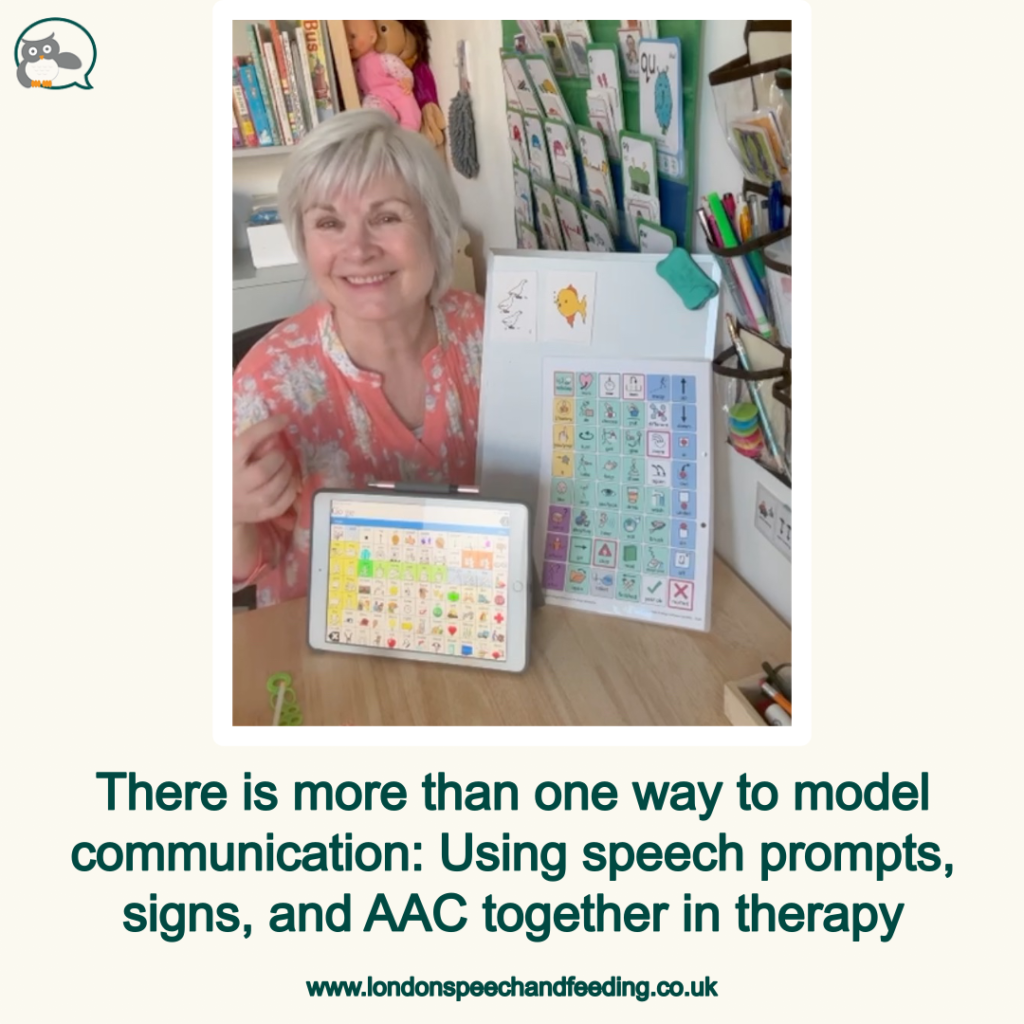
    When children find talking hard, parents often face a difficult question: ‘Should we wait and keep encouraging speech? Or introduce something like AAC?’

    AAC (Augmentative and Alternative Communication) can sound intimidating, but it simply means any way we support or replace spoken words, from simple gestures and picture boards to high-tech speech-generating devices. Far from ‘giving up on speech,’ AAC often becomes the bridge that helps children find their voice, in whatever form that takes.

    💡 What is AAC, really?

    AAC is a spectrum of tools and strategies that help people express themselves when speaking is difficult. It might include:

    • Low-tech supports: Gestures, key word signs (like Makaton), picture symbols, or printed boards
    • High-tech systems: Apps on tablets that speak aloud when pictures or words are tapped

    AAC is not just for children who will never talk. It’s for anyone whose speech isn’t meeting their communication needs right now.

    🤔 When to introduce AAC

    There’s a common myth that you should only try AAC after ‘exhausting’ other speech therapy options. In fact, AAC can be introduced at any stage, even alongside speech development.

    Here are some helpful signs that AAC might support your child:

    • Your child understands much more than they can say.
    • They rely on gestures, sounds, or behaviour to communicate.
    • They become frustrated trying to express themselves.
    • You find yourself ‘reading their mind’ to interpret needs.
    • Speech progress feels slow or inconsistent.

    If you recognise these patterns, AAC isn’t a ‘last resort’. It’s a communication support, not a replacement for speech.

    Recent research consistently shows that AAC does not stop children from talking. In fact, it can encourage speech to develop. A 2024 systematic review and meta-analysis published in the Journal of Autism and Developmental Disorders found that children who received interventions combining naturalistic developmental behavioural approaches with aided AAC showed improved language outcomes, and that AAC ‘does not negatively impact speech development and may even facilitate spoken language growth’ (Smith et al., 2024).

    🌉 How AAC supports speech development

    Speech and AAC aren’t competing paths: they’re parallel tracks that often feed each other.

    Here’s how AAC helps speech grow:

    1. Reduces frustration: When a child can express their needs, they’re more relaxed and ready to learn.
    2. Provides a visual model: Seeing symbols or words while hearing spoken language strengthens understanding and word recall.
    3. Builds consistent language structure: AAC systems follow the same grammar and word order as speech, helping children internalise how sentences work.
    4. Encourages turn-taking and social connection: AAC lets children join conversations even before speech is fluent, giving them more practice in real communication.

    AAC is not ‘giving up on speech’. It’s giving a child more ways to succeed while speech continues to develop.

    🧩 How to introduce AAC gently and effectively

    1. Start small and meaningful: Begin with a few key messages your child wants to say, not just what adults want to hear. Think ‘I want’, ‘stop’, ‘help’, ‘more’, ‘all done’, ‘no’, ‘again’. These are powerful words for real interaction and autonomy.
    2. Model, model, model: The most important part of AAC success is modelling—using the system yourself as you talk. For example: ‘You want banana 🍌’ and you tap the ‘want’ and ‘banana’ symbols. Children need to see and hear AAC used naturally before they try it themselves.
    3. Use it throughout the day: AAC isn’t a therapy tool to take out once a week. It’s a living part of communication. Model a few words during mealtimes, play, and routines. The more consistently it’s embedded, the more fluent both you and your child will become.
    4. Keep it accessible: If using a device or picture board, make sure it’s always nearby. If it’s in a bag or drawer, it can’t be used in real moments.
    5. Celebrate all communication: If your child points, signs, uses a sound, or taps a symbol, it all counts. Respond warmly and naturally to reinforce communication in any form.

    🧠 What parents often worry about

    • ‘Won’t AAC stop them from talking?’: No. Research shows AAC use either has no negative effect on speech or leads to increased spoken output (Smith et al., 2024). When children feel understood, their motivation to communicate grows.
    • ‘What if I model it wrong?’: There’s no perfect way to start. Your effort and consistency matter far more than accuracy.
    • ‘Will they get ‘stuck’ using pictures?’:  Some children do continue using AAC long-term; others move naturally toward more spoken language. The goal is always functional communication, not replacing one form with another.

    🪞 Bringing AAC into daily life

    Here are a few simple, parent-friendly ideas:

    • Create visual spaces: Post symbols or core words on the fridge, mirror, or play area.
    • Narrate routines: Use AAC during toothbrushing, dressing, or mealtimes; consistent contexts build understanding.
    • Pair speech and touch: Always say the word aloud when you point to or tap a symbol.
    • Involve siblings and friends: Model how they can respond to AAC too. ‘Oh, you said go! Let’s go fast!’
    • Use shared books and songs: Pause and model key words in stories or songs.

    🌱 The takeaway

    AAC doesn’t mean giving up on speech; it means opening more doors to communication. When words don’t come easily, AAC gives children a way to connect, share, and be heard.

    It helps parents move from guessing to understanding, and gives children the power to express themselves on their own terms.

    If you’re unsure where to start, reach out to a speech and language therapist experienced in AAC. Together, you can find a system that fits your child’s strengths, build confidence in modelling, and help every word (spoken or tapped) feel like a step forward.

    And download and print my one page summary.

    Because when communication is possible, everything else begins to grow.

    Sonja McGeachie

    Highly Specialist Speech and Language Therapist

    Owner of The London Speech and Feeding Practice.

    📚 Reference

    Smith, K., et al. (2024). The Effect of Naturalistic Developmental Behavioral Interventions and Aided AAC on the Language Development of Children on the Autism Spectrum with Minimal Speech: A Systematic Review and Meta‑Analysis. Journal of Autism and Developmental Disorders, 55, 3078–3099. https://doi.org/10.1007/s10803-024-06382-7


    Health Professions Council registered
    Royal College of Speech & Language Therapists Member
    Member of ASLTIP

    Find a speech and language therapist for your child in London. Are you concerned about your child’s speech, feeding or communication skills and don’t know where to turn? Please contact me and we can discuss how I can help you or visit my services page.

    2
  • ·

    Explore activities for Gestalt Language Processors to aid communication

    Speech Therpaist in London

    When you have a child who uses Gestalts it is often difficult to think and adapt clinic activities into those to use at home. More importantly, you find that individualising your activities for your child who uses Gestalt are time-consuming. But you value its importance for their communication development.

    You feel so busy, you are taking them to other appointments, or trying to get through your daily activities, all whilst still ensuring your child’s emotional needs are met. You know life should not get in the way of your child’s therapy activities at home, but it does. We know your spare time is precious and limited, so let us achieve your child’s or young person’s goals in the allotted time you have which meets their way of learning (using Gestalts).

    We wanted to support you by exploring items which you may have at home, and we will give you some key phrases which you can start to model with your child. Whereas our last blog introduced the idea of gestalt language processors, we are now developing ideas to give you the tools to implement activities at home. We recognise how overwhelming it may feel, and this is one of the reasons to make activities as straight forward as possible. Therapy does not need to be complicated; it just needs to be carried out on a regular basis.

    Explore the samples I’ve created to give you an idea of how this might look but please consult with a Speech and Language Therapist who knows about Gestalt Language Processing so that you can work together to develop great home activities for your child.

    Want to learn more about gestalt language processing?

    Please contact me for help.


    Find a speech and language therapist for your child in London. Are you concerned about your child’s speech, feeding or communication skills and don’t know where to turn? Please contact me and we can discuss how I can help you or visit my services page.

    1
  • Tele-therapy – What Is that And how does it work With Speech And Language Therapy?

    Tele-Therapy – What Is That And How Does It Work With Speech And Language Therapy?
    Tele-Therapy – What Is That And How Does It Work With Speech And Language Therapy?

    How can I help you assess and support your child when you live outside London or just can’t come to see me for any reason? The short answer is: YES I CAN and we can do it virtually! There are separate areas I can target using Teletherapy.

    Here is one of them:

    Parent – Child Interaction / Attunement

    Through the pandemic and lock-down I have had opportunity to re-think how I can help people virtually and what I can do to ensure that parents continue to feel empowered and help their children make good progress even when I cannot personally come to their home or they cannot visit me.

    My training with the HANEN METHOD came in so handy as of course in the US and Canada therapists and families traditionally cover huge areas and often are too far away from each other. They have been practising on-line/virtual or now known TELE-THERAPY for decades and are very advanced with research, materials and support in this area. I skilled up at the beginning of the pandemic early 2020 and by around April I was up and running! Nobody was able to see anyone in lockdown and of course parents were still desperate for help with their children.

    The basic premise when supporting young children under the age of 5 years is that a NATURALISTIC approach is the best and very well researched to be highly effective. This means that the parents or caregivers are the most important and consistent key people in every child’s life and they are the best therapists and AGENTS FOR CHANGE.

    Parents spent the most time with their child, even when they are working parents! – they are still most likely to spend many hours in the evenings and weekends with their child. When we are looking at how Social Communication develops we know that it emerges from birth through daily interaction and daily activities: playing, snuggling, running, eating, getting dressed, shopping with mum, sitting in the car with dad, playground, dinner around the table, bath time, story time, teeth brushing, bed time. These are the consistent areas where interaction takes place and where social communication can develop/be supported/ be enhanced. – do check out my other blog as well on this topic “What is Speech and Language Therapy”.

    Parents Are The Agents Of Change

    What do I mean by that? Parent-Child Interaction work focuses on helping the parent to tune in with their child and therefore enabling the child to tune in with the parent, in turn. Its about TUNING IN. This is often missing when children have social communication difficulties: they do not tune in. And parents end up tuning less into their children as time goes on, because the interaction is always so one-sided. Parents tell me again and again how hard it is to engage with their child as there seems to be so little “come-back”.

    I teach your really powerful strategies that you can implement quite easily during your normal daily activities! You will not need to do any “home work”, i.e anything extra on top of what you normally do with your child anyway! How good is that!?

    Each week I will teach you one or two new strategies to try out and together we will workshop exactly how you could do this. So you will walk away knowing what activities to target and how. Over a short period of time you will see positive changes, because you , the parent, have changed! PARENTS ARE THE AGENTS OF CHANGE. This is incredibly empowering for the parent as in the end you won’t need a therapist because you have become the ideal, consistent, expert therapist for your own child. The strategies will stay with you for life and over time you will be using them without even thinking about it. And your child will learn – over time – to tune in with you. TADAAAH! You’re welcome!

    So give Tele-Therapy a try! I would really recommend it:

    • Convenient as you do not need to travel, and therefore cost and time saving.
    • It takes just one hour out of your busy day, not 3 hours with travel in London etc.
    • You will be fully supported with on-line video clips, slides, my write-ups and other materials I often make for you to support your journey.
    • You will feel empowered to help your child develop the very day you start the therapy.
    • You can have weekly support, fortnightly or monthly. You can contact me for brief hand-holds in between and most importantly your child will make progress.

    If you would like to discuss this a bit more, get in touch with me! I would love to help. Check out my google reviews of clients who have done Tele-therapy with me, some of them live abroad, as far away as Australia and Tanzania or Germany. You will see it can work so very well.

    Find a speech and language therapist for your child in London. Are you concerned about your child’s speech, feeding or communication skills and don’t know where to turn? Please contact me and we can discuss how I can help you or visit my services page.

  • · ·

    The picky eater’s plate: Introducing solids to toddlers with ARFID

    Designed by Freepik

    Mealtimes can be a battleground for parents of picky eaters, especially toddlers with Avoidant/Restrictive Food Intake Disorder (ARFID). I see a great number of toddlers with Autism traits and many of my clients are picky eaters from mild to severe. Take a look at my blog for an outline of what the issues are and how to try and help.

    ARFID goes beyond typical ‘picky eating’ and can significantly impact a child’s growth, nutrition, and social-emotional well-being. If your toddler is resistant to trying new foods or has a very limited diet, here are some strategies to navigate the introduction of solids:

    1. Understand ARFID:

    ARFID is a diagnosable eating disorder characterised by:

    • Limited food variety: Eating only a small range of foods, often with specific textures or colours.
    • Fear of new foods: Intense anxiety or aversion to trying unfamiliar foods.
    • Sensory sensitivities: Heightened sensitivity to taste, smell, texture, or appearance of food.
    • Lack of interest in eating: May show little interest in food or mealtimes.

    2. Seek professional guidance:

    • Paediatrician and/or gastroenterologist: Rule out any underlying medical conditions.
    • Registered dietitian: Assess nutritional needs and create a balanced meal plan.
    • Speech and language therapist (SLT): If oral-motor skills or sensory sensitivities are contributing to feeding difficulties.
    • Occupational therapist (OT): If sensory processing challenges are affecting mealtime behaviours.
    • Child psychologist: If anxiety or emotional factors are contributing to ARFID.

    3. Strategies for introducing solids:

    • Start small: Introduce one new food at a time, in small amounts, alongside familiar favourites.
    • Patience is key: It can take multiple exposures (up to 10–15 times!) for a child to accept a new food. Don’t give up!
    • Positive reinforcement: Praise and encouragement for any interaction with the new food, even just touching or smelling it.
    • No pressure: Avoid forcing or pressuring the child to eat. This can create negative associations with food.
    • Make it fun: Present food in playful ways, use cookie cutters for fun shapes, or involve the child in food preparation.
    • Sensory exploration: Encourage exploration of food through touch, smell, and sight before tasting.
    • Role modelling: Show the child that you enjoy eating a variety of foods.
    • Use fun utensils: your child might like characters from ‘Frozen’ or ‘Dinosaurs’ or ‘Diggers’ there are a host of character-based cutlery and cups/plates to be had. Also, I really rate these two items very highly they are so good so I want to share these with you. Both are available online. But warning: the cup is outrageously expensive as it comes from the United States and is sold by a small scale company. But I feel this is cup very worth trying, I have had good results with this.
    • Gradual desensitisation: Start with foods that are similar in texture or taste to accepted foods, then gradually introduce more challenging options.
    • Food chaining: Introduce new foods that are similar in taste, texture, or appearance to accepted foods.

    4. Mealtime Environment:

    • Positive and relaxed: Create a calm and enjoyable mealtime atmosphere.
    • No distractions: Minimise distractions like TV or toys.
    • Consistent schedule: Offer meals and snacks at regular times.
    • Child-sized portions: Offer small, manageable portions to avoid overwhelming the child.
    • Involve the child: Let the child choose their utensils, plate, or cup.

    5. Remember:

    • Every child is different: What works for one child may not work for another.
    • Progress takes time: Be patient and celebrate small victories.
    • Focus on the positive: Praise any positive interaction with food.
    • Seek support: Connect with other parents or support groups.

    Introducing solids to toddlers with ARFID can be challenging, but with patience, persistence, and professional guidance, you can help your child develop a healthier relationship with food.

    Get in touch with me via my contact form if you need support

    Sonja McGeachie

    Early Intervention Speech and Language Therapist

    Feeding and Dysphagia (Swallowing) Specialist The London Speech and Feeding Practice

    The London Speech and Feeding Practice


    Find a speech and language therapist for your child in London. Are you concerned about your child’s speech, feeding or communication skills and don’t know where to turn? Please contact me and we can discuss how I can help you or visit my services page.

    1