Your baby’s communication journey: 3–6 months

| |

This is an exciting time for both you and your baby! Between 3 and 6 months, communication literally explodes. While your little one may not be saying words yet, he or she is actively learning to understand and express themselves. Here’s a glimpse into what you can expect:

Understanding:

Recognises familiar voices:

Your baby will likely turn his or her head towards the sound of your or other familiar adults’ voices.

Tips for supporting and expanding: Talk, sing and chant! Your baby will love and smile at hearing your talking voice, and he or she will not be judging your singing talent! You can sing to your hearts content, perhaps some lovely nursery rhymes you remember from your childhood, or festive songs like Jingle bells !. Or you can simply make up your own little songs and chants alongside all the daily activities you do with or for your baby. You could have a ‘nappy’ song, a ‘let’s get you ready for the park’ song, a ‘I’m hungry’ song or a ‘mummy’s cooking soup’ chant. It does not have to be beautiful but what does help is having little rhymes and rhythms to your singing. Your baby will love it and soak it all up.

Begins to understand ‘no’:

Your baby may pause or stop an action when you say ‘no’ and shake your head at the same time.

Tips for supporting and expanding: I don’t think that at this stage you will have much cause to say ‘no’ to be fair but you could do it playfully and bring it into a ‘no more’ situation so that your baby can make the connection between ‘no’ and ‘finished’ or ‘stop’ or ‘done’. Feeding might be a good opportunity for this one. You could also ask ‘who is it’ when someone is ringing the bell or coming down the stairs, e.g. ‘oh I hear footsteps! Is this daddy??…. no it’s not daddy no it’s grandma! daddy’s gone out!’

Responds to his or her name:

Your baby will start to show a reaction when you call his or her name.

Tips for supporting and expanding: Try calling your baby’s name a lot, and get different family members or visitors calling your baby by his or her name and calling his or her name before saying ‘look’ or ‘peek-a boo’ etc.

Use Baby Signing: You can introduce simple gestures and signs such as ‘milk’ ‘nappy’ ‘sleep’ ‘dog’ ‘cat’ etc to help your baby make the connection between what you are saying and what he or she is seeing.

Expressing:

Cooing, gurgling and babbling:

These sounds are more than just adorable! They are your baby’s way of experimenting with his or her voice and learning to control his or her vocal cords.

You might hear sounds like ‘ba-ba-ba’ or ‘ga-ga-ga’. This is a huge milestone!

Tips for Supporting and expanding: This is a wonderful time to copy your baby’s sounds, celebrate them and show your baby that you are listening to his or her sounds and you are understanding everything he or she is saying! This is also a brilliant time to start reading to your baby. You can read any children’s books you fancy. Again your baby will adore the sound of your voice but increasingly he or she will also look at the pages of a book and try and understand and make connections between the words you say and the pictures he or she sees.

When you hear your child babbling you can try and give it meaning where possible, for example your baby says: ‘ba ba ba’ you could fall into ‘Baa Baa black sheep have you any wool’ song or you could say ‘mmmh banana!’ And show a banana that’s lying on the table. Or you could just say: ‘baba baaaaah you are saying ba! That’s so great!’ Anything goes really at this stage!

Facial expressions:

Your baby uses smiles, frowns, and other facial expressions to communicate his or her emotions (happy, sad, angry).

Tips for supporting and expanding: Try and make interesting and exaggerated facial expressions yourself when you are talking to your baby! Try and be a little bit clowney and really practise showing ‘surprise’ ‘boo’ or a big grin, smile, purse your lips, blow raspberries, open and close your mouth and make funny faces. Copy your baby when you see his or her facial expression change. When your baby looks confused, say ’oh we don’t know what’s happening we are confused!’. When your baby looks happy, say ‘you look soo happy! What a lovely smile!’

Eye contact:

Your baby will start making more and more eye contact with you during interactions.

Tips for supporting and expanding: Try and get ‘face to face’ a lot with your baby. When cuddling your baby look at his or her face and often make sure that it is easy for your baby to see and look at you. If you can lower your position so that your face is in line with your baby that will make things easier for you both.

Good games to play:People-Games’ these are games where you do not need any toys to have a good time. All you need is the other person: Peek-a-boo, bumping your baby up and down on your lap with a song, Row Row Row your boat, tickling games, catch you games etc.

Now we are at 6 months another very exciting stage has arrived: feeding SOLIDS to our baby! More of this in my next post!

When to Seek Guidance:

If you have any concerns about your baby’s communication development, please don’t hesitate to consult with me. Early intervention can make a significant difference and really help your baby making progress.

Remember: Every baby develops at his or her own pace. These are general guidelines, and some babies may reach certain milestones earlier or later than others.

I look forward to seeing you! Get in touch with me via my contact form.

Sonja McGeachie

Early Intervention Speech and Language Therapist

Feeding and Dysphagia (Swallowing) Specialist The London Speech and Feeding Practice

The London Speech and Feeding Practice


Find a speech and language therapist for your child in London. Are you concerned about your child’s speech, feeding or communication skills and don’t know where to turn? Please contact me and we can discuss how I can help you or visit my services page.

1

Similar Posts

  • · ·

    Feeding therapy: A guide for parents and caregivers

    Feeding therapy is a specialised form of therapy and support that helps children develop healthy eating habits and overcome challenges related to food. It’s often used for children with picky eating, feeding disorders, or sensory processing issues.

    What is feeding therapy?

    Feeding therapy involves a series of techniques designed to improve a child’s eating skills and attitudes towards food. In the UK it’s typically provided by speech and language therapists and dietitians. These professionals work closely with parents and caregivers to create a personalised treatment plan tailored to each child’s unique needs.

    How does feeding therapy work?

    Feeding therapy sessions are typically 30–60 minutes long and involve a variety of techniques, including:

    • Family counselling: Providing support and guidance to parents and caregivers. This can help address any practical, behavioural and emotional issues that may be impacting the child’s eating.
    • Play-based activities: Engaging children in fun activities while introducing new foods or textures. This can help alleviate anxiety and make mealtimes more enjoyable.
    • Sensory exploration: Helping children become more comfortable with different tastes, smells, and textures. This can be achieved through activities like touching, smelling, and tasting various foods.
    • Oral motor exercises: Improving chewing, swallowing, and lip coordination. These exercises can help children develop the necessary skills for eating independently.
    • Behavioural techniques: Using positive reinforcement to encourage healthy eating habits. This can involve rewarding children for trying new foods or eating a variety of meals.

    When is feeding therapy needed?

    Feeding therapy may be beneficial for children who:

    • Are picky eaters: Refuse to eat a variety of foods or have strong preferences.
    • Have feeding disorders: Experience difficulties with eating, such as swallowing or chewing.
    • Have sensory processing issues: Are sensitive to certain textures, smells, or tastes.
    • Have medical conditions: Such as autism, cerebral palsy, or gastrointestinal disorders.

    Feeding therapy strategies you can try at home

    While professional feeding therapy can be invaluable, there are several techniques you can try at home to support your child’s eating development:

    • Create a positive mealtime environment: Make mealtimes enjoyable and stress-free by avoiding distractions, limiting screen time, and creating a calm atmosphere.
    • Create regular mealtimes and mealtime routines: Introduce set ways of announcing meal times, including songs or short nursery rhymes, try and involve your child with table setting, even just carrying their spoon to the table and putting the beaker next to the plate and ensure that meal time finishes after about 30 minutes, again with a set routine so that the child always knows: this is how we do it in our home, now I am finished and meal time is over.
    • Introduce new foods gradually: Start with small amounts and gradually increase exposure. This can help reduce anxiety and make new foods less overwhelming.
    • Model healthy eating: Show your child how to enjoy a variety of foods by eating a balanced diet yourself.
    • Avoid forcing food: Allow your child to choose and explore foods at their own pace. Forcing them to eat can create negative associations with food.

    Seek professional help

    If you’re concerned about your child’s eating habits, consult with a feeding therapist. We can provide guidance and support.

    Remember, feeding therapy is a collaborative process between parents, caregivers, and professionals. With patience, understanding, and the right strategies, you can help your child develop healthy eating habits and enjoy meals.

    Would you like to know more about specific techniques or have any other questions about feeding therapy?

    Please feel free to contact me.

    Sonja McGeachie

    Early Intervention Speech and Language Therapist

    Feeding and Dysphagia (Swallowing) Specialist The London Speech and Feeding Practice

    The London Speech and Feeding Practice


    Find a speech and language therapist for your child in London. Are you concerned about your child’s speech, feeding or communication skills and don’t know where to turn? Please contact me and we can discuss how I can help you or visit my services page.
    1
  • Submucous cleft palate: What is it and how does it impact on speech?

    Submucous cleft palate: What is it and how does it impact on speech?

    What exactly is a submucous cleft palate?

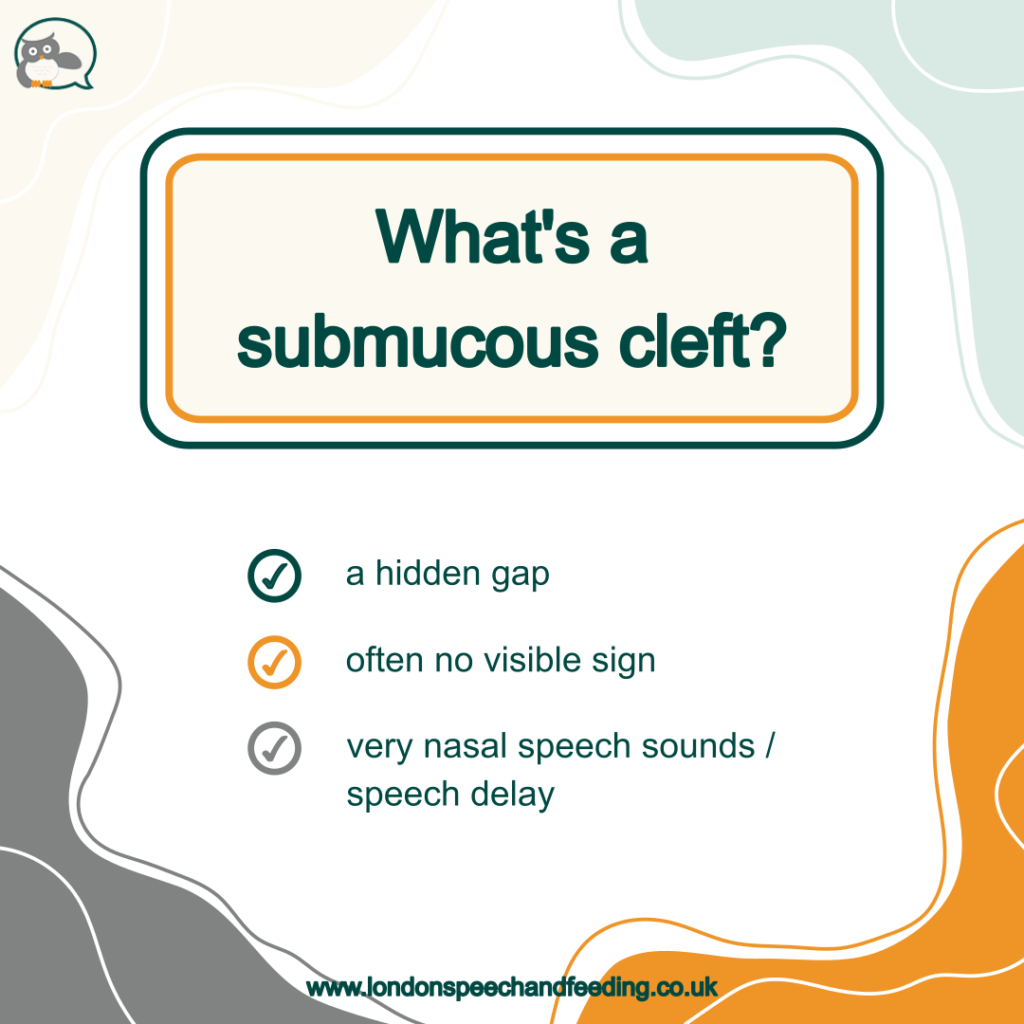
    A submucous cleft palate (SMCP) is much less obvious than its counterparts, cleft of lip and/or palate, and can profoundly impact a child’s speech development. It leads to often extreme hyper nasal speech and difficulty with producing many sounds (/K/ /G/ /T/ /D/ /P/ /B/ /S/ /Z/ /F/ /V/).

    In short, the muscles and bone of the soft palate, and sometimes the hard palate, do not fuse completely during foetal development and the mucous membrane that lines the roof of the mouth remains intact, effectively camouflaging the underlying muscular and bony deficit.

    So, while the surface of the palate appears normal, the essential muscle and functions responsible for sealing off the nasal cavity from the oral cavity during speech are compromised. This cleft (or lack of muscle) can be seen as a bluish midline discoloration of the soft palate, often a bifid (split) uvula, and at times a notch in the posterior border of the hard palate can be felt upon palpation. However, these signs aren’t always present or easily discernible, contributing to the difficulty arriving at a diagnosis.

    Diagnosing a submucous cleft palate is often akin to searching for a needle in a haystack, especially for the untrained eye. Unlike overt clefts that are visually apparent at birth, an SMCP can go undiagnosed for years, sometimes well into childhood or even adolescence. Paediatricians and even ENT surgeons have been known to miss it during routine checks due to the intact mucosal lining. Parents might notice their child’s speech sounds ‘different’ or ‘nasal’ but struggle to pinpoint the cause. Children might undergo extensive speech therapy without a proper diagnosis, as the underlying structural issue continues to hinder progress.

    My experience as a speech therapist in private practice:

    Over my years of practice, I have encountered several children presenting with persistent hyper-nasal speech and significant difficulties producing plosive and fricative sounds.

    It has been incredibly rewarding, though at times challenging, to successfully diagnose SMCP in a number of these children. My approach often involves:

    • a meticulous oral motor examination,
    • careful listening for the specific qualities of hypernasality,
    • and a deep understanding of the physiological requirements for clear speech sound production.

    When I suspect an SMCP, I refer these children to Great Ormond Street Hospital where a fantastic multidisciplinary team, typically including ENT surgeons and a specialist speech-language therapist can conduct more definitive assessments. These assessments often involve instrumental analyses such as videofluoroscopy or nasoendoscopy, which provide objective measures of velopharyngeal function and visual confirmation of the anatomical deficit.

    The path to resolution: surgery, therapy, and successful outcomes

    Surgery

    The journey for these children, once diagnosed, often involves surgical intervention. It’s not uncommon for children with SMCP to undergo multiple operations to achieve optimal velopharyngeal closure. These procedures aim to reconstruct or augment the velopharyngeal mechanism, enabling it to effectively separate the oral and nasal cavities during speech. The specific surgical approach depends on the individual child’s anatomy and the severity of the velopharyngeal insufficiency. It’s a testament to the skill of these specialised surgeons that such intricate repairs can be performed with remarkable success.

    Speech therapy

    Following surgery these children embark on the crucial phase of speech therapy. While surgery addresses the structural problem, speech therapy helps a child learn to utilise their newly improved anatomy. It involves intensive work on developing oral airflow, establishing correct articulatory placement, and reducing learned compensatory strategies that have developed due to the original structural deficit. It is immensely gratifying to witness the transformation. Children who once struggled to produce basic sounds, whose speech was difficult to understand, gradually develop clear speech.

    Next steps?

    If you’re a parent concerned about your child’s speech and feeding, you’re not alone. The journey can feel confusing, but professional guidance can make all the difference. Never hesitate to have a second opinion when you have that niggling feeling that there is something that has not yet been explored. At London Speech and Feeding I specialise in being thorough and thinking outside the box.

    I am here to provide the support you need. Reach out to schedule a consultation and take the first step towards helping your child communicate and thrive.

    Sonja McGeachie

    Highly Specialist Speech and Language Therapist

    Owner of The London Speech and Feeding Practice.


    Health Professions Council registered
    Royal College of Speech & Language Therapists Member
    Member of ASLTIP

    Find a speech and language therapist for your child in London. Are you concerned about your child’s speech, feeding or communication skills and don’t know where to turn? Please contact me and we can discuss how I can help you or visit my services page.

    1
  • · ·

    Milestones matter: What to expect in your baby’s first year of communication

    The first year of your baby’s life is a whirlwind of growth and development. While watching them learn to crawl, walk, and grasp objects is exciting, it’s equally important to pay attention to their developing communication skills. Here are some key speech, language, attention, play, and communication milestones you can expect to see between 6 and 9 months.

    Sounds:

    • Babbling becomes more complex, with strings of sounds like ‘bababa’ or ‘dadada.’
    • Your baby may start imitating some sounds.
    • When you call your baby he or she will respond to his or her own name.

    What you can do to help your baby

    First, please don’t panic. Every baby is different and it does not mean your baby is delayed if he or she is not quite ready.

    Make sure you spend time babbling, singing and talking to your baby in a tuneful, happy, sometimes silly! way, pulling faces, smiling, laughing and tickling your baby, all the while sing sing sing and chat!

    Try to imitate your baby’s sounds and actions. You will see that your baby likes this a lot and will reward you with smiles, giggles and after a while your baby will want you to continue copying him or her. At that time you will see that he or she will start to copy you more and more.

    Try and call your baby’s name lots of times. When you re-enter a room having been out for even a short time, say ‘Hello (baby’s name) I’m back’. Your baby will soon learn to look when you say their name.

    Attention:

    • Can follow simple directions (e.g., ‘Come here!’).
    • Shows interest in books and pictures.
    • Begins to understand the word ‘no.’

    What you can do to help attention skills develop

    Get down to your baby’s eye level or make it easy for your baby to look at you, even briefly.

    Try and gain your baby’s attention when he or she is not busy with something else.

    Try and become irresistibly funny and interesting to look at! Think of ‘Mr Tumble’! Wear a silly hat, silly glasses, blow some bubbles, blow a funny horn, stand on your head (joking)… make it impossible for your baby to ignore you!

    Play:

    • Explores objects by banging, shaking, and mouthing them.
    • Shows interest in cause-and-effect toys (e.g., dropping objects and watching them fall).
    • Engages in simple social games like peek-a-boo.

    What you can do to help play skills to develop

    Offer suitable objects that are attractive to look at and easy to hold and shake. Show your baby repeatedly what to do with these objects, bang them together and sing a little song, bang bang bang shake shake shake…

    Offer containers and drop items into them. Shape sorters, metal bowls make a terrific clangy noise when you drop items into them. Blow feathers or tissues and watch them fall. Blow bubbles and watch them pop.

    Sing a range of nursery songs repeatedly and make suitable actions along them. Try and involve your baby by sitting him or her on your lap so he or she can hear and feel you bopping him or her up and down, swinging him or her gently from side to side or row row rowing his or her boat gently down the stream

    Communication:

    • Uses gestures like waving ‘bye-bye’ and reaching for desired objects.
    • May begin to use babbling to express needs and wants (e.g., babbling while reaching for a toy).

    What you can do to help communication progress

    Practise waving ‘bye-bye’ to people coming and going all day long.

    When your baby babbles whilst reaching for a toy, you can copy him or her and then name that toy, for example.

    Baby: ‘gagabbagaga’ – whilst reaching for a shaker – Adult: ‘gagagag I want my shakey! Aargh I am reaching for it but I can’t get it, help me help me… ah there is my lovely shakey shakey!’

    If your baby is not responding to any of your efforts above then please do get in touch with a Speech and Language Therapist near you, or contact me via my contact form. Sometimes one consultation is all you need to get going with helping your baby and before you know it a lots of progress has been made and your baby is on the way to speaking!

    Sonja McGeachie

    Early Intervention Speech and Language Therapist

    Feeding and Dysphagia (Swallowing) Specialist The London Speech and Feeding Practice

    The London Speech and Feeding Practice


    Find a speech and language therapist for your child in London. Are you concerned about your child’s speech, feeding or communication skills and don’t know where to turn? Please contact me and we can discuss how I can help you or visit my services page.

    1
  • · ·

    Baby-led weaning: Empowering little eaters from the start

    I had a mum ask me about Baby Led Weaning the other day. So I thought I would write a blog on all the useful questions she had and what we discussed as it may help lots of mums and dads out there.

    As a Paediatric Feeding SLT, one of the exciting developments in recent years is the growing interest in baby-led weaning (BLW). This approach to introducing solids has gained significant traction, and for good reason. It empowers infants to take the lead in their feeding journey, fostering a positive relationship with food and supporting important developmental milestones.

    What exactly is baby-led weaning?

    At its core, baby-led weaning is about offering your baby appropriately sized and textured solid foods from the very beginning, allowing him or her to self-feed. Instead of spoon-feeding purées, you present whole, soft foods that your baby can grasp, bring to his or her mouth, and explore at his or her own pace. This means no mashing, no blending, and no forcing spoons into reluctant mouths. It’s a fun, messy, and intuitive process that is led by your baby’s natural instincts.

    The genesis of baby-led weaning

    ‘Baby-led weaning’ was popularised by British health visitor Gill Rapley. In the early 2000s, Rapley observed that babies naturally develop the skills needed to self-feed and that traditional spoon-feeding might actually hinder this development. Her work, particularly her book Baby-Led Weaning: The Essential Guide to Introducing Solid Foods (co-authored with Tracey Murkett), published in 2008, brought BLW into the mainstream and provided a structured framework for parents. Her research and observations highlighted the benefits of trusting a baby’s innate ability to regulate his or her intake and explore different textures.

    What’s the deal?

    Implementing BLW is simpler than you might think, though it does require a shift in mindset. Here’s a breakdown of what it typically involves:

    • Readiness is key: The golden rule of BLW is to wait until your baby shows clear signs of readiness. This isn’t about age alone, but rather developmental milestones. Your baby should be at least six months old, able to sit unassisted, have good head and neck control, show an interest in food (e.g., reaching for yours), and have lost his or her tongue-thrust reflex (which pushes solids out of his or her mouth).
    • Offer finger foods: Start with soft, easily graspable foods cut into finger-sized sticks or spears. Think cooked sweet potato fries, steamed broccoli florets (soft enough to mash with gentle pressure), banana sticks, or avocado slices. The goal is for babies to be able to pick it up and get some into their mouth.
    • Embrace the mess: BLW is inherently messy, especially in the beginning. Food will be squished, dropped, and smeared. This is a crucial part of the learning process as babies explore textures, smells, and the properties of food. A wipeable mat under the highchair and a good bib are your best friends!
    • Observe, don’t interfere: Allow your baby to lead. He or she will decide what to eat, how much, and how quickly. Avoid putting food into his or her mouth or pressuring him or her to eat more. This respects his or her hunger and fullness cues, laying the foundation for healthy eating habits.
    • Continue breastmilk or formula: Until your baby is well-established on solids, breastmilk or formula remains his or her primary source of nutrition. Solids are for exploration, taste, and developing skills, gradually increasing in quantity over time.

    The benefits of baby-led weaning

    The advantages of BLW extend far beyond simply getting food into your baby. From a speech and feeding perspective, the benefits are compelling:

    • Develops oral motor skills: Chewing, gnawing, and manipulating various food textures are crucial for developing the muscles in the mouth, jaw, and tongue. This strengthens the oral motor skills necessary for speech development.
    • Enhances fine motor skills and hand-eye coordination: The act of grasping food, bringing it to the mouth, and coordinating these movements significantly refines fine motor skills and hand-eye coordination.
    • Promotes self-regulation and intuitive eating: By allowing babies to control their intake, BLW helps them tune into their own hunger and fullness cues, fostering a healthy relationship with food and reducing the likelihood of overeating.
    • Encourages adventurous eating: Exposure to a wide variety of tastes and textures from the outset can lead to less picky eating later. Babies are more likely to accept new foods when they have been in control of their exploration.
    • Facilitates family mealtimes: BLW integrates babies into family mealtimes from an early age, promoting social interaction and making mealtime a shared, enjoyable experience.

    When is baby-led weaning appropriate, and when not?

    While BLW offers numerous benefits, it’s not a one-size-fits-all approach.

    When BLW is appropriate:

    • When your baby meets all the developmental readiness signs: This is paramount for safety and success.
    • When you are comfortable with the mess and the learning curve: It requires patience and a relaxed attitude.
    • When you are committed to offering a variety of safe, appropriate foods.
    • When you are willing to learn about and practise safe food preparation to minimise choking hazards.

    When BLW might not be appropriate (or requires extra caution and professional guidance):

    • If your baby has a history of prematurity or significant developmental delays: His or her oral motor skills might not be sufficiently developed.
    • If your baby has certain medical conditions or anatomical differences (e.g., cleft palate, severe reflux, swallowing difficulties): These may necessitate a modified approach to feeding.
    • If there are significant feeding difficulties, aversion, or a history of choking incidents.
    • If you feel overly anxious about choking: While BLW, when done correctly, is not associated with a higher choking risk than traditional weaning, parental anxiety can impact the feeding experience. Education and consultation with a professional can help alleviate these concerns.

    A note on safety: Choking hazards

    It’s crucial to understand the difference between gagging and choking. Gagging is a natural reflex that helps prevent choking and is very common in BLW as babies learn to manage food in their mouths. Choking is silent and serious. To minimise choking risks:

    • Always supervise your baby closely during mealtimes.
    • Offer appropriately sized and textured foods. Avoid small, round, hard foods like whole grapes, nuts, popcorn, and large chunks of meat.
    • Ensure your baby is sitting upright and calm.
    • Educate yourself on infant CPR.

    Final thoughts

    Baby-led weaning is a wonderfully empowering approach that celebrates a baby’s natural abilities and fosters a positive and independent relationship with food. As Speech and Language Therapists we often see the positive impact it has on oral motor development, self-regulation, and overall feeding confidence. By understanding what it entails, when it’s appropriate, and prioritising safety, you can embark on this exciting journey with your little one, helping him or her become a confident and capable eater from the very first bite.

    If you would like help and support with weaning your baby whilst continuing to breastfeed then please get in touch!

    Sonja McGeachie

    Highly Specialist Speech and Language Therapist

    Owner of The London Speech and Feeding Practice.


    Health Professions Council registered
    Royal College of Speech & Language Therapists Member
    Member of ASLTIP

    Find a speech and language therapist for your child in London. Are you concerned about your child’s speech, feeding or communication skills and don’t know where to turn? Please contact me and we can discuss how I can help you or visit my services page.

    1
  • · ·

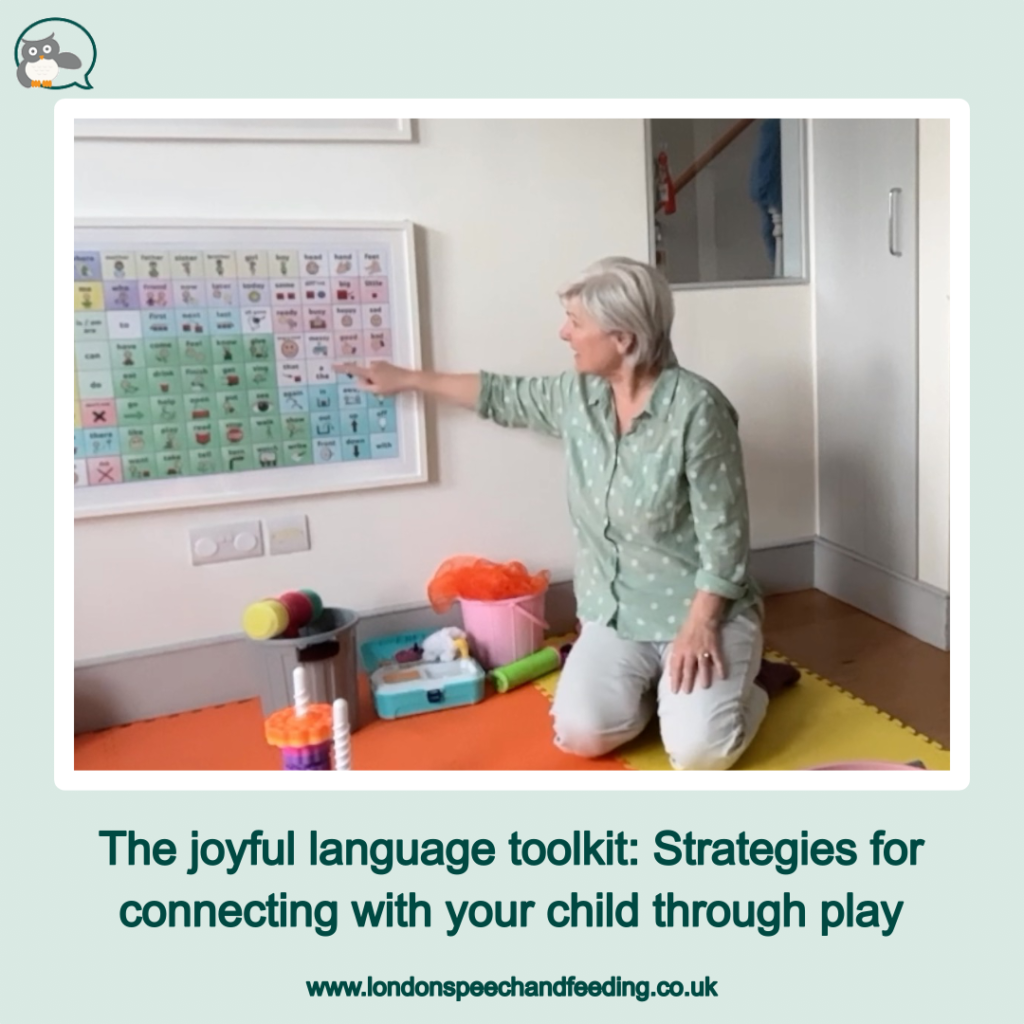
    The joyful language toolkit: Strategies for connecting with your child through play

    As parents and therapists, we all want to help our children communicate. But sometimes, the process can feel like ‘work’. If I had a penny for every parent saying ‘I find it so boring!’… Ok hang in… what if I told you the most effective therapy happens when it doesn’t look like therapy at all?

    My approach centres on connection, enthusiasm, and multi-sensory engagement. We don’t just teach words; we teach the joy of using them. These strategies can be used whether your child is speaking, using a core board, or communicating in his or her own unique way.

    Some of my favourite strategies

    Today I want to share a few of my favourite strategies to turn everyday interactions into powerful communication opportunities regardless of why or how big a delay your child is having.

    1. Facial expressions & exaggeration: Use an exaggerated facial expression to show surprise (wide eyes!), excitement (big smile!), or confusion (a crinkled brow!). Your face is a powerful teaching tool. I am always talking like a clown in my sessions. I can announce that I have also a normal speaking voice outside my clinic room! 😊
    2. Using your voice with intonation: Your voice is music! Use a singsong or ‘tuneful’ repeat to make words stand out. For example, ‘It’s a BIIIG ball!’ or ‘Let’s GO-O-O!’. Again think: clown!!
    3. Hands and body to show: Use gestures, hands, and body movements to demonstrate. Say ‘OPEN’ while pulling your hands apart, or ‘UP’ while raising the toy high above your head.
    4. Elongating our words: Stretching out key sounds or words gives them emphasis and more time for your child to process. ‘Criiiinkley’ ‘tiiickleyyyy’
    5. Core board & language modelling:
      • Model the core board with joy: Don’t just point: point with energy!
      • Model the core board repeatedly throughout the activity, showing genuine excitement. This demonstrates the board is a joyful tool, not homework.
      • Pointing to the core board: When you say a core word, point to the corresponding symbol. You are showing your child, ‘My words live here, and your words can too’.
    6. Describing it for your child: Help your child build his or her vocabulary by providing rich sensory language. ‘It’s squishy’, ‘It’s very noisy’, or ‘It’s so smooth’.
    7. Catchy phrases: Repetitive, positive phrases create a sense of shared fun. Use them consistently: ‘Oh, that’s a nice one!’ or ‘We like that!
    8. Following your child’s Interest: Put down your agenda and follow your child’s lead. If they pick up a block, talk about the block. This ensures they are engaged and ready to learn.
    9. Allowing for pauses: This is critical! After you made a comment, allow for a significant pause (count to five in your head) for your child to fill. The silence creates a powerful opportunity for them to initiate communication.
    10. Copying your child’s sounds: If he or she makes a sound (‘buh!’), you make the sound back! Copying your child’s sounds shows him or her ‘I hear you, and your communication is important’.
    11. Lots of repetition: Hearing a word many times in meaningful contexts is how we learn! Repeat key phrases and core words throughout the activity. Repetition is the key to retention.
    12. Getting turns: Explicitly teach and celebrate getting turns in a game. ‘My turn! Your turn!’ This is a foundational social and communication skill.
    13. Using tidy up as a teaching activity: Turn cleanup into a fun game! It’s a goldmine for core words like PUT IN, ALL DONE, HELP, and MORE. For example, ‘Let’s PUT IN the red block! Yay!’
    14. Using exaggerated repeats: When your child tries a sound or word, give it back with exaggerated, tuneful repeats.

    Try out all or even just a few of these strategies, and I can promise you, you’re not just encouraging language; you’re building a joyful, reciprocal relationship based on genuine communication!

    Which strategy are you excited to try first? Let me know in the comments!

    If I can help you with any of the above, if you want to practise these a bit more, I would love to help you!

    Sonja McGeachie

    Highly Specialist Speech and Language Therapist

    Owner of The London Speech and Feeding Practice.


    Health Professions Council registered
    Royal College of Speech & Language Therapists Member
    Member of ASLTIP

    Find a speech and language therapist for your child in London. Are you concerned about your child’s speech, feeding or communication skills and don’t know where to turn? Please contact me and we can discuss how I can help you or visit my services page.

    2
  • ·

    13 tips to support children and young people with food aversions

    When you have a picky eater it’s easy to feel on edge and that others are judging your parenting skills. It is astonishing how suddenly the world and its brother/sister are all experts on how to feed your child, even the lady in the corner shop is not shy to offer unsolicited tips and advice on your child’s nutrition intake. They will say “try this or that“, “how about these new crackers (only £1.99 special offer)” but…

    The fact is often that you are very concerned about what your child is eating. And you desperately want to give them a healthy, nutritious packed lunch but you know that it will get left, unopened, and unfinished. So, instead, you stick to the same sad soft cheese sandwich on white bread as it is at least something you know they’ll eat.

    Sensory needs can impact on eating with both individuals with and without other conditions. We need to consider all these elements:

    • taste (sweet vs. sour)
    • consistency (crunchy vs. soft)
    • temperature (hot vs. cold)
    • colour (beige vs. colourful)
    • and smell (pungent vs. mild)

    Let’s take a blueberry as an example: it can be sweet or sharp; it can be firm or mushy; it can even differ in colour. Now let’s look at a piece of cereal: it’s crunchy all the time; it looks the same. It’s very predictable, and therefore less anxiety provoking.

    Speech Therpaist in London

    Find our top tips here:

    1. Check with a medical professional that there is nothing physically wrong (e.g. gastrointestinal, or anatomical structural difficulties).
    2. For swallowing difficulties, whether confirmed or suspected, please book an assessment with a certified swallowing/feeding Speech and Language Therapist or please contact me.
    3. Does your child have confirmed or suspected allergies? If so, please contact a dietician who has experience with allergies and can advise, for example: Dr Rosan Meyer.
    4. Talk to other family members about food and their experiences of food. Perhaps there is a family tendency to be picky with eating/food avoidant. This may be important information that you can share with your clinician during the case history taking.
    5. Be patient, though this is easier said than done/felt! Know that many children need repeated exposure to food(s) before liking them, up to 14 spoons! So, take it at your child’s pace and it’s vital we don’t force them to try new foods or use bribes.
    6. You can provide opportunities to engage with food, perhaps you could cook with your child, and allow them to choose what they want to cook. For younger children try Messy Food Play – there are tons of suggestions on Pinterest for ideas on how to incorporate foods into play activities or ask your feeding-Speech and Language Therapist.
    7. You may want to talk about pictures in books that introduce new foods (e.g. The Very Hungry Caterpillar for younger children or magazines if older).
    8. You can play with toy food in a toy kitchen for little ones, or comment on supermarket adverts for young people who are older.
    9. Offer opportunities to taste new foods. You could use a toothpick for bite-sized pieces.
    10. Be sure you eat together with your child as often as you can, modelling positive eating behaviour is most important and can be really effective over time.
    11. You could ask your child to sort foods by colour or stack them on a plate.
    12. We know that Autistic Spectrum Conditions often come with hypersensitivity to textures, so consider what your child prefers (e.g. they may not like slices of tomato but prefer the runnier texture of a tomato sauce).
    13. Reward and give praise following your child’s flexibility with foods and their attempts to try and not whether they like/dislike the food, for example “well done for touching the avocado!” Or “great you licked your fingers with the humous on, that’s excellent”.

    We are always here to support you in whatever way we can. Contact me for support.


    Find a speech and language therapist for your child in London. Are you concerned about your child’s speech, feeding or communication skills and don’t know where to turn? Please contact me and we can discuss how I can help you or visit my services page.