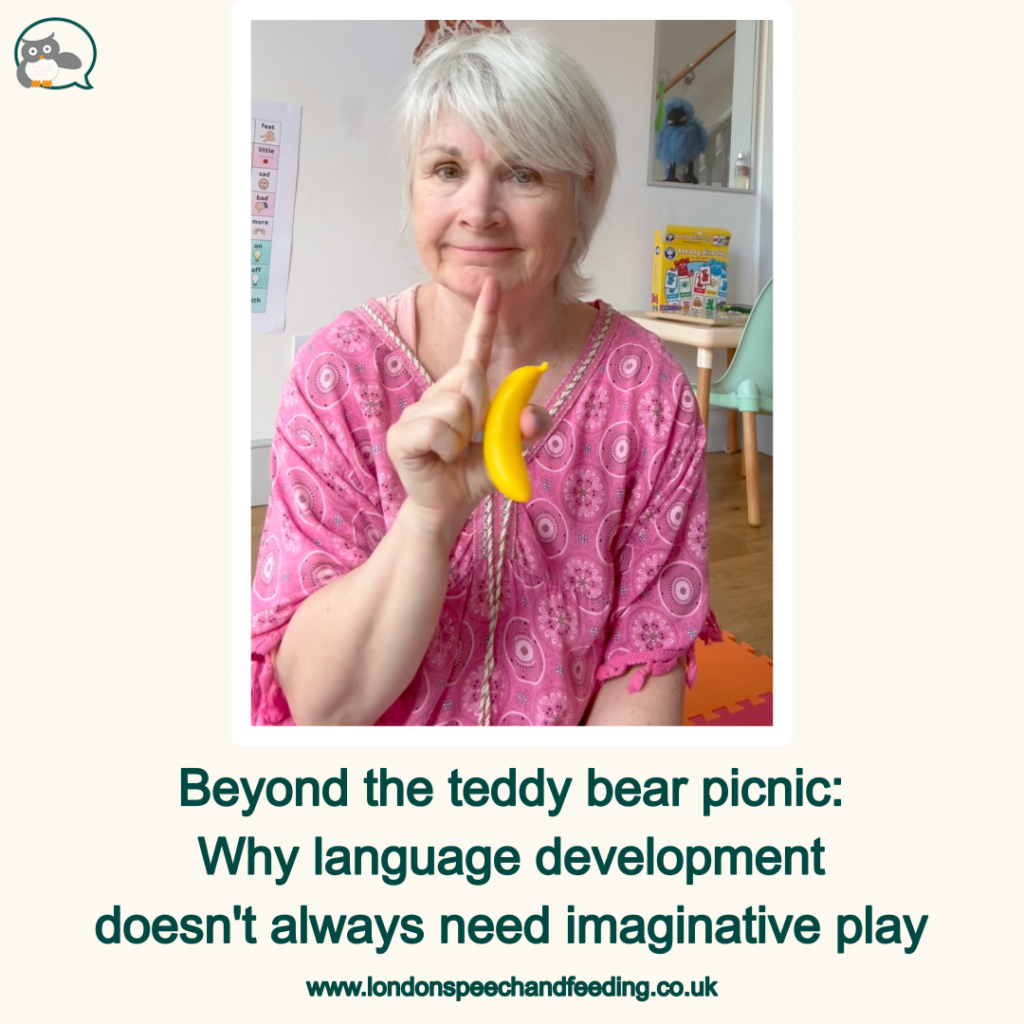
Discover how Attention Autism can support your Autistic child’s communication

|

“I’ve got something in my bag, in my bag, in my bag,

I’ve got something in my bag,

what it is”

You might be wondering why your Speech and Language Therapist is singing this song and then presenting items from a zipped-up bag. Let me take you through stage one of this evidence-based approach.

There are many aims of ‘bucket or bag time’. During stage one, you are simply engaging your child’s attention (whilst also exposing them to language). It’s important to remember that you are not forcing your child to say or do anything. The idea is that the items in the bag or bucket ‘offers an irresistible invitation to learn’ (Gina Davies, 2020).

You don’t need ‘special’ expensive toys. Use what you have at home. It might be that you have some bubbles, a wind-up toy. You might have some foil that you can roll up into a ball, or a balloon. Keep these items for ‘bucket time’. This means that your child is likely to be excited and motivated for the activity. The only stipulation is that these items must be highly motivating and must be the most exciting thing in the room. You’ll want to cover up any distractions.

So, you have your items and your opaque zipped bag, next you’ll want to put the items into the bag ensuring the zip is closed. The zip is important as it increases suspense and excitement as your child cannot see inside. You can also comment when unzipping ‘open bag’ using the signs ‘open’ + ‘bag’ to support your child’s understanding. Your Speech and Language Therapist can help with any Makaton signs that are unknown. The idea of this activity is that the item isn’t touched by your child. This can seem a little odd or feel “mean” but there is a reason for this: we want our child to look at us as well as the object or toy. As soon as we allow our child to touch and play with that toy their attention will go to the toy alone and we won’t get JOINT attention or engagement. This is the reason why we SHOW interesting things for a brief moment and then put these items back into the bag or bucket and out comes the next item. If your child wants to grab the toy and gets upset, then they may not be quite ready for this approach.

Next, we sing the song (as above) and unzip the bag taking out one of the items. The use of pausing is important. Pause after the song: does your child try to use gesture or sound? You can also use this opportunity to model short phrases, ideally one or two words such “it’s a spinner! Wow… so many colours”. After a couple of turns, repeat the process and pull out a different item. We tend not to sing the song each time for the next item. Just sing it at the beginning and then get on with producing the amazing, wonderful things in your bag. No hard and fast rules though, apart from “don’t let the child touch the toys”.

The biggest factor here is that you and your child enjoy the activity together. Have lots of fun!!

Keep up to date with our latest blogs to explore more stages of Attention Autism.

If you need speech, language or communication support or advice, I am always here to help.


Find a speech and language therapist for your child in London. Are you concerned about your child’s speech, feeding or communication skills and don’t know where to turn? Please contact me and we can discuss how I can help you or visit my services page.

0

Similar Posts

  • ·

    The great air debate: How different swallowing patterns impact breastfeeding and reflux

    The great air debate

    As a Speech and Language Therapist specialising in infant feeding, I often hear from worried mums describing their breastfed baby’s fussiness. ‘My baby is so burpy and gassy,’ ‘might it be reflux?’ or ‘she just seems uncomfortable after every feed’. While these concerns are incredibly valid and distressing for both baby and mum (and dads!), the underlying cause isn’t always what you might think. Often, the culprit isn’t primarily a digestive issue, but rather a mechanical one: how effectively your baby is managing air during feeding.

    Many parents are told their baby has ‘colic’ or ‘reflux’ and are offered solutions that don’t quite hit the mark because they overlook a fundamental aspect of feeding: the suck-swallow-breathe sequence. Understanding this intricate dance can be the key to unlocking a calmer, happier feeding experience for your baby and you.

    Understanding the suck-swallow-breathe sequence

    Your baby’s mouth, tongue, jaw, and throat muscles work together in a precise rhythm like a beautifully orchestrated symphony. First your baby draws milk, then swallows it, and then takes a breath, all without interruption. This is the ideal suck-swallow-breathe (SSB) sequence.

    When the SSB sequence functions optimally, a baby latches deeply, creates good suction, draws milk, swallows efficiently, and then pauses just long enough to take a gentle breath before the next suck. This smooth, coordinated process minimises the amount of air swallowed.

    However, for various reasons (it could be a shallow latch, oral motor challenges, an uncoordinated suck, or even an overly fast milk flow) this sequence can get a bit out of sync. Instead of a smooth rhythm, you might see:

    • Suck-suck-swallow-gasp!: Too much air pulled in with the swallow.
    • Rapid, shallow sucking followed by gulping: Inefficient milk transfer and air intake.
    • Clicking noises during feeding: Loss of suction, indicating air entry.
    • Frequent detaching and re-latching: Often to ‘catch a breath’ or because of discomfort.

    Each of these patterns can lead to increased air intake.

    The root cause: Air trapping leading to a gassy breastfed baby

    When a baby swallows too much air during a feed, that air must go somewhere. It builds up in the stomach, causing bloating, discomfort, and often leads to the familiar reflux-like symptoms parents describe: arching, spitting up, burping excessively, or simply appearing distressed.

    It’s a common misconception that all gassiness or reflux symptoms in a breastfed baby are due to something in the mother’s diet or a genuine digestive disorder. While these can be factors, as an SLT, we first look at the mechanics of the feed. If a baby is constantly struggling to maintain a seal, sucking inefficiently, or having to gulp to keep up with flow, he or she is inevitably swallowing air. This air then creates pressure, which can push milk back up (silent reflux) or out (visible reflux).

    Think of it like trying to drink through a straw with a hole in it. You’re sucking, but you’re also pulling in air, making it harder to get the liquid and leaving you with more bubbles in your stomach.

    Why mechanical speech therapy assessment is key

    This is where the distinction between a medical diagnosis (true gastro oesophageal reflux disease or GORD) and a functional feeding challenge becomes critical. A paediatrician will assess for medical causes and may prescribe medication to reduce stomach acid. This can be appropriate for severe cases of GORD.

    However, if the primary issue is air being trapped due to a suboptimal suck-swallow pattern, medication only treats the symptom (acid burning) and not the root cause (air intake). This is precisely where a Speech and Language Therapist specialising in infant feeding comes in.

    My role is to meticulously observe and assess your baby’s oral motor skills, latch, tongue function, and the efficiency of their SSB sequence. I look for subtle signs of inefficiency that contribute to excessive air swallowing.

    • Is the tongue elevating correctly to create suction?
    • Is the jaw stable, or is it excessively moving?
    • Is the latch deep enough to prevent air leaks?
    • Can the baby coordinate suck, swallow, and breathe without gasping?

    By identifying these mechanical challenges, I can then implement targeted strategies to improve feeding efficiency and reduce air intake, often leading to a significant reduction in reflux-like symptoms and overall discomfort.

    Strategies to optimise air management during breastfeeding

    The good news is that many babies can learn to feed more efficiently with the right support. Here are some general strategies we might explore:

    1. Optimise latch and position: A deep, asymmetric latch is crucial. Experiment with different positions that allow for a deeper latch and better head/neck alignment, such as laid-back feeding or upright positions.
    2. Paced feeding (even at the breast): If your milk flow is very fast, consider removing your baby from the breast briefly if you hear excessive gulping or see him or her struggling to breathe. This allows him or her to catch up and manage the flow.
    3. Support the jaw and cheeks: Sometimes, gentle support to the baby’s jaw or cheeks can help them maintain a more stable, efficient suck. I can demonstrate specific techniques for this.
    4. Burping effectively: While burping won’t get rid of all swallowed air, upright burping positions and gentle back rubs can help release some of it.
    5. Pre-feed oral preparation: Gentle oral massage or stretches before a feed can sometimes ‘wake up’ the oral muscles and improve coordination.

    Addressing the ‘Great Air Debate’ isn’t about blaming anyone; it’s about empowering parents with a deeper understanding of their baby’s feeding mechanics. By focusing on the how, not just the what, we can often resolve persistent feeding challenges, reduce discomfort, and make breastfeeding a more joyful, peaceful experience for both you and your little one.

    If you suspect your baby’s gassiness or reflux symptoms are related to how they are managing air during feeds, don’t hesitate to reach out for a specialist assessment.

    Sonja McGeachie

    Highly Specialist Speech and Language Therapist

    Owner of The London Speech and Feeding Practice.


    Health Professions Council registered
    Royal College of Speech & Language Therapists Member
    Member of ASLTIP

    Find a speech and language therapist for your child in London. Are you concerned about your child’s speech, feeding or communication skills and don’t know where to turn? Please contact me and we can discuss how I can help you or visit my services page.

    2
  • · ·

    Strategies to support children with eating difficulties

    where the cause is NOT a swallowing problem, but we are having a “fussy eater” in the family, seeming for no obvious reason

    When parents have a child who find mealtimes or eating difficult, it can put pressure on the whole family dynamics. Once we have observed a child’s eating and drinking skills and found that they are not swallowing impaired, but are for want of a better word “fussy” or “picky”, we can then start to look at what might be underpinning the food aversions/picky eating/food avoidance. Two of the main questions parents have (of course) are:

    • ‘is my child getting the right nutrition?’
    • ‘how can I have less anxiety-provoking and stressful mealtimes?’

    We all tend to have an image in our minds about the ‘perfect mealtime’, and how mealtimes ‘should’ be. Speech and Language Therapists with a Feeding Specialism are the perfect professionals to help you unpick feeding issues. We are trained to look at swallowing and oral skills and we also know a lot about feeding behaviours and sensory difficulties which could be causing your child’s eating avoidance.

    Here are some strategies that can support children with their eating:

    1. Create and maintain a mealtime culture that suits your home and lifestyle. Then stick to that. We all need some routine in our lives to thrive. Mealtimes are no different. It might be that you eat in the same place for every meal, with the same knives and forks, concentrating on maintaining good posture. Children learn by repetition so the more familiar it is, the easier they will find it. In the physical sense, our bodies also need preparing for food, regardless of whether we are eating with our mouths or we are tube-fed. We want every child to connect all the dots of the process. It starts with their eyes, noses, expectations, memories of past experiences, feelings and then finally their mouths….
    2. Be an excellent role model. Children learn through watching others, so your child will be observing you without you knowing. Ensure that you are positive about the food you are all eating, and talk about how delicious, tasty, juicy, and yummy the foods are. Make the atmosphere around the dinner table light hearted. Even though you are secretly stressed about your child not eating, try and not show this. Instead pick a topic or put on some nice music, or talk about something your child might be interested in, and try and avoid coercing your child to eat. Leave small finger foods on their plates and have a range of foods available on the table so that your child can see that everyone is eating a range of foods and enjoying them.
    3. Use positive reinforcement. Try and think of mealtimes as fun and motivating. Children who are happy will likely be more inclined to try foods and take part in family mealtimes. Reward all interactions around food, so if your child merely touches a new food then praise this behaviour. Or if your child licks a food just once, again make a nice comment and praise your child for touching and licking the food. The takeaway here is to try and keep all messages positive around food.
    4. Keep offering all types of food. What often happens is that parents stop serving foods they know will not be eaten. This makes sense in a way; we don’t want wastage! However, try and keep the doors open and re-offer all types of foods, even the ones that your child has not wanted in the past. Try and give your child one food they will like and one food they have tasted before and liked before, even a little, and then one new food to try. So, your child always has something to fall back on and they can join in with eating. But they can also try (or at least look at and think about trying) other foods that you and perhaps the siblings are eating.

    Take a look at this website, I find it very helpful in showing parents what types of foods and how big a portion to offer

    Have a go and try and implement some of the ideas above, and should you get stuck please get in touch!


    Find a speech and language therapist for your child in London. Are you concerned about your child’s speech, feeding or communication skills and don’t know where to turn? Please contact me and we can discuss how I can help you or visit my services page.

    0
  • ·

    Transforming Mealtimes

    Speech Therpaist in London

    Transforming Mealtimes

    Below are two reviews I got from grateful clients over the past 4-6 weeks; this blog is more about how Feeding Therapy can help you than blowing my own trumpet…. though that said, it is always so nice and gratifying to hear when parents are happy and hopeful about their little one’s feeding journey. Feeding Therapy is a substantial part of my work as a Children’s Speech and Language Therapist. One of my specialist subjects is Autism and we find that many children on the Autism Spectrum are very specific about eating, and will often refuse a range of typical family foods in favour of a narrow range of foods/snacks.

    Mostly, feeding difficulties are a combination and complex cocktail of factors that have contributed to the current status quo: sure, there may have been some physical problems to start off with, such as reflux causing the baby discomfort, constipation, a very tight tongue tie or a swallowing problem caused by neurological difficulties and of course sensory processing difficulties are also very physical experiences. We always begin with a very thorough case history taking and information gathering, followed by an oral assessment and observation of the actual swallow to establish what might have been – or still might be – the cause for the feeding difficulties.

    In most of the cases I see in my practice, the original obvious cause is no longer present, especially with older children. So, if the swallowing is fine, the reflux is no longer present, the tongue was divided (twice!) why are they still not eating much, refusing to try new foods, only accept certain textures etc.

    The answer is extremely complex and multi-faceted and this little blog is not covering any factors in detail (we would be here all night) -I mentioned sensory processing difficulties earlier on. These are mostly still present but often not acknowledged or recognised by parents. And it is certainly the case that one of the contributors is parental anxiety; this tends to run very high and has been for many months, sometimes years. This in turn often leads to very tense and unpleasant, endlessly long meal times and many times children are force-fed several times a day in order to “get something down there” as otherwise they would probably starve themselves.

    Additionally, parents end up only offering a very narrow range of foods because that is all their child will eat. This ends up in a vicious cycle of children being fed porridge-style food for all meal times and of course they won’t progress to more mature foods if these mature foods are never on offer.

    In order to help address and disentangle some of the issues I often introduce the “Division of Responsibility in Feeding” as researched and recommended by Ellyn Satter (The Satter Feeding Dynamics Model)

    Here are the main points of her approach:

    Children have a natural ability with eating, they eat as much as they need and they grow in the way that is right for them and they learn to eat what their parents eat. (E Satter). The parent is responsible for WHAT the child eats, WHERE and WHEN the child eats. The child is responsible for HOW MUCH they eat or WHETHER to eat. Satter proposes that parents should guide their child’s transition from nipple feeding through semi-solids, then thick and lumpy foods to finger foods and then on to normal family meals.

    Please note: this model is only appropriate for children where the original physical cause is no longer present!

    Of course it’s not easy! It requires a huge shift in thinking about feeding and it requires to trust our children to know what is best for them. This is very big for most parents, as it is not how we were brought up and it is not commonly known that babies and children know what is good for them!

    However, it is certainly true that parents who follow this particular approach and make small, steady changes in the way the offer foods, and in the way they create family meal times differently, children make very nice, pleasing progress and over some months we often see remarkable positive changes.

    I like to work in a team and especially for this type of problem it is essential to have a multi-disciplinary approach. A knowledgeable dietician is an enormous plus in any feeding team as is of course a

    Paediatrician and/ or a Gastroenterologist and the most important people in the team are the parents!

    Feeding Therapy is all about collaboration and a ‘team around the child” approach. When we have this in place and there is trust amongst the team members then we make fantastic progress.

    Do get in touch with me if you would like some help with your tricky feeder.

    Lovely Reviews

    I visited London Speech and Feeding a couple of days ago with my 8-month-old granddaughter and her mother. Sonja made us feel comfortable and at ease from our first introductions. She was able to pinpoint my granddaughter’s mum’s anxiety around weaning very quickly. She not only gave her the tools to do this successfully, but also really encouraged my granddaughter’s mum and instilled confidence that she had everything she needed to make this sometimes-difficult transition without further anxiety.

    Sonja was very thorough in her initial assessment of my granddaughter’s physical milestones and her developing speech. My granddaughter felt very comfortable with Sonja and happily played along with her. Then came the big moment – trying out various foods! We were amazed to see just how easily my granddaughter, with Sonja’s expert encouragement, took to sampling the wonderful array of different delicious morsels Sonja had prepared for the session. My granddaughter even drank from a cup for the first time! Wonderful!

    Sonja then emailed a summary of the session and an extensive array of resources with suggestions for my granddaughter’s mum which she has now put into action. My granddaughter’s mum couldn’t thank Sonja enough for her caring attitude, extensive knowledge, and warm professionalism. I have no hesitation in recommending Sonja, she’s a fantastic Feeding Therapist!

    Sonja (and her lovely colleague, Sandra) were stupendous. I had brought my one-year-old son to see them as I was concerned that he wasn’t eating enough. They looked at his history and we ate together to make sure they had all the information they needed to give an accurate diagnosis. Whilst our outcome was that Henry was in fact doing brilliantly (and I just needed to chill out a bit!), I would imagine if there was something more serious going on, Sonja would make you feel just as supported and empowered as she did with us. Excellent follow-ups too. Money well spent for a bit of reassurance for a stressed out mama. Thank you, Sonja!


    Find a speech and language therapist for your child in London. Are you concerned about your child’s speech, feeding or communication skills and don’t know where to turn? Please contact me and we can discuss how I can help you or visit my services page.

  • · ·

    Childhood Apraxia of Speech: Signs and first steps (2–5 years)

    If you’ve found yourself wondering ‘Why can my child say a word one day, but not at all the next?’ it might be that your child has a motor speech difficulty. This means the challenge isn’t that your child doesn’t know what they want to say; it’s that their brain finds it harder to plan and coordinate the movements needed for clear speech. This speech difficulty is called Childhood Apraxia of Speech (CAS)

    Sonja showing power words on a board

    In this post, I’ll explain what CAS can look like in 2–5 year olds, what an assessment usually involves, and what you can start doing at home to support your child without turning life into ‘speech homework all day long’.

    What is childhood apraxia of speech (CAS)?

    Children with CAS often have lots to communicate about (and strong ideas!) but their speech may come out as:

    • Unclear
    • inconsistent
    • hard to ‘copy’ on demand
    • frustrating for them and for you

    CAS is not caused by laziness and it is not a parenting issue. It is also not something children simply ‘grow out of’ without support. But with the right therapy approach, children can absolutely build clearer speech over time.

    If you’d like to read more about verbal dyspraxia, you may also find this helpful: Supporting children and families living with verbal dyspraxia.

    Why is CAS such a big topic right now?

    Many families come to me after months (or years) of being told:

    • ‘She’ll talk when she is ready’
    • ‘He’s just shy’
    • ‘It’s probably a speech delay’
    • ‘It’s normal for toddlers’

    And sometimes it is a general delay. But sometimes it’s something more specific, like CAS.

    There’s also been a huge rise in parents seeking information online, and CAS is often mentioned alongside speech sound difficulties such as:

    • phonological delay (pattern-based speech errors)
    • articulation difficulties (one sound that won’t come out clearly)
    • inconsistent speech disorder

    These can look similar at first glance, which is why a specialist assessment matters.

    Signs of childhood apraxia of speech in 2–5 year olds

    Children develop speech at different rates, and not every unclear speaker has CAS. But here are some common features that may raise a flag, especially when you notice several together.

    1) Inconsistent speech errors

    Your child might say the same word in different ways:

    • ‘banana’ → nana / baba / mana
    • ‘daddy’ → gaga / daddy / dadi

    This inconsistency is one of the biggest clues.

    2) Difficulty copying words on request

    Some children speak more easily in natural play, but when asked ‘Say ___’, they freeze or the word becomes much harder.

    3) Limited sound repertoire

    They may use only a small set of consonants (like /M/, /N/, /B/, /D/) and avoid others.

    4) Vowel distortions

    Many children with typical delays mainly struggle with consonants. But in CAS, vowels can also sound ‘off’ or change between attempts.

    5) Speech that sounds effortful

    You might notice your child:

    • pauses between sounds
    • tries multiple times
    • looks like they’re ‘searching’ for the right mouth movement

    6) Longer words are much harder

    ‘Car’ might be easier than ‘carry’, and ‘carry’ easier than ‘caterpillar’.

    7) Prosody differences (rhythm and stress)

    Some children with CAS sound a little unusual in their speech rhythm, stress, or intonation.

    8) Frustration or reduced confidence

    When a child is frequently misunderstood, they may:

    • talk less
    • use gestures more
    • become upset when asked to repeat themselves

    Important note: none of these signs alone prove CAS but they are a strong reason to seek a speech assessment rather than waiting.

    CAS vs phonological delay vs articulation difficulty (quick guide)

    These are some of the most common questions I hear.

    If it’s mainly an articulation difficulty…

    A child may consistently say one sound incorrectly (for example, ‘thun’ for ‘sun’- lisp- but everything else is developing well.

    If it’s mainly a phonological delay…

    You might notice clear patterns, like:

    • leaving off the ends of words (‘ca’ for ‘cat’)
    • swapping back sounds for front sounds (‘tar’ for ‘car’)

    Patterns are often consistent and respond well to phonology-based therapy.

    If it might be CAS…

    Speech often feels less predictable, harder to imitate, and more impacted by word length and complexity.

    If you’re unsure, that’s completely normal, and exactly why assessment matters.

    What happens in a CAS assessment?

    A high-quality speech assessment for possible CAS usually includes:

    1) Parent discussion and developmental history

    We talk about:

    • pregnancy and birth history (where relevant)
    • feeding history
    • early sounds and babbling
    • first words and how speech has progressed
    • family history of speech/language needs

    2) A speech sound assessment

    Your child might be shown pictures or play-based prompts so we can hear:

    • what sounds they can say
    • what they simplify
    • whether errors are consistent or inconsistent

    3) An oral-motor and movement check

    This isn’t about ‘strength’. It’s about coordination and planning. We look at how your child manages speech movements and transitions.

    4) Stimulability testing

    This means: how easily can your child learn a new sound or word with support?

    For CAS, we often explore how they respond to:

    • slowed-down speech
    • visual cues
    • rhythm/tapping
    • short, simple syllable shapes

    5) Functional communication and confidence

    We look at how speech impacts daily life:

    • being understood at nursery
    • joining in with peers
    • asking for help
    • managing emotions when misunderstood

    At the end, you should leave with:

    • a clear explanation of what we think is going on
    • a therapy plan
    • practical home strategies
    • realistic next steps

    What parents can do at home

    Here are CAS-friendly strategies you can start right away.

    1) Choose ‘power words’

    Pick 1–2 words that matter most in your child’s daily life, such as:

    • more
    • help
    • mummy
    • again
    • stop
    • open

    These words are motivating and functional.

    2) Keep it short and successful

    For many children with CAS, the goal is quality over quantity.

    Try five minutes a day rather than 30 minutes of struggle.

    3) Support speech with rhythm

    Some children benefit from:

    • tapping a beat on the table
    • clapping syllables
    • using a gentle ‘marching’ rhythm

    This can help the brain organise the sequence of movements.

    4) Celebrate approximations

    If your child says ‘moh’ for ‘more’, that’s communication!

    We want them to feel:

    • safe
    • understood
    • proud to try again

    Confidence is a key part of progress.

    A short parent story (anonymised)

    One mum said to me:

    ‘We kept being told to wait. But I could see my child understood everything; they just couldn’t get the words out. Once we had an assessment and a plan, it felt like we finally knew what to do. The biggest change was his confidence. He started trying more.’

    When should you seek support?

    You don’t need to wait until school.

    It’s worth getting an assessment if your child is:

    • hard to understand compared with peers
    • becoming frustrated or withdrawing from talking
    • inconsistent with words they used to say
    • struggling to imitate speech sounds
    • showing signs that match CAS

    Early support can reduce stress for the whole family and help your child feel successful in communication.

    Here’s how I can help:

    ✅ A detailed speech assessment (including whether CAS is likely)

    ✅ A clear therapy plan with realistic goals

    ✅ Practical home strategies you can use immediately

    ✅ Support for nurseries and schools (where needed)

    ✅ In-person sessions in North-West London and online options

    Book your consultation here.

    Final gentle reminder

    You are not overreacting. Trust your instincts.

    Your child is communicating the best way they can, and with the right support, speech can become easier, clearer, and more confident.

    Sonja McGeachie

    Highly Specialist Speech and Language Therapist

    Owner of The London Speech and Feeding Practice.


    Health Professions Council registered
    Royal College of Speech & Language Therapists Member
    Member of ASLTIP

    Find a speech and language therapist for your child in London. Are you concerned about your child’s speech, feeding or communication skills and don’t know where to turn? Please contact me and we can discuss how I can help you or visit my services page.
    3
  • · ·

    The power of babble: Why your baby’s ‘talk’ matters

    That adorable string of ‘ba-ba-ga-ga-ma-ma’ might sound like baby gibberish, but it’s actually a crucial milestone in your little one’s language development. Babbling or babble, as we call it, is far more than just cute baby noises. It’s a sequence of sounds that lays the foundation for future communication.

    Image by freepik

    What is babbling?

    Babbling typically begins around six months of age, though the timing can vary slightly from baby to baby. It involves your baby experimenting with different sounds, stringing together consonants and vowels. You might hear them repeating sounds like:

    • ‘Ba-ba’
    • ‘Da-da’
    • ‘Ma-ma’
    • ‘Ga-ga’

    As they progress, the babbling becomes more complex, with variations in pitch, rhythm, and intonation. It might even sound like they’re having a conversation with you!

    Why is babbling so important?

    1. Laying the groundwork for speech: Babbling is like a vocal workout for your baby. By practising these sounds, they’re strengthening the muscles in their mouth, tongue, and vocal cords that are essential for speech.
    2. Developing phonological skills: Through babbling, babies begin to understand the sound patterns of their native language. They’re learning which sounds go together and how they’re used.
    3. Enhancing social interaction: Babbling is a social activity. Babies often babble back and forth with their caregivers, which helps them learn about the give-and-take of communication.
    4. Cognitive development: The act of babbling requires babies to use their brains in new ways. They’re learning to control their vocalisations, pay attention to the sounds they’re making, and connect those sounds to the responses they receive from others.

    How can you encourage babbling?

    • Talk to your baby: Even though they can’t understand your words yet, talking to your baby exposes them to language and encourages them to respond with their own vocalisations.
    • Imitate their sounds: When your baby babbles, imitate them! This shows them that you’re paying attention and encourages them to keep ‘talking.’
    • Respond to their babbling: Treat your baby’s babbling as if it’s a real conversation. Respond with words, smiles, and gestures.
    • Play sound games: Make different sounds for your baby and encourage them to imitate you. This could include animal sounds, silly noises, or simple words.
    • Read to your baby: Even before they can understand the words, reading to your baby exposes them to the rhythm and sounds of language.
    • Sing songs: Singing is a fun and engaging way to introduce your baby to new sounds and words.
    • Use mirrors: Babies often enjoy watching themselves make sounds in a mirror.
    • Tactile stimulation: Gentle massage around the mouth and face can increase oral awareness and encourage vocalisations.
    • Vary textures: Offer different textured teethers.
    • Read books with sound effects: Choose books with animal sounds or other engaging noises.
    • Blow bubbles: The act of blowing and popping bubbles can encourage vocalisations.
    • Use visual aids: Show pictures of objects and say their names, emphasising the consonant sounds.
    • Use exaggerated facial expressions: When you make sounds, exaggerate your mouth movements to help your baby see how sounds are made.
    • Increase joint attention: Follow the child’s gaze and point to objects that they are looking at and say the name of the object.

    When to seek help

    If you notice that your baby is not babbling by eight months, it’s a good idea to talk to your speech and language therapist. You might also notice a lack of variation in tone when your child is making sounds, is your baby sounding a little ‘flat’ or monotonous? While every child develops at their own pace, a lack of babbling can sometimes indicate a developmental delay or hearing issue.

    Remember, babbling is a gift. So, enjoy those precious moments of ‘baby talk’ and take comfort in knowing that your little one is on the path to becoming a chatterbox!

    Do get in touch via my contact form if you are concerned about your child’s development or if you simply want some reassurance that your baby is developing well. We will be delighted to arrange a screening appointment for you and give you support and reassurance.

    Sonja McGeachie

    Highly Specialist Speech and Language Therapist

    Owner of The London Speech and Feeding Practice.


    Health Professions Council registered
    Royal College of Speech & Language Therapists Member
    Member of ASLTIP

    Find a speech and language therapist for your child in London. Are you concerned about your child’s speech, feeding or communication skills and don’t know where to turn? Please contact me and we can discuss how I can help you or visit my services page.

    1
  • ·

    The role of spinning and swinging in speech and language therapy

    Sonja with a child on a swinging with a stuffed monkey

    Spinning and swinging are often observed behaviours in autistic children. While these actions might seem repetitive or unusual to some, they serve crucial functions for these children. Understanding the underlying reasons for spinning and swinging can provide valuable insights into how to support autistic children and incorporate these activities into therapeutic settings.

    Why do children spin?

    Spinning is a common sensory-seeking activity in autistic children. Sensory seeking means that the child actively looks for sensory input to regulate their nervous system. Here’s why spinning can be beneficial:

    • Vestibular input: Spinning stimulates the vestibular system, which is located in the inner ear and is responsible for balance and spatial orientation. For children with sensory processing difficulties, spinning can provide essential sensory input.
    • Calming effect: For some children, spinning can be a self-regulating strategy. The rhythmic motion can help to calm the nervous system and reduce anxiety.
    • Sensory exploration: Spinning allows children to explore their sensory experiences. It can help them understand their bodies and how they move in space.

    The allure of swinging

    The rhythmic back-and-forth motion of a swing offers several benefits:

    • Vestibular input: Like spinning, swinging stimulates the vestibular system, helping to improve balance and coordination.
    • Proprioceptive input: Swinging provides proprioceptive input, which is the sense of where your body is in space. This information is crucial for motor planning and coordination.
    • Calming and organising: The rhythmic motion of swinging can have a calming effect on the nervous system, helping to regulate emotions and improve focus.
    • Social interaction: Swinging can be a shared experience, fostering social interaction and communication.
    • Facilitating communication: While swinging, children are so much more relaxed and open to communication. The rhythmic motion can also help facilitate singing, humming, listening to my singing, non-verbal communication for sure but also more verbal and mouth words can be heard from children on my swing. If nothing else, it is so fun and helps build trust and rapport between my child and me.

    Therapeutic Activities Combining Spinning, Swinging, and Speech and Language Therapy

    Here are some therapeutic techniques that I use at London Speech and Feeding to combine movement with speech and language development:

    • Swinging with verbal prompts: While the child is swinging, I provide simple verbal prompts such as ‘up’, ‘down’, ‘fast’, and ‘slow.’ This helps to develop receptive language skills and improve auditory processing.
    • Sensory-motor play: I like to combine swinging with tactile activities like playing with textured balls or bean bags. This can facilitate language development through descriptive language, words and scripts like: ‘that’s so soft’, ‘oooh tickle tickle tickle!’
    • Storytelling on the swing: Often I manage to create a story while the child is swinging. This can improve narrative skills, vocabulary, and imagination. Recently I did the ‘Tiger who came to tea’ story and each time the swing stopped the tiger came and ‘ate some more cakes’ and ‘tickled their tummy’ whilst eating. It may make not much sense but my child loved it and we had ‘more tiger eat more’.
    • Song and rhyme time: Often I sing the ‘rumble in the jungle’ song while swinging my child to enhance phonological awareness, rhythm, and timing.
    • Visual supports always help: I use LAMP Words for Life AAC support during swinging and show core words such as: ‘go’ / ‘stop’/ ‘more’ / ‘tickle tickle’ etc. #lampwordsforlife #aac
    • Movement-based activities: We can incorporate activities that require sequencing, such as imitating animal movements or following simple commands while swinging. This can improve motor planning and language comprehension.

    For more information follow me on Instagram, Facebook or LinkedIn.

    Sonja McGeachie

    Early Intervention Speech and Language Therapist

    Feeding and Dysphagia (Swallowing) Specialist The London Speech and Feeding Practice

    The London Speech and Feeding Practice


    Find a speech and language therapist for your child in London. Are you concerned about your child’s speech, feeding or communication skills and don’t know where to turn? Please contact me and we can discuss how I can help you or visit my services page.

    1