Explaining pronoun reversal: A window into gestalt language processing

| |
Explaining pronoun reversal: A window into gestalt language processing

Have you noticed your child referring to themselves as ‘you’, or calling you ‘me’? This seemingly confusing mix-up of pronouns, known as pronoun reversal, often raises concerns for parents. Below I outline why your child does this and want to reassure you that it is to do with his or her unique language learning style.

Gestalt language processing: Learning in chunks

Many children, particularly those on the autism spectrum, use a gestalt language processing approach. Unlike analytic language processors who learn individual words and build sentences, gestalt language processors learn language in whole ‘chunks’ or ‘gestalts’. Think of these gestalts as pre-packaged scripts they pick up from their environment — phrases, sentences, even snippets of songs or movie lines.

As Marge Blanc, author of Natural language acquisition on the autism spectrum, explains, ‘When a child picks up an entire gestalt (script), he’s got the pronoun of the original speaker. So ‘pronoun reversal’ is nothing more than that.’

So your child is simply repeating what they’ve heard, without yet understanding the individual word meanings or grammatical functions.

Imagine your child hearing ‘You want a rice cake?’ repeated frequently. They might then use this phrase to express their own desire for a rice cake, even though it doesn’t grammatically fit. So they are thinking and saying ‘You want a rice cake?’ and the meaning of this phrase is: ‘I want a rice cake’. This isn’t a sign of confusion, but a natural step in their language development. They’re working with the tools they have: the scripts they’ve acquired.

How can we support their natural language journey

Instead of trying to ‘correct’ pronoun usage, our role as caregivers and speech therapists is to support the child’s natural language progression. Here’s how we can do this:

  1. Learn about their gestalt stage and run with it: In the early stages (1–3) of gestalt language development, correcting pronouns can be counterproductive. These children are still processing language as whole units, not individual words. Direct corrections can lead to frustration and hinder their natural language exploration.
  2. Patience and trust: Gestalt language processing follows a predictable, albeit sometimes non-linear, path. By understanding their current stage, we can provide targeted support. Language sampling and scoring, guided by the Natural Language Acquisition framework, help us pinpoint their stage and tailor our approach.
  3. Model language strategically: In the early stages, avoid using pronouns like ‘you’ and ‘you’re’. Instead, model language from the child’s perspective or use joint perspectives. For example, instead of ‘Are you thirsty?’, try ‘I’m thirsty!’ or ‘Let’s get some water’,

The big picture: Language unfolds naturally

Pronoun reversal is a stepping stone, not a stumbling block. As gestalt language processors progress, they begin to break down these gestalts into smaller units and develop their own self-generated language. This is when their understanding and use of pronouns naturally emerge.

By shifting our perspective from ‘error correction’ to ‘developmental support’, we create a nurturing environment for these children to thrive. We empower them to navigate their unique language journey, ultimately leading to more meaningful and independent communication.

So, to summarise:

  • Pronoun reversal is a typical characteristic of early-stage gestalt language processing.
  • Focus on modelling language from the child’s perspective or a joint perspective.
  • Avoid correcting pronouns in the early stages.
  • Trust the process and support the child’s natural language development.

Let’s celebrate the diverse ways our children learn to communicate and empower them to find their unique voice!

If you have any questions or would like some help with understanding your little gestalt language learner, please get in touch with me via my contact form.

Sonja McGeachie

Highly Specialist Speech and Language Therapist

Owner of The London Speech and Feeding Practice.


Health Professions Council registered
Royal College of Speech & Language Therapists Member
Member of ASLTIP

Find a speech and language therapist for your child in London. Are you concerned about your child’s speech, feeding or communication skills and don’t know where to turn? Please contact me and we can discuss how I can help you or visit my services page.

1

Similar Posts

  • ·

    Let’s relax about making EYE CONTACT already…

    There’s been a long tradition with teaching staff and with Speech and Language Therapists working in schools that eye contact should be a goal. It is well known that Autistic individuals (whether that be children or adults) mostly avoid eye contact. Whilst it’s part of the way we communicate, it shouldn’t be used as a necessity for an individual who feels that it is uncomfortable. Whilst it does show that you’re listening and showing an interest, it’s not a fair expectation for neurodiverse children.

    Autistic children can find making and maintaining eye contact physically and emotionally uncomfortable as well as unnatural. It adds an extra layer of stress and has been reported to increase distractions rather than reduce them. Children who engage in conversations in their own way (i.e., with reduced eye contact) are not shown to suffer with schooling, work, or social interaction.

    By having fun through meaningful activities, I often experience that ‘BINGO’ moment (a phrase coined by Alex @meaningfulspeech) where the child is enjoying themselves and naturally makes eye contact. There is no demand on them, they are in a fun, engaging environment which suit their strengths and supports their needs.

    Following this, I often reflect on this question ‘Should we make eye contact as a goal?’

    It very much depends on the situation. If it places more demands on the child and becomes stressful. Then no. There are many strategies we can use which gain eye contact without placing extra demands on the child. We need to be mindful to adapt the environment and not place neurotypical expectations to meet the needs of neurodiverse children.

    How can you encourage eye contact without demand?

    • If you’re using toys, try holding them up to your eye level.
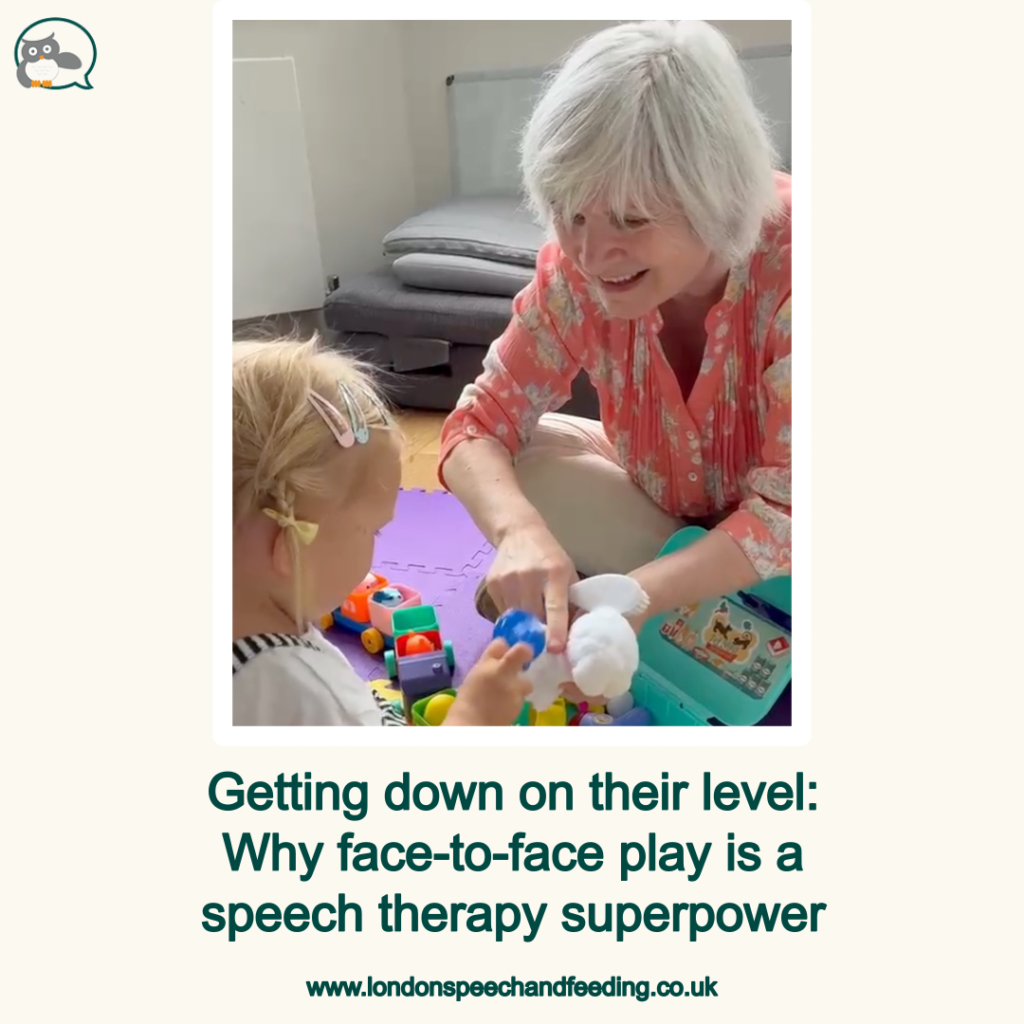
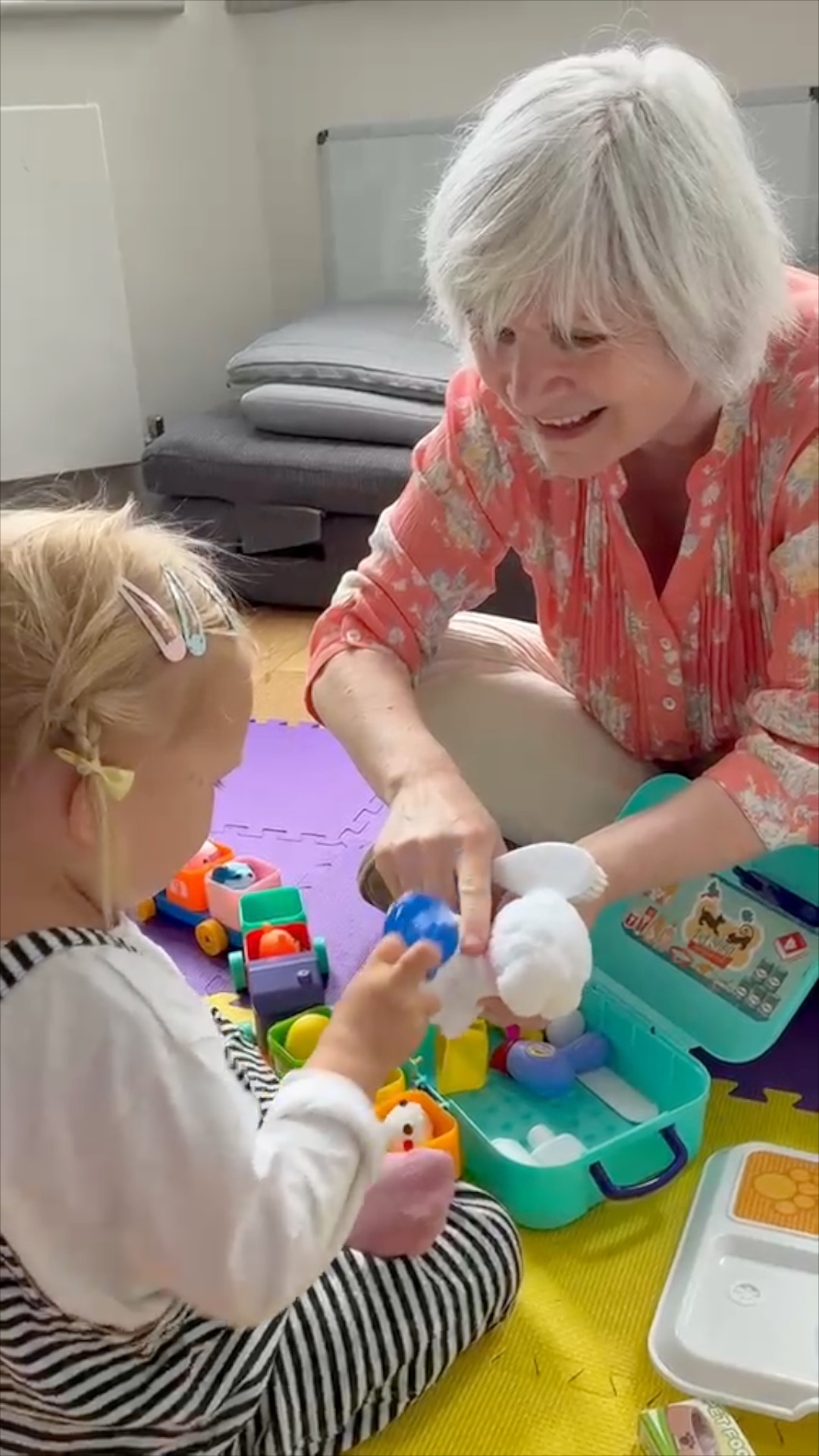
    • You can adjust your position, try sitting face to face during play.
    • Always get down to your child’s level. This might mean that you lay on the floor if your child is positioned in this way.
    • During play, waiting is extremely powerful. Before a key part of the activity, wait and see if your child looks at you. Remember silence is golden!
    • The best way I find is: do something unusual during play. It might be that you spray shaving foam with the lid still on. Or you bring out a wow toy and make it spin/light up or make a noise. A balloon can be good – see video clip. Use the excitement of the activity, and wait to see if you achieve that ‘BINGO’ moment.
    • Create opportunities when there are no toys involved such as during ‘tickles’ or ‘hide and seek’. Autistic children find it difficult to shift their attention between a toy and an adult. So by removing one option, you’re setting them up to succeed.

    Remember, it takes practice and time for you to develop these skills. Try one at a time and experiment, see which works best for your child. If you need speech, language or communication support or advice, I am always here to help.


    Find a speech and language therapist for your child in London. Are you concerned about your child’s speech, feeding or communication skills and don’t know where to turn? Please contact me and we can discuss how I can help you or visit my services page.

    0
  • · ·

    Speech sounds practice at home

    Speech therapists use a variety of tools to help children master specific sounds, and then the students are sent home with some practice sheets to use daily. Parents are able to observe what we do in the session, but I know that back at home three days later they can’t quite remember what it was all about and how to do the practice.

    Here I explain the importance of visual cues, finger shapes, pictures, and semantic prompts (fancy speech therapy term for word clues!). By understanding these tools, you can turn practice time into a fun and engaging experience for both of you.

    Why Visual Cues matter?

    Imagine learning a new language just by listening. It’s tough, right? Young children learning new speech sounds face a similar challenge. Visual cues act like flashcards for their minds, giving them a clear picture of how to position their mouth and tongue.

    • Mirrors: Encourage your child to watch your face (and theirs) in the mirror as you make the sound together. This helps them see the tongue placement and lip movements required.
    • Mouth pictures: Speech therapy sheets often have pictures of mouths making specific sounds. Point to the picture and explain how the tongue and lips look, then have your child try to imitate it.
    • Your face is the best cue! Don’t underestimate the power of your own face. Over-enunciate the sound and let your child observe your mouth movements. Watch this little video clip where I am teaching the /SH/ sound to my little student. You cannot see him but we are both sitting on the floor opposite one another so that he can see me easily.

    Finger fun: making sounds with our hands

    Finger shapes are another powerful tool in my speech therapy arsenal. Think of them as fun reminders of how to position the tongue.

    • ‘Open Wide’ fingers: For sounds like /AH/ and /OH/, hold your fingers wide apart, mimicking an open mouth.
    • ‘Tongue Up’ fingers: For sounds like /T/ and /D/, touch the tip of your thumb to your other fingers, creating a little ‘wall’ like the tongue tip touches the teeth ridge.
    • ‘Snake Tongue’ fingers: For the /S/ sound, wiggle your pinky finger to represent the snake-like tongue tip.
    • In this little video clip I am demonstrating the C-shape moving forward which I had taught my child, showing how the windy sound (/SH/) travels forward with lips open and slightly pursed.

    Bringing sounds to life with pictures

    Pictures serve as visual prompts to connect the sound with a familiar word.

    • Video clip: I am using the WINDY SOUND picture and the FLAT TYRE sound picture to represent /SH/ and /S/ respectively
    • Point and Say: Point to each picture and say the word clearly, emphasising the target sound. Encourage your child to repeat.

    Unlocking sounds with semantic prompts

    Semantic prompts are fancy words for clues that help your child guess the target sound. They can be simple questions or descriptive words.

    • ‘Can you feel the wind whooshing?’ (/SH/)
    • Think of tyre going flat, or a balloon losing air, or a train coming to a slow halt (/S/)

    Practice makes progress, but fun makes it funnier!

    Remember, the key is to keep practice sessions light and engaging. Here are some extra tips:

    • Short and sweet: Stick to short practice times (5-10 minutes) to avoid frustration.
    • Make it a routine: Integrate practice time into your daily routine, like after breakfast or before bedtime.
    • Positive reinforcement: Celebrate your child’s efforts with praise and high fives!
    • Make it multisensory: Incorporate sensory activities like blowing bubbles for /F/ or feeling the wind for /SH/.

    Parents you’re a vital part of your child’s speech development, and together we can make huge progress quickly.

    Please contact me if your child has speech sound difficulties.

    Sonja McGeachie

    Early Intervention Speech and Language Therapist

    Feeding and Dysphagia (Swallowing) Specialist The London Speech and Feeding Practice

    The London Speech and Feeding Practice


    Find a speech and language therapist for your child in London. Are you concerned about your child’s speech, feeding or communication skills and don’t know where to turn? Please contact me and we can discuss how I can help you or visit my services page.

    1
  • The tricky /R/: Mastering tongue placement for clear speech

    The /R/ sound is notoriously challenging for many children (and even some adults!). It’s one of the most complex sounds in the English language, with various pronunciations depending on its position in a word. If your child is struggling with their /R/s, you’re not alone. As Speech and Language Therapists (SLTs), we frequently work on this sound, and a key component of our therapy is focusing on proper tongue placement.

    Why is the /R/ so difficult?

    The /R/ sound requires precise coordination of the tongue, jaw, and lips. Unlike sounds like /P/ or /B/ that involve simple lip movements, the /R/ involves intricate tongue movements and tension. There are also different ways to produce the /R/ sound, which adds to the complexity:

    • Retroflex /R/: The tongue tip curls up and back towards the roof of the mouth.
    • Bunched /R/: The body of the tongue bunches up towards the roof of the mouth, while the tongue tip remains down.

    The importance of tongue placement

    Regardless of which /R/ variation is being targeted, accurate tongue placement is crucial. Even a slight deviation can result in a distorted or inaccurate sound. That’s why SLTs dedicate significant time to teaching and practising tongue positioning.

    Speech therapy techniques: Focusing on the tongue

    Here’s a glimpse into how I address /R/ sound difficulties, with a focus on tongue placement:

    • Visual aids:
      • Mirrors: I use a mirror to help children see their tongue movements and make adjustments.
      • Tongue diagrams and models: These visual tools provide a clear representation of where the tongue should be positioned.
    • Tactile cues:
      • Tongue depressors: These can be used to gently guide the tongue into the correct position.
      • Food-grade tools: Sometimes, I use flavoured tongue depressors or other tools to provide tactile feedback and increase awareness of tongue placement.
    • Auditory discrimination:
      • I help children distinguish between correct and incorrect /R/ sounds.
      • I use auditory cues and verbal feedback to reinforce proper pronunciation.
    • Exercises and drills:
      • Tongue strengthening exercises: Strengthening the tongue muscles can improve control and coordination.
      • Tongue placement drills: We practise positioning the tongue in the desired location and holding it there.
      • Sound approximation techniques: Sometimes we use other sounds to help approximate the /R/ sound. For example, I use the /L/ sound, to help achieve the correct tongue placement. Once my child has found the /L/ sound it is then a matter of pulling back just slightly to get a good /R/.
    • Contextual practice:
      • Once the child can produce the /R/ sound in isolation, we gradually introduce it into syllables, words, phrases, and sentences.
      • We also practise the /R/ sound in different contexts, such as at the beginning, middle, and end of words.

    Tips for Parents:

    • Be patient and supportive: Learning the /R/ sound takes time and practice.
    • Practise regularly: Short, frequent practice sessions are more effective than long, infrequent ones.
    • Make it fun! Use games, stories, and other engaging activities to keep your child motivated.
    • Work with an SLT: A qualified SLT can provide personalised guidance and support.

    In conclusion:

    The /R/ sound can be challenging, but with targeted speech therapy and a focus on tongue placement, most children can achieve clear and accurate pronunciation.

    I hope this blog post is helpful!

    Get in touch with me via my contact form if you need support

    Sonja McGeachie

    Early Intervention Speech and Language Therapist

    Feeding and Dysphagia (Swallowing) Specialist The London Speech and Feeding Practice

    The London Speech and Feeding Practice


    Find a speech and language therapist for your child in London. Are you concerned about your child’s speech, feeding or communication skills and don’t know where to turn? Please contact me and we can discuss how I can help you or visit my services page.

    1
  • · · ·

    The quiet power: Why silence and responsiveness boost communication in children with delays

    The quiet power: Why silence and responsiveness boost communication in children with delays
    Supplied by Sonja McGeachie, Practice Owner

    As parents and caregivers, our natural instinct when interacting with a child, especially one who struggles with communication, is often to fill every silence. We might ask lots of questions, offer constant commentary, or try to prompt him or her to speak. Our hearts are in the right place. We want to help him or her communicate! However, for children with language delays or those on the autism spectrum, this well-intentioned approach can sometimes inadvertently create more pressure and fewer opportunities for them to truly initiate and develop their own communication skills.

    What if I told you that one of the most powerful tools in your communication toolkit is often silence? And that responding to your child, rather than always initiating, can unlock incredible potential?

    Let’s explore why these seemingly simple strategies are so profoundly beneficial.

    The unspoken benefits of silence

    In our fast-paced world, silence can feel awkward, but for a child who is processing language differently, it’s a gift:

    1. Time to process: Children with language delays often need more time to process what they hear and to formulate their own thoughts or responses. When we bombard them with words, we don’t give their brains the crucial milliseconds they need to catch up. A pause of 5–10 seconds can make all the difference.
    2. Reduces pressure: Constant questioning or prompting can feel like a test. Silence removes this pressure, creating a more relaxed environment where the child feels safe to communicate without fear of being ‘wrong’ or rushed.
    3. Creates opportunity to initiate: If you’re always talking, when does your child get a turn to start the conversation? Silence opens up a space for him or her to initiate, whether it’s through a sound, a gesture, eye contact, or a word. This is vital for developing spontaneous communication.
    4. Encourages independent thinking: When a child is given space, he or she is more likely to try to figure things out himself or herself. This fosters problem-solving skills and reduces reliance on adult prompts.
    5. Prevents overwhelm (especially for ASD): Many children on the autism spectrum can be sensitive to auditory input. A constant stream of language can be overwhelming, leading to withdrawal or challenging behaviours. Strategic pauses can help them regulate and engage more effectively.

    The power of responding (not just initiating)

    Think of a tennis match: if only one person serves, it’s not a game. Communication is a rally, a back-and-forth exchange. When you primarily respond to your child’s communication attempts, you’re teaching him or her the rhythm of conversation:

    1. Follow the child’s lead: This is a cornerstone of effective language intervention, famously championed by programs like Hanen’s ‘It Takes Two to Talk’. When you respond to what your child is already interested in or doing, the interaction becomes immediately relevant and motivating for him or her.
    2. Validates his or her attempts: Every sound, gesture, glance, or partial word your child offers is a communication attempt. By responding to it, you’re telling him or her, ‘I see you. I hear you. Your communication matters.’ This builds immense confidence and encourages him or her to try again.
    3. Builds confidence and motivation: When a child feels understood and successful in his or her communication, he or she are more likely to communicate more often. It’s a positive feedback loop.
    4. Teaches turn-taking naturally: By taking your turn after his or hers, you model the natural flow of conversation. He or she learns that communication is a shared activity, not a one-sided lecture.
    5. Makes interactions meaningful: When you respond to his or her interests, you’re talking about things that are inherently motivating to him or her. This makes the language you use more easily understood and remembered.

    Practical strategies for parents: Observe, Wait, Listen (OWL)

    The Hanen Centre’s ‘Observe, Wait, Listen’ (OWL) strategy perfectly encapsulates these principles:

    • Observe: Watch your child closely. What is he or she looking at? What is he or she doing? What sounds is he or she making? What gestures is he or she using?
    • Wait: After you’ve observed, wait. Give him or her time. Resist the urge to jump in with a question or comment immediately. Count to five (or even ten) in your head. This silence is an invitation for him or her to communicate.
    • Listen: When he or she does communicate (in any way!), listen intently. Try to understand his or her message or intent.

    Beyond OWL – More tips:

    • Reduce questions, increase comments: Instead of ‘What’s that?’ try ‘Oh, a big red ball!’ or ‘The car is going fast!’ Comments provide language models without demanding a verbal response.
    • Expand, don’t just prompt: If your child says ‘Car’, you could respond with ‘Yes, That’s a big car!’ or ‘It’s really fast!’ You’re building on his or her communication with a slightly richer language model.
    • Create opportunities for communication: Place desired items slightly out of reach. This creates a natural reason for your child to communicate his or her wants (e.g., reaching, pointing, vocalising).
    • Respond to all communication: Don’t just wait for words. If your child points, look where he or she is pointing and comment. If he or she makes a sound, imitate it or respond with a related word.

    In summary

    Embracing silence and prioritising responsiveness might feel counterintuitive at first, especially when you’re eager for your child to talk. However, these powerful strategies create a nurturing, low-pressure environment that encourages spontaneous communication, builds confidence, and truly meets your child where he or she is. By giving your child the space and the meaningful responses he or she needs, you’re laying a strong foundation for his or her communication journey.

    Try incorporating these ‘quiet powers’ into your daily interactions and watch your child’s communication blossom.

    Sonja McGeachie

    Highly Specialist Speech and Language Therapist

    Owner of The London Speech and Feeding Practice.

    Health Professions Council registered
    Royal College of Speech & Language Therapists Member
    Member of ASLTIP

    Find a speech and language therapist for your child in London. Are you concerned about your child’s speech, feeding or communication skills and don’t know where to turn? Please contact me and we can discuss how I can help you or visit my services page.

    1
  • · ·

    Your child’s communication journey

    Understanding our neurodiversity-affirming, child-led approach

    Welcome to a different kind of therapy!

    Your child’s communication journey

    The start of a new year often brings fresh hope, and sometimes fresh worries, for parents supporting their child’s communication. I am always genuinely excited to begin a new journey with children and their families, and I know that, for many parents, this kind of therapy may look very different from what they were expecting.

    Parents (and children!) are often surprised to discover that our sessions are playful, joyful, and intentionally low-pressure. You won’t see demands for eye contact, sitting still, or being told to ‘do it this way’ or ‘put the red square there’. Instead, you’ll see your child being met exactly where they are.

    For families who have previously experienced more adult-led or behaviour-based approaches including Applied Behaviour Therapy, this difference can feel unfamiliar at first. Because of that, I want to take a moment to prepare you for what child-led, neurodiversity-affirming therapy looks like, so you can feel confident, comfortable, and reassured from day one.

    Why doesn’t child-led therapy look like ‘traditional’ therapy?

    Many people picture speech and language therapy as sitting at a table, using flashcards, or practising words through repetition. While those approaches can work well for some children, they are often not effective or appropriate for many neurodivergent children—including children with autistic profiles, ADHD, or demand-sensitive nervous systems.

    Our approach is grounded in a simple and powerful truth:

    Children learn best when they feel safe, motivated, and emotionally connected.

    When a child’s nervous system feels calm and secure, learning becomes possible. When a child feels pressured or controlled, communication often shuts down, even if they can speak.

    🎯 Our purpose: Communication through connection

    Our goal is not simply to help your child say more words. Our goals go deeper and are built on strong foundations:

    • Trust and regulation: We focus on building a trusting relationship where your child feels safe, understood, and emotionally regulated. A calm nervous system is the starting point for all communication.
    • Motivation: We follow your child’s intrinsic motivation, the things they naturally enjoy to make communication meaningful, joyful, and purposeful.
    • Spontaneous communication: We create opportunities for your child to communicate because they want to, not because they are asked or instructed to.

    🧸 What to expect in a session

    Our sessions are intentionally child-led and often look very much like play.

    FeatureWhat it looks likeWhy we do this
    Minimal toysWe usually offer just 3–4 carefully chosen activities (such as bubbles, blocks, or sensory play).Less is more. Fewer choices reduce overwhelm and help children focus on what genuinely interests them.
    Child choosesYour child decides what to play with and how to engage.This immediately establishes us as a safe, non-demanding partner and increases motivation.
    The therapist’s roleWe join your child’s play, observing closely and responding naturally.We model language, share attention, and reflect your child’s experiences in a way that feels natural and supportive.
    No pressure or demandsThere are no ‘must-do’ tasks. If your child wants to spin, crash, line up toys, or repeat an activity, we follow.Reducing demands lowers anxiety and supports communication, particularly for children with demand-sensitive profiles.

    Is this really effective?

    It’s completely natural to wonder, ‘Are they just playing?’ The answer is yes, and very intentionally so.

    Our sessions are guided by nearly 30 years of speech and language therapy experience, alongside clear, achievable goals tailored to each individual child. Play is a child’s natural language and their most powerful learning tool.

    Within play, we are constantly creating opportunities to:

    • Build joint attention (sharing focus and interest)
    • Model language at the right level
    • Encourage back-and-forth communication
    • Develop a deep, authentic connection

    If your child has struggled to engage or communicate in more structured or demand-heavy settings, this child-led approach is often the key to unlocking their potential.

    💛 What this might look like at home

    You may notice that when pressure is reduced:

    • Your child begins communicating more during everyday routines
    • Language emerges through play, movement, or shared enjoyment
    • Communication feels more natural and less forced

    Small moments could be a shared smile, a look, a sound, a gesture. All matter. These are the building blocks of meaningful communication.

    📚 Resources for parents

    If you’d like to explore these ideas further, you may find the following helpful:

    I look forward to meeting you and your child. Please bring any questions, uncertainties, or curiosities to our first session, there is no such thing as a silly question. This is a journey we take together. Contact me via my contact form.

    Sonja McGeachie

    Highly Specialist Speech and Language Therapist

    Owner of The London Speech and Feeding Practice.


    Health Professions Council registered
    Royal College of Speech & Language Therapists Member
    Member of ASLTIP

    Find a speech and language therapist for your child in London. Are you concerned about your child’s speech, feeding or communication skills and don’t know where to turn? Please contact me and we can discuss how I can help you or visit my services page.

    3
  • ·

    Bilingualism – should I speak only English with my speech delayed child?

    Introduction

    Bilingualism is a beautiful aspect of our diverse world. Growing up in a bi- or multi-lingual household is a wonderful gift, allowing children to communicate with a broader range of people and access many cultures.

    My own two children grew up in a bilingual German-English speaking household. They have both been so enriched by this experience, not only language- and learning-wise but of course also culturally: their world has always been so open and colourful. Growing up in inner London and having their German family and mum’s friends as well, this has been a wonderful experience. Both my boys speak German well (not quite like native speakers but like very good second language speakers) and both have very easily learned 3rd and 4th languages additionally when in secondary school.

    Whilst bilingualism has untold benefits, it’s not uncommon for bilingual children to take slightly longer to reach certain speech milestones. This should not be automatically mistaken for speech disorders but rather seen as a natural part of bilingual language development.

    Bilingualism and speech delays

    Sometimes, of course, we do see speech delays or disorders where a child’s speech development lags significantly behind their peers. We often see a delay in both languages equally, making it extra hard for to communicate effectively. BUT PLEASE KNOW the family speaking in multi-lingual languages never caused the delay/disorder!

    If there is a delay or a disorder any number of other reasons could have caused it, such as:

    • hearing impairments,
    • reduced phonological awareness,
    • sensory processing issues,
    • reduced attention and reduced joint attention,
    • neuro-developmental delays or difficulties,
    • general or specific learning difficulties
    • or sometimes other genetic factors.

    So, to say that the difficulty is due to a child being exposed to several languages is a red herring. (no offence to herrings!)

    Speech therapy

    Speech therapy can be powerful to help bilingual /multilingual children with speech delays unlock their full linguistic potential. By providing individualised assessments, targeted interventions, and involving families, speech therapy can bridge the gap between speech delays and bilingualism. It’s essential for the therapist and parents to work together to support the children in their unique linguistic journeys, helping them communicate effectively and thrive in both of their languages.

    Happy Islamic family sitting on the floor
    Image by Freepik

    Speak your home language at home

    Many parents report that they worry about speaking their home language at home and instead they have been focusing on just speaking English at home. They now rarely use their home language with their child. They fear that speaking a language other than English with their child will cause further delay and hinder their progress. All parents want the best for their child and often parents fear that their child won’t fit in or will be seen as ‘different’. So we can understand why parents feel that the English language is the only one worth having.

    But the opposite is the case: it is crucial to speak in both languages freely, both at home and outside the home! Both languages will benefit your child, no matter what the delay or difficulty is. Acquiring a ‘mother tongue’ or native language is absolutely vital for children to have a good, solid linguistic grounding on which to build other languages. Bilingual children may mix languages during speaking and parents may equally mix their languages. This does not hinder language development and is a natural part of linguistic development.

    Speak freely and naturally

    What is far more important than the question: ‘which language should I say this in?’ Instead think: ‘let me speak freely and naturally, let me respond naturally, in good intonation and let communication flow freely to the child.’

    Speech therapy can be a crucial resource for bilingual or multilingual children and their families.

    We work on targeted interventions to address speech and language difficulties, helping your child develop essential communication skills. For home practice between therapy sessions, we can recommend tailored treatment plans to help you help your child in daily life. Our input could be focusing on articulation, phonological awareness, attention and listening, vocabulary development and grammar.

    Family support is crucial in speech therapy. We like to work closely with parents to provide guidance and strategies for fostering language development in both languages at home.

    If you have any worries about your child being delayed in a bilingual or multilingual household do get in touch and we will be happy to support you in your journey.


    Find a speech and language therapist for your child in London. Are you concerned about your child’s speech, feeding or communication skills and don’t know where to turn? Please contact me and we can discuss how I can help you or visit my services page.
    1