Cycles Approach speech therapy: Why syllables come first
and why it matters more than you might think!
If your child’s speech is difficult to understand, it can feel tempting to focus straight away on individual sounds: those tricky /S/, /K/, or /SH/ sounds that just won’t come out clearly.
But in therapy, we don’t always start there.
When a child is very difficult to understand, and I have ruled out that the underlying cause is motor-based, I often opt for the Cycles Phonological Approach. This is helpful for those kids where we can feel like we don’t know where to start! The Cycles Approach helps to generate a broad overall increase in speech clarity by sequentially targeting a variety of speech patterns over the course of 8–10 weeks.
So rather than working on one sound until it’s ‘fixed,’ we:
- Work on patterns (not just individual sounds)
- Target each pattern for a short period of time
- Then cycle to the next one
- And come back around again later
This mirrors how speech development naturally happens: gradually, with increasing accuracy over time.
Why don’t we start by fixing erroneous sounds straight away?
To use a metaphor, if a child doesn’t have a strong syllable structure, working on individual sounds is like decorating a house that doesn’t have solid walls yet.
Many children with speech sound difficulties:
- Drop syllables (e.g. ‘banana’ → ‘nana’)
- Simplify longer words
- Struggle to maintain rhythm and stress patterns
So, before we refine speech sounds, we need to build the framework of speech.
Why syllables come first in every cycle
In the Cycles Approach, we always begin with 2- and 3-syllable words, even if that’s not the main concern.
Why?
Because syllable awareness supports:
- Speech clarity (intelligibility)
- Word structure and sequencing
- Prosody (rhythm and stress)
- Motor planning for longer words
Without this, even perfectly produced sounds can still be hard to understand in real speech.
What do ‘2 and 3 beats’ mean?
When we talk about ‘beats’ we mean syllables you can clap.
Try it:
- ‘Table’ → ta-ble (2 beats 👏👏)
- ‘Banana’ → ba-na-na (3 beats 👏👏👏)
In therapy, we help children:
- Hear the beats
- Feel the rhythm
- Produce the full word (without dropping parts)
What this looks like in therapy
In my sessions, this part of the cycle is active, visual, and repetitive.
You might see me using:
- 👏 Clapping or tapping out syllables
- 🧩 Using visual supports or blocks for each beat
- 🎲 Play-based repetition of target words
- 🎯 High-frequency practice (lots of turns!)
I also keep the focus on success and flow, rather than correction.
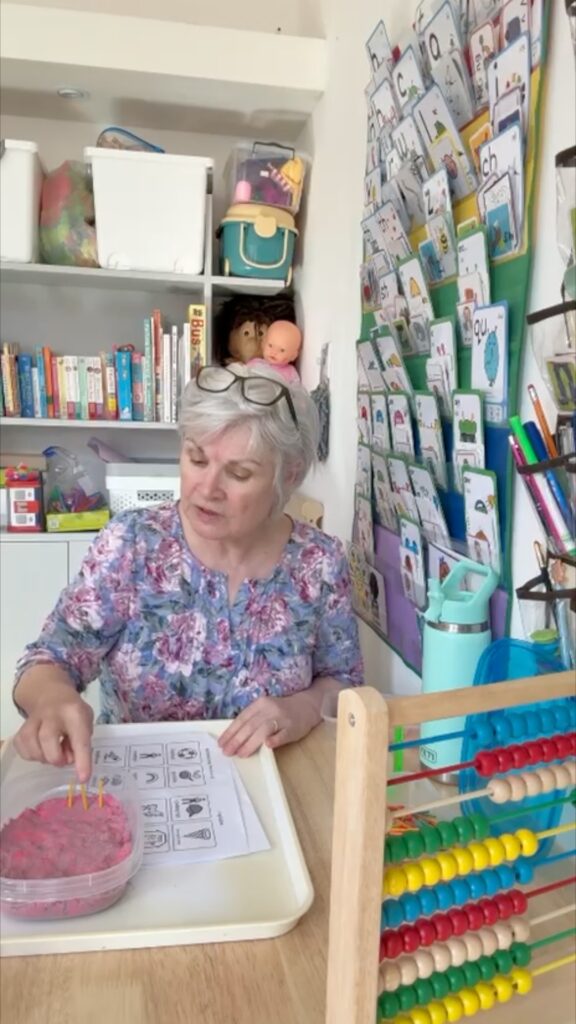
If you’re watching the video clip I’ve shared here, you’ll notice:
- I’m not over-correcting every sound
- I’m prioritising getting the whole word out
- I’m building rhythm, confidence, and consistency
Why this stage is so powerful
It can look simple, but it’s doing a lot of heavy lifting.
Working on syllables helps children:
- Say longer words more clearly
- Reduce ‘mumbling’ or collapsing of words
- Improve overall intelligibility quickly
- Prepare for more precise sound work later
Often, parents notice early wins like:
✨ ‘They’re easier to understand already’
✨ ‘They’re saying longer words!’
✨ ‘They’re more confident speaking’
And that’s before we’ve even fully targeted specific sounds.
But will my child still learn their sounds?
Yes. Absolutely.
The Cycles Approach is structured so that after syllables, we move into:
- Early developing sounds
- Then more complex patterns (like fronting or clusters)
And importantly, we come back around again.
Nothing is missed. It’s just sequenced in a way that supports success.
A different way of thinking about progress
One of the biggest mindset shifts with the Cycles Approach is this:
👉 We’re not aiming for perfection straight away
👉 We’re aiming for gradual system-wide change
That means:
- Your child doesn’t need to ‘master’ something before moving on
- Progress builds across cycles
- Speech becomes clearer over time, not overnight
So, to sum up
Starting with syllables might seem unexpected but it’s one of the most powerful foundations we can give a child whose speech is hard to understand.
By building rhythm, structure, and confidence first, we make everything that comes next more effective.
If your child is starting speech therapy and you notice we’re clapping words like ‘banana’ or ‘elephant’, there’s a very good reason for it.
We’re not going backwards.
We’re building from the ground up.
We’re making later sound work more effective and more likely to generalise into everyday talking.
Next steps:
If you’re concerned about your child’s speech clarity or wondering whether they might benefit from a structured approach like this, feel free to get in touch. I offer individualised assessments and therapy plans tailored to each child’s speech profile whether that’s early sound development, phonology, or motor speech difficulties.

Sonja McGeachie
Highly Specialist Speech and Language Therapist
Owner of The London Speech and Feeding Practice.


Find a speech and language therapist for your child in London. Are you concerned about your child’s speech, feeding or communication skills and don’t know where to turn? Please contact me and we can discuss how I can help you or visit my services page.
Parent FAQ section
Why is my child practising words like ‘banana’ instead of sounds like /K/ or /S/?
Because your child first needs to be able to hold and produce the full shape of a word. If they’re dropping syllables (e.g. ‘banana’ → ‘nana’), working on individual sounds won’t carry over into real speech. We build the structure first, then refine the sounds.
What if my child can already say some long words?
That’s great. But we’re looking for consistency and clarity across many words, not just a few familiar ones. This stage helps stabilise that skill so it becomes reliable in everyday talking.
How long will we stay on syllables?
Usually, this is a short but important phase within each cycle. We revisit it regularly, but we also move on to other patterns (like specific sounds or sound processes) within the same therapy block.
Will this delay my child learning their sounds?
No. In fact, it often speeds things up overall. Once the syllable structure is in place, children are much more able to use correct sounds in longer words and sentences.
What can I do at home?
Keep it simple and playful:
- Clap out words together (e.g. ‘el-e-phant’)
- Emphasise full words naturally in conversation
- Repeat back what your child says with the full structure (without pressure)
Consistency and exposure matter more than correction.
My child gets frustrated. Will this help?
Yes. Many children become frustrated when they’re not understood. Improving syllable structure often leads to quick wins in clarity, which can boost confidence and reduce that frustration.
Building clearer speech: Why we practise syllables first
What are syllables?
Syllables are the ‘beats’ in words.
- ‘Table’ = 2 beats (ta-ble)
- ‘Banana’ = 3 beats (ba-na-na)
Why is my child working on this?
If your child:
- Drops parts of words (‘banana’ → ‘nana’)
- Mumbles longer words
- Is hard to understand
…then we need to build the structure of words first.
This helps your child:
✔ Say longer words clearly
✔ Be easier to understand
✔ Feel more confident speaking
What does this look like in therapy?
We practise:
- Clapping or tapping out beats 👏
- Saying full words with rhythm
- Repeating target words through play
- Using visuals or actions to support learning
How you can help at home
Keep it light and playful, little and often!
Try this:
- Clap words together أثناء play (e.g. toys, food, animals)
- Model full words naturally (‘Yes, ba-na-na!’)
- Repeat and expand what your child says
Example:
Child: ‘nana’
You: ‘Yes! Ba-na-na‘
Important to know
- This is a key first step in speech therapy
- We will move on to sounds—but this helps them stick
- Small changes here can make a big difference in clarity