What is Total Communication, and why your child might need it more than just speech
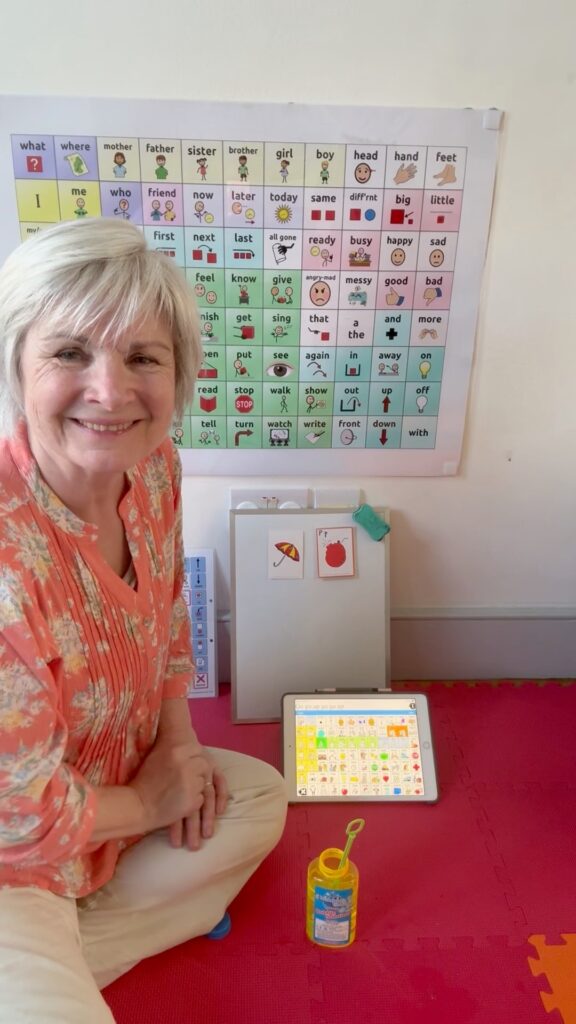
Sonja smiling

When a child’s speech is difficult to understand, it can feel overwhelming for everyone involved. As a parent, your instinct is often to focus on helping your child ‘talk properly’. And that makes complete sense. Speech is important. But here’s the key message I want to share with you:

Speech is just one way to communicate.

And when speech is not yet clear, not yet reliable, or not yet available, children need other ways to get their message across.

This is where Total Communication comes in.

What is Total Communication?

Total Communication is an approach that encourages the use of all available ways to communicate, not just speech.

This can include:

  • spoken words
  • gestures and pointing
  • facial expressions
  • signing (such as Makaton)
  • pictures or symbols
  • drawing
  • electronic AAC (Augmentative and Alternative Communication), such as apps like LAMP Words for Life

It’s not about replacing speech. It’s about supporting communication in every possible way.

Think of it like this: if speech is currently unclear or limited, why restrict a child to the hardest route? Why not give them more tools to succeed?

‘But won’t this stop my child from talking?’

This is one of the most common concerns I hear in clinic.

Parents often worry that if a child starts using signs or a communication device, they will become ‘dependent’ on it and stop trying to talk.

The research tells us something very different.

Studies consistently show that AAC does not prevent speech development. In fact, it often supports it.

  • A review by Millar, Light & Schlosser (2006) found that AAC interventions do not reduce speech production and may actually increase it.
  • Romski & Sevcik (2005) demonstrated that children given AAC often develop stronger overall communication skills, including spoken language.
  • More recent work continues to show that providing AAC early can accelerate language development, not delay it.

So rather than ‘giving up on speech’, using AAC is actually building the foundations that speech needs.

Why Total Communication matters, especially for unintelligible children

When a child is very difficult to understand, they are often experiencing a hidden frustration:

‘I know what I want to say, but no one understands me.’

Over time, this can lead to:

  • reduced confidence
  • behavioural frustration
  • withdrawal from communication
  • fewer opportunities to practise language

If a child cannot successfully communicate, they communicate less. And when they communicate less, their language development slows down.

Total Communication breaks this cycle.

By giving a child reliable ways to be understood, we:

  • reduce frustration
  • increase interaction
  • build confidence
  • create more opportunities for language learning

And importantly, we allow them to show us what they already know.

AAC is a bridge, not a barrier

Using AAC (whether that’s pointing to pictures, signing, or using a device) does something powerful:

It separates language from speech.

A child might have lots of ideas, vocabulary, and understanding but their speech system (especially in cases like phonological disorder or childhood apraxia of speech) cannot yet keep up.

AAC allows the child to:

  • express complex ideas now
  • practise sentence structure
  • develop vocabulary
  • take part in conversations

All while their speech is still developing.

In other words, AAC doesn’t replace speech. It keeps language moving forward while speech catches up.

What does this look like in real life?

In therapy, I often use a combination of approaches:

  • modelling simple signs alongside speech
  • pointing to symbols while talking
  • encouraging children to gesture or show
  • using drawings to support understanding
  • incorporating an AAC device such as LAMP Words for Life

You might see a child:

  • say part of a word
  • point to a symbol
  • use a gesture
  • and look at you expectantly

That is communication success.

And success builds motivation.

‘I just want them to talk’

Of course you do. And I do too!! That’s always the goal.

But here’s the important shift in thinking:

Children learn to talk by communicating, not by waiting until speech is perfect.

If we hold out for clear speech before allowing other communication methods, we risk:

  • limiting their ability to interact
  • reducing practice opportunities
  • increasing frustration

But if we support all communication, we give them:

  • more chances to express themselves
  • more positive communication experiences
  • more input and feedback

And that is what drives progress.

A balanced approach

Total Communication doesn’t mean ‘speech is no longer important’.

It means:

  • we continue targeted speech therapy
  • we work on sounds and clarity
  • and we support communication in the meantime

It’s not either/or.

It’s both/and.

Final thought

If your child’s speech is difficult to understand, the most important question is not:

‘Are they talking clearly yet?’

It’s:

‘Can they successfully communicate?’

Because communication is the foundation of:

  • relationships
  • learning
  • confidence
  • wellbeing

And every child deserves a voice, in whatever form that voice takes right now.

Feel free to contact me if your child needs help with speech and communication.

Sonja McGeachie

Highly Specialist Speech and Language Therapist

Owner of The London Speech and Feeding Practice.

References (parent-friendly):


Health Professions Council registered
Royal College of Speech & Language Therapists Member
Member of ASLTIP

Find a speech and language therapist for your child in London. Are you concerned about your child’s speech, feeding or communication skills and don’t know where to turn? Please contact me and we can discuss how I can help you or visit my services page.

3

Similar Posts

  • · ·

    How do we know our Gestalt Learner is moving to Stage 2?

    Image by Freepik

    Is our student ready to move to NLA 2 (Natural Language Acquisition stage 2)?

    We know that the GLP (Gestalt Language Processor) will move into the next stage when they are ready. But are they now ready you might think? When are they ready? How do I know? If you are not sure whether your child is ready to move forward then go and see your GLP trained Speech Therapist. Together you can work out what the next steps are and how to help your child settle into NLA 2. It’s very exciting!!

    Tip

    The first useful tip: keep a language sample of phrases your child says. This is very helpful!

    You might want to check with your Speech Therapist and offer some language sampling you have taken so they can help you figure out where your child is currently. Always keep an Utterance Journal that you can share with your Speech Therapist and with others who look after your child.

    Basically, we want to listen out for phrases our child says that you or nursery don’t say routinely; that way you can presume that this is not an echo but a mixing together of two chunks of gestalts. Watch out for those coco melon phrases though: double check it really isn’t an NLA 1 gestalt that is copied verbatim from a favourite you tube video.

    You can best support your child best by listening, and thus figuring out what your child is TRYING TO SAY. Often your child might skip over the parts of gestalts they don’t want to say. This is common in older kids who have long gestalts, sometimes even whole episodes or whole stories!

    Try and tease out their shorter mitigations and then focus on practicing and modelling those as they are so much more useful!

    So back to our question: are they ready?

    Are their gestalts covering a variety of situations and contexts?

    Make a note in your journal to see what the backgrounds are to each phrase you ear, so for example:

    • Transitioning: ‘it’s time for the park’ ‘what’s next’ ‘shoes on’
    • Bed Time: ‘we need to wash’ ‘let’s get in (bath/bed)’ ‘ready for our book’
    • Toilet/nappy: ‘we need the potty’ ‘where’s the potty’ ‘let’s wash hands’
    • Mealtime: ‘time to eat’ ‘go get a spoon’ ‘yummy num num’
    • Park/going out: ‘look at the squirrel’ ‘funny doggy’ ‘I wanna swing’
    • At the shops: ‘let’s get the trolley’ ‘lots of veggies’ ‘no tomatoes’ ‘ooh long queue’ ‘back to the car’

    And… does the child use the phrases for a variety of functions?

    • labelling
    • providing information
    • calling out
    • affirming
    • requesting
    • protesting
    • directing

    We need to offer lots of similar language models so that in their own time our children can extract/mitigate useful phrases for what they want to express. The more similar utterances a child hears around him the more he/she can discover the communalities. Once the child has a small range of phrases, he/she can mix them up and create semi-original own phrases.

    If the answer is YES!! our child has perhaps not all but a range of functions and a range of situations where they use a variety of easily mitigable gestalts then yes they are ready for moving to stage 2 of NLA!

    Hurrah!

    Keeping a journal of what your child is saying and in what circumstance is crucial to help with our ongoing detective work!

    Next time I will be looking at how we can help our NLA 2 GLP produce even more of their own mix and match phrases.

    If you need help with your child, please do not hesitate to contact me.


    Find a speech and language therapist for your child in London. Are you concerned about your child’s speech, feeding or communication skills and don’t know where to turn? Please contact me and we can discuss how I can help you or visit my services page.

    1
  • · · ·

    How do we play with our Gestalt Language Processors?

    Image by Freepik

    Child-led therapy

    When working with Gestalt Language Processors, it is always advisable to use child-led therapy. What does that mean? Child led therapy involves following a child’s interests and allowing her/him to lead the play activity throughout the speech and language therapy session. In other words, instead of having my own ideas of what we might want to play with or what activities I might try and use, I provide a range of toys I know the child likes or has played well with before; then I wait for the child to pick what she/he enjoys doing.

    Play can be very repetitive and we can often see our child cycling back to the same one or two toys throughout the session. But this is what she/he needs to do at that time and it means that we have focused attention and engagement. This in turn is very helpful for the therapeutic process, which is to offer great scripts and phrases/words alongside what she/he is playing with.

    Monotropic minds

    Often the mind of autistic children is more strongly pulled towards a smaller number of interests or hobbies as I like to call them. Dr Dinah Murray, Dr Winn Lawson and Mike Lesser have found in 2005 that autistic people have ‘monotropic’ minds. They explain that autistic children focus their energy on a narrow range of activities as the energy required to switch between several toys is much higher than we would see in the neuro-typical population.

    Gestalt Language Processors are often also Gestalt Cognitive Processors. This is when experiences are retained as episodic events and memories. An event is remembered by specific parts of the same event. And, therefore, these specific parts should always be part of that event, when the event is repeated.

    Should any of the specifics be changed or are missing, then this can cause great upset to Gestalt Cognitive Processors. So, for example, if the last two times in speech therapy we had the train set out and this was played with happily, then this becomes a specific part of the whole session. If, I then don’t offer the train set the third time a child comes to see me, this could be very upsetting.

    This is why I tend to try this out and see what happens. Usually in the 3rd or 4th session: I might not bring out the car run that has hitherto been super successful to see if we are able to transition well to other toys. If yes, then we can have new experiences but if not then I will re-offer the car run/or whatever toy pretty quickly so as not to cause complete dysregulation.

    A few pointers below which help with child-led play:

    Introduce a few new toys and see what happens

    Parents are encouraged to bring some familiar toys their child likes to the session. We can then introduce a couple of different toys to see how we go. Try offering a new toy alongside the familiar one; try offering new toys without the familiar one present, but be prepared to re-offer the “old” toy should our child get upset.

    Rotate toys and don’t offer out too many toys

    I find that children can get overwhelmed and overstimulated by too many items out all at once. I always talk to parents about toy rotation at home and I encourage storage and ‘tidy up’ of toys so that we can increase attention focus, and also maintain freshness and new interest in older toys.

    Some children are not yet ready to play with toys

    Here I suggest people games: these are games where the adult becomes part of a more motor-based activity. Some call it ‘rough and tumble play’ but it can be nursery rhymes such as sleeping bunnies/row row the boat or peek-a-boo for the younger ones.

    Copy/Imitation is so important – try getting two identical or similar play items

    When we are copying our child, it is often not desirable to ‘take turns’ with their toys/blogs/cars etc as our child may not be ready to let us take a turn. Instead, if we have the exact same toy that our child is having then we can play alongside our child and copy them perfectly without interrupting their play.

    References:

    Murray, D., Lesser, M., & Lawson, W. (2005). Attention, monotropism and the diagnostic criteria for autism. Autism9(2), 139-156.

    If you need help with your child, please do not hesitate to contact me.


    Find a speech and language therapist for your child in London. Are you concerned about your child’s speech, feeding or communication skills and don’t know where to turn? Please contact me and we can discuss how I can help you or visit my services page.

    0
  • When ‘star’ sounds like ‘dar’: Understanding speech sound disorders and the path to clearer speech

    If your child says ‘dar’ instead of ‘star’, you might be wondering if they will simply outgrow it or if they require specialised support. While ‘cluster reduction’—dropping one of the sounds in a blend—is a normal part of learning to talk, we typically expect these sounds to lock into place by age four years. If these errors persist as a child approaches school age, it often signals a speech sound delay that may now no longer pass without help. As a Speech and Language Therapist, I specialise in helping children bridge this gap using evidence-based techniques like backward chaining.

    This isn’t about constant correction; it’s about providing the right clinical scaffolding to move a child from ‘frustrated’ to ‘fluent’ before they hit those critical early school years.

    Dropping sounds from words is a common feature of speech sound difficulties, and while it can look small on the surface, it can have a big impact on how clearly a child is understood. In this short video clip, I’m working with a child on an /ST/ sound cluster, demonstrating how I use an evidence-based speech therapy technique called backward chaining to help children build clearer speech with confidence.

    What’s actually happening when a child drops the ‘S’?

    Clusters like /ST/, /SP/, and /SK/ are tricky. They require:

    • precise timing
    • careful airflow
    • and the ability to blend sounds smoothly

    For many children, especially those with speech sound difficulties, this is a big ask.

    So instead of hearing:

    ‘star’

    we might hear:

    ‘tar’ or ‘dar’

    This isn’t laziness or refusal. It’s the child simplifying the word to make it manageable.

    Why I don’t start by saying ‘say star’

    Telling a child to ‘just add the S’ rarely works.

    Instead, I meet them where they are already successful.

    In this clip, the child can already say ‘dar’ clearly. That’s our starting point.

    Backward chaining: building speech from success

    Backward chaining means we:

    1. Start with the part of the word the child can already say
    2. Gradually add the missing sound
    3. Keep the child feeling successful at every step

    So rather than jumping straight to ‘star’, we:

    • secure the ending
    • gently introduce the /S/
    • and blend it in a way that feels achievable

    This approach reduces frustration, builds confidence, and helps the sound stick not just in the therapy room, but out in the real world.

    Why this matters beyond one word

    This isn’t just about saying ‘star’.

    It’s about:

    • teaching the mouth a new movement pattern
    • giving the brain time to organise the sound sequence
    • and helping the child feel capable, not corrected

    When therapy feels safe and successful, children are far more likely to generalise their new sounds into everyday speech.

    Speech therapy works best when children feel supported not tested.

    If your child struggles with speech clarity

    If your child:

    • drops sounds from words
    • avoids longer or trickier words
    • or becomes frustrated when they’re not understood

    This is the kind of work I do every day building speech step by step, in a way that respects each child’s pace and strengths.

    Support can be gentle, effective, and empowering.

    If you’d like to learn more about how speech therapy can support your child, you’re always welcome to get in touch.

    Sonja McGeachie

    Highly Specialist Speech and Language Therapist

    Owner of The London Speech and Feeding Practice.


    Health Professions Council registered
    Royal College of Speech & Language Therapists Member
    Member of ASLTIP

    Find a speech and language therapist for your child in London. Are you concerned about your child’s speech, feeding or communication skills and don’t know where to turn? Please contact me and we can discuss how I can help you or visit my services page.

    3
  • · ·

    Childhood Apraxia of Speech: Signs and first steps (2–5 years)

    If you’ve found yourself wondering ‘Why can my child say a word one day, but not at all the next?’ it might be that your child has a motor speech difficulty. This means the challenge isn’t that your child doesn’t know what they want to say; it’s that their brain finds it harder to plan and coordinate the movements needed for clear speech. This speech difficulty is called Childhood Apraxia of Speech (CAS)

    Sonja showing power words on a board

    In this post, I’ll explain what CAS can look like in 2–5 year olds, what an assessment usually involves, and what you can start doing at home to support your child without turning life into ‘speech homework all day long’.

    What is childhood apraxia of speech (CAS)?

    Children with CAS often have lots to communicate about (and strong ideas!) but their speech may come out as:

    • Unclear
    • inconsistent
    • hard to ‘copy’ on demand
    • frustrating for them and for you

    CAS is not caused by laziness and it is not a parenting issue. It is also not something children simply ‘grow out of’ without support. But with the right therapy approach, children can absolutely build clearer speech over time.

    If you’d like to read more about verbal dyspraxia, you may also find this helpful: Supporting children and families living with verbal dyspraxia.

    Why is CAS such a big topic right now?

    Many families come to me after months (or years) of being told:

    • ‘She’ll talk when she is ready’
    • ‘He’s just shy’
    • ‘It’s probably a speech delay’
    • ‘It’s normal for toddlers’

    And sometimes it is a general delay. But sometimes it’s something more specific, like CAS.

    There’s also been a huge rise in parents seeking information online, and CAS is often mentioned alongside speech sound difficulties such as:

    • phonological delay (pattern-based speech errors)
    • articulation difficulties (one sound that won’t come out clearly)
    • inconsistent speech disorder

    These can look similar at first glance, which is why a specialist assessment matters.

    Signs of childhood apraxia of speech in 2–5 year olds

    Children develop speech at different rates, and not every unclear speaker has CAS. But here are some common features that may raise a flag, especially when you notice several together.

    1) Inconsistent speech errors

    Your child might say the same word in different ways:

    • ‘banana’ → nana / baba / mana
    • ‘daddy’ → gaga / daddy / dadi

    This inconsistency is one of the biggest clues.

    2) Difficulty copying words on request

    Some children speak more easily in natural play, but when asked ‘Say ___’, they freeze or the word becomes much harder.

    3) Limited sound repertoire

    They may use only a small set of consonants (like /M/, /N/, /B/, /D/) and avoid others.

    4) Vowel distortions

    Many children with typical delays mainly struggle with consonants. But in CAS, vowels can also sound ‘off’ or change between attempts.

    5) Speech that sounds effortful

    You might notice your child:

    • pauses between sounds
    • tries multiple times
    • looks like they’re ‘searching’ for the right mouth movement

    6) Longer words are much harder

    ‘Car’ might be easier than ‘carry’, and ‘carry’ easier than ‘caterpillar’.

    7) Prosody differences (rhythm and stress)

    Some children with CAS sound a little unusual in their speech rhythm, stress, or intonation.

    8) Frustration or reduced confidence

    When a child is frequently misunderstood, they may:

    • talk less
    • use gestures more
    • become upset when asked to repeat themselves

    Important note: none of these signs alone prove CAS but they are a strong reason to seek a speech assessment rather than waiting.

    CAS vs phonological delay vs articulation difficulty (quick guide)

    These are some of the most common questions I hear.

    If it’s mainly an articulation difficulty…

    A child may consistently say one sound incorrectly (for example, ‘thun’ for ‘sun’- lisp- but everything else is developing well.

    If it’s mainly a phonological delay…

    You might notice clear patterns, like:

    • leaving off the ends of words (‘ca’ for ‘cat’)
    • swapping back sounds for front sounds (‘tar’ for ‘car’)

    Patterns are often consistent and respond well to phonology-based therapy.

    If it might be CAS…

    Speech often feels less predictable, harder to imitate, and more impacted by word length and complexity.

    If you’re unsure, that’s completely normal, and exactly why assessment matters.

    What happens in a CAS assessment?

    A high-quality speech assessment for possible CAS usually includes:

    1) Parent discussion and developmental history

    We talk about:

    • pregnancy and birth history (where relevant)
    • feeding history
    • early sounds and babbling
    • first words and how speech has progressed
    • family history of speech/language needs

    2) A speech sound assessment

    Your child might be shown pictures or play-based prompts so we can hear:

    • what sounds they can say
    • what they simplify
    • whether errors are consistent or inconsistent

    3) An oral-motor and movement check

    This isn’t about ‘strength’. It’s about coordination and planning. We look at how your child manages speech movements and transitions.

    4) Stimulability testing

    This means: how easily can your child learn a new sound or word with support?

    For CAS, we often explore how they respond to:

    • slowed-down speech
    • visual cues
    • rhythm/tapping
    • short, simple syllable shapes

    5) Functional communication and confidence

    We look at how speech impacts daily life:

    • being understood at nursery
    • joining in with peers
    • asking for help
    • managing emotions when misunderstood

    At the end, you should leave with:

    • a clear explanation of what we think is going on
    • a therapy plan
    • practical home strategies
    • realistic next steps

    What parents can do at home

    Here are CAS-friendly strategies you can start right away.

    1) Choose ‘power words’

    Pick 1–2 words that matter most in your child’s daily life, such as:

    • more
    • help
    • mummy
    • again
    • stop
    • open

    These words are motivating and functional.

    2) Keep it short and successful

    For many children with CAS, the goal is quality over quantity.

    Try five minutes a day rather than 30 minutes of struggle.

    3) Support speech with rhythm

    Some children benefit from:

    • tapping a beat on the table
    • clapping syllables
    • using a gentle ‘marching’ rhythm

    This can help the brain organise the sequence of movements.

    4) Celebrate approximations

    If your child says ‘moh’ for ‘more’, that’s communication!

    We want them to feel:

    • safe
    • understood
    • proud to try again

    Confidence is a key part of progress.

    A short parent story (anonymised)

    One mum said to me:

    ‘We kept being told to wait. But I could see my child understood everything; they just couldn’t get the words out. Once we had an assessment and a plan, it felt like we finally knew what to do. The biggest change was his confidence. He started trying more.’

    When should you seek support?

    You don’t need to wait until school.

    It’s worth getting an assessment if your child is:

    • hard to understand compared with peers
    • becoming frustrated or withdrawing from talking
    • inconsistent with words they used to say
    • struggling to imitate speech sounds
    • showing signs that match CAS

    Early support can reduce stress for the whole family and help your child feel successful in communication.

    Here’s how I can help:

    ✅ A detailed speech assessment (including whether CAS is likely)

    ✅ A clear therapy plan with realistic goals

    ✅ Practical home strategies you can use immediately

    ✅ Support for nurseries and schools (where needed)

    ✅ In-person sessions in North-West London and online options

    Book your consultation here.

    Final gentle reminder

    You are not overreacting. Trust your instincts.

    Your child is communicating the best way they can, and with the right support, speech can become easier, clearer, and more confident.

    Sonja McGeachie

    Highly Specialist Speech and Language Therapist

    Owner of The London Speech and Feeding Practice.


    Health Professions Council registered
    Royal College of Speech & Language Therapists Member
    Member of ASLTIP

    Find a speech and language therapist for your child in London. Are you concerned about your child’s speech, feeding or communication skills and don’t know where to turn? Please contact me and we can discuss how I can help you or visit my services page.

    3
  • Using AAC – Augmentative and Alternative Communication for non-verbal and early verbal children

    Using a Core Vocabulary Board

    Your Speech Therapist might have been advising you to introduce words to your child with the help of a CORE BOARD. What on earth is she talking about and why would we want to do this, I hear you think – and in fact this is what I get asked a lot, as I often do recommend using Core Boards.

    Core boards belong to the category of Augmentative and Alternative Communication (AAC ) and they can be really useful for:

    • Children or adults who cannot speak at all or who are very hard to understand.
    • Children who are slow to speak and have difficulty expressing themselves verbally, due to genetic conditions as Down Syndrome, Verbal dyspraxia, Autism or any other learning difficulty that means a child is slow to develop speech.

    Here is what a Core board might look like, in fact this is one that I love to use. It is made by Beautiful Speech Life, there are a ton of similar boards out there for free. I have also made my own, you can check it out on my Instagram feed.

    Using a Core Vocabulary Board

    What is Core Vocabulary/ Core words?

    Core vocabulary consists of the most common words used by children throughout a day. In 2003 Banajee and Dicarlo et al found that 50 % of pre-schoolers in their project used nine words consistently across their daily play and meal routines. These words are Core words and are typically the ones you can see on a board, like the one above.

    How To Use It

    Adults always first need to consistently model and show their child how to use a board. This is key! For example: Adult can point to “YOU” “WANT” ‘MORE” and then point to the cup of Water on the counter. Child could then reply either by shaking his/her head and/or pointing to “NOT” which also stands for “NO”. Then adult can point to “NOT” “MORE” and do an OK sign as well. Eventually Child can initiate a request and point to “I” “ WANT” “MORE” and then point to the cup on the counter.

    This is not as cumbersome or limited as it first sounds or appears. Here’s why: As adult you can talk normally and, of course, many words you are using will not be on this board. But some will be, and you will be surprised how many you can find when you start using it. So you could say quite normally: Hey lovely (name of your child) would YOU LIKE some MORE water? The words in capital are on the board which you can point to as you speak normally. Basically, you are showing/saying to your child: “We can speak and these are the pictures we can use to help us; We call this TOTAL COMMUNICATION, as communication is so much more than just words! Great communication can be silent, where we use our facial expression, our smile, our eyes, our hand gestures, body movements and yes, of course, words. But when words fail us, these boards are so helpful.

    This still does not answer your original question of: why would I want to do this, I want my child to talk!? You are a SPEECH Therapist, please help my child TALK, not point to pictures, that is not what I had in mind.

    Let Me Explain

    When speech is difficult for a child it doesn’t mean that there is nothing to talk about! Of course, we want all our children and all people to speak because it is the easiest and most effective way of communicating, no doubt! However, sometimes this is very hard for some children and whilst we are always working towards speech where possible, we also want to make sure that whilst figuring out how to speak, your child has a MEANS TO COMMUNICATE. Using a board like this might well be a temporary strategy but whilst you are using it and working on their speech you will find a reduction in tantrums and frustration as you child is able to express themselves more effectively.

    Often we find that as soon as we offer a CORE VOCABULARY like the above sample a child who has had no or very few words suddenly blossoms and starts to point to new words on the board and starts to PRACTICE USING THESE WORDS!! Practice makes perfect, right? Yes it totally does! There is lots of evidence that tells us that using Core Vocabulary Boards ENHANCE AND SUPPORT SPEECH PRODUCTION AND NOT HINDER IT. Using a board like this will only ever be helpful to your child and will never make your child “lazy” – too lazy to speak? NO SUCH THING!

    Here is what one of my parents says about the core board we use with her little boy:

    “the board has been a game changer, my son is a visual learner so it really helps to have the board as he associates communication so much easier this way. We have incorporated his twin sister who models it’s use and have definitely seen improvement in speech through its support and his frustration around being unable to verbally communicate at times has definitely lessened”

    K Connolly, Mother of Tom (aged 3.5 years).

    Reading and hearing this makes me so happy!

    In addition to general core board above I also sometimes use a Core Board that is specific to an activity, such as for example BLOWING BUBBLES. Below is an example of such a board, which you can use very nicely during a bubble blowing activity and sometimes it is a nice place to start for newcomers, this can be an easy introduction. You can download this and many similar boards on www.widgit.com for free!

    Using a Core Vocabulary Board

    There is so much more to say about AAC and using Coreboards, visit my Instagram you can find a bit more information on how I use them.


    Find a speech and language therapist for your child in London. Are you concerned about your child’s speech, feeding or communication skills and don’t know where to turn? Please contact me and we can discuss how I can help you or visit my services page.

  • The tricky /R/: Mastering tongue placement for clear speech

    The /R/ sound is notoriously challenging for many children (and even some adults!). It’s one of the most complex sounds in the English language, with various pronunciations depending on its position in a word. If your child is struggling with their /R/s, you’re not alone. As Speech and Language Therapists (SLTs), we frequently work on this sound, and a key component of our therapy is focusing on proper tongue placement.

    Why is the /R/ so difficult?

    The /R/ sound requires precise coordination of the tongue, jaw, and lips. Unlike sounds like /P/ or /B/ that involve simple lip movements, the /R/ involves intricate tongue movements and tension. There are also different ways to produce the /R/ sound, which adds to the complexity:

    • Retroflex /R/: The tongue tip curls up and back towards the roof of the mouth.
    • Bunched /R/: The body of the tongue bunches up towards the roof of the mouth, while the tongue tip remains down.

    The importance of tongue placement

    Regardless of which /R/ variation is being targeted, accurate tongue placement is crucial. Even a slight deviation can result in a distorted or inaccurate sound. That’s why SLTs dedicate significant time to teaching and practising tongue positioning.

    Speech therapy techniques: Focusing on the tongue

    Here’s a glimpse into how I address /R/ sound difficulties, with a focus on tongue placement:

    • Visual aids:
      • Mirrors: I use a mirror to help children see their tongue movements and make adjustments.
      • Tongue diagrams and models: These visual tools provide a clear representation of where the tongue should be positioned.
    • Tactile cues:
      • Tongue depressors: These can be used to gently guide the tongue into the correct position.
      • Food-grade tools: Sometimes, I use flavoured tongue depressors or other tools to provide tactile feedback and increase awareness of tongue placement.
    • Auditory discrimination:
      • I help children distinguish between correct and incorrect /R/ sounds.
      • I use auditory cues and verbal feedback to reinforce proper pronunciation.
    • Exercises and drills:
      • Tongue strengthening exercises: Strengthening the tongue muscles can improve control and coordination.
      • Tongue placement drills: We practise positioning the tongue in the desired location and holding it there.
      • Sound approximation techniques: Sometimes we use other sounds to help approximate the /R/ sound. For example, I use the /L/ sound, to help achieve the correct tongue placement. Once my child has found the /L/ sound it is then a matter of pulling back just slightly to get a good /R/.
    • Contextual practice:
      • Once the child can produce the /R/ sound in isolation, we gradually introduce it into syllables, words, phrases, and sentences.
      • We also practise the /R/ sound in different contexts, such as at the beginning, middle, and end of words.

    Tips for Parents:

    • Be patient and supportive: Learning the /R/ sound takes time and practice.
    • Practise regularly: Short, frequent practice sessions are more effective than long, infrequent ones.
    • Make it fun! Use games, stories, and other engaging activities to keep your child motivated.
    • Work with an SLT: A qualified SLT can provide personalised guidance and support.

    In conclusion:

    The /R/ sound can be challenging, but with targeted speech therapy and a focus on tongue placement, most children can achieve clear and accurate pronunciation.

    I hope this blog post is helpful!

    Get in touch with me via my contact form if you need support

    Sonja McGeachie

    Early Intervention Speech and Language Therapist

    Feeding and Dysphagia (Swallowing) Specialist The London Speech and Feeding Practice

    The London Speech and Feeding Practice


    Find a speech and language therapist for your child in London. Are you concerned about your child’s speech, feeding or communication skills and don’t know where to turn? Please contact me and we can discuss how I can help you or visit my services page.

    1