How do we know our Gestalt Learner is moving to Stage 2?

| |
Image by Freepik

Is our student ready to move to NLA 2 (Natural Language Acquisition stage 2)?

We know that the GLP (Gestalt Language Processor) will move into the next stage when they are ready. But are they now ready you might think? When are they ready? How do I know? If you are not sure whether your child is ready to move forward then go and see your GLP trained Speech Therapist. Together you can work out what the next steps are and how to help your child settle into NLA 2. It’s very exciting!!

Tip

The first useful tip: keep a language sample of phrases your child says. This is very helpful!

You might want to check with your Speech Therapist and offer some language sampling you have taken so they can help you figure out where your child is currently. Always keep an Utterance Journal that you can share with your Speech Therapist and with others who look after your child.

Basically, we want to listen out for phrases our child says that you or nursery don’t say routinely; that way you can presume that this is not an echo but a mixing together of two chunks of gestalts. Watch out for those coco melon phrases though: double check it really isn’t an NLA 1 gestalt that is copied verbatim from a favourite you tube video.

You can best support your child best by listening, and thus figuring out what your child is TRYING TO SAY. Often your child might skip over the parts of gestalts they don’t want to say. This is common in older kids who have long gestalts, sometimes even whole episodes or whole stories!

Try and tease out their shorter mitigations and then focus on practicing and modelling those as they are so much more useful!

So back to our question: are they ready?

Are their gestalts covering a variety of situations and contexts?

Make a note in your journal to see what the backgrounds are to each phrase you ear, so for example:

  • Transitioning: ‘it’s time for the park’ ‘what’s next’ ‘shoes on’
  • Bed Time: ‘we need to wash’ ‘let’s get in (bath/bed)’ ‘ready for our book’
  • Toilet/nappy: ‘we need the potty’ ‘where’s the potty’ ‘let’s wash hands’
  • Mealtime: ‘time to eat’ ‘go get a spoon’ ‘yummy num num’
  • Park/going out: ‘look at the squirrel’ ‘funny doggy’ ‘I wanna swing’
  • At the shops: ‘let’s get the trolley’ ‘lots of veggies’ ‘no tomatoes’ ‘ooh long queue’ ‘back to the car’

And… does the child use the phrases for a variety of functions?

  • labelling
  • providing information
  • calling out
  • affirming
  • requesting
  • protesting
  • directing

We need to offer lots of similar language models so that in their own time our children can extract/mitigate useful phrases for what they want to express. The more similar utterances a child hears around him the more he/she can discover the communalities. Once the child has a small range of phrases, he/she can mix them up and create semi-original own phrases.

If the answer is YES!! our child has perhaps not all but a range of functions and a range of situations where they use a variety of easily mitigable gestalts then yes they are ready for moving to stage 2 of NLA!

Hurrah!

Keeping a journal of what your child is saying and in what circumstance is crucial to help with our ongoing detective work!

Next time I will be looking at how we can help our NLA 2 GLP produce even more of their own mix and match phrases.

If you need help with your child, please do not hesitate to contact me.


Find a speech and language therapist for your child in London. Are you concerned about your child’s speech, feeding or communication skills and don’t know where to turn? Please contact me and we can discuss how I can help you or visit my services page.
1

Similar Posts

  • · ·

    The power of imitation in supporting children with autism

    Image by Freepik

    Imitation, the act of mirroring someone else’s actions, gestures, sounds, or words, is a fundamental skill that plays a crucial role in human development. It’s how babies learn to wave ‘bye-bye’, how toddlers pick up new words, and how children acquire social skills. But for children with autism imitation can be a significant challenge and understanding why it’s important and how to foster it becomes a key focus for parents, educators, and speech and language therapists.

    Why is imitation important?

    Imitation is a building block for a wide range of developmental skills:

    • Social interaction: Imitation is the foundation of social reciprocity. When a child imitates, he or she is engaging in a shared experience, connecting with another person, and learning to take turns in social exchanges.
    • Communication development: Imitation is closely linked to language acquisition. Children often imitate sounds and words before they can produce them independently. Imitation also helps them understand the meaning of gestures and facial expressions, which are vital for nonverbal communication.
    • Cognitive development: Imitation plays a role in problem-solving, learning new skills, and understanding cause and effect. By imitating actions, children explore their environment and learn how things work.
    • Emotional development: Imitation helps children understand and share emotions. When a child imitates a smile, he or she may begin to understand the feeling of happiness.

    Imitation challenges in autism

    Many children with autism face challenges with imitation, which can affect their development in these key areas. These challenges can manifest in different ways:

    • Difficulty imitating motor actions: Children with autism may struggle to imitate simple motor movements, such as clapping hands, waving, or playing ‘peek-a-boo’.
    • Limited vocal imitation: Imitating sounds, words, and phrases can be difficult for some children with autism, which can impact their speech development.
    • Challenges with social imitation: Imitating social cues, such as facial expressions, gestures, and body language, can be particularly challenging for children with autism, affecting their ability to engage in social interactions.

    Why do children with autism struggle with imitation?

    The exact reasons for imitation difficulties in autism are complex and not fully understood. However, several factors may contribute:

    • Neurological differences: Research suggests that differences in brain structure and function, particularly in areas involved in social perception and motor control, may play a role.
    • Sensory processing differences: Some children with autism may have sensory differences that make it difficult to attend to and process the movements or sounds they are expected to imitate.
    • Attention and motivation: Challenges with attention, focus, and social motivation can also affect a child’s ability to engage in imitation.

    How to foster imitation in children with autism

    Fortunately, imitation skills can be developed and improved through targeted interventions and strategies. Here are some approaches that I use in my practice as a speech and language therapist working with autistic children and their families:

    • Create a playful and engaging environment: Children are more likely to imitate when they are having fun and feel motivated. I use toys, games, and activities that the child enjoys.
    • Start with simple imitation: Begin by imitating simple motor movements that the child is already capable of and gradually introduce more complex actions.
    • Imitate the child first: As the Hanen Program emphasises, imitating the child’s actions, sounds, and words can encourage him or her to interact and communicate more.
    • Use visual supports: Visual aids, such as pictures, photos or videos, can help children with autism understand what is expected of them and make imitation easier.
    • Break down complex actions: Divide complex actions into smaller, more manageable steps. For example, to teach a child to brush their teeth, break it down into steps like ‘pick up toothbrush’, ‘put toothpaste on brush’, and ‘move brush on teeth’.
    • Reinforce imitation attempts: Provide positive reinforcement, such as praise, smiles, or preferred activities, when the child attempts to imitate, even if the imitation is not perfect.
    • Integrate imitation into daily routines: Incorporate imitation into everyday activities, such as imitating sounds during playtime, imitating gestures during songs, or imitating actions during self-care routines.

    The role of speech therapy

    Speech-language therapists play a crucial role in helping children with autism develop imitation skills, particularly in the areas of vocal and verbal imitation. As part of my therapeutic role, I offer the following:

    • Assessing a child’s imitation abilities.
    • Developing individualised therapy plans to target specific imitation goals.
    • Using a variety of techniques to encourage vocal imitation.
    • Working with parents and caregivers to provide strategies and support for promoting imitation at home.

    Summary

    Imitation is a fundamental skill that is essential for social, communication, cognitive, and emotional development. While children with autism may face challenges with imitation, it is a skill that can be developed and improved with targeted interventions and support. By understanding the importance of imitation and using effective strategies to foster it, parents, educators, and therapists can make a significant difference in the lives of children with autism, helping them to connect with others, learn new skills, and reach their full potential.

    Do get in touch via my contact form if you have any question or need help with supporting your little one.

    Sonja McGeachie

    Highly Specialist Speech and Language Therapist

    Owner of The London Speech and Feeding Practice.


    Health Professions Council registered
    Royal College of Speech & Language Therapists Member
    Member of ASLTIP

    Find a speech and language therapist for your child in London. Are you concerned about your child’s speech, feeding or communication skills and don’t know where to turn? Please contact me and we can discuss how I can help you or visit my services page.

    1
  • · · · ·

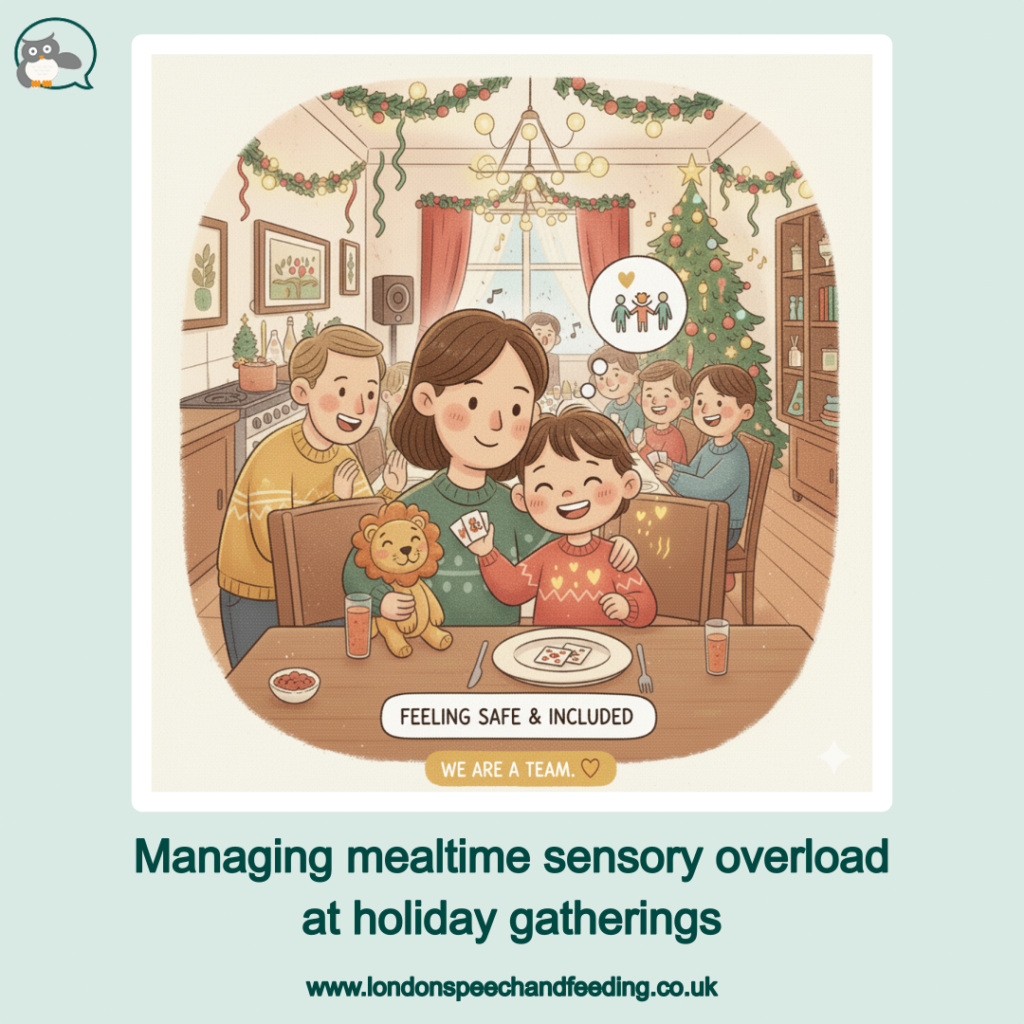
    Managing mealtime sensory overload at holiday gatherings: Supporting children with allergies and feeding differences

    Managing mealtime sensory overload at holiday gatherings: Supporting children with allergies and feeding differences

    Holiday meals are meant to be joyful and something we all look forward to. But for many children and their families, these occasions can be overwhelming and be the cause of dread and worry. The combination of new smells, unfamiliar foods, loud environments, social expectations, and allergy anxieties can quickly turn what should be a festive time into a stressful one.

    For parents of children with sensory processing differences, selective eating challenges, or food allergies, holiday gatherings often require careful planning and a big dose of tolerance and compassion. The good news is that with awareness and a few gentle strategies, you can support your child to feel safe, regulated, and included during festive meals without pressure, tears, or discomfort.

    Let’s explore how to make holiday mealtimes calmer, safer, and more connected this season.

    🎄 Why holiday meals feel so overwhelming

    Holiday gatherings usually combine several sensory triggers all at once:

    • Noisy, chaotic rooms
    • Strong smells from a mix of foods we don’t normally cook
    • Multiple conversations happening at once
    • Bright lights, Christmas décor, flickering candles
    • Unfamiliar foods with unexpected textures
    • Expectations to ‘try everything’ or ‘enjoy it’s sooo good!’
    • New environments, seating arrangements, or routines

    For children with sensory sensitivities, this can feel like a tidal wave of input. Research shows that children who are sensory-sensitive often have heightened responses to smell, taste, and texture, which may lead to avoidance or distress at mealtimes (Cermak, Curtin, & Bandini, 2010).

    Add food allergies into the picture and anxiety increases even further for both children and parents. A 2020 study by DunnGalvin et al. found that children with food allergies experience significantly higher stress in shared eating environments, especially when food preparation or contamination risk is hard to control.

    So, if your child becomes tearful, shuts down, or refuses to sit at the festive table, it isn’t ‘bad behaviour.’ It’s sensory overload, heightened vigilance, or discomfort communicating through their body.

    🌟 Preparing your child for a calmer festive meal

    Preparation is especially important for sensory-sensitive or allergy-aware children. Here’s how to set them up for success:

    1. Offer predictability through previewing

    Before the event, show your child pictures of:

    • where you’re going
    • who will be there
    • the types of foods that might be served
    • where they might sit

    A visual schedule or social story can help reduce anxiety and give your child a sense of control.

    2. Pack safe foods without apology

    If your child has allergies or selective eating, bring:

    • ‘Safe foods’ you know they will eat
    • Backup snacks
    • A separate (their own) plate, if needed
    • Emergency medication

    Announce clear, firm boundaries such as:

    ‘Ok people, these are Jamie’s safe foods — we’ll stick with these today.’ This will help relatives understand without pressure or judgement.

    3. Choose seating that supports sensory regulation

    If possible, seat your child:

    • at the end of the table
    • near a familiar adult
    • away from the kitchen (strong smells)
    • away from noise clusters
    • give them their favourite toy or fidget whilst waiting

    Let them take breaks when needed. This isn’t ‘rude,’ it’s self-regulation.

    🍽️ Supporting children during the meal

    1. Focus on connection, not consumption

    The holidays are not the time to expand your child’s food range. Keeping mealtimes low-pressure actually supports long-term progress.

    In fact, the research is clear: pressuring children to eat decreases acceptance and increases refusal (Galloway et al., 2006).

    So instead of ‘Just try it!’ try:

    • ‘You don’t have to eat it, you can look at it.’
    • ‘You’re in charge of what goes in your mouth.’
    • ‘You can keep your safe foods on your plate.’

    2. Protect your child’s allergy safety

    Holiday meals often include:

    • cross-contamination risks
    • shared utensils
    • buffets
    • homemade dishes without ingredient lists

    Use gentle but firm scripts:

    • ‘Because of Ellie’s allergies, we’ll keep her plate separate.’
    • ‘We’ll serve her food ourselves to make sure she stays safe.’

    Confidence in your boundary helps others respect it.

    3. Manage sensory load in real time

    Offer:

    • headphones
    • a small chew or fidget toy
    • a designated ‘calm corner’
    • time outside for fresh air
    • a predictable signal for breaks (e.g., a hand squeeze or card)

    Remember, sensory regulation is healthcare, not ‘giving in.’

    4. Model calm eating

    Children learn most from watching.

    Slow, happy bites and relaxed facial expressions tell the nervous system: ‘This environment is safe’.

    💛 What to say to well-meaning relatives

    Families often have big feelings about food. You can prepare nice phrases like:

    • ‘We’re focusing on helping him feel safe around food today.’
    • ‘She has allergies, so we’re sticking to our plan.’
    • ‘We’re avoiding pressure because it helps him eat better long term.’
    • ‘We’re celebrating together, eating is not the goal today.’

    Setting expectations ahead of time can reduce awkward moments later.

    🎁 The bigger picture: It’s about safety, not ‘picky eating’

    Children with allergies, sensory differences, or feeding challenges aren’t trying to be difficult. They are trying to stay safe, regulated, and comfortable.

    Your calm presence, gentle boundaries, and preparation create the conditions for a holiday that feels peaceful, not pressured.

    Sonja McGeachie

    Highly Specialist Speech and Language Therapist

    Owner of The London Speech and Feeding Practice.


    Health Professions Council registered
    Royal College of Speech & Language Therapists Member
    Member of ASLTIP

    Find a speech and language therapist for your child in London. Are you concerned about your child’s speech, feeding or communication skills and don’t know where to turn? Please contact me and we can discuss how I can help you or visit my services page.

    📚Research References

    Cermak, S. A., Curtin, C., & Bandini, L. G. (2010). Food selectivity and sensory sensitivity in children with autism spectrum disorders. Journal of the American Dietetic Association, 110(2), 238–246.

    DunnGalvin, A. et al. (2020). APPEAL-2: A pan-European qualitative study to explore the burden of peanut-allergic children, teenagers and their caregivers. Clinical & Experimental Allergy, 50(11), 1238–1248.

    Galloway, A. T., Fiorito, L. M., Francis, L. A., & Birch, L. L. (2006). ‘Finish your soup!’ Counterproductive effects of pressuring children to eat on intake and affect. Appetite, 46(3), 318–323.

    2
  • Using AAC – Augmentative and Alternative Communication for non-verbal and early verbal children

    Using a Core Vocabulary Board

    Your Speech Therapist might have been advising you to introduce words to your child with the help of a CORE BOARD. What on earth is she talking about and why would we want to do this, I hear you think – and in fact this is what I get asked a lot, as I often do recommend using Core Boards.

    Core boards belong to the category of Augmentative and Alternative Communication (AAC ) and they can be really useful for:

    • Children or adults who cannot speak at all or who are very hard to understand.
    • Children who are slow to speak and have difficulty expressing themselves verbally, due to genetic conditions as Down Syndrome, Verbal dyspraxia, Autism or any other learning difficulty that means a child is slow to develop speech.

    Here is what a Core board might look like, in fact this is one that I love to use. It is made by Beautiful Speech Life, there are a ton of similar boards out there for free. I have also made my own, you can check it out on my Instagram feed.

    Using a Core Vocabulary Board

    What is Core Vocabulary/ Core words?

    Core vocabulary consists of the most common words used by children throughout a day. In 2003 Banajee and Dicarlo et al found that 50 % of pre-schoolers in their project used nine words consistently across their daily play and meal routines. These words are Core words and are typically the ones you can see on a board, like the one above.

    How To Use It

    Adults always first need to consistently model and show their child how to use a board. This is key! For example: Adult can point to “YOU” “WANT” ‘MORE” and then point to the cup of Water on the counter. Child could then reply either by shaking his/her head and/or pointing to “NOT” which also stands for “NO”. Then adult can point to “NOT” “MORE” and do an OK sign as well. Eventually Child can initiate a request and point to “I” “ WANT” “MORE” and then point to the cup on the counter.

    This is not as cumbersome or limited as it first sounds or appears. Here’s why: As adult you can talk normally and, of course, many words you are using will not be on this board. But some will be, and you will be surprised how many you can find when you start using it. So you could say quite normally: Hey lovely (name of your child) would YOU LIKE some MORE water? The words in capital are on the board which you can point to as you speak normally. Basically, you are showing/saying to your child: “We can speak and these are the pictures we can use to help us; We call this TOTAL COMMUNICATION, as communication is so much more than just words! Great communication can be silent, where we use our facial expression, our smile, our eyes, our hand gestures, body movements and yes, of course, words. But when words fail us, these boards are so helpful.

    This still does not answer your original question of: why would I want to do this, I want my child to talk!? You are a SPEECH Therapist, please help my child TALK, not point to pictures, that is not what I had in mind.

    Let Me Explain

    When speech is difficult for a child it doesn’t mean that there is nothing to talk about! Of course, we want all our children and all people to speak because it is the easiest and most effective way of communicating, no doubt! However, sometimes this is very hard for some children and whilst we are always working towards speech where possible, we also want to make sure that whilst figuring out how to speak, your child has a MEANS TO COMMUNICATE. Using a board like this might well be a temporary strategy but whilst you are using it and working on their speech you will find a reduction in tantrums and frustration as you child is able to express themselves more effectively.

    Often we find that as soon as we offer a CORE VOCABULARY like the above sample a child who has had no or very few words suddenly blossoms and starts to point to new words on the board and starts to PRACTICE USING THESE WORDS!! Practice makes perfect, right? Yes it totally does! There is lots of evidence that tells us that using Core Vocabulary Boards ENHANCE AND SUPPORT SPEECH PRODUCTION AND NOT HINDER IT. Using a board like this will only ever be helpful to your child and will never make your child “lazy” – too lazy to speak? NO SUCH THING!

    Here is what one of my parents says about the core board we use with her little boy:

    “the board has been a game changer, my son is a visual learner so it really helps to have the board as he associates communication so much easier this way. We have incorporated his twin sister who models it’s use and have definitely seen improvement in speech through its support and his frustration around being unable to verbally communicate at times has definitely lessened”

    K Connolly, Mother of Tom (aged 3.5 years).

    Reading and hearing this makes me so happy!

    In addition to general core board above I also sometimes use a Core Board that is specific to an activity, such as for example BLOWING BUBBLES. Below is an example of such a board, which you can use very nicely during a bubble blowing activity and sometimes it is a nice place to start for newcomers, this can be an easy introduction. You can download this and many similar boards on www.widgit.com for free!

    Using a Core Vocabulary Board

    There is so much more to say about AAC and using Coreboards, visit my Instagram you can find a bit more information on how I use them.


    Find a speech and language therapist for your child in London. Are you concerned about your child’s speech, feeding or communication skills and don’t know where to turn? Please contact me and we can discuss how I can help you or visit my services page.
  • · ·

    Explaining pronoun reversal: A window into gestalt language processing

    Explaining pronoun reversal: A window into gestalt language processing

    Have you noticed your child referring to themselves as ‘you’, or calling you ‘me’? This seemingly confusing mix-up of pronouns, known as pronoun reversal, often raises concerns for parents. Below I outline why your child does this and want to reassure you that it is to do with his or her unique language learning style.

    Gestalt language processing: Learning in chunks

    Many children, particularly those on the autism spectrum, use a gestalt language processing approach. Unlike analytic language processors who learn individual words and build sentences, gestalt language processors learn language in whole ‘chunks’ or ‘gestalts’. Think of these gestalts as pre-packaged scripts they pick up from their environment — phrases, sentences, even snippets of songs or movie lines.

    As Marge Blanc, author of Natural language acquisition on the autism spectrum, explains, ‘When a child picks up an entire gestalt (script), he’s got the pronoun of the original speaker. So ‘pronoun reversal’ is nothing more than that.’

    So your child is simply repeating what they’ve heard, without yet understanding the individual word meanings or grammatical functions.

    Imagine your child hearing ‘You want a rice cake?’ repeated frequently. They might then use this phrase to express their own desire for a rice cake, even though it doesn’t grammatically fit. So they are thinking and saying ‘You want a rice cake?’ and the meaning of this phrase is: ‘I want a rice cake’. This isn’t a sign of confusion, but a natural step in their language development. They’re working with the tools they have: the scripts they’ve acquired.

    How can we support their natural language journey

    Instead of trying to ‘correct’ pronoun usage, our role as caregivers and speech therapists is to support the child’s natural language progression. Here’s how we can do this:

    1. Learn about their gestalt stage and run with it: In the early stages (1–3) of gestalt language development, correcting pronouns can be counterproductive. These children are still processing language as whole units, not individual words. Direct corrections can lead to frustration and hinder their natural language exploration.
    2. Patience and trust: Gestalt language processing follows a predictable, albeit sometimes non-linear, path. By understanding their current stage, we can provide targeted support. Language sampling and scoring, guided by the Natural Language Acquisition framework, help us pinpoint their stage and tailor our approach.
    3. Model language strategically: In the early stages, avoid using pronouns like ‘you’ and ‘you’re’. Instead, model language from the child’s perspective or use joint perspectives. For example, instead of ‘Are you thirsty?’, try ‘I’m thirsty!’ or ‘Let’s get some water’,

    The big picture: Language unfolds naturally

    Pronoun reversal is a stepping stone, not a stumbling block. As gestalt language processors progress, they begin to break down these gestalts into smaller units and develop their own self-generated language. This is when their understanding and use of pronouns naturally emerge.

    By shifting our perspective from ‘error correction’ to ‘developmental support’, we create a nurturing environment for these children to thrive. We empower them to navigate their unique language journey, ultimately leading to more meaningful and independent communication.

    So, to summarise:

    • Pronoun reversal is a typical characteristic of early-stage gestalt language processing.
    • Focus on modelling language from the child’s perspective or a joint perspective.
    • Avoid correcting pronouns in the early stages.
    • Trust the process and support the child’s natural language development.

    Let’s celebrate the diverse ways our children learn to communicate and empower them to find their unique voice!

    If you have any questions or would like some help with understanding your little gestalt language learner, please get in touch with me via my contact form.

    Sonja McGeachie

    Highly Specialist Speech and Language Therapist

    Owner of The London Speech and Feeding Practice.


    Health Professions Council registered
    Royal College of Speech & Language Therapists Member
    Member of ASLTIP

    Find a speech and language therapist for your child in London. Are you concerned about your child’s speech, feeding or communication skills and don’t know where to turn? Please contact me and we can discuss how I can help you or visit my services page.

    1
  • · ·

    AAC Systems and Speech and Language Development

    Introduction

    I see a lot of minimally speaking or non-verbal children in my practice. Some children are autistic and others are severely challenged with motor planning and some are both. Some children are simply delayed in their spoken language for reasons that we don’t quite know yet.

    Regardless of the causes, what is always apparent pretty quickly is that apart from the odd gestures or Makaton signs (mainly ‘more” ‘finished’ and “biscuit) we don’t have a robust alternative for speech in place. Instead, what we often have is a child with lots of frustration and tantrums and some behaviours we really don’t want like: hitting, biting, pushing, grabbing and often throwing… There are others, too many to mention, but we don’t enjoy watching our children in these states. And we are often fearful of what might happen next if we don’t find a way to calm our child.

    Fear not

    In my work, before I get to offer an alternative means of communication, I often have to work with a fair amount of resistance on the parents’ side as parents tend to feel that allowing such a system into their lives will prevent their child from speaking. They fear that their child will so enjoy pressing those buttons that they will become lazy and not talk at all.

    I totally get it!

    Parents often feel overwhelmed by the task of getting their own heads round how to use AAC, either in paper form or a computerised system. This can be a great turn-off for lots of people who feel they are not very “techy” – like myself actually! Indeed, it is true to say that I resisted operating in this field for a long time as I didn’t feel able to navigate electronic devices. But fear not. Truly, most systems are very user-friendly. The support is great. And I have managed to become quite proficient in one or two of these systems, through using it daily. It really is as simple as that.

    Alternative and Augmentative Communication (AAC)

    There is plenty of research on the efficacy of Alternative and Augmentative Communication (AAC). It is now very well understood and proven that, once we introduce our child to a good, attractive way of communicating that they can actually do, in time children who can speak will speak. Speaking is more effective than any AAC system. It is more versatile, more fun, and when human beings have discovered how to speak, most will do so in favour of any other system.

    Many children and adults, for many reasons, were never going to speak an awful lot, or with great difficulty. Or they were not going to like to speak. Or they were going to like to speak some times but not other times… And for all those people an AAC system is invaluable and a wonderful resource.

    Neuro-diversity affirming means that we do not impose one system of communication on our children (speaking with our mouth) only because it is the one we are using and most people we know too.

    Of course, we want the best for our children, and we want them to have the easiest and most straight forward existence on Earth. Of course we do. Speaking with our mouth does help with that. But we must come to understand that not all children and people feel like that and they struggle to use their mouth for talking.

    Personal experience

    I have difficulties understanding this myself, I will be very honest here. And I will say that – shoot me down in flames SLT fraternity – but I am learning to accept that using an AAC system proficiently is a very good alternative for when speech is not coming. I am learning to accept that some people are perfectly able to speak, and might do so but not always and only when conditions are right. I came into the profession as a speech therapist with the idea that I would help anybody that came to me to speak with their mouth. But I have changed my stance on that and now am happy to help anybody that comes to me to communicate most effectively with whatever works for them. I will always try for speech if I can … Just because it’s easiest!

    Acceptance

    Now I will equally celebrate a child pointing to a symbol or making a sign for something. It is a fantastic moment when it happens for the parents and me and the child! And we can always hope for more speech to come as we go. Nothing wrong with our aspirations, is there?

    The basic premise is this: accept any mode of communication as valid, as long as your communication partner understands what it means. Don’t require individuals to repeat themselves in another modality. Do model the response in the modality you are trying to teach. So, a child can point to a symbol and I will respond with speaking (with my mouth) but I will also respond by pointing to a symbol because that way I am signalling that both are ok and that I have understood and am encouraging the person to say some more.

    Here is some research;

    Binger, C., Berens, J., Kent-Walsh, J., & Taylor, S. (2008) The effects of aided AAC interventions on AAC use, speech and symbolic gestures. Seminars in Speech and Language, 29, 101-111.

    Sennott, S.C., Light, J., & McNaughton, D. (2016). AAC modelling intervention research review. Research and Practice for Persons with Severe Disabilities, 41, 101–15.

    Dada, S., & Alant, E. (2009). The effect of aided language stimulation on vocabulary acquisition in children with little or no functional speech. American Journal of Speech-Language Pathology, 18, 50–64.

    Contact me if you would like your child to have neurodiversity affirming speech and language therapy.


    Find a speech and language therapist for your child in London. Are you concerned about your child’s speech, feeding or communication skills and don’t know where to turn? Please contact me and we can discuss how I can help you or visit my services page.

    0
  • ·

    The role of spinning and swinging in speech and language therapy

    Sonja with a child on a swinging with a stuffed monkey

    Spinning and swinging are often observed behaviours in autistic children. While these actions might seem repetitive or unusual to some, they serve crucial functions for these children. Understanding the underlying reasons for spinning and swinging can provide valuable insights into how to support autistic children and incorporate these activities into therapeutic settings.

    Why do children spin?

    Spinning is a common sensory-seeking activity in autistic children. Sensory seeking means that the child actively looks for sensory input to regulate their nervous system. Here’s why spinning can be beneficial:

    • Vestibular input: Spinning stimulates the vestibular system, which is located in the inner ear and is responsible for balance and spatial orientation. For children with sensory processing difficulties, spinning can provide essential sensory input.
    • Calming effect: For some children, spinning can be a self-regulating strategy. The rhythmic motion can help to calm the nervous system and reduce anxiety.
    • Sensory exploration: Spinning allows children to explore their sensory experiences. It can help them understand their bodies and how they move in space.

    The allure of swinging

    The rhythmic back-and-forth motion of a swing offers several benefits:

    • Vestibular input: Like spinning, swinging stimulates the vestibular system, helping to improve balance and coordination.
    • Proprioceptive input: Swinging provides proprioceptive input, which is the sense of where your body is in space. This information is crucial for motor planning and coordination.
    • Calming and organising: The rhythmic motion of swinging can have a calming effect on the nervous system, helping to regulate emotions and improve focus.
    • Social interaction: Swinging can be a shared experience, fostering social interaction and communication.
    • Facilitating communication: While swinging, children are so much more relaxed and open to communication. The rhythmic motion can also help facilitate singing, humming, listening to my singing, non-verbal communication for sure but also more verbal and mouth words can be heard from children on my swing. If nothing else, it is so fun and helps build trust and rapport between my child and me.

    Therapeutic Activities Combining Spinning, Swinging, and Speech and Language Therapy

    Here are some therapeutic techniques that I use at London Speech and Feeding to combine movement with speech and language development:

    • Swinging with verbal prompts: While the child is swinging, I provide simple verbal prompts such as ‘up’, ‘down’, ‘fast’, and ‘slow.’ This helps to develop receptive language skills and improve auditory processing.
    • Sensory-motor play: I like to combine swinging with tactile activities like playing with textured balls or bean bags. This can facilitate language development through descriptive language, words and scripts like: ‘that’s so soft’, ‘oooh tickle tickle tickle!’
    • Storytelling on the swing: Often I manage to create a story while the child is swinging. This can improve narrative skills, vocabulary, and imagination. Recently I did the ‘Tiger who came to tea’ story and each time the swing stopped the tiger came and ‘ate some more cakes’ and ‘tickled their tummy’ whilst eating. It may make not much sense but my child loved it and we had ‘more tiger eat more’.
    • Song and rhyme time: Often I sing the ‘rumble in the jungle’ song while swinging my child to enhance phonological awareness, rhythm, and timing.
    • Visual supports always help: I use LAMP Words for Life AAC support during swinging and show core words such as: ‘go’ / ‘stop’/ ‘more’ / ‘tickle tickle’ etc. #lampwordsforlife #aac
    • Movement-based activities: We can incorporate activities that require sequencing, such as imitating animal movements or following simple commands while swinging. This can improve motor planning and language comprehension.

    For more information follow me on Instagram, Facebook or LinkedIn.

    Sonja McGeachie

    Early Intervention Speech and Language Therapist

    Feeding and Dysphagia (Swallowing) Specialist The London Speech and Feeding Practice

    The London Speech and Feeding Practice


    Find a speech and language therapist for your child in London. Are you concerned about your child’s speech, feeding or communication skills and don’t know where to turn? Please contact me and we can discuss how I can help you or visit my services page.

    1