Stage 2 NLA

| |
Image by Freepik

Last time we asked: is our child ready tp move to Stage 2 NLA (Natural Language Acquisition stage 2) and we looked at how we can know. Now we know: he/she is ready, they are mixing and matching those scripts quite liberally! Hurrah!

So for example we hear phrases like:

  • ‘let’s go’+ ‘downstairs’
  • ‘it’s’ + ‘downstairs’
  • ‘I see it’ + ‘downstairs‘
  • ‘I want to’ + ‘shoes downstairs’ (I want to put my shoes on downstairs)

To recap, it’s important to listen out to a variety of contexts because if we only hear the single version of a gestalt —this is so great, hurrah!— but that’s not yet Stage 2.

What we can now do on a daily basis to help and support at this time:

1. We need to offer more ‘mix and match’ phrases to help our child establish this new way of communicating.

Good phrases:

  • It’s … raining / cooking / eating / washing / brushing
  • That’s … great / cool / amazing / wow / so good
  • Let’s … see / look / go / run / chase
  • How’bout … some food / playing / I’ll chase / sleeping / we read a book
  • I see a … bird / large car / fire engine
  • I wanna … have a biscuit / have a book / have a snuggle
  • We’re … going out / going home / going in the car / going upstairs

Here in my video clip of train play I use:

  • Let’s go
  • It’s going up the hill
  • It’s coming down
  • Ooops it falls!
  • It’s stopping
  • Let’s put on another parcel
  • Ready steady go
  • Off we go
  • It’s come off!
  • Let’s fix it
  • I can do it
  • I don’t need help

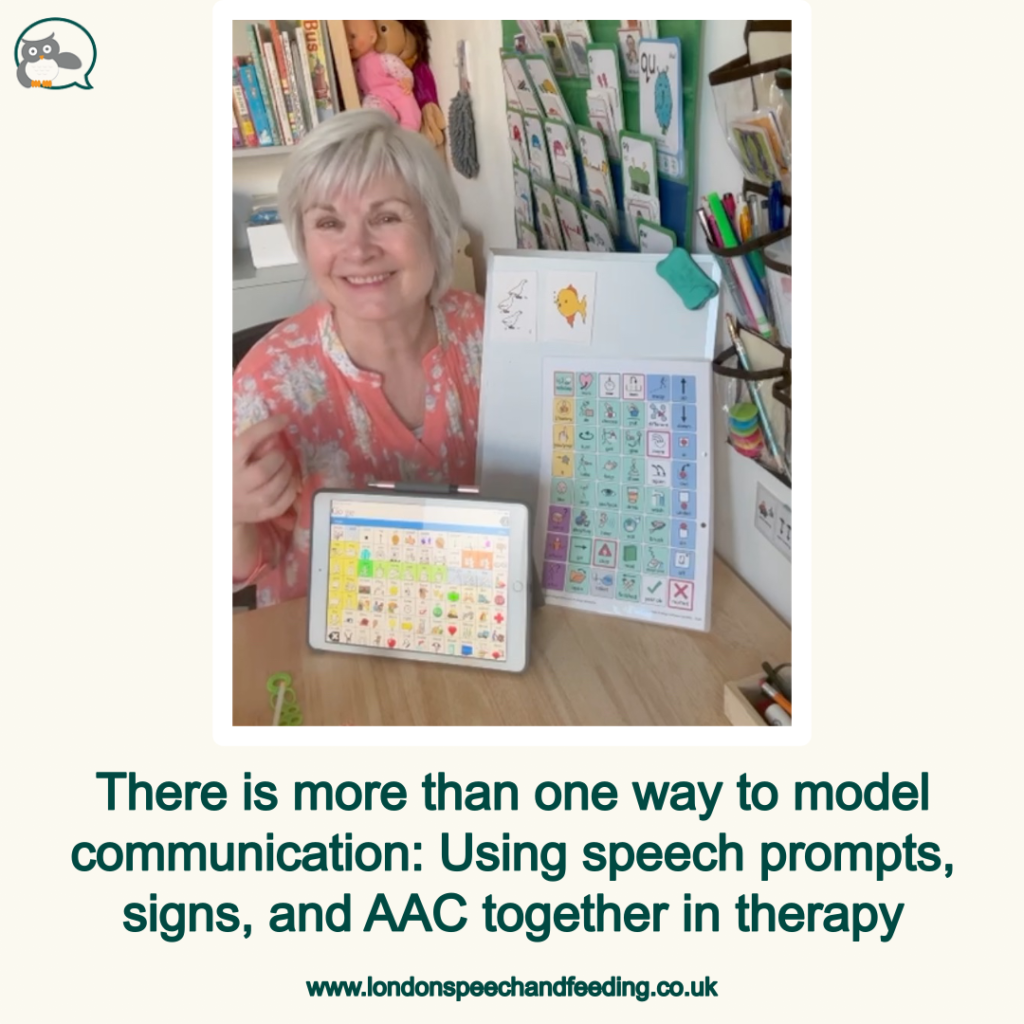
You can offer these gestalts either with an AAC as you can see me do in the video clip or you can just verbally offer these.

2. Watch out for Pronoun confusion or reversal:

Gestalt kids repeat gestalts, so we don’t want to create ‘pronoun reversal’.

Instead model from a:

  • first person perspective: ‘I’ / ‘Our’ / ‘Us’
  • joint perspective: ‘We’ / ‘Let’s’ or a
  • neutral perspective: ‘It’

You can turn almost any sentence into a good language model once you get used to it. And you can avoid ‘you’ and ‘your’ at the same time!

So instead of saying, ‘Do you want to go to the park?’

You could say:

  • We wanna go to the park?
  • Let’s go out?
  • Shall we go out / to the park?

3. Start providing ‘variation’ in your language modelling:

Instead of just modelling something one way, start thinking about offering a pattern in a couple of other ways, in a couple of different situations, then several ways in several different situations.

Example: once you hear your child saying: ‘it’s raining’ and you know it’s a mitigation, because you don’t often say ‘it’s raining’, or haven’t said it in a while and you know your child says other ‘it’s’ phrases.

Repeat: ‘it’s raining!’

Then: ‘it’s’ + ‘raining hard’ / ‘it’s wet out there’ / ‘It’s’ + ‘raining lot’s’.

Then later think of other combinations for ‘it’s’ + ‘something’:

  • (rice) ‘It’s’ + ‘cooking’
  • (water/tap) ‘It’s’ + ‘running’
  • (radio) ‘It’s’ + ‘singing
  • (dog) ‘It’s’ + ‘peeing’ / ‘it’s’ + ‘running’ / ‘it’s’ + ‘jumping’

In my train video clip:

  • Let’s go
  • It’s going
  • Let’s make it go
  • Ready steady go
  • Oops its gone

4. Use natural intonation that shows you really mean what you’re saying.

You can be animated or try for musical if your child prefers that / doesn’t mind you singing —they might not like it if their hearing is pitch perfect and your singing is off key…—

  • ‘I’m’ + ‘trying to find you!’ (animated, goofy face)
  • ‘I’m’ +’ getting tired!’ (exaggerated stretch and yawn)
  • ‘I’m’ + ‘catching up with you!’ (animated goofy)
  • ‘I’m’ + ‘gonna get you!’ (animated goofy)
  • ‘I’m’ + ‘sad right now’ (exaggerated face and tone of voice)

5. USE SILENCE!

Important, I might not have said this before but we need to hold back sometimes (hard I know) and not constantly offer models. Let our child sit in a bit of silence with us there just observing and waiting for their own offers. This is a very important point. Silence is golden sometimes. Try it out. I am not talking about the silence that comes with a person scrolling on their phone though, we do need to be present and receptive.

You will see this works wonders!

Do get in touch if you would like some in-person or on-line 1:1 support with this. It can be overwhelming to figure it all out alone.

You can also check my friend’s lovely handmade jewelry on her website.


Find a speech and language therapist for your child in London. Are you concerned about your child’s speech, feeding or communication skills and don’t know where to turn? Please contact me and we can discuss how I can help you or visit my services page.

1

Similar Posts

  • ·

    Target activities and games

    Target Activities and Games For Kids
    Target Activities and Games For Kids

    Target Activities and Games

    AMAZINGLY EASY Activities that we can do at home and in the clinic to help our children practise those targets!

    I bet you have wondered what amazing things are done by a therapist in the clinic that you could not possibly do at home…? Well, if so I am here to tell you that you will be absolutely fine with just a few select toys and games and you will be able to get those targets done in a jiffy!

    What we clinicians do very well and what you probably can’t do yourself is formulate and design the targets that are important for your child to practice. Once we have assessed or reviewed your child’s progress and needs we can then design the perfect next step of targets for you.

    So for example, we have decided your little one needs to be practicing their ‘r’ sounds at the beginning of short words. We decided that based on our clinical expertise and our assessment and we have already worked with your child and managed to get this tricky ‘r’ sound just about right on its own. Now we are ready for short word practice.

    It has been researched that in order for the brain pathways to re-shape or reform we need to get about 100 words in per day of our target sound. That sounds like quite a lot, right? But actually….. it’s not that bad. After all you only need to say 5-7 words about 20 times and hey presto that’s about 80-100 words.

    So here are some simple games I use in my clinic all the time and these games are easily available online or in your local toy shops and this is how to do them:

    Pop the Pirate

    Pop the Pirate, sooo good and popular:

    Lay out your target words which you will have been given by your speech therapist and put a few swords on each word.

    Each time your child picks up a sword they will need to say the target word 5 x, like:

    rip rip rip rip rip or run run run run run just like that in a row, bish bash bosh.

    Then they can stick the sword into the barrel. Onto the next sword which they can pick and then again

    race race race race race and stick in another sword

    So with this little lot I put out 5 target words and 3 swords on each.

    You will therefore get…… 15 words per picture, and that makes….75 words , there that is nearly all you need to do.

    If you then do another little game like this one:

    Magnetic board game

    This is a Magnetic Board game, and they are suddenly EVERYWHERE. But you could also just take a baking sheet and some fridge magnet you might have kicking about.

    Same principle as before, but now since this is your SECOND game of the day and you have already got 75 targets under your belt you only need to do one more round of 5 target words each:

    Each time your child picks up a magnet piece they will say the target word 5 more times:

    Ray ray ray ray ray and DONE you will now at the end of this short round have 105!! target words done with just two little fun games.

    How good is this? Your child won’t hardly notice that they are in fact doing their speech therapy homework.

    You’re welcome 🙂

    Get in touch if you would like me to help finding good targets for your child to work on. They can be speech and/or language targets with this game method.


    Find a speech and language therapist for your child in London. Are you concerned about your child’s speech, feeding or communication skills and don’t know where to turn? Please contact me and we can discuss how I can help you or visit my services page.

  • · ·

    Great toys and books for our toddlers (around 1–2 years old)

    As a speech and language therapist, I often get asked by parents what toys and books they should buy for their toddlers. It can feel overwhelming with so many options available! So, I’ve put together a list based on my experience and what I’ve found works well.

    Remember, every child is unique!

    Observe your toddler’s interests and play style. Some toys that are popular might not be engaging for your child.

    Here are a few ideas to get you started:

    Sensory Toys:

    • Stacking cups: These are fantastic for developing hand-eye coordination, fine motor skills, and understanding size relationships. (Various brands available) Note: You can stack many things you have around the house, like bowls or measuring cups, for a similar experience!
    • Shape sorters: Help with shape recognition, hand-eye coordination, and problem-solving. (Melissa & Doug, Vtech)
    • Sensory balls: Balls with different textures (soft, bumpy, squishy) provide tactile stimulation. (Various brands)
    • Push and pull toys: Encourage gross motor development and exploration. (Vtech, Fisher-Price)

    Communication-focused toys:

    • Picture books with flaps: Engage curiosity and encourage language development. (Various brands)
    • Talking toys: Introduce new vocabulary and encourage imitation. (Vtech, Fisher-Price)
    • Simple puzzles: Develop hand-eye coordination, problem-solving, and spatial awareness. (Melissa & Doug, Ravensburger)
    • Musical instruments: Encourage exploration of sounds and develop auditory skills. (Bright Starts, Fisher-Price)

    Now, let’s talk about books:

    • The Very Hungry Caterpillar by Eric Carle: A classic with repetitive text and vibrant illustrations, great for introducing vocabulary and concepts like days of the week.
    • Brown Bear, Brown Bear, What Do You See? by Bill Martin Jr. and Eric Carle: Simple, repetitive text and engaging illustrations make this a favourite for many toddlers.
    • Goodnight Moon by Margaret Wise Brown: A soothing bedtime story with calming illustrations.
    • Pat the Bunny by Dorothy Kunhardt: An interactive book with textures and flaps to engage young children.
    • Corduroy by Don Freeman: A heartwarming story about a teddy bear who loses his button.

    Remember:

    • Observe your child’s interests: Choose toys and books that capture their attention and encourage exploration.
    • Engage with your child: Play with the toys together and read books aloud with enthusiasm.
    • Keep it simple: Start with a few toys and books and gradually introduce new ones.
    • Rotate toys: Keep playtime fresh by rotating toys and books regularly.
    • Most importantly, have fun! Reading and playing with your child should be a joyful experience for both of you.

    Also consider the power of open-ended play

    In today’s world filled with electronic gadgets, it’s easy to overlook the value of open-ended play. Open-ended toys lack specific functions or prescribed outcomes, allowing children to use their imaginations to explore and create. Unlike toys with pre-determined ways to play, open-ended toys encourage:

    • Creative thinking: Children can use them in countless ways, developing their own rules and narratives. A block can become a car, a house, or a spaceship, depending on the child’s imagination.
    • Problem-solving skills: Children learn to figure out how to use the toys, experimenting and adapting as they go. Don’t immediately rush in and fix things for your little one, let them think for themselves and then communication incentive: let them come and find you!
    • Fine motor skills: Many open-ended toys, like blocks, encourage the development of fine motor skills like grasping, stacking, and building.
    • Cognitive development: Children learn about cause and effect, spatial relationships, and problem-solving as they play with open-ended toys.
    • Social-emotional development: Open-ended play can foster social interaction and cooperation as children play together and share ideas.

    Simple toys with big impact

    Some of the best toys for toddlers are often the simplest ones. Here are a few examples:

    • Wooden blocks: Building towers, bridges, and forts encourages creativity and problem-solving.
    • Balls: Throwing, kicking, and rolling balls promote gross motor skills and hand-eye coordination.
    • Fabric: Bits of fabric can be draped, draped, and used for imaginative play.
    • Empty boxes: From cardboard boxes to tissue boxes, these can be transformed into anything a child can imagine: a car, a house, a spaceship!
    • Natural materials: Sticks, leaves, pinecones, and rocks can be used for imaginative play and sensory exploration.

    Remember, the key to open-ended play is to let children explore and discover

    Step back and observe, allowing your child to use his or her imaginations without too much direction. You might be surprised at the creative ways he or she uses simple toys!

    Happy play times with your little one!

    Contact me via my contact form.

    Sonja McGeachie

    Early Intervention Speech and Language Therapist

    Feeding and Dysphagia (Swallowing) Specialist The London Speech and Feeding Practice

    The London Speech and Feeding Practice


    Find a speech and language therapist for your child in London. Are you concerned about your child’s speech, feeding or communication skills and don’t know where to turn? Please contact me and we can discuss how I can help you or visit my services page.
    1
  • ·

    Correcting a lisp

    Correcting A Lisp

    This is a surprisingly common speech error and it can be corrected really well in my experience. I have helped lots of children of all ages learn how to control their tongue movements and produce clear, sharp /S/ sounds and good /SH/ sounds.

    Initial consideration

    There are some factors which need to be considered before we can dive into therapy proper and these are they, in a nutshell:

    1. The student is not currently displaying negative oral habits such as thumb sucking or excessive sucking on clothing. This is because thumb sucking exerts pressure on the teeth and therefore can, over time, push teeth out of their natural order/position.
    2. The student does not have a restricted lingual frenulum or tongue tie which can cause at times restricted movements of the tongue (pending on how tight the frenulum is attaching the tongue to the base of the oral cavity); equally a labial frenulum or lip-tie can restrict lip movement and therefore physically restrict good speech sound production.
    3. The student does not have enlarged tonsils as they can sometimes push a tongue forward and also cause open mouth posture and open mouth breathing.
    4. The student’s motivation to change their speech pattern is high. (this is an important factor though with younger students I can get round this with a lot of fun games and good parental involvement!)

    When I do an Oral Assessment of my student these are the first factors I want to look at and consider. Often I will refer to other agencies such as Orthodontists, dentists or ENT specialists to advise and help with some of these factors before we can get going. However, there are strategies that we can work on almost straight away.

    Most of my Lisp students present with an open mouth posture: that is where the student has their mouth always slightly open for breathing. Over time the tongue starts to fall forward and rests on the front teeth or the bottom lip instead of finding a comfortable resting place either at the alveolar ridge (the bumpy spot behind the upper front teeth) or, alternatively, resting at the bottom of the mouth behind the lower front teeth.

    Another common problem is that the tongue is not moving independently from the jaw and so is reluctant to pull back or lift up inside the mouth as the tongue is guided in movement by the jaw.

    Combine those two factors and your tongue is not pulling back, or lifting up or doing very much at all without the jaw moving as well. This makes for unclear speech sounds, especially all the sounds we make at the front with our tongue or with our lips: /B/ /P/ /L/ /N/ and of course /S/ and /SH/ are particularly hard to make. We often also struggle with the /Y/ sound so ‘LELLOW’ instead of ‘yellow’.

    Do not fear!

    But no fear, these problems can be treated over time for sure! We often start with lip, tongue, and jaw exercises that help to move the tongue independently from the Jaw, our student learns that the tongue is a muscle and can be trained to do amazing acrobatic things in the mouth! WOW! It can actually pull back, lift up, and come down again all on its own!

    We work on breathing, holding our breath for a bit then pushing it out and then holding it again.

    And when it comes to the actual /S/ sound I often try and go a NEW route bypassing the Snake-Sound route if that is what had previously been tried and failed so that we can create completely new sound patterns in our brain and think about our sounds in a completely new way.

    We then work on producing the sound /S/ on its own for a bit, at the end of words, then on either side of complimentary sounds, for instance : ‘EASY” – the sound patterns here are EEE-S–EE : the /EEE/ sound is complimentary to the /S/ sound as the tongue is at the right hight for the /S/ already once you have it in place for /EEE/ -……see?! EASY!

    And gradually we work towards saying the /S/ sound clearly at the front of short words, then phrases and then sentences.

    The process takes some time and it depends on how ready the student is. This varies of course hugely so I can never promise the exact number of sessions we will take to get that Lisp fixed. A lot depends on home practice in between sessions, and this is of course crucial to all therapy! Every day 15-20 mins practice is a good average time to aim for and when this is done it shortens the therapy block drastically.

    I always give plenty of home work so there is never a chance of it getting boring or there being “nothing to do”!

    Do contact me. I really enjoy working with this type of student and get a great kick out of FIXING THAT LISP!


    Find a speech and language therapist for your child in London. Are you concerned about your child’s speech, feeding or communication skills and don’t know where to turn? Please contact me and we can discuss how I can help you or visit my services page.

  • ·

    Four struggles parents face when out and about with children with speech, language, and communication difficulties

    A man and a woman hug a young girl at a table
    Hug

    You (as parents) often describe yourselves as being under constant pressure and stress when looking after your children and young people with Special Educational Needs and Disabilities (SEND). You may find going out to do the simplest of tasks a challenge. And you will try to avoid social situations out of fear and anxiety. One of the most important factors to you is having like-minded people who understand your position as a parent with a young person with additional needs. Let’s look at some of the challenges you face and how I can support you and your family.

    1. Challenging behaviour and going out to the shops

    When your child displays challenging behaviour and won’t go into a shop without buying a toy that they insist on having, it can be tough on your family. You see people around you staring as you try to manage the situation. They do not understand the pressures you face, or that the simplest of tasks are a huge challenge.

    I can support you by giving strategies to use when out and about. I know that using visuals is important for your child. They may not understand or take in language when they are in a heightened state of anxiety or feeling overwhelmed. You could print pictures of the places you’re going to and put them on an easily accessible chain. Then you could use that chain when out and about at the shops. You may want to introduce a visual timetable at home. That way your child or young person understands where they are going. This may lessen their anxiety and subsequent behaviour.

    2. Your child is not able to communicate their needs to an unfamiliar communication partner

    When your child has difficulty communicating to an unfamiliar person it can be hard to manage. You feel yourself explaining your situation repeatedly. I can provide your child with individualised strategies or communication aids which support your child to communicate with both familiar and unfamiliar communication partners. We’ll work together to find which communication methods work in different situations and how your child will use these to help their independence.

    3. Being overwhelmed

    Your child or young person may easily be overwhelmed which may contribute to behaviour changes. I’ll work with your family to understand what the behaviour means, looking at what happened before and what happened afterwards. We’ll not only look at the behaviour but at the environment as well. This can inform how you can support your child or young person in the future, to reduce sensory stimuli (if needed) and for them to feel emotionally regulated.

    4. People avoid engaging with you

    One of the hardest things as a parent is for others to avoid you. You see them crossing the street because they don’t know what to say to you. All you want is them to accept you, to maintain your identity as a person and not as a SEND parent. I can support you emotionally. I can give you advice on local support networks where you can find other parents in a similar situation.

    We know the stresses that being a parent with a child with SEND comes with. Please know I am always here to support you, to find solutions so that when you’re next out and about. Your experience will be a little easier and you’ll feel less isolated.

    Improve your child’s communication, confidence, reduce overwhelm and feel supported here.


    Find a speech and language therapist for your child in London. Are you concerned about your child’s speech, feeding or communication skills and don’t know where to turn? Please contact me and we can discuss how I can help you or visit my services page.
    1
  • ·

    How to model AAC with our minimally speaking students?

    modelling AAC

    How should we start? Should we use prompts? What kind of prompts? hand-over-hand or just pointing? Should we wait, and, if so, how long? Introducing an alternative communication system (AAC) to our child is for many of us a confusing and sometimes scary prospect, but it needn’t be! Let me reassure you and share some tricks of my practice in this area.

    Once we have decided to try for a picture based communication system, I usually start with a paper-based single page with between 48–88 core-words. I choose the number of words depending on where the child is developmentally and also verbally.

    If a child does have a small handful of words already, I might start with the 88-cell board below. If, on the other hand, my student is completely non-speaking and still quite little then I might go for the 48-cell below here or I might have even less cells to start with. Again, sometimes I start with an electronic device in my clinic just to trial and introduce the idea and to see if, or how, a student responds. 

    Below are some samples: a 49-cell board which I made for a child in a nursery setting

    Below a Saltillo WordPower board that can be downloaded from the Saltillo website:

    Example of a slightly more advanced board, again from the Saltillo Website

    And here below one example of a board I made for a specific activity for a child who loves water and sand play:

    It is perfectly possible to be very flexible and create a suitable board for any student, starting with as few as 2–5 cells and working up to over a 100 (very small ones) on a sheet of A4 or A3 paper.

    So once we have a good board for our child, what now? How do we start introducing this into our daily life?

    We can start by showing/pointing to the word GO within a play activity. For example:

    • a car run,
    • or a marble run,
    • or a spinner activity,
    • a wind-up toy,
    • anything that can be stopped and started easily.

    How to start?

    I will talk us through each of the steps using the example for the word ‘GO’.

    First phase

    The first phase is a TEACHING/ LEARNING PHASE. In this phase we do not expect our student to do anything, to copy us or to point to the board. If they do that it is of course a huge bonus and we will celebrate it.

    Our job is to simply MODEL/SHOW/GIVE EXAMPLES of how we can use the board, by steadily and regularly pointing to the chosen word or words. We do so across the day and across settings:

    • play
    • meal time
    • getting dressed/undressed
    • bath time
    • going to the car/shops
    • etc

    Once we can be sure that our student has been submerged and SOAKED in seeing the coreboard being used, say after some 3–4 weeks of using it consistently…

    Second phase

    We can begin to move into the second phase which is the PRACTICE PHASE. By now the student has seen the boards and he or she has seen the word GO (as a example) modelled many times.

    Now we can start to see if we can tempt our student into trying this out for themselves.

    What sort of TEMPTING are we talking about? Take a look at the Prompt Hierarchy below, which shows us what to do to get our student to be independently communicating as soon as possible. 

    The PROMPT HIERARCHY: what sort of prompting should we do, should we expect something from our student or how should we view this stage?

    1.  TEMPT AND PAUSE

    I have the AAC near to the toy and each time the child starts another round of the activity I say clearly ‘GO’ and I point to the picture as do so. I then pause and wait to see what happens. NOTHING? Then…

    1. USE SIGNS AND BODY LANGUAGE

    Next time the child starts another round I might be very animated and do a Makaton sign for GO as I say ‘GO’ and I make a very over point to the picture again. Then I wait. STILL NOTHING? OK then…

    1. OPEN-ENDED QUESTION

    Now I might say ‘GO’ and follow with: ‘OOH I WONDER IF THERE IS A PICTURE TO POINT TO…’

    ‘OH LOOK HERE IS GO!’ I then point to GO.

     STILL NO RESPONSE?

    1. ASK FOR A RESPONSE

    I might say ‘GO’ followed by ‘LOOK! LET’S POINT TO GO HERE ON THE PICTURE.’

    STILL NO RESPONSE? 

    1.  PHYSICAL TOUCH

    Next time I say ‘GO’ I will try and take the student’s hand, help isolate their finger and help him or her to point to the actual picture.

    REMEMBER: Prompting serves a very important function in scaffolding learning for students BUT if we are constantly prompting kids, then we are teaching them to only communicate when someone tells them to. We want our student to become as independent in speaking and using words as possible.

    So once I have done Physical Prompting I will try and phase back down to number 1 where all I need to do is point to the picture or look at the board with the aim that the student will then point to the picture.

    Take away points:

    • Keep the learning phase pressure-free and model without expecting our student to jump in. In other words, let’s model first without expectation. Later we can have a little bit of expectation.
    • After they’ve been exposed to and have been ‘soaked’ in plenty of AAC input, then, YES, we can create an opportunity to help them say or point to the word on their own.
    • We can model BOTH with and without expectation.
    • Only after LOTS of exposure, use the least to most prompting hierarchy and start creating opportunities for a student to become an independent communicator.

    Do get in touch if you have any questions or comments or if you would like some practical help.

    I am always pleased to hear from you.


    Find a speech and language therapist for your child in London. Are you concerned about your child’s speech, feeding or communication skills and don’t know where to turn? Please contact me and we can discuss how I can help you or visit my services page.
    0
  • A day in my life as an Independent Speech and Language Therapist

    During the pandemic I wrote a blog on what my working day looked like. Now a good year has passed since coming back to some sort of normality and I thought I would update this ‘day in the life of an SLT’ as my working life has changed of course to reflect the ‘new normal’.

    I have become truly busy, perhaps busier than I have ever been to be honest. It’s probably mostly due to the fact that I do most of the aspects of my work myself — though I want to mention two invaluable people here without whom I could not function as well as I do: the excellent Nathalie Mahieu () helps me with my SEO, Insta posts and blog uploading and the wonderful Sue Bainbridge () makes sure that my accounts don’t get into trouble with His Majesty’s tax office.

    Attached to our role as Speech and Language Therapists is an arguably enormous amount of administration/paperwork and preparation required for each and every client. This needs to be factored in when deciding how many families I can realistically see each working day. For me it works out as typically 3–5 clients a day, Monday to Friday.

    So how does my day typically look? Each day varies a lot depending on what type of client I have, but on average it looks a bit like this:

    First thing in the morning — after having a coffee and a quick check-in with my besties on WhatsApp — I do my Buddhist chanting for about an hour. My Buddhist prayers are the base of all I do and get me connected to my higher purpose and how to create value with each activity and each person I see that day. It sets me up for the day, I keep in mind who is going to come and see me and how I can best help them.

    Next up, I do the daily ‘spring-clean’ of my therapy room (on all fours! no joke ???? those kids see every speck!), vacuum the floors, wipe down the toys with flash-wipes and tidy up all my boxes, making sure that the battery toys are working, and everything else is in place. On to the guest toilet, the hallway needs to be rid of all the men’s shoes and trainers and coats… It’s endless what needs tidying when you are living with three men… This takes about 45 minutes.

    An articulation activity – packaging practice into a little game

    Then I prep for all my clients that day. I have now got so much quicker about selecting therapy materials. For one thing I have purchased so many toys and materials over the past five years that I can literally now open a shop and need to consider building an extension! ???? The upside is that it is now very easy for me to select a good handful of toys or games for any one child, even at a minute’s notice. Though, on average, I spend about 30 minutes per child preparing activities.

    Hurrah, it’s 11 am and my first client of the day arrives and the fun begins.

    When they leave around an hour later, the cleaning and wiping down starts again, this time less extensively. I write up my notes and send homework whilst enjoying a cuppa.

    The next client comes at 12.30 pm and once they have left, floor cleaned, toys wiped, notes written it is time for a quick lunch. No more than half an hour usually.

    Afternoon clients tend to be one more little one (nursery age) at 2.15 pm and thereafter I see mostly older school children for a variety of reasons (mainly speech production but also some language-based activities). I tend to say farewell to my last client of the day around 6 pm. I spend another hour, sometimes more, on writing up notes, answering new enquiries, blogging and phone calls to keep my service fresh, inspirational and exciting.

    And then dinner and the rest of the day rushes by. I tend to finish my day with some more Buddhist chanting, not a lot, perhaps 10–20 minutes to reflect on what has gone well and what could have been better — re-determine to improve or make better as needed.

    Tele therapy activity using online materials plus a coreboard

    In terms of where I provide a service, I still do a good mix of online clients (tele-therapy) and in-person clients in my clinic, which I love. Occasionally, I visit children in their nursery or at home but this service is now only available for long-standing clients.

    Each client is hand-picked to make sure that we are a good fit: no one client gets the same treatment as another; each client is unique, we get to know one another well over the time we work together and they are always highly valued. That takes time and, in reality, each client gets about two hours of my time. That is the actual session plus all the preparation and aftercare, i.e., bespoke hand holding, tweaks, problem solving and reassurance in between sessions.

    I absolutely love this way of working and would not ever want to do anything else. Nearly three decades of working both in the NHS and in private practice, countless courses (continual professional development) have enabled me to flourish as a therapist and I know that I offer something special and very valuable to my clients.

    My unique way of working affords all my lovely clients the help they need to support their children to make progress; and it gives me the right balance of job satisfaction and work life balance for now. My lovely reviews and testimonials tell me that my clients appreciate my service and this at the end of the day is the most important.

    If you are interested in exploring Buddhism/buddhist chanting then check out this link (https://sgi-uk.org/), and feel free to contact me about that specifically, regardless of whether you want speech therapy. I am always happy to chat about Buddhism, it has been so enriching for the last 43 years of my life.

    If you need help with your child, please do not hesitate to contact me.


    Find a speech and language therapist for your child in London. Are you concerned about your child’s speech, feeding or communication skills and don’t know where to turn? Please contact me and we can discuss how I can help you or visit my services page.

    1