How we can help shape smooth consonant blends
For many children, especially those navigating Childhood Apraxia of Speech (CAS), the challenge isn’t just making individual sounds. It’s the ‘speech gymnastics’ required to move smoothly from one sound to the next.
You might notice that instead of saying ‘Train’, your child says ‘Ter-ain’, or for ‘Frog’, you hear ‘Fer-og’. That sneaky little ‘uh’ sound in the middle is what we call a schwa vowel. In the world of speech science, this is known as epenthesis. It’s essentially a ‘repair strategy’ the brain uses to break up a difficult cluster of sounds into two easier pieces.
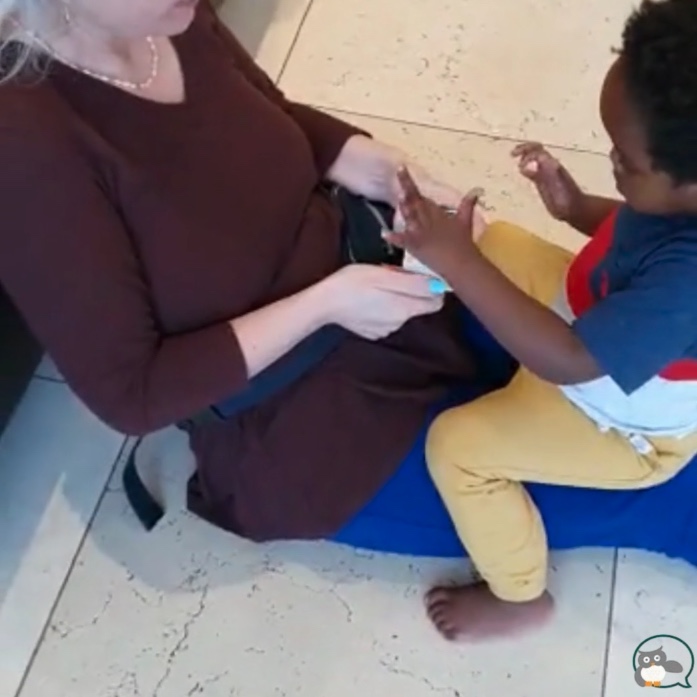
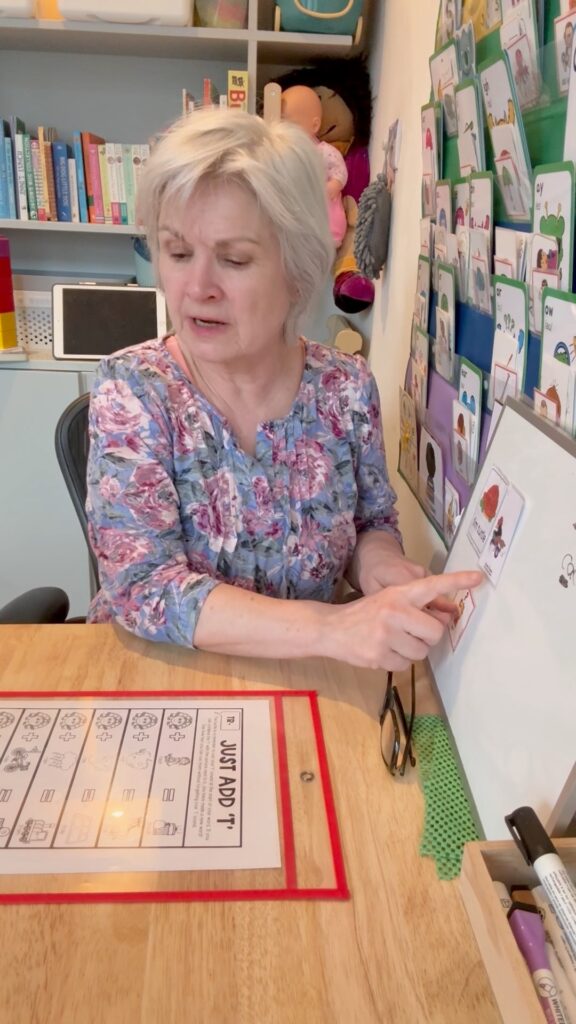
While it might seem like a small detail, that tiny vowel makes a big difference in how fluent and clear a child’s speech sounds. In today’s post (and the video below), I am working with my student on ironing out that schwa by focusing on co-articulation—the art of getting the mouth ready for the second sound while still finishing the first.
The ‘best friends’ strategy
To help my student understand this complex movement, I use visual cues and a story. There are many ways to portray two sounds living closely together, but for this session, I used the ‘Best Friends’ story.
In our story, the /T/ and the /R/ are older brother best friends who want to play together. The ‘schwa’ sound is represented by a little sister who keeps trying to jump in the middle of their game! Because my student has a younger sister, this scenario was instantly familiar and helped him visualise why we needed to ‘close the gap’ between those two sounds.
Alternative methods I often use:
Beyond stories, I often use other visual and tactile methods to show the closeness of two sounds:
- The sliding finger: I draw two dots on a paper—one for /T/ and one for /R/. We slide a finger quickly from one to the other. I might say, ‘Don’t let the ‘uh’ monster jump in the gap!’
- The rubber band: We stretch a rubber band as we speak. I tell my student that the word is one long, smooth stretch, rather than two separate ‘pops’.
- Visual cues for ‘quiet’ sounds: I often put my finger to my lips or tap my throat to remind a child to keep the first sound voiceless. If the voice stays ‘off’ during the /T/, it’s much harder for that schwa vowel to creep in.
The importance of ‘pure’ modelling
A major hurdle in clearing up these blends is how we, as adults, model sounds. Often, when teaching the alphabet, we say ‘Kuh’, ‘Puh’ or ‘Tuh’. But if you listen closely, you’re actually adding a vowel! If a child learns that /K/ says ‘Kuh’, it’s only natural they will say ‘Kuh-R’ for /KR/.
To give your child a cleaner blueprint, try modeling ‘pure’ sounds. Think of whispering rather than talking:
- The /K/ sound: A short, sharp burst of air from the back of the throat. No voice! (A quiet /K/ click).
- The /P/ sound: Just a ‘pop’ of air from the lips. If your throat vibrates, the vowel has snuck in.
- The /T/ sound: A tiny tap of the tongue behind the teeth.
Why is this important?
You might ask, ‘If I can still understand them, does it really matter if they say “ter-ain”?’
The goal of speech therapy isn’t just functional communication; it’s building phonological awareness. When a child adds extra vowels, it can eventually impact their literacy. If they hear ‘ter-ain,’ they are much more likely to eventually spell it as ‘terain’ or ‘traint’.
By helping them master these clusters through co-articulation now, we are setting them up for success in reading and writing. And we are giving them the confidence to speak with ease.
Feel free to contact me if your child needs help with clusters or other difficulties either aligned with Childhood Apraxia of Speech or other articulation difficulties.

Sonja McGeachie
Highly Specialist Speech and Language Therapist
Owner of The London Speech and Feeding Practice.
References
- Hall, N. (2011). Vowel Epenthesis. In The Blackwell Companion to Phonology (eds M. Oostendorp, C.J. Ewen, E. Hume and K. Rice). In this work, epenthesis is defined as the insertion of a vowel to break up complex consonant clusters into simpler, more manageable syllables. This is often viewed as a ‘repair strategy’ used by the brain when a transition between sounds is too complex to execute quickly.
- Aichert, I., & Ziegler, W. (2004) Brain and Language 88(1):148-59. Syllable frequency and syllable structure in apraxia of speech. This research highlights that children with Apraxia often struggle specifically with word-onset clusters, leading to distortions like the schwa.
- Browman, C. P., & Goldstein, L. (1992) Phonetica 1992;49(3-4):155-80. Articulatory Phonology: An Overview. This paper explains that fluent speech requires ‘gestural overlap,’ where the movements for two different sounds happen simultaneously. This supports the ‘Best Friends’ method of keeping sounds close together.


Find a speech and language therapist for your child in London. Are you concerned about your child’s speech, feeding or communication skills and don’t know where to turn? Please contact me and we can discuss how I can help you or visit my services page.