The world can be a beautiful and stimulating place, but for individuals with Sensory Processing difficulties (SPD), it can also be overwhelming and even painful. Everyday sights, sounds, smells, touches, and tastes can be amplified to uncomfortable or even unbearable levels. This can lead to anxiety, meltdowns, and a constant feeling of being on edge.
One important coping mechanism for SPD is containment. Containment strategies are techniques that help individuals manage their sensory experiences and create a sense of calm and safety.
Understanding containment needs:
Containment needs vary greatly from person to person. Some individuals might find comfort in deep pressure, while others might crave quiet and solitude.
Common containment strategies:
Here are some examples of containment strategies that can be helpful for individuals with SPD:
Deep pressure: This can involve activities like wearing weighted vests, using weighted blankets, getting firm hugs, or applying deep pressure massage.
Movement: Engaging in rhythmic movements like rocking, swinging, or jumping can be calming for some individuals.
Proprioceptive input: Activities that involve proprioception, the sense of body awareness, can be grounding. Examples include yoga, stretching, and proprioceptive toys like chewy necklaces or fidget spinners.
Visual calming: Utilising calming visuals like nature scenes, dimmed lights, or fidget toys with visual patterns can provide a sense of peace.
Auditory modifications: Noise-blocking headphones, earplugs, or white noise machines can help block out distracting or overwhelming sounds.
Oral motor activities: Chewing gum, crunchy snacks, or chewy toys can provide sensory input and help regulate emotions.
Sensory bottles: Watching calming visuals move within a liquid-filled bottle can be visually stimulating and promote focus.
Creating a safe space: Having a designated quiet area at home or school where individuals can retreat to self-regulate can be invaluable. This space should be free from clutter and overwhelming stimuli and can include calming sensory items.
Additional tips:
Be patient and understanding: It takes time and practice to find what works best for each individual. Be patient with yourself or your child as you explore different strategies.
Consistency is key: Once you find effective strategies, use them consistently in different settings to create a sense of predictability and comfort.
Communicate openly: Talk to teachers, caregivers, and others about individual needs and how they can support containment strategies.
Celebrate progress: No matter how small, acknowledge and celebrate successes in managing sensory experiences.
Remember:
Containment is not about suppressing sensory experiences altogether. It’s about creating a sense of control and reducing overwhelming sensations to a manageable level. By exploring different strategies and working with a qualified professional, individuals with SPD can develop the tools they need to navigate the world and experience life to the fullest.
Do get in touch if you would like some in-person or on-line 1:1 support with this. It can be overwhelming to figure it all out alone.
Find a speech and language therapist for your child in London. Are you concerned about your child’s speech, feeding or communication skills and don’t know where to turn? Please contact me and we can discuss how I can help you or visit my services page.
Let’s face it, introducing solids is a rollercoaster for parents. You’re bombarded with advice (solicited and otherwise) on purees, spoon-feeding, and the much-discussed ‘baby-led weaning’ (BLW). As a speech-language/feeding therapist I see the world through the lens of communication and development, as well as safe munching and swallowing. BLW can be a fantastic option for many little foodies. But is it right for yours? Let’s take a dive into the messy, hilarious world of toddler feeding.
BLW in a nutshell
Your baby, perched in their highchair, eyes wide with excitement and curiosity reaches out for a platter of food. He/She grabs a fat avocado slice, and curiously explore it with his/her lips, gums and tongue. He/She spits some of it out, mashes bits of it into his/her hair, there was a tiny swallow and the rest is smeared onto the high chair tray. Now he/she grabs a bit of the banana and rinse and repeat as before, except this one he/she keeps in his/her mouth for bit longer and takes a tiny bit more before the rest gets deposited into his/her bib.
This, in a nutshell, is BLW! It’s all about letting your little one take the lead in exploring new foods, textures, and tastes. No spoon-feeding, just pure, messy, self-directed feeding fun.
The pros of letting your little one loose on solids:
Motor Skills: BLW is a sensory party for developing motor skills. Picking up that slippery banana or gumming a chewy piece of toast strengthens those tiny hands and mouth muscles. These are the very skills they’ll need for future talking and chewing.
Texture Time: BLW exposes your baby to a variety of textures right from the start. Think soft, steamed broccoli florets or smooth, banana half-slices. This sensory exploration helps them develop an understanding of different textures in the world, which can translate to better oral motor skills needed for speech development.
Independence: BLW fosters a sense of self-feeding independence. Your toddler learns to control how much he/she eats and the pace of his/her meal. This can lead to better self-regulation later on, not just with food, but in other areas of his/her development too.
A wider variety of flavours: BLW encourages exposure to a wider variety of tastes and smells. Let your baby discover the sweetness of roasted sweet potato or the tang of mashed avocado! This early exploration can lead to less picky eating down the road.
There are some valid concerns:
Gagging vs. Choking: One of the biggest concerns parents have about BLW is choking. However, gagging is a natural reflex that helps babies learn to move food safely around their mouths. Choking is much rarer, and with proper food selection and supervision, the risk is very low. The con here really is parental anxiety more than anything else and if you can overcome this then a bit of gagging is just fine and part of the process. Choking, again most children do choke occasionally a bit! Of course, close supervision and common sense is very important here.
It’s ever so messy!: Be prepared for mashed banana on the highchair tray, rogue peas flung across the room, and a general sense of chaos. But then again, this is an important part of the learning process! I would encourage you to embrace the mess (within reason and your personal tolerance level) and focus on the fun of exploration.
Nutritional Concerns: Some parents worry that babies won’t get enough nutrients with BLW. While it might take a while for them to master the art of self-feeding, a healthy child’s body is pretty good at self-regulating. Offer a variety of healthy options, and he/she will eventually get the hang of it.
BLW: Is it right for your Little One?
BLW isn’t a one-size-fits-all approach. Here are some things to consider:
Developmental Milestones: Babies should be able to sit up with good head control and show an interest in food before starting BLW.
General good health and absence of food intolerances, allergies, or other significant health issues which might dictatea more controlled feeding regime.
Gag Reflex: A strong gag reflex is a good sign. It shows your baby’s natural ability to move food safely around their mouth. If, however, your baby’s gag is overly sensitive and causes frequent bouts of vomiting please consult your health care professional for an assessment (GP, Paediatrician, Dietician, Speech and Language – Feeding Therapist).
Your Comfort Level: BLW requires a relaxed and patient approach. If you’re feeling stressed about the mess or potential choking hazards, it might not be the right fit for you.
A final mouthful:
BLW can be a fantastic way to introduce your baby to solids. It promotes exploration, independence, and a love for food. Remember, there’s no pressure to go all-in on BLW. You can always combine it with spoon-feeding or purees to find an approach that works for your family and your child. The most important thing is to create a positive and relaxed mealtime environment where your little one can explore the wonderful world of food at their own pace.
P.S. As an SLT, I always recommend chatting with your health care professional. This way you can address any concerns you might have and ensure your baby is developmentally and physically on track for this exciting new chapter.
Feeding and Dysphagia (Swallowing) Specialist The London Speech and Feeding Practice
The London Speech and Feeding Practice
Find a speech and language therapist for your child in London. Are you concerned about your child’s speech, feeding or communication skills and don’t know where to turn? Please contact me and we can discuss how I can help you or visit my services page.
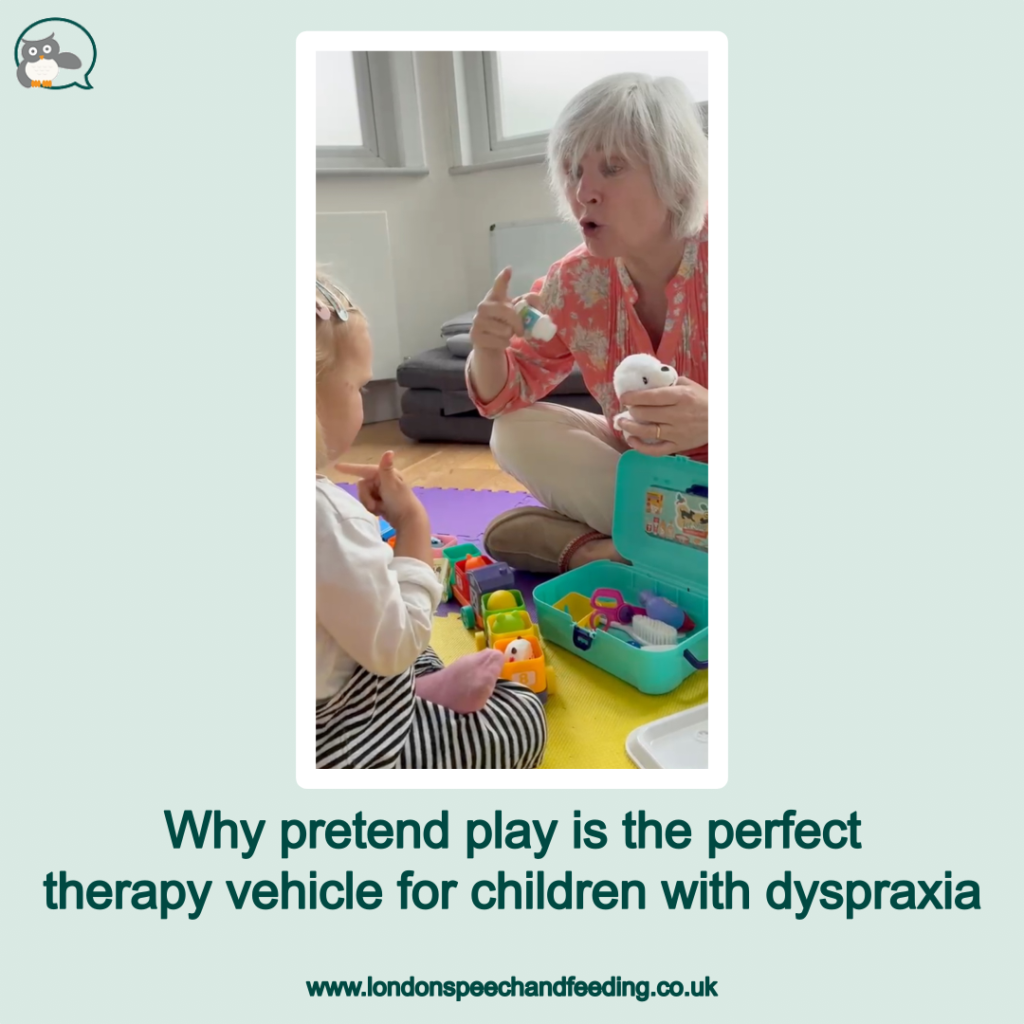
Picture this. A small dinosaur is stomping across a wooden floor. A tiny teacup is being filled with imaginary juice. Someone, probably you, has just been told very firmly that you are the baby and you must go to sleep now.
To the outside world, this is just play. Joyful, chaotic, completely ordinary toddler play.
But for a child with Childhood Apraxia of Speech (CAS), also known as verbal dyspraxia, what is happening inside a well-designed pretend play session is anything but ordinary. It is, in fact, some of the most powerful motor speech therapy we have.
Let me explain why.
First, a quick reminder: what is dyspraxia?
Childhood Apraxia of Speech is a motor speech disorder. The difficulty does not lie in the muscles of the mouth, those are perfectly capable. The difficulty lies in the brain’s ability to plan and sequence the precise movements needed to produce speech sounds consistently and accurately.
A child with CAS knows what they want to say. The message is there. But somewhere between the intention and the execution, the plan breaks down. Words come out differently each time, or not at all. It is effortful, unpredictable, and for many children, deeply frustrating.
What this means for therapy is important: CAS requires motor learning, not just language stimulation. And motor learning has very specific conditions under which it thrives.
Repetition is the medicine and pretend play delivers it without the child noticing
One of the most well-established principles of motor learning is that new movement patterns need to be practised many, many times before they become reliable. Think of learning to ride a bike, or to touch-type. Repetition is how the motor system builds consistency.
For speech, this means a child needs many opportunities to attempt a target word or phrase within a single session. In a formal drilling exercise, this quickly becomes tedious and dysregulating, especially for young children. After five attempts at ‘go’, most three-year-olds have mentally left the building.
But inside a pretend play scenario? The word ‘go’ appears naturally and meaningfully dozens of times. The car goes. The train goes. Ready, steady, go. Go to sleep. Go there doggie. Every repetition is embedded in a moment that makes sense to the child, which means they are motivated to keep going, and the practice is accumulating without any sense of effort or demand.
A relaxed brain learns better
There is a reason I tend not to sit a dyspraxic child at a table with flashcards and ask them to repeat after me. It is not because I lack structure. Every session I run has clear targets and intentional design. It is because we know that anxiety and pressure actively interfere with motor learning.
When a child feels observed, corrected, or under pressure to perform, the cognitive load increases and the very motor planning system we are trying to support becomes less accessible. The errors increase. The frustration escalates. The session unravels.
Pretend play, by contrast, creates a state of engaged, relaxed absorption. The child is leading. They are safe. They are having fun. In this state, the brain is far more receptive to new motor patterns being laid down. I am not asking the child to perform speech. I am simply being present, following their lead, and slipping in carefully chosen models at exactly the right moments.
Child-led play gives us the child’s own words to target
Another reason pretend play works so beautifully for children with dyspraxia is that it tells us exactly which words matter most to this particular child, right now, today. When a child reaches for the toy telephone and hands it to me with enormous expectation, I know that ‘hello’ is a word worth targeting in this moment. When they are clearly trying to tell me that the baby needs feeding, ‘more’ and ‘eat’ have instant, genuine relevance.
Targeting words a child is already motivated to say means the communication attempt is coming from them. And a self-initiated attempt, even an approximation, is neurologically far more valuable than a prompted imitation.
What this looks like in practice
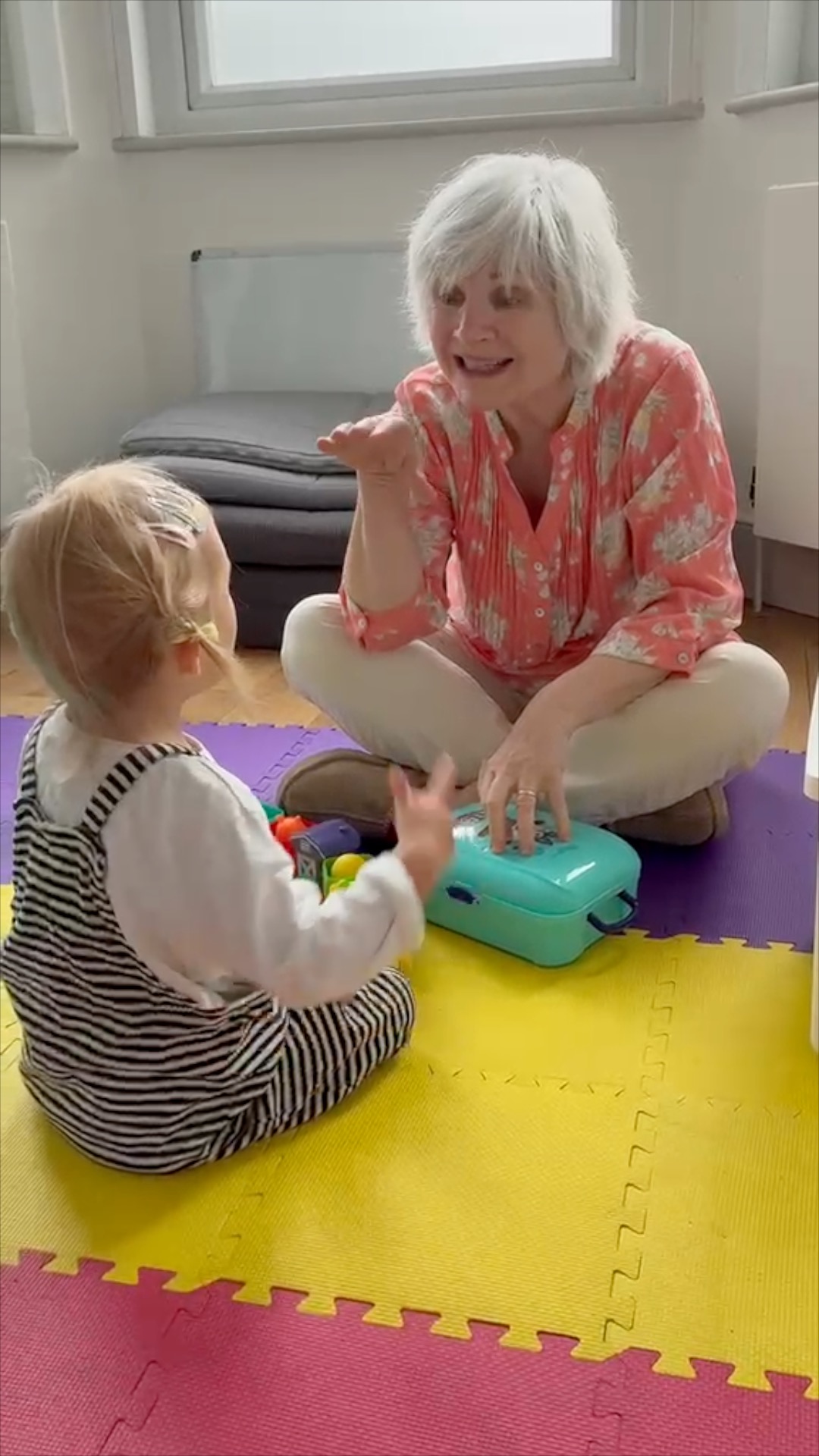
In the short video clip below you can see this dynamic in action. Notice how the session looks relaxed and playful on the surface. The child is absorbed in the pretend play scenario we have created together.
Notice, though, what is happening underneath:
the consistent, gentle modelling of target words
the use of Makaton signs alongside speech to provide an additional sensory pathway
the visual mouth cues that give the child a roadmap for how a sound is shaped
and running through all of it, the repetition. The same words, again and again, wrapped in play.
This is not therapy disguised as play. It is therapy that is play, because for a child with dyspraxia, those two things are not in opposition. They are, in fact, perfectly aligned.
If you are concerned about your child’s speech and wondering whether verbal dyspraxia might be a factor, please do not hesitate to get in touch. I would love to help you find some answers.
Sonja McGeachie
Highly Specialist Speech and Language Therapist
Owner of The London Speech and Feeding Practice.
Find a speech and language therapist for your child in London. Are you concerned about your child’s speech, feeding or communication skills and don’t know where to turn? Please contact me and we can discuss how I can help you or visit my services page.
When you have a child who uses Gestalts it is often difficult to think and adapt clinic activities into those to use at home. More importantly, you find that individualising your activities for your child who uses Gestalt are time-consuming. But you value its importance for their communication development.
You feel so busy, you are taking them to other appointments, or trying to get through your daily activities, all whilst still ensuring your child’s emotional needs are met. You know life should not get in the way of your child’s therapy activities at home, but it does. We know your spare time is precious and limited, so let us achieve your child’s or young person’s goals in the allotted time you have which meets their way of learning (using Gestalts).
We wanted to support you by exploring items which you may have at home, and we will give you some key phrases which you can start to model with your child. Whereas our last blog introduced the idea of gestalt language processors, we are now developing ideas to give you the tools to implement activities at home. We recognise how overwhelming it may feel, and this is one of the reasons to make activities as straight forward as possible. Therapy does not need to be complicated; it just needs to be carried out on a regular basis.
Explore the samples I’ve created to give you an idea of how this might look but please consult with a Speech and Language Therapist who knows about Gestalt Language Processing so that you can work together to develop great home activities for your child.
Want to learn more about gestalt language processing?
Find a speech and language therapist for your child in London. Are you concerned about your child’s speech, feeding or communication skills and don’t know where to turn? Please contact me and we can discuss how I can help you or visit my services page.
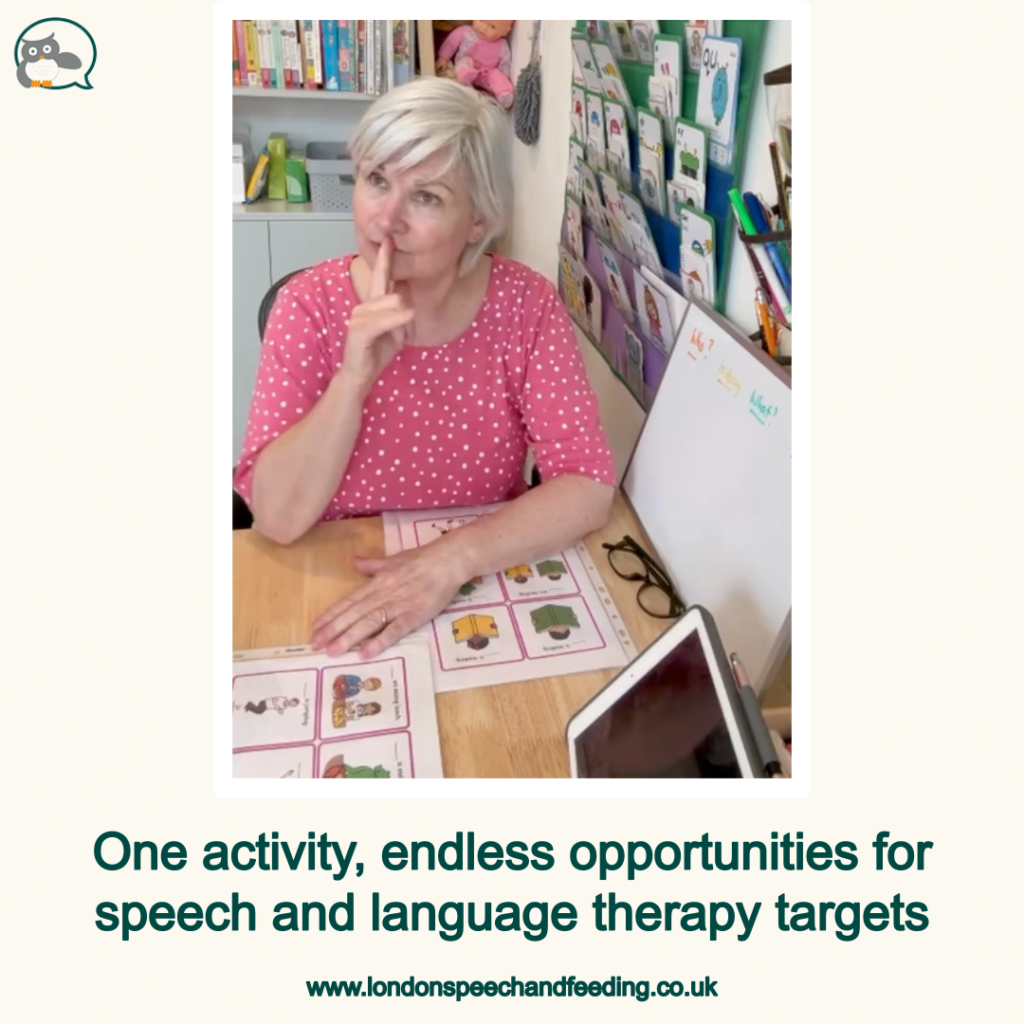
Communication does not happen in neat little boxes. In Speech and Language Therapy we often use one great activity to target multiple areas of speech and or language development all at once.
Children are trying to:
understand language
build sentences
organise their thoughts
pronounce sounds
remember words
use grammar
follow social interaction
communicate meaning…
all at the same time.
This short therapy clip is a little example of that.
Within one playful interaction, we naturally work on:
grammar
sentence expansion
pronouns
speech sound errors
modelling
visual cueing
turn-taking
confidence in communication
And, importantly, the child remains engaged, relaxed, and successful throughout.
Using language activities to refine speech sound targets
We all learn language through:
shared attention
play
repetition
connection
modelling
responsive interaction
As a Speech and Language Therapist I am constantly thinking and considering how to bring in all the targets a child is working on. The reason for that is that often we do not have a full therapy hour to work leisurely and calmly on various targets! Many children have short attention focus and ‘go off the boil’ quickly and often suddenly. Therefore, I always feel a sense of ‘make hay whilst the sun shines’ and pack it all in whilst the going is good. So then we can afford five minutes of trampolining in between activities to help the child regulate themselves without losing valuable speech therapy opportunities or time.
How can I expand this sentence?
How can I model better grammar?
Can I gently shape the pronunciation here?
Should I recast that phrase?
Is this the right moment to pause and encourage a longer utterance?
How can I keep communication flowing while still targeting goals?
These decisions happen continuously during therapy.
Building longer sentences naturally
In this clip, one of the key areas we are targeting is sentence expansion through Colourful Semantics, which is a particularly useful and researched approach, developed by UK Speech and Language Therapist Alison Bryan in 1997 to support children with speech and language difficulties.
Colourful Semantics is a visual, colour-coded therapy approach that helps children break down, understand, and construct sentences by assigning specific colours to thematic roles (e.g., Who, What Doing, What).
Many children with language delay use reduced language for example: they might say:
‘dog’ instead of ‘the dog is running fast’
‘eatin a dinner’ instead of we are eating our dinner
‘baby shhh’ instead of ‘the baby is sleeping’.
Using the Colourful Semantics Framework helps create a solid baseline from which to work and with which to construct basic good sentences using WHO is DOING WHAT and WHERE.
We are building language upward gently and positively.
This technique is incredibly powerful because children learn language through hearing it used meaningfully over and over again.
Supporting pronouns through real conversation
Pronouns can be surprisingly difficult for many children.
Words such as:
he
she
him
her
they
require children to understand perspective, grammar, and sentence structure all at once. Using pictures and basing the activity on the Colourful Semantics Model I can shape pronouns repeatedly as part of the overall activity.
Books, pictures, and play scenes are fantastic for this because they create endless opportunities for meaningful repetition.
Again, this may look simple from the outside.
But underneath it is highly intentional clinical work.
Listening for speech sound errors at the same time
While supporting grammar and language, I am also constantly listening to the child’s speech production.
In this short interaction, I respond to speech sound errors as they arise.
Sometimes I:
model the correct production
emphasise a sound slightly
use visual cues
slow the word down
add gesture or sign support
encourage another attempt.
And sometimes I intentionally let the error go in order to protect confidence and maintain communication flow.
That balance is incredibly important.
Children need support. But they also need to feel successful communicating.
The child simply experiences this as warm, responsive interaction.
But underneath it is detailed clinical reasoning.
This is why effective therapy is never about simply owning resources or downloading activities online.
The real skill lies in:
how the therapist uses the activity
how they adapt moment by moment
how they analyse communication in real time
how they shape interaction to maximise learning opportunities.
One activity. Endless opportunities.
A single book, picture scene, or playful interaction can provide opportunities to support:
speech sounds
language development
grammar
vocabulary
attention
confidence
social communication
emotional connection.
The magic is not in the activity itself.
The magic is in how a therapist uses it.
Because excellent speech therapy is never ‘just playing’.
It is careful, responsive, evidence-based intervention woven seamlessly into joyful interaction.
Bryan A (1997) Colourful semantics. In: Chiat S, Law J, and Marshall J (eds) Language disorders in children and adults: psycholinguistic approaches to therapy. London: Whurr, 143–61.
Find a speech and language therapist for your child in London. Are you concerned about your child’s speech, feeding or communication skills and don’t know where to turn? Please contact me and we can discuss how I can help you or visit my services page.
If your child’s speech is difficult to understand, it can feel tempting to focus straight away on individual sounds: those tricky /S/, /K/, or /SH/ sounds that just won’t come out clearly.
But in therapy, we don’t always start there.
When a child is very difficult to understand, and I have ruled out that the underlying cause is motor-based, I often opt for the Cycles Phonological Approach. This is helpful for those kids where we can feel like we don’t know where to start! The Cycles Approach helps to generate a broad overall increase in speech clarity by sequentially targeting a variety of speech patterns over the course of 8–10 weeks.
So rather than working on one sound until it’s ‘fixed,’ we:
Work on patterns (not just individual sounds)
Target each pattern for a short period of time
Then cycle to the next one
And come back around again later
This mirrors how speech development naturally happens: gradually, with increasing accuracy over time.
Why don’t we start by fixing erroneous sounds straight away?
To use a metaphor, if a child doesn’t have a strong syllable structure, working on individual sounds is like decorating a house that doesn’t have solid walls yet.
Many children with speech sound difficulties:
Drop syllables (e.g. ‘banana’ → ‘nana’)
Simplify longer words
Struggle to maintain rhythm and stress patterns
So, before we refine speech sounds, we need to build the framework of speech.
Why syllables come first in every cycle
In the Cycles Approach, we always begin with 2- and 3-syllable words, even if that’s not the main concern.
Why?
Because syllable awareness supports:
Speech clarity (intelligibility)
Word structure and sequencing
Prosody (rhythm and stress)
Motor planning for longer words
Without this, even perfectly produced sounds can still be hard to understand in real speech.
What do ‘2 and 3 beats’ mean?
When we talk about ‘beats’ we mean syllables you can clap.
Try it:
‘Table’ → ta-ble (2 beats 👏👏)
‘Banana’ → ba-na-na (3 beats 👏👏👏)
In therapy, we help children:
Hear the beats
Feel the rhythm
Produce the full word (without dropping parts)
What this looks like in therapy
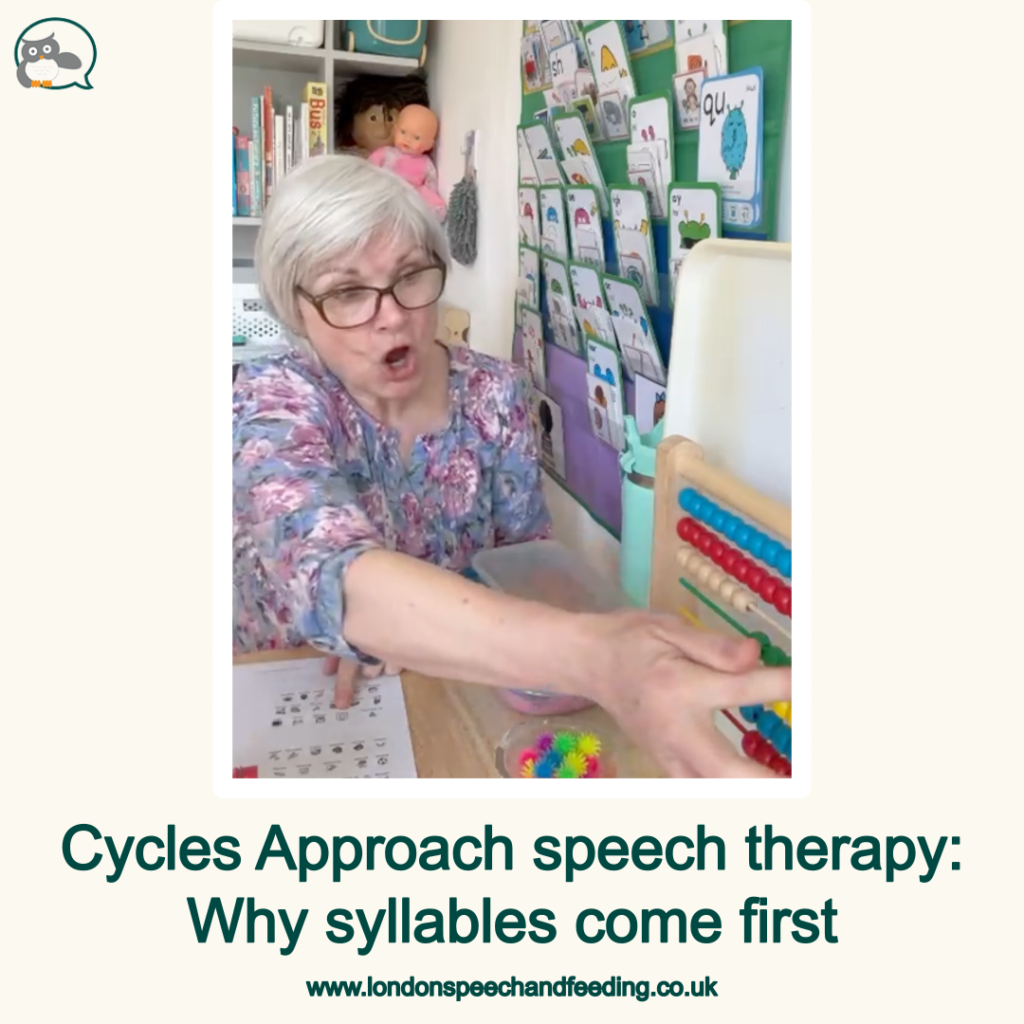
In my sessions, this part of the cycle is active, visual, and repetitive.
You might see me using:
👏 Clapping or tapping out syllables
🧩 Using visual supports or blocks for each beat
🎲 Play-based repetition of target words
🎯 High-frequency practice (lots of turns!)
I also keep the focus on success and flow, rather than correction.
If you’re watching the video clip I’ve shared here, you’ll notice:
I’m not over-correcting every sound
I’m prioritising getting the whole word out
I’m building rhythm, confidence, and consistency
Why this stage is so powerful
It can look simple, but it’s doing a lot of heavy lifting.
Working on syllables helps children:
Say longer words more clearly
Reduce ‘mumbling’ or collapsing of words
Improve overall intelligibility quickly
Prepare for more precise sound work later
Often, parents notice early wins like:
✨ ‘They’re easier to understand already’
✨ ‘They’re saying longer words!’
✨ ‘They’re more confident speaking’
And that’s before we’ve even fully targeted specific sounds.
But will my child still learn their sounds?
Yes. Absolutely.
The Cycles Approach is structured so that after syllables, we move into:
Early developing sounds
Then more complex patterns (like fronting or clusters)
And importantly, we come back around again.
Nothing is missed. It’s just sequenced in a way that supports success.
A different way of thinking about progress
One of the biggest mindset shifts with the Cycles Approach is this:
👉 We’re not aiming for perfection straight away
👉 We’re aiming for gradual system-wide change
That means:
Your child doesn’t need to ‘master’ something before moving on
Progress builds across cycles
Speech becomes clearer over time, not overnight
So, to sum up
Starting with syllables might seem unexpected but it’s one of the most powerful foundations we can give a child whose speech is hard to understand.
By building rhythm, structure, and confidence first, we make everything that comes next more effective.
If your child is starting speech therapy and you notice we’re clapping words like ‘banana’ or ‘elephant’, there’s a very good reason for it.
We’re not going backwards.
We’re building from the ground up.
We’re making later sound work more effective and more likely to generalise into everyday talking.
Next steps:
If you’re concerned about your child’s speech clarity or wondering whether they might benefit from a structured approach like this, feel free to get in touch. I offer individualised assessments and therapy plans tailored to each child’s speech profile whether that’s early sound development, phonology, or motor speech difficulties.
Sonja McGeachie
Highly Specialist Speech and Language Therapist
Owner of The London Speech and Feeding Practice.
Find a speech and language therapist for your child in London. Are you concerned about your child’s speech, feeding or communication skills and don’t know where to turn? Please contact me and we can discuss how I can help you or visit my services page.
Parent FAQ section
Why is my child practising words like ‘banana’ instead of sounds like /K/ or /S/?
Because your child first needs to be able to hold and produce the full shape of a word. If they’re dropping syllables (e.g. ‘banana’ → ‘nana’), working on individual sounds won’t carry over into real speech. We build the structure first, then refine the sounds.
What if my child can already say some long words?
That’s great. But we’re looking for consistency and clarity across many words, not just a few familiar ones. This stage helps stabilise that skill so it becomes reliable in everyday talking.
How long will we stay on syllables?
Usually, this is a short but important phase within each cycle. We revisit it regularly, but we also move on to other patterns (like specific sounds or sound processes) within the same therapy block.
Will this delay my child learning their sounds?
No. In fact, it often speeds things up overall. Once the syllable structure is in place, children are much more able to use correct sounds in longer words and sentences.
What can I do at home?
Keep it simple and playful:
Clap out words together (e.g. ‘el-e-phant’)
Emphasise full words naturally in conversation
Repeat back what your child says with the full structure (without pressure)
Consistency and exposure matter more than correction.
My child gets frustrated. Will this help?
Yes. Many children become frustrated when they’re not understood. Improving syllable structure often leads to quick wins in clarity, which can boost confidence and reduce that frustration.
Building clearer speech: Why we practise syllables first
What are syllables?
Syllables are the ‘beats’ in words.
‘Table’ = 2 beats (ta-ble)
‘Banana’ = 3 beats (ba-na-na)
Why is my child working on this?
If your child:
Drops parts of words (‘banana’ → ‘nana’)
Mumbles longer words
Is hard to understand
…then we need to build the structure of words first.
This helps your child:
✔ Say longer words clearly
✔ Be easier to understand
✔ Feel more confident speaking
What does this look like in therapy?
We practise:
Clapping or tapping out beats 👏
Saying full words with rhythm
Repeating target words through play
Using visuals or actions to support learning
How you can help at home
Keep it light and playful, little and often!
Try this:
Clap words together أثناء play (e.g. toys, food, animals)
Model full words naturally (‘Yes, ba-na-na!’)
Repeat and expand what your child says
Example:
Child: ‘nana’
You: ‘Yes! Ba-na-na‘
Important to know
This is a key first step in speech therapy
We will move on to sounds—but this helps them stick
Small changes here can make a big difference in clarity
Many parents are surprised when I bring AAC into a session, especially if they’ve come to see me primarily for speech sound work.
They might wonder: ‘If we’re working on pronunciation, why are we using a communication device?’
The simple answer is this: speech therapy is about communication first, and speech sounds second. Supporting a child’s ability to express themselves clearly and confidently is always the priority, and AAC can be a powerful tool alongside spoken speech.
What do we mean by AAC?
AAC stands for Augmentative and Alternative Communication.
This can include:
A speech-generating device (such as LAMP Words for Life or GRID as I used in the photo below)
A communication app on a tablet
A symbol board or communication book
Gestures, signs, or visual supports
AAC does not replace speech. Instead, it supports language development, reduces frustration, and builds communication success while speech skills are developing.
Pretend Play using Speech and AAC in my clinic room
But I mainly work on speech sounds… So how does AAC fit?
Most of the children I see are working on:
Articulation difficulties
Phonological delay
Motor planning challenges (including apraxia/dyspraxia)
Unclear speech affecting confidence
For these children, AAC isn’t a separate therapy. It’s simply woven naturally into what we are already doing.
If a child brings their device to sessions, I actively include it. If they don’t yet use AAC but could benefit from visual or symbolic support, I may introduce simple options within activities.
Using AAC to support speech practice
Let’s say we are working on early speech targets like: ‘GO’.
We might practise:
Saying the word verbally
Listening for the target sound
Using play (TOY TRAIN GOING ROUND A TRACK)
Now we can extend this using AAC.
On the device or communication board, we might model: ‘LET’S GO’ or ‘IT’s GOING up the hill’.
This allows the child to:
Practise their speech sound target
Build a simple sentence
Experience successful communication even if speech is not fully clear yet
All responses are valid and supported.
AAC helps children communicate more than they can say
Many children can understand and think in longer phrases than they can physically say.
For example:
A child who verbally says single words may build longer phrases on AAC.
A child who struggles to plan speech movements may use AAC to communicate smoothly while still practising verbal attempts.
A child who becomes frustrated when misunderstood gains a reliable backup system.
Rather than slowing speech progress, AAC often:
Reduces communication pressure
Increases participation in therapy
Encourages more attempts at speech
Supports language growth
When children feel understood, they usually become more motivated to try speaking.
There are no ‘prerequisites’ for AAC
One of the biggest myths I hear is: ‘My child isn’t ready for AAC yet.’
In reality, children do not need to:
Reach a certain speech level
Use pictures first
Prove they understand everything
Show immediate interest
Instead, we presume competence and introduce AAC in meaningful, playful ways.
That means:
Modelling words while blowing bubbles
Commenting during playdough activities
Choosing words during games
Building simple phrases in shared reading
AAC should never feel like extra ‘work’. It’s simply another way to join in communication.
My goal is always the same: to help each child communicate as clearly, confidently, and successfully as possible, using every helpful tool available.
If your child uses AAC (or might benefit from it)
Please feel free to:
Bring the device to sessions
Show me how your child currently uses it
Share advice from school or other therapists
I am very happy to incorporate AAC into our work together so that speech practice, language development, and real communication all move forward hand-in-hand. Because ultimately, therapy isn’t just about producing perfect sounds. It’s about helping your child be heard and understood.
Find a speech and language therapist for your child in London. Are you concerned about your child’s speech, feeding or communication skills and don’t know where to turn? Please contact me and we can discuss how I can help you or visit my services page.