Communication skills are critical in all areas of communication throughout childhood and into adulthood. They are needed for understanding, narrating, making predictions and to develop social skills, for example in understanding everyday language or talking in the classroom or socialising with peers. Children with communication needs can experience low self-esteem, potential behavioural difficulties, lower school attendance and attainment.
Communication skills have a strong impact on literacy. Let’s look at some of the facts:
50% of children with language delays also have challenges with literacy (Burns et al, 1999).
73% of poor readers in year three had a history of difficulties with phonemic awareness (the ability to hear, identify and manipulate sounds) or spoken language in pre-school (Catts et al, 1999).
The effect of expressive language on spelling and reading
The ability to read is very much dependent on competent language skills. Furthermore, a limited vocabulary will also have an impact on literacy skills. The more we know about a word, the easier it is to retrieve, recall, understand and use. So, if a young person has a poorer vocabulary, it’s likely that they will not have the same decoding skills as a peer with a richer set of vocabulary. By decoding we mean the ability to apply knowledge of letter-sound relationships including pronunciation of words. Decoding is a vital skill used in literacy.
Whilst learning to read is a key skill, it’s important to remember that a solid foundation is needed for success. We need to ensure that no steps are missed, otherwise there will be gaps in knowledge.
As your child moves further through the education system, they will be “reading to learn”. This is where young people with poorer language skills may show literacy difficulties (for example, reading comprehensions become more challenging, and their expressive language skills impact on their written abilities).
When should I seek advice or support?
Always seek the advice from a qualified professional such as a Speech and Language Therapist. You need appropriate advice for the age and stage of your child’s development and early intervention is of course key to success. It is never too late to ask for advice. The earlier you seek support, the better the outcome for your child in all areas (language, literacy, and emotional well-being).
Have you still got unanswered questions? Contact me here and we can have a look at your child’s phonemic awareness, auditory processing skills, verbal understanding and assess his/her ability and likelihood of reading and literacy struggles. If we find that your child has dyslexia I can refer on to a specialist colleague who can help you further.
Find a speech and language therapist for your child in London. Are you concerned about your child’s speech, feeding or communication skills and don’t know where to turn? Please contact me and we can discuss how I can help you or visit my services page.
There are various great ways to treat speech sound disorders and I use all the approaches available selectively; I decide what works with each individual child and I also vary the approach depending on the child’s frame of mind at any given time during my session.
Some of the approaches are more “drill-based” and require a child to be able to pay attention and really participate actively in the therapy, and this is what I am showing you today with this video clip.
My little student here has been working with me for some time and from only saying a handful of words which were not very easy to understand he has come a long way. He does have some features of Verbal Dyspraxia which I shall briefly outline here:
Making sounds in general is a struggle, especially when asked to copy certain sounds, example: ‘can you say: a ee ou oo?”
Repeating sound sequences or words sequences is hard, for example: “say p-t-k in sequence” or “say fish chips fish chips fish chips
When saying the same word again and again, different mistakes can be heard
Intonation difficulties: speech sounds monotonous
Vocabulary is very limited
Some therapy approaches are more play based, for example the Core Word method: here we pick a few words at a time which are very significant to the child and therefore highly motivating to try and say. These could be characters of Pokemon or Minecraft for example, or simple words like “GO!”
When you watch the video you will see that I use a lot of visual prompting, such as showing him where the tongue is moving to or from. I do this with my index finger and this approach is called Tactile Cueing or “Cued Articulation”. Part of the approach is to give a visual prompt and then reduce the prompt as the learner is more able to produce the correct sounds. Once he can produce the sound on its own, we quickly move to the sound within a word.
I do mix and match my approaches and in fact here I am drilling but I also use the Core Word which for him (YELLOW) — it’s his favourite colour and I happen to have quite a few good games where a YELLOW something or other can be asked for….. WHO KNEW!? 🙂
Find a speech and language therapist for your child in London. Are you concerned about your child’s speech, feeding or communication skills and don’t know where to turn? Please contact me and we can discuss how I can help you or visit my services page.
A Day In The Life Of An Independent Speech And Language Therapist
I often get asked how many clients/children I see per working day or what my working day/life looks like. I always reply that every day is different, which is true, but there is a sort of average working day which looks a bit like this:
I usually start preparing for my first client of the day at around 9.30 am: I clean the room, wipe down all the toys and materials (that’s if they are coming to my clinic room) and then it takes me about 30 minutes to select and sometimes make suitable materials, games and activities for the child’s therapy programme. Client arrives at 10.30 am and the fun begins. They leave around 11.30am, and the cleaning and wiping down starts again – yes it’s the pandemic but to be fair I would do this anyway. I quickly write up my notes and send home work to the client via email. Now it’s 12 noon and I start preparing for the next client at 12.30 pm. This might be online parent-child interaction coaching and so I need different materials and activities that are suitable for teletherapy. We finish around 1.30 pm and I will write up my notes before having some lunch.
Lunch tends to not be around 30 minutes. Around 2.00 pm I start prepping again for the next client: selecting activities, going over their last session, making sure I have everything I need to start at 2.45pm – we finish at 3.45pm, I write up my notes and then have a cuppa. The next client might be more on-line coaching or a child coming to see me: room cleaned and tidy, materials and activities prepared: client arrives at 4.30 pm and we finish at 5.30 pm. I clean the toys again, write up my notes and it is 6.00 pm ready for dinner. So that was four clients between 9 am and 6pm allowing for preparation, aftercare, cleaning and coffee and lunch.
Other days I might see three clients and do more admin like ordering toys or books or teletherapy activities, or making materials (we therapist make tons of materials, we’d put Blue Peter to shame!) Sometimes I do two home visits, one in the morning and one in the afternoon – the travelling/parking in London is so time consuming that it really reduces the number of clients I can see which is why I don’t do many of those.
I hand pick my clients to make sure that we are a good fit, and my service is bespoke: no one client gets the same treatment as another; each client is unique, usually very well-known and always highly valued. That takes time and means that in reality each client gets about 2 hours of my time, that is the actual session plus all the preparation and aftercare.
I love this way of working and would not ever want to return to seeing tons of clients each day, not knowing any of them really well, due to high caseload numbers, staff shortages and an overload of administration.
My way of working affords all my lovely clients the help they need to be able to feel empowered and to then support their children to make progress; when working with children they make the best progress they can make, fulfilling their potential. My lovely reviews and testimonials tell me that my clients appreciate the extra attention.
Find a speech and language therapist for your child in London. Are you concerned about your child’s speech, feeding or communication skills and don’t know where to turn? Please contact me and we can discuss how I can help you or visit my services page.
When your baby reaches around 12 months, there is a lot going on developmentally. They are learning to walk, communicate, feed themselves and become increasingly independent. One small but important milestone that can sometimes get overlooked is learning to drink from an open cup.
Many toddlers continue to have milk from a bottle well beyond their first birthday, and parents are often understandably reluctant to take it away. The bottle may be familiar, comforting and convenient, particularly at bedtime.
But moving towards an open cup is not simply about changing the way your child drinks. It is part of their development of oral-motor skills, feeding independence and mealtime development.
And there is another piece of the puzzle that is often overlooked: how your toddler is sitting while they eat and drink.
The way the body is supported can make a real difference to what the mouth is able to do.
Babies can begin learning to drink from an open cup much earlier than many parents realise. By around 12 months, most children should be given regular opportunities to practise drinking from an open cup alongside other suitable drinking vessels.
An open cup encourages your toddler to learn a different pattern of drinking from the sucking pattern they have used with a bottle.
With an open cup, your child needs to:
lean towards the cup and control its position
grade how much liquid enters the mouth
use their lips to help control the liquid
coordinate breathing and swallowing
develop increasingly mature tongue and jaw movements
learn to take a drink without relying on a teat or nipple.
These are useful skills for developing efficient eating and drinking.
This doesn’t mean that a toddler who still has a bottle at 14 or 18 months has somehow ‘missed their chance’. Children develop at different rates, and there is always an opportunity to work towards new skills.
However, if a bottle remains the main or only way a child drinks for a long time, there can be fewer opportunities to practise these more mature drinking skills.
The occasional bottle is not the issue. The concern is when a toddler continues to rely heavily on a bottle and therefore has little reason or opportunity to develop other drinking skills.
A bottle encourages a sucking pattern which is appropriate for infancy. As children mature, we want to see increasing use of their lips, tongue, jaw and facial muscles in more sophisticated ways.
Long-term bottle use can also make the transition to an open cup more difficult simply because the child has become very accustomed to the bottle.
There can also be practical considerations around dental health, particularly when milk is offered frequently throughout the day or overnight.
For many toddlers, the bottle has also become associated with comfort, sleep or emotional regulation. This can make giving it up feel like a very big change for the whole family.
So rather than thinking, ‘The bottle has to disappear tomorrow’, think:
‘How can I gradually increase opportunities for open-cup drinking?’
Offer the open cup regularly at meals. Let your toddler experiment. Expect spills. Keep the amount of liquid small initially and provide plenty of encouragement.
Learning to drink is a skill. And skills need practice.
When we think about feeding, we naturally tend to focus on the mouth. We watch what the tongue is doing, whether a child chews, whether they cough or gag and what foods they accept.
But feeding is a whole-body activity.
Your child needs a stable body position before they can use their mouth efficiently.
Think about trying to drink from a cup while sitting on a wobbly stool with your feet dangling in the air. You would probably find it much easier if your body was well supported.
The same principle applies to toddlers.
A well-designed highchair such as a Tripp Trapp chair can provide a stable base when it is correctly adjusted for the individual child. Ideally, your toddler should have:
hips well supported
knees comfortably bent
feet resting firmly on a footplate
a stable pelvis and trunk
the table or tray at an appropriate height
This gives your child a solid foundation from which to move.
And that matters because stability in the body supports movement and control in the mouth.
I sometimes hear parents say, ‘He doesn’t need the footrest don’t worry about it (as I crouch down with my Allenn key to adjust the Tripp Trapp chair) but I always explain it is very important to have his feet supported. Dangling legs can make it much harder to maintain a stable sitting position.
When the feet are supported, your toddler can push gently through their feet and stabilise their pelvis and trunk. This can help them maintain a more organised position while eating and drinking.
They can then devote more attention to the job in front of them:
looking, reaching, grasping, chewing, swallowing and drinking.
This is particularly important for toddlers who are developing their chewing skills or who find mealtimes physically demanding.
Eating involves an extraordinary amount of coordination.
Your toddler is managing food in their hands, bringing it to their mouth, biting, chewing, moving food around with their tongue, forming a bolus and swallowing, often while simultaneously looking around, communicating and interacting with you.
Drinking from an open cup adds another layer of coordination.
Good postural support doesn’t teach a child to drink from a cup, but it can give them a much better physical foundation from which to practise the skill.
This is why, when I assess a toddler’s feeding, I don’t just look inside the mouth.
I also look at how the child is positioned.
Making open-cup drinking part of everyday life
You don’t need a complicated programme.
At meals, offer a small amount of water in an open cup. You can help your toddler hold the cup initially, tipping it gently towards their lips and allowing them to control the drinking as much as possible.
Some mess is completely normal!
You might also use a small, lightweight open cup that is easy for little hands to manage.
And remember that the goal is not to make every drink perfect. The goal is to give your child regular, positive opportunities to practise.
If your toddler is struggling with drinking, frequently coughing or choking, refusing cups, relying heavily on a bottle, or experiencing difficulties with chewing and eating, it is worth seeking professional advice from a Speech and Language Therapist with expertise in paediatric feeding.
The bigger picture
Open-cup drinking and good sitting are not two unrelated developmental skills.
They are part of the same picture.
A stable body provides a foundation for skilled movement. Skilled movement supports feeding. And feeding skills develop through practice and opportunity.
So as your toddler approaches and moves beyond their first birthday, think beyond simply asking, ‘How much milk are they drinking?’
Think about how they are drinking, how they are sitting, and what opportunities they have to develop the skills they will need as they grow.
And if you have a little one sitting beautifully at the table in a well-supported Tripp Trapp chair, remember: you’re not just creating a comfortable seat.
You’re creating a stable foundation for eating, drinking, learning and growing.
Do get in touch with me. I would love to hear from you and help your little one develop good sitting and drinking habits.
Sonja McGeachie
Highly Specialist Speech and Language Therapist
Owner of The London Speech and Feeding Practice.
Find a speech and language therapist for your child in London. Are you concerned about your child’s speech, feeding or communication skills and don’t know where to turn? Please contact me and we can discuss how I can help you or visit my services page.
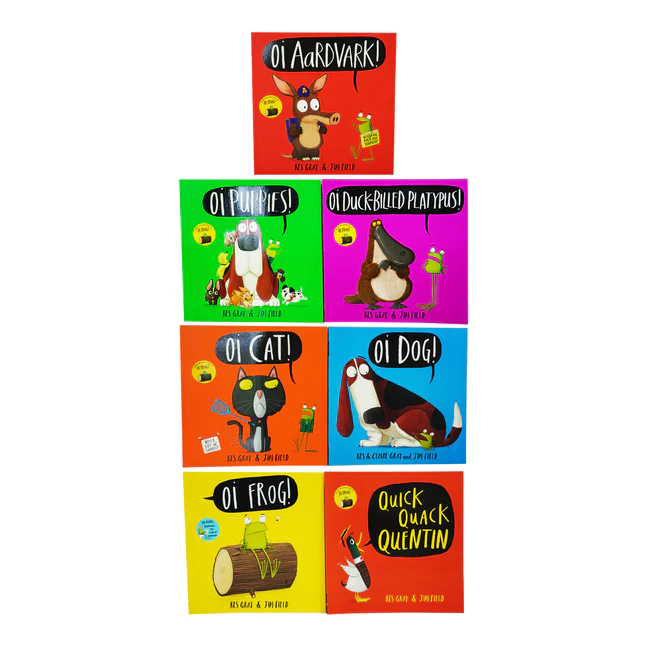
Book corner with Oi Frog! by Kes Gray and Jim Field.
Books are an engaging way to support your child’s communication development. Even if your little one dislikes reading in the traditional sense. They will become immersed in this adventure, without realising they are taking in language and developing vital communication skills. This is one of my favourite series for children.
Increase fun and interaction
These books are made for fun and excitement! It may seem silly putting on different voices for different characters, but this is one way in which you can engage your child. Why not try to use different intonation patterns (e.g., you may use a deep voice for the dog, and a higher pitch for the cat)? Make your story interactive: you could ‘rawww’ like a lion and see who can make the loudest noise. Make noises to encourage interaction (e.g., when scratching his chin, make a squeaky sound!). You could also relate the experience back to your child (e.g., ‘can you scratch your chin?’).
Time to talk
Talk about what you can see on the front cover (e.g., There’s a frog on a log, how funny!) You could also ask your child to choose the rhyming words on a page in the book. Can your child tell you what rhymes with certain words (e.g., can you guess what a parrot sits on?)? Make use of every page. You could comment on your favourite frog and see if your child can talk about their favourite. You can support them by giving them an example (“my favourite frog is the one swimming backwards because he looks funny”). Then you could use this scaffold to support their answer. Your favourite is [________________] because [_________________]
If your child is reluctant to use language, the use of commenting can take the pressure of them (“look at all those frogs” or “he’s climbing up the stool”) is a powerful way in which you (as parents) can take the pressure off your child. A top tip I like to give is to make sure you pause regularly, which creates opportunities for your child to use language.
This book uses a subject-verb-object sentence structure (e.g., ‘hares sit on chairs’) which allows your child to hear a good model of a sentence. You could also talk about things in the book that belong in a certain category (e.g., animals, food) or begin with a specific sound. See if your child will name any more.
Reap the reward of repetitive language
Oi Frog uses repetitive rhyming language and puts emphasis on these words. This is important because the more your child hears a word, the more likely they are to remember, understand and use it in the correct context.
Emotions matter
Talk about how the animals feel and why they may feel this emotion (e.g., the cat’s feeling annoyed because…, Lions sit on irons, how does the lion feel?). Reasons can be difficult for children with communication difficulties. Support them by giving an example or by giving them an option (e.g., “does the lion feel happy or sad? I think the lion feels sad because he’s burnt his bottom on the iron! It’s too hot!”)
Find a speech and language therapist for your child in London. Are you concerned about your child’s speech, feeding or communication skills and don’t know where to turn? Please contact me and we can discuss how I can help you or visit my services page.
Chaining is a therapeutic technique I like to use in my speech therapy work with children who have Childhood Apraxia of Speech (CAS) or phonological speech sound difficulties. It helps to break down a complex target behaviour into smaller, more manageable steps. By systematically teaching and reinforcing each step, I can help my students achieve their communication goals.
There are two types of chaining: Forward and backward chaining
Today I am going to show and talk about backward chaining. This technique involves starting with the last step and working backward to the first. This approach can be particularly effective for children with persistent speech sound difficulties where combining consonants into clusters, such as /BL/ or /FR/ or /SHR/ is very difficult.
Backward chaining allows my student to experience immediate success and build his confidence.
In my video I show you how I applied backward chaining to the words ‘Shriek’, ‘Shrub’, ‘Shrimp’ etc
My student struggles with both the /SH/ and the /R/ sounds and we have been working on both sounds for some weeks now. He has mild Childhood Apraxia of Speech and he has difficulties with coordinating his tongue movements, breathing and using his jaw effectively to make words. His sound repertoire has grown a lot since we started working together last year. Today in this session I show you how we pulled both the sound /SH/ together with /REEK/ to make ‘SHRIEK’. I love using the pictures and therapy materials from Adventures in Speech Pathology.
This is also part of the Complexity approach which I will explain in a separate blog post.
Step 1 (not shown in the video): I explain what the word means; I find that when my student understands what a word means he is much better at saying it. It increases his confidence and motivation to say a word that he knows the meaning of. Often this student does not tell me that he does not know what a word means, so I always remind myself to check that out first.
Step 2 (not shown in the video): We do a little rhyming game and think about what any one word rhymes with: ‘Shriek’ – ‘meek’, ‘weak’, ‘seek’.
Step 3: I show my student that there are two parts to this word /reek/ and the sound /SH/.
Step 3: We practise the easier part: /reek/ /reek/ /reek/.
Step 4: We add the /SH/ sound and pull it together to make our target word ‘Shriek’.
By breaking down the word into smaller, manageable steps, my student can focus on each syllable individually, get that right and then gradually build up to the full word. This approach can help to reduce frustration and increase motivation.
Forward chaining
Forward chaining is the same process but in reverse: we start with the front sound or syllable and work forward towards the next/last part of the word:
Increased motivation: By starting with the last step, my student experiences success, which boosts his motivation to continue trying to say the word and trying other words.
Reduced frustration: Breaking down the target behaviour into smaller steps can make the task less overwhelming, reducing frustration and anxiety.
Improved confidence: As the little learner masters each of the step, his confidence and self-esteem increases. Again, this leads to increased motivation.
Faster learning: By focusing on the final step first, and practising lots of chaining (forward and backward), a student can quickly learn to generalise to other words.
Backward chaining (and forward chaining) is a really great tool for teaching complex speech sounds and words to children with phonological disorders.
Watch out for my next blog which is all about the complexity approach in Phonology.
Do get in touch if your child has a speech sound disorder, I would love to help.
Any questions or need help with supporting your little one’s language please contact me via my contact form, or you could also check out www.hanen.org for advice and lots of inspiration.
Sonja McGeachie
Early Intervention Speech and Language Therapist
Feeding and Dysphagia (Swallowing) Specialist The London Speech and Feeding Practice
The London Speech and Feeding Practice
Find a speech and language therapist for your child in London. Are you concerned about your child’s speech, feeding or communication skills and don’t know where to turn? Please contact me and we can discuss how I can help you or visit my services page.
This is a surprisingly common speech error and it can be corrected really well in my experience. I have helped lots of children of all ages learn how to control their tongue movements and produce clear, sharp /S/ sounds and good /SH/ sounds.
Initial consideration
There are some factors which need to be considered before we can dive into therapy proper and these are they, in a nutshell:
The student is not currently displaying negative oral habits such as thumb sucking or excessive sucking on clothing. This is because thumb sucking exerts pressure on the teeth and therefore can, over time, push teeth out of their natural order/position.
The student does not have a restricted lingual frenulum or tongue tie which can cause at times restricted movements of the tongue (pending on how tight the frenulum is attaching the tongue to the base of the oral cavity); equally a labial frenulum or lip-tie can restrict lip movement and therefore physically restrict good speech sound production.
The student does not have enlarged tonsils as they can sometimes push a tongue forward and also cause open mouth posture and open mouth breathing.
The student’s motivation to change their speech pattern is high. (this is an important factor though with younger students I can get round this with a lot of fun games and good parental involvement!)
When I do an Oral Assessment of my student these are the first factors I want to look at and consider. Often I will refer to other agencies such as Orthodontists, dentists or ENT specialists to advise and help with some of these factors before we can get going. However, there are strategies that we can work on almost straight away.
Most of my Lisp students present with an open mouth posture: that is where the student has their mouth always slightly open for breathing. Over time the tongue starts to fall forward and rests on the front teeth or the bottom lip instead of finding a comfortable resting place either at the alveolar ridge (the bumpy spot behind the upper front teeth) or, alternatively, resting at the bottom of the mouth behind the lower front teeth.
Another common problem is that the tongue is not moving independently from the jaw and so is reluctant to pull back or lift up inside the mouth as the tongue is guided in movement by the jaw.
Combine those two factors and your tongue is not pulling back, or lifting up or doing very much at all without the jaw moving as well. This makes for unclear speech sounds, especially all the sounds we make at the front with our tongue or with our lips: /B/ /P/ /L/ /N/ and of course /S/ and /SH/ are particularly hard to make. We often also struggle with the /Y/ sound so ‘LELLOW’ instead of ‘yellow’.
Do not fear!
But no fear, these problems can be treated over time for sure! We often start with lip, tongue, and jaw exercises that help to move the tongue independently from the Jaw, our student learns that the tongue is a muscle and can be trained to do amazing acrobatic things in the mouth! WOW! It can actually pull back, lift up, and come down again all on its own!
We work on breathing, holding our breath for a bit then pushing it out and then holding it again.
And when it comes to the actual /S/ sound I often try and go a NEW route bypassing the Snake-Sound route if that is what had previously been tried and failed so that we can create completely new sound patterns in our brain and think about our sounds in a completely new way.
We then work on producing the sound /S/ on its own for a bit, at the end of words, then on either side of complimentary sounds, for instance : ‘EASY” – the sound patterns here are EEE-S–EE : the /EEE/ sound is complimentary to the /S/ sound as the tongue is at the right hight for the /S/ already once you have it in place for /EEE/ -……see?! EASY!
And gradually we work towards saying the /S/ sound clearly at the front of short words, then phrases and then sentences.
The process takes some time and it depends on how ready the student is. This varies of course hugely so I can never promise the exact number of sessions we will take to get that Lisp fixed. A lot depends on home practice in between sessions, and this is of course crucial to all therapy! Every day 15-20 mins practice is a good average time to aim for and when this is done it shortens the therapy block drastically.
I always give plenty of home work so there is never a chance of it getting boring or there being “nothing to do”!
Do contact me. I really enjoy working with this type of student and get a great kick out of FIXING THAT LISP!
Find a speech and language therapist for your child in London. Are you concerned about your child’s speech, feeding or communication skills and don’t know where to turn? Please contact me and we can discuss how I can help you or visit my services page.