AAC SLP

  • · · · ·

    What to do when words don’t come fast enough

    What to do when words don’t come fast enough

    When children find talking hard, parents often face a difficult question: ‘Should we wait and keep encouraging speech? Or introduce something like AAC?’

    AAC (Augmentative and Alternative Communication) can sound intimidating, but it simply means any way we support or replace spoken words, from simple gestures and picture boards to high-tech speech-generating devices. Far from ‘giving up on speech,’ AAC often becomes the bridge that helps children find their voice, in whatever form that takes.

    💡 What is AAC, really?

    AAC is a spectrum of tools and strategies that help people express themselves when speaking is difficult. It might include:

    • Low-tech supports: Gestures, key word signs (like Makaton), picture symbols, or printed boards
    • High-tech systems: Apps on tablets that speak aloud when pictures or words are tapped

    AAC is not just for children who will never talk. It’s for anyone whose speech isn’t meeting their communication needs right now.

    🤔 When to introduce AAC

    There’s a common myth that you should only try AAC after ‘exhausting’ other speech therapy options. In fact, AAC can be introduced at any stage, even alongside speech development.

    Here are some helpful signs that AAC might support your child:

    • Your child understands much more than they can say.
    • They rely on gestures, sounds, or behaviour to communicate.
    • They become frustrated trying to express themselves.
    • You find yourself ‘reading their mind’ to interpret needs.
    • Speech progress feels slow or inconsistent.

    If you recognise these patterns, AAC isn’t a ‘last resort’. It’s a communication support, not a replacement for speech.

    Recent research consistently shows that AAC does not stop children from talking. In fact, it can encourage speech to develop. A 2024 systematic review and meta-analysis published in the Journal of Autism and Developmental Disorders found that children who received interventions combining naturalistic developmental behavioural approaches with aided AAC showed improved language outcomes, and that AAC ‘does not negatively impact speech development and may even facilitate spoken language growth’ (Smith et al., 2024).

    🌉 How AAC supports speech development

    Speech and AAC aren’t competing paths: they’re parallel tracks that often feed each other.

    Here’s how AAC helps speech grow:

    1. Reduces frustration: When a child can express their needs, they’re more relaxed and ready to learn.
    2. Provides a visual model: Seeing symbols or words while hearing spoken language strengthens understanding and word recall.
    3. Builds consistent language structure: AAC systems follow the same grammar and word order as speech, helping children internalise how sentences work.
    4. Encourages turn-taking and social connection: AAC lets children join conversations even before speech is fluent, giving them more practice in real communication.

    AAC is not ‘giving up on speech’. It’s giving a child more ways to succeed while speech continues to develop.

    🧩 How to introduce AAC gently and effectively

    1. Start small and meaningful: Begin with a few key messages your child wants to say, not just what adults want to hear. Think ‘I want’, ‘stop’, ‘help’, ‘more’, ‘all done’, ‘no’, ‘again’. These are powerful words for real interaction and autonomy.
    2. Model, model, model: The most important part of AAC success is modelling—using the system yourself as you talk. For example: ‘You want banana 🍌’ and you tap the ‘want’ and ‘banana’ symbols. Children need to see and hear AAC used naturally before they try it themselves.
    3. Use it throughout the day: AAC isn’t a therapy tool to take out once a week. It’s a living part of communication. Model a few words during mealtimes, play, and routines. The more consistently it’s embedded, the more fluent both you and your child will become.
    4. Keep it accessible: If using a device or picture board, make sure it’s always nearby. If it’s in a bag or drawer, it can’t be used in real moments.
    5. Celebrate all communication: If your child points, signs, uses a sound, or taps a symbol, it all counts. Respond warmly and naturally to reinforce communication in any form.

    🧠 What parents often worry about

    • ‘Won’t AAC stop them from talking?’: No. Research shows AAC use either has no negative effect on speech or leads to increased spoken output (Smith et al., 2024). When children feel understood, their motivation to communicate grows.
    • ‘What if I model it wrong?’: There’s no perfect way to start. Your effort and consistency matter far more than accuracy.
    • ‘Will they get ‘stuck’ using pictures?’:  Some children do continue using AAC long-term; others move naturally toward more spoken language. The goal is always functional communication, not replacing one form with another.

    🪞 Bringing AAC into daily life

    Here are a few simple, parent-friendly ideas:

    • Create visual spaces: Post symbols or core words on the fridge, mirror, or play area.
    • Narrate routines: Use AAC during toothbrushing, dressing, or mealtimes; consistent contexts build understanding.
    • Pair speech and touch: Always say the word aloud when you point to or tap a symbol.
    • Involve siblings and friends: Model how they can respond to AAC too. ‘Oh, you said go! Let’s go fast!’
    • Use shared books and songs: Pause and model key words in stories or songs.

    🌱 The takeaway

    AAC doesn’t mean giving up on speech; it means opening more doors to communication. When words don’t come easily, AAC gives children a way to connect, share, and be heard.

    It helps parents move from guessing to understanding, and gives children the power to express themselves on their own terms.

    If you’re unsure where to start, reach out to a speech and language therapist experienced in AAC. Together, you can find a system that fits your child’s strengths, build confidence in modelling, and help every word (spoken or tapped) feel like a step forward.

    And download and print my one page summary.

    Because when communication is possible, everything else begins to grow.

    Sonja McGeachie

    Highly Specialist Speech and Language Therapist

    Owner of The London Speech and Feeding Practice.

    📚 Reference

    Smith, K., et al. (2024). The Effect of Naturalistic Developmental Behavioral Interventions and Aided AAC on the Language Development of Children on the Autism Spectrum with Minimal Speech: A Systematic Review and Meta‑Analysis. Journal of Autism and Developmental Disorders, 55, 3078–3099. https://doi.org/10.1007/s10803-024-06382-7

    Health Professions Council registered
    Royal College of Speech & Language Therapists Member
    Member of ASLTIP

    Find a speech and language therapist for your child in London. Are you concerned about your child’s speech, feeding or communication skills and don’t know where to turn? Please contact me and we can discuss how I can help you or visit my services page.
    2
  • · ·

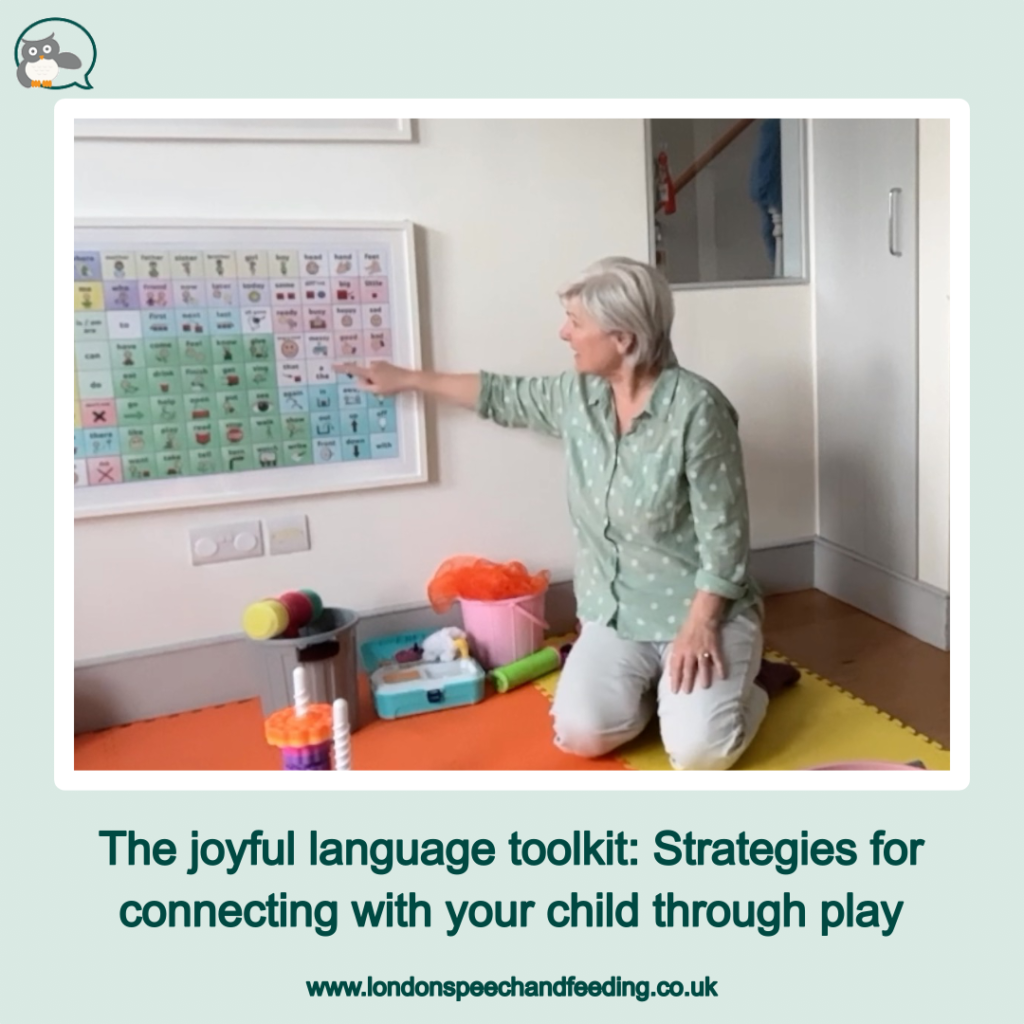
    The joyful language toolkit: Strategies for connecting with your child through play

    As parents and therapists, we all want to help our children communicate. But sometimes, the process can feel like ‘work’. If I had a penny for every parent saying ‘I find it so boring!’… Ok hang in… what if I told you the most effective therapy happens when it doesn’t look like therapy at all?

    My approach centres on connection, enthusiasm, and multi-sensory engagement. We don’t just teach words; we teach the joy of using them. These strategies can be used whether your child is speaking, using a core board, or communicating in his or her own unique way.

    Some of my favourite strategies

    Today I want to share a few of my favourite strategies to turn everyday interactions into powerful communication opportunities regardless of why or how big a delay your child is having.

    1. Facial expressions & exaggeration: Use an exaggerated facial expression to show surprise (wide eyes!), excitement (big smile!), or confusion (a crinkled brow!). Your face is a powerful teaching tool. I am always talking like a clown in my sessions. I can announce that I have also a normal speaking voice outside my clinic room! 😊
    2. Using your voice with intonation: Your voice is music! Use a singsong or ‘tuneful’ repeat to make words stand out. For example, ‘It’s a BIIIG ball!’ or ‘Let’s GO-O-O!’. Again think: clown!!
    3. Hands and body to show: Use gestures, hands, and body movements to demonstrate. Say ‘OPEN’ while pulling your hands apart, or ‘UP’ while raising the toy high above your head.
    4. Elongating our words: Stretching out key sounds or words gives them emphasis and more time for your child to process. ‘Criiiinkley’ ‘tiiickleyyyy’
    5. Core board & language modelling:
      • Model the core board with joy: Don’t just point: point with energy!
      • Model the core board repeatedly throughout the activity, showing genuine excitement. This demonstrates the board is a joyful tool, not homework.
      • Pointing to the core board: When you say a core word, point to the corresponding symbol. You are showing your child, ‘My words live here, and your words can too’.
    6. Describing it for your child: Help your child build his or her vocabulary by providing rich sensory language. ‘It’s squishy’, ‘It’s very noisy’, or ‘It’s so smooth’.
    7. Catchy phrases: Repetitive, positive phrases create a sense of shared fun. Use them consistently: ‘Oh, that’s a nice one!’ or ‘We like that!
    8. Following your child’s Interest: Put down your agenda and follow your child’s lead. If they pick up a block, talk about the block. This ensures they are engaged and ready to learn.
    9. Allowing for pauses: This is critical! After you made a comment, allow for a significant pause (count to five in your head) for your child to fill. The silence creates a powerful opportunity for them to initiate communication.
    10. Copying your child’s sounds: If he or she makes a sound (‘buh!’), you make the sound back! Copying your child’s sounds shows him or her ‘I hear you, and your communication is important’.
    11. Lots of repetition: Hearing a word many times in meaningful contexts is how we learn! Repeat key phrases and core words throughout the activity. Repetition is the key to retention.
    12. Getting turns: Explicitly teach and celebrate getting turns in a game. ‘My turn! Your turn!’ This is a foundational social and communication skill.
    13. Using tidy up as a teaching activity: Turn cleanup into a fun game! It’s a goldmine for core words like PUT IN, ALL DONE, HELP, and MORE. For example, ‘Let’s PUT IN the red block! Yay!’
    14. Using exaggerated repeats: When your child tries a sound or word, give it back with exaggerated, tuneful repeats.

    Try out all or even just a few of these strategies, and I can promise you, you’re not just encouraging language; you’re building a joyful, reciprocal relationship based on genuine communication!

    Which strategy are you excited to try first? Let me know in the comments!

    If I can help you with any of the above, if you want to practise these a bit more, I would love to help you!

    Sonja McGeachie

    Highly Specialist Speech and Language Therapist

    Owner of The London Speech and Feeding Practice.


    Health Professions Council registered
    Royal College of Speech & Language Therapists Member
    Member of ASLTIP

    Find a speech and language therapist for your child in London. Are you concerned about your child’s speech, feeding or communication skills and don’t know where to turn? Please contact me and we can discuss how I can help you or visit my services page.

    2
  • · · ·

    Unlocking communication: My daily life with the Saltillo 88 Core Board

    Introduction

    As an AAC speech and language therapist who uses the Saltillo 88 Core board every day, I can tell you it’s more than just a communication tool. It’s a doorway to independence, connection, and expressing my students’ unique voice.

    What is the Saltillo 88 and why do I use this one?

    In this blog post, I want to share practical, real-world examples of how I integrate the Saltillo 88 into various daily activities, empowering my students and parents to learn to communicate.

    There are literally hundreds of core boards out there and I have tried many different ones over the years. Which one should I use with this particular client? Should I make up my own? (I have made up tons!) or should I use a ready-made one like the one below which is what this blog is about.

    For me the best ones are boards with a good number of core words (at least 60) so that the board is versatile and can be used across a range of activities. The board needs to have a range of pronouns, verbs, descriptors, prepositions and question words to be useful and to stimulate not just requesting but commenting and asking questions. Another consideration is: can the board easily be transferred to a more robust AAC system. Once my student is used to the symbols and where they are could we move to an electronic talker/device. And if this answer is ’yes’ then we have a great board to get started with.

    Below is a picture of the Saltillo 88.

    Saltillo 88 Core Board
    Saltillo 88 Core Board

    It has 88 words and I find it really does suit most activities. The same board and design is also then found on the TOUCHCHAT AAC device which can be a seamless transition for our learner.

    Let me dive into how core words/board or AAC can be used daily:

    1.  Getting dressed

    Whilst choosing clothes for your little one and getting them ready for the day you can use the following words: want, like, get, finish. Always pack the words into little phrases you can speak naturally when using a board. I have tried to show you phrases that you could use below.

    The words in bold are the core words on the board and the other words are just words you say whilst pointing to the core word.

    • Goal: Express choices, needs, and preferences about clothing.
    • Ideas:
      • ‘I want this one [specific item of clothing: ‘shirt’, ‘pants’]’
      • ‘I like that one [colour/type of clothing]’
      • ‘Help me [put/get it on/take off]’
      • ‘let’s get your socks now’
      • finished let’s go’ (when dressed)

    2. Having a shower/bath

    • Goal: Bath time tends to happen daily and so it lends itself to using the same useful phrases and words to chat about temperature preferences, to ask for toys or for washing routines.
    • Ideas:
      • ‘let’s go have a bath/shower’
      • ‘let’s turn on the tap/water’
      • now turn it off
      • ‘let’s get/have more toys/water/bubbles/tickles’
      • all gone, what’s next?’
      • ‘how about washing your hands/feet’
      • ‘let’s do that again’
      • ‘need some help?’
      • Stop it now, let’s do something different’

    3. Mealtimes

    • Goal: Mealtimes can be (or should be) enjoyable and motivating to ask for specific things we like, and commenting about our eating experiences.
    • Ideas:
      • ‘I want/give me [food item: ‘apple’, ‘bread’]/[drink item: ‘water’, ‘juice’]’
      • More foods/drinks/snacks’
      • All done
      • ‘that’s messy we like that (not)’
      • ‘Like’/‘Don’t like’
      • Big’/‘Little’
      • ‘this is so nice!’

    4. Playing

    • Goal: This is where it’s at for children of course and we can use our core words to chat and engage with our little learners.
    • Ideas:
      • ‘I want play’
      • Go’/‘Stop
      • More/again’
      • ‘not it’s my My turn/’it’s Your turn
      • ‘that’s a Big one!’/‘let’s do Little bubbles (describing toys)
      • ‘let me Open it for you (for boxes, doors in play)
      • ‘I See it’ (to draw attention)
      • Help me’ (with a tricky toy)

    5. Opening boxes/doors/etc

    • Goal: Most kids love opening boxes, doors and cabinets to see what there is to play with. Help your child to ask for what they want.
    • Ideas:
      • let’s Open that box/bag/zip/door’
      • get me a (toy) out of here’
      • ‘Let’s Take it out and see what it is?’
      • finished’ (when finished with the task)
      • ‘I want [what’s inside]’
      • ‘What’s next? Let’s see’

    Tips for using AAC effectively

    • Consistency is key: Emphasise using it regularly, even for small things.
    • Modelling: this is crucial, the adults need to use the board for all situations first and foremost before we can expect our child to be interested.
    • Patience: Communication takes time and practice.
    • Celebrate successes: Acknowledge every communicative attempt.
    • Make it accessible: Keep the board within easy reach at all times.

    Conclusion

    If you’re considering the Saltillo 88, or TouchChat, or are already using it, I hope these examples inspire you. It’s a journey of discovery, and every word communicated is a step towards a more connected and independent life. What are your favourite ways to use the Saltillo 88 or which core board do you love using? I would love to hear your comments and stories.

    Sonja McGeachie

    Highly Specialist Speech and Language Therapist

    Owner of The London Speech and Feeding Practice.


    Health Professions Council registered
    Royal College of Speech & Language Therapists Member
    Member of ASLTIP

    Find a speech and language therapist for your child in London. Are you concerned about your child’s speech, feeding or communication skills and don’t know where to turn? Please contact me and we can discuss how I can help you or visit my services page.

    1
  • · ·

    The Hanen Program® – The beauty of the ‘4 S’

    One of my favourite pieces of advice I give to parents is the ‘4 S’, a strategy coined by the Hanen Program® which I teach, particularly the ‘More than Words’ programme which is designed for and aimed at parents of children with Social Communication Difficulties or Autism. It is honestly one of those golden nuggets that I use myself in my practice and I highly recommend it to all my parents. There is something about terms like the ‘4 S’ that is easy to recall and therefore use.

    Introduction

    The ‘4 S’ is a strategy that helps to clarify the words we use with our children so that they can notice us, hear us and understand what we are saying.

    Research shows that we use on average 120-200 words per minute during everyday conversation. That’s a lot! And our children who are still learning to communicate are often bombarded with endless speech coming at them all day long. If we take into account that many of our students are Gestalt Language Processors, we can see that picking out relevant chunks of what we are saying is not at all easy, and this contributes to our children’s delays.

    So let’s look at the ‘4 S’

    1. The first one is SAY LESS

    This means we should use shorter, simpler sentences with good grammar, for example, something like: ‘let’s get ready, time to put our shoes on’ instead of what we might be saying: ‘come on then darling, let’s put your shoes on we need to get going it’s dark outside’ or similar.

    Good grammar helps to give clues about what words mean and how they are used in sentences. So, instead of ‘shoes on’ say ‘let’s put our shoes on’.

    2. The second one is STRESS

    I hear you think ‘I am stressed!‘. – NO! here it means ‘highlight’. We use our voice to highlight the important words in our sentence or phrase. For example, when you say ‘this banana is so yummy’ you can stress the word ‘yummy’ by saying it a bit louder and you can make a gesture, like rubbing your tummy as you say it.

    3. The third one is GO SLOW

    This means to speak a bit slower than you normally would and add pauses. By slowing down the pace of our speaking we give our child time to think and understand what we are saying. When we allow for pauses after we have spoken, we are inviting our child to say something in response.

    4. The last one is SHOW

    Always remember to show actions, gestures, objects, and point to pictures while speaking to help support your child’s understanding. We can show our child what words mean by pointing to things or holding up objects whilst describing or talking about them.

    At this point I would also like to recommend the use of Core Boards, and particularly Electronic AAC devices, such as LAMP Words for Life or PODD. I have written about this in other blogs but can always be persuaded to say a bit more on the matter… 😊 It is such a big help to have an AAC talker available for both the child and the adult so we can find words and pictures to help support the words we are saying.

    For example, today when reading a book like The Hungry Caterpillar (so good!) I used my LAMP AAC talker to make comments as we were looking at the pages together with my student. Example: ‘Look! He is eating more cake he is very hungry’ using my AAC talker I was able to supplement my speech and at the same time I was inviting my minimally speaking child to press a button or two and reply with ‘cake!’ which they would not have said with their mouth otherwise.

    5. It does say ‘4 S’ but really it should be ‘5’ except the fifth is not an ‘S’

    The fifth is REPEAT.

    Repeat words and phrases often throughout the day. When learning a language we all need to hear words and phrases several times and in different situations before we can understand, remember, and then eventually use them. Our children are ‘new language learners’ and so we can apply the same principles that we would when learning a new foreign language ourselves.

    Any questions or need help with supporting your little one’s language please contact me via my contact form, or you could also check out www.hanen.org for advice and lots of inspiration.

    Sonja McGeachie

    Early Intervention Speech and Language Therapist

    Feeding and Dysphagia (Swallowing) Specialist The London Speech and Feeding Practice

    The London Speech and Feeding Practice


    Find a speech and language therapist for your child in London. Are you concerned about your child’s speech, feeding or communication skills and don’t know where to turn? Please contact me and we can discuss how I can help you or visit my services page.

    1