Learning Through Play

  • · ·

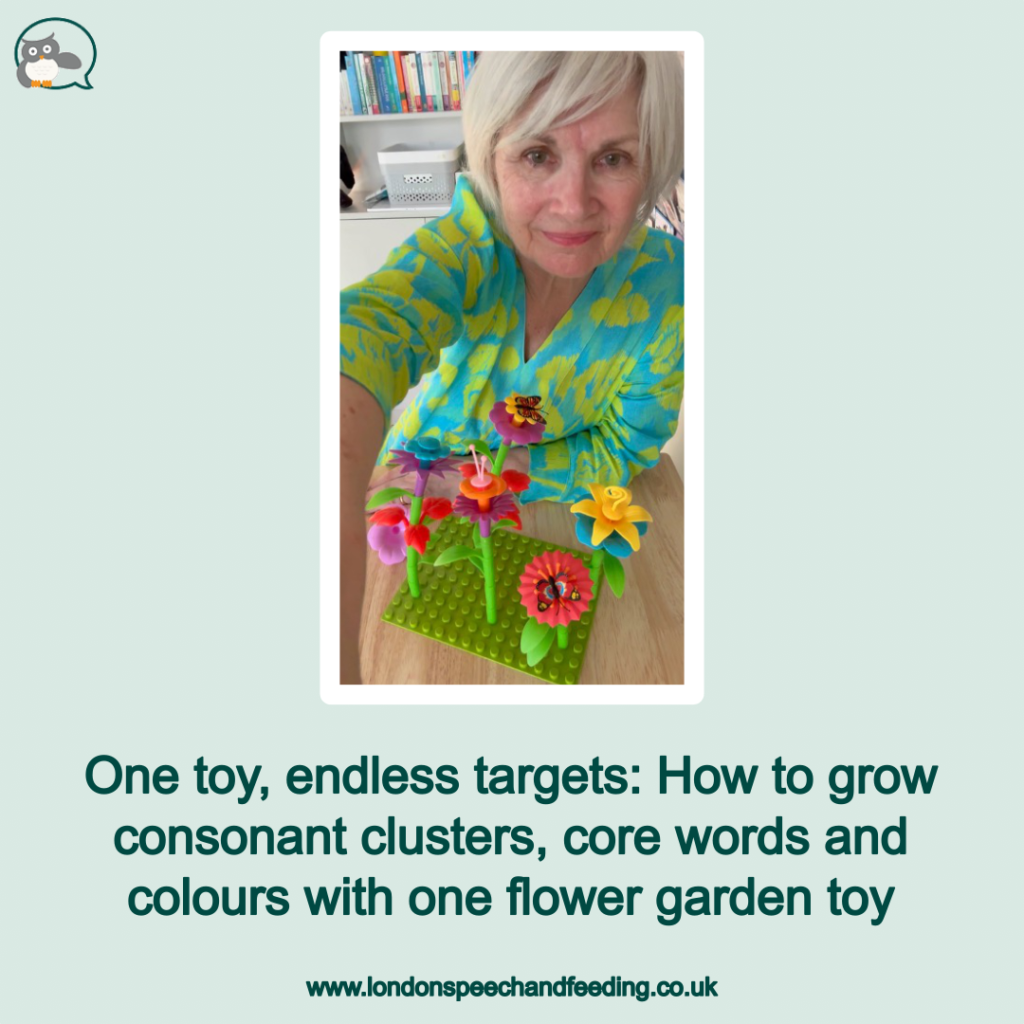
    One toy, endless targets: How to grow consonant clusters, core words and colours with one flower garden toy
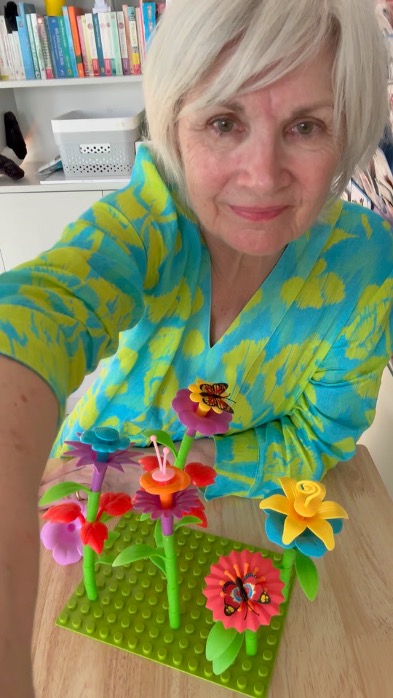
    Sonja McGeachie with the build-a-flower garden toy

    If you’ve been following me for a while you already know my absolute favourite rule for speech therapy: let the toy work for you. You don’t need an entire cabinet full of different flashcards or games to target a massive range of speech goals (though truth be told I do have 4 cabinets! What am I saying…) but often I find that sticking to one highly engaging, open-ended toy reduces a child’s cognitive load, keeps them firmly planted in play, and gives you dozens of natural opportunities for high-repetition practice. It also reduced my cognitive load!

    In today’s post we are looking at a classic: The build-a-flower garden toy. A link is here: https://www.amazon.co.uk/Fivejoy-Flower-Garden-Building.

    This vibrant, stacking toy isn’t just great for fine motor skills. It is an absolute goldmine for speech therapy. While it is incredible for targeting tricky consonant clusters (blends) like /ST/, /SP/, /SPR/, /FL/, /BL/, and /GR/, it is equally powerful for building functional core vocabulary.

    1. Digging deep with /ST/

    Let’s start building our garden.

    Stem & stalk: ‘Look at this long stem!’ or ‘Can you put the stem in?’ or ‘do you want the green or the red stem’?

    • Stuck: If a piece is a little tight to push down, it’s a brilliant opportunity for a natural exclamation: ‘Oh no, it’s stuck! Help me!’
    • Stand: Once it’s secure, you can celebrate: ‘it can stand up now!’
    • 👉 Core word integration: Use this setup stage to practise ANOTHER ONE. As you hold the base pieces, wait for the child to use their words or AAC device to request, ‘I want another one!’ before handing over the next stem.

    2. Sowing seeds with /SP/ and /SPR/

    Every good gardener needs the right equipment and a close eye for detail. We can introduce tools and descriptive language to hit our /SP/ and triple-blend /SPR/ targets.

    • Spade: Grab a toy shovel or pretend to use one. ‘Let’s dig a hole with the spade.’
    • Spot: Point to the holes on the base. ‘Find a good spot for this flower.’
    • Sprout: Talk about the little green pieces: ‘Look at the little sprout!’
    • 👉 Core word integration: Build on spontaneous requesting here. If they are eyeing a specific piece, model a full phrase like: ‘I WANT THE PINK ONE.’

    3. /FL/ and fine motor actions

    Now, we can start adding the colourful petals.

    • Flower: This is your high-frequency word for the entire activity. ‘Put the green/blue/pink flower on top.’
    • Flat & flutter: ‘This piece is flat on the ground,’ or ‘The butterfly flutters by!’
    • 👉 Core word integration: This stage is perfect for teaching directional actions. Every time they stack a petal onto a stem, model the core phrase: ‘PUT IT ON!’

    4. Blending it all together with /BL/

    Building a garden is a fantastic sensory experience because of the vivid colours. We can lean heavily into the /BL/ sound by focusing on colour selection and the action of growth.

    • Blue & bloom: ‘Should we use a blue flower?’ and ‘Watch it bloom!’
    • Blade & blend: Point out the blades of grass and talk about how we blend all the colours together.
    • 👉 Core word integration: Don’t just focus on putting the toy together, taking it apart is half the fun! If a child places a piece they don’t want, or when it’s time to clean up, model: ‘TAKE IT OFF.’

    5. Working the /GR/

    Finally, we look at the environment supporting our garden. The /GR/ blend can be targeted by looking downward at the base of our toy setup.

    • Green: Nearly every stem and base piece in this toy is a vibrant shade of green.
    • Grass & ground: ‘Put the base down on the ground.’ ‘Look at the green grass.’
    • 👉 Core word integration: Combine your /GR/ blend with a powerful core phrase. As you pull a stem upward slowly or stack the petals higher and higher, chant together: ‘MAKE IT GROW! Grow, grow, grow!’

    Maximise your repetitions in play

    The beauty of the flower garden toy is its repetitive nature. Because a child builds multiple flowers, you aren’t just saying a word or a phrase once, you have the potential to repeat it 10, 15, or 20 times in a single sitting without the child losing interest.

    By layering structural speech sounds (like blends) over functional communication phrases (like core words), we give children words they can use across their entire day.

    What toy would you like to see us target next in our series? Let me know in the comments on Instagram, and don’t forget to swipe through the carousel there to save these word lists for your next playtime!

    If you are concerned about your child’s speech, please do not hesitate to get in touch. I would love to help you find some answers.

    Sonja McGeachie

    Highly Specialist Speech and Language Therapist

    Owner of The London Speech and Feeding Practice.


    Health Professions Council registered
    Royal College of Speech & Language Therapists Member
    Member of ASLTIP

    Find a speech and language therapist for your child in London. Are you concerned about your child’s speech, feeding or communication skills and don’t know where to turn? Please contact me and we can discuss how I can help you or visit my services page.

    3
  • A day in my speech clinic: Mastering the /SP/ cluster

    I very often work on /S/ Blends (/SP/ /ST/ /SM/ /SK/ /SN/ and /SL/). When we work on these sound blends (like SPider, STop, or SMile), we are using a clever speech therapy ruse! Because these blends are complex, teaching a child how to master them naturally helps them clear up simpler single sounds (like just /S/ or just /P/) at the same time. Plus, because S-blend words are so common in everyday language think spoon, spy, spot, and spin, practising them gives your child an immediate confidence boost when they are understood much more easily.

    Good news: high-repetition motor practice doesn’t have to be a chore. In fact, the more sensory input we can provide, the faster those new neural pathways are built. Recently, I recorded a series of seven short clips to demonstrate how we can weave intense speech practice into the fabric of play.

    Here is a look at a typical day in the clinic focusing on /SP/ blends.

    1. The sensory sandbox:

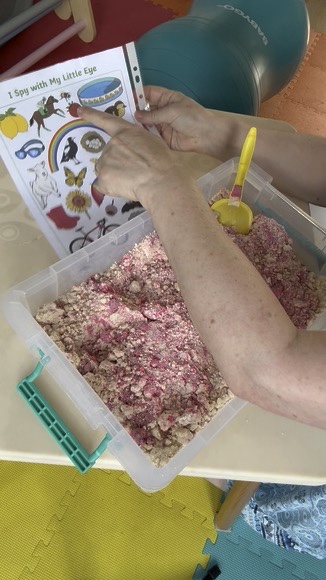
    We started our session at the sensory table. Sensory bins can often work well because they provide tactile feedback that grounds the child’s focus (of course they are usually messy, so one needs to have the physical space and energy for it to be fair!).

    • The Activity: I pointed to our ‘I Spy’ board before we dove into the sand. Using a toy spade we dug for hidden objects and named them each time we found one.
    • Every time we scooped, we practised Spade. Every discovery was a spider, a spoon or a spotty animal. By pairing the physical effort of digging with the speech sound, we help the brain synchronise motor planning and vocal execution.

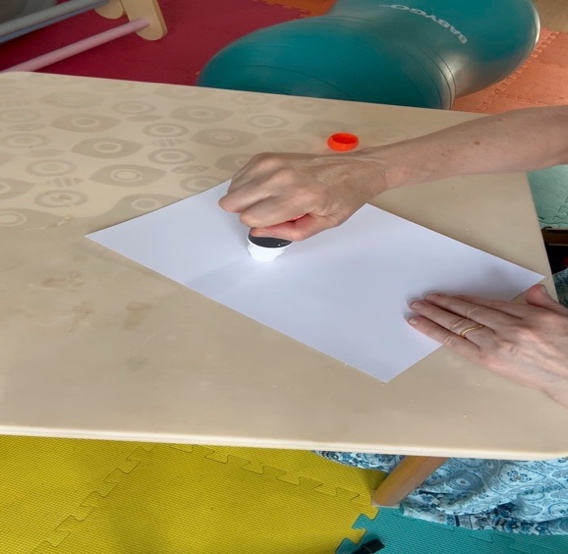
    2. Bingo dabbers rock!

    Next, we moved to making ink marks on paper.

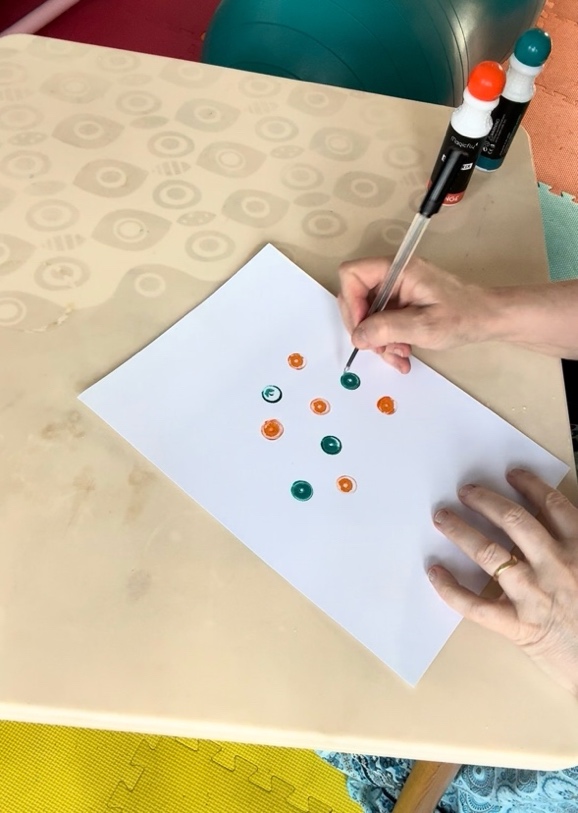
    • The Activity: I demonstrated making spots with coloured bingo dabbers.
    • We treated each ink spot as a visual anchor. Stamp –Spot Stamp –Spot. This creates a rhythmic pacing that prevents the child from rushing. It’s a wonderful way to get 50+ repetitions in under five minutes without the child even realising they are ‘working’.

    3. Drawing spiders

    Building on the previous activity, we took those spots and turned them into something more complex.

    • The Activity: I drew spiders out of the spots we had just made.
    • Drawing the legs provided a perfect opportunity for ‘stretch’ sounds. As we drew a long leg, we practise a long, hissy ‘Sssssssss’, snapping into the /P/ as the pen hits the spot.

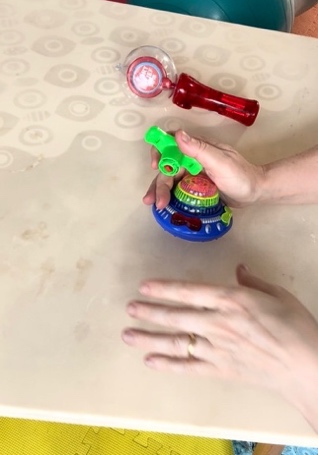
    4. Wind-up spinners

    High-energy toys are excellent for eliciting ‘power’ sounds.

    • The Activity: I brought out two mechanical wind-up spinners.
    • Method: The child says Spin or Spinner to get me to wind them up. The anticipation of the toy moving acts as a natural reinforcer.

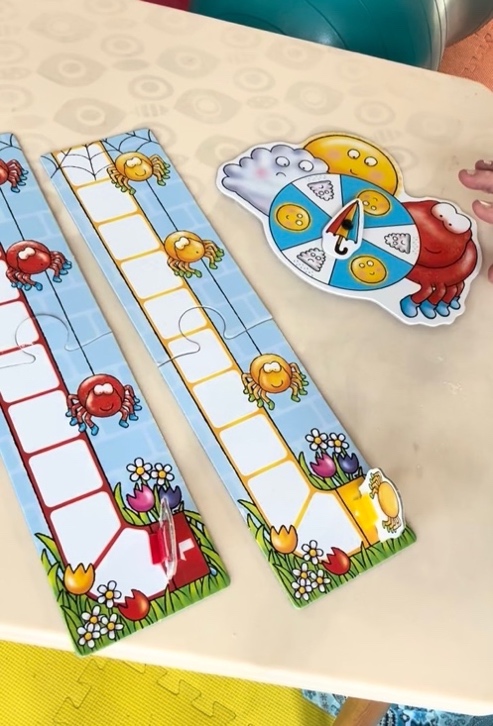
    5. The Incy Wincy spider game

    • The Activity: I spun a game spinner to determine how many steps our toy spiders would take up the spout.
    • This activity is a triple threat. We practised ‘Spin’, ‘Spider’, and ‘Spout’ all in one go. The visual of the spider moving up the spout also helps with the concept of UP and DOWN of course.

    6. Searching for Spot

    Books are a great tool for generalisation, taking a sound from a single word and moving it into phrases and sentences.

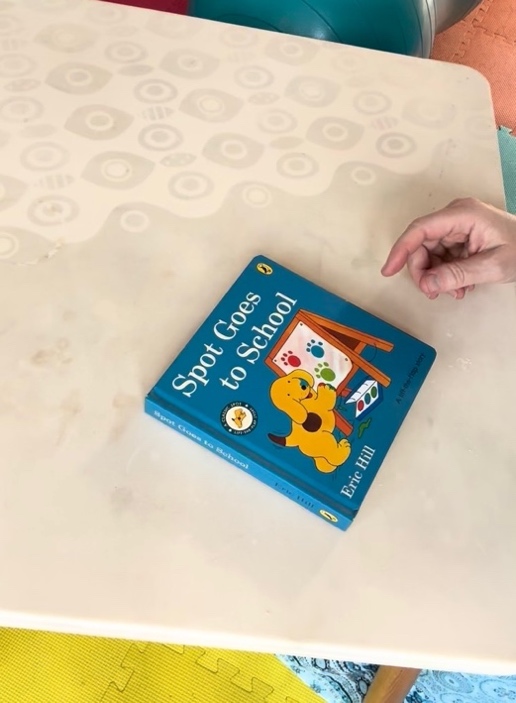
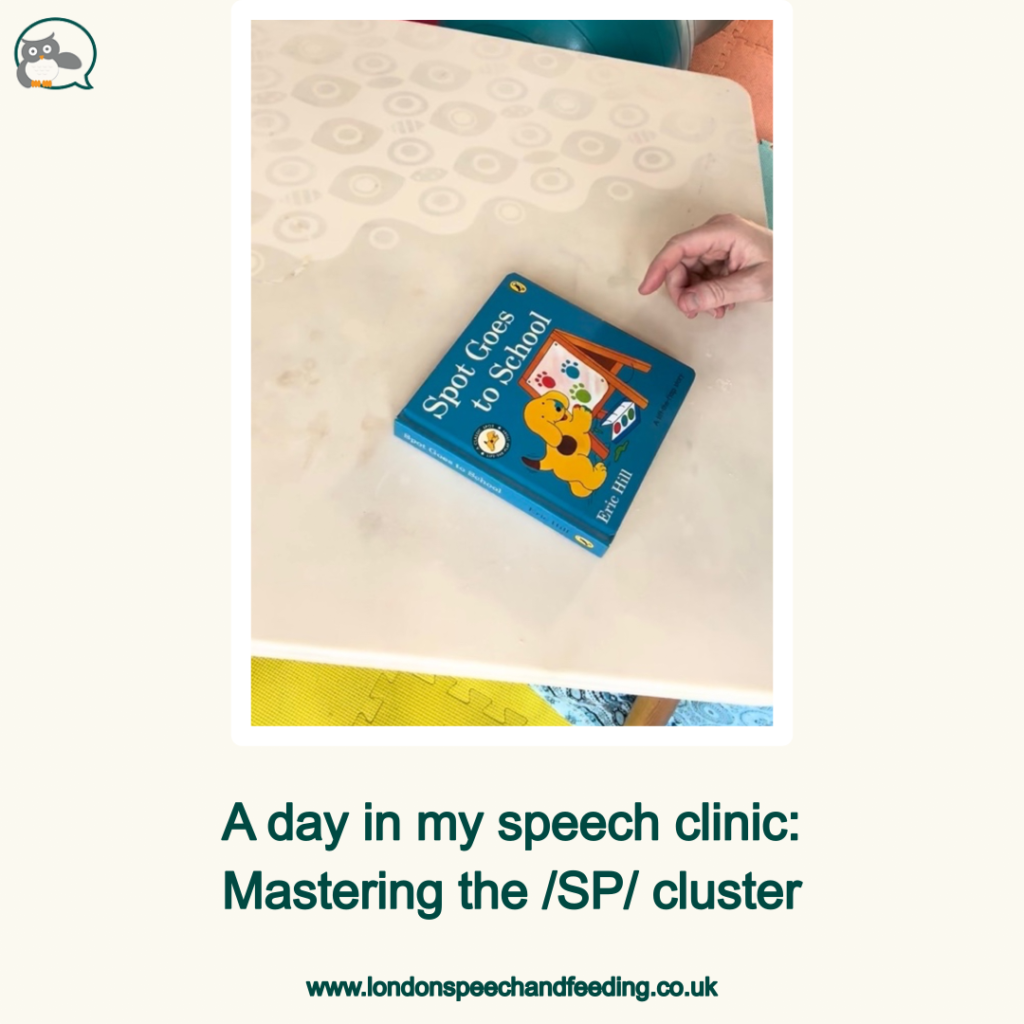
    • The Activity: We went through a ‘Spot the Dog’ book.
    • Instead of just reading, we used the ‘I Spy’ strategy. ‘I spy Spot! He has a big spot on his back!’ This encourages the child to use the target word in a functional, communicative way rather than just repeating it after me.

    7. Finally, sponging off some sand

    We ended the session with some ‘heavy work’ and cleaning.

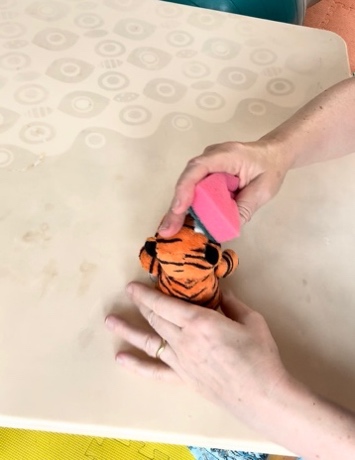
    • The Activity: We took a soft toy that had gotten a bit ‘dusty’ in the sandbox and used a sponge to clean it down.
    • The action of squeezing the sponge provides proprioceptive input (pressure), which can be very calming and help a child focus on their articulatory placement for those final repetitions of the day.
    A day in my speech clinic: Mastering the /SP/ cluster

    Speech therapy works on motor learning. Just like learning to ride a bike or play the piano, the brain needs thousands of correct repetitions to make a movement automatic. By using /SP/ words in these seven distinct, sensory-rich ways, we:

    1. Reduce frustration: The focus is on the play, not the correction.
    2. Increase engagement: A child who is having fun will stay in the learning zone longer.
    3. Provide context: The child learns that saying /SP/ correctly helps them get the spade, spin the spinner, and find the spider.

    Next time I will show you some more activities for /ST/ and /SM/ words. If you have any super ideas for /S/ cluster words please leave me your suggestions in the comments on instagram, I would appreciate it thank you! 😊

    If you are concerned about your child’s speech, please do not hesitate to get in touch. I would love to help you find some answers.

    Sonja McGeachie

    Highly Specialist Speech and Language Therapist

    Owner of The London Speech and Feeding Practice.


    Health Professions Council registered
    Royal College of Speech & Language Therapists Member
    Member of ASLTIP

    Find a speech and language therapist for your child in London. Are you concerned about your child’s speech, feeding or communication skills and don’t know where to turn? Please contact me and we can discuss how I can help you or visit my services page.
    3