One toy, endless targets: How to grow consonant clusters, core words and colours with one flower garden toy
| |
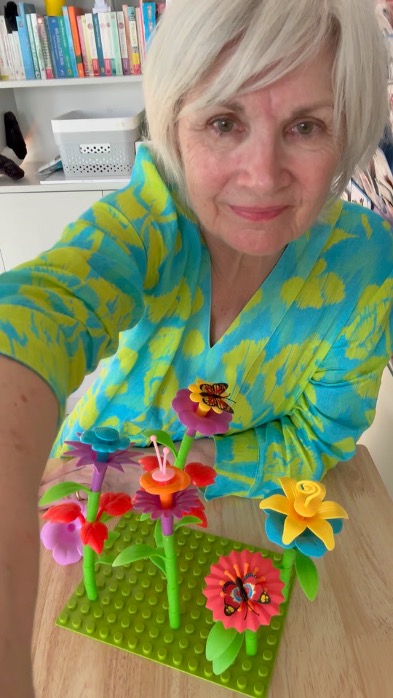
Sonja McGeachie with the build-a-flower garden toy

If you’ve been following me for a while you already know my absolute favourite rule for speech therapy: let the toy work for you. You don’t need an entire cabinet full of different flashcards or games to target a massive range of speech goals (though truth be told I do have 4 cabinets! What am I saying…) but often I find that sticking to one highly engaging, open-ended toy reduces a child’s cognitive load, keeps them firmly planted in play, and gives you dozens of natural opportunities for high-repetition practice. It also reduced my cognitive load!

In today’s post we are looking at a classic: The build-a-flower garden toy. A link is here: https://www.amazon.co.uk/Fivejoy-Flower-Garden-Building.

This vibrant, stacking toy isn’t just great for fine motor skills. It is an absolute goldmine for speech therapy. While it is incredible for targeting tricky consonant clusters (blends) like /ST/, /SP/, /SPR/, /FL/, /BL/, and /GR/, it is equally powerful for building functional core vocabulary.

1. Digging deep with /ST/

Let’s start building our garden.

Stem & stalk: ‘Look at this long stem!’ or ‘Can you put the stem in?’ or ‘do you want the green or the red stem’?

  • Stuck: If a piece is a little tight to push down, it’s a brilliant opportunity for a natural exclamation: ‘Oh no, it’s stuck! Help me!’
  • Stand: Once it’s secure, you can celebrate: ‘it can stand up now!’
  • 👉 Core word integration: Use this setup stage to practise ANOTHER ONE. As you hold the base pieces, wait for the child to use their words or AAC device to request, ‘I want another one!’ before handing over the next stem.

2. Sowing seeds with /SP/ and /SPR/

Every good gardener needs the right equipment and a close eye for detail. We can introduce tools and descriptive language to hit our /SP/ and triple-blend /SPR/ targets.

  • Spade: Grab a toy shovel or pretend to use one. ‘Let’s dig a hole with the spade.’
  • Spot: Point to the holes on the base. ‘Find a good spot for this flower.’
  • Sprout: Talk about the little green pieces: ‘Look at the little sprout!’
  • 👉 Core word integration: Build on spontaneous requesting here. If they are eyeing a specific piece, model a full phrase like: ‘I WANT THE PINK ONE.’

3. /FL/ and fine motor actions

Now, we can start adding the colourful petals.

  • Flower: This is your high-frequency word for the entire activity. ‘Put the green/blue/pink flower on top.’
  • Flat & flutter: ‘This piece is flat on the ground,’ or ‘The butterfly flutters by!’
  • 👉 Core word integration: This stage is perfect for teaching directional actions. Every time they stack a petal onto a stem, model the core phrase: ‘PUT IT ON!’

4. Blending it all together with /BL/

Building a garden is a fantastic sensory experience because of the vivid colours. We can lean heavily into the /BL/ sound by focusing on colour selection and the action of growth.

  • Blue & bloom: ‘Should we use a blue flower?’ and ‘Watch it bloom!’
  • Blade & blend: Point out the blades of grass and talk about how we blend all the colours together.
  • 👉 Core word integration: Don’t just focus on putting the toy together, taking it apart is half the fun! If a child places a piece they don’t want, or when it’s time to clean up, model: ‘TAKE IT OFF.’

5. Working the /GR/

Finally, we look at the environment supporting our garden. The /GR/ blend can be targeted by looking downward at the base of our toy setup.

  • Green: Nearly every stem and base piece in this toy is a vibrant shade of green.
  • Grass & ground: ‘Put the base down on the ground.’ ‘Look at the green grass.’
  • 👉 Core word integration: Combine your /GR/ blend with a powerful core phrase. As you pull a stem upward slowly or stack the petals higher and higher, chant together: ‘MAKE IT GROW! Grow, grow, grow!’

Maximise your repetitions in play

The beauty of the flower garden toy is its repetitive nature. Because a child builds multiple flowers, you aren’t just saying a word or a phrase once, you have the potential to repeat it 10, 15, or 20 times in a single sitting without the child losing interest.

By layering structural speech sounds (like blends) over functional communication phrases (like core words), we give children words they can use across their entire day.

What toy would you like to see us target next in our series? Let me know in the comments on Instagram, and don’t forget to swipe through the carousel there to save these word lists for your next playtime!

If you are concerned about your child’s speech, please do not hesitate to get in touch. I would love to help you find some answers.

Sonja McGeachie

Highly Specialist Speech and Language Therapist

Owner of The London Speech and Feeding Practice.


Health Professions Council registered
Royal College of Speech & Language Therapists Member
Member of ASLTIP

Find a speech and language therapist for your child in London. Are you concerned about your child’s speech, feeding or communication skills and don’t know where to turn? Please contact me and we can discuss how I can help you or visit my services page.

3

Similar Posts

  • · ·

    Speech prompts and strategies I use in Speech Sound Therapy

    This particular student has a mild motor planning difficulty and six weeks ago he came to me with a very strong lisp. In addition to the lisp he is struggling to produce a number of sounds, SH and L on its own and all the clusters (FL/BL/KL/PL) but also CH together with some vowel difficulties.

    The prompts are a mix partially from the DTTC (Dynamic Temporal and Tactile Cueing) model by Dr Edythe Strand as well as phonological models I have learned over the years, and some of them are my own.

    Visual/picture prompts and Images

    Here I use the ‘Flat Tyre’ Sound, to offer as an image for a new S sound and the ‘Tick Tock’ Sound for a new image of the T sound. Both cards are from the Bjorem Speech Sound Deck, which I love and use almost daily.

    Gestural Cues

    I like to use all the ‘cued articulation’ hand cues by Jane Passy for consonants and fricatives. Here we use our fingers and hand to illustrate what our tongue does, and we also show whether a sound is voiced or voiceless. When I use one finger it is voiceless (k/f/s/p) and when I use two fingers for the same cue it means that the voice needs to be turned on: (g/v/z/b/n/m). For vowels I like to use Pam Marshalla’s cue system.

    Simultaneous production

    We say the word together.

    Direct imitation

    I say the word and my student copies me directly.

    Imitation after a delay

    I say the word and then after a little wait my student says the word.

    Spontaneous production

    My student has now learned to say the word by him/herself.

    Offering feedback

    It sounds like… I just heard… I didn’t hear the first sound there? Can you try again?

    Letting the student reflect

    By just shaking my head or by looking quizzical so that my student realises something didn’t quite go right.

    Postitive reinforcement

    ‘Yes that was it, do it again, nice one…’

    Cognitive reframing

    This is a technique where we identify different semantic cues and metaphors or imagery cues, so instead of teaching or focusing on a sound we try out viewing each syllable from a different point of view.

    For example: ‘yellow’. I have had great success with this one: we start with just saying ‘yeah yeah yeah’. I might make a little joke and say something like ‘imagine your mum says tidy your bedroom, what do you say or what do you think?’ Answer: ‘yeah yeah yeah’. Then we practice ‘low’ together, I might blow some bubbles high and low and we talk about ‘low’. And then we put ‘Yeah’ and ‘Low’ together and now we have YELLOW!! It might at first still sound a bit odd, like ‘yea-low’ but we soon shape that up and have the real word.

    Each student is different and having a great rapport is crucial to our success.

    Then a little game break after some 7–10 or so repetitions and always trying to finish on a positive note.

    What game breaks do I use:

    Very quick ones! Students can post something, place a counter in a game, take out a Jenga block from the tower, pop in a counter for ‘connect 4’, stick a sword into the Pop the Pirate barrel or add a couple of Lego blocks to something they are building.

    I hope this is helpful, please contact me for any questions.

    Sonja McGeachie

    Early Intervention Speech and Language Therapist

    Feeding and Dysphagia (Swallowing) Specialist The London Speech and Feeding Practice

    The London Speech and Feeding Practice


    Find a speech and language therapist for your child in London. Are you concerned about your child’s speech, feeding or communication skills and don’t know where to turn? Please contact me and we can discuss how I can help you or visit my services page.

    1
  • · ·

    Neurodiversity affirming Speech and Language Therapy

    Introduction

    I am a neurodiversity affirming therapist and I love and endorse play-based therapy. I use it alongside a strengths-focused approach in all my sessions. Find out why we should use these transformative therapy methodologies in all our work and play with our children.

    I always have a range of different toys and activities up my sleeve so that when one toy is no longer interesting, that’s fine. ‘Look here’s a new one, how about we try this one?’ When therapy feels like play, children are more likely to be engaged and attentive, which leads to better outcomes.

    By using play as a context for Speech and Language Therapy we can create opportunities for children to use and practise their communication skills in a natural, real-life setting. This helps bridge the gap between the therapy room and everyday life.

    Goals and targets

    What about goals and targets I hear you say? Of course, as Speech and Language Therapists we always have our goals for any particular child. They can be speech goals (we want Bobbi to produce a ‘k’ sound at the end of words) or communication goals (we want Fatima to ask for something by pointing to it rather than grabbing it). And these goals can be achieved where there is a reciprocation and a positive, playful relationship between the adult and the child. That relationship comes through play and fun.

    Play and fun

    Play is how a child interacts and learns. If it’s fun, interesting, exciting or pleasurable then that is where the magic happens. And that is what we need to return to repeatedly and then see if we can fold our targets into the activity as we go.

    As soon as we expect our child to do something and we try and shape their behaviours towards a certain outcome we no longer ‘play’. We are now in teaching mode, where we direct and where we are ‘in charge’. As a neurodiversity affirming therapist, I believe that all play is valid. We must not get into the trap of thinking that only functional play is valid, that there is only one way to play with that car ramp/puzzle/potato head. Our autistic children often need to play in a particular way to navigate their world and we must not try and stop that.

    When we affirm and validate our child’s play and copy their play with enthusiasm and respect then, in my experience, all children regardless where they are on the neurodiversity spectrum will begin to engage with us, copy us, and learn how to communicate effectively about things that matter to them.

    Play-based therapy allows therapists to tailor interventions to each child’s unique interests and abilities. This individualised approach increases the likelihood of success and progress.

    Strengths-Focused Speech Therapy

    Strengths-focused therapy emphasizes a child’s strengths and abilities rather than their deficits. It recognises that every person has unique strengths that can be harnessed to overcome challenges.

    Focusing on strengths helps us build a positive self-image. This is especially important for children with communication disorders, as it can boost their confidence and self-esteem.

    When we encourage children to play in ways that they enjoy and are good at they feel empowered and more in control of their lives and play. This can lead to increased motivation and a sense of ownership over their progress.

    Now, imagine the powerful impact that can be achieved by combining play-based therapy and strengths-focused therapy in speech therapy sessions. This dynamic combination brings out the best of both worlds. It creates a therapeutic environment that is not only effective but also enjoyable for children and their families.

    As Speech Therapists we can use the child’s strengths and interests as a foundation for play-based activities. This personalisation not only makes therapy more engaging but also more effective.

    An example

    Charlie, a 3-year-old with social communication challenges, had a deep interest in anything that spins. We used this strength and interest to create a variety of spinning activities. As he is allowed to engage in his spinners, we can practise lots of speech and language and provide great phrases alongside his interest and activities: Ready steady go! Stop! ‘another one’ ‘the red one’ ‘again again’ ‘I love it’ ‘it’s a spinner’ ‘Charlie loves this toy’ ‘it’s going fast’ ‘it’s so fun’ etc..

    Over time Charlie started to copy some of these word models and then used them to create his own little phrases, such as ‘the blue one again’. When this occurred, we felt like celebrating because it had come naturally and appropriately to the situation without any coercion or direction. That is what communication is about! Well done Charlie!

    Conclusion

    Play-based and strengths-focused speech therapy approaches are powerful tools and by combining these approaches, we create a therapeutic environment that is not only effective but also enjoyable and empowering for our clients.

    Contact me if you would like your child to have neurodiversity affirming speech and language therapy.


    Find a speech and language therapist for your child in London. Are you concerned about your child’s speech, feeding or communication skills and don’t know where to turn? Please contact me and we can discuss how I can help you or visit my services page.

    0
  • ·

    Discover speech and language regression in autistic children and how you can support your child

    Discover speech and language regression in autistic children and how you can support your child

    There’s often this idea that autistic children have extensive vocabulary and knowledge, but this is not always the case. In fact, 30% of autistic children have language regression.

    Goldberg (2003) suggested that speech and language regression refers to the decline in a young child’s speech and communication abilities. We know that regression in speech, language and communication skills often occur before the age of two years. 25% of autistic children develop language at word level between 12 and 18 months of age before losing this language they have learned. As you’re probably aware this regression in communication is a diagnostic indicator of Autism.

    We understand that you want your child to progress, and you struggle to watch as their frustration grows as you feel helpless. I want to provide you with tips so that you can feel empowered to support your autistic child and reduce the impact their communication skills have on the family.

    1. Reduce frustration by providing visuals to support their communication
    2. Model gestalts. We know that autistic children are often gestalt language processors. Learn more about gestalt language processors in one of my previous posts.
    3. Praise the ability to communicate. Focus on what they say not how they say it. E.g., good listening, nice talking.
    4. Provide your child with choices (using real objects to represent your choices). E.g., do you want an apple or banana?
    5. Your child must be motivated and have a purpose to communicate. So, ensure you use highly motivating objects for conversations
    6. Provide them with opportunities to communicate. We need to teach children that if they want something, there’s a process that you need to have the opportunity to ask for it. We find that if parents understand what their child wants (without them asking), the object is given to them, and so there’s no reason for your child to ask.
    7. There’s this idea that we need to teach children eye contact. This is not always the case. Your child is unique, we do not want to take their unique skills away.
    8. Model words which are concrete. E.g., words such as ‘finished’, ‘more’. You can model these several times within the day. You can use a gesture to make the word more visual (see the images below). We know that autistic children are often visual learners.
    Makaton fro "more"
    Makaton for “more”
    Makaton for "finished"
    Makaton for “finished”

    Credit: Little Dots Makaton, Polkadot World

    Remember that if your child has speech, language and communication regression, it doesn’t mean your child will stay static.

    It’s vital that you seek support from a qualified Speech and Language Therapist. We can tell you at what point in the communication development that your child is at. And we can support you through the process. We can provide you with an individualised plan specifically for your child to ensure you maximise their potential.

    Contact me for help.


    Find a speech and language therapist for your child in London. Are you concerned about your child’s speech, feeding or communication skills and don’t know where to turn? Please contact me and we can discuss how I can help you or visit my services page.

    1
  • ·

    Unlocking language and thinking skills: The power of sequencing

    Sonja demonstrates the power of sequencing

    As speech and language therapists, we often use a variety of techniques to help children develop their communication and cognitive skills. One incredibly valuable tool in our toolkit is the use of sequencing activities. But what exactly is sequencing, and why is it so beneficial?

    What is sequencing?

    Sequencing, at its core, involves arranging items, events, or actions in a specific order. This could involve putting pictures in the correct order to tell a story, following the steps in a recipe, or understanding the order of daily routines like brushing teeth or getting dressed.

    The link between sequencing and language

    Sequencing is fundamental to language development and is quintessential to executive functioning skills in several ways:

    • Narrative skills: Storytelling, whether oral or written, relies heavily on sequencing. A child needs to understand the order of events (beginning, middle, end) to construct a coherent narrative.
    • Explanations and instructions: Providing clear explanations or instructions requires the ability to sequence information logically. For example, explaining how to play a game or how to get from one place to another. In the video clip below we are working on ‘how do make a sandwich’.
    • Vocabulary development: Sequencing helps children understand temporal words and phrases like ‘first,’ ‘then,’ ‘next,’ ‘before,’ and ‘after’.
    • Sentence structure: Constructing grammatically correct sentences often involves sequencing words in a specific order (e.g., subject-verb-object).

    Beyond language, sequencing plays a crucial role in developing executive functioning skills. These are higher-level cognitive skills that help us plan, organise, and manage our time and actions.

    Sequencing activities can help children improve in the following areas:

    • Planning and organisation: Sequencing tasks require children to think ahead, plan the steps involved, and organise them in a logical order.
    • Problem-solving: When they are faced with a problem, sequencing helps children break it down into smaller, more manageable steps.
    • Working memory: Holding information in mind and manipulating it, such as remembering the steps in a multi-step direction, is supported by sequencing skills.
    • Cognitive flexibility: Being able to adjust to changes in a sequence or think of alternative sequences promotes cognitive flexibility.

    Examples of sequencing activities

    Here are some practical examples of sequencing activities you can do with your child:

    • Picture sequencing: Use a set of picture cards to tell a short story or illustrate a process (e.g., making a sandwich, going to the park). Ask your child to arrange the cards in the correct order.
    • Story retelling: After reading a story, have your child retell it, focusing on the order of events.
    • Following instructions: Give your child multi-step instructions to follow (e.g., ‘First, get your shoes. Then, put on your coat. Next, go to the door.’).
    • Sequencing during play: Integrate sequencing into everyday play. For example, while building with blocks, talk about the steps: ‘First, we put this block here. Next, we add this one…’
    • Daily routines: Create visual schedules for daily routines, like getting ready for school or bedtime, to help children understand the sequence of events.
    • In the video clip below I am using an on-line language activity which is often fun for children as they can use their finger to swipe the pictures effortlessly into the right place and, if we realise at the end of the story that we have made a little error, we can then easily re-jig the pictures into their correct place.

    In conclusion

    Sequencing activities offer a powerful way to support children’s language development and enhance their executive functioning skills. By helping children understand and create order, we equip them with essential tools for communicating, learning, and navigating the world around them.

    Do get in touch via my contact form if you are concerned about your child’s development.

    Sonja McGeachie

    Highly Specialist Speech and Language Therapist

    Owner of The London Speech and Feeding Practice.


    Health Professions Council registered
    Royal College of Speech & Language Therapists Member
    Member of ASLTIP

    Find a speech and language therapist for your child in London. Are you concerned about your child’s speech, feeding or communication skills and don’t know where to turn? Please contact me and we can discuss how I can help you or visit my services page.

    1
  • Language development

    Kids Speech Therapist London
    Language Development

    Books, Stories And Colourful Semantics

    Many of my students have difficulties telling stories. When looking at a book together, even books they love and have seen many times, they often struggle to understand what they are reading and cannot therefore retell the story in any sequence. A great method I often use with those students is called Colourful Semantics.

    What is Colourful Semantics?

    Colourful Semantics is an approach aimed at helping children develop grammar and meaning of phrases and sentences. We help children identify WHO is the subject in a story, what is he/she/it DOING to WHAT and WHERE. There are lots of colour coded stages but we tend to start with the basic 4:

    WHO = ORANGE

    DOING = YELLOW

    WHAT = GREEN

    WHERE = BLUE

    Once a student is accomplished at this level, we move on to different colour codes for describing words (adjectives), connecting words (with/together/and/therefore) feeling words (PINK), timing words (BROWN) eg. when, tomorrow, last week etc.

    Colourful Semantics is a really useful method and helps children to organise their sentences. It also helps me knowing how to guide a student in thinking about the story.

    The approach can be used with children with a range of Speech and Language Needs, such as:

    • Developmental Delay / Disorder
    • Autistic Spectrum Condition
    • Down Syndrome
    • Any other syndromes and related speech and language delays
    • General Literacy difficulties

    There are a wide range of benefits to using this approach and I use it in my therapeutic work with children of around 3 years plus. Below is a little video which shows how I use it with this student who has general language difficulties associated with Autism. One of the main benefits with this student is that seeing the Cue Cards helps her to use a much wider range of vocabulary than she would ordinarily generate. Her sentences are getting longer and she is more able to answer questions. In general, I find it useful to help with storytelling and to guide us through the story in a sequence.

    There are many on-line games these days that have incorporated the Colourful Semantics Approach. Once a child is familiar with the basic colour scheme then gradually the visual prompts can be reduced to using verbal prompts.


    Find a speech and language therapist for your child in London. Are you concerned about your child’s speech, feeding or communication skills and don’t know where to turn? Please contact me and we can discuss how I can help you or visit my services page.

  • · · ·

    Following your child’s lead: A playful path to AAC success

    Unlocking playtime: A guide to child-led learning

    Does your child struggle to focus on toys or activities? Do they dart away as soon as you approach? You’re not alone!

    The key to unlocking your child’s potential lies in following their lead. Let them guide the play session, and watch their engagement and focus soar.

    Why Child-Led Play Works:

    • Empowerment: Children feel in control, sparking their curiosity and motivation.
    • Focused attention: They’ll stay engaged with activities for longer periods.
    • Reduced frustration: By stepping back and observing, you eliminate the pressure and stress that often comes with directed play.

    How to Implement Child-Led Play:

    1. Prepare the environment: Set out a limited selection of engaging toys.
    2. Observe and wait: Sit back, watch, and listen to your child’s interests.
    3. Embrace the moment: Resist the urge to direct or question; simply enjoy the process.

    Remember: This simple approach can transform playtime and support your child’s development. Give it a try for a week and see the difference!

    #OWLing #hanenmorethanwords

    Observe, Wait, Listen. It’s a powerful formula for unlocking your child’s potential.

    You will likely see:

    • Your child will stay put with any toy for longer whilst you are near them.
    • Your child will tolerate you being nearby and he/she won’t move away.
    • Your child will start giving you brief glances of enjoyment, or perhaps they will hand things to you, or they might take your hand and lead it to something that needs opening etc.
    • In other words, you will see that there suddenly is JOINT PLAY. Yes, granted it may not be according to your adult agenda, but there will be more togetherness than there was before. And this is the START of communication and social engagement.

    USE Core words and a coreboard — to help your child understand the power of words

    Core words are the building blocks of communication. Try using a coreboard like the one below, they are versatile and can be used in countless ways. By modelling these words naturally during play, you expose your child to their meaning and function in context. This approach is far more effective than isolated drill and practice, more powerful than flashcards!

    Using AAC coreboard
    Photo by lemonlenz

    A Winning Combination

    Combining child-led play and AAC modelling creates a magic effect. To summarise:

    • Increased engagement: When you follow your child’s lead, they are more likely to be engaged and receptive to learning. This creates optimal conditions for introducing AAC core words.
    • Natural learning: By modelling AAC core words in the context of play, you help your child understand their meaning and purpose naturally. This fosters generalisation and spontaneous use.
    • Building relationships: Shared play experiences strengthen the bond between you and your child. This trust and connection are essential for successful communication.
    • Reduced pressure: Modelling AAC core words without expectation removes the pressure to produce language. This allows your child to explore communication at their own pace.
    • Expanded vocabulary: As your child becomes more comfortable with AAC, they will begin to incorporate core words into their own communication. This leads to vocabulary growth and increased independence.

    Practical Tips

    • Observe and respond: Pay close attention to your child’s interests and actions. Respond to their cues with enthusiasm and support.
    • Keep it simple: Start with a few core words and gradually introduce new ones as your child’s skills develop.
    • Be patient: Language learning takes time. Celebrate small successes and avoid frustration.
    • Have fun: Remember, play is supposed to be enjoyable for both you and your child. Relax and have fun together!

    Example:

    Photo by lemonlenz

    Let’s say your child is playing with a pop-up toy like you see me do in the above photograph. Here, I followed my child’s lead by waiting to see what she wanted to do with the toy. You are now OWLING! (Observe Wait and Listen)

    Once I noticed that there was repetitive opening of the flaps going on I then pointed to OPEN and MORE on the board, as I said: ‘let’s OPEN this one’ / let’s see MORE animals’ / ‘MORE cow! it says moo!’ ‘OPEN another one’ and so on.

    Important to know, we are not expecting our child to respond verbally or with AAC, but we are providing language input and demonstrating how these words can be used with enthusiasm.

    Naturally in time your child will look at the board and at your pointing and they will eventually want to copy you!

    By incorporating these strategies into your daily interactions, you can create a supportive environment that fosters language development and communication growth.  If you would like more guidance please get in touch and book in for a consultation, some individual therapy and/ or some parent coaching.

    I look forward to supporting you. Please contact me and let’s see how.

    Sonja McGeachie

    Early Intervention Speech and Language Therapist

    Feeding and Dysphagia (Swallowing) Specialist The London Speech and Feeding Practice

    The London Speech and Feeding Practice


    Find a speech and language therapist for your child in London. Are you concerned about your child’s speech, feeding or communication skills and don’t know where to turn? Please contact me and we can discuss how I can help you or visit my services page.
    1