Neuroaffirming Practice

  • When ‘star’ sounds like ‘dar’: Understanding speech sound disorders and the path to clearer speech

    If your child says ‘dar’ instead of ‘star’, you might be wondering if they will simply outgrow it or if they require specialised support. While ‘cluster reduction’—dropping one of the sounds in a blend—is a normal part of learning to talk, we typically expect these sounds to lock into place by age four years. If these errors persist as a child approaches school age, it often signals a speech sound delay that may now no longer pass without help. As a Speech and Language Therapist, I specialise in helping children bridge this gap using evidence-based techniques like backward chaining.

    This isn’t about constant correction; it’s about providing the right clinical scaffolding to move a child from ‘frustrated’ to ‘fluent’ before they hit those critical early school years.

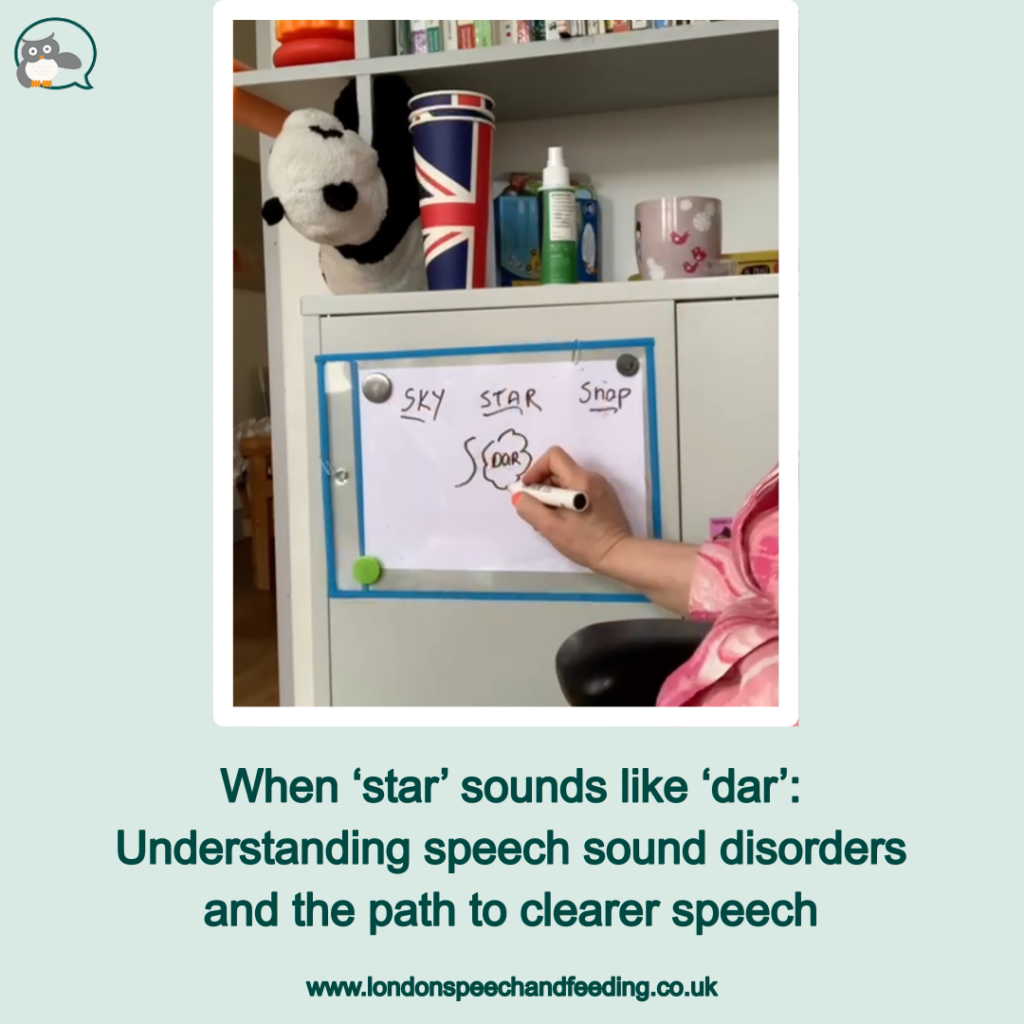
    Dropping sounds from words is a common feature of speech sound difficulties, and while it can look small on the surface, it can have a big impact on how clearly a child is understood. In this short video clip, I’m working with a child on an /ST/ sound cluster, demonstrating how I use an evidence-based speech therapy technique called backward chaining to help children build clearer speech with confidence.

    What’s actually happening when a child drops the ‘S’?

    Clusters like /ST/, /SP/, and /SK/ are tricky. They require:

    • precise timing
    • careful airflow
    • and the ability to blend sounds smoothly

    For many children, especially those with speech sound difficulties, this is a big ask.

    So instead of hearing:

    ‘star’

    we might hear:

    ‘tar’ or ‘dar’

    This isn’t laziness or refusal. It’s the child simplifying the word to make it manageable.

    Why I don’t start by saying ‘say star’

    Telling a child to ‘just add the S’ rarely works.

    Instead, I meet them where they are already successful.

    In this clip, the child can already say ‘dar’ clearly. That’s our starting point.

    Backward chaining: building speech from success

    Backward chaining means we:

    1. Start with the part of the word the child can already say
    2. Gradually add the missing sound
    3. Keep the child feeling successful at every step

    So rather than jumping straight to ‘star’, we:

    • secure the ending
    • gently introduce the /S/
    • and blend it in a way that feels achievable

    This approach reduces frustration, builds confidence, and helps the sound stick not just in the therapy room, but out in the real world.

    Why this matters beyond one word

    This isn’t just about saying ‘star’.

    It’s about:

    • teaching the mouth a new movement pattern
    • giving the brain time to organise the sound sequence
    • and helping the child feel capable, not corrected

    When therapy feels safe and successful, children are far more likely to generalise their new sounds into everyday speech.

    Speech therapy works best when children feel supported not tested.

    If your child struggles with speech clarity

    If your child:

    • drops sounds from words
    • avoids longer or trickier words
    • or becomes frustrated when they’re not understood

    This is the kind of work I do every day building speech step by step, in a way that respects each child’s pace and strengths.

    Support can be gentle, effective, and empowering.

    If you’d like to learn more about how speech therapy can support your child, you’re always welcome to get in touch.

    Sonja McGeachie

    Highly Specialist Speech and Language Therapist

    Owner of The London Speech and Feeding Practice.


    Health Professions Council registered
    Royal College of Speech & Language Therapists Member
    Member of ASLTIP

    Find a speech and language therapist for your child in London. Are you concerned about your child’s speech, feeding or communication skills and don’t know where to turn? Please contact me and we can discuss how I can help you or visit my services page.

    3
  • Tele-Speechtherapy: Online, connected, and highly effective

    A different kind of therapy. Online, connected, and highly effective

    When parents first enquire about speech and language therapy, many assume it will happen face-to-face, in a clinic room, with a therapist sitting across from their child.

    So when therapy is offered online, it’s natural for questions to arise:

    Can this really work? Will my child engage? Will progress be slower?

    This short video offers a glimpse into what online therapy can look like: calm, interactive, relationship-based, and surprisingly effective.

    Online therapy is not ‘less than’ in the right circumstances

    Teletherapy is not suitable for every child in every situation. However, for many school-aged children, particularly those who enjoy conversation, technology, and shared activities, online therapy can be an excellent fit.

    The child you see in this video is around eight years old and was supported for a persistent lisp. Sessions were primarily online, with the occasional in-person appointment when helpful.

    What made the difference was not the screen. It was the combination of engagement, support, and consistency.

    Parent involvement changes everything

    One of the greatest strengths of online therapy is the way it naturally invites parents in.

    In this case, parents regularly joined the video sessions:

    • Listening in
    • Taking part when appropriate
    • Learning how to support practice gently between sessions

    This meant that therapy didn’t stay ‘on the screen’. Strategies carried over into everyday conversation, making progress faster and more meaningful.

    Speech sound therapy, including support for lisps, relies heavily on awareness, feedback, and confidence, all of which can be supported very effectively at home with the right guidance.

    Therapy through a screen can still be deeply relational

    A common concern is whether connection can truly be built online.

    In reality, many children feel more relaxed in their own home environment. They are often more willing to talk, experiment with sounds, and reflect on their speech when they feel comfortable and supported.

    Online sessions allow:

    • Shared focus and conversation
    • Clear visual feedback
    • Real-life practice in a familiar setting
    • Immediate parent support

    For some children, this actually enhances engagement rather than limits it.

    Real progress, real outcomes

    Over the course of approximately 12 online sessions, alongside a small number of in-person appointments, this child achieved resolution of their lisp.

    Progress was steady, positive, and confidence-building. Importantly, the child remained motivated and proud of their achievements throughout the process.

    While every child’s journey is different, this example highlights what is possible when:

    • The child is ready
    • Parents are involved
    • Therapy is tailored and collaborative

    If you’re considering online therapy

    If you’re unsure whether teletherapy could work for your child, it’s worth remembering that effective speech and language therapy is less about the room you’re in, and more about:

    • Relationship
    • Understanding
    • Consistency
    • Carryover into daily life

    For many families, online therapy offers flexibility, accessibility, and excellent outcomes especially when parents are active partners in the process.

    If you’re at the start of your child’s speech journey and wondering whether online therapy could be the right fit, I’m always happy to talk it through. Sometimes clarity begins with simply understanding what therapy can look like

    Teletherapy: Frequently Asked Questions

    Is online speech and language therapy really effective?

    Yes. For many children, particularly school-aged children, online therapy can be highly effective. Progress depends far more on engagement, consistency, and support than on physical location.

    What age does online therapy work best for?

    Teletherapy often works well for children from around six years and up, especially those who can attend to a screen, enjoy conversation, and follow simple instructions. That said, suitability is always considered individually and often a supportive adult is needed to help guide the child through the activities.

    Can speech sound work (such as a lisp) really be done online?

    Absolutely. Speech sound therapy relies on clear visual feedback, listening skills, and practice all of which can be supported very effectively online. Many children respond particularly well when practising in their own home environment.

    Do parents need to be involved in sessions?

    Parental involvement is strongly encouraged. Parents may sit in, join parts of the session, or support practice between appointments. This involvement often leads to quicker progress and better carryover into everyday speech.

    Will my child still build a relationship with the therapist?

    Yes. Strong therapeutic relationships can and do develop online. Many children feel more relaxed and confident communicating from home, which can actually enhance connection and learning.

    Is online therapy suitable for every child?

    Not in my experience. Some children benefit more from in-person support, or a combination of online and face-to-face sessions. A discussion and initial assessment help determine the best approach for each child.

    Sonja McGeachie

    Highly Specialist Speech and Language Therapist

    Owner of The London Speech and Feeding Practice.

    Health Professions Council registered
    Royal College of Speech & Language Therapists Member
    Member of ASLTIP

    Find a speech and language therapist for your child in London. Are you concerned about your child’s speech, feeding or communication skills and don’t know where to turn? Please contact me and we can discuss how I can help you or visit my services page.

    3
  • · ·

    Your child’s communication journey

    Understanding our neurodiversity-affirming, child-led approach

    Welcome to a different kind of therapy!

    Your child’s communication journey

    The start of a new year often brings fresh hope, and sometimes fresh worries, for parents supporting their child’s communication. I am always genuinely excited to begin a new journey with children and their families, and I know that, for many parents, this kind of therapy may look very different from what they were expecting.

    Parents (and children!) are often surprised to discover that our sessions are playful, joyful, and intentionally low-pressure. You won’t see demands for eye contact, sitting still, or being told to ‘do it this way’ or ‘put the red square there’. Instead, you’ll see your child being met exactly where they are.

    For families who have previously experienced more adult-led or behaviour-based approaches including Applied Behaviour Therapy, this difference can feel unfamiliar at first. Because of that, I want to take a moment to prepare you for what child-led, neurodiversity-affirming therapy looks like, so you can feel confident, comfortable, and reassured from day one.

    Why doesn’t child-led therapy look like ‘traditional’ therapy?

    Many people picture speech and language therapy as sitting at a table, using flashcards, or practising words through repetition. While those approaches can work well for some children, they are often not effective or appropriate for many neurodivergent children—including children with autistic profiles, ADHD, or demand-sensitive nervous systems.

    Our approach is grounded in a simple and powerful truth:

    Children learn best when they feel safe, motivated, and emotionally connected.

    When a child’s nervous system feels calm and secure, learning becomes possible. When a child feels pressured or controlled, communication often shuts down, even if they can speak.

    🎯 Our purpose: Communication through connection

    Our goal is not simply to help your child say more words. Our goals go deeper and are built on strong foundations:

    • Trust and regulation: We focus on building a trusting relationship where your child feels safe, understood, and emotionally regulated. A calm nervous system is the starting point for all communication.
    • Motivation: We follow your child’s intrinsic motivation, the things they naturally enjoy to make communication meaningful, joyful, and purposeful.
    • Spontaneous communication: We create opportunities for your child to communicate because they want to, not because they are asked or instructed to.

    🧸 What to expect in a session

    Our sessions are intentionally child-led and often look very much like play.

    FeatureWhat it looks likeWhy we do this
    Minimal toysWe usually offer just 3–4 carefully chosen activities (such as bubbles, blocks, or sensory play).Less is more. Fewer choices reduce overwhelm and help children focus on what genuinely interests them.
    Child choosesYour child decides what to play with and how to engage.This immediately establishes us as a safe, non-demanding partner and increases motivation.
    The therapist’s roleWe join your child’s play, observing closely and responding naturally.We model language, share attention, and reflect your child’s experiences in a way that feels natural and supportive.
    No pressure or demandsThere are no ‘must-do’ tasks. If your child wants to spin, crash, line up toys, or repeat an activity, we follow.Reducing demands lowers anxiety and supports communication, particularly for children with demand-sensitive profiles.

    Is this really effective?

    It’s completely natural to wonder, ‘Are they just playing?’ The answer is yes, and very intentionally so.

    Our sessions are guided by nearly 30 years of speech and language therapy experience, alongside clear, achievable goals tailored to each individual child. Play is a child’s natural language and their most powerful learning tool.

    Within play, we are constantly creating opportunities to:

    • Build joint attention (sharing focus and interest)
    • Model language at the right level
    • Encourage back-and-forth communication
    • Develop a deep, authentic connection

    If your child has struggled to engage or communicate in more structured or demand-heavy settings, this child-led approach is often the key to unlocking their potential.

    💛 What this might look like at home

    You may notice that when pressure is reduced:

    • Your child begins communicating more during everyday routines
    • Language emerges through play, movement, or shared enjoyment
    • Communication feels more natural and less forced

    Small moments could be a shared smile, a look, a sound, a gesture. All matter. These are the building blocks of meaningful communication.

    📚 Resources for parents

    If you’d like to explore these ideas further, you may find the following helpful:

    I look forward to meeting you and your child. Please bring any questions, uncertainties, or curiosities to our first session, there is no such thing as a silly question. This is a journey we take together. Contact me via my contact form.

    Sonja McGeachie

    Highly Specialist Speech and Language Therapist

    Owner of The London Speech and Feeding Practice.


    Health Professions Council registered
    Royal College of Speech & Language Therapists Member
    Member of ASLTIP

    Find a speech and language therapist for your child in London. Are you concerned about your child’s speech, feeding or communication skills and don’t know where to turn? Please contact me and we can discuss how I can help you or visit my services page.

    3