Tele-Speechtherapy: Online, connected, and highly effective

A different kind of therapy. Online, connected, and highly effective

When parents first enquire about speech and language therapy, many assume it will happen face-to-face, in a clinic room, with a therapist sitting across from their child.

So when therapy is offered online, it’s natural for questions to arise:

Can this really work? Will my child engage? Will progress be slower?

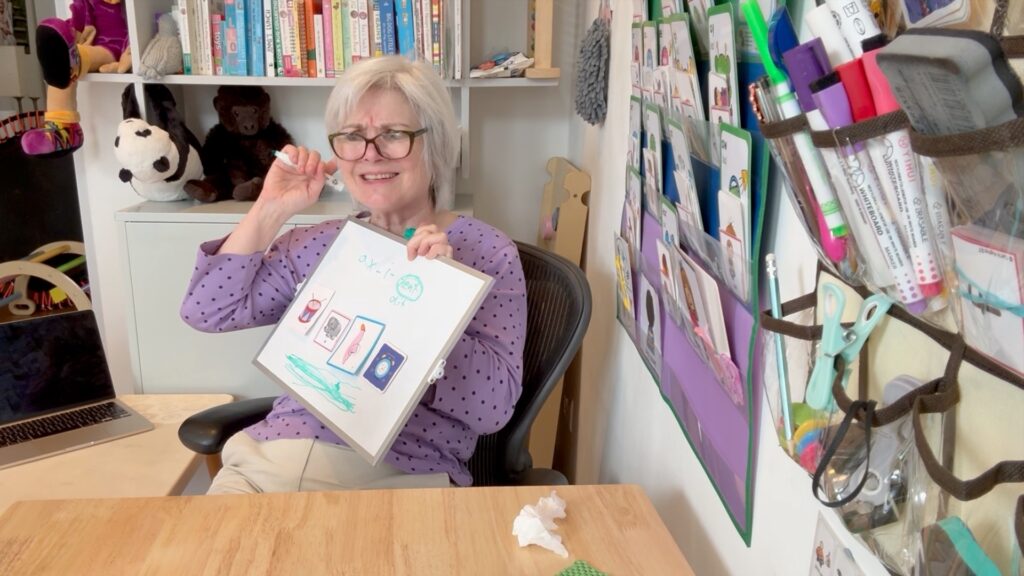
This short video offers a glimpse into what online therapy can look like: calm, interactive, relationship-based, and surprisingly effective.

Online therapy is not ‘less than’ in the right circumstances

Teletherapy is not suitable for every child in every situation. However, for many school-aged children, particularly those who enjoy conversation, technology, and shared activities, online therapy can be an excellent fit.

The child you see in this video is around eight years old and was supported for a persistent lisp. Sessions were primarily online, with the occasional in-person appointment when helpful.

What made the difference was not the screen. It was the combination of engagement, support, and consistency.

Parent involvement changes everything

One of the greatest strengths of online therapy is the way it naturally invites parents in.

In this case, parents regularly joined the video sessions:

  • Listening in
  • Taking part when appropriate
  • Learning how to support practice gently between sessions

This meant that therapy didn’t stay ‘on the screen’. Strategies carried over into everyday conversation, making progress faster and more meaningful.

Speech sound therapy, including support for lisps, relies heavily on awareness, feedback, and confidence, all of which can be supported very effectively at home with the right guidance.

Therapy through a screen can still be deeply relational

A common concern is whether connection can truly be built online.

In reality, many children feel more relaxed in their own home environment. They are often more willing to talk, experiment with sounds, and reflect on their speech when they feel comfortable and supported.

Online sessions allow:

  • Shared focus and conversation
  • Clear visual feedback
  • Real-life practice in a familiar setting
  • Immediate parent support

For some children, this actually enhances engagement rather than limits it.

Real progress, real outcomes

Over the course of approximately 12 online sessions, alongside a small number of in-person appointments, this child achieved resolution of their lisp.

Progress was steady, positive, and confidence-building. Importantly, the child remained motivated and proud of their achievements throughout the process.

While every child’s journey is different, this example highlights what is possible when:

  • The child is ready
  • Parents are involved
  • Therapy is tailored and collaborative

If you’re considering online therapy

If you’re unsure whether teletherapy could work for your child, it’s worth remembering that effective speech and language therapy is less about the room you’re in, and more about:

  • Relationship
  • Understanding
  • Consistency
  • Carryover into daily life

For many families, online therapy offers flexibility, accessibility, and excellent outcomes especially when parents are active partners in the process.

If you’re at the start of your child’s speech journey and wondering whether online therapy could be the right fit, I’m always happy to talk it through. Sometimes clarity begins with simply understanding what therapy can look like

Teletherapy: Frequently Asked Questions

Is online speech and language therapy really effective?

Yes. For many children, particularly school-aged children, online therapy can be highly effective. Progress depends far more on engagement, consistency, and support than on physical location.

What age does online therapy work best for?

Teletherapy often works well for children from around six years and up, especially those who can attend to a screen, enjoy conversation, and follow simple instructions. That said, suitability is always considered individually and often a supportive adult is needed to help guide the child through the activities.

Can speech sound work (such as a lisp) really be done online?

Absolutely. Speech sound therapy relies on clear visual feedback, listening skills, and practice all of which can be supported very effectively online. Many children respond particularly well when practising in their own home environment.

Do parents need to be involved in sessions?

Parental involvement is strongly encouraged. Parents may sit in, join parts of the session, or support practice between appointments. This involvement often leads to quicker progress and better carryover into everyday speech.

Will my child still build a relationship with the therapist?

Yes. Strong therapeutic relationships can and do develop online. Many children feel more relaxed and confident communicating from home, which can actually enhance connection and learning.

Is online therapy suitable for every child?

Not in my experience. Some children benefit more from in-person support, or a combination of online and face-to-face sessions. A discussion and initial assessment help determine the best approach for each child.

Sonja McGeachie

Highly Specialist Speech and Language Therapist

Owner of The London Speech and Feeding Practice.


Health Professions Council registered
Royal College of Speech & Language Therapists Member
Member of ASLTIP

Find a speech and language therapist for your child in London. Are you concerned about your child’s speech, feeding or communication skills and don’t know where to turn? Please contact me and we can discuss how I can help you or visit my services page.

3

Similar Posts

  • · ·

    Unveiling the hidden spectrum: Why girls and autism often go unseen

    Unveiling the hidden spectrum: Why girls and autism often go unseen
    Image by Freepik

    Autism is a complex neurodevelopmental condition characterised by social-communication challenges, restricted and repetitive behaviours, and sensory processing difficulties. While the prevalence of autism is estimated at 1 in 54 children, research suggests a significant disparity in diagnoses between genders. Boys are diagnosed with autism roughly four times more often than girls, leading us to question: Why are girls so much harder to diagnose with autism?

    The answer lies in a complex interplay of factors, including:

    1. Different presentations of autistic traits:

    • Socialisation: The stereotypical image of autism often portrays boys with aloofness and a lack of interest in social interaction. However, autistic girls may exhibit more subtle social difficulties. They may appear interested in socialising but struggle with understanding social cues, maintaining eye contact, or navigating complex social dynamics. This ability to ‘camouflage’ their challenges can lead to misinterpretations of their intentions and abilities.
    • Restricted interests: While autistic boys may have intense interests in stereotypically ‘masculine’ topics like dinosaurs or trains, girls might gravitate towards interests traditionally associated with girls, like specific characters or activities. These interests, often deemed ‘typical’ might be overlooked as potential indicators of autism.
    • Repetitive behaviours: Repetitive behaviours are another core diagnostic feature of autism. However, autistic girls may exhibit these behaviours in more subtle ways, such as intense focus on specific routines, scripting conversations, or engaging in repetitive social interactions. These subtle expressions can easily go unnoticed.

    2. The ‘camouflage’ effect:

    Autistic girls, particularly those with higher cognitive abilities, may develop coping mechanisms to mask their challenges in social situations. This ‘camouflaging’ can involve mimicking social behaviours they observe in others, leading to significant internal distress and exhaustion. This effort to appear ‘normal/typical’ can further hinder accurate diagnosis.

    3. Societal biases and diagnostic tools:

    • Gender bias: The current diagnostic criteria for autism were largely developed based on studies of boys, leading to a potential bias towards male presentations of the condition. This can result in girls who don’t exhibit the ‘typical’ symptoms being missed altogether.
    • Lack of awareness: Healthcare professionals and educators may have limited awareness of how autism manifests differently in girls. This lack of understanding can lead to misinterpretations of their behaviours and missed opportunities for diagnosis and support. I must say that this is really common in my working day. I see a child—girls or boys in this case to be fair, but mainly girls—where parents tell me: the doctor/health visitor/paediatrician has said it was ‘just a little delay’ and I am thinking ‘Really!??? What did they look at? How did they not see X Y Z’… It really is still very common.

    4. Co-occurring conditions:

    Autistic girls are more likely to experience co-occurring conditions like anxiety and depression, which can overshadow the core features of autism. This makes it even more challenging to identify the underlying autism diagnosis.

    The consequences of missed diagnoses and this goes of course for both, autistic girls AND boys!:

    The consequences of undiagnosed autism can be significant. Children may experience:

    • Lack of access to appropriate support: Without a diagnosis, children may miss out on crucial interventions and therapies that can help them manage their challenges and thrive.
    • Increased vulnerability to mental health issues: The stress of masking and navigating social complexities can lead to anxiety, depression, and other mental health challenges.
    • Difficulty forming meaningful relationships: Social difficulties and communication challenges can hinder their ability to build and maintain healthy relationships.

    Moving forward: Towards a more inclusive diagnosis:

    To ensure all individuals on the spectrum receive the support they need, it’s crucial to:

    • Increase awareness and education: Healthcare professionals, educators, and the general public need to be educated about the diverse presentations of autism in girls and of course also in boys. Let’s not forget that we are still seeing older autistic boys with diagnoses given aged 12 years and older who have slipped through the net.
    • Develop gender-neutral diagnostic tools: Diagnostic criteria and assessments should be revised to encompass the broader spectrum of autistic traits, regardless of gender.
    • Encourage open communication: Parents, caregivers, and individuals themselves should be encouraged to voice their concerns and seek evaluations, even if their experiences don’t perfectly align with stereotypical presentations of autism.

    By acknowledging the complexities of diagnosing autism, particularly in girls, and working towards a more inclusive approach, we can pave the way for earlier diagnoses, appropriate support, and a brighter future for all individuals on the autism spectrum.

    Do get in touch if you would like some in-person or on-line 1:1 support with this. It can be overwhelming to figure it all out alone.


    Find a speech and language therapist for your child in London. Are you concerned about your child’s speech, feeding or communication skills and don’t know where to turn? Please contact me and we can discuss how I can help you or visit my services page.

    1
  • ·

    Supporting children and families living with verbal dyspraxia

    “It’s brill-i-ant, it’s brill-ant, it’s brillnt”

    Have you ever wondered why children may pronounce a word correctly one minute and in the next breath they struggle to say the same word? It’s equally as frustrating for you as it is for your child. The biggest question of all is WHY? Why does this happen and what causes it? Whilst there are many explanations. When it persists, it might be a condition called verbal dyspraxia.

    What is verbal dyspraxia

    Verbal dyspraxia is a neurological motor speech disorder that affects the coordination and planning of muscle movements that are needed for speech production. A child may have difficulty making the precise movements needed for speech, which may result in inconsistent and unintelligible speech. Children may also have trouble sequencing sounds and syllables, producing speech sounds accurately, and coordinating the movements of their articulators (e.g., lips, tongue, teeth, jaw). This can lead to a range of speech errors (including sound distortions, substitutions, omissions, and difficulty with rhythm and prosody).

    We know that these speech errors, and not being able to get a message across, can be frustrating for children with speech difficulties. Can you imagine talking and limited people understanding you? It’s so tough on children and the people trying to communicate with them.

    Creating a person-centred therapy plan is vital. This allows your child to stay motivated, as intervention is likely to be long term. This planning may include favourite words to use during their hobby or favourite activity, or person-centred goals such as ‘giving Alexa an instruction’.

    Children with verbal dyspraxia can have several different ways of producing words, which often makes it trickier for them as there’s no consistent pattern to work with. So, we’ve put together some top tips to support their communication and make their (and your) lives a little easier in the process.

    Ten ways to make communication easier for your child with verbal dyspraxia

    • Have a list of frequently used words and practise this set. Little and often is best!
    • Use cued articulation to support speech production (ask your Speech and Language Therapist for the gestures)
    • Give time and use active listening. This means showing interest and trying not to think about what is on your never ending ‘to do’ list
    • Reduce frustration in any way that you can. This might mean allowing your child to demonstrate using gestures rather than speech. You might also give top tips for other adults or children who communicate with your child when out and about
    • Talk about the structure of words with your child (i.e., there are two beats/syllables in this word)
    • Show the written form of the word to go alongside their production
    • Split down tasks, so that your child only has to respond to one question at a time, reducing their motor capacity
    • Recognise when your child is working well and when they may need support of an Alternative and Augmentative Communication device
    • Allow all environments to have the same training and equipment (i.e., at school, home, out and about)
    • Have regular periods in the day where your child can practise their specific words in different environments. This can be effective for children with verbal dyspraxia

    Do you still have questions? Contact Sonja for support.


    Find a speech and language therapist for your child in London. Are you concerned about your child’s speech, feeding or communication skills and don’t know where to turn? Please contact me and we can discuss how I can help you or visit my services page.

    0
  • How can we help practise speech targets with our children during the day, without it being an “extra tedious ask”?

    Image by Freepik

    Say, your child replaces the ‘f’ sound with a ‘p’ so they say PAN when they mean FAN or POUR when they mean FOUR. Now after one or two therapy sessions we have managed to get your child to “bite your lip and blow” and we are seeing a little ‘f’ sound right there! Result! But now we need to practise this so it becomes a habit, so that we can start building up some little words like FAN and FUR and FAR or FOUR….

    Now, for older children, let’s say over 6 years old, we might just get away with saying: ‘darling come and sit down now and do your speech practice quickly before you go and play.’ But for the little ones, under 5 years old, it is often necessary to “package” the practice within daily activities.

    Daily activities

    So, our goal might be: produce an ‘f’ about 50 times a day. You might think: ‘oh gosh, I won’t be able to do that, it’s too much’, but wait! It can actually be done as part of your daily activities.

    Here are some little examples and you will be able to think of some more for sure.

    Morning

    Before brushing teeth look into the mirror together and say ‘let’s practise our “bunny sound” quickly: bite your lip and blow: FFF FFF FFF FFF FFF FFF FFFF’. Look in the mirror, get as many done here as possible, 10-15, RESULT! Now brush teeth and done.

    Mid-morning snack

    A … muffin? Pop a little birthday candle on it and say: ‘let’s practice our Bunny Sound here quickly: bite your lip and blow and try and blow out this candle.’ FFF FFF FFF FFF FFF (you might have to re-light it a few times). Do 10-15, now eat the cake, done!

    Play

    Pretend to fly an aeroplane and say: “’oh look, I can make the ‘bunny sound’ and make a noise at the same time VVV VVV VVV VVV VVV. That’s cool, let’s try. Ten times?’

    Lunch

    ‘Oh, that soup is a bit hot, let’s blow it, let’s do it with our “bunny sound”: FFF FFF FFF.’ Do ten and by now you have done most if not all of your repeats.

    Book time

    Select a book with a lot of ‘f’ sounds it in or a book with bunnies (your Speech Therapist will make suggestions). Read the book together with your child and each time there is a bunny or a fish practise the FFF FFF FFF FFF.

    By now you will probably have exceeded your target of 50 times FFFs a day!!

    Story telling

    Now for something different like “Story Telling”: your child’s goal might be: “to talk about what’s first, then, next and finally”.

    Examples:

    Tooth brushing

    Ask your child to think about what is first, what’s next and then last before you start brushing teeth.

    Meal times

    Talk about what did we eat the other day at Nando’s? ‘First, I had xxx then I had xxx. What about you?’ Or as you are about to lay the table: ‘what do we need to do first, then and then?’

    Dressing

    Pretend to be an alien who does not know what to do first, get it all wrong and have a laugh… ‘oh I think those underpants must go on my head?!’ Etc

    Play time

    Use figurines with farms or Lego houses or Playmobil and help your child make up simple little stories using first, then next and last.

    Books

    Share a book with a clear start, middle and finish and talk about the characters, who does what, who is first, then and then and finally.

    At the end of each session with your child we will talk about what the targets for the week will be and together we can think about how you can incorporate your practice easily into your daily life, no matter how busy you are!

    Be sure to bring this up next time you have your session, so that we can figure out together what will work for you and your daily schedules.

    Together we can make it happen!

    Sonja


    Find a speech and language therapist for your child in London. Are you concerned about your child’s speech, feeding or communication skills and don’t know where to turn? Please contact me and we can discuss how I can help you or visit my services page.

    0
  • · ·

    Why ‘Prosody’ Matters in Childhood Apraxia of Speech (CAS)

    Prosody refers to the ‘music’ of speech — the rhythm, pitch, stress, and volume that convey meaning and emotion beyond the literal words themselves. Think about a monotone statement like ‘Really?’ compared to one with a rising inflection, expressing genuine curiosity.

    When I work with children on producing speech sound sequences, we focus on mastering individual sounds and then putting them together into target words. A crucial element that can significantly impact a child’s speech production is ‘prosody’.

    In CAS, where the difficulty lies in planning and executing the motor movements for speech, prosody can be a powerful tool for producing clearer words and phrases.

    Here’s why working on prosody is an essential tool in CAS speech therapy:

    1.  It aids Motor Learning:

    Apraxia of Speech means that the planning and execution of speech movements are impaired. When we use exaggerated intonation or stress patterns while modelling words, we are providing additional prosodic variation and, therefore, additional auditory cues. These cues often help my student to carry out the correct motor movements for a word or syllable sequence.

    For instance, I might say ‘ball’ with a high-pitched emphasis on the ‘b’ sound. This auditory cue might be more effective in guiding the child’s tongue placement than simply repeating the word without variation.

    In this little video clip I get my student to say the word ‘snuggle’ (since we were working on that particular sound sequence: snuggle, snout, snore and sneeze) with a high voice and then a lower voice ‘like a bear’ — again it provides that extra auditory cue, but, in addition, the fun aspect also helps to take away the intense focus on a tricky movement pattern.

    By now the new pathways have been laid through repeated practice and now automaticity takes over and without too much effort my student can suddenly produce a motor pattern. It’s magical when it happens and gives me such a thrill.

    2. It makes speech more engaging and natural sounding:

    Children with CAS often sound robotic or flat due to challenges with prosodic elements. By incorporating variations in pitch, volume, and rhythm during therapy, we can help achieve a more natural flow of speech

    3. It makes it easier to express our emotions:

    Children with CAS often struggle to express themselves emotionally; partly through the difficulty of producing clear words — period, but also in addition due to the difficulties or absence of musicality and rhythm in their speech.

    Therefore, it is so important to incorporate activities focused on practising different emotions with varied intonation patterns. This can really empower our students to put emotions into their words.

    Good words to practise are fun words like ‘Wow!’ or ‘Yeiih’ or power words and phrases like ‘No!’ or ‘Gimme that’ etc.

    Making Therapy Fun and Engaging:

    Speech therapy for CAS doesn’t have to be all drills and exercises (though to be fair sometimes we can’t quite get round to making each and every word huge fun though we try…).

    I aim to make all my sessions fun and have intrinsic rewards built into the speech practice where possible.

    Home practice tips:

    Therapy shouldn’t exist in a bubble. Working on prosody during sessions is crucial, but it’s equally important to integrate these skills into everyday interactions. Parents and caregivers can model appropriate prosody during playtime, story time, or even simple conversations. This consistent reinforcement helps our children to generalise their newfound skills and use them naturally in their daily lives.

    • Sing songs and rhymes: Songs naturally incorporate variations in pitch and rhythm. Singing familiar songs and creating silly rhymes can be a delightful way to practise prosody.
    • Use puppets and toys: Assign different voices and personalities to puppets or toys. This encourages children to experiment with pitch and volume to differentiate characters.
    • Read aloud with enthusiasm: Model expressive reading, varying your voice for different characters and emphasising key words. This makes reading time engaging and helps children understand the power of prosody.

    Please feel free to contact me if your child has speech sound difficulties. It is my passion. I love supporting children with apraxia.

    Sonja McGeachie

    Early Intervention Speech and Language Therapist

    Feeding and Dysphagia (Swallowing) Specialist The London Speech and Feeding Practice

    The London Speech and Feeding Practice


    Find a speech and language therapist for your child in London. Are you concerned about your child’s speech, feeding or communication skills and don’t know where to turn? Please contact me and we can discuss how I can help you or visit my services page.

    1
  • · · ·

    Developing Joint Attention

    Image by Freepik

    Joint attention skills what are they and how can we facilitate those?

    Most of us want to make friends, connect with others and bond with a friend or be part of a community. To do so we need to develop an important social skill which is: initiating, responding to, and maintaining ‘shared/joint attention’ with another. When we can do this, we are able to focus on the same thing with another person or a group of people: music, hobbies, sport, art, books, toys, games or memories: remember when we did x y z…

    Many children who struggle with speech and language development are not able to share or hold attention with another person very easily. My latest blog is all about what we can do to help our children develop Joint Attention.

    So to re-cap, joint or shared attention happens when one person gets the other’s attention by either words, or gestures like pointing to something and saying ‘OMG look over there!’ – both people look at that same thing.

    What does it take to have or develop this skill?

    We need to first of all find something of interest that captivates our own attention. This part is usually not difficult for most people or children.

    Then, crucially, we need to direct our focus away from what we find interesting, for long enough to get another person’s attention onto the same topic. This could be just seconds or it could be longer if we are very determined and good at embracing others into our experience. But if we are not then it must not take longer than seconds!

    Let me give an example: if someone is in the room with me whilst I see something strange out the window, I would take that second to draw their attention to it. However, I might not be bothered to run upstairs and find someone only to show them something odd outside in the road. If I am very bored, I might do! But as I am rarely bored it is unlikely. So, unless someone else is right here with me, they are not going to be part of that particular experience, I would not share it.

    Back to our child: if we make it difficult for a child who is not naturally inclined to share an interest then it is not going to happen. We must be ready, and right there for our child to have that fleeting second to look at us before returning to their hobby/interest.

    This skill ‘to share a moment’ tends to develop around 12 months of age and starts with a child pointing to things. Prior to that, our child might give us something or come to show us a thing. Joint attention underpins language skills and is strong predictors of later language development (Law et al, 2017).

    What are the signs that my child is struggling with Joint Attention?

    • Tunes out or does not respond when I call their name
    • Cannot follow my suggestions for games or toys/play activities
    • Does not point to anything of interest, like a truck passing by, or an aeroplane in the sky
    • Ignores or does not respond to what I say, does not follow instructions, only when he/she wants to

    What can I do to help with this?

    Here are some ideas you can follow in no particular order – see which one sticks:

    1. Get down to your child’s eye/face level, we call it ‘face to face’. It does not require your child to make eye contact with you but they might just do so more easily if you are ‘just there’ and don’t have to crook their neck to look up at you. When reading a book with your child, instead of sitting behind try sitting opposite him/her.
    2. Mirror play – making funny faces together in a mirror can be fun.
    3. COPY your child: top tip!! Imitate your child’s vocalisations and actions. Even if these are repetitive, just enjoy the ride.
    4. Follow your child and let your child take the lead in the play activity. What does that look like? The adult has no agenda, does not want to teach, to ask questions (see point number 9) does not want to direct or show the child how to ‘do it better/differently’ – instead accept that the child is the boss when it comes to their play and take their lead in how a toy should be played with.
    5. Hold up objects to your face or at eye level so that your child can see your face and the item at the same time.
    6. Be the ‘funniest thing’ in the room; be hugely entertaining, watchable and offer the ‘irresistible invitation’ to look at you or play with you.
    7. Offer PEOPLE TOYS (any toy where another person is needed to have fun) so: wind-up toys, bubbles, anything that needs opening or holding or doing which is tricky for the child to do alone. I always try and hide the buttons that make something ‘go’ so that my child needs to come back to me for ‘more/again’.
    8. Do PEOPLE GAMES – as above really but games that do not need a toy, that need another person to have fun: being swung round, row row the boat, being pushed on a swing etc.
    9. REDUCE ASKING QUESTIONS – this is my favourite top tip!!! Instead of asking lots of questions try and make simple statements/comments on what is happening so there is absolutely no pressure on your child to ‘perform’. Equally, silence is actually golden sometimes! An odd bit of advice from a speech therapist? Try sitting with your child, next to them or opposite and just don’t talk but simply BE… yes easier said than done, I do know this. Turn off your phone (OMG did I just say that!?) yes, please turn it off and just be with your child for a little while, just like a comfy buddy who is just enjoying their company with no agenda. You might be very surprised how your child suddenly seeks you out!

    I will write about more ideas on this in my next blog so look out for more play ideas to encourage Joint Attention.

    Most important, try and have fun with your child. Think about what is fun for her or him. And make it EASY for your child, remember unless you are ‘right there’ it might not happen so easily.

    Happy New Year!

    If you need help with your child, please do not hesitate to contact me.


    Find a speech and language therapist for your child in London. Are you concerned about your child’s speech, feeding or communication skills and don’t know where to turn? Please contact me and we can discuss how I can help you or visit my services page.

    0
  • The tricky /R/: Mastering tongue placement for clear speech

    The /R/ sound is notoriously challenging for many children (and even some adults!). It’s one of the most complex sounds in the English language, with various pronunciations depending on its position in a word. If your child is struggling with their /R/s, you’re not alone. As Speech and Language Therapists (SLTs), we frequently work on this sound, and a key component of our therapy is focusing on proper tongue placement.

    Why is the /R/ so difficult?

    The /R/ sound requires precise coordination of the tongue, jaw, and lips. Unlike sounds like /P/ or /B/ that involve simple lip movements, the /R/ involves intricate tongue movements and tension. There are also different ways to produce the /R/ sound, which adds to the complexity:

    • Retroflex /R/: The tongue tip curls up and back towards the roof of the mouth.
    • Bunched /R/: The body of the tongue bunches up towards the roof of the mouth, while the tongue tip remains down.

    The importance of tongue placement

    Regardless of which /R/ variation is being targeted, accurate tongue placement is crucial. Even a slight deviation can result in a distorted or inaccurate sound. That’s why SLTs dedicate significant time to teaching and practising tongue positioning.

    Speech therapy techniques: Focusing on the tongue

    Here’s a glimpse into how I address /R/ sound difficulties, with a focus on tongue placement:

    • Visual aids:
      • Mirrors: I use a mirror to help children see their tongue movements and make adjustments.
      • Tongue diagrams and models: These visual tools provide a clear representation of where the tongue should be positioned.
    • Tactile cues:
      • Tongue depressors: These can be used to gently guide the tongue into the correct position.
      • Food-grade tools: Sometimes, I use flavoured tongue depressors or other tools to provide tactile feedback and increase awareness of tongue placement.
    • Auditory discrimination:
      • I help children distinguish between correct and incorrect /R/ sounds.
      • I use auditory cues and verbal feedback to reinforce proper pronunciation.
    • Exercises and drills:
      • Tongue strengthening exercises: Strengthening the tongue muscles can improve control and coordination.
      • Tongue placement drills: We practise positioning the tongue in the desired location and holding it there.
      • Sound approximation techniques: Sometimes we use other sounds to help approximate the /R/ sound. For example, I use the /L/ sound, to help achieve the correct tongue placement. Once my child has found the /L/ sound it is then a matter of pulling back just slightly to get a good /R/.
    • Contextual practice:
      • Once the child can produce the /R/ sound in isolation, we gradually introduce it into syllables, words, phrases, and sentences.
      • We also practise the /R/ sound in different contexts, such as at the beginning, middle, and end of words.

    Tips for Parents:

    • Be patient and supportive: Learning the /R/ sound takes time and practice.
    • Practise regularly: Short, frequent practice sessions are more effective than long, infrequent ones.
    • Make it fun! Use games, stories, and other engaging activities to keep your child motivated.
    • Work with an SLT: A qualified SLT can provide personalised guidance and support.

    In conclusion:

    The /R/ sound can be challenging, but with targeted speech therapy and a focus on tongue placement, most children can achieve clear and accurate pronunciation.

    I hope this blog post is helpful!

    Get in touch with me via my contact form if you need support

    Sonja McGeachie

    Early Intervention Speech and Language Therapist

    Feeding and Dysphagia (Swallowing) Specialist The London Speech and Feeding Practice

    The London Speech and Feeding Practice


    Find a speech and language therapist for your child in London. Are you concerned about your child’s speech, feeding or communication skills and don’t know where to turn? Please contact me and we can discuss how I can help you or visit my services page.
    1