Milestones of Autistic Children: Crawling, Walking, and Talking

|

For all children every milestone achieved is a testament to the unique and intricate process unfolding within each young mind. For autistic children, this journey may present a distinct pattern, with some reaching developmental milestones like crawling, walking, and talking later than their neurotypical peers. Let’s have a look into the fascinating realm of Autism and explore why some autistic children might crawl, walk, and talk later, shedding light on the underlying factors contributing to this unique way of developing.

1. Individual Pacing:

Child development is not a one-size-fits-all journey. Each child, whether neurotypical or autistic, has a unique timeline for achieving milestones. Autistic children, like any other children, follow their own pacing. This individual rhythm might lead them to focus on one set of skills before they progress to others. Like some neurotypical children might focus on talking earlier than walking, autistic children might prioritise other areas before crawling or talking.

2. Neurodevelopmental Complexity:

The human brain is a remarkable entity, with a bewildering array of interconnected processes that lead to us achieving our developmental milestones. Autistic children often have variations in “neural wiring”, which can impact the balance between gross motor skills (crawling, walking) and fine motor skills. Speech and language acquisition falls under fine motor skills and may be momentarily disrupted due to the divergent neurological pathways at play in autism.

2. Sensory Processing Differences:

One of the hallmarks of autism is altered sensory processing. Autistic children often experience sensory stimuli differently than their neurotypical peers. This heightened or diminished sensitivity can influence a child’s desire or ability to engage in activities like crawling and walking. The sensation of movement while crawling or walking, for instance, might be overwhelming for some autistic children, causing them to either avoid or delay these activities.

3. Visual-Spatial Abilities:

Autistic children and adults frequently display excellent visual-spatial abilities. This strength might lead some children to focus more on activities that engage these skills, potentially delaying their engagement with activities like walking or talking. As they navigate their environment and process information visually, they might naturally invest more time in activities that stimulate this particular cognitive ability and strength.

4. Communication Challenges:

For many autistic children, speaking can be a really complex and difficult endeavour. Communication delays are a common feature of autism. This can affect both receptive and expressive language development. While some children might be physically capable of crawling or walking, they may not yet have the tools to communicate their desires and intentions. This leads to a temporary focus on non-speaking forms of expression. This does not mean that they do not communicate at all. But autistic individuals often start out using jargoning or echolalia as a form of communication as well as behaviours and physical forms of communication.

5. Executive Functioning and Motor Skills:

Executive functioning, or abilities for planning, organising, and carrying out tasks, can vary in autistic children. These skills are crucial for activities like crawling, walking, and talking, which need coordination and planning. About 40% of autistic persons have a motor planning difficulty.

6. Intense Interests and Routines:

Autistic children often develop intense interests in specific subjects, sometimes to the exclusion of other activities. These interests might become their primary mode of engagement. They might side-line milestones like crawling, walking, or talking. The mostly rigid adherence to routines and preferences might cause them to allocate more time to their preferred activities. This delays their engagement with other developmental tasks.

How can Speech and Language Therapy help:

Support and Intervention:

Early intervention and regular Speech and Language Therapy play a pivotal role in the developmental journey of autistic children. Therapies tailored to individual needs can aid in bridging the gaps between milestones. Occupational therapy, for example, can help address sensory sensitivities and motor skill challenges that might impact crawling and walking. Speech therapy can help communication development, gradually bridging the gap between non-verbal expressions and spoken language.

For example, we now know that echolalia or jargoning of longer phrases with intonation, repeating scripts from favourite tv shows or songs have many meanings and communicative functions. For example, a child who utters long strings of echolalic utterances, often difficult to understand, might want to do any one of the following:

  • Comment
  • greet
  • ask a question
  • make a request
  • express surprise
  • negate something.

We now understand that the way to support a child with echolalia is to acknowledge all utterances and try and find out what the meaning is behind these scripts. This is very supportive. Over time it will lead a child to move on to understanding and saying more clear and self-generated language. For more information about this Natural Language Acquisition here are some other great websites for you to look at:

Conclusion

In conclusion, the journey of an autistic child’s development is a testament to the uniqueness and complexity of the human mind. The delays or differences in achieving milestones like crawling, walking, and talking can be attributed to a range of factors, including

  • neurodevelopmental intricacies,
  • sensory processing variations,
  • and communication challenges.

It’s crucial to recognise that these delays are not indicative of a lack of potential, but rather a manifestation of the intricate interplay between an autistic child’s strengths and challenges. By embracing these differences and providing tailored support, we can help each autistic child unfold their potential at their own pace.

Do get in touch if you would like to book an appointment where we can explore how to help your child develop and thrive

Do get in touch if you would like to book an appointment where we can explore how to help your child develop and thrive


Find a speech and language therapist for your child in London. Are you concerned about your child’s speech, feeding or communication skills and don’t know where to turn? Please contact me and we can discuss how I can help you or visit my services page.
0

Similar Posts

  • · ·

    Using AAC in daily life

    Communication is a fundamental human right, a bridge that connects us to the world and each other. For many, spoken language is the primary mode, but for individuals with complex communication needs, Augmentative and Alternative Communication (AAC) offers a powerful pathway to expression and connection. This guide will demystify AAC, highlight the crucial role of modelling, and provide practical examples of how low-tech AAC can be seamlessly integrated into everyday activities.

    What is AAC in a nutshell?

    AAC encompasses a wide range of tools and strategies that supplement or replace spoken language. It’s not about replacing speech, but rather about providing additional ways for individuals to communicate effectively. Think of it as a spectrum:

    • Unaided AAC: This involves using only your body, such as gestures, facial expressions, body language, and sign language.
    • Aided AAC: This involves external tools or devices. These can range from low-tech options like picture boards and communication books to high-tech speech-generating devices (SGDs) and apps on tablets.

    The beauty of AAC lies in its flexibility and personalisation. It empowers individuals to express their wants, needs, thoughts, and feelings, fostering independence and participation in all aspects of life.

    Modelling is KEY: Showing, not just telling

    Imagine trying to learn a new language without ever hearing it spoken. It would be incredibly difficult, right? The same principle applies to AAC. Modelling is the single most important strategy for teaching and supporting AAC users. It means actively using the AAC system yourself while talking, demonstrating how to navigate the system and express messages.

    Here’s why modelling is so vital:

    • It’s how we learn language: Typically developing children learn language by hearing it constantly around them. AAC users need the same immersion.
    • It reduces pressure: When you model, you’re not asking the individual to communicate, you’re just showing them how it’s done. This takes the pressure off and makes learning more enjoyable.
    • It expands vocabulary and concepts: By modelling a variety of words and phrases, you introduce new vocabulary and demonstrate how to combine symbols to create more complex messages.
    • It demonstrates purpose: Modelling shows that AAC is a functional and effective way to communicate, not just a set of pictures.

    So, how do you model? It’s simple: point to the symbols on the communication board or device as you speak the words. For example, if you say, ‘Time to eat breakfast,’ you might point to ‘time’, ‘eat’, and ‘breakfast’ on the board.

    Low-tech AAC in action: Everyday activities

    Low-tech AAC, such as communication boards, books, or single-page displays, is incredibly versatile and can be easily incorporated into daily routines. These can be as simple as printed pages with symbols, laminated for durability.

    Let’s explore how low-tech AAC can be used throughout a typical day, with examples of symbols:

    1. Getting ready for nursery

    Mornings can be busy, but they also offer rich communication opportunities. A ‘Getting Ready’ communication board can help sequence activities and offer choices.

    Activity example:

    ‘Time to get up!’ (point to GET UP). ‘What do you want to wear today, the blue shirt or the red shirt?’ (point to GET DRESSED) ‘Then, we brush teeth’ (point to TOOTHBRUSH) and so on.

    AAC mornings symbol examples

    2. Breakfast Time

    Mealtimes are perfect for making choices, expressing preferences, and commenting. A ‘Breakfast’ communication board can focus on food items, actions, and social comments.

    Example symbols:

    AAC meal times symbol examples

    Activity example:

    ‘What do you want to eat for breakfast?’ (point to EAT). ‘Do you want cereal or toast?’ (point to CEREAL or TOAST). If they finish their milk, you could say, ‘Are you ALL DONE or do you want MORE MILK?’ (point to symbols).

    3. Catching the Bus

    Even routine transitions like catching the bus can be communication rich. A small, portable ‘Travel’ board can be useful.

    Example symbols:

    AAC catching the bus symbol examples

    3. Being on the playground

    The playground is a dynamic environment perfect for commenting, requesting actions, and engaging in social play.

    AAC playground symbol examples

    Activity example:

    ‘Let’s PLAY!’ (point to PLAY). ‘Do you want to go on the SWING or the SLIDE?’ (point to symbols). If they are on the swing, you can say, ‘Do you want to go FAST or SLOW?’ (point to symbols) and ‘Push AGAIN!’ (point to PUSH) You can also model social language like ‘It’s MY TURN.’

    Beyond the symbols: Key takeaways

    • Consistency is key: Use AAC consistently across all environments and with all communication partners.
    • Be patient: Learning a new language takes time. Celebrate small successes.
    • Make it fun: Integrate AAC into play and enjoyable activities.
    • Follow the individual’s lead: Respond to all communication attempts, even if they are imperfect.

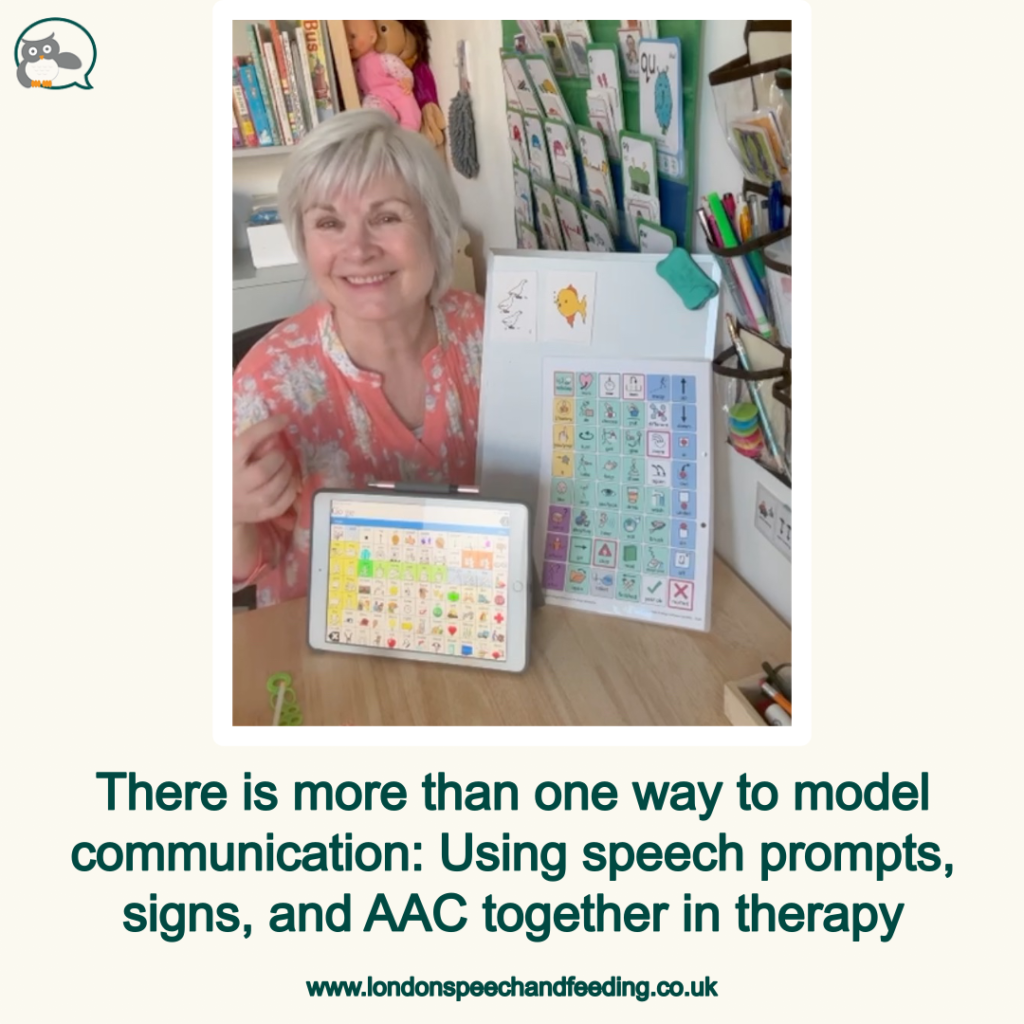
    In the video below I model how to integrate AAC into everyday activities with a few more examples and I discuss the difference between AAC and PECS.

    If you need some inspiration with using AAC or would like your child assessed for the right type of AAC then please get in touch.

    Sonja McGeachie

    Highly Specialist Speech and Language Therapist

    Owner of The London Speech and Feeding Practice.


    Health Professions Council registered
    Royal College of Speech & Language Therapists Member
    Member of ASLTIP

    Find a speech and language therapist for your child in London. Are you concerned about your child’s speech, feeding or communication skills and don’t know where to turn? Please contact me and we can discuss how I can help you or visit my services page.

    1
  • Tele-Speechtherapy: Online, connected, and highly effective

    A different kind of therapy. Online, connected, and highly effective

    When parents first enquire about speech and language therapy, many assume it will happen face-to-face, in a clinic room, with a therapist sitting across from their child.

    So when therapy is offered online, it’s natural for questions to arise:

    Can this really work? Will my child engage? Will progress be slower?

    This short video offers a glimpse into what online therapy can look like: calm, interactive, relationship-based, and surprisingly effective.

    Online therapy is not ‘less than’ in the right circumstances

    Teletherapy is not suitable for every child in every situation. However, for many school-aged children, particularly those who enjoy conversation, technology, and shared activities, online therapy can be an excellent fit.

    The child you see in this video is around eight years old and was supported for a persistent lisp. Sessions were primarily online, with the occasional in-person appointment when helpful.

    What made the difference was not the screen. It was the combination of engagement, support, and consistency.

    Parent involvement changes everything

    One of the greatest strengths of online therapy is the way it naturally invites parents in.

    In this case, parents regularly joined the video sessions:

    • Listening in
    • Taking part when appropriate
    • Learning how to support practice gently between sessions

    This meant that therapy didn’t stay ‘on the screen’. Strategies carried over into everyday conversation, making progress faster and more meaningful.

    Speech sound therapy, including support for lisps, relies heavily on awareness, feedback, and confidence, all of which can be supported very effectively at home with the right guidance.

    Therapy through a screen can still be deeply relational

    A common concern is whether connection can truly be built online.

    In reality, many children feel more relaxed in their own home environment. They are often more willing to talk, experiment with sounds, and reflect on their speech when they feel comfortable and supported.

    Online sessions allow:

    • Shared focus and conversation
    • Clear visual feedback
    • Real-life practice in a familiar setting
    • Immediate parent support

    For some children, this actually enhances engagement rather than limits it.

    Real progress, real outcomes

    Over the course of approximately 12 online sessions, alongside a small number of in-person appointments, this child achieved resolution of their lisp.

    Progress was steady, positive, and confidence-building. Importantly, the child remained motivated and proud of their achievements throughout the process.

    While every child’s journey is different, this example highlights what is possible when:

    • The child is ready
    • Parents are involved
    • Therapy is tailored and collaborative

    If you’re considering online therapy

    If you’re unsure whether teletherapy could work for your child, it’s worth remembering that effective speech and language therapy is less about the room you’re in, and more about:

    • Relationship
    • Understanding
    • Consistency
    • Carryover into daily life

    For many families, online therapy offers flexibility, accessibility, and excellent outcomes especially when parents are active partners in the process.

    If you’re at the start of your child’s speech journey and wondering whether online therapy could be the right fit, I’m always happy to talk it through. Sometimes clarity begins with simply understanding what therapy can look like

    Teletherapy: Frequently Asked Questions

    Is online speech and language therapy really effective?

    Yes. For many children, particularly school-aged children, online therapy can be highly effective. Progress depends far more on engagement, consistency, and support than on physical location.

    What age does online therapy work best for?

    Teletherapy often works well for children from around six years and up, especially those who can attend to a screen, enjoy conversation, and follow simple instructions. That said, suitability is always considered individually and often a supportive adult is needed to help guide the child through the activities.

    Can speech sound work (such as a lisp) really be done online?

    Absolutely. Speech sound therapy relies on clear visual feedback, listening skills, and practice all of which can be supported very effectively online. Many children respond particularly well when practising in their own home environment.

    Do parents need to be involved in sessions?

    Parental involvement is strongly encouraged. Parents may sit in, join parts of the session, or support practice between appointments. This involvement often leads to quicker progress and better carryover into everyday speech.

    Will my child still build a relationship with the therapist?

    Yes. Strong therapeutic relationships can and do develop online. Many children feel more relaxed and confident communicating from home, which can actually enhance connection and learning.

    Is online therapy suitable for every child?

    Not in my experience. Some children benefit more from in-person support, or a combination of online and face-to-face sessions. A discussion and initial assessment help determine the best approach for each child.

    Sonja McGeachie

    Highly Specialist Speech and Language Therapist

    Owner of The London Speech and Feeding Practice.


    Health Professions Council registered
    Royal College of Speech & Language Therapists Member
    Member of ASLTIP

    Find a speech and language therapist for your child in London. Are you concerned about your child’s speech, feeding or communication skills and don’t know where to turn? Please contact me and we can discuss how I can help you or visit my services page.

    3
  • · · ·

    Autism – Benefits of Early Assessment and Intervention

    I think my child might be autistic – how can we help?
    Image by macrovector on Freepik

    Consulting a Specialist Speech and Language Therapist can help you in several ways: assessment, informal and formal observation, discussion and advice, onward referrals, direct intervention, parent coaching, educational support and much more, all geared towards supporting you the parents, and helping your child to flourish and thrive.

    First up, we can help you with assessment and advice: with a wealth of expertise in observing childrens’ play and communication, as well as knowledge of the latest research we can see a child’s strengths and areas of struggle very quickly indeed.

    Within a short space of time, we can identify the areas we need to focus on and start guiding you towards helping your child to connect, respond, react and feel better.

    Early detection is key

    If autism is detected in infancy, then therapy can take full advantage of the brain’s plasticity. It is hard to diagnose Autism before 18 months but there are early signs we know to look out for. Let’s have a brief look at the sorts of things we look at.

    The earliest signs of Autism involve more of an absence of typical behaviours and not the presence of atypical ones.

    • Often the earliest signs are that a baby is very quiet and undemanding. Some babies don’t respond to being cuddled or spoken to. Baby is being described as a ‘good baby, so quiet, no trouble at all’.
    • Baby is very object focused: he/she may look for long periods of time at a red spot/twinkly item further away, at the corner of the room for example.
    • Baby does not make eye contact: we can often see that a baby looks at your glasses for example instead of ‘connecting’ with your eyes.
    • At around 4 months we should see a baby copying adults’ facial expressions and some body movements, gestures and then increasingly cooing sounds we make; babies who were later diagnosed with autism were not seen to be doing this.
    • Baby does not respond with smiles by about 6 months.
    • By about 9 months, baby does not share sounds in a back-and-forth fashion.
    • By about 12 months baby does not respond/turn their heads when their name is called.
    • By around 16 months we have no spoken words; perhaps we hear sounds that sound like ‘speech’ but we cannot make out what the sounds are.
    • By about 24 months we see no meaningful two-word combinations that are self-generated by the toddler. We might see some copying of single words.

    24 months plus:

    • Our child is not interested in other children or people and seems unaware of others in the same room/play area.
    • Our child prefers to play alone, and dislikes being touched, held or cuddled.
    • He/she does not share an interest or draw attention to their own achievements e.g., ‘daddy look I got a dog’.
    • We can see our child not being aware that others are talking to them.
    • We see very little creative pretend play.
    • In the nursery our child might be rough with other children, pushing, pinching or scratching, biting sometimes; or our child might simply not interact with others and be unable to sit in a circle when asked to.

    What sort of speech and language difficulties might we see?

    Our child might do any of the following:

    • have no speech at all, but uses body movements to request things, takes adults by the hand
    • repeat the same word or phrase over and over; sometimes straight away after we have said it or sometimes hours later
    • repeat phrases and songs from adverts or videos, nursery rhymes or what dad says every day when he gets back from work etc.
    • copy our way of intonation
    • not understand questions – and respond by repeating the question just asked:
      • adult: Do you want apple? child: do you want apple?
    • not understand directions or only high frequency directions in daily life
    • avoid eye contact or sometimes ‘stares’
    • lack of pointing or other gestures

    Common behaviours:

    • Hand flapping
    • Rocking back-and-forth
    • Finger flicking or wriggling/moving
    • Lining up items/toys
    • Wheel spinning, spinning around self
    • Flicking lights on and off, or other switches
    • Running back-and-forth in the room, needing to touch each wall/door
    • Loud screaming when excited
    • Bashing ears when frustrated or excited
    • Atypical postures or walking, tip toeing, can be falling over easily, uncoordinated
    • Can be hyper sensitive to noises, smells, textures, foods, clothing, hair cutting, washing etc.
    • Being rigid and inflexible, needing to stick to routines, unable to transition into new environments
    • Food sensitivity, food avoidance, food phobias

    I mentioned this to be a ‘brief’ look at the areas and it is: each topic is looked at very deeply and each area is multi-facetted therefore a diagnosis is rarely arrived at very quickly. We want to make sure we have covered all aspects and have got to know your child very well before coming to conclusions.

    Early detection is key, because we want to start helping your child to make progress as quickly as is possible. If you feel /know that your child is delayed in their speech and language development and you would like a professional opinion then please do contact me, I look forward to supporting you. It is important to know at this point, that if your child only has one or two of the above aspects it may mean that your child is simply delayed for reasons other than Autism and if that is the case, we will be able to help you iron out a few areas of need so that your child can go on thriving.

    If you need help with your child, please do not hesitate to contact me.


    Find a speech and language therapist for your child in London. Are you concerned about your child’s speech, feeding or communication skills and don’t know where to turn? Please contact me and we can discuss how I can help you or visit my services page.
    1
  • · ·

    Unveiling the hidden spectrum: Why girls and autism often go unseen

    Unveiling the hidden spectrum: Why girls and autism often go unseen
    Image by Freepik

    Autism is a complex neurodevelopmental condition characterised by social-communication challenges, restricted and repetitive behaviours, and sensory processing difficulties. While the prevalence of autism is estimated at 1 in 54 children, research suggests a significant disparity in diagnoses between genders. Boys are diagnosed with autism roughly four times more often than girls, leading us to question: Why are girls so much harder to diagnose with autism?

    The answer lies in a complex interplay of factors, including:

    1. Different presentations of autistic traits:

    • Socialisation: The stereotypical image of autism often portrays boys with aloofness and a lack of interest in social interaction. However, autistic girls may exhibit more subtle social difficulties. They may appear interested in socialising but struggle with understanding social cues, maintaining eye contact, or navigating complex social dynamics. This ability to ‘camouflage’ their challenges can lead to misinterpretations of their intentions and abilities.
    • Restricted interests: While autistic boys may have intense interests in stereotypically ‘masculine’ topics like dinosaurs or trains, girls might gravitate towards interests traditionally associated with girls, like specific characters or activities. These interests, often deemed ‘typical’ might be overlooked as potential indicators of autism.
    • Repetitive behaviours: Repetitive behaviours are another core diagnostic feature of autism. However, autistic girls may exhibit these behaviours in more subtle ways, such as intense focus on specific routines, scripting conversations, or engaging in repetitive social interactions. These subtle expressions can easily go unnoticed.

    2. The ‘camouflage’ effect:

    Autistic girls, particularly those with higher cognitive abilities, may develop coping mechanisms to mask their challenges in social situations. This ‘camouflaging’ can involve mimicking social behaviours they observe in others, leading to significant internal distress and exhaustion. This effort to appear ‘normal/typical’ can further hinder accurate diagnosis.

    3. Societal biases and diagnostic tools:

    • Gender bias: The current diagnostic criteria for autism were largely developed based on studies of boys, leading to a potential bias towards male presentations of the condition. This can result in girls who don’t exhibit the ‘typical’ symptoms being missed altogether.
    • Lack of awareness: Healthcare professionals and educators may have limited awareness of how autism manifests differently in girls. This lack of understanding can lead to misinterpretations of their behaviours and missed opportunities for diagnosis and support. I must say that this is really common in my working day. I see a child—girls or boys in this case to be fair, but mainly girls—where parents tell me: the doctor/health visitor/paediatrician has said it was ‘just a little delay’ and I am thinking ‘Really!??? What did they look at? How did they not see X Y Z’… It really is still very common.

    4. Co-occurring conditions:

    Autistic girls are more likely to experience co-occurring conditions like anxiety and depression, which can overshadow the core features of autism. This makes it even more challenging to identify the underlying autism diagnosis.

    The consequences of missed diagnoses and this goes of course for both, autistic girls AND boys!:

    The consequences of undiagnosed autism can be significant. Children may experience:

    • Lack of access to appropriate support: Without a diagnosis, children may miss out on crucial interventions and therapies that can help them manage their challenges and thrive.
    • Increased vulnerability to mental health issues: The stress of masking and navigating social complexities can lead to anxiety, depression, and other mental health challenges.
    • Difficulty forming meaningful relationships: Social difficulties and communication challenges can hinder their ability to build and maintain healthy relationships.

    Moving forward: Towards a more inclusive diagnosis:

    To ensure all individuals on the spectrum receive the support they need, it’s crucial to:

    • Increase awareness and education: Healthcare professionals, educators, and the general public need to be educated about the diverse presentations of autism in girls and of course also in boys. Let’s not forget that we are still seeing older autistic boys with diagnoses given aged 12 years and older who have slipped through the net.
    • Develop gender-neutral diagnostic tools: Diagnostic criteria and assessments should be revised to encompass the broader spectrum of autistic traits, regardless of gender.
    • Encourage open communication: Parents, caregivers, and individuals themselves should be encouraged to voice their concerns and seek evaluations, even if their experiences don’t perfectly align with stereotypical presentations of autism.

    By acknowledging the complexities of diagnosing autism, particularly in girls, and working towards a more inclusive approach, we can pave the way for earlier diagnoses, appropriate support, and a brighter future for all individuals on the autism spectrum.

    Do get in touch if you would like some in-person or on-line 1:1 support with this. It can be overwhelming to figure it all out alone.


    Find a speech and language therapist for your child in London. Are you concerned about your child’s speech, feeding or communication skills and don’t know where to turn? Please contact me and we can discuss how I can help you or visit my services page.

    1
  • Explore the relationship between poor speech, language and communication and literacy skills

    Communication skills are critical in all areas of communication throughout childhood and into adulthood. They are needed for understanding, narrating, making predictions and to develop social skills, for example in understanding everyday language or talking in the classroom or socialising with peers. Children with communication needs can experience low self-esteem, potential behavioural difficulties, lower school attendance and attainment.

    Communication skills have a strong impact on literacy. Let’s look at some of the facts:

    • 50% of children with language delays also have challenges with literacy (Burns et al, 1999).
    • 73% of poor readers in year three had a history of difficulties with phonemic awareness (the ability to hear, identify and manipulate sounds) or spoken language in pre-school (Catts et al, 1999).
    Speech Therpaist in London

    The effect of expressive language on spelling and reading

    The ability to read is very much dependent on competent language skills. Furthermore, a limited vocabulary will also have an impact on literacy skills. The more we know about a word, the easier it is to retrieve, recall, understand and use. So, if a young person has a poorer vocabulary, it’s likely that they will not have the same decoding skills as a peer with a richer set of vocabulary. By decoding we mean the ability to apply knowledge of letter-sound relationships including pronunciation of words. Decoding is a vital skill used in literacy.

    Whilst learning to read is a key skill, it’s important to remember that a solid foundation is needed for success. We need to ensure that no steps are missed, otherwise there will be gaps in knowledge.

    As your child moves further through the education system, they will be “reading to learn”. This is where young people with poorer language skills may show literacy difficulties (for example, reading comprehensions become more challenging, and their expressive language skills impact on their written abilities).

    When should I seek advice or support?

    Always seek the advice from a qualified professional such as a Speech and Language Therapist. You need appropriate advice for the age and stage of your child’s development and early intervention is of course key to success. It is never too late to ask for advice. The earlier you seek support, the better the outcome for your child in all areas (language, literacy, and emotional well-being).

    Have you still got unanswered questions? Contact me here and we can have a look at your child’s phonemic awareness, auditory processing skills, verbal understanding and assess his/her ability and likelihood of reading and literacy struggles. If we find that your child has dyslexia I can refer on to a specialist colleague who can help you further.


    Find a speech and language therapist for your child in London. Are you concerned about your child’s speech, feeding or communication skills and don’t know where to turn? Please contact me and we can discuss how I can help you or visit my services page.

  • Attention Autism Therapy

    Sonja is kneeling on a multicoloured carpet holding a bucket in one hand and a toy in the other
    Sonja

    Attention Autism” is an Early Years Intervention designed by Gina Davies, Specialist Speech and Language Therapist. Gina created this amazing therapy approach based on her many years of working with children on the autism spectrum. It aims to develop natural and spontaneous communication through the use of highly motivating activities. These activities offer your child an IRRESISTABLE INVITATION to engage and attend to.

    I love using this approach and have trained in all of the stages including the Curiosity Stage which is for another blog. I use it frequently with all children who have trouble attending, listening, sitting or waiting regardless of whether they are neuro-diverse or neuro-typical, this activity and method is so great for all children!!

    Why is it important for our children to attend and listen?

    It is commonly assumed that, as our child has passed their hearing tests he/she will be able to listen and respond to being called, being questioned or asked to do something. However, all children I see in my practice have reduced joint attention skills, which means that whilst their hearing is often good, even brilliant to the point that they can often hear a faint noise somewhere outside the house like a distant train rushing by – but strangely they can’t seem to hear their name being called. Parents often ask me why this is the case, why can my child not turn round when I call him?

    The reason lies in the difference between hearing and listening. Listening is a skill that needs to be learned and practiced. As a child develops, their hearing tunes into (listening) the sounds and noises they hear on a daily basis. This is how a child develops understanding of the speech sounds they hear every day (which then form the basis of their native language); they also get to know “their door bell, dog barking next door, daddy coming up the stairs” and so on. They tune into those common every day sounds and noises and gradually start to copy speech sounds to form words. So listening is tuning our ears to the sounds that surround us. In contrast, many of us have to work in large office spaces or noisy environment, perhaps even a café, etc, where we are able to tune out those environmental noises and sounds that surround us, for otherwise we will not get that report/piece of work done in time! Our focus means that we become single-minded and single-channelled concentrating on our work and so we do not hear people chat and clutter all around us.

    Tuning in and out is a skill that we learn and some of us are better than it that others, it comes largely with practice but also with motivation – I go back to the report that needs doing by end of the day – my motivation is strong and I can now focus and blend out all around me so that I get the work done. Other times when I am not so motivated I might doodle and tune into what is being said at the table next to me, because my focus is not that strongly dedicated to my work.

    Many children who are delayed in their development and especially children on the neuro-diverse continuum have difficulty with tuning in. By contrast, they are very good at being single-minded, single focused on what it is they are wanting/needing to do at any one point. And so they cannot listen to sounds, speech, noises around them very easily at all. They are fully absorbed in their activity and are not able to look and listen to mum/dad calling their name. Once we understand this we can start helping our children to practise tuning in a bit more bit by bit and day by day.

    Enter the Attention Autism approach!

    There are 4 stages to this method:

    Stage 1: The Bucket to Focus Attention

    The first stage involves filling a bucket with visually engaging toys that aim to help children learn how to focus their attention. Three toys will be presented to the child/group one at a time and the therapist will make simple comments about each toy to help introduce them to the children and expand their vocabulary.

    Important to know: the Attention Autism approach does not require the child to look at the adult, or to sustain eye-gaze on the objects. Instead engagement may be indicated by non-verbal signals such as seeming alert and interested, and looking frequently at the object.

    Stage 2: The Attention Builder

    At this stage the child/group is introduced to visually stimulating activities. This stage aims to build and sustain attention for a longer period of time. Activities may include ideas such as:

    • Flour castles which can be built like sandcastles, using flour, a bowl and moulds
    • Erupting volcano activity
    • Wriggly worms foam – pile shaving foam onto an upside down plastic flower pot with the holes taped over; then slowly press down another plastic flower pot over the shaving foam and the foam will come through the top holes looking like wriggly worms, especially if you have dropped a bit of food colouring on top of the foam

    Important: children are not required to make eye contact or sit still during these activities. The focus is on engagement, in whatever way the child demonstrates this.

    Stage 3: The Interactive Game – Turn-Taking and Shifting Attention

    The therapist demonstrates a simple engaging activity and invites children up to have a turn. This may be the same activity from stage 2 or something new. The aim is for children to learn to shift their attention from the group/sitting experience to doing something and then going back to sitting again.

    Stage 4: Individual Activity

    In the final stage of Attention Autism, the adult models an activity, and then each child is given the same equipment to use themselves. They do not have to copy exactly what the adult modelled. The aim is for the child watching to have a go independently with confidence, and then to take their materials back to the leading adult at the end. The activity should be engaging and enjoyable for the children. The Attention Autism approach aims to foster an interest in learning new things and to inspire communication in whatever form works for the child.

    Ideally this should be practised 4-5 times a week aside from the therapy session. But I have seen it work with just 2-3 practice repeats per week. It can be tough in the beginning until your child gets used to the “no touch just look” rule but with a little bit of practice usually children do sit well for the first part of the Bucket activity within about 10 sessions and after that you are on a roll!

    Do get in touch with me if you would like to find out more about this approach! Here is a great link to Gina Davis’s Autism Centre facebook site for more inspiration: https://facebook.com/ginadaviesautism/.


    Find a speech and language therapist for your child in London. Are you concerned about your child’s speech, feeding or communication skills and don’t know where to turn? Please contact me and we can discuss how I can help you or visit my services page.