Pediatric Speech Therapy

  • · ·

    The hidden impact of mouth breathing and open mouth posture on speech and feeding

    When most people think about speech or feeding difficulties, they picture the tongue, lips, or chewing skills, but how a child breathes at rest plays a surprisingly big role too.

    Mouth breathing and open mouth resting posture can quietly influence everything from how a child’s face grows to how clearly they speak, to how confidently they chew and swallow. It’s something many parents never think about, until they start noticing the subtle signs.

    Let’s explore why this happens, what to look for, and how to gently support better breathing and oral posture.

    Recent research supports this link between mouth breathing and speech difficulties. For example, a 2022 study by Alhazmi et al., published in the Journal of Pharmacy and Bioallied Sciences, found that 81.7% of children aged 9–17 who breathed primarily through their mouths presented with speech sound disorders. The study highlights how mouth breathing can significantly influence orofacial development and articulation patterns.

    💨 Why we’re designed to breathe through our nose

    Our bodies are made for nasal breathing. When we breathe through the nose, the air is filtered, warmed, and humidified before reaching the lungs. The tongue naturally rests against the roof of the mouth, the lips close gently, and the jaw stays relaxed, all of which encourage healthy oral development.

    In contrast, mouth breathing often means the tongue rests low in the mouth and the lips stay apart. Over time, this posture can subtly reshape how the muscles and bones of the face grow.

    Children who breathe through their mouths most of the time may develop:

    • A longer face and narrower palate
    • Forward head posture
    • Slightly open lips and low tongue position at rest
    • A tendency toward drooling or noisy breathing
    • A dry mouth and consequently bad breath
    • At times the tongue pushes constantly against the front teeth causing them to grow forward (buck teeth)

    These changes are not anyone’s fault, as they often start because of blocked noses, allergies, enlarged adenoids, low facial muscle tone or habits formed when a child was younger. But understanding the pattern helps us know how to support change.

    🗣 How mouth breathing affects speech

    Speech depends on precise coordination between the lips, tongue, and jaw. The resting position of these structures affects how ready they are to move.

    1. Reduced tongue strength and placement, i.e. the tongue rests low in the mouth (as it does in mouth breathing), it’s harder for children to lift it efficiently for sounds like /T/, /D/, /N/, /L/, and /S/. This can lead to speech that sounds slightly slushy or unclear, or a frontal lisp.
    2. Open mouth posture and resonance: An open mouth at rest may affect how air vibrates in the oral and nasal cavities. Children might have speech that sounds a bit ‘muffled’ or lacks crispness because the lips and jaw aren’t fully supporting articulation.
    3. Fatigue and breath control: Mouth breathing can lead to drier mouths and less efficient breath support. That can make longer sentences or conversations feel tiring, especially in noisy environments.

    🥄 How mouth breathing affects feeding and chewing

    Feeding involves the same structures that control speech, so posture and breathing patterns matter here, too.

    1. Chewing efficiency: Children who habitually keep their mouths open often have low tongue tone and reduced jaw stability. They may prefer softer foods, chew slowly, or struggle with mixed textures.
    2. Swallowing pattern: A tongue that rests low may push forward when swallowing. This ‘tongue-thrust swallow’ can interfere with efficient chewing and even affect dental alignment over time.
    3. Breathing while eating: Since it’s hard to chew, swallow, and breathe through the mouth simultaneously, children who can’t comfortably nasal breathe may rush bites or pause to catch their breath. This can contribute to coughing, choking, or food refusal.

    Common signs to watch for

    Parents often notice subtle clues before realising mouth breathing is a pattern. Some red flags include:

    • Lips habitually open at rest
    • Drooling after the toddler years
    • Snoring or noisy breathing during sleep
    • Preference for soft foods or grazing eating habits
    • Dark circles under the eyes due to allergies
    • Frequent colds, congestion, or mouth odour
    • Speech that sounds slushy or unclear despite good effort

    If several of these sound familiar, it’s worth mentioning them to your child’s GP, dentist, or speech and language therapist.

    👩‍⚕️ What can help

    1. Address the underlying cause: If nasal blockage, allergies, or enlarged adenoids are making nasal breathing difficult, a medical assessment is the first step. ENT specialists can rule out or treat physical causes.
    2. Encourage closed mouth rest: Gentle reminders like ‘Lips together, tongue up, breathe through your nose’ can help older children become aware of their resting posture. For younger ones, visual cues (stickers or mirrors) can make it a game.
    3. Build oral-motor strength and awareness: Speech therapists can design activities to strengthen the tongue and lips, improve jaw stability, and encourage balanced breathing. This might include blowing games, tongue-tip lifts, use of dental-palatal devices or oral-motor exercises disguised as play.
    4. Support good posture: Sometimes mouth breathing goes hand-in-hand with forward-head posture. Encouraging upright sitting during meals and screen time helps keep the airway open and supports better breathing habits.
    5. Make nasal breathing part of daily routines: Gentle nose-breathing practice during calm times (reading, bedtime, car rides) helps normalise it. Avoid making it a battle: calm, consistent reminders work best.

    🌱 A gentle note on change

    Patterns of mouth breathing develop over time, and change doesn’t happen overnight. It’s important to approach this with curiosity, not criticism. The aim isn’t ‘perfect breathing,’ but to give your child the tools and awareness to breathe comfortably and efficiently.

    Small improvements in nasal breathing and resting posture can lead to big gains in speech clarity, eating confidence, and even sleep quality.

    💡 The takeaway

    Breathing seems automatic, and it is! but how we breathe matters. Mouth breathing and open-mouth posture can quietly shape how a child speaks, eats, and grows.

    By noticing early signs, addressing underlying causes, and building supportive habits, you can help your child move toward stronger, clearer speech and more comfortable mealtimes.

    Just like every area of development, progress starts with connection, patience, and gentle consistency, one calm breath at a time.

    Sonja McGeachie

    Highly Specialist Speech and Language Therapist

    Owner of The London Speech and Feeding Practice.

    References

    Alhazmi, A., Alshamrani, A., Alhussain, A., et al. (2022). Mouth Breathing and Speech Disorders: A Multidisciplinary Study. Journal of Pharmacy and Bioallied Sciences 14(5):911. https://www.researchgate.net/publication/361978128_Mouth_breathing_and_speech_disorders_A_multidisciplinary_evaluation_based_on_the_etiology

    Health Professions Council registered
    Royal College of Speech & Language Therapists Member
    Member of ASLTIP

    Find a speech and language therapist for your child in London. Are you concerned about your child’s speech, feeding or communication skills and don’t know where to turn? Please contact me and we can discuss how I can help you or visit my services page.
    2
  • · · ·

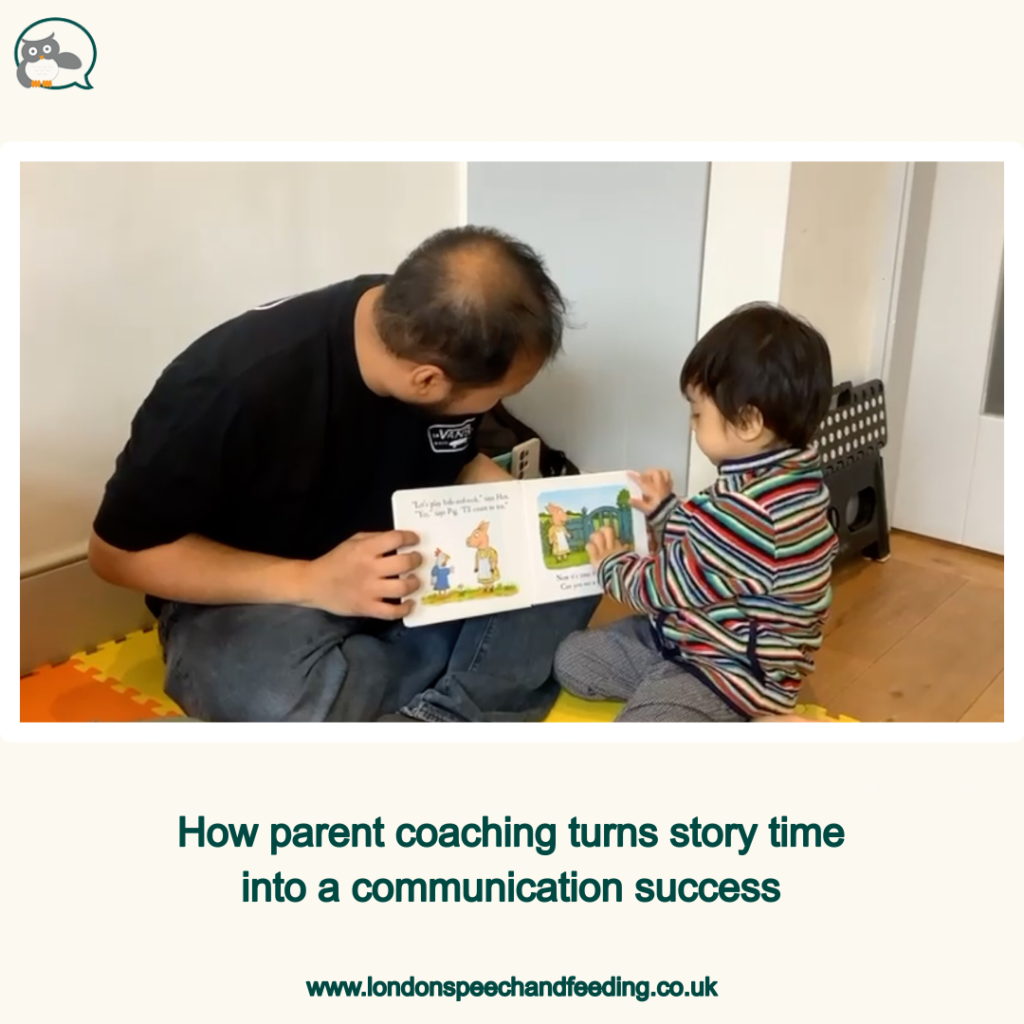
    How parent coaching turns story time into a communication success

    We often hear from parents who are trying their best to connect with their child, especially when reading books, but are met with frustration. They’ll say, ‘I read the book exactly as it’s written, but my child can’t focus for very long and just runs off!’ or ‘my child just flicks through the pages then turns it upside down and runs off with it’ or similar.

    It’s a common story. Traditional reading—going through the text from cover-to-cover—has its place of course, but for little ones with a language delay or autism it can move too quickly and place all the focus on the book’s words, not on the interaction.

    But what if I told you that story time could become one of the most fun and productive times for your child’s communication development?

    Watch the fantastic little video clip above! You can see the pure joy and connection between this dad and his son. This is the same family who, just a few weeks ago, felt defeated when trying to read a book, with their child quickly losing interest and leaving the reading/book corner.

    What changed?

    The power of parent coaching and Hanen principles

    The difference you see in the video is the direct result of parent interaction therapy, or parent coaching, based on the internationally recognised Hanen principles.

    I didn’t ‘fix’ the child. Instead, I coached the parents in a few simple, powerful strategies that completely changed the dynamic of their interaction. Instead of being a time for teaching and instruction, story time became a back-and-forth conversation.

    Here are the four major transformations that coaching helped this family achieve:

    1. From reader to play partner

    Before coaching, the parents felt their job was to read the text and to teach the words in it to their child. Now, their job is to follow their child’s lead. They learned to Observe, Wait, and Listen (OWL). If the child points to the tree or the badger on the page, the parent talks about the tree or the badger.

    The result

    The child is now initiating and leading the conversation! He is sharing what he finds interesting, which makes him feel powerful and keeps him deeply engaged.

    2. Building connection and attention

    When parents focus solely on reading, they often forget to make frequent eye contact and use animated facial expressions. The principles taught them to put the text aside and prioritise connection.

    The result

    Our little boy is looking at his dad more frequently, making great eye contact, and clearly having fun! When the interaction is fun, the child’s attention span naturally lengthens, allowing him to attend to the book and the interaction for a much longer time.

    3. Creating opportunities for communication

    The parents learned simple ways to prompt communication without pressure. They stopped asking knowledge-based questions (‘What colour is that? Or point to the pig!’), which can feel like a test.

    Instead, they learned to use techniques like ‘Saying less and pausing’ or ‘copying their little one’s echolalia ‘, signalling that they are very interested in what he is saying and that his communication matters!

    The result

    The child is now spontaneously using strings of sounds and gestures to communicate his needs and interests, knowing and enjoying his parents’ enthusiastic responses.

    This video is a testament to the fact that you are your child’s best therapist. With the right tools and coaching, you can transform everyday routines, like reading a book, into the most joyful and effective communication sessions.

    4. Acknowledging and interpreting echolalia

    In the video, you may hear the little boy repeat a phrase from the book or from what his dad just said. This is called echolalia, and for a long time, it was often dismissed or discouraged.

    However, a core principle of our parent coaching is that echolalia is communication. For children who are ‘Gestalt Language Processors,’ these memorised phrases (or ‘gestalts’) are their building blocks of language.

    The key is not to stop the repetition, but to become a ‘language detective’ and ‘interpreter’!

    By modelling the correct, first-person phrase right after the echo, parents/caregivers are teaching a child how to break down the ‘chunk’ and use the individual words functionally. They are showing their child: ‘I heard you. Your communication makes sense to me.’

    This strategy is a game-changer because it:

    1. Validates the child’s communication: It honours the child’s natural way of learning language, which boosts their confidence and willingness to communicate.
    2. Facilitates language development: It provides the child with the next step—a meaningful, functional phrase—to move them from repeating language to generating their own spontaneous sentences.

    Look at the child’s face again in the video. When his dad acknowledges and interprets his communication, you see that spark of joy and connection—that’s the moment when true, functional language learning happens!

    Ready to unlock the potential in your family’s story time? Contact me to learn more about our parent coaching programs.

    Sonja McGeachie

    Highly Specialist Speech and Language Therapist

    Owner of The London Speech and Feeding Practice.


    Health Professions Council registered
    Royal College of Speech & Language Therapists Member
    Member of ASLTIP

    Find a speech and language therapist for your child in London. Are you concerned about your child’s speech, feeding or communication skills and don’t know where to turn? Please contact me and we can discuss how I can help you or visit my services page.

    2
  • · ·

    Chaining: A powerful tool for phonological development

    Understanding chaining

    Chaining is a therapeutic technique I like to use in my speech therapy work with children who have Childhood Apraxia of Speech (CAS) or phonological speech sound difficulties. It helps to break down a complex target behaviour into smaller, more manageable steps. By systematically teaching and reinforcing each step, I can help my students achieve their communication goals.

    There are two types of chaining: Forward and backward chaining

    Today I am going to show and talk about backward chaining. This technique involves starting with the last step and working backward to the first. This approach can be particularly effective for children with persistent speech sound difficulties where combining consonants into clusters, such as /BL/ or /FR/ or /SHR/ is very difficult.

    Backward chaining allows my student to experience immediate success and build his confidence.

    In my video I show you how I applied backward chaining to the words ‘Shriek’, ‘Shrub’, ‘Shrimp’ etc

    My student struggles with both the /SH/ and the /R/ sounds and we have been working on both sounds for some weeks now. He has mild Childhood Apraxia of Speech and he has difficulties with coordinating his tongue movements, breathing and using his jaw effectively to make words. His sound repertoire has grown a lot since we started working together last year. Today in this session I show you how we pulled both the sound /SH/ together with /REEK/ to make ‘SHRIEK’. I love using the pictures and therapy materials from Adventures in Speech Pathology.

    This is also part of the Complexity approach which I will explain in a separate blog post.

    • Step 1 (not shown in the video): I explain what the word means; I find that when my student understands what a word means he is much better at saying it. It increases his confidence and motivation to say a word that he knows the meaning of. Often this student does not tell me that he does not know what a word means, so I always remind myself to check that out first.
    • Step 2 (not shown in the video): We do a little rhyming game and think about what any one word rhymes with: ‘Shriek’ – ‘meek’, ‘weak’, ‘seek’.
    • Step 3: I show my student that there are two parts to this word /reek/ and the sound /SH/.
    • Step 3: We practise the easier part: /reek/ /reek/ /reek/.
    • Step 4: We add the /SH/ sound and pull it together to make our target word ‘Shriek’.

    /REEK/ /REEK/ /REEK/ + /SH/ = ‘SHRIEK’
    /RUB/ /RUB/ /RUB/ + /SH/ = ‘SHRUB’
    /RUG/ /RUG/ /RUG/ + /SH/ = ‘SHRUG’

    By breaking down the word into smaller, manageable steps, my student can focus on each syllable individually, get that right and then gradually build up to the full word. This approach can help to reduce frustration and increase motivation.

    Forward chaining

    Forward chaining is the same process but in reverse: we start with the front sound or syllable and work forward towards the next/last part of the word:

    /SH/ + /REEK/ = ‘SHRIEK’
    /SH/ + /RUB/ = ‘SHRUB’
    /SH/ + /RUG/ = ‘SHRUG’

    Benefits of chaining

    • Increased motivation: By starting with the last step, my student experiences success, which boosts his motivation to continue trying to say the word and trying other words.
    • Reduced frustration: Breaking down the target behaviour into smaller steps can make the task less overwhelming, reducing frustration and anxiety.
    • Improved confidence: As the little learner masters each of the step, his confidence and self-esteem increases. Again, this leads to increased motivation.
    • Faster learning: By focusing on the final step first, and practising lots of chaining (forward and backward), a student can quickly learn to generalise to other words.

    Backward chaining (and forward chaining) is a really great tool for teaching complex speech sounds and words to children with phonological disorders.

    Watch out for my next blog which is all about the complexity approach in Phonology.

    Do get in touch if your child has a speech sound disorder, I would love to help.

    Any questions or need help with supporting your little one’s language please contact me via my contact form, or you could also check out www.hanen.org for advice and lots of inspiration.

    Sonja McGeachie

    Early Intervention Speech and Language Therapist

    Feeding and Dysphagia (Swallowing) Specialist The London Speech and Feeding Practice

    The London Speech and Feeding Practice


    Find a speech and language therapist for your child in London. Are you concerned about your child’s speech, feeding or communication skills and don’t know where to turn? Please contact me and we can discuss how I can help you or visit my services page.

    1