The hidden impact of mouth breathing and open mouth posture on speech and feeding

| |

When most people think about speech or feeding difficulties, they picture the tongue, lips, or chewing skills, but how a child breathes at rest plays a surprisingly big role too.

Mouth breathing and open mouth resting posture can quietly influence everything from how a child’s face grows to how clearly they speak, to how confidently they chew and swallow. It’s something many parents never think about, until they start noticing the subtle signs.

Let’s explore why this happens, what to look for, and how to gently support better breathing and oral posture.

Recent research supports this link between mouth breathing and speech difficulties. For example, a 2022 study by Alhazmi et al., published in the Journal of Pharmacy and Bioallied Sciences, found that 81.7% of children aged 9–17 who breathed primarily through their mouths presented with speech sound disorders. The study highlights how mouth breathing can significantly influence orofacial development and articulation patterns.

💨 Why we’re designed to breathe through our nose

Our bodies are made for nasal breathing. When we breathe through the nose, the air is filtered, warmed, and humidified before reaching the lungs. The tongue naturally rests against the roof of the mouth, the lips close gently, and the jaw stays relaxed, all of which encourage healthy oral development.

In contrast, mouth breathing often means the tongue rests low in the mouth and the lips stay apart. Over time, this posture can subtly reshape how the muscles and bones of the face grow.

Children who breathe through their mouths most of the time may develop:

  • A longer face and narrower palate
  • Forward head posture
  • Slightly open lips and low tongue position at rest
  • A tendency toward drooling or noisy breathing
  • A dry mouth and consequently bad breath
  • At times the tongue pushes constantly against the front teeth causing them to grow forward (buck teeth)

These changes are not anyone’s fault, as they often start because of blocked noses, allergies, enlarged adenoids, low facial muscle tone or habits formed when a child was younger. But understanding the pattern helps us know how to support change.

🗣 How mouth breathing affects speech

Speech depends on precise coordination between the lips, tongue, and jaw. The resting position of these structures affects how ready they are to move.

  1. Reduced tongue strength and placement, i.e. the tongue rests low in the mouth (as it does in mouth breathing), it’s harder for children to lift it efficiently for sounds like /T/, /D/, /N/, /L/, and /S/. This can lead to speech that sounds slightly slushy or unclear, or a frontal lisp.
  2. Open mouth posture and resonance: An open mouth at rest may affect how air vibrates in the oral and nasal cavities. Children might have speech that sounds a bit ‘muffled’ or lacks crispness because the lips and jaw aren’t fully supporting articulation.
  3. Fatigue and breath control: Mouth breathing can lead to drier mouths and less efficient breath support. That can make longer sentences or conversations feel tiring, especially in noisy environments.

🥄 How mouth breathing affects feeding and chewing

Feeding involves the same structures that control speech, so posture and breathing patterns matter here, too.

  1. Chewing efficiency: Children who habitually keep their mouths open often have low tongue tone and reduced jaw stability. They may prefer softer foods, chew slowly, or struggle with mixed textures.
  2. Swallowing pattern: A tongue that rests low may push forward when swallowing. This ‘tongue-thrust swallow’ can interfere with efficient chewing and even affect dental alignment over time.
  3. Breathing while eating: Since it’s hard to chew, swallow, and breathe through the mouth simultaneously, children who can’t comfortably nasal breathe may rush bites or pause to catch their breath. This can contribute to coughing, choking, or food refusal.

Common signs to watch for

Parents often notice subtle clues before realising mouth breathing is a pattern. Some red flags include:

  • Lips habitually open at rest
  • Drooling after the toddler years
  • Snoring or noisy breathing during sleep
  • Preference for soft foods or grazing eating habits
  • Dark circles under the eyes due to allergies
  • Frequent colds, congestion, or mouth odour
  • Speech that sounds slushy or unclear despite good effort

If several of these sound familiar, it’s worth mentioning them to your child’s GP, dentist, or speech and language therapist.

👩‍⚕️ What can help

  1. Address the underlying cause: If nasal blockage, allergies, or enlarged adenoids are making nasal breathing difficult, a medical assessment is the first step. ENT specialists can rule out or treat physical causes.
  2. Encourage closed mouth rest: Gentle reminders like ‘Lips together, tongue up, breathe through your nose’ can help older children become aware of their resting posture. For younger ones, visual cues (stickers or mirrors) can make it a game.
  3. Build oral-motor strength and awareness: Speech therapists can design activities to strengthen the tongue and lips, improve jaw stability, and encourage balanced breathing. This might include blowing games, tongue-tip lifts, use of dental-palatal devices or oral-motor exercises disguised as play.
  4. Support good posture: Sometimes mouth breathing goes hand-in-hand with forward-head posture. Encouraging upright sitting during meals and screen time helps keep the airway open and supports better breathing habits.
  5. Make nasal breathing part of daily routines: Gentle nose-breathing practice during calm times (reading, bedtime, car rides) helps normalise it. Avoid making it a battle: calm, consistent reminders work best.

🌱 A gentle note on change

Patterns of mouth breathing develop over time, and change doesn’t happen overnight. It’s important to approach this with curiosity, not criticism. The aim isn’t ‘perfect breathing,’ but to give your child the tools and awareness to breathe comfortably and efficiently.

Small improvements in nasal breathing and resting posture can lead to big gains in speech clarity, eating confidence, and even sleep quality.

💡 The takeaway

Breathing seems automatic, and it is! but how we breathe matters. Mouth breathing and open-mouth posture can quietly shape how a child speaks, eats, and grows.

By noticing early signs, addressing underlying causes, and building supportive habits, you can help your child move toward stronger, clearer speech and more comfortable mealtimes.

Just like every area of development, progress starts with connection, patience, and gentle consistency, one calm breath at a time.

Sonja McGeachie

Highly Specialist Speech and Language Therapist

Owner of The London Speech and Feeding Practice.

References

Alhazmi, A., Alshamrani, A., Alhussain, A., et al. (2022). Mouth Breathing and Speech Disorders: A Multidisciplinary Study. Journal of Pharmacy and Bioallied Sciences 14(5):911. https://www.researchgate.net/publication/361978128_Mouth_breathing_and_speech_disorders_A_multidisciplinary_evaluation_based_on_the_etiology

Health Professions Council registered
Royal College of Speech & Language Therapists Member
Member of ASLTIP

Find a speech and language therapist for your child in London. Are you concerned about your child’s speech, feeding or communication skills and don’t know where to turn? Please contact me and we can discuss how I can help you or visit my services page.

2

Similar Posts

  • · · ·

    Unlocking communication: My daily life with the Saltillo 88 Core Board

    Introduction

    As an AAC speech and language therapist who uses the Saltillo 88 Core board every day, I can tell you it’s more than just a communication tool. It’s a doorway to independence, connection, and expressing my students’ unique voice.

    What is the Saltillo 88 and why do I use this one?

    In this blog post, I want to share practical, real-world examples of how I integrate the Saltillo 88 into various daily activities, empowering my students and parents to learn to communicate.

    There are literally hundreds of core boards out there and I have tried many different ones over the years. Which one should I use with this particular client? Should I make up my own? (I have made up tons!) or should I use a ready-made one like the one below which is what this blog is about.

    For me the best ones are boards with a good number of core words (at least 60) so that the board is versatile and can be used across a range of activities. The board needs to have a range of pronouns, verbs, descriptors, prepositions and question words to be useful and to stimulate not just requesting but commenting and asking questions. Another consideration is: can the board easily be transferred to a more robust AAC system. Once my student is used to the symbols and where they are could we move to an electronic talker/device. And if this answer is ’yes’ then we have a great board to get started with.

    Below is a picture of the Saltillo 88.

    Saltillo 88 Core Board
    Saltillo 88 Core Board

    It has 88 words and I find it really does suit most activities. The same board and design is also then found on the TOUCHCHAT AAC device which can be a seamless transition for our learner.

    Let me dive into how core words/board or AAC can be used daily:

    1.  Getting dressed

    Whilst choosing clothes for your little one and getting them ready for the day you can use the following words: want, like, get, finish. Always pack the words into little phrases you can speak naturally when using a board. I have tried to show you phrases that you could use below.

    The words in bold are the core words on the board and the other words are just words you say whilst pointing to the core word.

    • Goal: Express choices, needs, and preferences about clothing.
    • Ideas:
      • ‘I want this one [specific item of clothing: ‘shirt’, ‘pants’]’
      • ‘I like that one [colour/type of clothing]’
      • ‘Help me [put/get it on/take off]’
      • ‘let’s get your socks now’
      • finished let’s go’ (when dressed)

    2. Having a shower/bath

    • Goal: Bath time tends to happen daily and so it lends itself to using the same useful phrases and words to chat about temperature preferences, to ask for toys or for washing routines.
    • Ideas:
      • ‘let’s go have a bath/shower’
      • ‘let’s turn on the tap/water’
      • now turn it off
      • ‘let’s get/have more toys/water/bubbles/tickles’
      • all gone, what’s next?’
      • ‘how about washing your hands/feet’
      • ‘let’s do that again’
      • ‘need some help?’
      • Stop it now, let’s do something different’

    3. Mealtimes

    • Goal: Mealtimes can be (or should be) enjoyable and motivating to ask for specific things we like, and commenting about our eating experiences.
    • Ideas:
      • ‘I want/give me [food item: ‘apple’, ‘bread’]/[drink item: ‘water’, ‘juice’]’
      • More foods/drinks/snacks’
      • All done
      • ‘that’s messy we like that (not)’
      • ‘Like’/‘Don’t like’
      • Big’/‘Little’
      • ‘this is so nice!’

    4. Playing

    • Goal: This is where it’s at for children of course and we can use our core words to chat and engage with our little learners.
    • Ideas:
      • ‘I want play’
      • Go’/‘Stop
      • More/again’
      • ‘not it’s my My turn/’it’s Your turn
      • ‘that’s a Big one!’/‘let’s do Little bubbles (describing toys)
      • ‘let me Open it for you (for boxes, doors in play)
      • ‘I See it’ (to draw attention)
      • Help me’ (with a tricky toy)

    5. Opening boxes/doors/etc

    • Goal: Most kids love opening boxes, doors and cabinets to see what there is to play with. Help your child to ask for what they want.
    • Ideas:
      • let’s Open that box/bag/zip/door’
      • get me a (toy) out of here’
      • ‘Let’s Take it out and see what it is?’
      • finished’ (when finished with the task)
      • ‘I want [what’s inside]’
      • ‘What’s next? Let’s see’

    Tips for using AAC effectively

    • Consistency is key: Emphasise using it regularly, even for small things.
    • Modelling: this is crucial, the adults need to use the board for all situations first and foremost before we can expect our child to be interested.
    • Patience: Communication takes time and practice.
    • Celebrate successes: Acknowledge every communicative attempt.
    • Make it accessible: Keep the board within easy reach at all times.

    Conclusion

    If you’re considering the Saltillo 88, or TouchChat, or are already using it, I hope these examples inspire you. It’s a journey of discovery, and every word communicated is a step towards a more connected and independent life. What are your favourite ways to use the Saltillo 88 or which core board do you love using? I would love to hear your comments and stories.

    Sonja McGeachie

    Highly Specialist Speech and Language Therapist

    Owner of The London Speech and Feeding Practice.


    Health Professions Council registered
    Royal College of Speech & Language Therapists Member
    Member of ASLTIP

    Find a speech and language therapist for your child in London. Are you concerned about your child’s speech, feeding or communication skills and don’t know where to turn? Please contact me and we can discuss how I can help you or visit my services page.
    2
  • ·

    Explore four truths or myths about speech, language, and communication

    There are many truths and myths out there that I’d like to explain to prevent misunderstanding. This will enable you to support your child by seeking the correct information.

    Why not have a look at the following statements and decide if you think they are true or false?

    1. Flashcards will fix my child’s speech, language, and communication needs.
    2. Singing to my child will not help their language development.
    3. My child communicates in a variety of ways not just through speech.
    4. Learning another language is good for my child.
    Speech Therpaist in London

    Now let’s explore these statements in more detail.

    1. Flashcards will fix my child’s speech, language and communication needs – False

    To develop your child’s communication skills, you’ll want your child to generalise their skills across multiple areas. I would highly recommend staying away from flashcards if they are only teaching ‘rote learning’. Children need to explore the world through play. However if you’re looking at cards, talking about them and having meaningful conversations, and your child is enjoying it, then there potentially is a use for flashcards. But at London Speech and Feeding, we love innovative activities that your child is fully immersed in.

    2. Singing to my child will not help their language development – False

    Singing introduces your child to rhyme, and repetition amongst many other benefits. It allows them to attend and listen to you as their caregiver and develop the vital stages of early communication. Singing slows down language so your child becomes more aware of the relationship between letters and sounds. You’re also supporting your child’s oral fluency as well as their memory. Furthermore, you’ll often be face to face with your child singing which allows them to see your facial expressions, lip patterns and eye contact (to name a few).

    3. My child communicates in a variety of ways not just through speech – True

    Communication is much more than just talking. So, it’s true that communication happens in a variety of ways. Think about it. If you didn’t talk and you wanted to convey a message of frustration, you may show different facial expressions, body language; you may point at something which has caused your frustration. We can communicate through a variety of means (some of which include symbols, gestures, hand signals, and pictures). Can you think of any other ways in which you communicate to others?

    4. Learning another language is good for my child – True

    Current evidence suggests that speaking another language to your child is a positive. It allows your child to interact with different members of the family or with their friends. ASHA suggests that children who speak two languages fluently often learn new vocabulary easier and find categorisation simpler. Bilingual children have been shown to understand the needs of their communication partner. In addition, increased vocabulary may support better understanding. There are no negative factors about learning more than one language. We would recommend that, whatever language(s) your child is learning, they have a good model of that language, so they learn best practice.

    Always seek the advice from a qualified Speech and Language Therapist if you’re unsure of how your child’s speech, language and communication is developing, as there are lots of information online that aren’t always accurate.

    I’m always happy to support your family to increase your knowledge and understanding.

    You can find support by contacting Specialist Speech and Language Therapist Sonja here.


    Find a speech and language therapist for your child in London. Are you concerned about your child’s speech, feeding or communication skills and don’t know where to turn? Please contact me and we can discuss how I can help you or visit my services page.
  • · ·

    The power of containment: A therapeutic approach for autistic children

    Photo by lemonlenz

    The practice of wrapping or swaddling children, often referred to as ‘containment,’ has been used for centuries to soothe and comfort infants. I use this therapeutic approach with autistic children at the London Speech and Feeding Practice. While it might seem counterintuitive, the act of being tightly wrapped can provide significant benefits for children who struggle with sensory processing, emotional regulation, and communication.

    Understanding sensory processing and autism

    Autistic persons often experience challenges with sensory processing, which is their brain’s ability to interpret and respond to sensory information. This can lead to sensory overload or under-responsivity. Containment can be a valuable tool in helping children regulate their sensory input.

    Photo by lemonlenz

    To summarise, here are some of the benefits of containment:

    • Sensory Regulation:
      • Provides deep pressure input: The tight, enveloping sensation of being wrapped can provide deep pressure input, which is calming and organising for many children.
      • Reduces sensory overload: By creating a controlled sensory environment, containment can help to reduce overstimulation and promote a sense of safety.
    • Emotional Regulation:
      • Containment creates a sense of security: Being wrapped tightly can mimic the feeling of being in the womb, providing a sense of security and comfort.
      • Facilitates calming: The deep pressure input can help to calm the nervous system and reduce anxiety.
    • Improved Body Awareness:
      • Enhances proprioception: Containment can improve the child’s awareness of their body in space, which is essential for motor development and sensory integration. I often provide extra pressure on a child’s arms and legs sticking out of the yoga mat; this helps my child understand where their limbs are in space: I can feel my legs and I can feel my arms and I can feel where they are right now, i.e. they are under Sonja’s hand, I can feel them.
    • Facilitates Communication – and this is obviously where I come in as a Speech and Language Therapist:
      • Swaddling creates a safe space: When a child feels calm and secure, they are more likely to engage in communication.
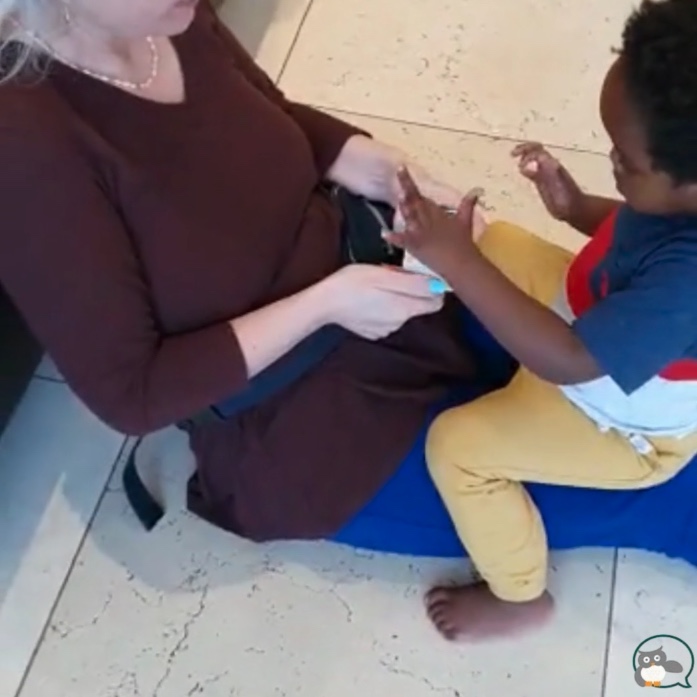
      • Enhances joint attention: The shared experience of being wrapped can foster joint attention, which is essential for language development. You can see this one in my highlights where I swaddle my student in the yoga mat (picture above). She absolutely loves it, and what is more she is calm and steady when usually this child likes to be on the move constantly. Here we have a wonderful moment of joint engagement. She looks at me, she can listen to what I say or sing, and she can tell me in her own way to carry on rolling her or to carry on singing or providing calming pressure to her legs and arms or to stop.

    A few pointers for when you try this at home: How to practise containment safely and effectively

    • Create a safe environment: Ensure the wrapping material is soft, breathable, and free from any hazards.
    • Observe your child’s cues: Pay attention to your child’s body language and verbal cues to determine their comfort level.
    • Respect your child’s boundaries: If your child shows signs of distress, stop the containment immediately – this might seem obvious but sometimes we adults get so carried away with some ‘great idea’ that we have seen work elsewhere. And so we can be a little too ‘determined’ sometimes to ‘make it happen’… perhaps this rings a bell with some of my readers.
    • MAKE IT FUN: Start carefully and take it step by step. See if the student is having a nice time. It is all about trust and therefore it might not work the very first time you do it.

    It’s important to remember that containment is not a one-size-fits-all approach. Some children may respond better to other sensory-based interventions. However, for many autistic children containment can be a valuable tool in their journey towards improved communication and emotional regulation.

    For more information follow me on Instagram, Facebook or LinkedIn.

    Sonja McGeachie

    Early Intervention Speech and Language Therapist

    Feeding and Dysphagia (Swallowing) Specialist The London Speech and Feeding Practice

    The London Speech and Feeding Practice


    Find a speech and language therapist for your child in London. Are you concerned about your child’s speech, feeding or communication skills and don’t know where to turn? Please contact me and we can discuss how I can help you or visit my services page.
    1
  • ·

    Correcting a lisp

    Correcting A Lisp

    This is a surprisingly common speech error and it can be corrected really well in my experience. I have helped lots of children of all ages learn how to control their tongue movements and produce clear, sharp /S/ sounds and good /SH/ sounds.

    Initial consideration

    There are some factors which need to be considered before we can dive into therapy proper and these are they, in a nutshell:

    1. The student is not currently displaying negative oral habits such as thumb sucking or excessive sucking on clothing. This is because thumb sucking exerts pressure on the teeth and therefore can, over time, push teeth out of their natural order/position.
    2. The student does not have a restricted lingual frenulum or tongue tie which can cause at times restricted movements of the tongue (pending on how tight the frenulum is attaching the tongue to the base of the oral cavity); equally a labial frenulum or lip-tie can restrict lip movement and therefore physically restrict good speech sound production.
    3. The student does not have enlarged tonsils as they can sometimes push a tongue forward and also cause open mouth posture and open mouth breathing.
    4. The student’s motivation to change their speech pattern is high. (this is an important factor though with younger students I can get round this with a lot of fun games and good parental involvement!)

    When I do an Oral Assessment of my student these are the first factors I want to look at and consider. Often I will refer to other agencies such as Orthodontists, dentists or ENT specialists to advise and help with some of these factors before we can get going. However, there are strategies that we can work on almost straight away.

    Most of my Lisp students present with an open mouth posture: that is where the student has their mouth always slightly open for breathing. Over time the tongue starts to fall forward and rests on the front teeth or the bottom lip instead of finding a comfortable resting place either at the alveolar ridge (the bumpy spot behind the upper front teeth) or, alternatively, resting at the bottom of the mouth behind the lower front teeth.

    Another common problem is that the tongue is not moving independently from the jaw and so is reluctant to pull back or lift up inside the mouth as the tongue is guided in movement by the jaw.

    Combine those two factors and your tongue is not pulling back, or lifting up or doing very much at all without the jaw moving as well. This makes for unclear speech sounds, especially all the sounds we make at the front with our tongue or with our lips: /B/ /P/ /L/ /N/ and of course /S/ and /SH/ are particularly hard to make. We often also struggle with the /Y/ sound so ‘LELLOW’ instead of ‘yellow’.

    Do not fear!

    But no fear, these problems can be treated over time for sure! We often start with lip, tongue, and jaw exercises that help to move the tongue independently from the Jaw, our student learns that the tongue is a muscle and can be trained to do amazing acrobatic things in the mouth! WOW! It can actually pull back, lift up, and come down again all on its own!

    We work on breathing, holding our breath for a bit then pushing it out and then holding it again.

    And when it comes to the actual /S/ sound I often try and go a NEW route bypassing the Snake-Sound route if that is what had previously been tried and failed so that we can create completely new sound patterns in our brain and think about our sounds in a completely new way.

    We then work on producing the sound /S/ on its own for a bit, at the end of words, then on either side of complimentary sounds, for instance : ‘EASY” – the sound patterns here are EEE-S–EE : the /EEE/ sound is complimentary to the /S/ sound as the tongue is at the right hight for the /S/ already once you have it in place for /EEE/ -……see?! EASY!

    And gradually we work towards saying the /S/ sound clearly at the front of short words, then phrases and then sentences.

    The process takes some time and it depends on how ready the student is. This varies of course hugely so I can never promise the exact number of sessions we will take to get that Lisp fixed. A lot depends on home practice in between sessions, and this is of course crucial to all therapy! Every day 15-20 mins practice is a good average time to aim for and when this is done it shortens the therapy block drastically.

    I always give plenty of home work so there is never a chance of it getting boring or there being “nothing to do”!

    Do contact me. I really enjoy working with this type of student and get a great kick out of FIXING THAT LISP!


    Find a speech and language therapist for your child in London. Are you concerned about your child’s speech, feeding or communication skills and don’t know where to turn? Please contact me and we can discuss how I can help you or visit my services page.

  • Learn why ‘watchful waiting’ isn’t the answer

    As a Speech and Language Therapist, I am a big advocate of early intervention. And I’m always encouraging you (as parents and carers) to seek intervention as early as possible. But you might be thinking, “my child just needs more time.” Have you ever wondered why early intervention is important? Read on to learn more.

    Speech Therpaist in London
    Watchful waiting is not the answer

    Early intervention

    By intervening at a later age or stage of development, you may be leading your child to develop consequences as a result. One consequence can be challenging behaviour due to their inability to express their wants and needs. They may have difficulty in understanding and following directions. This will not only affect their ability in the classroom but also socially, maintaining friendships. Early intervention can support understanding. This can also help you support your child in breaking down activities so they can fully take part in home and school life. The Early Intervention Foundation (2021) suggest that providing early intervention can develop a young person’s strengths. You can use these activities to support their needs which creates better outcome measures. This allows young people to reach their full potential across a range of settings. It can positively impact on mental health and self-esteem.n

    Positive outcomes

    Also, we are protecting our young people from harmful situations by giving them a voice. And by giving them a voice, they are:

    • more likely to achieve and
    • less likely to have in negative experiences such as crime and with the justice system.

    We know that social and emotional skills (such as developing self-awareness, social skills, and emotional regulation) are crucial to a young person’s development. Research has found that children with a higher level of social and emotional skills are more likely to:

    • achieve in education,
    • graduate from university,
    • have career prospects,
    • have positive work and family relationships,n
    • maintain good mental and physical health.

    By having these positive aspects in their lives, they are less likely to engage in antisocial behaviour and related crime. It’s easy to think this feels like a long way off for your family. But by giving them the best possible start, you are promoting a positive future in all aspects of their life.

    Contact me today to get started with speech, language and communication intervention.


    Find a speech and language therapist for your child in London. Are you concerned about your child’s speech, feeding or communication skills and don’t know where to turn? Please contact me and we can discuss how I can help you or visit my services page.

    1
  • ·

    How to model AAC with our minimally speaking students?

    modelling AAC

    How should we start? Should we use prompts? What kind of prompts? hand-over-hand or just pointing? Should we wait, and, if so, how long? Introducing an alternative communication system (AAC) to our child is for many of us a confusing and sometimes scary prospect, but it needn’t be! Let me reassure you and share some tricks of my practice in this area.

    Once we have decided to try for a picture based communication system, I usually start with a paper-based single page with between 48–88 core-words. I choose the number of words depending on where the child is developmentally and also verbally.

    If a child does have a small handful of words already, I might start with the 88-cell board below. If, on the other hand, my student is completely non-speaking and still quite little then I might go for the 48-cell below here or I might have even less cells to start with. Again, sometimes I start with an electronic device in my clinic just to trial and introduce the idea and to see if, or how, a student responds. 

    Below are some samples: a 49-cell board which I made for a child in a nursery setting

    Below a Saltillo WordPower board that can be downloaded from the Saltillo website:

    Example of a slightly more advanced board, again from the Saltillo Website

    And here below one example of a board I made for a specific activity for a child who loves water and sand play:

    It is perfectly possible to be very flexible and create a suitable board for any student, starting with as few as 2–5 cells and working up to over a 100 (very small ones) on a sheet of A4 or A3 paper.

    So once we have a good board for our child, what now? How do we start introducing this into our daily life?

    We can start by showing/pointing to the word GO within a play activity. For example:

    • a car run,
    • or a marble run,
    • or a spinner activity,
    • a wind-up toy,
    • anything that can be stopped and started easily.

    How to start?

    I will talk us through each of the steps using the example for the word ‘GO’.

    First phase

    The first phase is a TEACHING/ LEARNING PHASE. In this phase we do not expect our student to do anything, to copy us or to point to the board. If they do that it is of course a huge bonus and we will celebrate it.

    Our job is to simply MODEL/SHOW/GIVE EXAMPLES of how we can use the board, by steadily and regularly pointing to the chosen word or words. We do so across the day and across settings:

    • play
    • meal time
    • getting dressed/undressed
    • bath time
    • going to the car/shops
    • etc

    Once we can be sure that our student has been submerged and SOAKED in seeing the coreboard being used, say after some 3–4 weeks of using it consistently…

    Second phase

    We can begin to move into the second phase which is the PRACTICE PHASE. By now the student has seen the boards and he or she has seen the word GO (as a example) modelled many times.

    Now we can start to see if we can tempt our student into trying this out for themselves.

    What sort of TEMPTING are we talking about? Take a look at the Prompt Hierarchy below, which shows us what to do to get our student to be independently communicating as soon as possible. 

    The PROMPT HIERARCHY: what sort of prompting should we do, should we expect something from our student or how should we view this stage?

    1.  TEMPT AND PAUSE

    I have the AAC near to the toy and each time the child starts another round of the activity I say clearly ‘GO’ and I point to the picture as do so. I then pause and wait to see what happens. NOTHING? Then…

    1. USE SIGNS AND BODY LANGUAGE

    Next time the child starts another round I might be very animated and do a Makaton sign for GO as I say ‘GO’ and I make a very over point to the picture again. Then I wait. STILL NOTHING? OK then…

    1. OPEN-ENDED QUESTION

    Now I might say ‘GO’ and follow with: ‘OOH I WONDER IF THERE IS A PICTURE TO POINT TO…’

    ‘OH LOOK HERE IS GO!’ I then point to GO.

     STILL NO RESPONSE?

    1. ASK FOR A RESPONSE

    I might say ‘GO’ followed by ‘LOOK! LET’S POINT TO GO HERE ON THE PICTURE.’

    STILL NO RESPONSE? 

    1.  PHYSICAL TOUCH

    Next time I say ‘GO’ I will try and take the student’s hand, help isolate their finger and help him or her to point to the actual picture.

    REMEMBER: Prompting serves a very important function in scaffolding learning for students BUT if we are constantly prompting kids, then we are teaching them to only communicate when someone tells them to. We want our student to become as independent in speaking and using words as possible.

    So once I have done Physical Prompting I will try and phase back down to number 1 where all I need to do is point to the picture or look at the board with the aim that the student will then point to the picture.

    Take away points:

    • Keep the learning phase pressure-free and model without expecting our student to jump in. In other words, let’s model first without expectation. Later we can have a little bit of expectation.
    • After they’ve been exposed to and have been ‘soaked’ in plenty of AAC input, then, YES, we can create an opportunity to help them say or point to the word on their own.
    • We can model BOTH with and without expectation.
    • Only after LOTS of exposure, use the least to most prompting hierarchy and start creating opportunities for a student to become an independent communicator.

    Do get in touch if you have any questions or comments or if you would like some practical help.

    I am always pleased to hear from you.


    Find a speech and language therapist for your child in London. Are you concerned about your child’s speech, feeding or communication skills and don’t know where to turn? Please contact me and we can discuss how I can help you or visit my services page.

    0