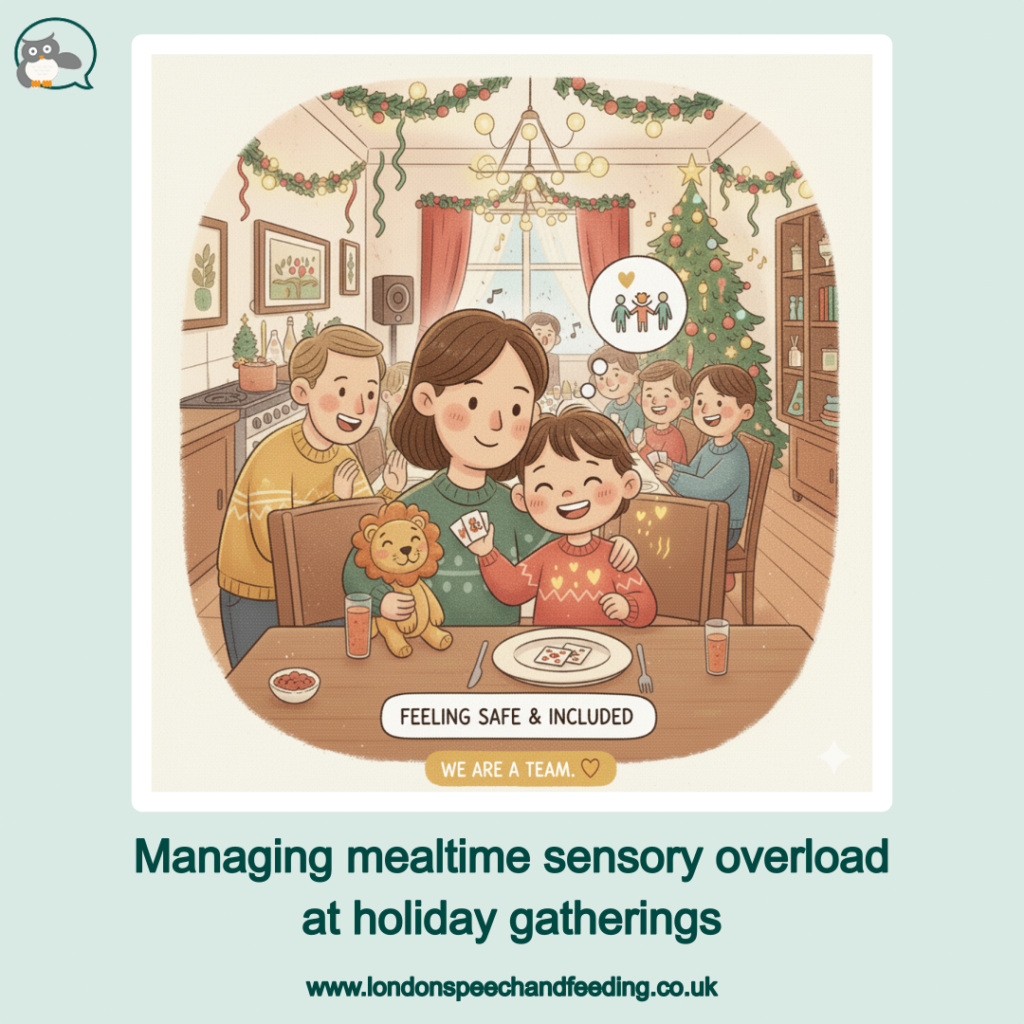
Managing mealtime sensory overload at holiday gatherings: Supporting children with allergies and feeding differences

Holiday meals are meant to be joyful and something we all look forward to. But for many children and their families, these occasions can be overwhelming and be the cause of dread and worry. The combination of new smells, unfamiliar foods, loud environments, social expectations, and allergy anxieties can quickly turn what should be a festive time into a stressful one.
For parents of children with sensory processing differences, selective eating challenges, or food allergies, holiday gatherings often require careful planning and a big dose of tolerance and compassion. The good news is that with awareness and a few gentle strategies, you can support your child to feel safe, regulated, and included during festive meals without pressure, tears, or discomfort.
Let’s explore how to make holiday mealtimes calmer, safer, and more connected this season.
🎄 Why holiday meals feel so overwhelming
Holiday gatherings usually combine several sensory triggers all at once:
- Noisy, chaotic rooms
- Strong smells from a mix of foods we don’t normally cook
- Multiple conversations happening at once
- Bright lights, Christmas décor, flickering candles
- Unfamiliar foods with unexpected textures
- Expectations to ‘try everything’ or ‘enjoy it’s sooo good!’
- New environments, seating arrangements, or routines
For children with sensory sensitivities, this can feel like a tidal wave of input. Research shows that children who are sensory-sensitive often have heightened responses to smell, taste, and texture, which may lead to avoidance or distress at mealtimes (Cermak, Curtin, & Bandini, 2010).
Add food allergies into the picture and anxiety increases even further for both children and parents. A 2020 study by DunnGalvin et al. found that children with food allergies experience significantly higher stress in shared eating environments, especially when food preparation or contamination risk is hard to control.
So, if your child becomes tearful, shuts down, or refuses to sit at the festive table, it isn’t ‘bad behaviour.’ It’s sensory overload, heightened vigilance, or discomfort communicating through their body.
🌟 Preparing your child for a calmer festive meal
Preparation is especially important for sensory-sensitive or allergy-aware children. Here’s how to set them up for success:
1. Offer predictability through previewing
Before the event, show your child pictures of:
- where you’re going
- who will be there
- the types of foods that might be served
- where they might sit
A visual schedule or social story can help reduce anxiety and give your child a sense of control.
2. Pack safe foods without apology
If your child has allergies or selective eating, bring:
- ‘Safe foods’ you know they will eat
- Backup snacks
- A separate (their own) plate, if needed
- Emergency medication
Announce clear, firm boundaries such as:
‘Ok people, these are Jamie’s safe foods — we’ll stick with these today.’ This will help relatives understand without pressure or judgement.
3. Choose seating that supports sensory regulation
If possible, seat your child:
- at the end of the table
- near a familiar adult
- away from the kitchen (strong smells)
- away from noise clusters
- give them their favourite toy or fidget whilst waiting
Let them take breaks when needed. This isn’t ‘rude,’ it’s self-regulation.
🍽️ Supporting children during the meal
1. Focus on connection, not consumption
The holidays are not the time to expand your child’s food range. Keeping mealtimes low-pressure actually supports long-term progress.
In fact, the research is clear: pressuring children to eat decreases acceptance and increases refusal (Galloway et al., 2006).
So instead of ‘Just try it!’ try:
- ‘You don’t have to eat it, you can look at it.’
- ‘You’re in charge of what goes in your mouth.’
- ‘You can keep your safe foods on your plate.’
2. Protect your child’s allergy safety
Holiday meals often include:
- cross-contamination risks
- shared utensils
- buffets
- homemade dishes without ingredient lists
Use gentle but firm scripts:
- ‘Because of Ellie’s allergies, we’ll keep her plate separate.’
- ‘We’ll serve her food ourselves to make sure she stays safe.’
Confidence in your boundary helps others respect it.
3. Manage sensory load in real time
Offer:
- headphones
- a small chew or fidget toy
- a designated ‘calm corner’
- time outside for fresh air
- a predictable signal for breaks (e.g., a hand squeeze or card)
Remember, sensory regulation is healthcare, not ‘giving in.’
4. Model calm eating
Children learn most from watching.
Slow, happy bites and relaxed facial expressions tell the nervous system: ‘This environment is safe’.
💛 What to say to well-meaning relatives
Families often have big feelings about food. You can prepare nice phrases like:
- ‘We’re focusing on helping him feel safe around food today.’
- ‘She has allergies, so we’re sticking to our plan.’
- ‘We’re avoiding pressure because it helps him eat better long term.’
- ‘We’re celebrating together, eating is not the goal today.’
Setting expectations ahead of time can reduce awkward moments later.
🎁 The bigger picture: It’s about safety, not ‘picky eating’
Children with allergies, sensory differences, or feeding challenges aren’t trying to be difficult. They are trying to stay safe, regulated, and comfortable.
Your calm presence, gentle boundaries, and preparation create the conditions for a holiday that feels peaceful, not pressured.

Sonja McGeachie
Highly Specialist Speech and Language Therapist
Owner of The London Speech and Feeding Practice.



Find a speech and language therapist for your child in London. Are you concerned about your child’s speech, feeding or communication skills and don’t know where to turn? Please contact me and we can discuss how I can help you or visit my services page.
📚Research References
Cermak, S. A., Curtin, C., & Bandini, L. G. (2010). Food selectivity and sensory sensitivity in children with autism spectrum disorders. Journal of the American Dietetic Association, 110(2), 238–246.
DunnGalvin, A. et al. (2020). APPEAL-2: A pan-European qualitative study to explore the burden of peanut-allergic children, teenagers and their caregivers. Clinical & Experimental Allergy, 50(11), 1238–1248.
Galloway, A. T., Fiorito, L. M., Francis, L. A., & Birch, L. L. (2006). ‘Finish your soup!’ Counterproductive effects of pressuring children to eat on intake and affect. Appetite, 46(3), 318–323.