

When speech difficulties overlap: Helping children with phonological delay and childhood apraxia of speech
One of the questions parents often ask is:
‘What kind of speech difficulty does my child have?’
It’s a very understandable question. We often hear different terms such as phonological delay, articulation difficulties, or Childhood Apraxia of Speech (CAS), and it can be confusing.
The reality is that many children don’t fit neatly into one single category.
In fact, quite often I see children whose speech profile includes a mixture of difficulties. They might have some phonological patterns (where they substitute one sound for another) alongside challenges with motor speech planning, where coordinating the movements needed for speech is harder.
When this happens, therapy needs to be flexible, responsive, and tailored to the child sitting in front of us.
Example
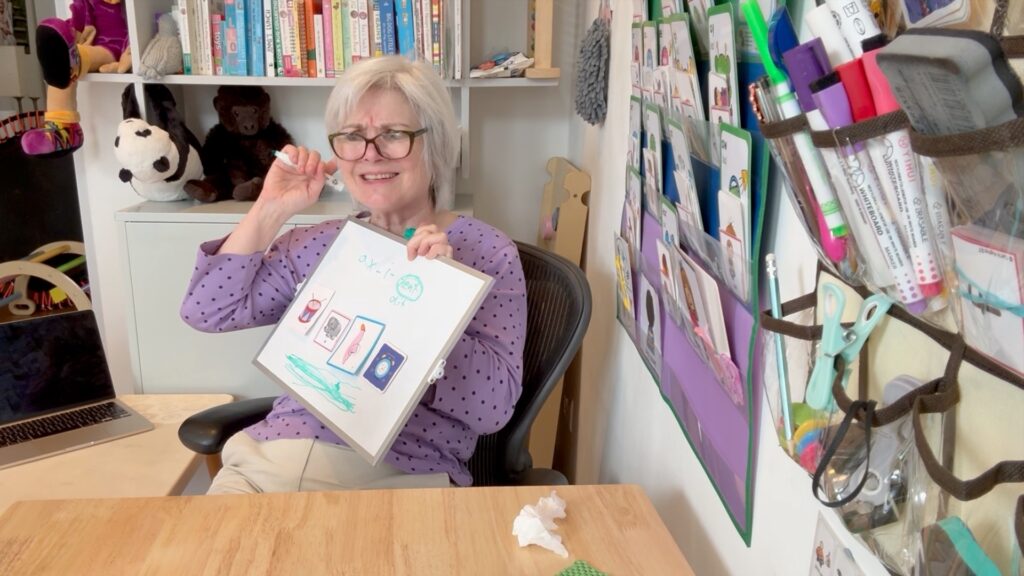
Recently I filmed a short clip from one of my therapy sessions which shows exactly how this works in practice.
The child I was working with has difficulties with several speech sounds. Part of the challenge relates to a phonological pattern called fronting.
Fronting is when sounds that should be made further back in the mouth (like /K/ or /G/) are produced further forward instead.
At the same time, this child also shows signs of motor speech planning difficulty, which means the brain has to work harder to organise and sequence the movements of the tongue, lips and jaw for speech.
This type of profile can sometimes overlap with characteristics seen in Childhood Apraxia of Speech (CAS).
When difficulties overlap like this, therapy cannot rely on a single approach. Instead, it needs to draw on multiple evidence-based strategies.
That is exactly what you see happening in the clip. We started out generalising the /K/ sound which until recently had been replaced by a /T/ sound. Whilst looking at a sound loaded picture of /K/ sounds we somehow got talking about a ‘dent’ (I don’t recall how we got there!) but the ‘dent’ was a ‘det’ and I decided to tackle this there and then because there are other great words that end in ‘nt’ like : ‘count’ ‘giant’ ‘point’ or ‘paint’.
Using visual cues to support motor planning
Speech is incredibly complex. For children with motor speech difficulties, the challenge is not only knowing what sound they want to say, but also how to move their mouth to produce it.
This is where visual cues can be incredibly helpful.
In the clip, you can see me using a whiteboard with pictures and simple visual prompts. These help to:
- Focus attention on the target sound
- Understand where the sound occurs in the word
- Remember the sequence of sounds needed
Visual supports can act almost like a map for the mouth, guiding children as they practise new speech movements.
For children with motor planning difficulties, this type of cueing can make a huge difference.
Why repetition of a single word (massed practice) is so important
Another key feature you will notice in the clip is lots of repetition.
This is very deliberate.
When we are supporting children with motor speech challenges, the brain needs repeated opportunities to practise the correct movement patterns. Just like learning a musical instrument or a new sport, repetition helps the brain build stronger and more efficient pathways.
In therapy we call this massed practice.
Rather than saying a word only once or twice, we practise it many times in a structured way, helping the child stabilise the new speech pattern.
But repetition alone is not enough. The child also needs to understand why the sound matters.
Showing children that sounds change meaning
This is where another powerful therapy approach comes in: minimal pairs.
Minimal pairs are word pairs that differ by only one sound. For example:
- debt
- dent
In the clip, I use these two words to help the child realise that the /N/ sound makes a meaningful difference.
Without the /N/, the word becomes something else entirely.
This approach helps children recognise that speech sounds are not random: they carry meaning. If a sound is missing or substituted, the message may change.
Helping children notice these differences can be a very motivating moment in therapy. Suddenly the sound is no longer just an abstract exercise; it becomes part of real communication.
Blending approaches for the best outcomes
In this short therapy moment, I am combining:
• Visual cueing
• Motor speech practice
• High repetition (massed practice)
• Minimal pair contrasts
• Listening and awareness of sound differences
Each element supports a different part of the speech system.
Some strategies help with motor planning, others support phonological awareness, and others build accuracy and consistency.
Together they create a therapy session that is both structured and responsive.
Every child’s speech journey is unique
One of the most important things I want to convey is that speech development is not always straightforward.
Two children may both struggle with speech sounds, yet the underlying reasons may be very different.
This is why careful assessment is essential, and why therapy needs to stay flexible as we learn more about how a child’s speech system works.
Sometimes a child needs more motor-based work.
Sometimes the focus shifts towards phonological contrasts.
Often, as in this example, the most effective therapy uses both.
Small steps lead to big progress
Every session helps us understand a little more about how a child’s speech system works and what support will help them move forward.
And when the pieces start to come together, when a child realises that one tiny sound can change a whole word, that is when the real progress begins.
If you are concerned about your child’s speech sounds, clarity of speech, or possible motor speech difficulties, early support can make a significant difference. A detailed assessment can help identify the nature of the difficulty and guide a therapy approach tailored to your child’s individual needs.
Feel free to contact me on www.londonspeechandfeeding.co.uk

Sonja McGeachie
Highly Specialist Speech and Language Therapist
Owner of The London Speech and Feeding Practice.


Find a speech and language therapist for your child in London. Are you concerned about your child’s speech, feeding or communication skills and don’t know where to turn? Please contact me and we can discuss how I can help you or visit my services page.
Reference
McNeill, B. C., Gillon, G. T., & Dodd, B. (2009). Effectiveness of an integrated phonological awareness approach for children with childhood apraxia of speech (CAS). Child Language Teaching and Therapy, 25(3), 341-366.


