How can I incorporate AAC into my speech therapy sessions?

|

Many parents are surprised when I bring AAC into a session, especially if they’ve come to see me primarily for speech sound work.

They might wonder: ‘If we’re working on pronunciation, why are we using a communication device?’

The simple answer is this: speech therapy is about communication first, and speech sounds second. Supporting a child’s ability to express themselves clearly and confidently is always the priority, and AAC can be a powerful tool alongside spoken speech.

What do we mean by AAC?

AAC stands for Augmentative and Alternative Communication.

This can include:

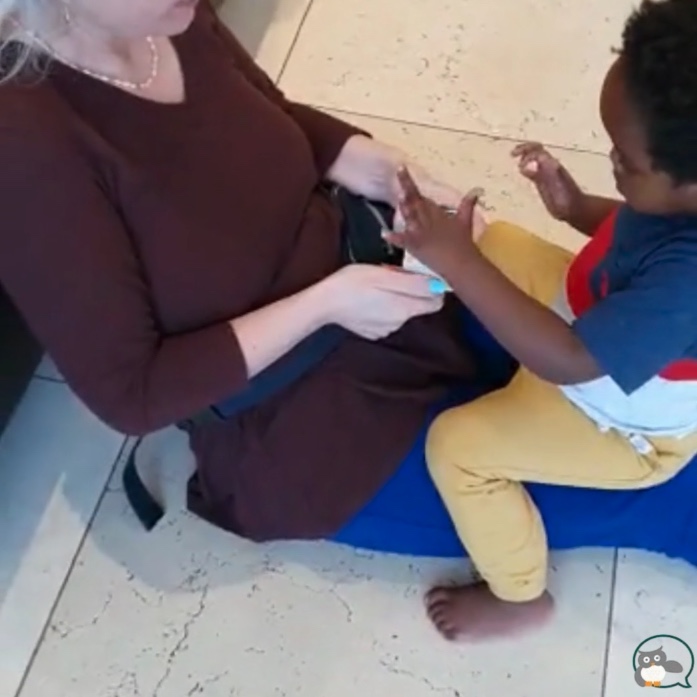
  • A speech-generating device (such as LAMP Words for Life or GRID as I used in the photo below)
  • A communication app on a tablet
  • A symbol board or communication book
  • Gestures, signs, or visual supports

AAC does not replace speech. Instead, it supports language development, reduces frustration, and builds communication success while speech skills are developing.

Pretend Play using Speech and AAC in my clinic room

But I mainly work on speech sounds… So how does AAC fit?

Most of the children I see are working on:

  • Articulation difficulties
  • Phonological delay
  • Motor planning challenges (including apraxia/dyspraxia)
  • Unclear speech affecting confidence

For these children, AAC isn’t a separate therapy. It’s simply woven naturally into what we are already doing.

If a child brings their device to sessions, I actively include it. If they don’t yet use AAC but could benefit from visual or symbolic support, I may introduce simple options within activities.

Using AAC to support speech practice

Let’s say we are working on early speech targets like: ‘GO’.

We might practise:

  • Saying the word verbally
  • Listening for the target sound
  • Using play (TOY TRAIN GOING ROUND A TRACK)

Now we can extend this using AAC.

On the device or communication board, we might model: ‘LET’S GO’ or ‘IT’s GOING up the hill’.

This allows the child to:

  • Practise their speech sound target
  • Build a simple sentence
  • Experience successful communication even if speech is not fully clear yet

All responses are valid and supported.

AAC helps children communicate more than they can say

Many children can understand and think in longer phrases than they can physically say.

For example:

  • A child who verbally says single words may build longer phrases on AAC.
  • A child who struggles to plan speech movements may use AAC to communicate smoothly while still practising verbal attempts.
  • A child who becomes frustrated when misunderstood gains a reliable backup system.

Rather than slowing speech progress, AAC often:

  • Reduces communication pressure
  • Increases participation in therapy
  • Encourages more attempts at speech
  • Supports language growth

When children feel understood, they usually become more motivated to try speaking.

There are no ‘prerequisites’ for AAC

One of the biggest myths I hear is: ‘My child isn’t ready for AAC yet.’

In reality, children do not need to:

  • Reach a certain speech level
  • Use pictures first
  • Prove they understand everything
  • Show immediate interest

Instead, we presume competence and introduce AAC in meaningful, playful ways.

That means:

  • Modelling words while blowing bubbles
  • Commenting during playdough activities
  • Choosing words during games
  • Building simple phrases in shared reading

AAC should never feel like extra ‘work’. It’s simply another way to join in communication.

My goal is always the same: to help each child communicate as clearly, confidently, and successfully as possible, using every helpful tool available.

If your child uses AAC (or might benefit from it)

 Please feel free to:

  • Bring the device to sessions
  • Show me how your child currently uses it
  • Share advice from school or other therapists

I am very happy to incorporate AAC into our work together so that speech practice, language development, and real communication all move forward hand-in-hand. Because ultimately, therapy isn’t just about producing perfect sounds. It’s about helping your child be heard and understood.

If you’d like support or advice, please contact me and I can help guide the next steps.

Sonja McGeachie

Highly Specialist Speech and Language Therapist

Owner of The London Speech and Feeding Practice.


    Health Professions Council registered
    Royal College of Speech & Language Therapists Member
    Member of ASLTIP

    Find a speech and language therapist for your child in London. Are you concerned about your child’s speech, feeding or communication skills and don’t know where to turn? Please contact me and we can discuss how I can help you or visit my services page.

    3

    Similar Posts

    • Learn why ‘watchful waiting’ isn’t the answer

      As a Speech and Language Therapist, I am a big advocate of early intervention. And I’m always encouraging you (as parents and carers) to seek intervention as early as possible. But you might be thinking, “my child just needs more time.” Have you ever wondered why early intervention is important? Read on to learn more.

      Speech Therpaist in London
      Watchful waiting is not the answer

      Early intervention

      By intervening at a later age or stage of development, you may be leading your child to develop consequences as a result. One consequence can be challenging behaviour due to their inability to express their wants and needs. They may have difficulty in understanding and following directions. This will not only affect their ability in the classroom but also socially, maintaining friendships. Early intervention can support understanding. This can also help you support your child in breaking down activities so they can fully take part in home and school life. The Early Intervention Foundation (2021) suggest that providing early intervention can develop a young person’s strengths. You can use these activities to support their needs which creates better outcome measures. This allows young people to reach their full potential across a range of settings. It can positively impact on mental health and self-esteem.n

      Positive outcomes

      Also, we are protecting our young people from harmful situations by giving them a voice. And by giving them a voice, they are:

      • more likely to achieve and
      • less likely to have in negative experiences such as crime and with the justice system.

      We know that social and emotional skills (such as developing self-awareness, social skills, and emotional regulation) are crucial to a young person’s development. Research has found that children with a higher level of social and emotional skills are more likely to:

      • achieve in education,
      • graduate from university,
      • have career prospects,
      • have positive work and family relationships,n
      • maintain good mental and physical health.

      By having these positive aspects in their lives, they are less likely to engage in antisocial behaviour and related crime. It’s easy to think this feels like a long way off for your family. But by giving them the best possible start, you are promoting a positive future in all aspects of their life.

      Contact me today to get started with speech, language and communication intervention.


      Find a speech and language therapist for your child in London. Are you concerned about your child’s speech, feeding or communication skills and don’t know where to turn? Please contact me and we can discuss how I can help you or visit my services page.

      1
    • · · · ·

      Managing mealtime sensory overload at holiday gatherings: Supporting children with allergies and feeding differences

      Managing mealtime sensory overload at holiday gatherings: Supporting children with allergies and feeding differences

      Holiday meals are meant to be joyful and something we all look forward to. But for many children and their families, these occasions can be overwhelming and be the cause of dread and worry. The combination of new smells, unfamiliar foods, loud environments, social expectations, and allergy anxieties can quickly turn what should be a festive time into a stressful one.

      For parents of children with sensory processing differences, selective eating challenges, or food allergies, holiday gatherings often require careful planning and a big dose of tolerance and compassion. The good news is that with awareness and a few gentle strategies, you can support your child to feel safe, regulated, and included during festive meals without pressure, tears, or discomfort.

      Let’s explore how to make holiday mealtimes calmer, safer, and more connected this season.

      🎄 Why holiday meals feel so overwhelming

      Holiday gatherings usually combine several sensory triggers all at once:

      • Noisy, chaotic rooms
      • Strong smells from a mix of foods we don’t normally cook
      • Multiple conversations happening at once
      • Bright lights, Christmas décor, flickering candles
      • Unfamiliar foods with unexpected textures
      • Expectations to ‘try everything’ or ‘enjoy it’s sooo good!’
      • New environments, seating arrangements, or routines

      For children with sensory sensitivities, this can feel like a tidal wave of input. Research shows that children who are sensory-sensitive often have heightened responses to smell, taste, and texture, which may lead to avoidance or distress at mealtimes (Cermak, Curtin, & Bandini, 2010).

      Add food allergies into the picture and anxiety increases even further for both children and parents. A 2020 study by DunnGalvin et al. found that children with food allergies experience significantly higher stress in shared eating environments, especially when food preparation or contamination risk is hard to control.

      So, if your child becomes tearful, shuts down, or refuses to sit at the festive table, it isn’t ‘bad behaviour.’ It’s sensory overload, heightened vigilance, or discomfort communicating through their body.

      🌟 Preparing your child for a calmer festive meal

      Preparation is especially important for sensory-sensitive or allergy-aware children. Here’s how to set them up for success:

      1. Offer predictability through previewing

      Before the event, show your child pictures of:

      • where you’re going
      • who will be there
      • the types of foods that might be served
      • where they might sit

      A visual schedule or social story can help reduce anxiety and give your child a sense of control.

      2. Pack safe foods without apology

      If your child has allergies or selective eating, bring:

      • ‘Safe foods’ you know they will eat
      • Backup snacks
      • A separate (their own) plate, if needed
      • Emergency medication

      Announce clear, firm boundaries such as:

      ‘Ok people, these are Jamie’s safe foods — we’ll stick with these today.’ This will help relatives understand without pressure or judgement.

      3. Choose seating that supports sensory regulation

      If possible, seat your child:

      • at the end of the table
      • near a familiar adult
      • away from the kitchen (strong smells)
      • away from noise clusters
      • give them their favourite toy or fidget whilst waiting

      Let them take breaks when needed. This isn’t ‘rude,’ it’s self-regulation.

      🍽️ Supporting children during the meal

      1. Focus on connection, not consumption

      The holidays are not the time to expand your child’s food range. Keeping mealtimes low-pressure actually supports long-term progress.

      In fact, the research is clear: pressuring children to eat decreases acceptance and increases refusal (Galloway et al., 2006).

      So instead of ‘Just try it!’ try:

      • ‘You don’t have to eat it, you can look at it.’
      • ‘You’re in charge of what goes in your mouth.’
      • ‘You can keep your safe foods on your plate.’

      2. Protect your child’s allergy safety

      Holiday meals often include:

      • cross-contamination risks
      • shared utensils
      • buffets
      • homemade dishes without ingredient lists

      Use gentle but firm scripts:

      • ‘Because of Ellie’s allergies, we’ll keep her plate separate.’
      • ‘We’ll serve her food ourselves to make sure she stays safe.’

      Confidence in your boundary helps others respect it.

      3. Manage sensory load in real time

      Offer:

      • headphones
      • a small chew or fidget toy
      • a designated ‘calm corner’
      • time outside for fresh air
      • a predictable signal for breaks (e.g., a hand squeeze or card)

      Remember, sensory regulation is healthcare, not ‘giving in.’

      4. Model calm eating

      Children learn most from watching.

      Slow, happy bites and relaxed facial expressions tell the nervous system: ‘This environment is safe’.

      💛 What to say to well-meaning relatives

      Families often have big feelings about food. You can prepare nice phrases like:

      • ‘We’re focusing on helping him feel safe around food today.’
      • ‘She has allergies, so we’re sticking to our plan.’
      • ‘We’re avoiding pressure because it helps him eat better long term.’
      • ‘We’re celebrating together, eating is not the goal today.’

      Setting expectations ahead of time can reduce awkward moments later.

      🎁 The bigger picture: It’s about safety, not ‘picky eating’

      Children with allergies, sensory differences, or feeding challenges aren’t trying to be difficult. They are trying to stay safe, regulated, and comfortable.

      Your calm presence, gentle boundaries, and preparation create the conditions for a holiday that feels peaceful, not pressured.

      Sonja McGeachie

      Highly Specialist Speech and Language Therapist

      Owner of The London Speech and Feeding Practice.

      Health Professions Council registered
      Royal College of Speech & Language Therapists Member
      Member of ASLTIP

      Find a speech and language therapist for your child in London. Are you concerned about your child’s speech, feeding or communication skills and don’t know where to turn? Please contact me and we can discuss how I can help you or visit my services page.
      📚Research References

      Cermak, S. A., Curtin, C., & Bandini, L. G. (2010). Food selectivity and sensory sensitivity in children with autism spectrum disorders. Journal of the American Dietetic Association, 110(2), 238–246.

      DunnGalvin, A. et al. (2020). APPEAL-2: A pan-European qualitative study to explore the burden of peanut-allergic children, teenagers and their caregivers. Clinical & Experimental Allergy, 50(11), 1238–1248.

      Galloway, A. T., Fiorito, L. M., Francis, L. A., & Birch, L. L. (2006). ‘Finish your soup!’ Counterproductive effects of pressuring children to eat on intake and affect. Appetite, 46(3), 318–323.

      2
    • Why teletherapy is great

      Did you know that you don’t have to see a therapist with your child present to have improved communication? For younger children, evidence suggests that regular tailored interaction with parents/carers is as good as seeing a Speech and Language Therapist, with their advice followed. Often your child will respond better because they are in familiar surroundings with their favourite toys present. By learning the techniques I teach you in our weekly virtual zoom sessions, you can support your child’s language and communication every single day. This can be as good and sometimes even better than coming into clinic once a week. You’re embedding and generalising what your child is learning into everyday situations. This is important for your child’s communication development.

      Speech Therpaist in London

      It takes two to talk – the Hanen approach

      The Hanen approach is about improving your child’s communication by tweaking your own communication style as parents and carers. It looks at your strengths and weaknesses in your communication with your child. You film a session playing with your child, and with a trained Hanen Speech and Language Therapist you review the video identifying strengths and weaknesses in your communication on a regular basis for a set period. For example, you may give your child plenty of time to answer questions, but you might identify from the video that you ask too many questions.

      The Hanen approach works well online because:

      • Parents and carers can concentrate on the information they are given without interruption from their child
      • It is a process; you’re not told what’s right and wrong. It’s a process of discussion, reflection, and understanding by analysing the video footage
      • This method can be applied to daily activities, so together we can think about how it can be individualised specifically for your family situation
      • You can carry out the techniques in your own time when your child is well, calm, and willing to engage.

      Online therapy is also ideal for older children (aged 7+) who have difficulties with speech, word-finding, sequencing, or executive functioning (planning and processing information) skills. You can see and hear the therapist and gain knowledge from their valuable expertise whilst saving you time, money, and energy resources. In addition, children tend to love technology, so the online resources are motivating and capture their attention.

      Remove the barriers and start your online therapy journey today.

      Contact me to learn more.


      Sonja is a highly knowledgeable and experienced speech and language therapist. Don’t hesitate to contact her, especially if you are concerned that remote/zoom sessions aren’t as effective as ‘real life’. We have found quite the opposite! She has worked with us on Hanen and now troubleshoots when problems come up. This is such a wonderful way of working. She acts as your indispensable guide (a speech and language fairy godmother, if you like) but make no mistake, it’s your application of what she teaches you, on a day-to-day basis that results in the most change.

      P. Goeldner


      Find a speech and language therapist for your child in London. Are you concerned about your child’s speech, feeding or communication skills and don’t know where to turn? Please contact me and we can discuss how I can help you or visit my services page.
    • · ·

      LAMP Words for Life: A revolutionary AAC system

      Introduction

      When working with non-speaking or minimally speaking children the LAMP Words for Life AAC (Augmentative and Alternative Communication) system is my absolute go-to every time. For me it stands out as a revolutionary system that has transformed the lives of many of my non-speaking students. LAMP Words for Life is a ROBUST, comprehensive language-based AAC system and it is designed to help any user to express their thoughts, feelings, and needs effectively, thereby achieving maximal independence in their daily life. A winner!

      There is a whole host of AAC apps and systems out there and each has their own advantages and benefits for sure. I have tried a good number of other systems. I do also like certain features of other AAC systems for sure. For example GRID: I love the versatility of GRID and the ease of editing the system is fantastic.

      Why I think it works so well

      However, strangely I always return to LAMP when push comes to shove. I have thought very carefully about it and so here are my thoughts on why this is and why it works so well:

      1. Intuitive interface: LAMP Words for Life features are for me really user-friendly and it is easy to navigate and understand (this is very important for non-techy people). I think it makes sense and it is accessible to users of all ages and abilities. Yes the pictures are a little bit different to other symbol systems we use, especially here in the UK to be sure, and this is one of the reasons why it is good to have a variety of systems available, so that we can cater for students who are used to other symbols or do very well with specific symbol core boards. I have learned though that the pictures are not that important when using LAMP because the entire system is based on MOTOR PLANNING. And once one knows the motor plan to find a picture it is in our brain and we do not look at the picture any more. So, the motor plan to find a word is much more important when using LAMP than worrying about what the picture looks like.
      2. Comprehensive vocabulary: The system offers a vast vocabulary of words and phrases, covering a wide range of topics and contexts. This enables users to express themselves effectively on a variety of subjects. That said, almost every time I use LAMP there is a little word I need and it’s not on there. But that’s not a problem: for example, I was looking for ‘sunglasses’ the other day. Sure, there is ‘sun’ and ‘glasses’ but that would be two separate motor plans and for my student that would be too many for now, so it was very easy to quickly add the new word ‘sunglasses’ under ‘accessories’ or ‘beach wear’ — I added it within less than one minute. Likewise, there are a ton of words which cater for the US market, and I tend to change them to fit the UK vocabulary like ‘nappy’ for ‘diaper’. Or I delete them entirely if I feel my child will never need to use a certain word like ‘conference’ or ‘nun’. PS: should they get to a point of using the system as an adult independently then these words can surely be added again, or if my student ever moves to the US then the words can be changed back to US terms again without any problem.
      3. Grammar support: LAMP provides built-in grammar support, helping users construct grammatically correct sentences. This can be particularly beneficial for individuals with language processing difficulties. But what I love about the way LAMP is organised here is that, in contrast with other systems I have used, it does not PREDICT what you want to say, it lets the user decide and find the right grammatical structure. I appreciate this because, just like I hate my phone or email offering predictive text or offer corrections to my words, I really do not get the systems that offer automatically a grammar change which mostly I don’t want. Where that is the case, I am often confused and hindered in finding the correct wording. I love the simplicity of LAMP and at the same the complexity that can be achieved gradually with practice. LAMP is fully designed to enable a user to build up not only vocabulary but a full language system. On a course recently I was able to hear adult LAMP users speaking to the audience in full and quick grammatically well-rounded sentences on a host of topics.
      4. Customisation: LAMP can be customised to meet the individual needs of each user. This includes options for adjusting the vocabulary, layout, and accessibility features. It is not as easy to edit as GRID I will say and that can cause me a little bit of frustration at times, but on balance I still vastly prefer the system as a whole. It can also be customised quite well for Gestalt Language Processors. It takes a little bit of practice and thinking about how best to do this but I have found a way that works well which I demonstrate in the short video clip.
      5. Community support: LAMP Words for Life has a thriving community of users on Facebook and this is so valuable and inspiring. Therapists and families of LAMP users alike share experiences, provide resources, and offer encouragement. This can be a valuable source of support for both users and their families.
      6. Comprehensive support: LAMP Words for Life offers quick and thorough support services, including training, resources, and ongoing assistance. This is invaluable and reassuring for both users and caregivers.
      7. Research-based: The development of LAMP Words for Life is based on extensive research and evidence-based practices. This ensures that the system is grounded in sound scientific principles.

      Conclusion

      To conclude LAMP Words for Life is a powerful AAC which provides us with a means of effective communication, language development, and social interaction. Whether you are a parent of a non-speaking child or a speech therapist looking for innovative AAC solutions, LAMP Words for Life is worth exploring.

      Example on how to use AAC at story time

      Feel free to contact me if you need help with your child.

      Sonja McGeachie

      Early Intervention Speech and Language Therapist

      Feeding and Dysphagia (Swallowing) Specialist The London Speech and Feeding Practice

      The London Speech and Feeding Practice


      Find a speech and language therapist for your child in London. Are you concerned about your child’s speech, feeding or communication skills and don’t know where to turn? Please contact me and we can discuss how I can help you or visit my services page.

      1
    • Speech sound disorders

      Kids Speech Therapist London
      Speech Sound Disorders

      Treatment Approaches – A Typical Session

      There are various great ways to treat speech sound disorders and I use all the approaches available selectively; I decide what works with each individual child and I also vary the approach depending on the child’s frame of mind at any given time during my session.

      Some of the approaches are more “drill-based” and require a child to be able to pay attention and really participate actively in the therapy, and this is what I am showing you today with this video clip.

      My little student here has been working with me for some time and from only saying a handful of words which were not very easy to understand he has come a long way. He does have some features of Verbal Dyspraxia which I shall briefly outline here:

      • Making sounds in general is a struggle, especially when asked to copy certain sounds, example: ‘can you say: a ee ou oo?”
      • Repeating sound sequences or words sequences is hard, for example: “say p-t-k in sequence” or “say fish chips fish chips fish chips
      • When saying the same word again and again, different mistakes can be heard
      • Intonation difficulties: speech sounds monotonous
      • Vocabulary is very limited

      Some therapy approaches are more play based, for example the Core Word method: here we pick a few words at a time which are very significant to the child and therefore highly motivating to try and say. These could be characters of Pokemon or Minecraft for example, or simple words like “GO!”

      When you watch the video you will see that I use a lot of visual prompting, such as showing him where the tongue is moving to or from. I do this with my index finger and this approach is called Tactile Cueing or “Cued Articulation”. Part of the approach is to give a visual prompt and then reduce the prompt as the learner is more able to produce the correct sounds. Once he can produce the sound on its own, we quickly move to the sound within a word.

      I do mix and match my approaches and in fact here I am drilling but I also use the Core Word which for him (YELLOW) — it’s his favourite colour and I happen to have quite a few good games where a YELLOW something or other can be asked for….. WHO KNEW!? 🙂


      Find a speech and language therapist for your child in London. Are you concerned about your child’s speech, feeding or communication skills and don’t know where to turn? Please contact me and we can discuss how I can help you or visit my services page.

    • · ·

      How do we know our Gestalt Learner is moving to Stage 2?

      Image by Freepik

      Is our student ready to move to NLA 2 (Natural Language Acquisition stage 2)?

      We know that the GLP (Gestalt Language Processor) will move into the next stage when they are ready. But are they now ready you might think? When are they ready? How do I know? If you are not sure whether your child is ready to move forward then go and see your GLP trained Speech Therapist. Together you can work out what the next steps are and how to help your child settle into NLA 2. It’s very exciting!!

      Tip

      The first useful tip: keep a language sample of phrases your child says. This is very helpful!

      You might want to check with your Speech Therapist and offer some language sampling you have taken so they can help you figure out where your child is currently. Always keep an Utterance Journal that you can share with your Speech Therapist and with others who look after your child.

      Basically, we want to listen out for phrases our child says that you or nursery don’t say routinely; that way you can presume that this is not an echo but a mixing together of two chunks of gestalts. Watch out for those coco melon phrases though: double check it really isn’t an NLA 1 gestalt that is copied verbatim from a favourite you tube video.

      You can best support your child best by listening, and thus figuring out what your child is TRYING TO SAY. Often your child might skip over the parts of gestalts they don’t want to say. This is common in older kids who have long gestalts, sometimes even whole episodes or whole stories!

      Try and tease out their shorter mitigations and then focus on practicing and modelling those as they are so much more useful!

      So back to our question: are they ready?

      Are their gestalts covering a variety of situations and contexts?

      Make a note in your journal to see what the backgrounds are to each phrase you ear, so for example:

      • Transitioning: ‘it’s time for the park’ ‘what’s next’ ‘shoes on’
      • Bed Time: ‘we need to wash’ ‘let’s get in (bath/bed)’ ‘ready for our book’
      • Toilet/nappy: ‘we need the potty’ ‘where’s the potty’ ‘let’s wash hands’
      • Mealtime: ‘time to eat’ ‘go get a spoon’ ‘yummy num num’
      • Park/going out: ‘look at the squirrel’ ‘funny doggy’ ‘I wanna swing’
      • At the shops: ‘let’s get the trolley’ ‘lots of veggies’ ‘no tomatoes’ ‘ooh long queue’ ‘back to the car’

      And… does the child use the phrases for a variety of functions?

      • labelling
      • providing information
      • calling out
      • affirming
      • requesting
      • protesting
      • directing

      We need to offer lots of similar language models so that in their own time our children can extract/mitigate useful phrases for what they want to express. The more similar utterances a child hears around him the more he/she can discover the communalities. Once the child has a small range of phrases, he/she can mix them up and create semi-original own phrases.

      If the answer is YES!! our child has perhaps not all but a range of functions and a range of situations where they use a variety of easily mitigable gestalts then yes they are ready for moving to stage 2 of NLA!

      Hurrah!

      Keeping a journal of what your child is saying and in what circumstance is crucial to help with our ongoing detective work!

      Next time I will be looking at how we can help our NLA 2 GLP produce even more of their own mix and match phrases.

      If you need help with your child, please do not hesitate to contact me.


      Find a speech and language therapist for your child in London. Are you concerned about your child’s speech, feeding or communication skills and don’t know where to turn? Please contact me and we can discuss how I can help you or visit my services page.

      1