When speech difficulties overlap: Helping children with phonological delay and childhood apraxia of speech
| |

One of the questions parents often ask is:

‘What kind of speech difficulty does my child have?’

It’s a very understandable question. We often hear different terms such as phonological delay, articulation difficulties, or Childhood Apraxia of Speech (CAS), and it can be confusing.

The reality is that many children don’t fit neatly into one single category.

In fact, quite often I see children whose speech profile includes a mixture of difficulties. They might have some phonological patterns (where they substitute one sound for another) alongside challenges with motor speech planning, where coordinating the movements needed for speech is harder.

When this happens, therapy needs to be flexible, responsive, and tailored to the child sitting in front of us.

Example

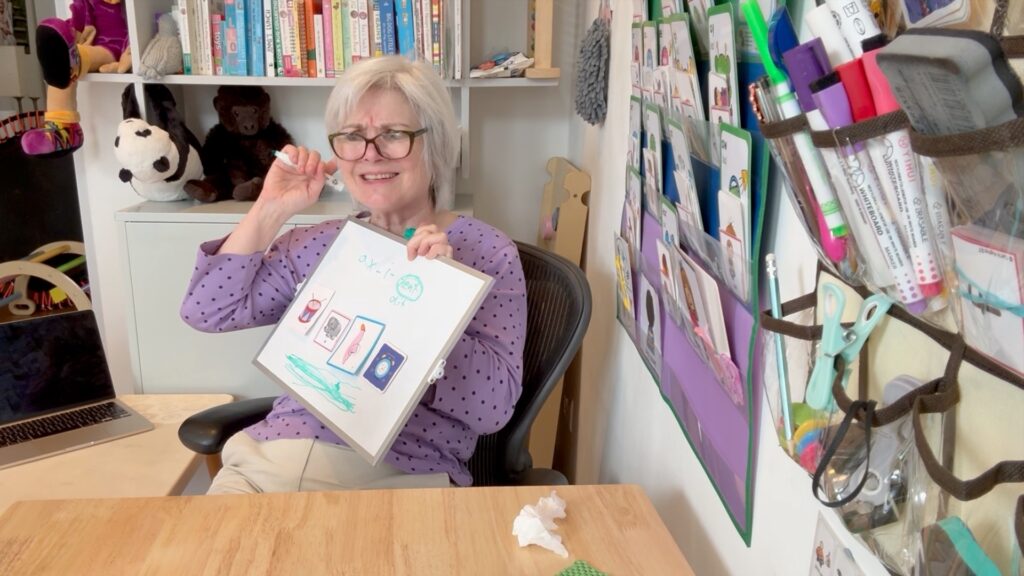
Recently I filmed a short clip from one of my therapy sessions which shows exactly how this works in practice.

The child I was working with has difficulties with several speech sounds. Part of the challenge relates to a phonological pattern called fronting.

Fronting is when sounds that should be made further back in the mouth (like /K/ or /G/) are produced further forward instead.

At the same time, this child also shows signs of motor speech planning difficulty, which means the brain has to work harder to organise and sequence the movements of the tongue, lips and jaw for speech.

This type of profile can sometimes overlap with characteristics seen in Childhood Apraxia of Speech (CAS).

When difficulties overlap like this, therapy cannot rely on a single approach. Instead, it needs to draw on multiple evidence-based strategies.

That is exactly what you see happening in the clip. We started out generalising the /K/ sound which until recently had been replaced by a /T/ sound. Whilst looking at a sound loaded picture of /K/ sounds we somehow got talking about a ‘dent’ (I don’t recall how we got there!) but the ‘dent’ was a ‘det’ and I decided to tackle this there and then because there are other great words that end in ‘nt’ like : ‘count’ ‘giant’ ‘point’ or ‘paint’.

Using visual cues to support motor planning

Speech is incredibly complex. For children with motor speech difficulties, the challenge is not only knowing what sound they want to say, but also how to move their mouth to produce it.

This is where visual cues can be incredibly helpful.

In the clip, you can see me using a whiteboard with pictures and simple visual prompts. These help to:

  • Focus attention on the target sound
  • Understand where the sound occurs in the word
  • Remember the sequence of sounds needed

Visual supports can act almost like a map for the mouth, guiding children as they practise new speech movements.

For children with motor planning difficulties, this type of cueing can make a huge difference.

Why repetition of a single word (massed practice) is so important

Another key feature you will notice in the clip is lots of repetition.

This is very deliberate.

When we are supporting children with motor speech challenges, the brain needs repeated opportunities to practise the correct movement patterns. Just like learning a musical instrument or a new sport, repetition helps the brain build stronger and more efficient pathways.

In therapy we call this massed practice.

Rather than saying a word only once or twice, we practise it many times in a structured way, helping the child stabilise the new speech pattern.

But repetition alone is not enough. The child also needs to understand why the sound matters.

Showing children that sounds change meaning

This is where another powerful therapy approach comes in: minimal pairs.

Minimal pairs are word pairs that differ by only one sound. For example:

  • debt
  • dent

In the clip, I use these two words to help the child realise that the /N/ sound makes a meaningful difference.

Without the /N/, the word becomes something else entirely.

This approach helps children recognise that speech sounds are not random: they carry meaning. If a sound is missing or substituted, the message may change.

Helping children notice these differences can be a very motivating moment in therapy. Suddenly the sound is no longer just an abstract exercise; it becomes part of real communication.

Blending approaches for the best outcomes

In this short therapy moment, I am combining:

• Visual cueing

• Motor speech practice

• High repetition (massed practice)

• Minimal pair contrasts

• Listening and awareness of sound differences

Each element supports a different part of the speech system.

Some strategies help with motor planning, others support phonological awareness, and others build accuracy and consistency.

Together they create a therapy session that is both structured and responsive.

Every child’s speech journey is unique

One of the most important things I want to convey is that speech development is not always straightforward.

Two children may both struggle with speech sounds, yet the underlying reasons may be very different.

This is why careful assessment is essential, and why therapy needs to stay flexible as we learn more about how a child’s speech system works.

Sometimes a child needs more motor-based work.

Sometimes the focus shifts towards phonological contrasts.

Often, as in this example, the most effective therapy uses both.

Small steps lead to big progress

Every session helps us understand a little more about how a child’s speech system works and what support will help them move forward.

And when the pieces start to come together, when a child realises that one tiny sound can change a whole word, that is when the real progress begins.

If you are concerned about your child’s speech sounds, clarity of speech, or possible motor speech difficulties, early support can make a significant difference. A detailed assessment can help identify the nature of the difficulty and guide a therapy approach tailored to your child’s individual needs.

Feel free to contact me on www.londonspeechandfeeding.co.uk

Sonja McGeachie

Highly Specialist Speech and Language Therapist

Owner of The London Speech and Feeding Practice.


Health Professions Council registered
Royal College of Speech & Language Therapists Member
Member of ASLTIP

Find a speech and language therapist for your child in London. Are you concerned about your child’s speech, feeding or communication skills and don’t know where to turn? Please contact me and we can discuss how I can help you or visit my services page.

Reference

McNeill, B. C., Gillon, G. T., & Dodd, B. (2009). Effectiveness of an integrated phonological awareness approach for children with childhood apraxia of speech (CAS). Child Language Teaching and Therapy, 25(3), 341-366.

3

Similar Posts

  • · ·

    Why ‘Prosody’ Matters in Childhood Apraxia of Speech (CAS)

    Prosody refers to the ‘music’ of speech — the rhythm, pitch, stress, and volume that convey meaning and emotion beyond the literal words themselves. Think about a monotone statement like ‘Really?’ compared to one with a rising inflection, expressing genuine curiosity.

    When I work with children on producing speech sound sequences, we focus on mastering individual sounds and then putting them together into target words. A crucial element that can significantly impact a child’s speech production is ‘prosody’.

    In CAS, where the difficulty lies in planning and executing the motor movements for speech, prosody can be a powerful tool for producing clearer words and phrases.

    Here’s why working on prosody is an essential tool in CAS speech therapy:

    1.  It aids Motor Learning:

    Apraxia of Speech means that the planning and execution of speech movements are impaired. When we use exaggerated intonation or stress patterns while modelling words, we are providing additional prosodic variation and, therefore, additional auditory cues. These cues often help my student to carry out the correct motor movements for a word or syllable sequence.

    For instance, I might say ‘ball’ with a high-pitched emphasis on the ‘b’ sound. This auditory cue might be more effective in guiding the child’s tongue placement than simply repeating the word without variation.

    In this little video clip I get my student to say the word ‘snuggle’ (since we were working on that particular sound sequence: snuggle, snout, snore and sneeze) with a high voice and then a lower voice ‘like a bear’ — again it provides that extra auditory cue, but, in addition, the fun aspect also helps to take away the intense focus on a tricky movement pattern.

    By now the new pathways have been laid through repeated practice and now automaticity takes over and without too much effort my student can suddenly produce a motor pattern. It’s magical when it happens and gives me such a thrill.

    2. It makes speech more engaging and natural sounding:

    Children with CAS often sound robotic or flat due to challenges with prosodic elements. By incorporating variations in pitch, volume, and rhythm during therapy, we can help achieve a more natural flow of speech

    3. It makes it easier to express our emotions:

    Children with CAS often struggle to express themselves emotionally; partly through the difficulty of producing clear words — period, but also in addition due to the difficulties or absence of musicality and rhythm in their speech.

    Therefore, it is so important to incorporate activities focused on practising different emotions with varied intonation patterns. This can really empower our students to put emotions into their words.

    Good words to practise are fun words like ‘Wow!’ or ‘Yeiih’ or power words and phrases like ‘No!’ or ‘Gimme that’ etc.

    Making Therapy Fun and Engaging:

    Speech therapy for CAS doesn’t have to be all drills and exercises (though to be fair sometimes we can’t quite get round to making each and every word huge fun though we try…).

    I aim to make all my sessions fun and have intrinsic rewards built into the speech practice where possible.

    Home practice tips:

    Therapy shouldn’t exist in a bubble. Working on prosody during sessions is crucial, but it’s equally important to integrate these skills into everyday interactions. Parents and caregivers can model appropriate prosody during playtime, story time, or even simple conversations. This consistent reinforcement helps our children to generalise their newfound skills and use them naturally in their daily lives.

    • Sing songs and rhymes: Songs naturally incorporate variations in pitch and rhythm. Singing familiar songs and creating silly rhymes can be a delightful way to practise prosody.
    • Use puppets and toys: Assign different voices and personalities to puppets or toys. This encourages children to experiment with pitch and volume to differentiate characters.
    • Read aloud with enthusiasm: Model expressive reading, varying your voice for different characters and emphasising key words. This makes reading time engaging and helps children understand the power of prosody.

    Please feel free to contact me if your child has speech sound difficulties. It is my passion. I love supporting children with apraxia.

    Sonja McGeachie

    Early Intervention Speech and Language Therapist

    Feeding and Dysphagia (Swallowing) Specialist The London Speech and Feeding Practice

    The London Speech and Feeding Practice


    Find a speech and language therapist for your child in London. Are you concerned about your child’s speech, feeding or communication skills and don’t know where to turn? Please contact me and we can discuss how I can help you or visit my services page.

    1
  • · ·

    How do we know our Gestalt Learner is moving to Stage 2?

    Image by Freepik

    Is our student ready to move to NLA 2 (Natural Language Acquisition stage 2)?

    We know that the GLP (Gestalt Language Processor) will move into the next stage when they are ready. But are they now ready you might think? When are they ready? How do I know? If you are not sure whether your child is ready to move forward then go and see your GLP trained Speech Therapist. Together you can work out what the next steps are and how to help your child settle into NLA 2. It’s very exciting!!

    Tip

    The first useful tip: keep a language sample of phrases your child says. This is very helpful!

    You might want to check with your Speech Therapist and offer some language sampling you have taken so they can help you figure out where your child is currently. Always keep an Utterance Journal that you can share with your Speech Therapist and with others who look after your child.

    Basically, we want to listen out for phrases our child says that you or nursery don’t say routinely; that way you can presume that this is not an echo but a mixing together of two chunks of gestalts. Watch out for those coco melon phrases though: double check it really isn’t an NLA 1 gestalt that is copied verbatim from a favourite you tube video.

    You can best support your child best by listening, and thus figuring out what your child is TRYING TO SAY. Often your child might skip over the parts of gestalts they don’t want to say. This is common in older kids who have long gestalts, sometimes even whole episodes or whole stories!

    Try and tease out their shorter mitigations and then focus on practicing and modelling those as they are so much more useful!

    So back to our question: are they ready?

    Are their gestalts covering a variety of situations and contexts?

    Make a note in your journal to see what the backgrounds are to each phrase you ear, so for example:

    • Transitioning: ‘it’s time for the park’ ‘what’s next’ ‘shoes on’
    • Bed Time: ‘we need to wash’ ‘let’s get in (bath/bed)’ ‘ready for our book’
    • Toilet/nappy: ‘we need the potty’ ‘where’s the potty’ ‘let’s wash hands’
    • Mealtime: ‘time to eat’ ‘go get a spoon’ ‘yummy num num’
    • Park/going out: ‘look at the squirrel’ ‘funny doggy’ ‘I wanna swing’
    • At the shops: ‘let’s get the trolley’ ‘lots of veggies’ ‘no tomatoes’ ‘ooh long queue’ ‘back to the car’

    And… does the child use the phrases for a variety of functions?

    • labelling
    • providing information
    • calling out
    • affirming
    • requesting
    • protesting
    • directing

    We need to offer lots of similar language models so that in their own time our children can extract/mitigate useful phrases for what they want to express. The more similar utterances a child hears around him the more he/she can discover the communalities. Once the child has a small range of phrases, he/she can mix them up and create semi-original own phrases.

    If the answer is YES!! our child has perhaps not all but a range of functions and a range of situations where they use a variety of easily mitigable gestalts then yes they are ready for moving to stage 2 of NLA!

    Hurrah!

    Keeping a journal of what your child is saying and in what circumstance is crucial to help with our ongoing detective work!

    Next time I will be looking at how we can help our NLA 2 GLP produce even more of their own mix and match phrases.

    If you need help with your child, please do not hesitate to contact me.


    Find a speech and language therapist for your child in London. Are you concerned about your child’s speech, feeding or communication skills and don’t know where to turn? Please contact me and we can discuss how I can help you or visit my services page.

    1
  • ·

    Empowering non-speaking children: the power of AAC Core Boards

    Communication is the essence of human interaction, allowing us to express thoughts, feelings, wants and needs. For non-speaking children and their families finding an avenue to communicate effectively can be a really challenging journey.

    Augmentative and Alternative Communication (AAC) offers a solution: with AAC Core Boards as a powerful ally and tool to empower and express more than requests: ideas, comments, surprise and delight, as well as saying no to something! Very important!

    “AAC is a set of tools and strategies that an individual uses to solve every day communicative challenges. Communication can take many forms such as: speech, a shared glance, text, gestures, facial expressions, touch, sign language, symbols, pictures, and speech-generating devices” (RCSLT, 2023) to name just some.

    AAC Core Boards are a powerful tool to empower non-speakers to express ideas. In this blog, we’ll explore the significance of AAC Core Boards and how they can unlock the world of communication for non-speaking children.

    Let’s discover and understand AAC Core Boards

    Firstly, let’s look at what a Core Board looks like…

    AAC Coreboards
    Credit: Saltillo Word Power

    Why not have a go and download your own copy (and other boards) for free on the Saltillo Word Power website.

    AAC Core Boards are a specific type of AAC system that employs a grid-style board. This grid contains a set of core vocabulary words or symbols, which serve as a foundation for all communicative functions (e.g., initiating, greeting, requesting, negating, commenting, asking a question, and expressing surprise).

    These boards incorporate high-frequency (most used) and versatile words. They enable us to construct sentences, express emotions, and take part in conversations, fostering a sense of independence and autonomy. By enabling communication, we also remove some of the frustration (from not being able to communicate) which contributes/or often leads to behavioural difficulties.

    Building literacy skills

    AAC Core Boards are not only tools for immediate communication. They also play a pivotal role in language and literacy development. By using these boards, non-verbal children engage with words and symbols. It reinforces their understanding of language structure and grammar.

    As they consistently play with and then use their boards, they naturally absorb language patterns, laying the foundation for improved literacy skills. This immersive learning experience paves the way for future language acquisition and communication growth.

    Customisation for individual needs

    Every child is unique, and their communication needs can vary significantly. AAC Core Boards are designed with this diversity in mind, allowing for customisation to suit individual preferences and abilities. The boards can be adapted to include specific vocabulary relevant to a child’s daily life, interests, and activities. This personalisation ensures that the AAC Core Board is a true reflection of your child’s personality and needs, making communication more motivating, engaging and effective.

    Collaboration between AAC Core Boards and Speech Therapy

    AAC Core Boards are an excellent tool but we need to know one important aspect: they only work well when used regularly by the child’s family and key people in the first place.

    The board needs to be used and modelled by adults consistently and regularly across environments. This is so our children know what to expect, take an interest and begin to use the boards themselves. Modelling the use of AAC Core boards is vital. Think how long it typically takes for a child to learn their first word. Around a year! During that time the adults talk constantly to their child without hesitation or expectation! The same goes for introducing this new way of communicating.

    Collaborating with your child’s Speech and Language Therapist (SLT) ensures that your child receives the right guidance in using the AAC system. SLTs can assess your child’s communication abilities, recommend appropriate boards and provide guidance on how to best put them in place, so that your child can reach their communicative potential.

    For non-speaking children, AAC Core Boards are more than just tools. They are bridges to a world of communication, connection, and empowerment. These boards harness the power of visual communication, foster language development, social interaction, and personal expression. They can be tailored to individual needs with the support of skilled professionals. AAC Core Boards offer a beacon of hope, helping to break through communication barriers and thrive in a world that is waiting to hear your child’s voice.

    For answers to your questions and to explore the most effective support for your child, feel free to contact us.


    Find a speech and language therapist for your child in London. Are you concerned about your child’s speech, feeding or communication skills and don’t know where to turn? Please contact me and we can discuss how I can help you or visit my services page.

    0
  • A Day In The Life Of An Independent Speech And Language Therapist

    A Day In The Life Of An Independent Speech And Language Therapist

    A Day In The Life Of An Independent Speech And Language Therapist

    I often get asked how many clients/children I see per working day or what my working day/life looks like. I always reply that every day is different, which is true, but there is a sort of average working day which looks a bit like this:

    I usually start preparing for my first client of the day at around 9.30 am: I clean the room, wipe down all the toys and materials (that’s if they are coming to my clinic room) and then it takes me about 30 minutes to select and sometimes make suitable materials, games and activities for the child’s therapy programme. Client arrives at 10.30 am and the fun begins. They leave around 11.30am, and the cleaning and wiping down starts again – yes it’s the pandemic but to be fair I would do this anyway. I quickly write up my notes and send home work to the client via email. Now it’s 12 noon and I start preparing for the next client at 12.30 pm. This might be online parent-child interaction coaching and so I need different materials and activities that are suitable for teletherapy. We finish around 1.30 pm and I will write up my notes before having some lunch.

    Lunch tends to not be around 30 minutes. Around 2.00 pm I start prepping again for the next client: selecting activities, going over their last session, making sure I have everything I need to start at 2.45pm – we finish at 3.45pm, I write up my notes and then have a cuppa. The next client might be more on-line coaching or a child coming to see me: room cleaned and tidy, materials and activities prepared: client arrives at 4.30 pm and we finish at 5.30 pm. I clean the toys again, write up my notes and it is 6.00 pm ready for dinner. So that was four clients between 9 am and 6pm allowing for preparation, aftercare, cleaning and coffee and lunch.

    Other days I might see three clients and do more admin like ordering toys or books or teletherapy activities, or making materials (we therapist make tons of materials, we’d put Blue Peter to shame!) Sometimes I do two home visits, one in the morning and one in the afternoon – the travelling/parking in London is so time consuming that it really reduces the number of clients I can see which is why I don’t do many of those.

    I hand pick my clients to make sure that we are a good fit, and my service is bespoke: no one client gets the same treatment as another; each client is unique, usually very well-known and always highly valued. That takes time and means that in reality each client gets about 2 hours of my time, that is the actual session plus all the preparation and aftercare.

    I love this way of working and would not ever want to return to seeing tons of clients each day, not knowing any of them really well, due to high caseload numbers, staff shortages and an overload of administration.

    My way of working affords all my lovely clients the help they need to be able to feel empowered and to then support their children to make progress; when working with children they make the best progress they can make, fulfilling their potential. My lovely reviews and testimonials tell me that my clients appreciate the extra attention.


    Find a speech and language therapist for your child in London. Are you concerned about your child’s speech, feeding or communication skills and don’t know where to turn? Please contact me and we can discuss how I can help you or visit my services page.

  • · · · ·

    Let’s ditch the ‘Fix-It’ approach to autistic play and stimming

    Let’s ditch the 'Fix-It' approach to autistic play and stimming

    December is often presented as a time of perfect, reciprocal play. Children are supposed to be unwrapping toys, sharing, and engaging in imaginative scenarios with family. But for parents of young autistic children, this high-pressure, socially demanding period can often feel like a battleground.

    If you’ve been told to interrupt your child’s stimming, push for eye contact, or force them to play ‘functionally’ with toys, it’s time to take a deep breath. Those traditional approaches are not only stressful—they often miss the point of your child’s communication.

    As a neurodiversity-affirming Speech and Language Therapist, I want to encourage you this December: You are allowed to follow your child’s lead, validate his or her unique interests, and trust that his or her play and movement are profoundly meaningful.

    1. Stimming: not a distraction, but a regulator 💡

    Stimming is short for self-stimulatory behaviour and includes repetitive movements or sounds like hand flapping, humming, rocking, finger flicking, or repeating phrases (called echolalia).

    For years, parents were incorrectly advised to block or eliminate these behaviours. The neurodiversity-affirming view tells us the exact opposite: Stimming is a vital and essential tool for your child’s self-regulation.

    Think of stimming as an internal volume dial:

    • Too loud/overwhelmed: Your child may stim to reduce incoming sensory input (e.g., rocking to ground himself or herself in a busy room).
    • Too quiet/under-stimulated: Your child may stim to increase sensory input and focus (e.g., running back and forth to maintain alertness).

    The shift: validate, don’t block

    Instead of saying, ‘Stop flapping your hands’, try to understand the message behind the movement.

    • Observe: When does the stimming happen? Is it before a meltdown? When your child excited? When your child is bored?
    • Validate: Name the need, not just the behaviour. You might say, ‘I see your body needs to move fast right now. That helps you calm down!’
    • Co-regulate: If the stim is unsafe (e.g., head-banging), help your child find a safer, alternative stim that meets the same sensory need (e.g., pushing hard against a wall, squeezing a stress ball).

    By validating your child’s need to regulate, you are building trust, reducing anxiety, and teaching him or her critical self-awareness.

    2. Autistic play: Meaningful, even if it’s monologue

    The traditional idea of ‘good play’ often involves turn-taking, pretending, and specific toy functions (e.g., pushing a train around a track). When an autistic child spends 30 minutes lining up cars, spinning their wheels, or scripting whole scenes from a favourite movie, it can often be dismissed as non-functional or repetitive.

    In neurodiversity-affirming practice, we recognise that autistic play is authentic play. These activities are crucial for learning, deep focus, and imaginative development.

    • Lining up toys may be an exploration of patterns, visual organisation, and order.
    • Spinning wheels may be a deep interest in cause-and-effect and visual sensory input.
    • Scripting is often a way to process language, regulate emotions, and practise complex social situations in a safe, controlled way.

    Make a change: Join your child’s world, don’t drag them to yours.

    Stop trying to force the ‘right’ way to play. Instead, try these neuro-affirming strategies:

    1. Be a co-regulator, not a director: If your child is lining up cars, sit down next to him or her. Instead of moving a car, try handing him or her another car to line up. Focus on the shared interest rather than forcing interaction.
    2. Narrate (don’t question): Avoid constantly asking, ‘What are you doing?’ or ‘What does this car say?’ This puts pressure on your child to perform. Instead, narrate your observations using his or her interest: ‘I see you made a long, straight line of red cars. Look at all the wheels spinning!’
    3. Validate the interest: Show genuine appreciation for your child’s focus. ‘Wow, you know so much about how magnets stick together! That’s incredible.’

    3. The communication revolution: Honouring gestalt language processing 

    Many young autistic children communicate in ways that don’t fit the traditional model of building language word-by-word. Many use Gestalt Language Processing (GLP).

    A gestalt language processor learns language in chunks or scripts (e.g., ‘what’s-in-there?’ or ‘ready-go!’). These chunks (or gestalts) are not random; they are often tied to an emotional memory or meaning. Over time, the child breaks down these big chunks into individual words then learns to recombine those words creatively.

    If your child repeats movie phrases or whole sentences that seem unrelated, he or she is likely a gestalt language processor!

    Affirm the script, then model something useful.

    1. Affirm the script: When your child says a script, respond to the meaning or emotion behind it, not the literal words. If he or she says, ‘We’re going to need a bigger boat’, and he or she is looking at a messy toy pile, he or she may be trying to express overwhelm or a need for help. You can affirm: ‘That pile is too big! I can help you move it.’
    2. Model new ‘mix and match’ scripts: To help your child move from whole scripts to single words, you can model shorter, slightly changed versions of the script, also called ‘mitigated gestalts’. If they say, ‘I want to go home now’, you might model, ‘Let’s go home, now’ or ‘I wanna go home’.

    By honouring your child’s communication style, you validate his or her experience and naturally support his or her path to language development—a core part of neurodiversity-affirming SLT.

    Your December gift to your little one:

    This December, stop trying to make your child fit into a neurotypical box. Instead, make your home a safe space where he or she can be his or her authentic selves.

    Prioritise regulation and connection over compliance.

    Trust that when your child is regulated, his or her communication, learning, and engagement will flourish naturally. This is the true gift of neurodiversity-affirming practice.

    Download and print my neuro-affirming quick reference guide and keep this guide handy on your fridge and/or in your child’s play area for a quick reminder to prioritise connection over conformity.

    Sonja McGeachie

    Highly Specialist Speech and Language Therapist

    Owner of The London Speech and Feeding Practice.

    Health Professions Council registered
    Royal College of Speech & Language Therapists Member
    Member of ASLTIP

    Find a speech and language therapist for your child in London. Are you concerned about your child’s speech, feeding or communication skills and don’t know where to turn? Please contact me and we can discuss how I can help you or visit my services page.

    2
  • · ·

    The power of imitation in supporting children with autism

    Image by Freepik

    Imitation, the act of mirroring someone else’s actions, gestures, sounds, or words, is a fundamental skill that plays a crucial role in human development. It’s how babies learn to wave ‘bye-bye’, how toddlers pick up new words, and how children acquire social skills. But for children with autism imitation can be a significant challenge and understanding why it’s important and how to foster it becomes a key focus for parents, educators, and speech and language therapists.

    Why is imitation important?

    Imitation is a building block for a wide range of developmental skills:

    • Social interaction: Imitation is the foundation of social reciprocity. When a child imitates, he or she is engaging in a shared experience, connecting with another person, and learning to take turns in social exchanges.
    • Communication development: Imitation is closely linked to language acquisition. Children often imitate sounds and words before they can produce them independently. Imitation also helps them understand the meaning of gestures and facial expressions, which are vital for nonverbal communication.
    • Cognitive development: Imitation plays a role in problem-solving, learning new skills, and understanding cause and effect. By imitating actions, children explore their environment and learn how things work.
    • Emotional development: Imitation helps children understand and share emotions. When a child imitates a smile, he or she may begin to understand the feeling of happiness.

    Imitation challenges in autism

    Many children with autism face challenges with imitation, which can affect their development in these key areas. These challenges can manifest in different ways:

    • Difficulty imitating motor actions: Children with autism may struggle to imitate simple motor movements, such as clapping hands, waving, or playing ‘peek-a-boo’.
    • Limited vocal imitation: Imitating sounds, words, and phrases can be difficult for some children with autism, which can impact their speech development.
    • Challenges with social imitation: Imitating social cues, such as facial expressions, gestures, and body language, can be particularly challenging for children with autism, affecting their ability to engage in social interactions.

    Why do children with autism struggle with imitation?

    The exact reasons for imitation difficulties in autism are complex and not fully understood. However, several factors may contribute:

    • Neurological differences: Research suggests that differences in brain structure and function, particularly in areas involved in social perception and motor control, may play a role.
    • Sensory processing differences: Some children with autism may have sensory differences that make it difficult to attend to and process the movements or sounds they are expected to imitate.
    • Attention and motivation: Challenges with attention, focus, and social motivation can also affect a child’s ability to engage in imitation.

    How to foster imitation in children with autism

    Fortunately, imitation skills can be developed and improved through targeted interventions and strategies. Here are some approaches that I use in my practice as a speech and language therapist working with autistic children and their families:

    • Create a playful and engaging environment: Children are more likely to imitate when they are having fun and feel motivated. I use toys, games, and activities that the child enjoys.
    • Start with simple imitation: Begin by imitating simple motor movements that the child is already capable of and gradually introduce more complex actions.
    • Imitate the child first: As the Hanen Program emphasises, imitating the child’s actions, sounds, and words can encourage him or her to interact and communicate more.
    • Use visual supports: Visual aids, such as pictures, photos or videos, can help children with autism understand what is expected of them and make imitation easier.
    • Break down complex actions: Divide complex actions into smaller, more manageable steps. For example, to teach a child to brush their teeth, break it down into steps like ‘pick up toothbrush’, ‘put toothpaste on brush’, and ‘move brush on teeth’.
    • Reinforce imitation attempts: Provide positive reinforcement, such as praise, smiles, or preferred activities, when the child attempts to imitate, even if the imitation is not perfect.
    • Integrate imitation into daily routines: Incorporate imitation into everyday activities, such as imitating sounds during playtime, imitating gestures during songs, or imitating actions during self-care routines.

    The role of speech therapy

    Speech-language therapists play a crucial role in helping children with autism develop imitation skills, particularly in the areas of vocal and verbal imitation. As part of my therapeutic role, I offer the following:

    • Assessing a child’s imitation abilities.
    • Developing individualised therapy plans to target specific imitation goals.
    • Using a variety of techniques to encourage vocal imitation.
    • Working with parents and caregivers to provide strategies and support for promoting imitation at home.

    Summary

    Imitation is a fundamental skill that is essential for social, communication, cognitive, and emotional development. While children with autism may face challenges with imitation, it is a skill that can be developed and improved with targeted interventions and support. By understanding the importance of imitation and using effective strategies to foster it, parents, educators, and therapists can make a significant difference in the lives of children with autism, helping them to connect with others, learn new skills, and reach their full potential.

    Do get in touch via my contact form if you have any question or need help with supporting your little one.

    Sonja McGeachie

    Highly Specialist Speech and Language Therapist

    Owner of The London Speech and Feeding Practice.


    Health Professions Council registered
    Royal College of Speech & Language Therapists Member
    Member of ASLTIP

    Find a speech and language therapist for your child in London. Are you concerned about your child’s speech, feeding or communication skills and don’t know where to turn? Please contact me and we can discuss how I can help you or visit my services page.

    1