Speech Therapy UK

  • · · · ·

    How we assess speech sound difficulties

    If your child is hard to understand, mixes up sounds, or says ‘tat’ instead of ‘cat’, you might be wondering what actually happens at a speech sound assessment. It is a really common question, so I want to walk you through what I do in clinic.
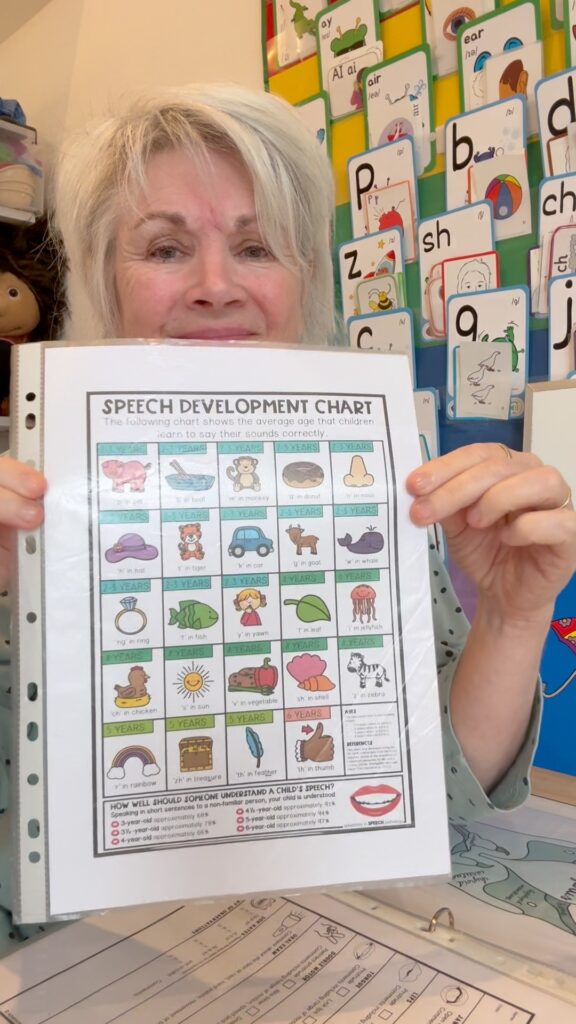
    Speech sound difficulties look different in every child. Two children can both struggle with the /K/ sound for completely different reasons. The assessment is how I find out the why, so that therapy targets the right thing from the start. For your child, it mostly feels like playing games and looking at pictures.

    Step 1: Listening to sounds

    I usually begin with sound awareness. This is your child’s ability to hear, notice and play with the sounds in words.

    We might do some rhyming (‘Does cat rhyme with hat?’) or clap out the beats in words, like ba-na-na or el-e-phant. Children usually enjoy this part, and it helps them settle in.

    Why start here? Being able to hear and think about sounds is the foundation for saying them clearly. It also supports reading and spelling later on. If a child finds it hard to hear the difference between sounds, that tells me a lot about where their speech difficulties may be coming from.

    Step 2: How the mouth moves

    Next, I look at oro-motor skills. That simply means how the lips, tongue and jaw look and move.

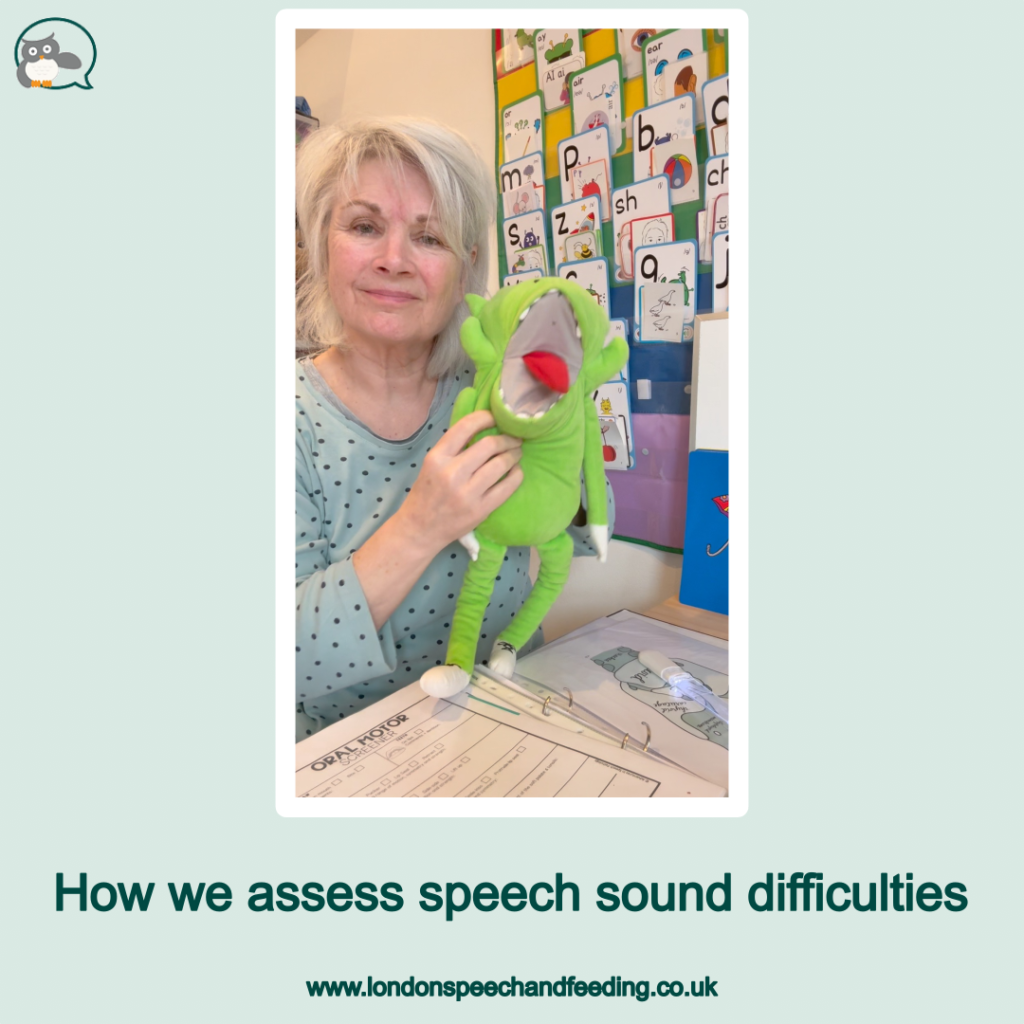
    I might ask your child to copy some movements: a big smile, a kiss, poking their tongue out, or moving it from side to side. I also watch how they manage these movements one after another. I often use my puppet and show how its tongue can move. Before I go and look into a child’s mouth I demonstrate on my puppet how we do this.

    This helps me check whether the muscles and movements needed for speech are working as they should. It is one piece of the puzzle, not the whole answer, but it helps me rule things in or out.

    Step 3: Vowels

    Vowels are the ‘open’ sounds in words, like the sounds in cat, bed, sheep, moon and boat. They are easy to overlook, but they make a huge difference to how clear speech sounds.

    I use vowel picture sheets and vowel pictures, and I listen carefully as your child names them. Most children get their vowels right quite early. If vowels are tricky, it can point towards particular types of speech difficulty, so this step really matters.

    Step 4: Choosing the right next assessment

    By this point I have a good idea of what might be going on. I then choose the assessment that fits your child best.

    The CLEAR Phonology Screen (or an informal phonology screen).

    Your child names a set of pictures, and I write down exactly how they say each word. This shows me which sounds they can say, which ones they swap, and any patterns. For example, some children leave off the ends of words (‘ca’ for ‘cat’). Others replace all back sounds with front sounds (‘tar’ for ‘car’). It also picks up difficulties with single sounds, such as a lisp on /S/.

    The Nuffield Dyspraxia Programme assessment.

    If I think your child might have difficulty planning and sequencing the movements for speech, I use this instead or as well as. This can be the case with childhood apraxia of speech, sometimes called verbal dyspraxia. Your child names pictures and copies words that gradually get longer. I am looking at how well they can link sounds and syllables together smoothly, and how consistent their speech is.

    I do not use every test with every child. Choosing the right one means the assessment is focused, and it does not tire your child out.

    What happens afterwards

    Once the assessment is done, I look closely at everything I have noted. I then talk you through what I found, in plain language. Together we agree clear goals for therapy and the order in which to work on them.

    You will also get ideas for simple games and activities to do at home. Short, regular practice at home makes a real difference to progress.

    A few things parents often ask

    Does my child need to prepare? No. Just come as you are. I adapt everything to your child’s age and mood on the day.

    What if my child is shy or will not join in? That is completely normal. I take things at your child’s pace, and we can always finish another time.

    Can I stay in the room? Yes. Many children feel more relaxed with a parent nearby, and it helps you see what we do. Some children do better on their own and we can discuss this as we go and I get to know you and your child.

    Will we need to do homework in between speech sessions? Yes, this is very important. Each week I will give you a couple of activities to do with your child which will help you practise what we do in the therapy room daily, and this is where progress is made!

    Worried about your child’s speech?

    If you have concerns about how your child is speaking, and assessment gives you clear answers and a plan. Get in touch with me to book an assessment or to ask any questions via my contact form. I look forward to hearing from you.

    Sonja McGeachie

    Sonja McGeachie

    Highly Specialist Speech and Language Therapist

    Owner of The London Speech and Feeding Practice.


    Health Professions Council registered
    Royal College of Speech & Language Therapists Member
    Member of ASLTIP

    Find a speech and language therapist for your child in London. Are you concerned about your child’s speech, feeding or communication skills and don’t know where to turn? Please contact me and we can discuss how I can help you or visit my services page.

    3
  • ·

    How can I incorporate AAC into my speech therapy sessions?

    Many parents are surprised when I bring AAC into a session, especially if they’ve come to see me primarily for speech sound work.

    They might wonder: ‘If we’re working on pronunciation, why are we using a communication device?’

    The simple answer is this: speech therapy is about communication first, and speech sounds second. Supporting a child’s ability to express themselves clearly and confidently is always the priority, and AAC can be a powerful tool alongside spoken speech.

    What do we mean by AAC?

    AAC stands for Augmentative and Alternative Communication.

    This can include:

    • A speech-generating device (such as LAMP Words for Life or GRID as I used in the photo below)
    • A communication app on a tablet
    • A symbol board or communication book
    • Gestures, signs, or visual supports

    AAC does not replace speech. Instead, it supports language development, reduces frustration, and builds communication success while speech skills are developing.

    Pretend Play using Speech and AAC in my clinic room

    But I mainly work on speech sounds… So how does AAC fit?

    Most of the children I see are working on:

    • Articulation difficulties
    • Phonological delay
    • Motor planning challenges (including apraxia/dyspraxia)
    • Unclear speech affecting confidence

    For these children, AAC isn’t a separate therapy. It’s simply woven naturally into what we are already doing.

    If a child brings their device to sessions, I actively include it. If they don’t yet use AAC but could benefit from visual or symbolic support, I may introduce simple options within activities.

    Using AAC to support speech practice

    Let’s say we are working on early speech targets like: ‘GO’.

    We might practise:

    • Saying the word verbally
    • Listening for the target sound
    • Using play (TOY TRAIN GOING ROUND A TRACK)

    Now we can extend this using AAC.

    On the device or communication board, we might model: ‘LET’S GO’ or ‘IT’s GOING up the hill’.

    This allows the child to:

    • Practise their speech sound target
    • Build a simple sentence
    • Experience successful communication even if speech is not fully clear yet

    All responses are valid and supported.

    AAC helps children communicate more than they can say

    Many children can understand and think in longer phrases than they can physically say.

    For example:

    • A child who verbally says single words may build longer phrases on AAC.
    • A child who struggles to plan speech movements may use AAC to communicate smoothly while still practising verbal attempts.
    • A child who becomes frustrated when misunderstood gains a reliable backup system.

    Rather than slowing speech progress, AAC often:

    • Reduces communication pressure
    • Increases participation in therapy
    • Encourages more attempts at speech
    • Supports language growth

    When children feel understood, they usually become more motivated to try speaking.

    There are no ‘prerequisites’ for AAC

    One of the biggest myths I hear is: ‘My child isn’t ready for AAC yet.’

    In reality, children do not need to:

    • Reach a certain speech level
    • Use pictures first
    • Prove they understand everything
    • Show immediate interest

    Instead, we presume competence and introduce AAC in meaningful, playful ways.

    That means:

    • Modelling words while blowing bubbles
    • Commenting during playdough activities
    • Choosing words during games
    • Building simple phrases in shared reading

    AAC should never feel like extra ‘work’. It’s simply another way to join in communication.

    My goal is always the same: to help each child communicate as clearly, confidently, and successfully as possible, using every helpful tool available.

    If your child uses AAC (or might benefit from it)

     Please feel free to:

    • Bring the device to sessions
    • Show me how your child currently uses it
    • Share advice from school or other therapists

    I am very happy to incorporate AAC into our work together so that speech practice, language development, and real communication all move forward hand-in-hand. Because ultimately, therapy isn’t just about producing perfect sounds. It’s about helping your child be heard and understood.

    If you’d like support or advice, please contact me and I can help guide the next steps.

    Sonja McGeachie

    Highly Specialist Speech and Language Therapist

    Owner of The London Speech and Feeding Practice.

      Health Professions Council registered
      Royal College of Speech & Language Therapists Member
      Member of ASLTIP

      Find a speech and language therapist for your child in London. Are you concerned about your child’s speech, feeding or communication skills and don’t know where to turn? Please contact me and we can discuss how I can help you or visit my services page.

      3