Toddler Development

  • · · ·

    Why open cup drinking and good sitting matter for your toddler
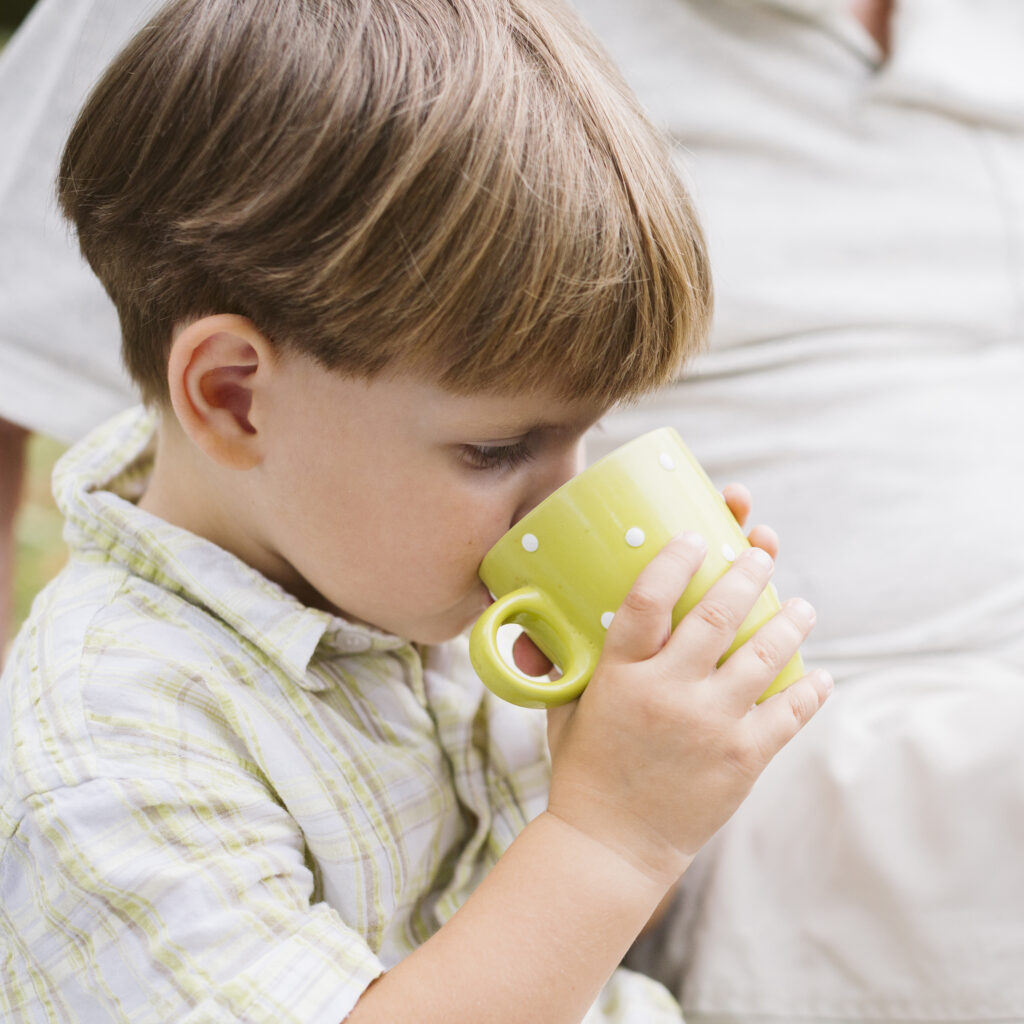
    When your baby reaches around 12 months, there is a lot going on developmentally. They are learning to walk, communicate, feed themselves and become increasingly independent. One small but important milestone that can sometimes get overlooked is learning to drink from an open cup.

    Many toddlers continue to have milk from a bottle well beyond their first birthday, and parents are often understandably reluctant to take it away. The bottle may be familiar, comforting and convenient, particularly at bedtime.

    But moving towards an open cup is not simply about changing the way your child drinks. It is part of their development of oral-motor skills, feeding independence and mealtime development.

    And there is another piece of the puzzle that is often overlooked: how your toddler is sitting while they eat and drink.

    The way the body is supported can make a real difference to what the mouth is able to do.

    Why introduce an open cup from around 12 months?

    Babies can begin learning to drink from an open cup much earlier than many parents realise. By around 12 months, most children should be given regular opportunities to practise drinking from an open cup alongside other suitable drinking vessels.

    An open cup encourages your toddler to learn a different pattern of drinking from the sucking pattern they have used with a bottle.

    With an open cup, your child needs to:

    • lean towards the cup and control its position
    • grade how much liquid enters the mouth
    • use their lips to help control the liquid
    • coordinate breathing and swallowing
    • develop increasingly mature tongue and jaw movements
    • learn to take a drink without relying on a teat or nipple.

    These are useful skills for developing efficient eating and drinking.

    This doesn’t mean that a toddler who still has a bottle at 14 or 18 months has somehow ‘missed their chance’. Children develop at different rates, and there is always an opportunity to work towards new skills.

    However, if a bottle remains the main or only way a child drinks for a long time, there can be fewer opportunities to practise these more mature drinking skills.

    What are the pitfalls of staying with a bottle for too long?

    The occasional bottle is not the issue. The concern is when a toddler continues to rely heavily on a bottle and therefore has little reason or opportunity to develop other drinking skills.

    A bottle encourages a sucking pattern which is appropriate for infancy. As children mature, we want to see increasing use of their lips, tongue, jaw and facial muscles in more sophisticated ways.

    Long-term bottle use can also make the transition to an open cup more difficult simply because the child has become very accustomed to the bottle.

    There can also be practical considerations around dental health, particularly when milk is offered frequently throughout the day or overnight.

    For many toddlers, the bottle has also become associated with comfort, sleep or emotional regulation. This can make giving it up feel like a very big change for the whole family.

    So rather than thinking, ‘The bottle has to disappear tomorrow’, think:

    ‘How can I gradually increase opportunities for open-cup drinking?’

    Offer the open cup regularly at meals. Let your toddler experiment. Expect spills. Keep the amount of liquid small initially and provide plenty of encouragement.

    Learning to drink is a skill. And skills need practice.

    But what has sitting got to do with drinking?

    Quite a lot!

    When we think about feeding, we naturally tend to focus on the mouth. We watch what the tongue is doing, whether a child chews, whether they cough or gag and what foods they accept.

    But feeding is a whole-body activity.

    Your child needs a stable body position before they can use their mouth efficiently.

    Think about trying to drink from a cup while sitting on a wobbly stool with your feet dangling in the air. You would probably find it much easier if your body was well supported.

    The same principle applies to toddlers.

    Tripp Trapp® Chair

    A well-designed highchair such as a Tripp Trapp chair can provide a stable base when it is correctly adjusted for the individual child. Ideally, your toddler should have:

    • hips well supported
    • knees comfortably bent
    • feet resting firmly on a footplate
    • a stable pelvis and trunk
    • the table or tray at an appropriate height

    This gives your child a solid foundation from which to move.

    And that matters because stability in the body supports movement and control in the mouth.

    Feet supported = better feeding?

    I sometimes hear parents say, ‘He doesn’t need the footrest don’t worry about it (as I crouch down with my Allenn key to adjust the Tripp Trapp chair) but I always explain it is very important to have his feet supported. Dangling legs can make it much harder to maintain a stable sitting position.

    When the feet are supported, your toddler can push gently through their feet and stabilise their pelvis and trunk. This can help them maintain a more organised position while eating and drinking.

    They can then devote more attention to the job in front of them:

    looking, reaching, grasping, chewing, swallowing and drinking.

    This is particularly important for toddlers who are developing their chewing skills or who find mealtimes physically demanding.

    A stable body supports a busy mouth

    Eating involves an extraordinary amount of coordination.

    Your toddler is managing food in their hands, bringing it to their mouth, biting, chewing, moving food around with their tongue, forming a bolus and swallowing,  often while simultaneously looking around, communicating and interacting with you.

    Drinking from an open cup adds another layer of coordination.

    Good postural support doesn’t teach a child to drink from a cup, but it can give them a much better physical foundation from which to practise the skill.

    This is why, when I assess a toddler’s feeding, I don’t just look inside the mouth.

    I also look at how the child is positioned.

    Making open-cup drinking part of everyday life

    You don’t need a complicated programme.

    At meals, offer a small amount of water in an open cup. You can help your toddler hold the cup initially, tipping it gently towards their lips and allowing them to control the drinking as much as possible.

    Some mess is completely normal!

    You might also use a small, lightweight open cup that is easy for little hands to manage.

    And remember that the goal is not to make every drink perfect. The goal is to give your child regular, positive opportunities to practise.

    If your toddler is struggling with drinking, frequently coughing or choking, refusing cups, relying heavily on a bottle, or experiencing difficulties with chewing and eating, it is worth seeking professional advice from a Speech and Language Therapist with expertise in paediatric feeding.

    The bigger picture

    Open-cup drinking and good sitting are not two unrelated developmental skills.

    They are part of the same picture.

    A stable body provides a foundation for skilled movement. Skilled movement supports feeding. And feeding skills develop through practice and opportunity.

    So as your toddler approaches and moves beyond their first birthday, think beyond simply asking, ‘How much milk are they drinking?’

    Think about how they are drinking, how they are sitting, and what opportunities they have to develop the skills they will need as they grow.

    And if you have a little one sitting beautifully at the table in a well-supported Tripp Trapp chair, remember: you’re not just creating a comfortable seat.

    You’re creating a stable foundation for eating, drinking, learning and growing.

    Do get in touch with me. I would love to hear from you and help your little one develop good sitting and drinking habits.

    Sonja McGeachie

    Highly Specialist Speech and Language Therapist

    Owner of The London Speech and Feeding Practice.


    Health Professions Council registered
    Royal College of Speech & Language Therapists Member
    Member of ASLTIP

    Find a speech and language therapist for your child in London. Are you concerned about your child’s speech, feeding or communication skills and don’t know where to turn? Please contact me and we can discuss how I can help you or visit my services page.

    3
  • · ·

    Why pointing matters: Unpacking the power of this simple gesture

    As a speech and language therapist, I’m often asked about the significance of seemingly simple gestures in child development. One question that comes up frequently is, ‘Why is pointing so important?’ It might seem like a trivial action, but pointing is a powerful communication tool and a critical milestone in a child’s development.

    Why is pointing so important?

    Let’s delve into the theory behind why pointing matters:

    1. Pointing as pre verbal communication:

    Before children can use words, they use gestures to communicate their needs and interests. Pointing is one of the earliest and most important gestures. It allows children to:

    • Request: ‘I want that!’
    • Protest: ‘No, not that!’
    • Direct attention: ‘Look at that!’
    • Share interest: ‘Wow, cool!’

    2. Pointing and language development:

    Pointing is not just about communicating in the here and now; it also plays a crucial role in language development. Research shows that:

    • Early pointing predicts later language skills: Children who point more often tend to have larger vocabularies and better grammar later on.
    • Pointing helps children learn new words: When children point at something, adults tend to label it, providing valuable language input.
    • Pointing supports joint attention: Joint attention, or the shared focus of two individuals on an object or event, is essential for language learning. Pointing helps establish joint attention, creating opportunities for communication and learning.

    3. Pointing and social-emotional development:

    Pointing is not just about language; it’s also about social interaction. It allows children to:

    • Engage with others: Pointing invites others to share their focus and participate in their world.
    • Express emotions: Pointing can convey excitement, curiosity, or concern.
    • Develop social understanding: By observing how others respond to their pointing, children learn about social cues and communication.

    4. Pointing and cognitive development:

    Pointing is linked to cognitive skills, such as:

    • Understanding object permanence: The ability to know that objects exist even when they are out of sight.
    • Categorisation: The ability to group similar objects together.
    • Problem-solving: Pointing can be used to ask for help or to indicate a problem.

    5. Types of Pointing:

    It’s important to note that there are different types of pointing, each with its own significance:

    • Imperative pointing: To request something.
    • Declarative pointing: To share interest or direct attention.
    • Informative pointing: To provide information.

    If you have concerns about your child’s pointing or overall communication development, don’t hesitate to seek professional guidance from a speech-language therapist. Early intervention can make a significant difference in supporting your child’s communication journey.

    How can we create opportunities for pointing?

    • ‘Where’s the…?’ games:
      • Play games like ‘Where’s the doggy?’ or ‘Where’s the ball?’ and encourage your toddler to point to the object.
      • Start with familiar objects and gradually introduce new ones.
    • Reading together:
      • When reading picture books, ask your toddler to point to specific objects or characters on the page.
      • Use phrases like, ‘Can you point to the puppy?’
    • Everyday activities:
      • During daily routines, ask your toddler to point to things they want or need.
      • For example, ‘Do you want the apple or the banana?’
      • When walking outside say ‘LOOK’ and encourage pointing.
    • Use of toys:
      • Use toys that have buttons or points of interest that when pressed make a noise. Encourage your toddler to point to the area that makes the noise.
      • Use toys that have many different parts, and ask the toddler to point to a specific part.

    Model pointing:

    • Point yourself:
      • When you see something interesting, point to it and say the name of the object.
      • For example, ‘Look! A bird!’
    • Point to show choices:
      • When offering choices, point to each item as you name it.
      • For example, ‘Do you want the blue cup or the red cup?’ (Point to each cup).
    • Point to indicate direction:
      • When giving directions, point in the direction you want your toddler to go.
      • For example, ‘Let’s go that way!’ (Point).

    Make it rewarding:

    • Respond to pointing:
      • When your toddler points, immediately respond to their communication.
      • Give them the object they want, or acknowledge what they are pointing at.
    • Use positive reinforcement:
      • Praise and encourage your toddler when they point.
      • Say things like, ‘Good pointing!’ or ‘You showed me the car!’
    • Show excitement:
      • When they point to something, show excitement, this will encourage them to point again.

    Use specific techniques:

    • Use gestures and verbal cues:
      • Combine pointing with verbal cues and other gestures.
      • For example, say ‘Look!’ while pointing and nodding your head.
    • Simplify the environment:
      • Reduce distractions to help your toddler focus on the object you want them to point to.
    • Use exaggerated movements:
      • Use large, exaggerated pointing movements to draw your toddler’s attention.

    Consider developmental factors:

    • Age-appropriate expectations:
      • Remember that pointing develops at different rates for different children.
      • Be patient and supportive.
    • Underlying issues:
      • If your toddler is not pointing by 18 months, or if you have any concerns about their development, consult with a speech and language therapist.
      • There may be underlying sensory or motor issues.

    Key points:

    • Consistency is key. Practise these strategies regularly.
    • Make it fun and engaging for your toddler.
    • Celebrate every success, no matter how small.
    • If you have any concerns about your child’s development, contact your local health services.

    Great toys and items for pointing

    1. Interactive books:

    • Touch-and-feel books: Books with different textures, flaps to lift, and sounds encourage interaction and pointing. ‘Where’s the…?’ questions prompt pointing to specific features.
    • Books with simple pictures: Clear, uncluttered pictures make it easier for toddlers to focus and point to objects or characters.

    2. Cause-and-effect toys:

    • Activity cubes: These often have buttons, dials, and levers that produce sounds or actions when manipulated, prompting pointing and exploration.
    • Pop-up toys: Toys where figures pop up or things happen when a button is pressed encourage anticipation and pointing to the action.
    • Simple musical instruments: A toy piano, drum, or xylophone encourages pointing to the keys/surfaces to make sounds.

    3. Toys with parts to manipulate:

    • Shape sorters: Encourage pointing to the shapes and the matching holes.
    • Stacking cups or rings: Nesting cups or stacking rings invite pointing to select the correct size or order.
    • Puzzles with knobs: Simple puzzles with large knobs are easier for toddlers to grasp and point to the pieces.

    4. Toys that encourage joint attention:

    • Bubbles: Blowing bubbles and following them with your eyes and pointing encourages joint attention (shared focus).
    • Balls: Rolling a ball back and forth and pointing to where it’s going can promote joint attention and turn-taking.
    • Wind-Up Toys: Wind-up toys that move across the floor can be exciting to follow with pointing.

    5. Pretend play toys:

    • Toy telephones: Encourage pointing to the buttons and pretending to dial.
    • Dolls and stuffed animals: Pointing to the doll’s eyes, nose, mouth, etc., or asking the child to point to these features on themselves.
    • Toy food and dishes: Pretend play with food and dishes can involve pointing to request items or indicate actions (e.g., ‘Can I have the apple?’).

    Tips for using toys to encourage pointing:

    • Get involved: Play alongside your toddler, modelling pointing and using language to describe what you’re doing.
    • Follow their lead: Observe what your child is interested in and use that to encourage pointing.
    • Limit distractions: Reduce background noise and visual clutter to help your child focus.
    • Use gestures and words: Combine pointing with words and other gestures (e.g., ‘Look!’ while pointing).
    • Be patient and positive: Celebrate all attempts at pointing and provide lots of encouragement.

    Remember, the most important factor is the interaction you have with your child while playing. Use these toys as tools to create opportunities for communication and joint attention, and your toddler will be well on their way to mastering pointing!

    Get in touch with me via my contact form if you need support

    Sonja McGeachie

    Early Intervention Speech and Language Therapist

    Feeding and Dysphagia (Swallowing) Specialist The London Speech and Feeding Practice

    The London Speech and Feeding Practice


    Find a speech and language therapist for your child in London. Are you concerned about your child’s speech, feeding or communication skills and don’t know where to turn? Please contact me and we can discuss how I can help you or visit my services page.

    1
  • · ·

    Great toys and books for our toddlers (around 1–2 years old)

    As a speech and language therapist, I often get asked by parents what toys and books they should buy for their toddlers. It can feel overwhelming with so many options available! So, I’ve put together a list based on my experience and what I’ve found works well.

    Remember, every child is unique!

    Observe your toddler’s interests and play style. Some toys that are popular might not be engaging for your child.

    Here are a few ideas to get you started:

    Sensory Toys:

    • Stacking cups: These are fantastic for developing hand-eye coordination, fine motor skills, and understanding size relationships. (Various brands available) Note: You can stack many things you have around the house, like bowls or measuring cups, for a similar experience!
    • Shape sorters: Help with shape recognition, hand-eye coordination, and problem-solving. (Melissa & Doug, Vtech)
    • Sensory balls: Balls with different textures (soft, bumpy, squishy) provide tactile stimulation. (Various brands)
    • Push and pull toys: Encourage gross motor development and exploration. (Vtech, Fisher-Price)

    Communication-focused toys:

    • Picture books with flaps: Engage curiosity and encourage language development. (Various brands)
    • Talking toys: Introduce new vocabulary and encourage imitation. (Vtech, Fisher-Price)
    • Simple puzzles: Develop hand-eye coordination, problem-solving, and spatial awareness. (Melissa & Doug, Ravensburger)
    • Musical instruments: Encourage exploration of sounds and develop auditory skills. (Bright Starts, Fisher-Price)

    Now, let’s talk about books:

    • The Very Hungry Caterpillar by Eric Carle: A classic with repetitive text and vibrant illustrations, great for introducing vocabulary and concepts like days of the week.
    • Brown Bear, Brown Bear, What Do You See? by Bill Martin Jr. and Eric Carle: Simple, repetitive text and engaging illustrations make this a favourite for many toddlers.
    • Goodnight Moon by Margaret Wise Brown: A soothing bedtime story with calming illustrations.
    • Pat the Bunny by Dorothy Kunhardt: An interactive book with textures and flaps to engage young children.
    • Corduroy by Don Freeman: A heartwarming story about a teddy bear who loses his button.

    Remember:

    • Observe your child’s interests: Choose toys and books that capture their attention and encourage exploration.
    • Engage with your child: Play with the toys together and read books aloud with enthusiasm.
    • Keep it simple: Start with a few toys and books and gradually introduce new ones.
    • Rotate toys: Keep playtime fresh by rotating toys and books regularly.
    • Most importantly, have fun! Reading and playing with your child should be a joyful experience for both of you.

    Also consider the power of open-ended play

    In today’s world filled with electronic gadgets, it’s easy to overlook the value of open-ended play. Open-ended toys lack specific functions or prescribed outcomes, allowing children to use their imaginations to explore and create. Unlike toys with pre-determined ways to play, open-ended toys encourage:

    • Creative thinking: Children can use them in countless ways, developing their own rules and narratives. A block can become a car, a house, or a spaceship, depending on the child’s imagination.
    • Problem-solving skills: Children learn to figure out how to use the toys, experimenting and adapting as they go. Don’t immediately rush in and fix things for your little one, let them think for themselves and then communication incentive: let them come and find you!
    • Fine motor skills: Many open-ended toys, like blocks, encourage the development of fine motor skills like grasping, stacking, and building.
    • Cognitive development: Children learn about cause and effect, spatial relationships, and problem-solving as they play with open-ended toys.
    • Social-emotional development: Open-ended play can foster social interaction and cooperation as children play together and share ideas.

    Simple toys with big impact

    Some of the best toys for toddlers are often the simplest ones. Here are a few examples:

    • Wooden blocks: Building towers, bridges, and forts encourages creativity and problem-solving.
    • Balls: Throwing, kicking, and rolling balls promote gross motor skills and hand-eye coordination.
    • Fabric: Bits of fabric can be draped, draped, and used for imaginative play.
    • Empty boxes: From cardboard boxes to tissue boxes, these can be transformed into anything a child can imagine: a car, a house, a spaceship!
    • Natural materials: Sticks, leaves, pinecones, and rocks can be used for imaginative play and sensory exploration.

    Remember, the key to open-ended play is to let children explore and discover

    Step back and observe, allowing your child to use his or her imaginations without too much direction. You might be surprised at the creative ways he or she uses simple toys!

    Happy play times with your little one!

    Contact me via my contact form.

    Sonja McGeachie

    Early Intervention Speech and Language Therapist

    Feeding and Dysphagia (Swallowing) Specialist The London Speech and Feeding Practice

    The London Speech and Feeding Practice


    Find a speech and language therapist for your child in London. Are you concerned about your child’s speech, feeding or communication skills and don’t know where to turn? Please contact me and we can discuss how I can help you or visit my services page.

    1
  • · ·

    Navigating the exciting 9–18 months journey: Your baby’s communication milestones

    Between 9 and 18 months, your little one undergoes a remarkable transformation, blossoming from a curious explorer into a budding communicator. This period is filled with exciting milestones in speech, language, and social development. Let’s delve into what you can expect.

    9–12 months: The world opens up

    Communication takes flight

    • Babbling becomes more complex with a wider range of sounds. By babbling we mean syllables like: pa ga ka ma da and then ‘baba’ gohgoh’. First we hear one and two syllables together and then longer and longer strings! This is so exciting!
    • First words! One day around the 12 months–14 months mark we hear a first word! My older son’s first word was ‘Licht’ which is the German word for ‘light’ as literally every time I carried him along the corridors in our home, I pointed out the light switches to him and turned them off and on a few times. And each time I said ‘Licht!’ and it stuck! PS: sadly I cannot remember what my younger son’s first word was… poor second and third babies they just have to muddle along and call loudly to get noticed!
    • Understanding grows! Baby now understands simple instructions like ‘where is your ball’ and responds by looking to the ball across the room!

    Social butterflies

    • Your baby now starts to show interest in other children, and may try to copy their actions. Now we are getting proper traction with simple social games like peek-a-boo and patty-cake. Whilst your baby is generally interested in other people and children he or she may show separation anxiety when mum or dad or other familiar person suddenly leaves the room and they feel alone with strangers.

    Fine motor skills

    • Pincer grasp develops. This is where your child puts an index finger to the thumb in order to pick up of small objects, hold them and transfer them to either a box, back on the floor or into the other hand.
    • Your baby may start to explore objects by banging, shaking, and mouthing.

    12–15 months: Words are taking shape

    • Language explosion: From our early words we now suddenly see baby’s vocabulary expanding, with new words added each week. I would highly recommend parents keep a little journal of all the words they hear. If nothing else this is a wonderful aide-memoire for years down the road when you might like to reminisce about the first ten words. I promise you otherwise you won’t recall! (especially for second and third babies; I would do this now, had I the time again).
    • Understanding grows:
      • By about 15 months our baby can follow simple two-step instructions like ‘Go get your shoes and bring them here.’
      • Begins to understand the concept of ‘no.’ and that’s a very useful thing. Though before you breathe a sigh of relief… your toddler may well show you that he is understanding a ‘no’ though he may not stop doing what he is doing or come down off the table!
    • Playtime gets interactive:
      • Now we engage in more complex play, such as stacking blocks, pretending to eat with a spoon, and imitating actions.
      • Many toddlers now start showing an interest in picture books.

    15–18 months: Communication blossoms

    • Words combine: Towards 18 months or around about then your toddler may start to put two words together, such as ‘more milk’ or ‘bye-bye dada.’
    • Gestures and sounds: Now we also use gestures to communicate, such as pointing, shaking head ‘no,’ and waving ‘bye-bye.’
    • Exploration and curiosity:
      • Your toddler is now EVERYWHERE! Turn your back and he or she is gone! Your toddler now shows a strong sense of curiosity and explores their environment with enthusiasm.
    • Copying
    • Look out for actions and gestures your toddler will copy such as clapping hands or patting a cushion or banging a spoon on the table .

    Remember

    • Every child develops at his or her own pace.
    • These are just general guidelines, and some children may reach certain milestones earlier or later than others.
    • If you have any concerns about your child’s development, please consult with your speech and language therapist. We are always keen to hear from parents and happy to help promote all those lovely early skills.

    General tips to encourage communication if you feel your child needs a little more help

    • Talk, talk, talk! Engage in frequent chatting with your child.
    • Listen to your child: Allow for periods of silence when playing with your child to allow them to say something or make sounds which you can then copy and respond to.
    • Read aloud regularly. Use books with simple words and pictures.
    • Play interactive games: Hickory Dickory Dock, Row Row the boat, Old McDonalds, 5 little monkeys jumping on the bed, chasing and catching, tickling games.
    • Respond to your child’s babbling and gestures. You can copy them or if your toddler says long strings of babbling you cannot understand you could just say: ‘Oh ok!? ‘yes that’s great!’ ‘who knew!’ ‘wow you’ve got much to say!’ as if you understood.
    • Limit screen time or if your child is very passionate about watching clips then sit and watch with your child so that you can see what is the best bit, which songs they like the best and what sort of phrases they love hearing.

    This exciting period of rapid growth and development is a precious time for both you and your child.

    By providing a loving, stimulating, and responsive environment, you will naturally nurture their communication skills! Any more questions, please get in touch!

    Sonja McGeachie

    Early Intervention Speech and Language Therapist

    Feeding and Dysphagia (Swallowing) Specialist The London Speech and Feeding Practice

    The London Speech and Feeding Practice


    Find a speech and language therapist for your child in London. Are you concerned about your child’s speech, feeding or communication skills and don’t know where to turn? Please contact me and we can discuss how I can help you or visit my services page.

    1