top tips

  • · ·

    Ten games to support communication in primary school aged children

    When parents visit me with their child, their stress is palpable. Often parents don’t relish or even expect to be asked to practise strategies at home with their child between sessions. Let alone to practise whilst on holiday. I understand that you don’t necessarily want anything extra added to your daily ‘to do’ lists. This is why we try our best to incorporate all speech and language therapy practice into children’s daily activities.

    For example:

    1. during bath time;
    2. mealtimes;
    3. getting ready for bedtime;
    4. story time
    5. yes, playtime!

    These are activities that all parents will engage with anyway, so it seems to make sense to incorporate both. This is to avoid adding extra pressure on parents’ already stressful and time-poor daily lives. I am hoping my blog will come in handy, especially for the summer holidays.

    On holiday you are unlikely to have your usual games and toys with you – so here is a nice little list of things you can use instead of traditional games and toys:
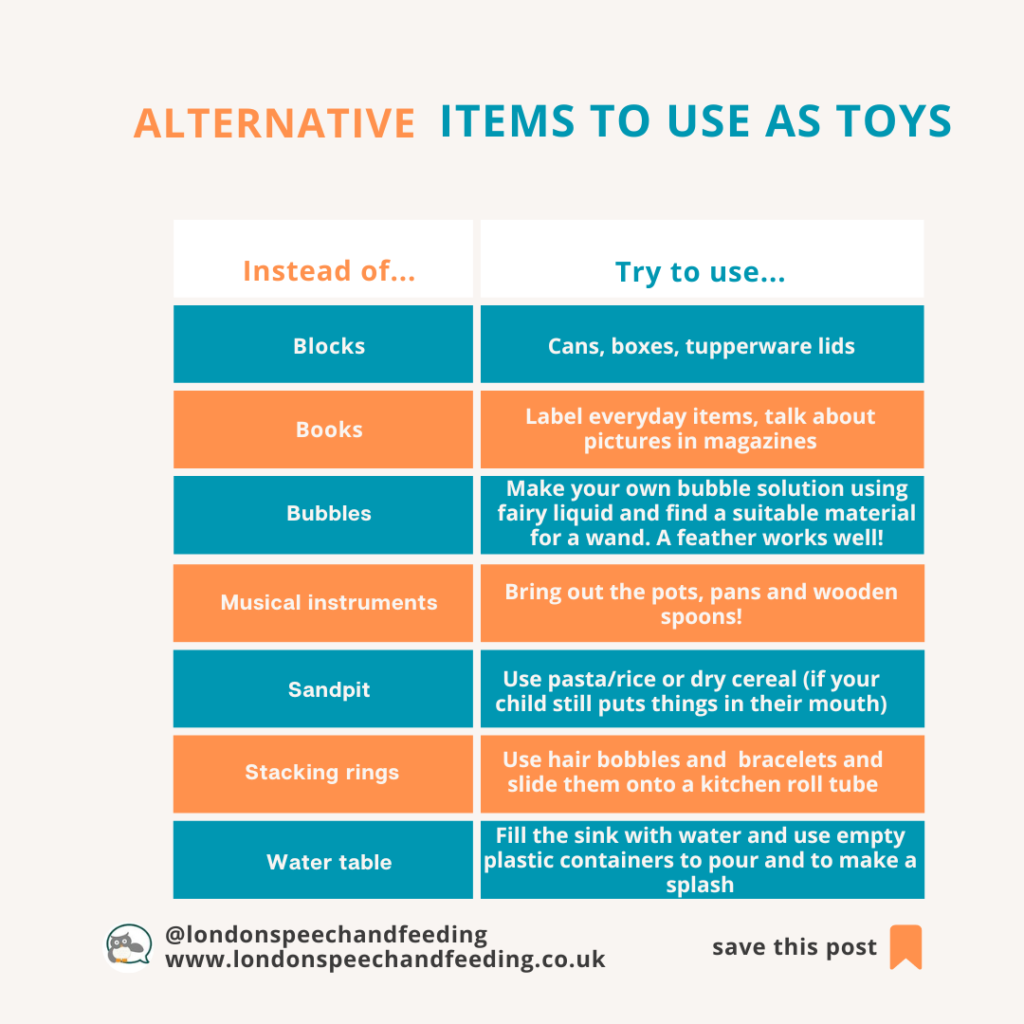
    If you can think of any other alternatives on holiday and would like to tell me about them, I would love to see your comments below. We can never have too many holiday games!!

    If you are at home over the summer and you do have some games in the cupboard you might want to dust these ones down or buy one or two new ones (if you want to).

    Most games have multiple uses, and it’s always best to adapt a game to match your child’s interests and what motivates them.

    So let’s start…

    1. Pop up pirate: pop a sword into the barrel and watch the pirate pop up randomly. Practise social skills, speech sounds, expressive language (e.g., put a sword on a picture, say the word/sentence then pick up the sword and push it into the barrel).
    2. Word games such as ‘ISpy’, ‘I went to the shop and I bought…’, ‘describe a person and guess who they are’: perfect for when you’re on the move, whether travelling or walking. You can play this anywhere and still support speech, language and communication. You could play ISpy using your child’s special sound, or ‘I went to the shop and bought all things beginning with [insert special sound here]’.
    3. Shopping list: Orchard game is a game to practise categorising. We explain the analogy of the brain being like a filing cabinet. If information is all in the correct place, it’s easier to find, retrieve and use. You can also practise specific speech sounds in this activity. You could also put the words in a sentence to add more of an expressive language element.
    4. Wiggly worms: this Orchard game is all about phonological (awareness of sounds) awareness. Matching a letter with the word. You can also practise the sounds in the words (e.g, g-o-l-d = gold; m-a-ke = make). Talk about the elements, e.g., ‘g-o-l-d’ has 4 sounds, 1 syllable; ‘m-a-ke has 3 sounds, one syllable. You can talk about what words rhyme with the different words and what makes a rhyming word (i.e., the middle and end sounds remain the same).
    5. Sound detectives: this Orchard game allows children to identify sounds. It also has an app (if your child prefers a tech-way of learning). Children identify the sound then they can add the picture card to their path and become closer to being a successful detective. This game can also support memory skills.
    6. Conversation cubes: throw the dice and start building a story. You can also create and use ‘colourful semantics’ sentence strips to support expressive (spoken) language as support to build the narrative.
    7. Think words: ‘name it, press it, pass it’. A great game to expand word knowledge. You can talk about the words at the end of each round exploring semantic (meanings) and phonemic (sounds) links. Your child can also develop social skills (such as attention, listening and turn-taking).
    8. Poo bingo: this is perfectly disgusting but equally fun for kids of about 3.5 years plus – if your child’s target is to practise /p/ sound this is the one for you. You can also learn all about the different animal’s poo, which I am sure you have always wanted to do!! The more we know about a word, the easier it is to store, retrieve and use. Yes, even talking about poo can help!! Also, it’s great for our visual learners.
    9. Simon says: a game that can be played indoors or outdoors. Parents can take turns being “Simon” and give various commands that your child must follow. This means that your child can practise their receptive (understanding of) language as well as their expressive language, speech sounds and social skills (such as turn-taking and initiating).
    10. Ker-plunk: this is perfect for practising your child’s special sound. Repetition is very important, but also can be monotonous, so finding a game that they enjoy is vital. Take turns to pull out a stick. Next, your child can either say their special sound or word (depending on what stage they are at) or hear a good model from other players.

    Do you still have questions? Contact Sonja for support.


    Find a speech and language therapist for your child in London. Are you concerned about your child’s speech, feeding or communication skills and don’t know where to turn? Please contact me and we can discuss how I can help you or visit my services page.

    0
  • · ·

    Discover nine ways to support literacy in autistic children

    We are all aware that Autism is on a spectrum. By the very nature of this, it means that every child will present differently, so an individualised approach is required. We need to remember to use a child’s strengths to support their needs. By using a person-centred approach, you’ll see your child’s literacy develop and thrive.

    I hear many parents concerns about literacy as well as communication. Will they be able to read, write and spell? How will they manage their literacy independently? The questions are endless, so let’s look at how you can support your child’s literacy skills and how together we can provide a scaffold to them becoming independent learners.

    1. The one thing we know is that Autistic children are visual learners. They succeed by us sharing pictures and demonstrating how the narrative is shown.
    2. Start reading to your child at an early age. You can never start too early. This creates a love for books and supports vital pre-literacy skills (such as increasing vocabulary, following narratives, awareness of sounds in words, and letter recognition and awareness). By supporting pre-literacy skills, you’re starting the process to create confident young readers.
    3. There are many ways to use books. You can narrate the story using different voices and tones to increase interest. You can do this even if your child isn’t interested. They are still listening and learning vital skills. You may even ask and answer questions and voice the skills that they will need for internal monitoring.
    4. Use their interests to select appropriate reading material. In addition, you can then create questions on the book and provide a scaffold to support your child with the answer.
    5. Use technology to spark their interest in reading. Demonstrate how they can read online. This is often successful as it becomes an individual activity as opposed to needing social interaction.
    6. Provide them with a choice of texts (e.g., would you like ‘Perfectly Norman or when things get too loud’) rather than an open-ended question such as ‘What book would you like to read?’
    7. Write key pieces of information down on paper. Research suggests that Autistic learners understand written text better than speech.
    8. You could have a ‘word of the day’ from chosen reading material that you explore together.
    9. Reading aloud to your child can have many benefits which include understanding vocabulary to how the book is read, with appropriate intonation.

    I highly recommend the boom decks as they are a great resource!

    The ethos at London Speech and Feeding:

    “If they can’t learn in the way we teach, then we teach the way they learn”

    If you need speech, language or communication support or advice, I am always here to help.


    Find a speech and language therapist for your child in London. Are you concerned about your child’s speech, feeding or communication skills and don’t know where to turn? Please contact me and we can discuss how I can help you or visit my services page.

    0
  • ·

    Five ways to increase confidence and reduce frustration in children with speech and language and communication difficulties

    An orange speech bubble with a testimonial

    Your child’s speech, language and communication difficulties may impact their self-esteem. And they may show signs of increased frustration. You want them to be full of confidence, increasing their participation in school and fully engaging with their peers.

    1. Practise active listening

    Speech difficulties can mean that it’s more challenging to understand what your child says. It’s important to show that you’re paying attention, giving them time to express themselves. Focus on what your child says rather than how they are speaking. Remember to maintain eye contact, and actively listen. Active listening and giving time can be trickier than it sounds. I can provide strategies to support your active listening skills.

    2. Give other means and forms of communication

    Allowing children to express themselves in a variety of ways (e.g., gesture, signs, written, use descriptions to describe a word (e.g., sand – you find it out the beach, it can have pebbles on it, it’s not the sea), use of symbols or high-tech augmentative communication methods such as a computer). Using different ways is vital in reducing frustration and communicating their message. If you’re unsure of what other forms of communication you can use, please contact me for some top tips.

    3. Praise efforts

    Providing specific praise allows your child to understand what they’ve achieved. E.g., you could praise the way your child listens, or how they take turns, or their resilience (e.g., “I like the way you listened” or “good listening”). Think of different ways you could praise you child during different activities, so you are prepared with phrases that you can use.

    4. Have clear start and end points in activities

    Some children with speech, language and communication needs have difficulties with transitioning from one activity to another. They also have difficulties with changes in routine. This can add to their frustration and changes in behaviour. So, how do you show a clear start and end to an activity? You can have a visual timetable, or you could have ‘start’ and ‘finish’ boxes where you place all the materials in the box labelled ‘start’. And once the activity has finished, you put the items in the box labelled ’finished’. If you need support with transitions, please contact me.

    5. Use visuals

    Visuals can support your child to understand routine and spoken language. Visuals can range from symbols to online images, to photographs, or a combination. Explore which type of visuals work well for your children. Using visuals can be powerful if used correctly. Make the most of the opportunities that visuals can provide for your family.

    Increase confidence and reduce frustration in children with speech and language and communication difficulties today. Please feel free to contact me if you need any support or tips on maximising these opportunities.


    Find a speech and language therapist for your child in London. Are you concerned about your child’s speech, feeding or communication skills and don’t know where to turn? Please contact me and we can discuss how I can help you or visit my services page.

    1
  • Six ways to prepare your child for the Christmas festivities

    It feels like the Christmas festivities start earlier and earlier every year. This makes it harder for your child with communication difficulties to process what is happening. Whilst you can’t do anything about the events that happen around your child, you can start to put into practice strategies which may support them and allow them to regulate their emotions.

    Speech Therpaist in London
    Six ways to prepare your child for the Christmas festivities

    Explore six ideas here:

    1. Print off or buy a blank calendar to use at home

    You can start to write in activities out of the usual routine and add a picture to allow your child to understand what it’s about. You can also use it as a countdown to Christmas Day to try to prevent ‘how long’ questions.

    2. Make use of visual timetables

    These are useful in everyday settings and activities but also when change occurs.

    3. Be aware of any non-uniform days

    Days like ‘Christmas Jumper Day’ can make your child feel uncomfortable and may affect their behaviour. By giving yourself time, you can have conversations with your child’s teacher to find a more suitable alternative. For example, they can wear a Christmas t-shirt that they find more comfortable.

    4. Think about what will benefit your child

    Do they like being surrounded by people or do they prefer a quiet space on a 1:1 basis? Christmas activities often involve lots of group work in school (e.g., rehearsing for carol concerts or plays). They might prefer to pre-record their part in the Christmas play or create pieces of art which can be used. At home, they may prefer one guest visiting at a time, rather than all at once.

    5. Explore how your child is feeling

    It’s important to find out how your young person is feeling and how these impact on the activities of that day. It might be that your child doesn’t like surprises and the intensity of opening gifts is too much for them. They may prefer gifts to be left unwrapped and given throughout the day, rather than all at once.

    6. Consider sensory needs

    Ensure your young person has everything they need to meet their sensory needs. This can be e.g. noise cancelling headphones, fidget toys, or comforting items. These will particularly be helpful with routines changing, often with little notice. If at home, you may wish to not put lights on the Christmas tree if visual stimuli become too much.

    Remember clear communication between home, school and other family members is vital during this time. By having clear communication and expectations, your young person will feel more secure. And you can have a Christmas that is right for you and your family.


    Find a speech and language therapist for your child in London. Are you concerned about your child’s speech, feeding or communication skills and don’t know where to turn? Please contact me and we can discuss how I can help you or visit my services page.