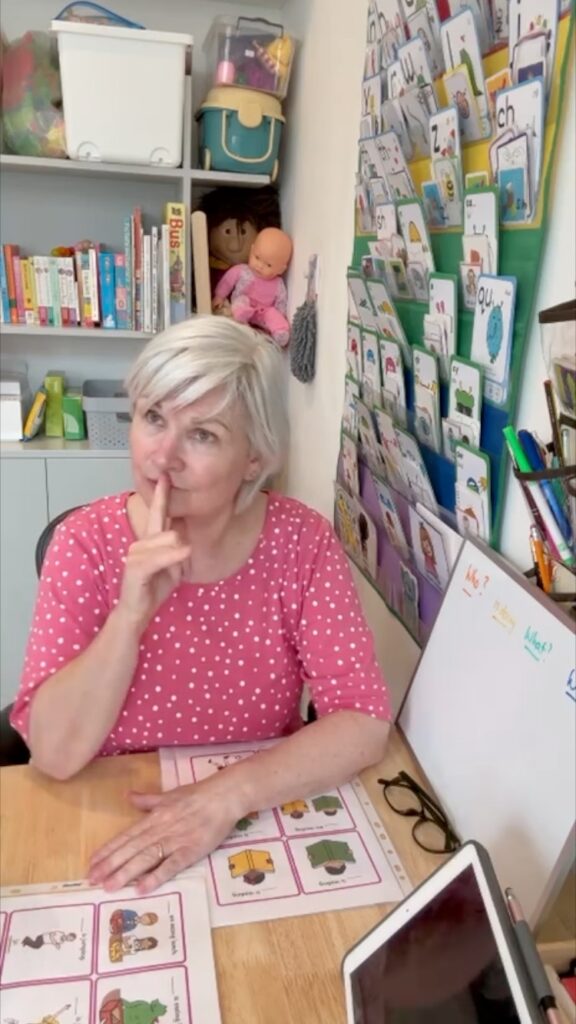
Your child’s speech, language and communication difficulties may impact their self-esteem. And they may show signs of increased frustration. You want them to be full of confidence, increasing their participation in school and fully engaging with their peers.
1. Practise active listening
Speech difficulties can mean that it’s more challenging to understand what your child says. It’s important to show that you’re paying attention, giving them time to express themselves. Focus on what your child says rather than how they are speaking. Remember to maintain eye contact, and actively listen. Active listening and giving time can be trickier than it sounds. I can provide strategies to support your active listening skills.
2. Give other means and forms of communication
Allowing children to express themselves in a variety of ways (e.g., gesture, signs, written, use descriptions to describe a word (e.g., sand – you find it out the beach, it can have pebbles on it, it’s not the sea), use of symbols or high-tech augmentative communication methods such as a computer). Using different ways is vital in reducing frustration and communicating their message. If you’re unsure of what other forms of communication you can use, please contact me for some top tips.
3. Praise efforts
Providing specific praise allows your child to understand what they’ve achieved. E.g., you could praise the way your child listens, or how they take turns, or their resilience (e.g., “I like the way you listened” or “good listening”). Think of different ways you could praise you child during different activities, so you are prepared with phrases that you can use.
4. Have clear start and end points in activities
Some children with speech, language and communication needs have difficulties with transitioning from one activity to another. They also have difficulties with changes in routine. This can add to their frustration and changes in behaviour. So, how do you show a clear start and end to an activity? You can have a visual timetable, or you could have ‘start’ and ‘finish’ boxes where you place all the materials in the box labelled ‘start’. And once the activity has finished, you put the items in the box labelled ’finished’. If you need support with transitions, please contact me.
5. Use visuals
Visuals can support your child to understand routine and spoken language. Visuals can range from symbols to online images, to photographs, or a combination. Explore which type of visuals work well for your children. Using visuals can be powerful if used correctly. Make the most of the opportunities that visuals can provide for your family.
Increase confidence and reduce frustration in children with speech and language and communication difficulties today. Please feel free to contact me if you need any support or tips on maximising these opportunities.
Find a speech and language therapist for your child in London. Are you concerned about your child’s speech, feeding or communication skills and don’t know where to turn? Please contact me and we can discuss how I can help you or visit my services page.
When your baby reaches around 12 months, there is a lot going on developmentally. They are learning to walk, communicate, feed themselves and become increasingly independent. One small but important milestone that can sometimes get overlooked is learning to drink from an open cup.
Many toddlers continue to have milk from a bottle well beyond their first birthday, and parents are often understandably reluctant to take it away. The bottle may be familiar, comforting and convenient, particularly at bedtime.
But moving towards an open cup is not simply about changing the way your child drinks. It is part of their development of oral-motor skills, feeding independence and mealtime development.
And there is another piece of the puzzle that is often overlooked: how your toddler is sitting while they eat and drink.
The way the body is supported can make a real difference to what the mouth is able to do.
Babies can begin learning to drink from an open cup much earlier than many parents realise. By around 12 months, most children should be given regular opportunities to practise drinking from an open cup alongside other suitable drinking vessels.
An open cup encourages your toddler to learn a different pattern of drinking from the sucking pattern they have used with a bottle.
With an open cup, your child needs to:
lean towards the cup and control its position
grade how much liquid enters the mouth
use their lips to help control the liquid
coordinate breathing and swallowing
develop increasingly mature tongue and jaw movements
learn to take a drink without relying on a teat or nipple.
These are useful skills for developing efficient eating and drinking.
This doesn’t mean that a toddler who still has a bottle at 14 or 18 months has somehow ‘missed their chance’. Children develop at different rates, and there is always an opportunity to work towards new skills.
However, if a bottle remains the main or only way a child drinks for a long time, there can be fewer opportunities to practise these more mature drinking skills.
The occasional bottle is not the issue. The concern is when a toddler continues to rely heavily on a bottle and therefore has little reason or opportunity to develop other drinking skills.
A bottle encourages a sucking pattern which is appropriate for infancy. As children mature, we want to see increasing use of their lips, tongue, jaw and facial muscles in more sophisticated ways.
Long-term bottle use can also make the transition to an open cup more difficult simply because the child has become very accustomed to the bottle.
There can also be practical considerations around dental health, particularly when milk is offered frequently throughout the day or overnight.
For many toddlers, the bottle has also become associated with comfort, sleep or emotional regulation. This can make giving it up feel like a very big change for the whole family.
So rather than thinking, ‘The bottle has to disappear tomorrow’, think:
‘How can I gradually increase opportunities for open-cup drinking?’
Offer the open cup regularly at meals. Let your toddler experiment. Expect spills. Keep the amount of liquid small initially and provide plenty of encouragement.
Learning to drink is a skill. And skills need practice.
When we think about feeding, we naturally tend to focus on the mouth. We watch what the tongue is doing, whether a child chews, whether they cough or gag and what foods they accept.
But feeding is a whole-body activity.
Your child needs a stable body position before they can use their mouth efficiently.
Think about trying to drink from a cup while sitting on a wobbly stool with your feet dangling in the air. You would probably find it much easier if your body was well supported.
The same principle applies to toddlers.
A well-designed highchair such as a Tripp Trapp chair can provide a stable base when it is correctly adjusted for the individual child. Ideally, your toddler should have:
hips well supported
knees comfortably bent
feet resting firmly on a footplate
a stable pelvis and trunk
the table or tray at an appropriate height
This gives your child a solid foundation from which to move.
And that matters because stability in the body supports movement and control in the mouth.
I sometimes hear parents say, ‘He doesn’t need the footrest don’t worry about it (as I crouch down with my Allenn key to adjust the Tripp Trapp chair) but I always explain it is very important to have his feet supported. Dangling legs can make it much harder to maintain a stable sitting position.
When the feet are supported, your toddler can push gently through their feet and stabilise their pelvis and trunk. This can help them maintain a more organised position while eating and drinking.
They can then devote more attention to the job in front of them:
looking, reaching, grasping, chewing, swallowing and drinking.
This is particularly important for toddlers who are developing their chewing skills or who find mealtimes physically demanding.
Eating involves an extraordinary amount of coordination.
Your toddler is managing food in their hands, bringing it to their mouth, biting, chewing, moving food around with their tongue, forming a bolus and swallowing, often while simultaneously looking around, communicating and interacting with you.
Drinking from an open cup adds another layer of coordination.
Good postural support doesn’t teach a child to drink from a cup, but it can give them a much better physical foundation from which to practise the skill.
This is why, when I assess a toddler’s feeding, I don’t just look inside the mouth.
I also look at how the child is positioned.
Making open-cup drinking part of everyday life
You don’t need a complicated programme.
At meals, offer a small amount of water in an open cup. You can help your toddler hold the cup initially, tipping it gently towards their lips and allowing them to control the drinking as much as possible.
Some mess is completely normal!
You might also use a small, lightweight open cup that is easy for little hands to manage.
And remember that the goal is not to make every drink perfect. The goal is to give your child regular, positive opportunities to practise.
If your toddler is struggling with drinking, frequently coughing or choking, refusing cups, relying heavily on a bottle, or experiencing difficulties with chewing and eating, it is worth seeking professional advice from a Speech and Language Therapist with expertise in paediatric feeding.
The bigger picture
Open-cup drinking and good sitting are not two unrelated developmental skills.
They are part of the same picture.
A stable body provides a foundation for skilled movement. Skilled movement supports feeding. And feeding skills develop through practice and opportunity.
So as your toddler approaches and moves beyond their first birthday, think beyond simply asking, ‘How much milk are they drinking?’
Think about how they are drinking, how they are sitting, and what opportunities they have to develop the skills they will need as they grow.
And if you have a little one sitting beautifully at the table in a well-supported Tripp Trapp chair, remember: you’re not just creating a comfortable seat.
You’re creating a stable foundation for eating, drinking, learning and growing.
Do get in touch with me. I would love to hear from you and help your little one develop good sitting and drinking habits.
Sonja McGeachie
Highly Specialist Speech and Language Therapist
Owner of The London Speech and Feeding Practice.
Find a speech and language therapist for your child in London. Are you concerned about your child’s speech, feeding or communication skills and don’t know where to turn? Please contact me and we can discuss how I can help you or visit my services page.
Intensive Interaction is an approach that I might suggest for your child. Here is an overview of this approach to increase your knowledge. There are a range of approaches that overlap and having trained in them all I use them all interchangeably to tailor to each child individually. This approach is particularly good for children who work mostly to their own agenda and find it hard to engage with others.
So, what is Intensive Interaction?
According to its founder, Hewett (1980), the approach “involves mirroring a person’s actions, sounds and facial expressions.” This allows your child to recognise and form communication between themselves and another, in a fun, play-based setting. Attention and listening are the fundamentals to speech and language development. By using the Intensive Interaction approach, we can increase the time your child can attend for and with another person. We are working towards a child enjoying another person’s presence. We are hoping to make gains with playing together with a child, taking turns and achieving reciprocity. That is the platform which we need to start with to build communication, language, words and perhaps even speech.
There are many aspects that this approach supports:
such as using facial expressions
being in the presence of other people
having a shared space
attending to others
recognising and using non-verbal behaviours (e.g., gestures)
making sounds/noises (vocalisations) that have meaning
and eye contact. Although, we must be careful when suggesting ‘improving’ the use of eye contact. For some individuals making eye contact can be physically painful. So be aware that we are not making our children ‘look’ we are encouraging their natural behaviour.
Who benefits from Intensive Interaction?
Children with more complex communication and learning delay can benefit from the Intensive Interaction approach. Each session can be adapted to the needs of the individual and the sessions can be designed to use the whole or part of the approach. It is especially useful for children who are finding it hard to engage in any way socially with another person. Autistic children who tend to work to their own agenda often benefit from this approach.
How is Intensive Interaction implemented?
You need to have an environment that your child is comfortable in, and to be able to come down to their level so that you can see each other. This is why I often visit children in their own homes to ensure that they are comfortable and that they can withdraw for periods of time if they need to as well.
Ensure your child knows you’re there and you are 100% present. This is very important. I would recommend that you put your phone away for some 10 minutes or so and give your undivided attention to your child for that period of time.
Waiting
Waiting is very important: we need to give your child time to process what is happening around them. After waiting for a response, you might want to start copying any gestures they use, any facial expressions they make, or perhaps imitate any sounds. You’ll want to continue with this for a few minutes to see if the communication between you and your child changes. Remember always take the cues from your child; if they communicate a message with you, respond. It might be that they are ready to finish and that they’ve shown this by walking away or signing.
Giving your child a way to respond is vital. We can use visuals to support their communication. We can create ‘yes’ and ‘no’ symbols so they can use them in a functional way.
A top tip in these sessions is to use mirrors, so that your child can see and begin to recognise their own facial expressions.
Now you know a bit about Intensive Interaction, why not book a call to discuss how we can support your Autistic child’s communication using this evidence-based approach.
Find a speech and language therapist for your child in London. Are you concerned about your child’s speech, feeding or communication skills and don’t know where to turn? Please contact me and we can discuss how I can help you or visit my services page.
During the pandemic I wrote a blog on what my working day looked like. Now a good year has passed since coming back to some sort of normality and I thought I would update this ‘day in the life of an SLT’ as my working life has changed of course to reflect the ‘new normal’.
I have become truly busy, perhaps busier than I have ever been to be honest. It’s probably mostly due to the fact that I do most of the aspects of my work myself — though I want to mention two invaluable people here without whom I could not function as well as I do: the excellent Nathalie Mahieu (nathalie@nmediting.nemediting.co.uk) helps me with my SEO, Insta posts and blog uploading and the wonderful Sue Bainbridge (sueybee@btinternet.btinternet.com) makes sure that my accounts don’t get into trouble with His Majesty’s tax office.
Attached to our role as Speech and Language Therapists is an arguably enormous amount of administration/paperwork and preparation required for each and every client. This needs to be factored in when deciding how many families I can realistically see each working day. For me it works out as typically 3–5 clients a day, Monday to Friday.
So how does my day typically look? Each day varies a lot depending on what type of client I have, but on average it looks a bit like this:
First thing in the morning — after having a coffee and a quick check-in with my besties on WhatsApp — I do my Buddhist chanting for about an hour. My Buddhist prayers are the base of all I do and get me connected to my higher purpose and how to create value with each activity and each person I see that day. It sets me up for the day, I keep in mind who is going to come and see me and how I can best help them.
Next up, I do the daily ‘spring-clean’ of my therapy room (on all fours! no joke ???? those kids see every speck!), vacuum the floors, wipe down the toys with flash-wipes and tidy up all my boxes, making sure that the battery toys are working, and everything else is in place. On to the guest toilet, the hallway needs to be rid of all the men’s shoes and trainers and coats… It’s endless what needs tidying when you are living with three men… This takes about 45 minutes.
An articulation activity – packaging practice into a little game
Then I prep for all my clients that day. I have now got so much quicker about selecting therapy materials. For one thing I have purchased so many toys and materials over the past five years that I can literally now open a shop and need to consider building an extension! ???? The upside is that it is now very easy for me to select a good handful of toys or games for any one child, even at a minute’s notice. Though, on average, I spend about 30 minutes per child preparing activities.
Hurrah, it’s 11 am and my first client of the day arrives and the fun begins.
When they leave around an hour later, the cleaning and wiping down starts again, this time less extensively. I write up my notes and send homework whilst enjoying a cuppa.
The next client comes at 12.30 pm and once they have left, floor cleaned, toys wiped, notes written it is time for a quick lunch. No more than half an hour usually.
Afternoon clients tend to be one more little one (nursery age) at 2.15 pm and thereafter I see mostly older school children for a variety of reasons (mainly speech production but also some language-based activities). I tend to say farewell to my last client of the day around 6 pm. I spend another hour, sometimes more, on writing up notes, answering new enquiries, blogging and phone calls to keep my service fresh, inspirational and exciting.
And then dinner and the rest of the day rushes by. I tend to finish my day with some more Buddhist chanting, not a lot, perhaps 10–20 minutes to reflect on what has gone well and what could have been better — re-determine to improve or make better as needed.
Tele therapy activity using online materials plus a coreboard
In terms of where I provide a service, I still do a good mix of online clients (tele-therapy) and in-person clients in my clinic, which I love. Occasionally, I visit children in their nursery or at home but this service is now only available for long-standing clients.
Each client is hand-picked to make sure that we are a good fit: no one client gets the same treatment as another; each client is unique, we get to know one another well over the time we work together and they are always highly valued. That takes time and, in reality, each client gets about two hours of my time. That is the actual session plus all the preparation and aftercare, i.e., bespoke hand holding, tweaks, problem solving and reassurance in between sessions.
I absolutely love this way of working and would not ever want to do anything else. Nearly three decades of working both in the NHS and in private practice, countless courses (continual professional development) have enabled me to flourish as a therapist and I know that I offer something special and very valuable to my clients.
My unique way of working affords all my lovely clients the help they need to support their children to make progress; and it gives me the right balance of job satisfaction and work life balance for now. My lovely reviews and testimonials tell me that my clients appreciate my service and this at the end of the day is the most important.
If you are interested in exploring Buddhism/buddhist chanting then check out this link (https://sgi-uk.org/), and feel free to contact me about that specifically, regardless of whether you want speech therapy. I am always happy to chat about Buddhism, it has been so enriching for the last 43 years of my life.
Find a speech and language therapist for your child in London. Are you concerned about your child’s speech, feeding or communication skills and don’t know where to turn? Please contact me and we can discuss how I can help you or visit my services page.
My baby isn’t babbling and developing speech – what can I do to support?
While every baby develops at their own pace, if your child isn’t babbling by nine months, it’s worth seeking help from an Early Intervention Health Professional, such as a doctor and a speech therapist. Don’t panic! There are many reasons for delayed babbling, and early intervention is key.
In the meantime, it is highly recommended that we talk, sing, and read to our baby often. Exaggerate sounds and expressions, and respond to their coos and smiles. This playful interaction helps stimulate their communication skills.
Below are some tips and tricks from my experience of working with babies and toddlers who need a little bit of help and support to develop.
The benefits of imitating your baby
Copying your baby’s sounds and gestures isn’t just silly fun, it’s a powerful learning tool! By mimicking their babbles and actions, you activate “mirror neurons” in their brain that help them connect sounds with meaning. This playful back-and-forth teaches turn-taking, a foundation for conversation. Plus, it encourages them to copy you, building their own language skills and social interaction abilities.
This is a nice clip on youtube showing how copying/imitating your baby looks like:
Here are some fun ways to imitate your baby:
Matchmaker: Grab two of the same, or two similar toys your child loves, like rainmakers or shakers. Give one to your baby and keep the other for yourself. When your child plays with his/her toy, mirror his/her actions with yours! This creates a fun, interactive game.
Face Time: Get down to your baby’s level, sitting opposite him/her on the floor or kneeling. This makes eye contact easy and encourages him/her to look at you during your playful imitation.
Be the Funniest You: Go all out with silly faces, exaggerated sounds, and big gestures. The goal is to capture your baby’s attention and make you irresistible to watch. This playful energy encourages him/her to interact and potentially imitate you back!
By incorporating these tips, you can turn imitation into a fun and engaging way to boost your baby’s communication skills. I have seen this happen numerous times over the past decades. It is very powerful, go ahead and try it! You cannot be silly and goofy enough!
Did you know that speech and language development starts with how we talk to our babies?
Adults naturally use a special way of speaking called motherese. It involves a higher pitch, slower pace, and exaggerated sounds compared to regular conversation. Sentences are simpler, with shorter words and repetition. This grabs babies’ attention, helps them distinguish sounds, and reinforces word meaning.
Imitation is a key part of motherese. We wait for our baby to make a sound or gesture, then playfully imitate it with exaggeration. Babies notice this right away and often respond with more vocalisations, creating a mini conversation. This back-and-forth teaches turn-taking, a foundation for future conversations.
By responding warmly and engaging in these playful interactions, we encourage our babies to keep exploring the world of communication. Talking, singing, reading and, of course, imitating, these simple actions can have a big impact on a baby’s language development.
Once your conversation is underway then try and keep it going for as long as possible. It’s a beautiful dance of turn-taking, even without words!
A last word on oxytocin
There’s evidence suggesting early non-verbal communication with your baby can increase a mother’s oxytocin levels, often called the ‘love hormone’. This hormone plays a key role in bonding and social connection. Positive interactions, touch, and stress reduction all contribute to oxytocin release, strengthening the mother–baby bond.
For parents of babies with extra needs
The stress of caring for a child with medical needs or developmental delays can be difficult. Stress can lower oxytocin levels, creating a cycle of sadness for both parent and child.
Breaking the cycle:
Knowledge is Power: Understanding the importance of communication can empower parents.
Seek Support: Speech therapists and other healthcare professionals can provide valuable guidance on communication strategies.
Start Small, Celebrate Big: Even small interactions can boost oxytocin. Focus on playful imitation and positive reinforcement. Remember, friends, family and healthcare professionals are there to encourage you.
This approach can help reverse the negative cycle and create a more positive and connected relationship between parent and child.
Feeding and Dysphagia (Swallowing) Specialist The London Speech and Feeding Practice
The London Speech and Feeding Practice
Find a speech and language therapist for your child in London. Are you concerned about your child’s speech, feeding or communication skills and don’t know where to turn? Please contact me and we can discuss how I can help you or visit my services page.
When working with non-speaking or minimally speaking children the LAMP Words for Life AAC (Augmentative and Alternative Communication) system is my absolute go-to every time. For me it stands out as a revolutionary system that has transformed the lives of many of my non-speaking students. LAMP Words for Life is a ROBUST, comprehensive language-based AAC system and it is designed to help any user to express their thoughts, feelings, and needs effectively, thereby achieving maximal independence in their daily life. A winner!
There is a whole host of AAC apps and systems out there and each has their own advantages and benefits for sure. I have tried a good number of other systems. I do also like certain features of other AAC systems for sure. For example GRID: I love the versatility of GRID and the ease of editing the system is fantastic.
Why I think it works so well
However, strangely I always return to LAMP when push comes to shove. I have thought very carefully about it and so here are my thoughts on why this is and why it works so well:
Intuitive interface: LAMP Words for Life features are for me really user-friendly and it is easy to navigate and understand (this is very important for non-techy people). I think it makes sense and it is accessible to users of all ages and abilities. Yes the pictures are a little bit different to other symbol systems we use, especially here in the UK to be sure, and this is one of the reasons why it is good to have a variety of systems available, so that we can cater for students who are used to other symbols or do very well with specific symbol core boards. I have learned though that the pictures are not that important when using LAMP because the entire system is based on MOTOR PLANNING. And once one knows the motor plan to find a picture it is in our brain and we do not look at the picture any more. So, the motor plan to find a word is much more important when using LAMP than worrying about what the picture looks like.
Comprehensive vocabulary: The system offers a vast vocabulary of words and phrases, covering a wide range of topics and contexts. This enables users to express themselves effectively on a variety of subjects. That said, almost every time I use LAMP there is a little word I need and it’s not on there. But that’s not a problem: for example, I was looking for ‘sunglasses’ the other day. Sure, there is ‘sun’ and ‘glasses’ but that would be two separate motor plans and for my student that would be too many for now, so it was very easy to quickly add the new word ‘sunglasses’ under ‘accessories’ or ‘beach wear’ — I added it within less than one minute. Likewise, there are a ton of words which cater for the US market, and I tend to change them to fit the UK vocabulary like ‘nappy’ for ‘diaper’. Or I delete them entirely if I feel my child will never need to use a certain word like ‘conference’ or ‘nun’. PS: should they get to a point of using the system as an adult independently then these words can surely be added again, or if my student ever moves to the US then the words can be changed back to US terms again without any problem.
Grammar support: LAMP provides built-in grammar support, helping users construct grammatically correct sentences. This can be particularly beneficial for individuals with language processing difficulties. But what I love about the way LAMP is organised here is that, in contrast with other systems I have used, it does not PREDICT what you want to say, it lets the user decide and find the right grammatical structure. I appreciate this because, just like I hate my phone or email offering predictive text or offer corrections to my words, I really do not get the systems that offer automatically a grammar change which mostly I don’t want. Where that is the case, I am often confused and hindered in finding the correct wording. I love the simplicity of LAMP and at the same the complexity that can be achieved gradually with practice. LAMP is fully designed to enable a user to build up not only vocabulary but a full language system. On a course recently I was able to hear adult LAMP users speaking to the audience in full and quick grammatically well-rounded sentences on a host of topics.
Customisation: LAMP can be customised to meet the individual needs of each user. This includes options for adjusting the vocabulary, layout, and accessibility features. It is not as easy to edit as GRID I will say and that can cause me a little bit of frustration at times, but on balance I still vastly prefer the system as a whole. It can also be customised quite well for Gestalt Language Processors. It takes a little bit of practice and thinking about how best to do this but I have found a way that works well which I demonstrate in the short video clip.
Community support: LAMP Words for Life has a thriving community of users on Facebook and this is so valuable and inspiring. Therapists and families of LAMP users alike share experiences, provide resources, and offer encouragement. This can be a valuable source of support for both users and their families.
Comprehensive support: LAMP Words for Life offers quick and thorough support services, including training, resources, and ongoing assistance. This is invaluable and reassuring for both users and caregivers.
Research-based: The development of LAMP Words for Life is based on extensive research and evidence-based practices. This ensures that the system is grounded in sound scientific principles.
Conclusion
To conclude LAMP Words for Life is a powerful AAC which provides us with a means of effective communication, language development, and social interaction. Whether you are a parent of a non-speaking child or a speech therapist looking for innovative AAC solutions, LAMP Words for Life is worth exploring.
Example on how to use AAC at story time
Feel free to contact me if you need help with your child.
Sonja McGeachie
Early Intervention Speech and Language Therapist
Feeding and Dysphagia (Swallowing) Specialist The London Speech and Feeding Practice
The London Speech and Feeding Practice
Find a speech and language therapist for your child in London. Are you concerned about your child’s speech, feeding or communication skills and don’t know where to turn? Please contact me and we can discuss how I can help you or visit my services page.
Communication does not happen in neat little boxes. In Speech and Language Therapy we often use one great activity to target multiple areas of speech and or language development all at once.
Children are trying to:
understand language
build sentences
organise their thoughts
pronounce sounds
remember words
use grammar
follow social interaction
communicate meaning…
all at the same time.
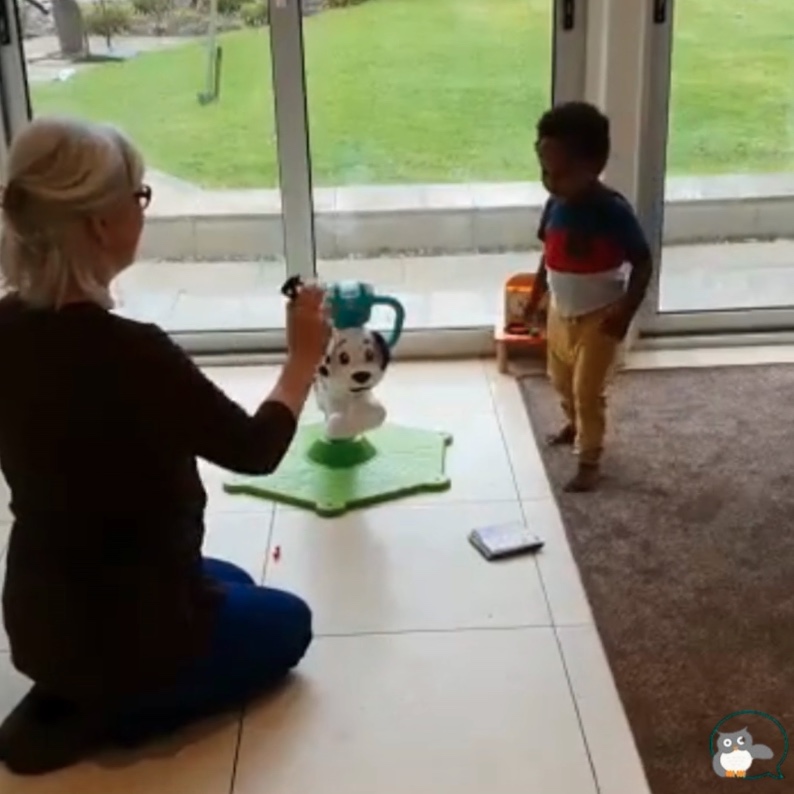
This short therapy clip is a little example of that.
Within one playful interaction, we naturally work on:
grammar
sentence expansion
pronouns
speech sound errors
modelling
visual cueing
turn-taking
confidence in communication
And, importantly, the child remains engaged, relaxed, and successful throughout.
Using language activities to refine speech sound targets
We all learn language through:
shared attention
play
repetition
connection
modelling
responsive interaction
As a Speech and Language Therapist I am constantly thinking and considering how to bring in all the targets a child is working on. The reason for that is that often we do not have a full therapy hour to work leisurely and calmly on various targets! Many children have short attention focus and ‘go off the boil’ quickly and often suddenly. Therefore, I always feel a sense of ‘make hay whilst the sun shines’ and pack it all in whilst the going is good. So then we can afford five minutes of trampolining in between activities to help the child regulate themselves without losing valuable speech therapy opportunities or time.
How can I expand this sentence?
How can I model better grammar?
Can I gently shape the pronunciation here?
Should I recast that phrase?
Is this the right moment to pause and encourage a longer utterance?
How can I keep communication flowing while still targeting goals?
These decisions happen continuously during therapy.
Building longer sentences naturally
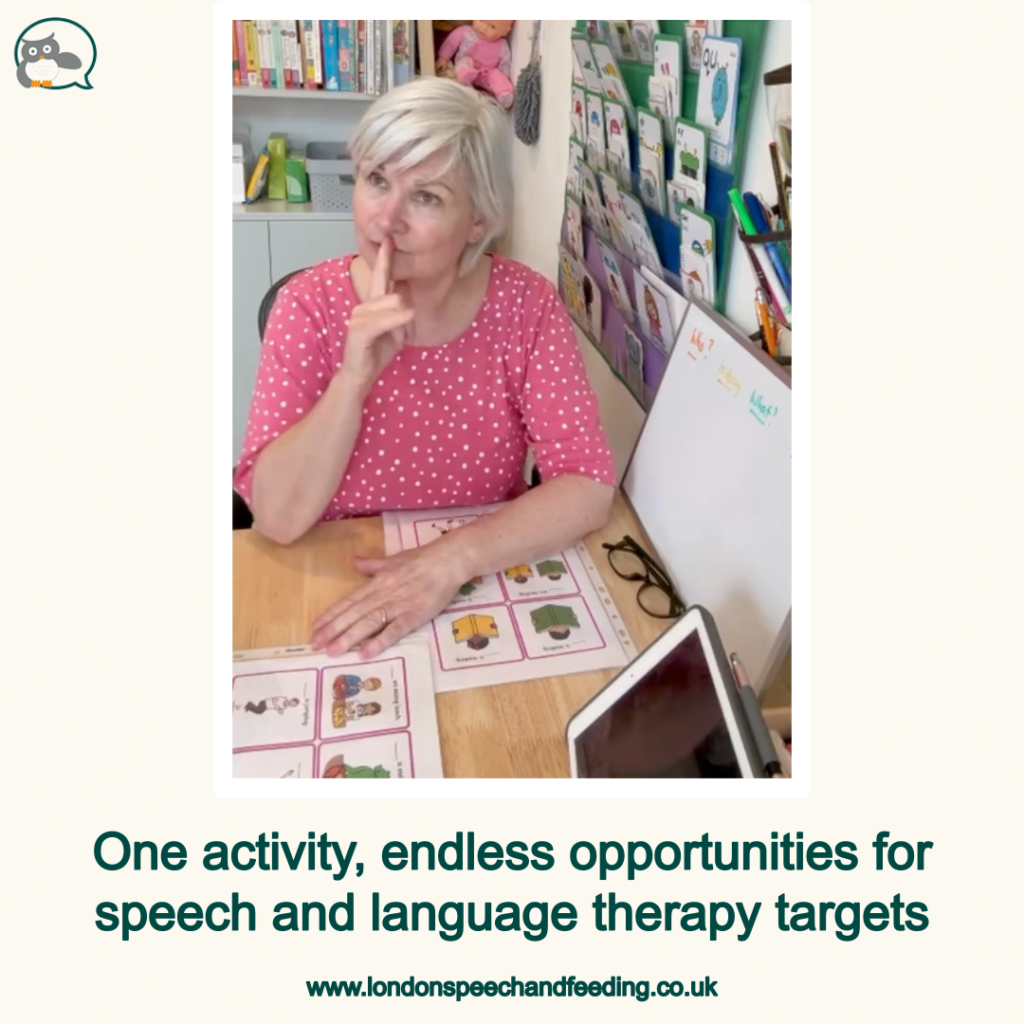
In this clip, one of the key areas we are targeting is sentence expansion through Colourful Semantics, which is a particularly useful and researched approach, developed by UK Speech and Language Therapist Alison Bryan in 1997 to support children with speech and language difficulties.
Colourful Semantics is a visual, colour-coded therapy approach that helps children break down, understand, and construct sentences by assigning specific colours to thematic roles (e.g., Who, What Doing, What).
Many children with language delay use reduced language for example: they might say:
‘dog’ instead of ‘the dog is running fast’
‘eatin a dinner’ instead of we are eating our dinner
‘baby shhh’ instead of ‘the baby is sleeping’.
Using the Colourful Semantics Framework helps create a solid baseline from which to work and with which to construct basic good sentences using WHO is DOING WHAT and WHERE.
We are building language upward gently and positively.
This technique is incredibly powerful because children learn language through hearing it used meaningfully over and over again.
Supporting pronouns through real conversation
Pronouns can be surprisingly difficult for many children.
Words such as:
he
she
him
her
they
require children to understand perspective, grammar, and sentence structure all at once. Using pictures and basing the activity on the Colourful Semantics Model I can shape pronouns repeatedly as part of the overall activity.
Books, pictures, and play scenes are fantastic for this because they create endless opportunities for meaningful repetition.
Again, this may look simple from the outside.
But underneath it is highly intentional clinical work.
Listening for speech sound errors at the same time
While supporting grammar and language, I am also constantly listening to the child’s speech production.
In this short interaction, I respond to speech sound errors as they arise.
Sometimes I:
model the correct production
emphasise a sound slightly
use visual cues
slow the word down
add gesture or sign support
encourage another attempt.
And sometimes I intentionally let the error go in order to protect confidence and maintain communication flow.
That balance is incredibly important.
Children need support. But they also need to feel successful communicating.
The child simply experiences this as warm, responsive interaction.
But underneath it is detailed clinical reasoning.
This is why effective therapy is never about simply owning resources or downloading activities online.
The real skill lies in:
how the therapist uses the activity
how they adapt moment by moment
how they analyse communication in real time
how they shape interaction to maximise learning opportunities.
One activity. Endless opportunities.
A single book, picture scene, or playful interaction can provide opportunities to support:
speech sounds
language development
grammar
vocabulary
attention
confidence
social communication
emotional connection.
The magic is not in the activity itself.
The magic is in how a therapist uses it.
Because excellent speech therapy is never ‘just playing’.
It is careful, responsive, evidence-based intervention woven seamlessly into joyful interaction.
Bryan A (1997) Colourful semantics. In: Chiat S, Law J, and Marshall J (eds) Language disorders in children and adults: psycholinguistic approaches to therapy. London: Whurr, 143–61.
Find a speech and language therapist for your child in London. Are you concerned about your child’s speech, feeding or communication skills and don’t know where to turn? Please contact me and we can discuss how I can help you or visit my services page.