There’s often this idea that autistic children have extensive vocabulary and knowledge, but this is not always the case. In fact, 30% of autistic children have language regression.
Goldberg (2003) suggested that speech and language regression refers to the decline in a young child’s speech and communication abilities. We know that regression in speech, language and communication skills often occur before the age of two years. 25% of autistic children develop language at word level between 12 and 18 months of age before losing this language they have learned. As you’re probably aware this regression in communication is a diagnostic indicator of Autism.
We understand that you want your child to progress, and you struggle to watch as their frustration grows as you feel helpless. I want to provide you with tips so that you can feel empowered to support your autistic child and reduce the impact their communication skills have on the family.
Reduce frustration by providing visuals to support their communication
Praise the ability to communicate. Focus on what they say not how they say it. E.g., good listening, nice talking.
Provide your child with choices (using real objects to represent your choices). E.g., do you want an apple or banana?
Your child must be motivated and have a purpose to communicate. So, ensure you use highly motivating objects for conversations
Provide them with opportunities to communicate. We need to teach children that if they want something, there’s a process that you need to have the opportunity to ask for it. We find that if parents understand what their child wants (without them asking), the object is given to them, and so there’s no reason for your child to ask.
There’s this idea that we need to teach children eye contact. This is not always the case. Your child is unique, we do not want to take their unique skills away.
Model words which are concrete. E.g., words such as ‘finished’, ‘more’. You can model these several times within the day. You can use a gesture to make the word more visual (see the images below). We know that autistic children are often visual learners.
Remember that if your child has speech, language and communication regression, it doesn’t mean your child will stay static.
It’s vital that you seek support from a qualified Speech and Language Therapist. We can tell you at what point in the communication development that your child is at. And we can support you through the process. We can provide you with an individualised plan specifically for your child to ensure you maximise their potential.
Find a speech and language therapist for your child in London. Are you concerned about your child’s speech, feeding or communication skills and don’t know where to turn? Please contact me and we can discuss how I can help you or visit my services page.
What is a Speech and Language – Feeding Therapist?
You’ve probably heard of speech therapists helping people who stutter or struggle to pronounce words. But did you know that they also work with children and adults who have problems with eating and swallowing? This specialised area is called Speech and Language Therapy: Feeding and Swallowing, or Dysphagia Therapy.
Why does a Speech Therapist help with eating and swallowing?
The mouth, tongue, and throat are all involved in both speech and swallowing. When there’s a problem with any of these parts, it can affect both your ability to talk and to eat. For example:
Weak tongue muscles: Can make it hard to chew food and to form sounds.
Difficulty coordinating swallowing: Can lead to choking or aspiration (when food or liquid goes into the lungs).
Sensory issues: Can make certain textures or tastes feel unpleasant or overwhelming.
Communication: If we are not able to express ourselves we are likely to have difficulties during daily mealtimes: how do we ask for ‘more’ of something, how do we say we have had enough or we don’t like a particular food?
How does a Speech and Language Therapist help?
Our work involves a combination of assessment and therapy. We carefully observe how your child feeds, eats and swallows, and we look into your child’s mouth to help us see what the cause of the difficulties are: could be a very highly-arched palate, it could be a very flaccid/low tone tongue, it could be poor dentition. Then, we create a personalised treatment plan to address your specific needs.
Here are some of the things we might do:
Teach swallowing techniques: We can help your child learn strategies to improve or facilitate a safe swallow.
Recommend dietary modifications: We may suggest changes to your child’s diet to make it easier to eat and swallow.
Provide sensory therapy: If your child has sensory needs we can help your child become more comfortable with different textures, tastes, and smells.
Work on oral motor skills: We can help to encourage more effective chewing, or drinking skills, or we can help your child to close his/her mouth more during chewing or drinking from a straw.
Collaborate with other professionals: We often work closely with doctors, nurses, occupational therapists, and dietitians to provide comprehensive care.
What kinds of problems do Speech and Language Therapists help with?
We see a wide range of feeding and swallowing difficulties, including:
Delayed feeding: Children who are slow to develop feeding skills or who have difficulty transitioning to solid foods.
Tongue-ties: Babies can have significant difficulties with feeding when the tongue is very tightly tethered to the floor of the mouth.
Refusal to eat: Children who refuse to eat certain foods or textures.
Aspiration: When food or liquid goes into the lungs, which can lead to pneumonia and other serious complications.
Chewing difficulties: Problems with chewing food, such as difficulty breaking down food or keeping food in the mouth.
Swallowing difficulties: Problems with swallowing, such as feeling like food is stuck or choking.
Neurological conditions: Conditions like cerebral palsy, down syndrome or other genetic syndromes can affect feeding and swallowing.
Developmental delays: Children with developmental delays may have difficulties with feeding and swallowing.
Is there hope?
If your child is struggling with feeding or swallowing, know that there is help available. Speech and Language Therapy can make a significant difference in your and your child’s quality of life. We’re here to support you every step of the way.
Remember, you don’t have to suffer in silence. If you’re concerned about your child feeding or swallowing, please reach out. You can find a Speech and Language Therapist with a Feeding/dysphagia qualification near you via www.asltip.co.uk or contact me.
Sonja McGeachie
Early Intervention Speech and Language Therapist
Feeding and Dysphagia (Swallowing) Specialist The London Speech and Feeding Practice
The London Speech and Feeding Practice
Find a speech and language therapist for your child in London. Are you concerned about your child’s speech, feeding or communication skills and don’t know where to turn? Please contact me and we can discuss how I can help you or visit my services page.
I very often work on /S/ Blends (/SP/ /ST/ /SM/ /SK/ /SN/ and /SL/). When we work on these sound blends (like SPider, STop, or SMile), we are using a clever speech therapy ruse! Because these blends are complex, teaching a child how to master them naturally helps them clear up simpler single sounds (like just /S/ or just /P/) at the same time. Plus, because S-blend words are so common in everyday language think spoon, spy, spot, and spin, practising them gives your child an immediate confidence boost when they are understood much more easily.
Good news: high-repetition motor practice doesn’t have to be a chore. In fact, the more sensory input we can provide, the faster those new neural pathways are built. Recently, I recorded a series of seven short clips to demonstrate how we can weave intense speech practice into the fabric of play.
Here is a look at a typical day in the clinic focusing on /SP/ blends.
1. The sensory sandbox:
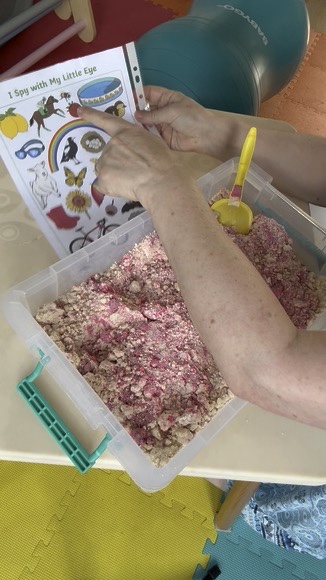
We started our session at the sensory table. Sensory bins can often work well because they provide tactile feedback that grounds the child’s focus (of course they are usually messy, so one needs to have the physical space and energy for it to be fair!).
The Activity: I pointed to our ‘I Spy’ board before we dove into the sand. Using a toy spade we dug for hidden objects and named them each time we found one.
Every time we scooped, we practised Spade. Every discovery was a spider, a spoon or a spotty animal. By pairing the physical effort of digging with the speech sound, we help the brain synchronise motor planning and vocal execution.
2. Bingo dabbers rock!
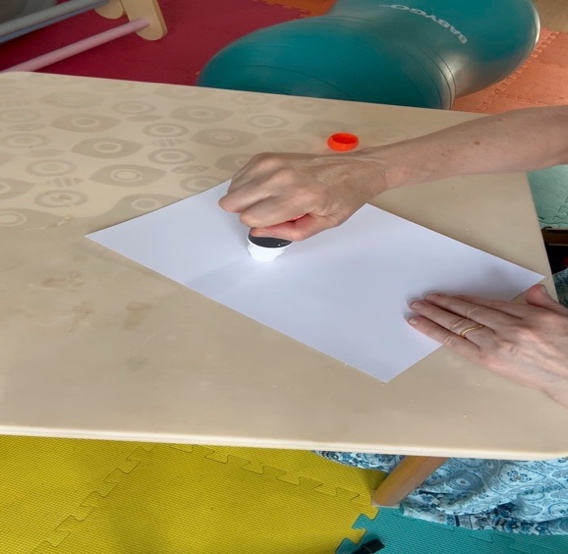
Next, we moved to making ink marks on paper.
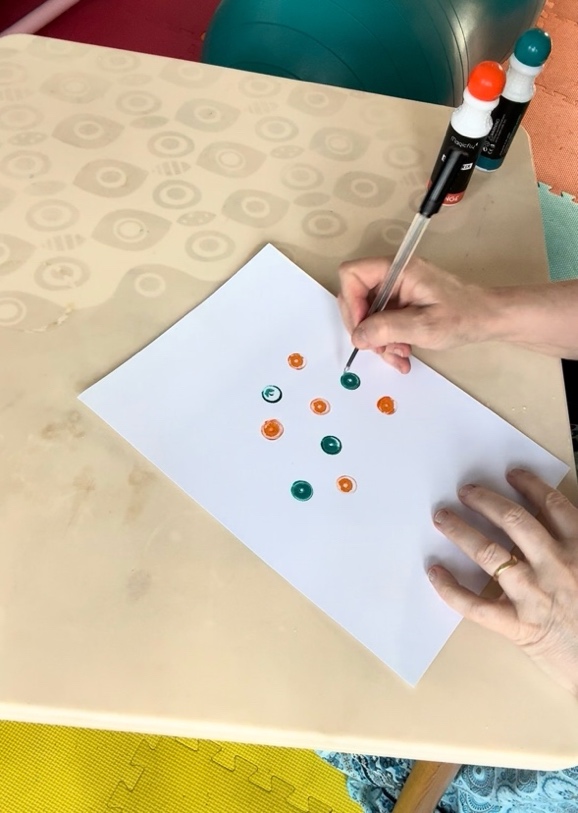
The Activity: I demonstrated making spots with coloured bingo dabbers.
We treated each ink spot as a visual anchor. Stamp –Spot Stamp –Spot. This creates a rhythmic pacing that prevents the child from rushing. It’s a wonderful way to get 50+ repetitions in under five minutes without the child even realising they are ‘working’.
3. Drawing spiders
Building on the previous activity, we took those spots and turned them into something more complex.
The Activity: I drew spiders out of the spots we had just made.
Drawing the legs provided a perfect opportunity for ‘stretch’ sounds. As we drew a long leg, we practise a long, hissy ‘Sssssssss’, snapping into the /P/ as the pen hits the spot.
4. Wind-up spinners
High-energy toys are excellent for eliciting ‘power’ sounds.
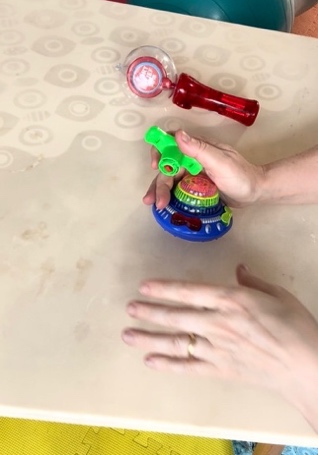
The Activity: I brought out two mechanical wind-up spinners.
Method: The child says Spin or Spinner to get me to wind them up. The anticipation of the toy moving acts as a natural reinforcer.
5. The Incy Wincy spider game
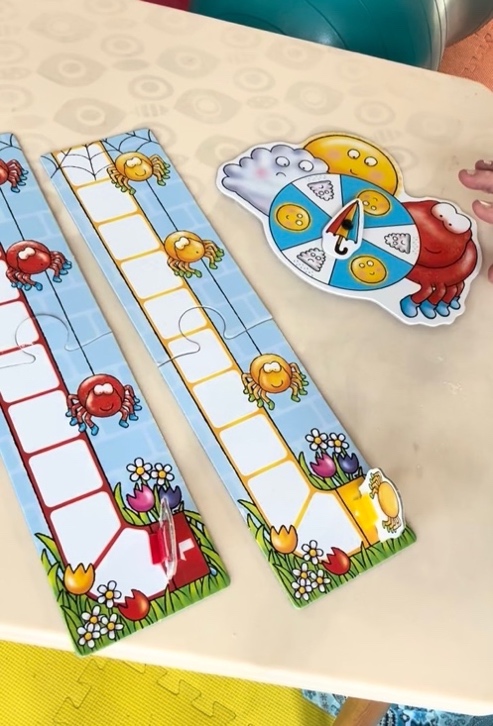
The Activity: I spun a game spinner to determine how many steps our toy spiders would take up the spout.
This activity is a triple threat. We practised ‘Spin’, ‘Spider’, and ‘Spout’ all in one go. The visual of the spider moving up the spout also helps with the concept of UP and DOWN of course.
6. Searching for Spot
Books are a great tool for generalisation, taking a sound from a single word and moving it into phrases and sentences.
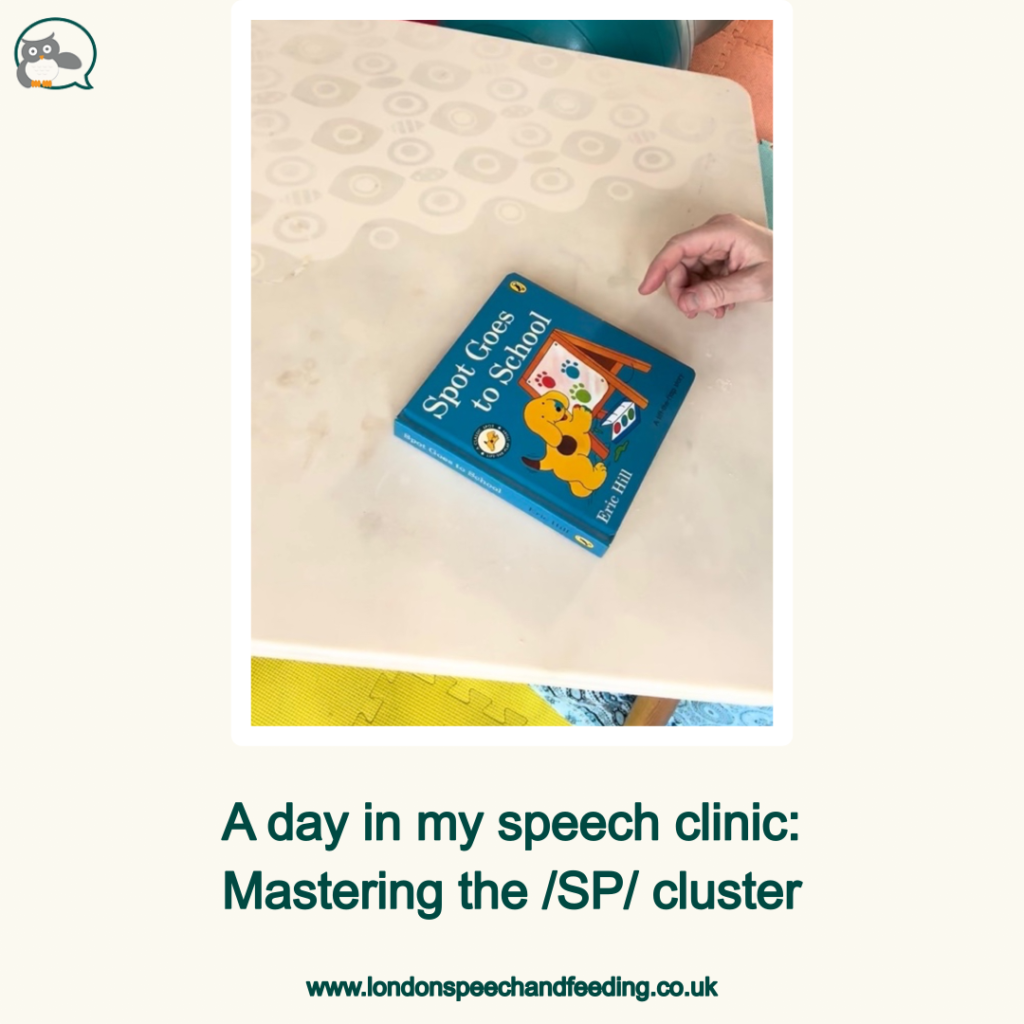
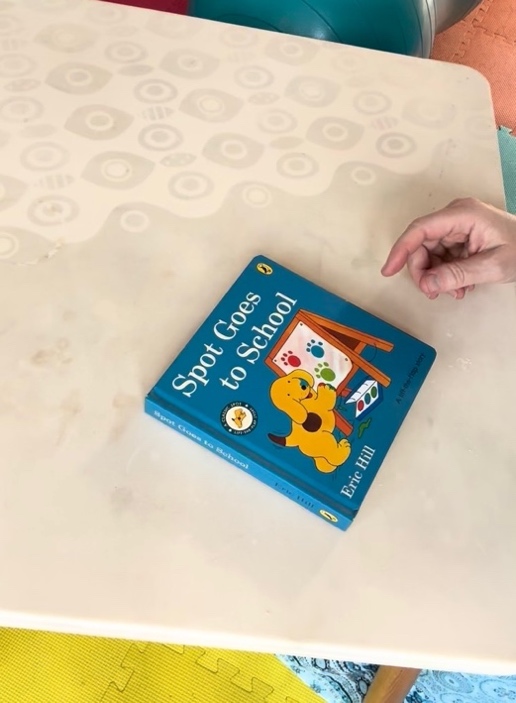
The Activity: We went through a ‘Spot the Dog’ book.
Instead of just reading, we used the ‘I Spy’ strategy. ‘I spy Spot! He has a big spot on his back!’ This encourages the child to use the target word in a functional, communicative way rather than just repeating it after me.
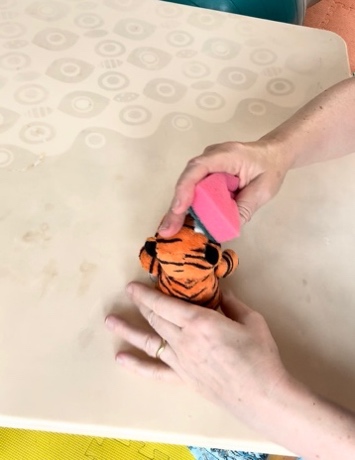
7. Finally, sponging off some sand
We ended the session with some ‘heavy work’ and cleaning.
The Activity: We took a soft toy that had gotten a bit ‘dusty’ in the sandbox and used a sponge to clean it down.
The action of squeezing the sponge provides proprioceptive input (pressure), which can be very calming and help a child focus on their articulatory placement for those final repetitions of the day.
A day in my speech clinic: Mastering the /SP/ cluster
Speech therapy works on motor learning. Just like learning to ride a bike or play the piano, the brain needs thousands of correct repetitions to make a movement automatic. By using /SP/ words in these seven distinct, sensory-rich ways, we:
Reduce frustration: The focus is on the play, not the correction.
Increase engagement: A child who is having fun will stay in the learning zone longer.
Provide context: The child learns that saying /SP/ correctly helps them get the spade, spin the spinner, and find the spider.
Next time I will show you some more activities for /ST/ and /SM/ words. If you have any super ideas for /S/ cluster words please leave me your suggestions in the comments on instagram, I would appreciate it thank you! 😊
If you are concerned about your child’s speech, please do not hesitate to get in touch. I would love to help you find some answers.
Sonja McGeachie
Highly Specialist Speech and Language Therapist
Owner of The London Speech and Feeding Practice.
Find a speech and language therapist for your child in London. Are you concerned about your child’s speech, feeding or communication skills and don’t know where to turn? Please contact me and we can discuss how I can help you or visit my services page.
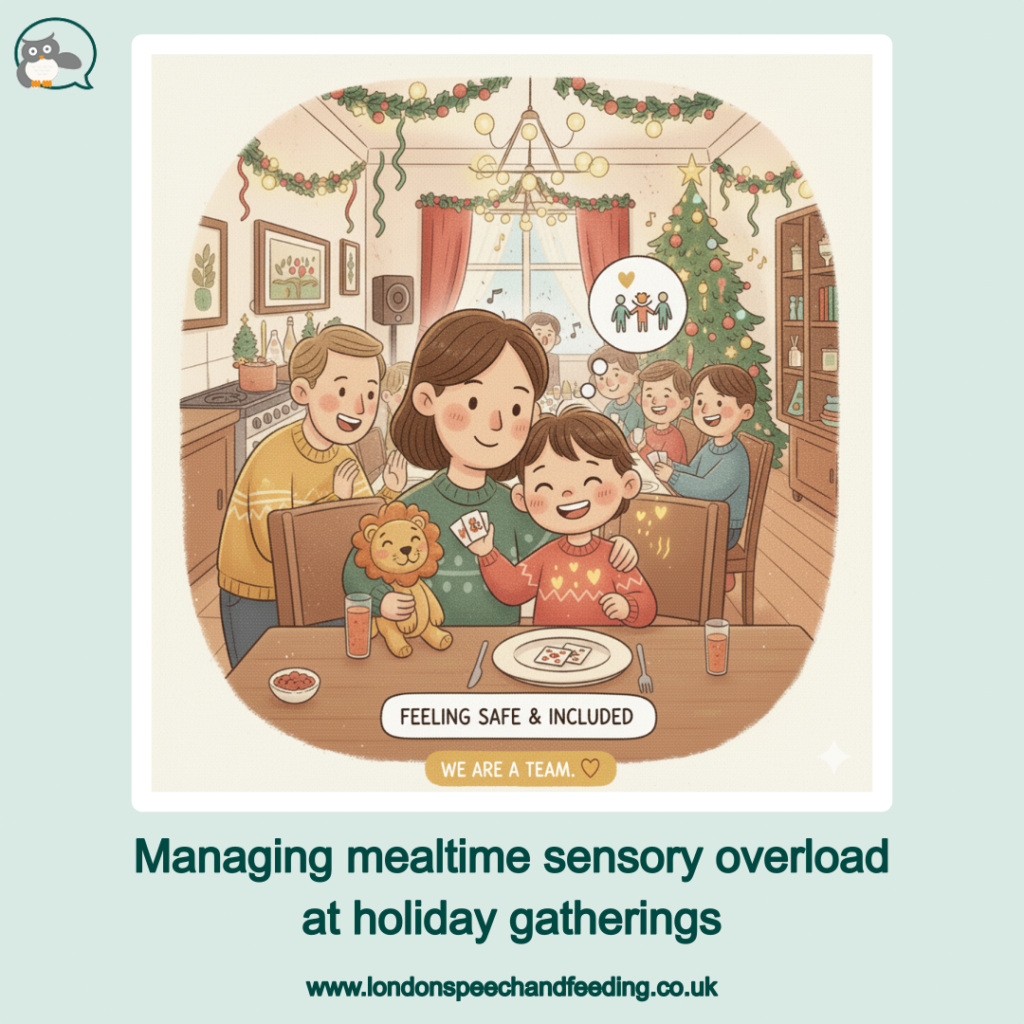
Holiday meals are meant to be joyful and something we all look forward to. But for many children and their families, these occasions can be overwhelming and be the cause of dread and worry. The combination of new smells, unfamiliar foods, loud environments, social expectations, and allergy anxieties can quickly turn what should be a festive time into a stressful one.
For parents of children with sensory processing differences, selective eating challenges, or food allergies, holiday gatherings often require careful planning and a big dose of tolerance and compassion. The good news is that with awareness and a few gentle strategies, you can support your child to feel safe, regulated, and included during festive meals without pressure, tears, or discomfort.
Let’s explore how to make holiday mealtimes calmer, safer, and more connected this season.
🎄 Why holiday meals feel so overwhelming
Holiday gatherings usually combine several sensory triggers all at once:
Noisy, chaotic rooms
Strong smells from a mix of foods we don’t normally cook
Expectations to ‘try everything’ or ‘enjoy it’s sooo good!’
New environments, seating arrangements, or routines
For children with sensory sensitivities, this can feel like a tidal wave of input. Research shows that children who are sensory-sensitive often have heightened responses to smell, taste, and texture, which may lead to avoidance or distress at mealtimes (Cermak, Curtin, & Bandini, 2010).
Add food allergies into the picture and anxiety increases even further for both children and parents. A 2020 study by DunnGalvin et al. found that children with food allergies experience significantly higher stress in shared eating environments, especially when food preparation or contamination risk is hard to control.
So, if your child becomes tearful, shuts down, or refuses to sit at the festive table, it isn’t ‘bad behaviour.’ It’s sensory overload, heightened vigilance, or discomfort communicating through their body.
🌟 Preparing your child for a calmer festive meal
Preparation is especially important for sensory-sensitive or allergy-aware children. Here’s how to set them up for success:
1. Offer predictability through previewing
Before the event, show your child pictures of:
where you’re going
who will be there
the types of foods that might be served
where they might sit
A visual schedule or social story can help reduce anxiety and give your child a sense of control.
2. Pack safe foods without apology
If your child has allergies or selective eating, bring:
‘Safe foods’ you know they will eat
Backup snacks
A separate (their own) plate, if needed
Emergency medication
Announce clear, firm boundaries such as:
‘Ok people, these are Jamie’s safe foods — we’ll stick with these today.’ This will help relatives understand without pressure or judgement.
3. Choose seating that supports sensory regulation
If possible, seat your child:
at the end of the table
near a familiar adult
away from the kitchen (strong smells)
away from noise clusters
give them their favourite toy or fidget whilst waiting
Let them take breaks when needed. This isn’t ‘rude,’ it’s self-regulation.
🍽️ Supporting children during the meal
1. Focus on connection, not consumption
The holidays are not the time to expand your child’s food range. Keeping mealtimes low-pressure actually supports long-term progress.
In fact, the research is clear: pressuring children to eat decreases acceptance and increases refusal (Galloway et al., 2006).
So instead of ‘Just try it!’ try:
‘You don’t have to eat it, you can look at it.’
‘You’re in charge of what goes in your mouth.’
‘You can keep your safe foods on your plate.’
2. Protect your child’s allergy safety
Holiday meals often include:
cross-contamination risks
shared utensils
buffets
homemade dishes without ingredient lists
Use gentle but firm scripts:
‘Because of Ellie’s allergies, we’ll keep her plate separate.’
‘We’ll serve her food ourselves to make sure she stays safe.’
Confidence in your boundary helps others respect it.
3. Manage sensory load in real time
Offer:
headphones
a small chew or fidget toy
a designated ‘calm corner’
time outside for fresh air
a predictable signal for breaks (e.g., a hand squeeze or card)
Remember, sensory regulation is healthcare, not ‘giving in.’
4. Model calm eating
Children learn most from watching.
Slow, happy bites and relaxed facial expressions tell the nervous system: ‘This environment is safe’.
💛 What to say to well-meaning relatives
Families often have big feelings about food. You can prepare nice phrases like:
‘We’re focusing on helping him feel safe around food today.’
‘She has allergies, so we’re sticking to our plan.’
‘We’re avoiding pressure because it helps him eat better long term.’
‘We’re celebrating together, eating is not the goal today.’
Setting expectations ahead of time can reduce awkward moments later.
🎁 The bigger picture: It’s about safety, not ‘picky eating’
Children with allergies, sensory differences, or feeding challenges aren’t trying to be difficult. They are trying to stay safe, regulated, and comfortable.
Your calm presence, gentle boundaries, and preparation create the conditions for a holiday that feels peaceful, not pressured.
Sonja McGeachie
Highly Specialist Speech and Language Therapist
Owner of The London Speech and Feeding Practice.
Find a speech and language therapist for your child in London. Are you concerned about your child’s speech, feeding or communication skills and don’t know where to turn? Please contact me and we can discuss how I can help you or visit my services page.
I have been avoiding the use of the Empty Set approach for the longest time as I was not sure if it would work seeing that I am challenging two sounds my student struggles with at the same time. But I decided to give it a go and it works a treat!
With this approach, we use two sounds that our student is struggling with. For example, in my video this student cannot produce /sh/ and /r/. Both sounds have different rules, so I decided to contrast them with each other.
The rules of /sh/ are: no voice, air is pushed out through teeth, produced at the front.
The rules for /r/ are: use your voice, produce the sound in the middle of the mouth by shaping your tongue in a particular way.
So I chose the words ‘shoes’ and ‘ruse’ as their rules are quite different. Contrasting two sounds the student does not know has been shown to lead to greater change in the child’s articulation. And I can certainly vouch for this as my student is making the best progress with this approach.
Phonology Therapy – what is it, why and how?
Phonology is the study of the sound system of a language. It’s distinct from articulation therapy which focuses on the physical production of sounds.
Phonology therapy focuses on rules. For example, sounds that are produced at the front of the mouth, in contrast to sounds that are produced at the back of the mouth, or sounds that are produced with a long air stream: /s/ or /f/ versus short sounds like /p/ or /t/; sounds are produced with voice or without voice.
Many children, and sometimes adults, are unaware of some of the speech rules and confuse and replace individual sounds. They might say TAT instead of CAT or SIP instead of SHIP.
A quick overview of phonology approaches I use:
Minimal Pairs:
This approach is good for single sound substitutions. We offer word pairs that differ by only one sound, like ‘ship’ and ‘sip.’ One of our first goal in therapy is to highlight the difference between the target sound (e.g., /sh/) and the sound the child uses (e.g., /s/). This helps discriminate and eventually produce the correct sound.
Multiple Oppositions:
A child might replace lots of sounds with a single sound like a /d/. So instead of ‘four’, ‘chore’ and ‘store’ our child says ‘door’, making speech very unintelligible.
The approach is typically geared towards shaking up the phonological system. Our goal is to choose two to four targets that are different from each other, and different from the substituted sound. If our child’s favourite sound is /d/ they can use their voice and make a short sound by stopping their airflow. So I will choose a different target sound to change up the speech system. For example I might choose an /f/, a /m/ and a /k/ sound. So I would contrast: ‘door’ with ‘four’, ‘more’ and ‘core’.
Maximal Oppositions:
In the Maximal Oppositions approach the treatment sets consists of words that are minimally contrasted and that have maximal or near maximal feature differences between each word pair. One word in a pair represents a sound the child ‘knows’ (can say at word level) and the other represents a sound the child does not know (cannot say).
For example, a child may ‘know’ /m/ and be able to say words like ‘man’, ‘mat’ and ‘mine’. However, the same child may be unable to say /f/ as in ‘fan’, ‘fat’ and ‘fine’. The consonants /f/ and /m/ are maximally opposed as follows.
I am always delighted to work on speech sound disorders, I love the challenge and the successes we can celebrate together. Get in touch with me!
Sonja McGeachie
Early Intervention Speech and Language Therapist
Feeding and Dysphagia (Swallowing) Specialist The London Speech and Feeding Practice
The London Speech and Feeding Practice
Find a speech and language therapist for your child in London. Are you concerned about your child’s speech, feeding or communication skills and don’t know where to turn? Please contact me and we can discuss how I can help you or visit my services page.
As a speech therapist, few things are as rewarding as helping a child find their clear, confident voice. Among the various speech sound disorders, the ‘lateral lisp’ – often described as a ‘slushy’ or ‘wet’ /S/ sound – presents a unique challenge. While it can be tricky to treat, I’m thrilled to share that I’ve had significant success in helping children overcome this particular hurdle.
What is a lateral lisp?
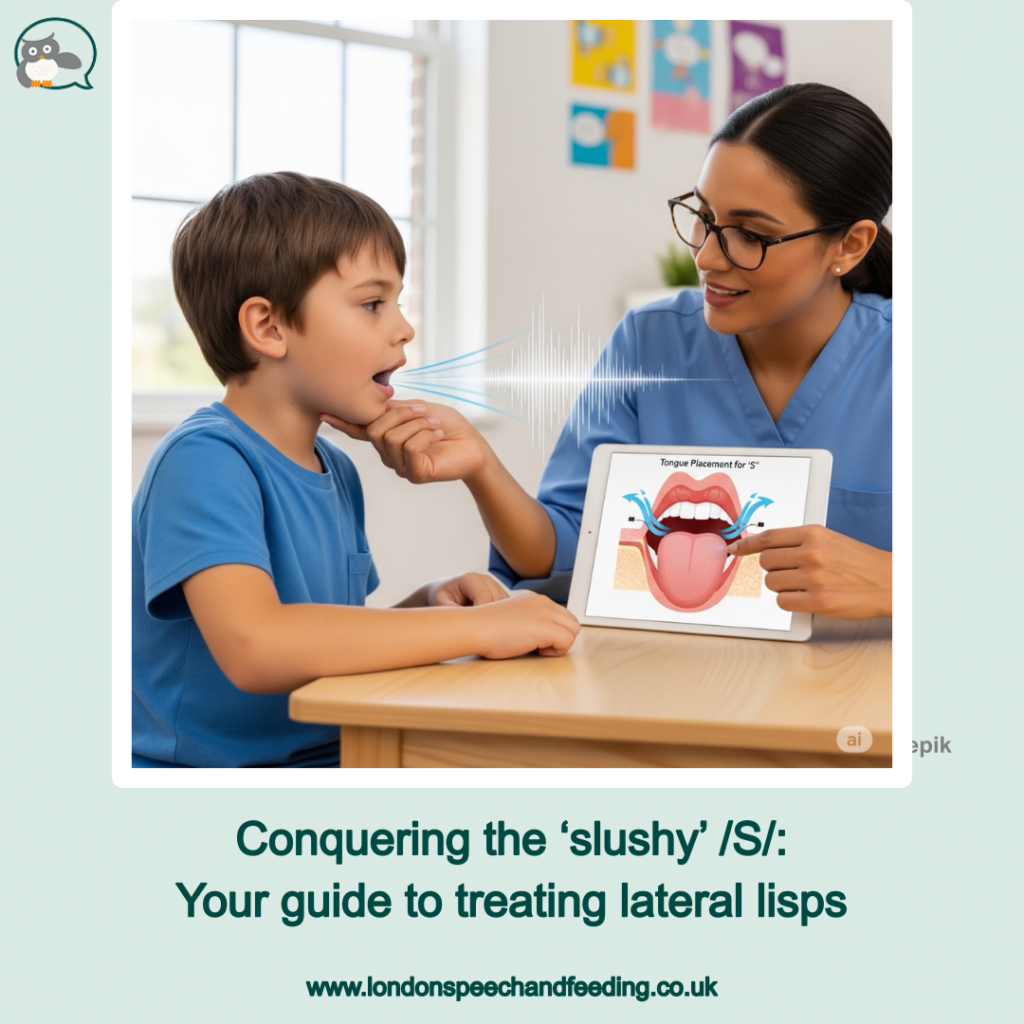
Most people are familiar with a frontal lisp, where the tongue protrudes between the front teeth, resulting in a /TH/ sound for an /S/ (e.g., ‘thun’ for ‘sun’). A lateral lisp, however, is different. Instead of the air escaping over the front of the tongue, it escapes over the sides, often giving the /S/ and /Z/ sounds a distinct, muffled, or ‘slushy’ quality. This happens because the tongue is not forming the correct central groove, allowing air to spill out laterally.
The science behind a perfect /S/ vs. a slushy one
To understand how to fix a lateral lisp, it’s helpful to understand how a ‘perfect’ /S/ sound is made. Imagine a narrow, focused stream of air. For a clear /S/ sound, your tongue forms a shallow groove down its centre, directing a precise, thin stream of air right down the middle, over the tip of your tongue, and out through a tiny opening between your tongue and the roof of your mouth, just behind your front teeth. This focused airflow creates that crisp, sharp /SSSS/ sound we recognise.
Now, picture what happens with a lateral lisp. Instead of that neat, central channel, the tongue is often flatter or positioned in a way that allows the air to escape over one or both sides. Think of it like a river overflowing its banks – the air, instead of flowing in a controlled stream, spills out sideways, creating that characteristic ‘slushy’ sound. This lateral airflow is what we need to retrain.
Why is it tricky to treat?
Treating a lateral lisp can be challenging for a few reasons:
Habitual muscle memory: The way the tongue moves and positions itself for a lateral lisp is deeply ingrained. It’s a motor habit that needs to be unlearned and replaced with a new, more precise movement.
Subtle differences: The difference between a lateral lisp and a correct /S/ sound can be quite subtle to perceive, both for the child and sometimes even for parents. This makes it harder for the child to self-monitor and correct.
Oral motor control: It requires fine motor control of the tongue muscles to create and maintain that central groove for airflow.
My success with children aged six years and over
I’ve found great success in treating lateral lisps, particularly with children aged six years and older. Why this age group? By this age, children typically have:
Increased awareness: They are more aware of their speech and often more motivated to make changes. They can better perceive the difference between their ‘slushy’ /S/ and a clear one.
Improved cognitive skills: They can understand and follow more complex instructions and strategies.
Better self-monitoring: Their ability to listen to themselves and correct their own speech improves significantly.
Enhanced oral motor control: Their fine motor skills, including those of the tongue, are more developed, allowing for greater precision.
My approach focuses on a combination of auditory discrimination, tactile cues, and targeted myofunctional exercises to help children ‘feel’ the correct airflow and tongue placement. We use a variety of engaging activities to make the process fun and effective.
It is crucial to understand tongue functioning and focusing on correcting improper oral resting posture and muscle function, which are often significant contributors to a lateral lisp. For example, if the tongue rests low and wide in the mouth consistently, or if there’s a tongue thrust during swallowing, these habits can prevent the tongue from achieving the precise, midline placement necessary for a clear /S/ or /Z/ sound. Through targeted exercises I aim to re-educate the oral and facial muscles, promoting correct tongue posture at rest, during swallowing, and, ultimately, during speech production. By strengthening the muscles responsible for tongue lifting and encouraging a more appropriate swallowing pattern we can establish the correct oral motor skills needed to overcome a lateral lisp and achieve clearer articulation.
The recipe for success: Little and often
The single most crucial ingredient for success in treating a lateral lisp is daily home practice of all the strategies given. This isn’t about long, arduous sessions; it’s about consistency. Think of it like building a muscle: short, frequent workouts yield better results than sporadic, intense ones.
My recommended formula is ‘little and often’. This means:
Short, focused sessions: Aim for 5-10 minutes of practice, 2-3 times a day. This prevents fatigue and keeps the child engaged.
Integrate into daily routines: Practise while waiting for dinner, during a car ride, or before bedtime. Make it a natural part of their day.
Positive reinforcement: Celebrate every small success! Encouragement goes a long way in building confidence and motivation.
Parental involvement: Parents play a vital role in providing consistent cues and encouragement at home. I equip families with clear, easy-to-follow strategies.
Overcoming a lateral lisp requires dedication, but with the right guidance and consistent practice, a clear, confident /S/ sound is achievable. If your child is struggling with a ‘slushy’ /S/, please don’t hesitate to reach out. Together, we can achieve success!
Sonja McGeachie
Highly Specialist Speech and Language Therapist
Owner of The London Speech and Feeding Practice.
Find a speech and language therapist for your child in London. Are you concerned about your child’s speech, feeding or communication skills and don’t know where to turn? Please contact me and we can discuss how I can help you or visit my services page.
There’s been a long tradition with teaching staff and with Speech and Language Therapists working in schools that eye contact should be a goal. It is well known that Autistic individuals (whether that be children or adults) mostly avoid eye contact. Whilst it’s part of the way we communicate, it shouldn’t be used as a necessity for an individual who feels that it is uncomfortable. Whilst it does show that you’re listening and showing an interest, it’s not a fair expectation for neurodiverse children.
Autistic children can find making and maintaining eye contact physically and emotionally uncomfortable as well as unnatural. It adds an extra layer of stress and has been reported to increase distractions rather than reduce them. Children who engage in conversations in their own way (i.e., with reduced eye contact) are not shown to suffer with schooling, work, or social interaction.
By having fun through meaningful activities, I often experience that ‘BINGO’ moment (a phrase coined by Alex @meaningfulspeech) where the child is enjoying themselves and naturally makes eye contact. There is no demand on them, they are in a fun, engaging environment which suit their strengths and supports their needs.
Following this, I often reflect on this question ‘Should we make eye contact as a goal?’
It very much depends on the situation. If it places more demands on the child and becomes stressful. Then no. There are many strategies we can use which gain eye contact without placing extra demands on the child. We need to be mindful to adapt the environment and not place neurotypical expectations to meet the needs of neurodiverse children.
How can you encourage eye contact without demand?
If you’re using toys, try holding them up to your eye level.
You can adjust your position, try sitting face to face during play.
Always get down to your child’s level. This might mean that you lay on the floor if your child is positioned in this way.
During play, waiting is extremely powerful. Before a key part of the activity, wait and see if your child looks at you. Remember silence is golden!
The best way I find is: do something unusual during play. It might be that you spray shaving foam with the lid still on. Or you bring out a wow toy and make it spin/light up or make a noise. A balloon can be good – see video clip. Use the excitement of the activity, and wait to see if you achieve that ‘BINGO’ moment.
Create opportunities when there are no toys involved such as during ‘tickles’ or ‘hide and seek’. Autistic children find it difficult to shift their attention between a toy and an adult. So by removing one option, you’re setting them up to succeed.
Remember, it takes practice and time for you to develop these skills. Try one at a time and experiment, see which works best for your child. If you need speech, language or communication support or advice, I am always here to help.
Find a speech and language therapist for your child in London. Are you concerned about your child’s speech, feeding or communication skills and don’t know where to turn? Please contact me and we can discuss how I can help you or visit my services page.