Speech sounds: Expectations vs reality

|

Sometimes our kids find it hard to listen to sounds in words and hearing the difference between sounds. This is an important skill which we call “sound awareness”. A lack of it can really impact on clear speech sounds production.

Your child might be confusing similar sounding words. Or they might not notice that a TAT is not a CAT for a DOD is not a DOG. Often children with speech sound disorders or difficulties don’t tune into individual sounds or even syllables. Grow your knowledge to support your child.

Read our latest blog on hearing the difference between sounds to develop speech sound production.

Practice makes perfect

There is a lot more to speech sound production than first meets the eye. Did you know that producing the correct speech sound at sentence level is the last piece to the communication puzzle? There’s a lot of practice before your child develops this last stage of speaking clearly. Your Speech and Language Therapist will start by determining if your child can hear the difference between the sound they are producing and the correct sound. So if your child says LIT instead of LICK we might contrast those two words by perhaps using a candle and a lollypop. Each time he/she says LICK they get to have a lick (or 3) on the lolly. But if they say LIT then we light up and blow out a candle. This way your child can see that there is a difference between those words and that the sounds we make actually matter. Fancy that!!

We call this auditory awareness, which is essentially hearing the sounds in words. Don’t be surprised if you hear your child’s therapist model the sound a lot. This is to develop their awareness. The more your child hears a sound, the easier they will find production. Furthermore, your Speech and Language Therapist will work on phonemic awareness (sound structures) such as the difference between a sound (e.g. sh, is one sound) vs a syllable (e.g., shell has one syllable) vs total number of sounds in a word (shell has three sounds sh-e-ll ), like you can see in my little video clip.

Once a child is able to produce a sound on its own and they can hear and identify how a short word is said correctly we can go and repeat lots of similar words with the sound at the beginning or end until it becomes automatic and new neuro pathways are laid in the child’s brain. From there we branch out into short phrases and then eventually sentences.

Six tips to practise auditory discrimination for speech sound production

  1. Sit opposite your child so they can see your mouth or or sit next to the child and place a mirror in front of you so they can see and hear your production.
  2. Make it fun! Once they’ve identified the sounds in the word, play part of a game (e.g., pop up pirate, Jenga, something which allows plenty of turns).
  3. Use car journeys or walking to school to practise (e.g., oh I see a sheep, sh-ee-p, sh-ee-p has three sounds. Can you spot something beginning with /sh/?)
  4. Remember that spellings can differ (e.g., ‘chef’ and ‘shed’ both have the same initial sound).
  5. Talk about what you’re doing with your mouth (e.g., my lips are rounded for /sh/). Your Speech and Language Therapist will be able to support you with this.
  6. Make silly sentences using your child’s special sound (e.g., Sheep show shepherds shearing).

At this stage you are not expecting your child to produce the sound. This is why it’s important that they continually hear an excellent model. If your child attempts speech sound production at any stage, this is to be encouraged as it’s a great opportunity to model the correct version.

Contact me to develop your child’s speech sounds.


Find a speech and language therapist for your child in London. Are you concerned about your child’s speech, feeding or communication skills and don’t know where to turn? Please contact me and we can discuss how I can help you or visit my services page.
0

Similar Posts

  • ·

    Five ways to increase confidence and reduce frustration in children with speech and language and communication difficulties

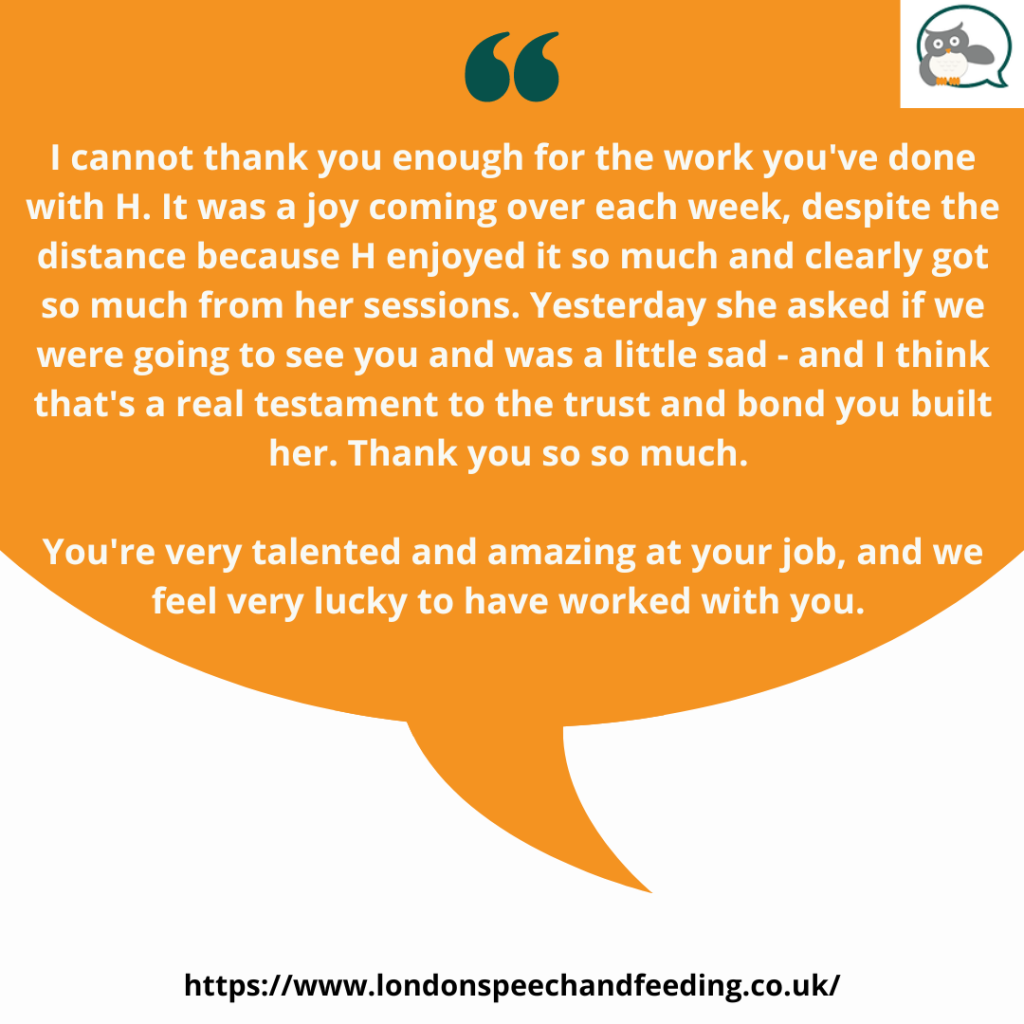
    An orange speech bubble with a testimonial

    Your child’s speech, language and communication difficulties may impact their self-esteem. And they may show signs of increased frustration. You want them to be full of confidence, increasing their participation in school and fully engaging with their peers.

    1. Practise active listening

    Speech difficulties can mean that it’s more challenging to understand what your child says. It’s important to show that you’re paying attention, giving them time to express themselves. Focus on what your child says rather than how they are speaking. Remember to maintain eye contact, and actively listen. Active listening and giving time can be trickier than it sounds. I can provide strategies to support your active listening skills.

    2. Give other means and forms of communication

    Allowing children to express themselves in a variety of ways (e.g., gesture, signs, written, use descriptions to describe a word (e.g., sand – you find it out the beach, it can have pebbles on it, it’s not the sea), use of symbols or high-tech augmentative communication methods such as a computer). Using different ways is vital in reducing frustration and communicating their message. If you’re unsure of what other forms of communication you can use, please contact me for some top tips.

    3. Praise efforts

    Providing specific praise allows your child to understand what they’ve achieved. E.g., you could praise the way your child listens, or how they take turns, or their resilience (e.g., “I like the way you listened” or “good listening”). Think of different ways you could praise you child during different activities, so you are prepared with phrases that you can use.

    4. Have clear start and end points in activities

    Some children with speech, language and communication needs have difficulties with transitioning from one activity to another. They also have difficulties with changes in routine. This can add to their frustration and changes in behaviour. So, how do you show a clear start and end to an activity? You can have a visual timetable, or you could have ‘start’ and ‘finish’ boxes where you place all the materials in the box labelled ‘start’. And once the activity has finished, you put the items in the box labelled ’finished’. If you need support with transitions, please contact me.

    5. Use visuals

    Visuals can support your child to understand routine and spoken language. Visuals can range from symbols to online images, to photographs, or a combination. Explore which type of visuals work well for your children. Using visuals can be powerful if used correctly. Make the most of the opportunities that visuals can provide for your family.

    Increase confidence and reduce frustration in children with speech and language and communication difficulties today. Please feel free to contact me if you need any support or tips on maximising these opportunities.


    Find a speech and language therapist for your child in London. Are you concerned about your child’s speech, feeding or communication skills and don’t know where to turn? Please contact me and we can discuss how I can help you or visit my services page.

    1
  • ·

    Let’s relax about making EYE CONTACT already…

    There’s been a long tradition with teaching staff and with Speech and Language Therapists working in schools that eye contact should be a goal. It is well known that Autistic individuals (whether that be children or adults) mostly avoid eye contact. Whilst it’s part of the way we communicate, it shouldn’t be used as a necessity for an individual who feels that it is uncomfortable. Whilst it does show that you’re listening and showing an interest, it’s not a fair expectation for neurodiverse children.

    Autistic children can find making and maintaining eye contact physically and emotionally uncomfortable as well as unnatural. It adds an extra layer of stress and has been reported to increase distractions rather than reduce them. Children who engage in conversations in their own way (i.e., with reduced eye contact) are not shown to suffer with schooling, work, or social interaction.

    By having fun through meaningful activities, I often experience that ‘BINGO’ moment (a phrase coined by Alex @meaningfulspeech) where the child is enjoying themselves and naturally makes eye contact. There is no demand on them, they are in a fun, engaging environment which suit their strengths and supports their needs.

    Following this, I often reflect on this question ‘Should we make eye contact as a goal?’

    It very much depends on the situation. If it places more demands on the child and becomes stressful. Then no. There are many strategies we can use which gain eye contact without placing extra demands on the child. We need to be mindful to adapt the environment and not place neurotypical expectations to meet the needs of neurodiverse children.

    How can you encourage eye contact without demand?

    • If you’re using toys, try holding them up to your eye level.
    • You can adjust your position, try sitting face to face during play.
    • Always get down to your child’s level. This might mean that you lay on the floor if your child is positioned in this way.
    • During play, waiting is extremely powerful. Before a key part of the activity, wait and see if your child looks at you. Remember silence is golden!
    • The best way I find is: do something unusual during play. It might be that you spray shaving foam with the lid still on. Or you bring out a wow toy and make it spin/light up or make a noise. A balloon can be good – see video clip. Use the excitement of the activity, and wait to see if you achieve that ‘BINGO’ moment.
    • Create opportunities when there are no toys involved such as during ‘tickles’ or ‘hide and seek’. Autistic children find it difficult to shift their attention between a toy and an adult. So by removing one option, you’re setting them up to succeed.

    Remember, it takes practice and time for you to develop these skills. Try one at a time and experiment, see which works best for your child. If you need speech, language or communication support or advice, I am always here to help.


    Find a speech and language therapist for your child in London. Are you concerned about your child’s speech, feeding or communication skills and don’t know where to turn? Please contact me and we can discuss how I can help you or visit my services page.

    0
  • · ·

    Why pointing matters: Unpacking the power of this simple gesture

    As a speech and language therapist, I’m often asked about the significance of seemingly simple gestures in child development. One question that comes up frequently is, ‘Why is pointing so important?’ It might seem like a trivial action, but pointing is a powerful communication tool and a critical milestone in a child’s development.

    Why is pointing so important?

    Let’s delve into the theory behind why pointing matters:

    1. Pointing as pre verbal communication:

    Before children can use words, they use gestures to communicate their needs and interests. Pointing is one of the earliest and most important gestures. It allows children to:

    • Request: ‘I want that!’
    • Protest: ‘No, not that!’
    • Direct attention: ‘Look at that!’
    • Share interest: ‘Wow, cool!’

    2. Pointing and language development:

    Pointing is not just about communicating in the here and now; it also plays a crucial role in language development. Research shows that:

    • Early pointing predicts later language skills: Children who point more often tend to have larger vocabularies and better grammar later on.
    • Pointing helps children learn new words: When children point at something, adults tend to label it, providing valuable language input.
    • Pointing supports joint attention: Joint attention, or the shared focus of two individuals on an object or event, is essential for language learning. Pointing helps establish joint attention, creating opportunities for communication and learning.

    3. Pointing and social-emotional development:

    Pointing is not just about language; it’s also about social interaction. It allows children to:

    • Engage with others: Pointing invites others to share their focus and participate in their world.
    • Express emotions: Pointing can convey excitement, curiosity, or concern.
    • Develop social understanding: By observing how others respond to their pointing, children learn about social cues and communication.

    4. Pointing and cognitive development:

    Pointing is linked to cognitive skills, such as:

    • Understanding object permanence: The ability to know that objects exist even when they are out of sight.
    • Categorisation: The ability to group similar objects together.
    • Problem-solving: Pointing can be used to ask for help or to indicate a problem.

    5. Types of Pointing:

    It’s important to note that there are different types of pointing, each with its own significance:

    • Imperative pointing: To request something.
    • Declarative pointing: To share interest or direct attention.
    • Informative pointing: To provide information.

    If you have concerns about your child’s pointing or overall communication development, don’t hesitate to seek professional guidance from a speech-language therapist. Early intervention can make a significant difference in supporting your child’s communication journey.

    How can we create opportunities for pointing?

    • ‘Where’s the…?’ games:
      • Play games like ‘Where’s the doggy?’ or ‘Where’s the ball?’ and encourage your toddler to point to the object.
      • Start with familiar objects and gradually introduce new ones.
    • Reading together:
      • When reading picture books, ask your toddler to point to specific objects or characters on the page.
      • Use phrases like, ‘Can you point to the puppy?’
    • Everyday activities:
      • During daily routines, ask your toddler to point to things they want or need.
      • For example, ‘Do you want the apple or the banana?’
      • When walking outside say ‘LOOK’ and encourage pointing.
    • Use of toys:
      • Use toys that have buttons or points of interest that when pressed make a noise. Encourage your toddler to point to the area that makes the noise.
      • Use toys that have many different parts, and ask the toddler to point to a specific part.

    Model pointing:

    • Point yourself:
      • When you see something interesting, point to it and say the name of the object.
      • For example, ‘Look! A bird!’
    • Point to show choices:
      • When offering choices, point to each item as you name it.
      • For example, ‘Do you want the blue cup or the red cup?’ (Point to each cup).
    • Point to indicate direction:
      • When giving directions, point in the direction you want your toddler to go.
      • For example, ‘Let’s go that way!’ (Point).

    Make it rewarding:

    • Respond to pointing:
      • When your toddler points, immediately respond to their communication.
      • Give them the object they want, or acknowledge what they are pointing at.
    • Use positive reinforcement:
      • Praise and encourage your toddler when they point.
      • Say things like, ‘Good pointing!’ or ‘You showed me the car!’
    • Show excitement:
      • When they point to something, show excitement, this will encourage them to point again.

    Use specific techniques:

    • Use gestures and verbal cues:
      • Combine pointing with verbal cues and other gestures.
      • For example, say ‘Look!’ while pointing and nodding your head.
    • Simplify the environment:
      • Reduce distractions to help your toddler focus on the object you want them to point to.
    • Use exaggerated movements:
      • Use large, exaggerated pointing movements to draw your toddler’s attention.

    Consider developmental factors:

    • Age-appropriate expectations:
      • Remember that pointing develops at different rates for different children.
      • Be patient and supportive.
    • Underlying issues:
      • If your toddler is not pointing by 18 months, or if you have any concerns about their development, consult with a speech and language therapist.
      • There may be underlying sensory or motor issues.

    Key points:

    • Consistency is key. Practise these strategies regularly.
    • Make it fun and engaging for your toddler.
    • Celebrate every success, no matter how small.
    • If you have any concerns about your child’s development, contact your local health services.

    Great toys and items for pointing

    1. Interactive books:

    • Touch-and-feel books: Books with different textures, flaps to lift, and sounds encourage interaction and pointing. ‘Where’s the…?’ questions prompt pointing to specific features.
    • Books with simple pictures: Clear, uncluttered pictures make it easier for toddlers to focus and point to objects or characters.

    2. Cause-and-effect toys:

    • Activity cubes: These often have buttons, dials, and levers that produce sounds or actions when manipulated, prompting pointing and exploration.
    • Pop-up toys: Toys where figures pop up or things happen when a button is pressed encourage anticipation and pointing to the action.
    • Simple musical instruments: A toy piano, drum, or xylophone encourages pointing to the keys/surfaces to make sounds.

    3. Toys with parts to manipulate:

    • Shape sorters: Encourage pointing to the shapes and the matching holes.
    • Stacking cups or rings: Nesting cups or stacking rings invite pointing to select the correct size or order.
    • Puzzles with knobs: Simple puzzles with large knobs are easier for toddlers to grasp and point to the pieces.

    4. Toys that encourage joint attention:

    • Bubbles: Blowing bubbles and following them with your eyes and pointing encourages joint attention (shared focus).
    • Balls: Rolling a ball back and forth and pointing to where it’s going can promote joint attention and turn-taking.
    • Wind-Up Toys: Wind-up toys that move across the floor can be exciting to follow with pointing.

    5. Pretend play toys:

    • Toy telephones: Encourage pointing to the buttons and pretending to dial.
    • Dolls and stuffed animals: Pointing to the doll’s eyes, nose, mouth, etc., or asking the child to point to these features on themselves.
    • Toy food and dishes: Pretend play with food and dishes can involve pointing to request items or indicate actions (e.g., ‘Can I have the apple?’).

    Tips for using toys to encourage pointing:

    • Get involved: Play alongside your toddler, modelling pointing and using language to describe what you’re doing.
    • Follow their lead: Observe what your child is interested in and use that to encourage pointing.
    • Limit distractions: Reduce background noise and visual clutter to help your child focus.
    • Use gestures and words: Combine pointing with words and other gestures (e.g., ‘Look!’ while pointing).
    • Be patient and positive: Celebrate all attempts at pointing and provide lots of encouragement.

    Remember, the most important factor is the interaction you have with your child while playing. Use these toys as tools to create opportunities for communication and joint attention, and your toddler will be well on their way to mastering pointing!

    Get in touch with me via my contact form if you need support

    Sonja McGeachie

    Early Intervention Speech and Language Therapist

    Feeding and Dysphagia (Swallowing) Specialist The London Speech and Feeding Practice

    The London Speech and Feeding Practice


    Find a speech and language therapist for your child in London. Are you concerned about your child’s speech, feeding or communication skills and don’t know where to turn? Please contact me and we can discuss how I can help you or visit my services page.

    1
  • How can we help practise speech targets with our children during the day, without it being an “extra tedious ask”?

    Image by Freepik

    Say, your child replaces the ‘f’ sound with a ‘p’ so they say PAN when they mean FAN or POUR when they mean FOUR. Now after one or two therapy sessions we have managed to get your child to “bite your lip and blow” and we are seeing a little ‘f’ sound right there! Result! But now we need to practise this so it becomes a habit, so that we can start building up some little words like FAN and FUR and FAR or FOUR….

    Now, for older children, let’s say over 6 years old, we might just get away with saying: ‘darling come and sit down now and do your speech practice quickly before you go and play.’ But for the little ones, under 5 years old, it is often necessary to “package” the practice within daily activities.

    Daily activities

    So, our goal might be: produce an ‘f’ about 50 times a day. You might think: ‘oh gosh, I won’t be able to do that, it’s too much’, but wait! It can actually be done as part of your daily activities.

    Here are some little examples and you will be able to think of some more for sure.

    Morning

    Before brushing teeth look into the mirror together and say ‘let’s practise our “bunny sound” quickly: bite your lip and blow: FFF FFF FFF FFF FFF FFF FFFF’. Look in the mirror, get as many done here as possible, 10-15, RESULT! Now brush teeth and done.

    Mid-morning snack

    A … muffin? Pop a little birthday candle on it and say: ‘let’s practice our Bunny Sound here quickly: bite your lip and blow and try and blow out this candle.’ FFF FFF FFF FFF FFF (you might have to re-light it a few times). Do 10-15, now eat the cake, done!

    Play

    Pretend to fly an aeroplane and say: “’oh look, I can make the ‘bunny sound’ and make a noise at the same time VVV VVV VVV VVV VVV. That’s cool, let’s try. Ten times?’

    Lunch

    ‘Oh, that soup is a bit hot, let’s blow it, let’s do it with our “bunny sound”: FFF FFF FFF.’ Do ten and by now you have done most if not all of your repeats.

    Book time

    Select a book with a lot of ‘f’ sounds it in or a book with bunnies (your Speech Therapist will make suggestions). Read the book together with your child and each time there is a bunny or a fish practise the FFF FFF FFF FFF.

    By now you will probably have exceeded your target of 50 times FFFs a day!!

    Story telling

    Now for something different like “Story Telling”: your child’s goal might be: “to talk about what’s first, then, next and finally”.

    Examples:

    Tooth brushing

    Ask your child to think about what is first, what’s next and then last before you start brushing teeth.

    Meal times

    Talk about what did we eat the other day at Nando’s? ‘First, I had xxx then I had xxx. What about you?’ Or as you are about to lay the table: ‘what do we need to do first, then and then?’

    Dressing

    Pretend to be an alien who does not know what to do first, get it all wrong and have a laugh… ‘oh I think those underpants must go on my head?!’ Etc

    Play time

    Use figurines with farms or Lego houses or Playmobil and help your child make up simple little stories using first, then next and last.

    Books

    Share a book with a clear start, middle and finish and talk about the characters, who does what, who is first, then and then and finally.

    At the end of each session with your child we will talk about what the targets for the week will be and together we can think about how you can incorporate your practice easily into your daily life, no matter how busy you are!

    Be sure to bring this up next time you have your session, so that we can figure out together what will work for you and your daily schedules.

    Together we can make it happen!

    Sonja


    Find a speech and language therapist for your child in London. Are you concerned about your child’s speech, feeding or communication skills and don’t know where to turn? Please contact me and we can discuss how I can help you or visit my services page.

    0
  • Why teletherapy is great

    Did you know that you don’t have to see a therapist with your child present to have improved communication? For younger children, evidence suggests that regular tailored interaction with parents/carers is as good as seeing a Speech and Language Therapist, with their advice followed. Often your child will respond better because they are in familiar surroundings with their favourite toys present. By learning the techniques I teach you in our weekly virtual zoom sessions, you can support your child’s language and communication every single day. This can be as good and sometimes even better than coming into clinic once a week. You’re embedding and generalising what your child is learning into everyday situations. This is important for your child’s communication development.

    Speech Therpaist in London

    It takes two to talk – the Hanen approach

    The Hanen approach is about improving your child’s communication by tweaking your own communication style as parents and carers. It looks at your strengths and weaknesses in your communication with your child. You film a session playing with your child, and with a trained Hanen Speech and Language Therapist you review the video identifying strengths and weaknesses in your communication on a regular basis for a set period. For example, you may give your child plenty of time to answer questions, but you might identify from the video that you ask too many questions.

    The Hanen approach works well online because:

    • Parents and carers can concentrate on the information they are given without interruption from their child
    • It is a process; you’re not told what’s right and wrong. It’s a process of discussion, reflection, and understanding by analysing the video footage
    • This method can be applied to daily activities, so together we can think about how it can be individualised specifically for your family situation
    • You can carry out the techniques in your own time when your child is well, calm, and willing to engage.

    Online therapy is also ideal for older children (aged 7+) who have difficulties with speech, word-finding, sequencing, or executive functioning (planning and processing information) skills. You can see and hear the therapist and gain knowledge from their valuable expertise whilst saving you time, money, and energy resources. In addition, children tend to love technology, so the online resources are motivating and capture their attention.

    Remove the barriers and start your online therapy journey today.

    Contact me to learn more.


    Sonja is a highly knowledgeable and experienced speech and language therapist. Don’t hesitate to contact her, especially if you are concerned that remote/zoom sessions aren’t as effective as ‘real life’. We have found quite the opposite! She has worked with us on Hanen and now troubleshoots when problems come up. This is such a wonderful way of working. She acts as your indispensable guide (a speech and language fairy godmother, if you like) but make no mistake, it’s your application of what she teaches you, on a day-to-day basis that results in the most change.

    P. Goeldner


    Find a speech and language therapist for your child in London. Are you concerned about your child’s speech, feeding or communication skills and don’t know where to turn? Please contact me and we can discuss how I can help you or visit my services page.

  • · ·

    Explaining pronoun reversal: A window into gestalt language processing

    Explaining pronoun reversal: A window into gestalt language processing

    Have you noticed your child referring to themselves as ‘you’, or calling you ‘me’? This seemingly confusing mix-up of pronouns, known as pronoun reversal, often raises concerns for parents. Below I outline why your child does this and want to reassure you that it is to do with his or her unique language learning style.

    Gestalt language processing: Learning in chunks

    Many children, particularly those on the autism spectrum, use a gestalt language processing approach. Unlike analytic language processors who learn individual words and build sentences, gestalt language processors learn language in whole ‘chunks’ or ‘gestalts’. Think of these gestalts as pre-packaged scripts they pick up from their environment — phrases, sentences, even snippets of songs or movie lines.

    As Marge Blanc, author of Natural language acquisition on the autism spectrum, explains, ‘When a child picks up an entire gestalt (script), he’s got the pronoun of the original speaker. So ‘pronoun reversal’ is nothing more than that.’

    So your child is simply repeating what they’ve heard, without yet understanding the individual word meanings or grammatical functions.

    Imagine your child hearing ‘You want a rice cake?’ repeated frequently. They might then use this phrase to express their own desire for a rice cake, even though it doesn’t grammatically fit. So they are thinking and saying ‘You want a rice cake?’ and the meaning of this phrase is: ‘I want a rice cake’. This isn’t a sign of confusion, but a natural step in their language development. They’re working with the tools they have: the scripts they’ve acquired.

    How can we support their natural language journey

    Instead of trying to ‘correct’ pronoun usage, our role as caregivers and speech therapists is to support the child’s natural language progression. Here’s how we can do this:

    1. Learn about their gestalt stage and run with it: In the early stages (1–3) of gestalt language development, correcting pronouns can be counterproductive. These children are still processing language as whole units, not individual words. Direct corrections can lead to frustration and hinder their natural language exploration.
    2. Patience and trust: Gestalt language processing follows a predictable, albeit sometimes non-linear, path. By understanding their current stage, we can provide targeted support. Language sampling and scoring, guided by the Natural Language Acquisition framework, help us pinpoint their stage and tailor our approach.
    3. Model language strategically: In the early stages, avoid using pronouns like ‘you’ and ‘you’re’. Instead, model language from the child’s perspective or use joint perspectives. For example, instead of ‘Are you thirsty?’, try ‘I’m thirsty!’ or ‘Let’s get some water’,

    The big picture: Language unfolds naturally

    Pronoun reversal is a stepping stone, not a stumbling block. As gestalt language processors progress, they begin to break down these gestalts into smaller units and develop their own self-generated language. This is when their understanding and use of pronouns naturally emerge.

    By shifting our perspective from ‘error correction’ to ‘developmental support’, we create a nurturing environment for these children to thrive. We empower them to navigate their unique language journey, ultimately leading to more meaningful and independent communication.

    So, to summarise:

    • Pronoun reversal is a typical characteristic of early-stage gestalt language processing.
    • Focus on modelling language from the child’s perspective or a joint perspective.
    • Avoid correcting pronouns in the early stages.
    • Trust the process and support the child’s natural language development.

    Let’s celebrate the diverse ways our children learn to communicate and empower them to find their unique voice!

    If you have any questions or would like some help with understanding your little gestalt language learner, please get in touch with me via my contact form.

    Sonja McGeachie

    Highly Specialist Speech and Language Therapist

    Owner of The London Speech and Feeding Practice.


    Health Professions Council registered
    Royal College of Speech & Language Therapists Member
    Member of ASLTIP

    Find a speech and language therapist for your child in London. Are you concerned about your child’s speech, feeding or communication skills and don’t know where to turn? Please contact me and we can discuss how I can help you or visit my services page.

    1