Attention Autism Therapy

Sonja is kneeling on a multicoloured carpet holding a bucket in one hand and a toy in the other
Sonja

Attention Autism” is an Early Years Intervention designed by Gina Davies, Specialist Speech and Language Therapist. Gina created this amazing therapy approach based on her many years of working with children on the autism spectrum. It aims to develop natural and spontaneous communication through the use of highly motivating activities. These activities offer your child an IRRESISTABLE INVITATION to engage and attend to.

I love using this approach and have trained in all of the stages including the Curiosity Stage which is for another blog. I use it frequently with all children who have trouble attending, listening, sitting or waiting regardless of whether they are neuro-diverse or neuro-typical, this activity and method is so great for all children!!

Why is it important for our children to attend and listen?

It is commonly assumed that, as our child has passed their hearing tests he/she will be able to listen and respond to being called, being questioned or asked to do something. However, all children I see in my practice have reduced joint attention skills, which means that whilst their hearing is often good, even brilliant to the point that they can often hear a faint noise somewhere outside the house like a distant train rushing by – but strangely they can’t seem to hear their name being called. Parents often ask me why this is the case, why can my child not turn round when I call him?

The reason lies in the difference between hearing and listening. Listening is a skill that needs to be learned and practiced. As a child develops, their hearing tunes into (listening) the sounds and noises they hear on a daily basis. This is how a child develops understanding of the speech sounds they hear every day (which then form the basis of their native language); they also get to know “their door bell, dog barking next door, daddy coming up the stairs” and so on. They tune into those common every day sounds and noises and gradually start to copy speech sounds to form words. So listening is tuning our ears to the sounds that surround us. In contrast, many of us have to work in large office spaces or noisy environment, perhaps even a café, etc, where we are able to tune out those environmental noises and sounds that surround us, for otherwise we will not get that report/piece of work done in time! Our focus means that we become single-minded and single-channelled concentrating on our work and so we do not hear people chat and clutter all around us.

Tuning in and out is a skill that we learn and some of us are better than it that others, it comes largely with practice but also with motivation – I go back to the report that needs doing by end of the day – my motivation is strong and I can now focus and blend out all around me so that I get the work done. Other times when I am not so motivated I might doodle and tune into what is being said at the table next to me, because my focus is not that strongly dedicated to my work.

Many children who are delayed in their development and especially children on the neuro-diverse continuum have difficulty with tuning in. By contrast, they are very good at being single-minded, single focused on what it is they are wanting/needing to do at any one point. And so they cannot listen to sounds, speech, noises around them very easily at all. They are fully absorbed in their activity and are not able to look and listen to mum/dad calling their name. Once we understand this we can start helping our children to practise tuning in a bit more bit by bit and day by day.

Enter the Attention Autism approach!

There are 4 stages to this method:

Stage 1: The Bucket to Focus Attention

The first stage involves filling a bucket with visually engaging toys that aim to help children learn how to focus their attention. Three toys will be presented to the child/group one at a time and the therapist will make simple comments about each toy to help introduce them to the children and expand their vocabulary.

Important to know: the Attention Autism approach does not require the child to look at the adult, or to sustain eye-gaze on the objects. Instead engagement may be indicated by non-verbal signals such as seeming alert and interested, and looking frequently at the object.

Stage 2: The Attention Builder

At this stage the child/group is introduced to visually stimulating activities. This stage aims to build and sustain attention for a longer period of time. Activities may include ideas such as:

  • Flour castles which can be built like sandcastles, using flour, a bowl and moulds
  • Erupting volcano activity
  • Wriggly worms foam – pile shaving foam onto an upside down plastic flower pot with the holes taped over; then slowly press down another plastic flower pot over the shaving foam and the foam will come through the top holes looking like wriggly worms, especially if you have dropped a bit of food colouring on top of the foam

Important: children are not required to make eye contact or sit still during these activities. The focus is on engagement, in whatever way the child demonstrates this.

Stage 3: The Interactive Game – Turn-Taking and Shifting Attention

The therapist demonstrates a simple engaging activity and invites children up to have a turn. This may be the same activity from stage 2 or something new. The aim is for children to learn to shift their attention from the group/sitting experience to doing something and then going back to sitting again.

Stage 4: Individual Activity

In the final stage of Attention Autism, the adult models an activity, and then each child is given the same equipment to use themselves. They do not have to copy exactly what the adult modelled. The aim is for the child watching to have a go independently with confidence, and then to take their materials back to the leading adult at the end. The activity should be engaging and enjoyable for the children. The Attention Autism approach aims to foster an interest in learning new things and to inspire communication in whatever form works for the child.

Ideally this should be practised 4-5 times a week aside from the therapy session. But I have seen it work with just 2-3 practice repeats per week. It can be tough in the beginning until your child gets used to the “no touch just look” rule but with a little bit of practice usually children do sit well for the first part of the Bucket activity within about 10 sessions and after that you are on a roll!

Do get in touch with me if you would like to find out more about this approach! Here is a great link to Gina Davis’s Autism Centre facebook site for more inspiration: https://facebook.com/ginadaviesautism/.


Find a speech and language therapist for your child in London. Are you concerned about your child’s speech, feeding or communication skills and don’t know where to turn? Please contact me and we can discuss how I can help you or visit my services page.

Similar Posts

  • ·

    How to use Attention Autism to develop language and communication

    Now you’ve read Attention Autism (part one), you are familiar with the concept of ‘bucket time’ and the benefits it has to offer your child. It’s time to explore all the different stages. In sessions, it can be noisy and with so much to take in, you may want something to refer to. If you’re in need of a helping hand or memory jogger for stage two, read on…

    Knowing what stage your child is working at is vital. Every stage has different aims to develop and enhance functional communication. So being familiar with your child’s goals ensures you can continue to practise at home. If you’re unsure of their goals, please ask your Speech and Language Therapist.

    With all speech, language and communication goals, the aim is always to generalise skills from therapy settings to home and nursery or school life. This generalisation period will take time. Please try to stick with the plan. You will experience the benefits for your child, and it’ll make family life a little easier.

    You may remember that Autistic children thrive on visuals. Let’s use their strengths to support their communication needs. It is a good idea at the start of the activity to have a visual for what’s happening now and what will happen next. If you’re anything like me, you’ll grab a pen and paper or a whiteboard and whiteboard pen, and will doodle away! You don’t need fancy photos.

    On the left is a bag with Now written above it and Bag below. On the right are three children playing with Net written above and Play written below.

    The attention builder

    Stage two of the Attention Autism approach is called “the attention builder”. The clue is in the name, your child’s goal is to keep focused on the activity for a longer period. The duration will be different for every child, but it’s useful to time their attention, so you can report progress back to your therapist.

    Parents are often worried about doing something wrong. If it all goes a bit pear-shaped or not as you expected, don’t panic! This is the time to ask yourself, did my child have fun? Did they engage in the activity? It’s very helpful to reflect on the experience. What could you do that would make the activity easier for your child to access? (For example, did you set up the activity before your child entered the room? This would allow for a smoother session, so that waiting time was minimal.)

    Three ideas for stage two activities

    There are so many ideas out there, which at times can feel overwhelming. I’m always looking for the easiest options to present to you to reduce overwhelm and allow it to feel manageable.

    Remember this is about having fun. Your child’s communication will benefit from you relaxing and having this structured approach.

    Here are our three top ideas for stage two attention Autism activities:

    1. Flour castles

    You’ll need:

    • Container, cup or glass
    • Flour
    • Sheet (for the table/floor) (optional)

    This is a fun-filled activity to try. But it can get a little messy!

    Fill a small glass, cup or container with flour and flip the cup over to build flour castles. It’s great to engage your child especially with the “Splat” at the end.

    2. Paint balls

    Another activity which is a little bit cleaner is ‘Paint balls’.

    You’ll need:

    • Tray, container
    • Paint
    • Rubber balls or marbles
    • Paper (optional)

    First dip the marbles into the paint, then drop into the container and roll it around to make a pattern. You could always make a pattern on some paper.

    I love to use everyday objects in therapy, so when I came across this next idea, it was added to the list. It’s simple, effective, not to mention clean!

    3. Skittles

    You’ll need:

    • A packet of skittles
    • Warm water
    • Plate

    You’ll need to create a circle of skittles around the edge of the plate. Then add small amounts of warm water to the plate and watch the rainbow of colours appear.

    These activities offer a sequence to build and sustain your child’s attention. Remember the key is to have fun. Create meaningful interactions that your child cannot miss! If they can learn to hold their attention, they can learn to use functional skills.

    Now you’ve got ideas for stage two activities. Go ahead and carry them out.

    Have fun!

    If you need speech, language or communication support or advice, I am always here to help.


    Find a speech and language therapist for your child in London. Are you concerned about your child’s speech, feeding or communication skills and don’t know where to turn? Please contact me and we can discuss how I can help you or visit my services page.

    0
  • ·

    Explore four truths or myths about speech, language, and communication

    There are many truths and myths out there that I’d like to explain to prevent misunderstanding. This will enable you to support your child by seeking the correct information.

    Why not have a look at the following statements and decide if you think they are true or false?

    1. Flashcards will fix my child’s speech, language, and communication needs.
    2. Singing to my child will not help their language development.
    3. My child communicates in a variety of ways not just through speech.
    4. Learning another language is good for my child.
    Speech Therpaist in London

    Now let’s explore these statements in more detail.

    1. Flashcards will fix my child’s speech, language and communication needs – False

    To develop your child’s communication skills, you’ll want your child to generalise their skills across multiple areas. I would highly recommend staying away from flashcards if they are only teaching ‘rote learning’. Children need to explore the world through play. However if you’re looking at cards, talking about them and having meaningful conversations, and your child is enjoying it, then there potentially is a use for flashcards. But at London Speech and Feeding, we love innovative activities that your child is fully immersed in.

    2. Singing to my child will not help their language development – False

    Singing introduces your child to rhyme, and repetition amongst many other benefits. It allows them to attend and listen to you as their caregiver and develop the vital stages of early communication. Singing slows down language so your child becomes more aware of the relationship between letters and sounds. You’re also supporting your child’s oral fluency as well as their memory. Furthermore, you’ll often be face to face with your child singing which allows them to see your facial expressions, lip patterns and eye contact (to name a few).

    3. My child communicates in a variety of ways not just through speech – True

    Communication is much more than just talking. So, it’s true that communication happens in a variety of ways. Think about it. If you didn’t talk and you wanted to convey a message of frustration, you may show different facial expressions, body language; you may point at something which has caused your frustration. We can communicate through a variety of means (some of which include symbols, gestures, hand signals, and pictures). Can you think of any other ways in which you communicate to others?

    4. Learning another language is good for my child – True

    Current evidence suggests that speaking another language to your child is a positive. It allows your child to interact with different members of the family or with their friends. ASHA suggests that children who speak two languages fluently often learn new vocabulary easier and find categorisation simpler. Bilingual children have been shown to understand the needs of their communication partner. In addition, increased vocabulary may support better understanding. There are no negative factors about learning more than one language. We would recommend that, whatever language(s) your child is learning, they have a good model of that language, so they learn best practice.

    Always seek the advice from a qualified Speech and Language Therapist if you’re unsure of how your child’s speech, language and communication is developing, as there are lots of information online that aren’t always accurate.

    I’m always happy to support your family to increase your knowledge and understanding.

    You can find support by contacting Specialist Speech and Language Therapist Sonja here.


    Find a speech and language therapist for your child in London. Are you concerned about your child’s speech, feeding or communication skills and don’t know where to turn? Please contact me and we can discuss how I can help you or visit my services page.

  • · ·

    Are the Gestalts I model easy to mix and match later on?

    Image by bearfotos on Freepik

    Here are some examples of great phrases and Gestalts that we could use:

    • Let’s get a banana / Let’s go out / Let’s play lego / Let’s go see daddy
    • That’s nice! / That’s really good! / That’s a green one / That’s a submarine
    • Need more help / Need a wee wee / Need that / Need to run
    • How about a biscuit / How about a cuddle / How about watching tv
    • We love bananas / We love a monkey / We love a cuddle

    Why or how could these examples be mixed and matched?

    You can see I have given several examples for each, that is how later a child can take one chunk (let’s) and add another (go out) or (need) + (go out).

    What about our own grammar? Should we be using grammatical phrases?

    In general for NLA 1 (Natural Language Acquisition stage 1) we want to use short phrases and keep them quite generic, something like:

    ‘Let’s go’ or ‘let’s play’ and pick 2-3 phrases per communicative function (see next point below).

    And if we are going to say longer sentences, for example: ‘let’s go and feed the ducks now’, then we should do so with good grammar and really varied intonation. It sometimes helps me to make up a little song/jingle on the spot that has a lot of intonation, more than I would perhaps use just by speaking.

    How many varied communicative functions do we cover with our modelling?

    We want to model a variety of Gestalts other than just requesting for example. In general, we are looking at our child having one or two Gestalts in the following areas before they are ready to move on into stage 2.

    These are the most common ones I see in my practice:

    • Requesting ‘want a banana/biscuit’ ‘Wanna play ball’
    • Transitioning: ‘what now?’ ‘what next?’
    • Ask for help: ‘need help’ ‘help me’ ‘mummy help’
    • Commenting: ‘it’s big’ ‘it’s red’ ‘it’s fast’ ‘too loud’
    • Speak up for self: ‘not that one’ ‘go now’ ‘stop it’

    Is the Gestalt I am modelling meaningful to my child?

    We don’t use all available Gestalts for every child. It has to be meaningful to the individual and has to match their interests. If our child is a big fan of feeding the ducks in the park then we can think about Gestalts like:

    • I see ducks!
    • They’re over there
    • Let’s feed them?
    • Let’s get some seeds
    • They’re coming!
    • They want food / They wanna eat!
    • That’s a big one
    • It’s so hungry
    • It loves the seeds!
    • No more! All done! Finished! Let’s go home

    What is my child actually trying to tell me?

    We have to be become word/phrase detectives! Is the phrase/script/Gestalt they are using right now actually meaning what they said or does it mean something else, and if so, what?

    Here is an example from my own personal experience in my practice:

    The little boy I was working/playing with was building a tall tower with blocks. When it finally fell with a great big bang he said in a sing-song voice ‘ring-a-ring-a roses’ … then he began to collect the blocks again to make a fresh tower. I sat there and thought: why ‘ring-a-ring-a roses’? What does that mean in this context? I then sang the song (silently) to myself with my detective hat on and realised as I came to the end that it finishes with ‘we all fall down’! it was a real AHA!!! moment for me as I saw right there what the meaning of his Gestalt was. He sang the first line of the song to say ‘all fall down!’

    So realising this I waited for the next tower to fall, and there it was again, he sang the first line of the song. I replied thus, copying him at first:

    ‘RING-A-RING-A ROSES – WE ALL FALL DOWN!…

    FALL DOWN

    WE LOVE IT FALLING DOWN.’

    The process to find what we should say is not always straight forward or easy at all, and often we don’t quite know in the moment what our child is trying to say. But we can try and get to know their interests and then gradually we do know more and more what the meaning behind the Gestalt is or could be.

    What pronouns should we use?

    This can be a tricky one.

    We don’t want to use language that uses the pronouns ‘you’ or ‘you’re’. The reason is that our child will likely copy us exactly as we have said it. Therefore, using pronouns ‘you’ and ‘you’re’ will then sound wrong.

    Always try to model language that is from the child’s perspective or in other words how they would say it if they could.

    Alternatively, you can model using WE or US. For example, if the child is tired, rather than saying ‘you are so tired’ model language from his or her point of view: ‘I’m tired’ or ‘let’s go have a lie down’.

    There is so much more to talk about. Stay tuned for a blog on NLA stage 2 coming soon.

    If you need help with your child, please do not hesitate to contact me.


    Find a speech and language therapist for your child in London. Are you concerned about your child’s speech, feeding or communication skills and don’t know where to turn? Please contact me and we can discuss how I can help you or visit my services page.

    0
  • ·

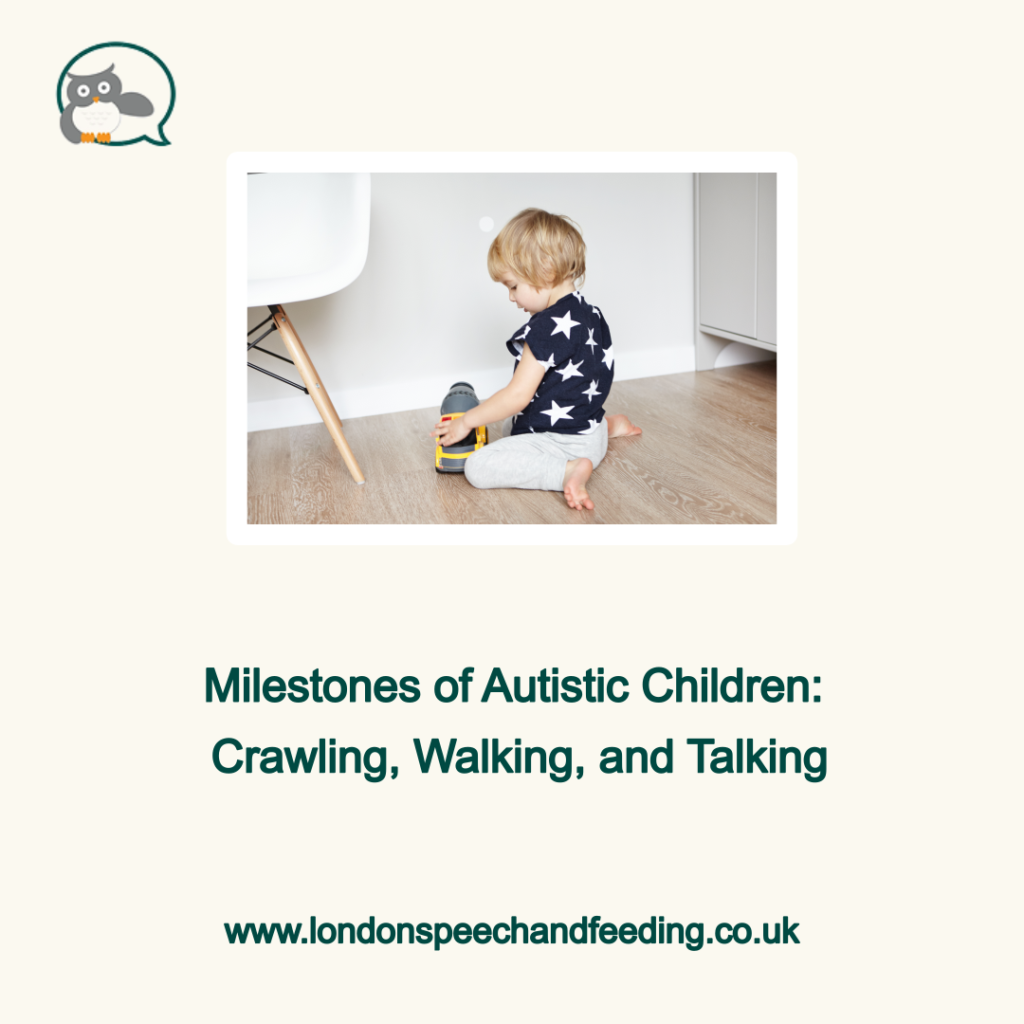
    Milestones of Autistic Children: Crawling, Walking, and Talking

    For all children every milestone achieved is a testament to the unique and intricate process unfolding within each young mind. For autistic children, this journey may present a distinct pattern, with some reaching developmental milestones like crawling, walking, and talking later than their neurotypical peers. Let’s have a look into the fascinating realm of Autism and explore why some autistic children might crawl, walk, and talk later, shedding light on the underlying factors contributing to this unique way of developing.

    1. Individual Pacing:

    Child development is not a one-size-fits-all journey. Each child, whether neurotypical or autistic, has a unique timeline for achieving milestones. Autistic children, like any other children, follow their own pacing. This individual rhythm might lead them to focus on one set of skills before they progress to others. Like some neurotypical children might focus on talking earlier than walking, autistic children might prioritise other areas before crawling or talking.

    2. Neurodevelopmental Complexity:

    The human brain is a remarkable entity, with a bewildering array of interconnected processes that lead to us achieving our developmental milestones. Autistic children often have variations in “neural wiring”, which can impact the balance between gross motor skills (crawling, walking) and fine motor skills. Speech and language acquisition falls under fine motor skills and may be momentarily disrupted due to the divergent neurological pathways at play in autism.

    2. Sensory Processing Differences:

    One of the hallmarks of autism is altered sensory processing. Autistic children often experience sensory stimuli differently than their neurotypical peers. This heightened or diminished sensitivity can influence a child’s desire or ability to engage in activities like crawling and walking. The sensation of movement while crawling or walking, for instance, might be overwhelming for some autistic children, causing them to either avoid or delay these activities.

    3. Visual-Spatial Abilities:

    Autistic children and adults frequently display excellent visual-spatial abilities. This strength might lead some children to focus more on activities that engage these skills, potentially delaying their engagement with activities like walking or talking. As they navigate their environment and process information visually, they might naturally invest more time in activities that stimulate this particular cognitive ability and strength.

    4. Communication Challenges:

    For many autistic children, speaking can be a really complex and difficult endeavour. Communication delays are a common feature of autism. This can affect both receptive and expressive language development. While some children might be physically capable of crawling or walking, they may not yet have the tools to communicate their desires and intentions. This leads to a temporary focus on non-speaking forms of expression. This does not mean that they do not communicate at all. But autistic individuals often start out using jargoning or echolalia as a form of communication as well as behaviours and physical forms of communication.

    5. Executive Functioning and Motor Skills:

    Executive functioning, or abilities for planning, organising, and carrying out tasks, can vary in autistic children. These skills are crucial for activities like crawling, walking, and talking, which need coordination and planning. About 40% of autistic persons have a motor planning difficulty.

    6. Intense Interests and Routines:

    Autistic children often develop intense interests in specific subjects, sometimes to the exclusion of other activities. These interests might become their primary mode of engagement. They might side-line milestones like crawling, walking, or talking. The mostly rigid adherence to routines and preferences might cause them to allocate more time to their preferred activities. This delays their engagement with other developmental tasks.

    How can Speech and Language Therapy help:

    Support and Intervention:

    Early intervention and regular Speech and Language Therapy play a pivotal role in the developmental journey of autistic children. Therapies tailored to individual needs can aid in bridging the gaps between milestones. Occupational therapy, for example, can help address sensory sensitivities and motor skill challenges that might impact crawling and walking. Speech therapy can help communication development, gradually bridging the gap between non-verbal expressions and spoken language.

    For example, we now know that echolalia or jargoning of longer phrases with intonation, repeating scripts from favourite tv shows or songs have many meanings and communicative functions. For example, a child who utters long strings of echolalic utterances, often difficult to understand, might want to do any one of the following:

    • Comment
    • greet
    • ask a question
    • make a request
    • express surprise
    • negate something.

    We now understand that the way to support a child with echolalia is to acknowledge all utterances and try and find out what the meaning is behind these scripts. This is very supportive. Over time it will lead a child to move on to understanding and saying more clear and self-generated language. For more information about this Natural Language Acquisition here are some other great websites for you to look at:

    Conclusion

    In conclusion, the journey of an autistic child’s development is a testament to the uniqueness and complexity of the human mind. The delays or differences in achieving milestones like crawling, walking, and talking can be attributed to a range of factors, including

    • neurodevelopmental intricacies,
    • sensory processing variations,
    • and communication challenges.

    It’s crucial to recognise that these delays are not indicative of a lack of potential, but rather a manifestation of the intricate interplay between an autistic child’s strengths and challenges. By embracing these differences and providing tailored support, we can help each autistic child unfold their potential at their own pace.

    Do get in touch if you would like to book an appointment where we can explore how to help your child develop and thrive

    Do get in touch if you would like to book an appointment where we can explore how to help your child develop and thrive


    Find a speech and language therapist for your child in London. Are you concerned about your child’s speech, feeding or communication skills and don’t know where to turn? Please contact me and we can discuss how I can help you or visit my services page.

    0
  • A day in my life as an Independent Speech and Language Therapist

    During the pandemic I wrote a blog on what my working day looked like. Now a good year has passed since coming back to some sort of normality and I thought I would update this ‘day in the life of an SLT’ as my working life has changed of course to reflect the ‘new normal’.

    I have become truly busy, perhaps busier than I have ever been to be honest. It’s probably mostly due to the fact that I do most of the aspects of my work myself — though I want to mention two invaluable people here without whom I could not function as well as I do: the excellent Nathalie Mahieu () helps me with my SEO, Insta posts and blog uploading and the wonderful Sue Bainbridge () makes sure that my accounts don’t get into trouble with His Majesty’s tax office.

    Attached to our role as Speech and Language Therapists is an arguably enormous amount of administration/paperwork and preparation required for each and every client. This needs to be factored in when deciding how many families I can realistically see each working day. For me it works out as typically 3–5 clients a day, Monday to Friday.

    So how does my day typically look? Each day varies a lot depending on what type of client I have, but on average it looks a bit like this:

    First thing in the morning — after having a coffee and a quick check-in with my besties on WhatsApp — I do my Buddhist chanting for about an hour. My Buddhist prayers are the base of all I do and get me connected to my higher purpose and how to create value with each activity and each person I see that day. It sets me up for the day, I keep in mind who is going to come and see me and how I can best help them.

    Next up, I do the daily ‘spring-clean’ of my therapy room (on all fours! no joke ???? those kids see every speck!), vacuum the floors, wipe down the toys with flash-wipes and tidy up all my boxes, making sure that the battery toys are working, and everything else is in place. On to the guest toilet, the hallway needs to be rid of all the men’s shoes and trainers and coats… It’s endless what needs tidying when you are living with three men… This takes about 45 minutes.

    An articulation activity – packaging practice into a little game

    Then I prep for all my clients that day. I have now got so much quicker about selecting therapy materials. For one thing I have purchased so many toys and materials over the past five years that I can literally now open a shop and need to consider building an extension! ???? The upside is that it is now very easy for me to select a good handful of toys or games for any one child, even at a minute’s notice. Though, on average, I spend about 30 minutes per child preparing activities.

    Hurrah, it’s 11 am and my first client of the day arrives and the fun begins.

    When they leave around an hour later, the cleaning and wiping down starts again, this time less extensively. I write up my notes and send homework whilst enjoying a cuppa.

    The next client comes at 12.30 pm and once they have left, floor cleaned, toys wiped, notes written it is time for a quick lunch. No more than half an hour usually.

    Afternoon clients tend to be one more little one (nursery age) at 2.15 pm and thereafter I see mostly older school children for a variety of reasons (mainly speech production but also some language-based activities). I tend to say farewell to my last client of the day around 6 pm. I spend another hour, sometimes more, on writing up notes, answering new enquiries, blogging and phone calls to keep my service fresh, inspirational and exciting.

    And then dinner and the rest of the day rushes by. I tend to finish my day with some more Buddhist chanting, not a lot, perhaps 10–20 minutes to reflect on what has gone well and what could have been better — re-determine to improve or make better as needed.

    Tele therapy activity using online materials plus a coreboard

    In terms of where I provide a service, I still do a good mix of online clients (tele-therapy) and in-person clients in my clinic, which I love. Occasionally, I visit children in their nursery or at home but this service is now only available for long-standing clients.

    Each client is hand-picked to make sure that we are a good fit: no one client gets the same treatment as another; each client is unique, we get to know one another well over the time we work together and they are always highly valued. That takes time and, in reality, each client gets about two hours of my time. That is the actual session plus all the preparation and aftercare, i.e., bespoke hand holding, tweaks, problem solving and reassurance in between sessions.

    I absolutely love this way of working and would not ever want to do anything else. Nearly three decades of working both in the NHS and in private practice, countless courses (continual professional development) have enabled me to flourish as a therapist and I know that I offer something special and very valuable to my clients.

    My unique way of working affords all my lovely clients the help they need to support their children to make progress; and it gives me the right balance of job satisfaction and work life balance for now. My lovely reviews and testimonials tell me that my clients appreciate my service and this at the end of the day is the most important.

    If you are interested in exploring Buddhism/buddhist chanting then check out this link (https://sgi-uk.org/), and feel free to contact me about that specifically, regardless of whether you want speech therapy. I am always happy to chat about Buddhism, it has been so enriching for the last 43 years of my life.

    If you need help with your child, please do not hesitate to contact me.


    Find a speech and language therapist for your child in London. Are you concerned about your child’s speech, feeding or communication skills and don’t know where to turn? Please contact me and we can discuss how I can help you or visit my services page.
    1
  • ·

    Discover how Attention Autism can support your Autistic child’s communication

    “I’ve got something in my bag, in my bag, in my bag,

    I’ve got something in my bag,

    what it is”

    You might be wondering why your Speech and Language Therapist is singing this song and then presenting items from a zipped-up bag. Let me take you through stage one of this evidence-based approach.

    There are many aims of ‘bucket or bag time’. During stage one, you are simply engaging your child’s attention (whilst also exposing them to language). It’s important to remember that you are not forcing your child to say or do anything. The idea is that the items in the bag or bucket ‘offers an irresistible invitation to learn’ (Gina Davies, 2020).

    You don’t need ‘special’ expensive toys. Use what you have at home. It might be that you have some bubbles, a wind-up toy. You might have some foil that you can roll up into a ball, or a balloon. Keep these items for ‘bucket time’. This means that your child is likely to be excited and motivated for the activity. The only stipulation is that these items must be highly motivating and must be the most exciting thing in the room. You’ll want to cover up any distractions.

    So, you have your items and your opaque zipped bag, next you’ll want to put the items into the bag ensuring the zip is closed. The zip is important as it increases suspense and excitement as your child cannot see inside. You can also comment when unzipping ‘open bag’ using the signs ‘open’ + ‘bag’ to support your child’s understanding. Your Speech and Language Therapist can help with any Makaton signs that are unknown. The idea of this activity is that the item isn’t touched by your child. This can seem a little odd or feel “mean” but there is a reason for this: we want our child to look at us as well as the object or toy. As soon as we allow our child to touch and play with that toy their attention will go to the toy alone and we won’t get JOINT attention or engagement. This is the reason why we SHOW interesting things for a brief moment and then put these items back into the bag or bucket and out comes the next item. If your child wants to grab the toy and gets upset, then they may not be quite ready for this approach.

    Next, we sing the song (as above) and unzip the bag taking out one of the items. The use of pausing is important. Pause after the song: does your child try to use gesture or sound? You can also use this opportunity to model short phrases, ideally one or two words such “it’s a spinner! Wow… so many colours”. After a couple of turns, repeat the process and pull out a different item. We tend not to sing the song each time for the next item. Just sing it at the beginning and then get on with producing the amazing, wonderful things in your bag. No hard and fast rules though, apart from “don’t let the child touch the toys”.

    The biggest factor here is that you and your child enjoy the activity together. Have lots of fun!!

    Keep up to date with our latest blogs to explore more stages of Attention Autism.

    If you need speech, language or communication support or advice, I am always here to help.


    Find a speech and language therapist for your child in London. Are you concerned about your child’s speech, feeding or communication skills and don’t know where to turn? Please contact me and we can discuss how I can help you or visit my services page.

    0