Autism – Benefits of Early Assessment and Intervention

| | |
I think my child might be autistic – how can we help?
Image by macrovector on Freepik

Consulting a Specialist Speech and Language Therapist can help you in several ways: assessment, informal and formal observation, discussion and advice, onward referrals, direct intervention, parent coaching, educational support and much more, all geared towards supporting you the parents, and helping your child to flourish and thrive.

First up, we can help you with assessment and advice: with a wealth of expertise in observing childrens’ play and communication, as well as knowledge of the latest research we can see a child’s strengths and areas of struggle very quickly indeed.

Within a short space of time, we can identify the areas we need to focus on and start guiding you towards helping your child to connect, respond, react and feel better.

Early detection is key

If autism is detected in infancy, then therapy can take full advantage of the brain’s plasticity. It is hard to diagnose Autism before 18 months but there are early signs we know to look out for. Let’s have a brief look at the sorts of things we look at.

The earliest signs of Autism involve more of an absence of typical behaviours and not the presence of atypical ones.

  • Often the earliest signs are that a baby is very quiet and undemanding. Some babies don’t respond to being cuddled or spoken to. Baby is being described as a ‘good baby, so quiet, no trouble at all’.
  • Baby is very object focused: he/she may look for long periods of time at a red spot/twinkly item further away, at the corner of the room for example.
  • Baby does not make eye contact: we can often see that a baby looks at your glasses for example instead of ‘connecting’ with your eyes.
  • At around 4 months we should see a baby copying adults’ facial expressions and some body movements, gestures and then increasingly cooing sounds we make; babies who were later diagnosed with autism were not seen to be doing this.
  • Baby does not respond with smiles by about 6 months.
  • By about 9 months, baby does not share sounds in a back-and-forth fashion.
  • By about 12 months baby does not respond/turn their heads when their name is called.
  • By around 16 months we have no spoken words; perhaps we hear sounds that sound like ‘speech’ but we cannot make out what the sounds are.
  • By about 24 months we see no meaningful two-word combinations that are self-generated by the toddler. We might see some copying of single words.

24 months plus:

  • Our child is not interested in other children or people and seems unaware of others in the same room/play area.
  • Our child prefers to play alone, and dislikes being touched, held or cuddled.
  • He/she does not share an interest or draw attention to their own achievements e.g., ‘daddy look I got a dog’.
  • We can see our child not being aware that others are talking to them.
  • We see very little creative pretend play.
  • In the nursery our child might be rough with other children, pushing, pinching or scratching, biting sometimes; or our child might simply not interact with others and be unable to sit in a circle when asked to.

What sort of speech and language difficulties might we see?

Our child might do any of the following:

  • have no speech at all, but uses body movements to request things, takes adults by the hand
  • repeat the same word or phrase over and over; sometimes straight away after we have said it or sometimes hours later
  • repeat phrases and songs from adverts or videos, nursery rhymes or what dad says every day when he gets back from work etc.
  • copy our way of intonation
  • not understand questions – and respond by repeating the question just asked:
    • adult: Do you want apple? child: do you want apple?
  • not understand directions or only high frequency directions in daily life
  • avoid eye contact or sometimes ‘stares’
  • lack of pointing or other gestures

Common behaviours:

  • Hand flapping
  • Rocking back-and-forth
  • Finger flicking or wriggling/moving
  • Lining up items/toys
  • Wheel spinning, spinning around self
  • Flicking lights on and off, or other switches
  • Running back-and-forth in the room, needing to touch each wall/door
  • Loud screaming when excited
  • Bashing ears when frustrated or excited
  • Atypical postures or walking, tip toeing, can be falling over easily, uncoordinated
  • Can be hyper sensitive to noises, smells, textures, foods, clothing, hair cutting, washing etc.
  • Being rigid and inflexible, needing to stick to routines, unable to transition into new environments
  • Food sensitivity, food avoidance, food phobias

I mentioned this to be a ‘brief’ look at the areas and it is: each topic is looked at very deeply and each area is multi-facetted therefore a diagnosis is rarely arrived at very quickly. We want to make sure we have covered all aspects and have got to know your child very well before coming to conclusions.

Early detection is key, because we want to start helping your child to make progress as quickly as is possible. If you feel /know that your child is delayed in their speech and language development and you would like a professional opinion then please do contact me, I look forward to supporting you. It is important to know at this point, that if your child only has one or two of the above aspects it may mean that your child is simply delayed for reasons other than Autism and if that is the case, we will be able to help you iron out a few areas of need so that your child can go on thriving.

If you need help with your child, please do not hesitate to contact me.


Find a speech and language therapist for your child in London. Are you concerned about your child’s speech, feeding or communication skills and don’t know where to turn? Please contact me and we can discuss how I can help you or visit my services page.
1

Similar Posts

  • · ·

    Chaining: A powerful tool for phonological development

    Understanding chaining

    Chaining is a therapeutic technique I like to use in my speech therapy work with children who have Childhood Apraxia of Speech (CAS) or phonological speech sound difficulties. It helps to break down a complex target behaviour into smaller, more manageable steps. By systematically teaching and reinforcing each step, I can help my students achieve their communication goals.

    There are two types of chaining: Forward and backward chaining

    Today I am going to show and talk about backward chaining. This technique involves starting with the last step and working backward to the first. This approach can be particularly effective for children with persistent speech sound difficulties where combining consonants into clusters, such as /BL/ or /FR/ or /SHR/ is very difficult.

    Backward chaining allows my student to experience immediate success and build his confidence.

    In my video I show you how I applied backward chaining to the words ‘Shriek’, ‘Shrub’, ‘Shrimp’ etc

    My student struggles with both the /SH/ and the /R/ sounds and we have been working on both sounds for some weeks now. He has mild Childhood Apraxia of Speech and he has difficulties with coordinating his tongue movements, breathing and using his jaw effectively to make words. His sound repertoire has grown a lot since we started working together last year. Today in this session I show you how we pulled both the sound /SH/ together with /REEK/ to make ‘SHRIEK’. I love using the pictures and therapy materials from Adventures in Speech Pathology.

    This is also part of the Complexity approach which I will explain in a separate blog post.

    • Step 1 (not shown in the video): I explain what the word means; I find that when my student understands what a word means he is much better at saying it. It increases his confidence and motivation to say a word that he knows the meaning of. Often this student does not tell me that he does not know what a word means, so I always remind myself to check that out first.
    • Step 2 (not shown in the video): We do a little rhyming game and think about what any one word rhymes with: ‘Shriek’ – ‘meek’, ‘weak’, ‘seek’.
    • Step 3: I show my student that there are two parts to this word /reek/ and the sound /SH/.
    • Step 3: We practise the easier part: /reek/ /reek/ /reek/.
    • Step 4: We add the /SH/ sound and pull it together to make our target word ‘Shriek’.

    /REEK/ /REEK/ /REEK/ + /SH/ = ‘SHRIEK’
    /RUB/ /RUB/ /RUB/ + /SH/ = ‘SHRUB’
    /RUG/ /RUG/ /RUG/ + /SH/ = ‘SHRUG’

    By breaking down the word into smaller, manageable steps, my student can focus on each syllable individually, get that right and then gradually build up to the full word. This approach can help to reduce frustration and increase motivation.

    Forward chaining

    Forward chaining is the same process but in reverse: we start with the front sound or syllable and work forward towards the next/last part of the word:

    /SH/ + /REEK/ = ‘SHRIEK’
    /SH/ + /RUB/ = ‘SHRUB’
    /SH/ + /RUG/ = ‘SHRUG’

    Benefits of chaining

    • Increased motivation: By starting with the last step, my student experiences success, which boosts his motivation to continue trying to say the word and trying other words.
    • Reduced frustration: Breaking down the target behaviour into smaller steps can make the task less overwhelming, reducing frustration and anxiety.
    • Improved confidence: As the little learner masters each of the step, his confidence and self-esteem increases. Again, this leads to increased motivation.
    • Faster learning: By focusing on the final step first, and practising lots of chaining (forward and backward), a student can quickly learn to generalise to other words.

    Backward chaining (and forward chaining) is a really great tool for teaching complex speech sounds and words to children with phonological disorders.

    Watch out for my next blog which is all about the complexity approach in Phonology.

    Do get in touch if your child has a speech sound disorder, I would love to help.

    Any questions or need help with supporting your little one’s language please contact me via my contact form, or you could also check out www.hanen.org for advice and lots of inspiration.

    Sonja McGeachie

    Early Intervention Speech and Language Therapist

    Feeding and Dysphagia (Swallowing) Specialist The London Speech and Feeding Practice

    The London Speech and Feeding Practice


    Find a speech and language therapist for your child in London. Are you concerned about your child’s speech, feeding or communication skills and don’t know where to turn? Please contact me and we can discuss how I can help you or visit my services page.

    1
  • Using AAC – Augmentative and Alternative Communication for non-verbal and early verbal children

    Using a Core Vocabulary Board

    Your Speech Therapist might have been advising you to introduce words to your child with the help of a CORE BOARD. What on earth is she talking about and why would we want to do this, I hear you think – and in fact this is what I get asked a lot, as I often do recommend using Core Boards.

    Core boards belong to the category of Augmentative and Alternative Communication (AAC ) and they can be really useful for:

    • Children or adults who cannot speak at all or who are very hard to understand.
    • Children who are slow to speak and have difficulty expressing themselves verbally, due to genetic conditions as Down Syndrome, Verbal dyspraxia, Autism or any other learning difficulty that means a child is slow to develop speech.

    Here is what a Core board might look like, in fact this is one that I love to use. It is made by Beautiful Speech Life, there are a ton of similar boards out there for free. I have also made my own, you can check it out on my Instagram feed.

    Using a Core Vocabulary Board

    What is Core Vocabulary/ Core words?

    Core vocabulary consists of the most common words used by children throughout a day. In 2003 Banajee and Dicarlo et al found that 50 % of pre-schoolers in their project used nine words consistently across their daily play and meal routines. These words are Core words and are typically the ones you can see on a board, like the one above.

    How To Use It

    Adults always first need to consistently model and show their child how to use a board. This is key! For example: Adult can point to “YOU” “WANT” ‘MORE” and then point to the cup of Water on the counter. Child could then reply either by shaking his/her head and/or pointing to “NOT” which also stands for “NO”. Then adult can point to “NOT” “MORE” and do an OK sign as well. Eventually Child can initiate a request and point to “I” “ WANT” “MORE” and then point to the cup on the counter.

    This is not as cumbersome or limited as it first sounds or appears. Here’s why: As adult you can talk normally and, of course, many words you are using will not be on this board. But some will be, and you will be surprised how many you can find when you start using it. So you could say quite normally: Hey lovely (name of your child) would YOU LIKE some MORE water? The words in capital are on the board which you can point to as you speak normally. Basically, you are showing/saying to your child: “We can speak and these are the pictures we can use to help us; We call this TOTAL COMMUNICATION, as communication is so much more than just words! Great communication can be silent, where we use our facial expression, our smile, our eyes, our hand gestures, body movements and yes, of course, words. But when words fail us, these boards are so helpful.

    This still does not answer your original question of: why would I want to do this, I want my child to talk!? You are a SPEECH Therapist, please help my child TALK, not point to pictures, that is not what I had in mind.

    Let Me Explain

    When speech is difficult for a child it doesn’t mean that there is nothing to talk about! Of course, we want all our children and all people to speak because it is the easiest and most effective way of communicating, no doubt! However, sometimes this is very hard for some children and whilst we are always working towards speech where possible, we also want to make sure that whilst figuring out how to speak, your child has a MEANS TO COMMUNICATE. Using a board like this might well be a temporary strategy but whilst you are using it and working on their speech you will find a reduction in tantrums and frustration as you child is able to express themselves more effectively.

    Often we find that as soon as we offer a CORE VOCABULARY like the above sample a child who has had no or very few words suddenly blossoms and starts to point to new words on the board and starts to PRACTICE USING THESE WORDS!! Practice makes perfect, right? Yes it totally does! There is lots of evidence that tells us that using Core Vocabulary Boards ENHANCE AND SUPPORT SPEECH PRODUCTION AND NOT HINDER IT. Using a board like this will only ever be helpful to your child and will never make your child “lazy” – too lazy to speak? NO SUCH THING!

    Here is what one of my parents says about the core board we use with her little boy:

    “the board has been a game changer, my son is a visual learner so it really helps to have the board as he associates communication so much easier this way. We have incorporated his twin sister who models it’s use and have definitely seen improvement in speech through its support and his frustration around being unable to verbally communicate at times has definitely lessened”

    K Connolly, Mother of Tom (aged 3.5 years).

    Reading and hearing this makes me so happy!

    In addition to general core board above I also sometimes use a Core Board that is specific to an activity, such as for example BLOWING BUBBLES. Below is an example of such a board, which you can use very nicely during a bubble blowing activity and sometimes it is a nice place to start for newcomers, this can be an easy introduction. You can download this and many similar boards on www.widgit.com for free!

    Using a Core Vocabulary Board

    There is so much more to say about AAC and using Coreboards, visit my Instagram you can find a bit more information on how I use them.


    Find a speech and language therapist for your child in London. Are you concerned about your child’s speech, feeding or communication skills and don’t know where to turn? Please contact me and we can discuss how I can help you or visit my services page.

  • Help! My child has a lisp. What can we do about it?

    What is a LISP?

    There are different types of LISPS. Let me explain:

    A lisp is the difficulty making a clear ‘S’ and ‘Z’. Other sounds can also be affected by the tongue protruding too far forward and touching the upper teeth or the upper lip even. ‘T’ and ‘D’ can be produced with ‘too much tongue at the front’ and this can also have an impact on ‘CH’ and often also ‘SH’.

    1. Interdental lisp

    Protruding the tongue between the front teeth while attempting ‘S’ or ‘Z’ is referred to as interdental lisp; it can make the speech sound ‘muffled’ or ‘hissy’. Often, we associate a lisp with the person sounding a bit immature. The good news is that this type of lisp is the easiest to correct and, in my practice. I have a 100% success rate with this type of lisp.

    1. Lateral lisp

    In a lateral lisp the person produces the ‘S’ and ‘Z’ sounds with the air escaping over the sides of the tongue. This renders the ‘S’ as sounding ‘slushy’ or ‘wet’. This type of lisp is a bit harder to correct than the interdental lisp. In my experience this can be fixed but it might need a bit longer, more intensive therapy than the interdental lisp.

    1. Palatal lisp

    With a palatal lisp the ‘S’ sound is attempted with the tongue touching the palate, much further back than it should be. The ‘S’ sounds ‘windy’ and ‘hissy’. This is a quite rare lisp production but it is also not difficult to correct.

    These types of speech difficulties come under the category of ‘speech delay of unknown origin’ and may persist into adolescence and adulthood as ‘residual errors‘.

    Some thoughts on Treatment in general:

    Lisps can be treated successfully by a Speech and Language Therapist. However, for the treatment to work well, a student needs to be able to cooperate and want to improve his or her speech. Lisp remediation entails a fair amount of repetitive work and very young children or unmotivated older children don’t make the best candidates for treatment for this reason. Often students present with other speech, language or social communication difficulties and here the lisp might not be the priority for treating. For example, it might be that due to a student’s Attention Deficit Disorder they are simply not able to focus on speech practice in their daily life.

    When should treatment of lisp begin?

    Waiting well past 4½ years is not advisable as the longer we wait and do nothing the stronger engrained the erroneous tongue/speech habit will become. The ‘right’ age for therapy for one child may be different from the ‘right’ age for another child even within the same family. So do make an appointment with a speech and language therapist to assess and see whether your child might be ready to start therapy.

    Do lots of children lisp—is it normal?

    Until the age of about 4–4.5 years old it can be a perfectly normal developmental phase for some children to have the interdental lisp. But when we see and hear a lateral or palatal lisp we ought to act and see a speech and language therapist for sure.

    After the age of 4.5 or 5 years old most speech therapists would agree on at least having a look to see if treatment could be started. The longer we wait the harder it is to retrain the brain pathways to adopt new speech habits.

    What happens during the first Speech and Language Consultation?

    The first consultation takes about an hour and involves screening relevant areas of communicative function. We take a detailed history, examine the anatomy of the child’s mouth and tongue movements. We check for tongue tie, teeth formation, palate structure and function, as well as swallowing patterns.

    Then we begin straight away to try and see if any of the alveolar sounds (T/D/L/N) can be produced correctly with the right tongue placement as that would be the starting point from where to shape a good, clear ‘S’ sound.

    The first consultation usually ends with home practice being given, explained to parents and another appointment being made for follow up.

    Therapy – what does a session look like?

    Each therapy session consists of:

    1. Listening to sounds, discriminating sounds, identifying sounds, listening to rhyming sounds, sound awareness. We call this Auditory discrimination of single sounds: can the student hear the difference between two words that are the same apart from the first sound: ‘sing’ and ‘thing’ or ‘sigh’ and ‘thigh’?
    2. Sound production: using a variety of different prompts and cues we will teach how to physically make the new sound. Often, we work on making a NEW sound, instead of correcting the OLD one. We work on imitation of single sounds then gradually we try and make new sounds in short words, then longer words and then phrases and sentences.
    3. Games! We play games and try and have fun in between listening and producing our new sounds to help students stay motivated and even enjoy the therapy session and process.

    How long does it take to ‘fix up’ a lisp?

    It tends to take about one term with weekly sessions to help a student make good ‘S’ sounds in phrases and sentences. If the student can do the home practice every day in between the weekly sessions, then in most cases I am able to pronounce the lisp as ‘fixed’ after about one term.

    After that the student needs to practise, practise, practise, at home and in daily life to keep reminding themselves of their new skills and their new sound production.

    It is a matter of reminding and wanting to get it right. Occasionally a student returns to me for another term of simply practising their skills together with me as they are finding it hard for any number of reasons to practise at home. But generally, 8/10 students will be fine after some 12–13 sessions and their speech will be perceived as perfectly typical by family and friends.

    If your child has a lisp or any other speech error, please do not hesitate to contact me.


    Find a speech and language therapist for your child in London. Are you concerned about your child’s speech, feeding or communication skills and don’t know where to turn? Please contact me and we can discuss how I can help you or visit my services page.

    0
  • · · ·

    The joy of container play: Exploring play development and understanding of how things work

    Have you heard the term ‘Container play’? I use this very often with children in my sessions as it is so versatile and an enjoyable activity that can be done in parallel with a child or together. Container play is a powerful tool for fostering development in young children, especially those with developmental delays. This seemingly mundane activity provides a rich environment for sensory exploration, motor skill development, and cognitive growth.

    What is container play?

    Container play involves children interacting with various containers—boxes, buckets, bowls, cups, various bags, etc.—and filling, emptying, and transferring objects within and between them. Objects can include literally anything: small beads, bead chains, table tennis balls, wooden pegs, dinosaurs or any other little person toy, blocks of varying sizes, sand, water, or any other safe material. Larger containers obviously take larger items: socks, stuffed animals, bigger balls, bigger blocks etc really the choices are endless.

    Benefits for children with developmental delays:

    Sensory exploration:

    • Touch: Children explore different textures and temperatures of containers and objects.
    • Sight: They observe how objects look inside and outside the containers, how light reflects off them, and how colours change.
    • Sound: They listen to the sounds of objects clinking, rattling, and splashing.
    • Proprioception: Filling and emptying containers helps develop body awareness and spatial awareness.

    For neurodivergent children who might have sensory regulation difficulties, consider the following adaptions to accommodate your child’s sensory needs:

    • Over-stimulation: For children who are easily overstimulated, start with simple setups using a limited number of containers and objects. Gradually increase the complexity as they tolerate it.
    • Under-stimulation: For children who seek sensory input, provide a variety of textures and materials, such as sand, water, slime, or beans.
    • Temperature: Offer a variety of temperature options. Some children may enjoy warm water or cool sand.
    • Lighting: Adjust the lighting to create a calming or stimulating environment.
    • Focus on one sense at a time: Initially, focus on one sensory aspect, such as the feel of sand or the sound of water.
    • Weighted containers: Use heavy containers filled with rice or beans to provide deep pressure input.
    • Fidget toys: Incorporate fidget toys into the activity to provide sensory input and help with self-regulation.
    • Tactile exploration: Encourage exploration of different textures using objects with varying surfaces.

    Fine motor skill development:

    • Hand-eye coordination: Scooping, pouring, and transferring objects require precise hand-eye coordination.
    • Pincer grasp: Picking up small objects helps develop fine motor skills like the pincer grasp.
    • Strength and dexterity: Manipulating containers and objects strengthens hand muscles and improves dexterity. Opening and closing containers can be a huge area of interest; how does the top screw back on, or off?

    Cognitive development:

    • Cause and effect: Children learn that their actions (e.g., pouring water or sand) have consequences (e.g., the water spills).
    • Spatial awareness: They develop an understanding of concepts like inside, outside, full, empty, and over/under; also how big is the vessel and how much goes in before it’s full or spills over. How small is the vessel opening and what do I need to do to get the beads into the container.
    • Problem-solving: Children learn to solve problems, such as how to get an object out of a narrow container or how to transfer water without spilling.

    Social and emotional development:

    • Communication: Container play can encourage communication as children interact with others, sharing toys and commenting on their actions. Asking for help to open and close a container is often a great opportunity to practise ‘help me’ or ‘open it’
    • Turn-taking: Sharing containers and materials helps children learn to take turns and cooperate.
    • Sensory regulation: For children with sensory sensitivities, container play can be a calming and self-regulating activity.

    Tips for engaging children in container play:

    • Create a safe and inviting environment. A shower curtain on the floor makes things easier for tidy up afterwards. And it allows for spillages.
    • Provide a variety of containers: Use different sizes, shapes, and materials. Use containers that are visually interesting and pleasing, perhaps a festive biscuit tin, or a tin that looks like train engine. Use see-through containers at first which make the filling and emptying more obvious. This is important for children who have no previous experience with this type of play and need to ‘warm up’ to it. Once a child loves and is used to container play you can go wild with all types of containers.
    • Offer a variety of objects: Include balls, blocks, sand, water, and other age-appropriate materials.
    • Join in the fun! Start off the process, show your child what the joy of the activity is for yourself, how fun it is to fill and empty containers, provide enough containers for your child to start playing alongside you, and comment on their actions.
    • Follow your child’s lead: Allow them to explore and experiment at their own pace.
    • Adapt activities: Adjust the level of challenge based on your child’s abilities and interests.

    Container play is a simple yet powerful tool that can support the overall development of young children, especially those with developmental delays. By providing a rich and engaging sensory experience, container play can help children build essential skills in motor, cognitive, social, and emotional domains.

    If you have any questions or would like to have more in-depths demonstration of this or other play styles for your child please contact me.

    I look forward to hearing from you.

    Sonja McGeachie

    Early Intervention Speech and Language Therapist

    Feeding and Dysphagia (Swallowing) Specialist The London Speech and Feeding Practice

    The London Speech and Feeding Practice


    Find a speech and language therapist for your child in London. Are you concerned about your child’s speech, feeding or communication skills and don’t know where to turn? Please contact me and we can discuss how I can help you or visit my services page.

    1
  • · ·

    Why pointing matters: Unpacking the power of this simple gesture

    As a speech and language therapist, I’m often asked about the significance of seemingly simple gestures in child development. One question that comes up frequently is, ‘Why is pointing so important?’ It might seem like a trivial action, but pointing is a powerful communication tool and a critical milestone in a child’s development.

    Why is pointing so important?

    Let’s delve into the theory behind why pointing matters:

    1. Pointing as pre verbal communication:

    Before children can use words, they use gestures to communicate their needs and interests. Pointing is one of the earliest and most important gestures. It allows children to:

    • Request: ‘I want that!’
    • Protest: ‘No, not that!’
    • Direct attention: ‘Look at that!’
    • Share interest: ‘Wow, cool!’

    2. Pointing and language development:

    Pointing is not just about communicating in the here and now; it also plays a crucial role in language development. Research shows that:

    • Early pointing predicts later language skills: Children who point more often tend to have larger vocabularies and better grammar later on.
    • Pointing helps children learn new words: When children point at something, adults tend to label it, providing valuable language input.
    • Pointing supports joint attention: Joint attention, or the shared focus of two individuals on an object or event, is essential for language learning. Pointing helps establish joint attention, creating opportunities for communication and learning.

    3. Pointing and social-emotional development:

    Pointing is not just about language; it’s also about social interaction. It allows children to:

    • Engage with others: Pointing invites others to share their focus and participate in their world.
    • Express emotions: Pointing can convey excitement, curiosity, or concern.
    • Develop social understanding: By observing how others respond to their pointing, children learn about social cues and communication.

    4. Pointing and cognitive development:

    Pointing is linked to cognitive skills, such as:

    • Understanding object permanence: The ability to know that objects exist even when they are out of sight.
    • Categorisation: The ability to group similar objects together.
    • Problem-solving: Pointing can be used to ask for help or to indicate a problem.

    5. Types of Pointing:

    It’s important to note that there are different types of pointing, each with its own significance:

    • Imperative pointing: To request something.
    • Declarative pointing: To share interest or direct attention.
    • Informative pointing: To provide information.

    If you have concerns about your child’s pointing or overall communication development, don’t hesitate to seek professional guidance from a speech-language therapist. Early intervention can make a significant difference in supporting your child’s communication journey.

    How can we create opportunities for pointing?

    • ‘Where’s the…?’ games:
      • Play games like ‘Where’s the doggy?’ or ‘Where’s the ball?’ and encourage your toddler to point to the object.
      • Start with familiar objects and gradually introduce new ones.
    • Reading together:
      • When reading picture books, ask your toddler to point to specific objects or characters on the page.
      • Use phrases like, ‘Can you point to the puppy?’
    • Everyday activities:
      • During daily routines, ask your toddler to point to things they want or need.
      • For example, ‘Do you want the apple or the banana?’
      • When walking outside say ‘LOOK’ and encourage pointing.
    • Use of toys:
      • Use toys that have buttons or points of interest that when pressed make a noise. Encourage your toddler to point to the area that makes the noise.
      • Use toys that have many different parts, and ask the toddler to point to a specific part.

    Model pointing:

    • Point yourself:
      • When you see something interesting, point to it and say the name of the object.
      • For example, ‘Look! A bird!’
    • Point to show choices:
      • When offering choices, point to each item as you name it.
      • For example, ‘Do you want the blue cup or the red cup?’ (Point to each cup).
    • Point to indicate direction:
      • When giving directions, point in the direction you want your toddler to go.
      • For example, ‘Let’s go that way!’ (Point).

    Make it rewarding:

    • Respond to pointing:
      • When your toddler points, immediately respond to their communication.
      • Give them the object they want, or acknowledge what they are pointing at.
    • Use positive reinforcement:
      • Praise and encourage your toddler when they point.
      • Say things like, ‘Good pointing!’ or ‘You showed me the car!’
    • Show excitement:
      • When they point to something, show excitement, this will encourage them to point again.

    Use specific techniques:

    • Use gestures and verbal cues:
      • Combine pointing with verbal cues and other gestures.
      • For example, say ‘Look!’ while pointing and nodding your head.
    • Simplify the environment:
      • Reduce distractions to help your toddler focus on the object you want them to point to.
    • Use exaggerated movements:
      • Use large, exaggerated pointing movements to draw your toddler’s attention.

    Consider developmental factors:

    • Age-appropriate expectations:
      • Remember that pointing develops at different rates for different children.
      • Be patient and supportive.
    • Underlying issues:
      • If your toddler is not pointing by 18 months, or if you have any concerns about their development, consult with a speech and language therapist.
      • There may be underlying sensory or motor issues.

    Key points:

    • Consistency is key. Practise these strategies regularly.
    • Make it fun and engaging for your toddler.
    • Celebrate every success, no matter how small.
    • If you have any concerns about your child’s development, contact your local health services.

    Great toys and items for pointing

    1. Interactive books:

    • Touch-and-feel books: Books with different textures, flaps to lift, and sounds encourage interaction and pointing. ‘Where’s the…?’ questions prompt pointing to specific features.
    • Books with simple pictures: Clear, uncluttered pictures make it easier for toddlers to focus and point to objects or characters.

    2. Cause-and-effect toys:

    • Activity cubes: These often have buttons, dials, and levers that produce sounds or actions when manipulated, prompting pointing and exploration.
    • Pop-up toys: Toys where figures pop up or things happen when a button is pressed encourage anticipation and pointing to the action.
    • Simple musical instruments: A toy piano, drum, or xylophone encourages pointing to the keys/surfaces to make sounds.

    3. Toys with parts to manipulate:

    • Shape sorters: Encourage pointing to the shapes and the matching holes.
    • Stacking cups or rings: Nesting cups or stacking rings invite pointing to select the correct size or order.
    • Puzzles with knobs: Simple puzzles with large knobs are easier for toddlers to grasp and point to the pieces.

    4. Toys that encourage joint attention:

    • Bubbles: Blowing bubbles and following them with your eyes and pointing encourages joint attention (shared focus).
    • Balls: Rolling a ball back and forth and pointing to where it’s going can promote joint attention and turn-taking.
    • Wind-Up Toys: Wind-up toys that move across the floor can be exciting to follow with pointing.

    5. Pretend play toys:

    • Toy telephones: Encourage pointing to the buttons and pretending to dial.
    • Dolls and stuffed animals: Pointing to the doll’s eyes, nose, mouth, etc., or asking the child to point to these features on themselves.
    • Toy food and dishes: Pretend play with food and dishes can involve pointing to request items or indicate actions (e.g., ‘Can I have the apple?’).

    Tips for using toys to encourage pointing:

    • Get involved: Play alongside your toddler, modelling pointing and using language to describe what you’re doing.
    • Follow their lead: Observe what your child is interested in and use that to encourage pointing.
    • Limit distractions: Reduce background noise and visual clutter to help your child focus.
    • Use gestures and words: Combine pointing with words and other gestures (e.g., ‘Look!’ while pointing).
    • Be patient and positive: Celebrate all attempts at pointing and provide lots of encouragement.

    Remember, the most important factor is the interaction you have with your child while playing. Use these toys as tools to create opportunities for communication and joint attention, and your toddler will be well on their way to mastering pointing!

    Get in touch with me via my contact form if you need support

    Sonja McGeachie

    Early Intervention Speech and Language Therapist

    Feeding and Dysphagia (Swallowing) Specialist The London Speech and Feeding Practice

    The London Speech and Feeding Practice


    Find a speech and language therapist for your child in London. Are you concerned about your child’s speech, feeding or communication skills and don’t know where to turn? Please contact me and we can discuss how I can help you or visit my services page.

    1
  • ·

    How to use Attention Autism to develop language and communication

    Now you’ve read Attention Autism (part one), you are familiar with the concept of ‘bucket time’ and the benefits it has to offer your child. It’s time to explore all the different stages. In sessions, it can be noisy and with so much to take in, you may want something to refer to. If you’re in need of a helping hand or memory jogger for stage two, read on…

    Knowing what stage your child is working at is vital. Every stage has different aims to develop and enhance functional communication. So being familiar with your child’s goals ensures you can continue to practise at home. If you’re unsure of their goals, please ask your Speech and Language Therapist.

    With all speech, language and communication goals, the aim is always to generalise skills from therapy settings to home and nursery or school life. This generalisation period will take time. Please try to stick with the plan. You will experience the benefits for your child, and it’ll make family life a little easier.

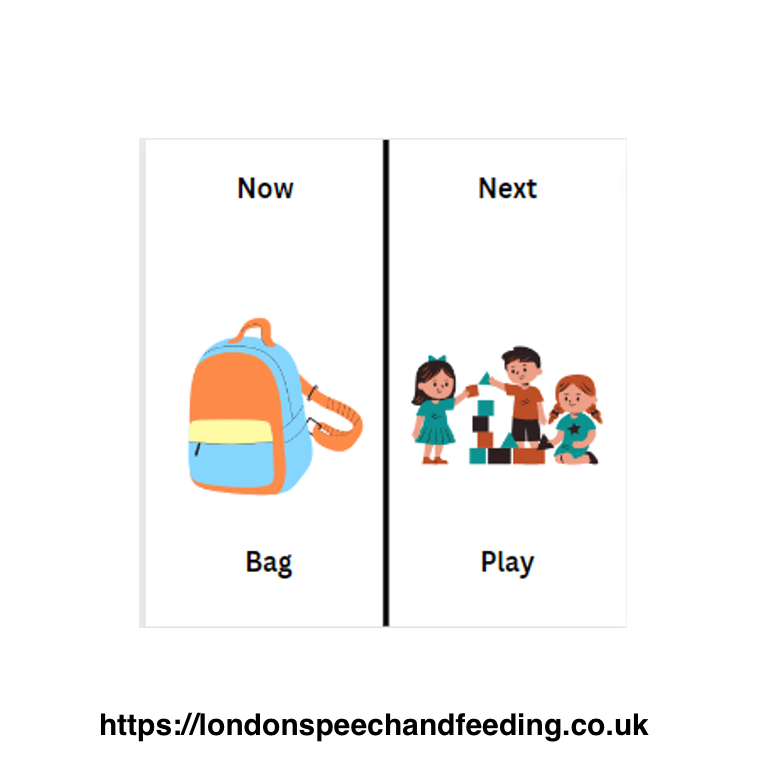
    You may remember that Autistic children thrive on visuals. Let’s use their strengths to support their communication needs. It is a good idea at the start of the activity to have a visual for what’s happening now and what will happen next. If you’re anything like me, you’ll grab a pen and paper or a whiteboard and whiteboard pen, and will doodle away! You don’t need fancy photos.

    On the left is a bag with Now written above it and Bag below. On the right are three children playing with Net written above and Play written below.

    The attention builder

    Stage two of the Attention Autism approach is called “the attention builder”. The clue is in the name, your child’s goal is to keep focused on the activity for a longer period. The duration will be different for every child, but it’s useful to time their attention, so you can report progress back to your therapist.

    Parents are often worried about doing something wrong. If it all goes a bit pear-shaped or not as you expected, don’t panic! This is the time to ask yourself, did my child have fun? Did they engage in the activity? It’s very helpful to reflect on the experience. What could you do that would make the activity easier for your child to access? (For example, did you set up the activity before your child entered the room? This would allow for a smoother session, so that waiting time was minimal.)

    Three ideas for stage two activities

    There are so many ideas out there, which at times can feel overwhelming. I’m always looking for the easiest options to present to you to reduce overwhelm and allow it to feel manageable.

    Remember this is about having fun. Your child’s communication will benefit from you relaxing and having this structured approach.

    Here are our three top ideas for stage two attention Autism activities:

    1. Flour castles

    You’ll need:

    • Container, cup or glass
    • Flour
    • Sheet (for the table/floor) (optional)

    This is a fun-filled activity to try. But it can get a little messy!

    Fill a small glass, cup or container with flour and flip the cup over to build flour castles. It’s great to engage your child especially with the “Splat” at the end.

    2. Paint balls

    Another activity which is a little bit cleaner is ‘Paint balls’.

    You’ll need:

    • Tray, container
    • Paint
    • Rubber balls or marbles
    • Paper (optional)

    First dip the marbles into the paint, then drop into the container and roll it around to make a pattern. You could always make a pattern on some paper.

    I love to use everyday objects in therapy, so when I came across this next idea, it was added to the list. It’s simple, effective, not to mention clean!

    3. Skittles

    You’ll need:

    • A packet of skittles
    • Warm water
    • Plate

    You’ll need to create a circle of skittles around the edge of the plate. Then add small amounts of warm water to the plate and watch the rainbow of colours appear.

    These activities offer a sequence to build and sustain your child’s attention. Remember the key is to have fun. Create meaningful interactions that your child cannot miss! If they can learn to hold their attention, they can learn to use functional skills.

    Now you’ve got ideas for stage two activities. Go ahead and carry them out.

    Have fun!

    If you need speech, language or communication support or advice, I am always here to help.


    Find a speech and language therapist for your child in London. Are you concerned about your child’s speech, feeding or communication skills and don’t know where to turn? Please contact me and we can discuss how I can help you or visit my services page.

    0