My baby isn’t babbling and developing speech – what can I do to support?
While every baby develops at their own pace, if your child isn’t babbling by nine months, it’s worth seeking help from an Early Intervention Health Professional, such as a doctor and a speech therapist. Don’t panic! There are many reasons for delayed babbling, and early intervention is key.
In the meantime, it is highly recommended that we talk, sing, and read to our baby often. Exaggerate sounds and expressions, and respond to their coos and smiles. This playful interaction helps stimulate their communication skills.
Below are some tips and tricks from my experience of working with babies and toddlers who need a little bit of help and support to develop.
The benefits of imitating your baby
Copying your baby’s sounds and gestures isn’t just silly fun, it’s a powerful learning tool! By mimicking their babbles and actions, you activate “mirror neurons” in their brain that help them connect sounds with meaning. This playful back-and-forth teaches turn-taking, a foundation for conversation. Plus, it encourages them to copy you, building their own language skills and social interaction abilities.
This is a nice clip on youtube showing how copying/imitating your baby looks like:
Here are some fun ways to imitate your baby:
Matchmaker: Grab two of the same, or two similar toys your child loves, like rainmakers or shakers. Give one to your baby and keep the other for yourself. When your child plays with his/her toy, mirror his/her actions with yours! This creates a fun, interactive game.
Face Time: Get down to your baby’s level, sitting opposite him/her on the floor or kneeling. This makes eye contact easy and encourages him/her to look at you during your playful imitation.
Be the Funniest You: Go all out with silly faces, exaggerated sounds, and big gestures. The goal is to capture your baby’s attention and make you irresistible to watch. This playful energy encourages him/her to interact and potentially imitate you back!
By incorporating these tips, you can turn imitation into a fun and engaging way to boost your baby’s communication skills. I have seen this happen numerous times over the past decades. It is very powerful, go ahead and try it! You cannot be silly and goofy enough!
Did you know that speech and language development starts with how we talk to our babies?
Adults naturally use a special way of speaking called motherese. It involves a higher pitch, slower pace, and exaggerated sounds compared to regular conversation. Sentences are simpler, with shorter words and repetition. This grabs babies’ attention, helps them distinguish sounds, and reinforces word meaning.
Imitation is a key part of motherese. We wait for our baby to make a sound or gesture, then playfully imitate it with exaggeration. Babies notice this right away and often respond with more vocalisations, creating a mini conversation. This back-and-forth teaches turn-taking, a foundation for future conversations.
By responding warmly and engaging in these playful interactions, we encourage our babies to keep exploring the world of communication. Talking, singing, reading and, of course, imitating, these simple actions can have a big impact on a baby’s language development.
Once your conversation is underway then try and keep it going for as long as possible. It’s a beautiful dance of turn-taking, even without words!
A last word on oxytocin
There’s evidence suggesting early non-verbal communication with your baby can increase a mother’s oxytocin levels, often called the ‘love hormone’. This hormone plays a key role in bonding and social connection. Positive interactions, touch, and stress reduction all contribute to oxytocin release, strengthening the mother–baby bond.
For parents of babies with extra needs
The stress of caring for a child with medical needs or developmental delays can be difficult. Stress can lower oxytocin levels, creating a cycle of sadness for both parent and child.
Breaking the cycle:
Knowledge is Power: Understanding the importance of communication can empower parents.
Seek Support: Speech therapists and other healthcare professionals can provide valuable guidance on communication strategies.
Start Small, Celebrate Big: Even small interactions can boost oxytocin. Focus on playful imitation and positive reinforcement. Remember, friends, family and healthcare professionals are there to encourage you.
This approach can help reverse the negative cycle and create a more positive and connected relationship between parent and child.
Feeding and Dysphagia (Swallowing) Specialist The London Speech and Feeding Practice
The London Speech and Feeding Practice
Find a speech and language therapist for your child in London. Are you concerned about your child’s speech, feeding or communication skills and don’t know where to turn? Please contact me and we can discuss how I can help you or visit my services page.
That adorable string of ‘ba-ba-ga-ga-ma-ma’ might sound like baby gibberish, but it’s actually a crucial milestone in your little one’s language development. Babbling or babble, as we call it, is far more than just cute baby noises. It’s a sequence of sounds that lays the foundation for future communication.
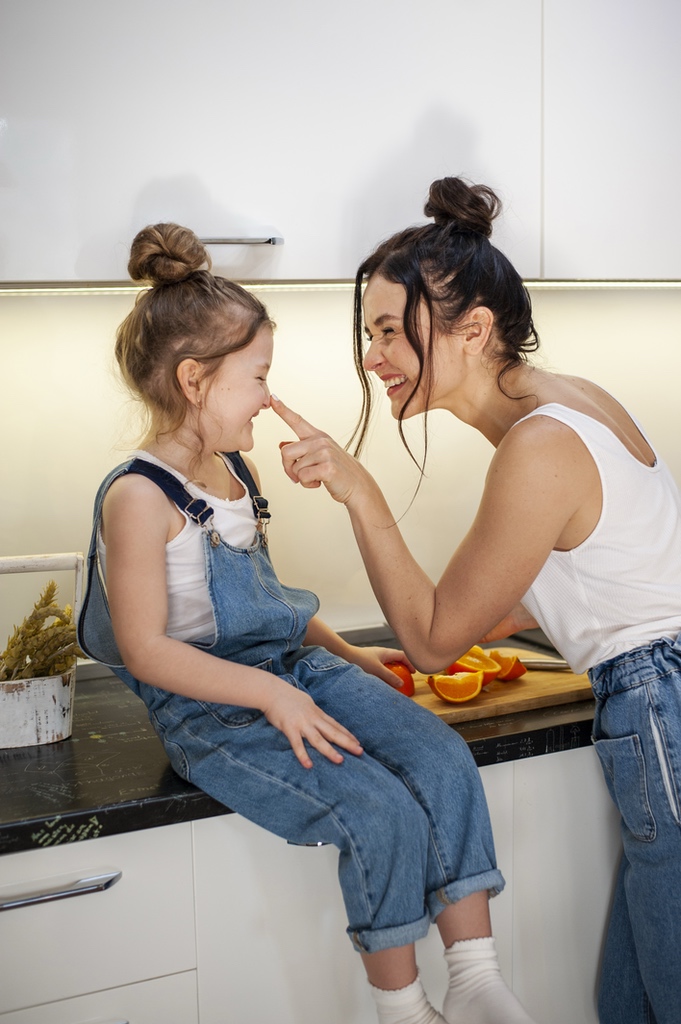
Image by freepik
What is babbling?
Babbling typically begins around six months of age, though the timing can vary slightly from baby to baby. It involves your baby experimenting with different sounds, stringing together consonants and vowels. You might hear them repeating sounds like:
‘Ba-ba’
‘Da-da’
‘Ma-ma’
‘Ga-ga’
As they progress, the babbling becomes more complex, with variations in pitch, rhythm, and intonation. It might even sound like they’re having a conversation with you!
Why is babbling so important?
Laying the groundwork for speech: Babbling is like a vocal workout for your baby. By practising these sounds, they’re strengthening the muscles in their mouth, tongue, and vocal cords that are essential for speech.
Developing phonological skills: Through babbling, babies begin to understand the sound patterns of their native language. They’re learning which sounds go together and how they’re used.
Enhancing social interaction: Babbling is a social activity. Babies often babble back and forth with their caregivers, which helps them learn about the give-and-take of communication.
Cognitive development: The act of babbling requires babies to use their brains in new ways. They’re learning to control their vocalisations, pay attention to the sounds they’re making, and connect those sounds to the responses they receive from others.
How can you encourage babbling?
Talk to your baby: Even though they can’t understand your words yet, talking to your baby exposes them to language and encourages them to respond with their own vocalisations.
Imitate their sounds: When your baby babbles, imitate them! This shows them that you’re paying attention and encourages them to keep ‘talking.’
Respond to their babbling: Treat your baby’s babbling as if it’s a real conversation. Respond with words, smiles, and gestures.
Play sound games: Make different sounds for your baby and encourage them to imitate you. This could include animal sounds, silly noises, or simple words.
Read to your baby: Even before they can understand the words, reading to your baby exposes them to the rhythm and sounds of language.
Sing songs: Singing is a fun and engaging way to introduce your baby to new sounds and words.
Use mirrors: Babies often enjoy watching themselves make sounds in a mirror.
Tactile stimulation: Gentle massage around the mouth and face can increase oral awareness and encourage vocalisations.
Vary textures: Offer different textured teethers.
Read books with sound effects: Choose books with animal sounds or other engaging noises.
Blow bubbles: The act of blowing and popping bubbles can encourage vocalisations.
Use visual aids: Show pictures of objects and say their names, emphasising the consonant sounds.
Use exaggerated facial expressions: When you make sounds, exaggerate your mouth movements to help your baby see how sounds are made.
Increase joint attention: Follow the child’s gaze and point to objects that they are looking at and say the name of the object.
When to seek help
If you notice that your baby is not babbling by eight months, it’s a good idea to talk to your speech and language therapist. You might also notice a lack of variation in tone when your child is making sounds, is your baby sounding a little ‘flat’ or monotonous? While every child develops at their own pace, a lack of babbling can sometimes indicate a developmental delay or hearing issue.
Remember, babbling is a gift. So, enjoy those precious moments of ‘baby talk’ and take comfort in knowing that your little one is on the path to becoming a chatterbox!
Do get in touch via my contact form if you are concerned about your child’s development or if you simply want some reassurance that your baby is developing well. We will be delighted to arrange a screening appointment for you and give you support and reassurance.
Sonja McGeachie
Highly Specialist Speech and Language Therapist
Owner of The London Speech and Feeding Practice.
Find a speech and language therapist for your child in London. Are you concerned about your child’s speech, feeding or communication skills and don’t know where to turn? Please contact me and we can discuss how I can help you or visit my services page.
If you were to peek through the window of one of my speech therapy sessions, you might notice two things: a room full of engaging games and activities, and a therapist who is carefully guiding a child towards a specific goal.
There will be laughter, encouragement and opportunities to play. But there will also be moments when I ask a child to stop, listen carefully, try a sound again or adjust the way they are producing it.
To an outside observer, this might sometimes look quite structured. And that raises an important question: does effective speech therapy need to be more than simply playing with a child?
My answer is yes.
Play has a valuable place in speech therapy, but when a child is working on a speech sound disorder, we also need clinical expertise, purposeful practice, careful listening and clear goals. Children deserve sessions that are enjoyable and supportive, while also helping them develop the skills they need to communicate more clearly and confidently.
For me, the key is combining warmth and encouragement with high expectations, appropriate structure and an approach tailored to each individual child.
Here is why I believe this balance matters.
1. Speech sound therapy involves learning a new skill
Learning to produce a speech sound accurately is not simply a matter of telling a child what to do. Speech involves highly coordinated movements, and children who have difficulty producing particular sounds may need considerable support to develop new or more consistent ways of producing them.
Think about learning to play a musical instrument. Understanding what a note should sound like is not the same as being able to play it accurately. It takes practice, feedback and time to develop the necessary skills.
Speech sound therapy can be similar. A child may understand that they need to make a /K/ sound, for example, but continue to produce a /T/ sound instead. They may need help to notice the difference, understand where the sound is produced in the mouth and practise the new movement with appropriate support.
This is where purposeful practice becomes important.
During a session, I listen closely to how a child produces a sound. I may model the sound, use a visual cue, help the child notice their tongue position or break the task into smaller, more manageable steps.
Sometimes a child can produce a sound accurately straight away. At other times, we need to slow down, change our approach or practise at an easier level before moving on.
The aim is not simply to produce lots of sounds. It is to help a child practise in a way that supports accurate, increasingly consistent speech.
That means I will sometimes ask a child to try again. Not because I expect perfection, but because I want to help them discover what works and build on their successes.
2. Clear structure can help children know what to expect
Some children arrive at therapy full of energy. Others may find it difficult to concentrate on a task, manage transitions or persist when something feels challenging.
Expecting every child to sit still and work in exactly the same way would not be realistic, nor would it be appropriate.
However, children often benefit from knowing what is happening, what we are working towards and what comes next.
For example, I might explain:
‘First, let’s practise five careful /S/ sounds together. Then we’ll take our turn in the game.’
This gives the child a clear, achievable goal and a predictable next step. For another child, I might use a visual timetable, shorter practice bursts, movement breaks or a more playful activity to support participation.
Structure does not mean that every session must look the same. It means that the activities have a purpose and that I am making thoughtful decisions about how best to help the child learn.
If a child becomes tired, frustrated or overwhelmed, I may need to adapt the task rather than simply insist that they continue. Sometimes a short break or a different approach is exactly what enables the child to return to the activity successfully.
My responsibility is to recognise what the child needs while keeping sight of the therapeutic goal.
3. Warmth and high expectations belong together
I believe one of the most important qualities of a good speech and language therapist is the ability to combine a positive relationship with clear clinical guidance.
Children need to feel safe enough to try something difficult, make mistakes and have another go. They also need a therapist who can recognise when they are ready for the next step and help them work towards it.
In my sessions, encouragement might sound like this:
‘That was a good try. Let’s see if we can make that sound even clearer together.’
‘I know this sound is tricky. Let’s slow it down and find the mouth position that works.’
‘You did that one really carefully! Can you remember what you did with your tongue?’
These are small moments, but they matter. They help children understand that speech sounds can take practice, that mistakes are part of learning and that they can make progress with the right support.
I celebrate genuine achievements, whether that means producing a difficult sound accurately for the first time, becoming more aware of how a sound feels, or managing to use a new skill more consistently.
I also want children to understand that they are not expected to get everything right immediately. My job is to guide them, give them appropriate feedback and help them develop their skills step by step.
High expectations should never mean expecting every child to progress at the same pace. They mean taking each child’s potential seriously and giving them the support they need to move forward.
4. Play can be powerful when it has a purpose
I love using games and playful activities in therapy. They can motivate children, create opportunities for interaction and make repeated practice much more enjoyable.
But the game itself is not the therapy. It is one of the ways I help a child engage with the therapeutic task.
For example, a simple board game might provide opportunities to practise a target sound in carefully chosen words. A picture activity might help a child listen for the difference between two sounds. A motivating toy might encourage a child to practise a word several times without the session feeling repetitive.
While the child is playing, I am listening, observing, adjusting the level of difficulty and deciding what support to offer next.
If a child is not yet able to produce a sound accurately in a particular word, I may return to an easier level of practice. If they are achieving the target consistently, I may begin to introduce more challenging words or activities that help them use the sound in a wider range of situations.
The activities may look simple, but the clinical reasoning behind them is important.
Parents should be able to understand what their child is working on, why a particular approach has been chosen and how progress is being monitored.
For me, effective therapy is about making the session purposeful, responsive and productive.
5. Progress takes clinical expertise, practice and partnership
When parents seek specialist speech and language therapy, they understandably want to see progress. They want their child to be understood more easily, to feel more confident communicating and to experience fewer frustrations when speaking.
My role is to assess the child’s speech carefully, identify the areas that need support and develop an appropriate plan.
Depending on the child’s needs, this may involve working on individual speech sounds, helping them distinguish between sounds, addressing patterns that affect several sounds, or using a more specialised approach where speech motor planning is a concern.
There is no single programme that suits every child. The type of intervention, the amount of practice and the pace of progress will depend on the child’s individual profile and response to therapy.
I monitor how a child is progressing and adjust my approach accordingly. I also explain what we are working towards and, where appropriate, suggest practical ways parents can support learning between sessions.
Home practice is particularly valuable, and it needs to be realistic and manageable for each family. Even a short period of well-supported practice provide useful opportunities to build on what a child has been learning in therapy.
Ultimately, I want parents to feel informed and involved, with a clear understanding of their child’s goals and the steps we are taking to work towards them.
The takeaway: Structure with warmth
I believe children deserve speech therapy that combines a warm, trusting relationship with skilled clinical intervention.
I will encourage a child, celebrate their achievements and make sessions enjoyable. I will also listen carefully, give feedback, revisit difficult sounds and help them work towards their goals.
Sometimes that means asking for another attempt. Sometimes it means changing the activity, taking a break or approaching the task in a completely different way.
The important thing is understanding when to encourage, when to challenge and when to adapt.
High expectations are not about making children comply. They are about believing in their capacity to learn while giving them the individual support they need to succeed.
For me, that is the balance at the heart of effective speech sound therapy: warmth, structure, clinical expertise and a genuine commitment to helping every child make meaningful progress.
Looking for specialist speech sound therapy?
If your child has difficulty producing particular speech sounds, is difficult to understand or is becoming frustrated when trying to communicate, an individual assessment can help clarify their needs and identify appropriate next steps.
At London Speech and Feeding, I provide tailored speech and language therapy with clear goals, careful clinical guidance and an approach that recognises each child as an individual.
Find a speech and language therapist for your child in London. Are you concerned about your child’s speech, feeding or communication skills and don’t know where to turn? Please contact me and we can discuss how I can help you or visit my services page.
As a parent, you’ve likely experienced the triumphant feeling when your child, who’s been working so hard on his or her /S/ sound, produces it perfectly in a therapy session. He or she is rocking those ‘sun’ and ‘socks’ words, his or her lisp seemingly a distant memory. You leave feeling elated, confident that all that hard work is finally paying off.
Then you get home. And within minutes, you hear it: ‘Thooper!’ instead of ‘Super!’ Or maybe the clear /R/ in ‘rabbit’ from therapy reverts to a ‘wabbit’ when his or she is playing with his or her toys. It’s frustrating, confusing, and can feel like you’re back to square one.
So, what’s going on? Why is it so difficult for children to take those amazing skills learned in a focused therapy session and seamlessly apply them to their everyday conversations? You’re not alone in wondering this. It’s a common challenge in speech therapy and understanding the ‘why’ can help both parents and children navigate this crucial stage.
The brain’s habits: Old pathways are strong pathways
Think of your child’s brain as having established ‘pathways’ for how he or she produces certain sounds. If he or she has been lisping his or her /S/ sound for years, that neural pathway is deeply ingrained. It’s like a well-worn path through a field: easy to follow because it’s always been there.
In therapy, we’re essentially trying to forge a new path. We’re teaching him or her a new, more accurate way to make the sound. This new path is initially faint, like a barely visible trail. It takes conscious effort and repeated practice to strengthen it. Outside of the structured therapy environment, his or her brain often defaults to the old, comfortable, and well-established pathway, even if it’s not the most accurate.
The demands of daily conversation: A multitasking challenge
Therapy sessions are designed to be focused and controlled. We isolate sounds, practice them in specific words, and provide immediate feedback. There are minimal distractions, and your child’s full attention is on his or her speech production.
Now, consider daily conversation:
Speed: We speak much faster in natural conversation than we do during structured practice. There is less time to think about individual sounds.
Cognitive load: Children are simultaneously thinking about what they want to say, understanding what others are saying, processing social cues, and managing their emotions. Adding the conscious effort of producing a new speech sound correctly on top of all that is a huge cognitive demand.
Variety of contexts: In therapy, we might practise ‘sun’ and ‘socks’. In real life, the /S/ sound appears in countless words, in different positions within words, and alongside a vast array of other sounds. Each new word and phonetic context present a fresh challenge.
Lack of immediate feedback: In therapy, the speech therapist is right there to provide instant correction and reinforcement. In a playground, during a family dinner, or while playing with friends, that immediate, consistent feedback isn’t present.
The role of automaticity: Making it second nature
The ultimate goal of speech therapy isn’t just correct sound production; it’s automaticity. This means producing the sound correctly without having to consciously think about it. It’s like learning to ride a bike. Initially, every pedal stroke and steering adjustment is deliberate. Eventually, it becomes second nature.
Generalisation is the process of moving from conscious, controlled production to unconscious, automatic production. This takes time, consistent practice, and exposure to a wide variety of real-life speaking situations.
How can we help? Bridging the gap
So, what can parents do to help their children bridge this gap between therapy success and everyday speech?
Be patient and positive: This is a marathon, not a sprint. Celebrate the small victories and avoid getting discouraged by setbacks. Your positive reinforcement is crucial.
Practise little and often: Instead of long, infrequent practice sessions, aim for short, consistent bursts throughout the day. ‘Sprinkle’ in opportunities to practise their target sounds in natural conversations.
Create ‘sound awareness’ moments: Gently draw your child’s attention to his or her target sounds in everyday words. For example, if he or she is working on /R/, you might say, ‘Oh, you said ‘wabbit.’ Can you try to make your /RRR/ sound for ‘rabbit’?’
Model correct production: Continue to model the correct production of their target sounds in your own speech.
Collaborate with your speech therapist: Your therapist is your best resource! Ask them for specific strategies and activities you can do at home to support generalisation. They can also provide guidance on when and how to gently correct your child.
Tips and tricks
Below I have listed a few good tips and tricks that can help the transition from therapy room to daily life:
Empowering your child as the ‘sound detective’:
‘Secret sound listener’: Instead of you doing the correcting, make your child the detective. When you’re having a conversation, say ‘your /S/ sounds are sometimes a bit “slippery”’ (or whatever fun, non-judgmental term you like). Ask your child to quietly listen for your /S/ sounds. You can even purposely make a few ‘slippery’ ones (or correct yourself immediately after) and see if they notice. This shifts the focus from being corrected to actively listening and identifying the sound in a non-threatening way.
‘Sound scorecard’: For a short period (maybe 10–15 minutes during a specific activity, like dinner or a game), provide a small notepad and pencil. Explain that your child is going to listen for his or her /S/ sounds and gently mark a tally every time he or she uses it correctly. The goal isn’t perfection, but awareness. This gives your child agency and a visual representation of progress. You can even make it a game: ‘Let’s see how many /S/ sounds we can catch in five minutes!’
/S/ sound song/rhyme creation: Work together to create silly songs or rhymes that are packed with /S/ sounds. The sillier, the better! You can sing them in the car, while doing chores, etc.
/S/ sound superpower: Frame the new sound skill as a ‘superpower’. ‘You’re getting so good at using your /S/ superpower! It’s going to help you speak so clearly and confidently.’
Highlighting successes: Always go out of your way to acknowledge and praise successful /S/ productions in natural conversation. ‘I really understood you clearly when you said ”s_top”.’ or ‘That /S/ sound was perfect when you told me about the “s_tory”!’
Important considerations:
Keep it low-pressure: The goal is generalisation, not perfection. If your child is feeling pressured, he or she will likely revert to old patterns.
Focus on awareness, not just correction: Help your child become aware of his or her own speech rather than relying on you for corrections.
Short, frequent bursts: A few minutes of subtle focus multiple times a day is more effective than one long, forced session.
Acknowledge feelings: If your child expresses frustration about ‘being corrected’, validate these feelings. ‘I understand it can feel like a lot of listening, but we’re just trying to help you use that super /S/ sound all the time!’
By incorporating these strategies, you can help your child naturally integrate the new /S/ sound into daily speech, fostering independence and confidence without it feeling like constant ‘testing’ or ‘correction’. Generalising new speech sounds is arguably the hardest part of speech therapy, but it’s also the most rewarding. With patience, consistent effort, and a collaborative approach between parents and therapists, children can successfully integrate their new, clearer speech sounds into every aspect of their daily lives.
Any comments or if you need help and support with your child’s speech please do not hesitate to get in touch with me: simply fill out the contact form here on the website. I endeavour to reply within 48 hours.
Sonja McGeachie
Highly Specialist Speech and Language Therapist
Owner of The London Speech and Feeding Practice.
Find a speech and language therapist for your child in London. Are you concerned about your child’s speech, feeding or communication skills and don’t know where to turn? Please contact me and we can discuss how I can help you or visit my services page.
For all children every milestone achieved is a testament to the unique and intricate process unfolding within each young mind. For autistic children, this journey may present a distinct pattern, with some reaching developmental milestones like crawling, walking, and talking later than their neurotypical peers. Let’s have a look into the fascinating realm of Autism and explore why some autistic children might crawl, walk, and talk later, shedding light on the underlying factors contributing to this unique way of developing.
1. Individual Pacing:
Child development is not a one-size-fits-all journey. Each child, whether neurotypical or autistic, has a unique timeline for achieving milestones. Autistic children, like any other children, follow their own pacing. This individual rhythm might lead them to focus on one set of skills before they progress to others. Like some neurotypical children might focus on talking earlier than walking, autistic children might prioritise other areas before crawling or talking.
2. Neurodevelopmental Complexity:
The human brain is a remarkable entity, with a bewildering array of interconnected processes that lead to us achieving our developmental milestones. Autistic children often have variations in “neural wiring”, which can impact the balance between gross motor skills (crawling, walking) and fine motor skills. Speech and language acquisition falls under fine motor skills and may be momentarily disrupted due to the divergent neurological pathways at play in autism.
2. Sensory Processing Differences:
One of the hallmarks of autism is altered sensory processing. Autistic children often experience sensory stimuli differently than their neurotypical peers. This heightened or diminished sensitivity can influence a child’s desire or ability to engage in activities like crawling and walking. The sensation of movement while crawling or walking, for instance, might be overwhelming for some autistic children, causing them to either avoid or delay these activities.
3. Visual-Spatial Abilities:
Autistic children and adults frequently display excellent visual-spatial abilities. This strength might lead some children to focus more on activities that engage these skills, potentially delaying their engagement with activities like walking or talking. As they navigate their environment and process information visually, they might naturally invest more time in activities that stimulate this particular cognitive ability and strength.
4. Communication Challenges:
For many autistic children, speaking can be a really complex and difficult endeavour. Communication delays are a common feature of autism. This can affect both receptive and expressive language development. While some children might be physically capable of crawling or walking, they may not yet have the tools to communicate their desires and intentions. This leads to a temporary focus on non-speaking forms of expression. This does not mean that they do not communicate at all. But autistic individuals often start out using jargoning or echolalia as a form of communication as well as behaviours and physical forms of communication.
5. Executive Functioning and Motor Skills:
Executive functioning, or abilities for planning, organising, and carrying out tasks, can vary in autistic children. These skills are crucial for activities like crawling, walking, and talking, which need coordination and planning. About 40% of autistic persons have a motor planning difficulty.
6. Intense Interests and Routines:
Autistic children often develop intense interests in specific subjects, sometimes to the exclusion of other activities. These interests might become their primary mode of engagement. They might side-line milestones like crawling, walking, or talking. The mostly rigid adherence to routines and preferences might cause them to allocate more time to their preferred activities. This delays their engagement with other developmental tasks.
How can Speech and Language Therapy help:
Support and Intervention:
Early intervention and regular Speech and Language Therapy play a pivotal role in the developmental journey of autistic children. Therapies tailored to individual needs can aid in bridging the gaps between milestones. Occupational therapy, for example, can help address sensory sensitivities and motor skill challenges that might impact crawling and walking. Speech therapy can help communication development, gradually bridging the gap between non-verbal expressions and spoken language.
For example, we now know that echolalia or jargoning of longer phrases with intonation, repeating scripts from favourite tv shows or songs have many meanings and communicative functions. For example, a child who utters long strings of echolalic utterances, often difficult to understand, might want to do any one of the following:
Comment
greet
ask a question
make a request
express surprise
negate something.
We now understand that the way to support a child with echolalia is to acknowledge all utterances and try and find out what the meaning is behind these scripts. This is very supportive. Over time it will lead a child to move on to understanding and saying more clear and self-generated language. For more information about this Natural Language Acquisition here are some other great websites for you to look at:
In conclusion, the journey of an autistic child’s development is a testament to the uniqueness and complexity of the human mind. The delays or differences in achieving milestones like crawling, walking, and talking can be attributed to a range of factors, including
neurodevelopmental intricacies,
sensory processing variations,
and communication challenges.
It’s crucial to recognise that these delays are not indicative of a lack of potential, but rather a manifestation of the intricate interplay between an autistic child’s strengths and challenges. By embracing these differences and providing tailored support, we can help each autistic child unfold their potential at their own pace.
Do get in touch if you would like to book an appointment where we can explore how to help your child develop and thrive
Do get in touch if you would like to book an appointment where we can explore how to help your child develop and thrive
Find a speech and language therapist for your child in London. Are you concerned about your child’s speech, feeding or communication skills and don’t know where to turn? Please contact me and we can discuss how I can help you or visit my services page.
One of the most important things I have learned as a paediatric speech and language therapist is this:
Children do not all learn communication in the same way.
Some children learn best through listening. Some need visual support. Some need movement and gesture. Some benefit from symbols or technology. And many children need multiple supports together before communication truly starts to develop.
That is why flexible, responsive therapy matters so much.
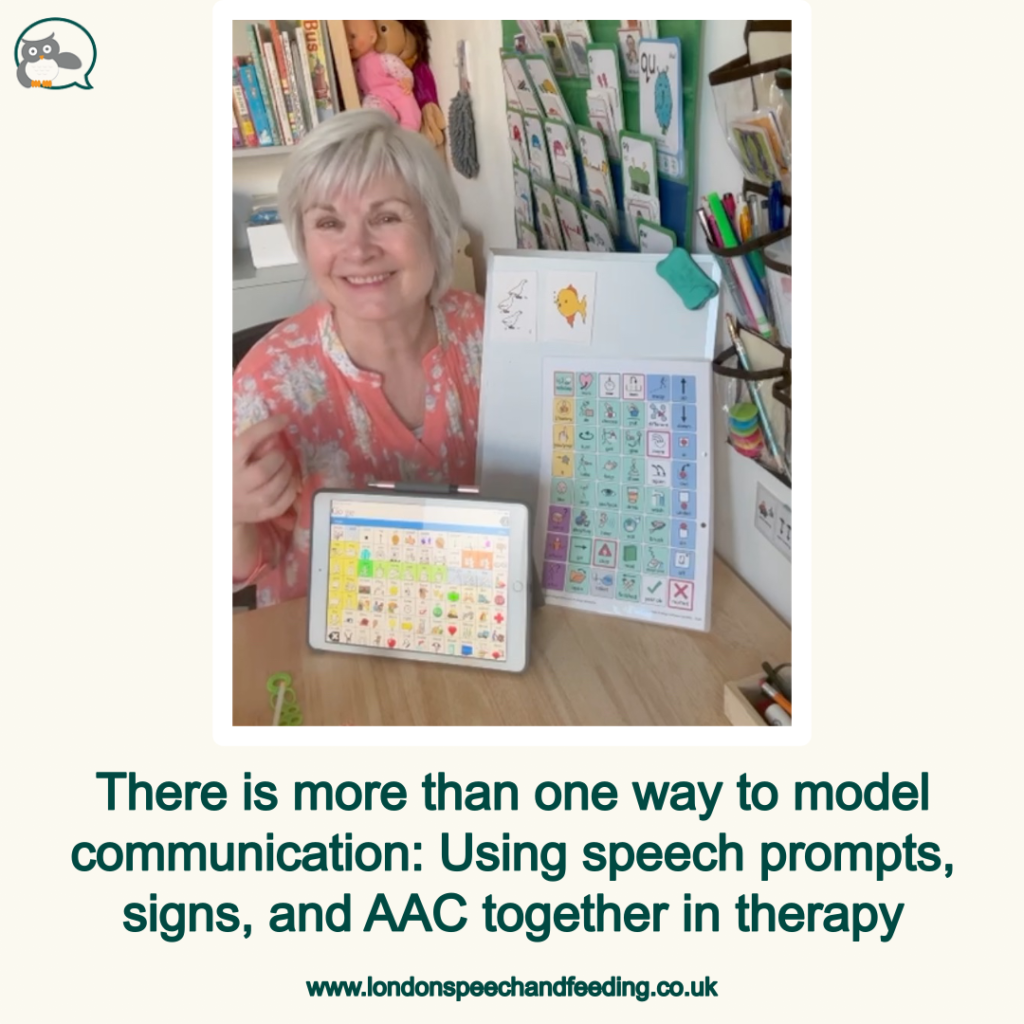
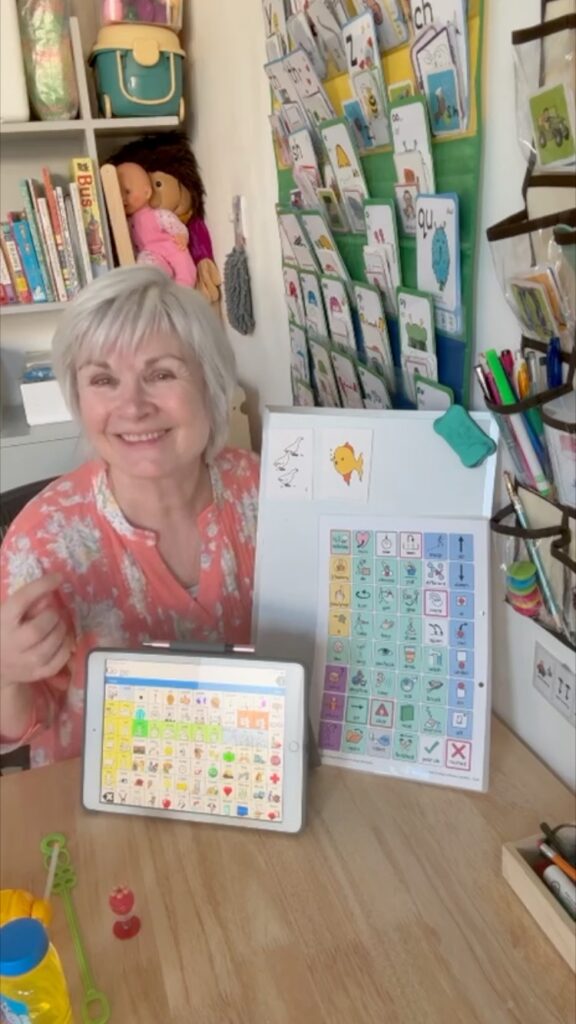
In this short therapy clip, I model just two simple words: ‘Go’ and ‘Up’.
But underneath those tiny moments is a combination of therapeutic strategies:
speech sound prompting
visual cueing
Makaton signing
AAC (Augmentative and Alternative Communication) modelling
repetition
motor planning support
language modelling
total communication principles.
Communication is bigger than speech alone
One of the biggest misconceptions about speech therapy is the idea that communication only ‘counts’ if a child says the word verbally.
In reality, communication comes in many forms:
speech
gesture
facial expression
signing
pointing
symbols
body language
AAC.
This is particularly true for children with:
developmental language disorder (DLD)
autism
motor speech difficulties
childhood apraxia of speech (CAS)
phonological difficulties
global developmental delay
complex communication needs.
These children often need communication to be presented through multiple pathways at once.
That is where total communication approaches become so powerful.
This is important to know: this does not confuse children. In fact, for many children, it does the opposite. It creates clarity.
Research suggests that learning signs alongside spoken language does not hinder speech development and may support overall language acquisition, communication confidence, and vocabulary growth in many children.
For many children, signs actually help speech emerge because they:
reduce communication pressure
build confidence
strengthen understanding of words.
A child who can successfully communicate is far more likely to keep attempting interaction.
The power of AAC and LAMP Words for Life
In the clip, I also model language using an electronic AAC system: LAMP Words for Life.
AAC stands for Augmentative and Alternative Communication.
AAC includes any tool that supports communication beyond speech alone, including:
picture systems
symbol boards
communication books
speech-generating devices.
LAMP Words for Life is one of my favourite AAC systems because it focuses on consistent motor patterns and meaningful language development. Because communication is not about achieving perfection. It is about connection.
And when children are given multiple ways to express themselves, they often become more confident, more engaged, and more willing to interact with the world around them.
That is the true power of total communication therapy.
Find a speech and language therapist for your child in London. Are you concerned about your child’s speech, feeding or communication skills and don’t know where to turn? Please contact me and we can discuss how I can help you or visit my services page.
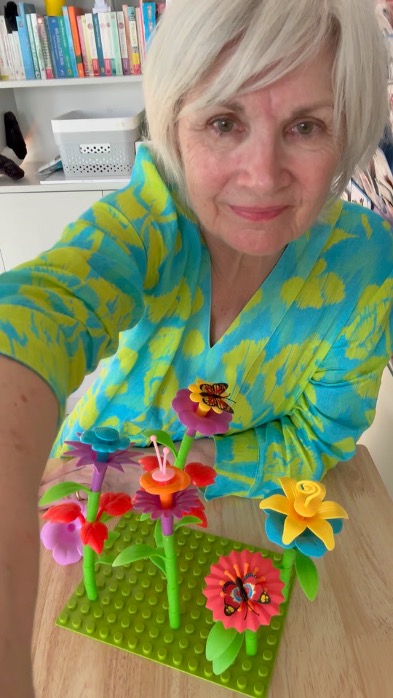
If you’ve been following me for a while you already know my absolute favourite rule for speech therapy: let the toy work for you. You don’t need an entire cabinet full of different flashcards or games to target a massive range of speech goals (though truth be told I do have 4 cabinets! What am I saying…) but often I find that sticking to one highly engaging, open-ended toy reduces a child’s cognitive load, keeps them firmly planted in play, and gives you dozens of natural opportunities for high-repetition practice. It also reduced my cognitive load!
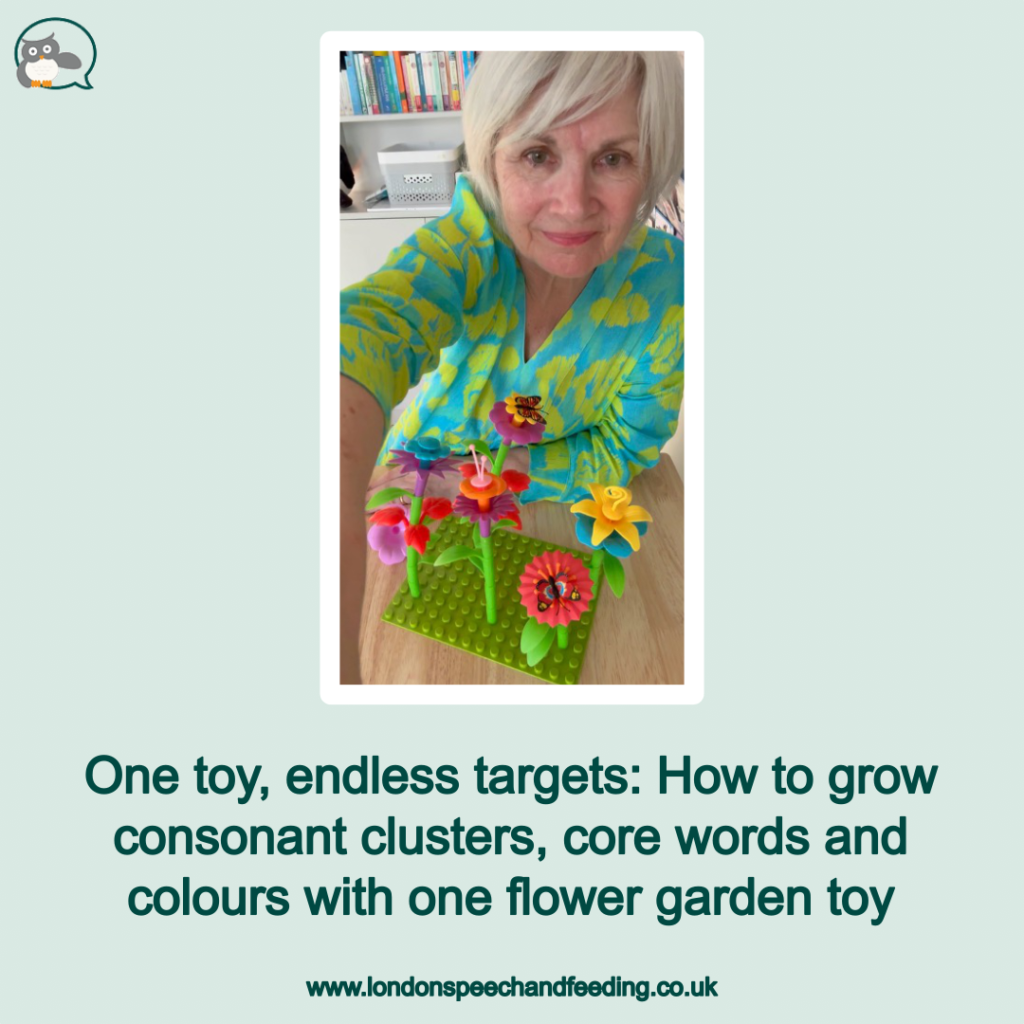
This vibrant, stacking toy isn’t just great for fine motor skills. It is an absolute goldmine for speech therapy. While it is incredible for targeting tricky consonant clusters (blends) like /ST/, /SP/, /SPR/, /FL/, /BL/, and /GR/, it is equally powerful for building functional core vocabulary.
1. Digging deep with /ST/
Let’s start building our garden.
Stem & stalk: ‘Look at this long stem!’ or ‘Can you put the stem in?’ or ‘do you want the green or the red stem’?
Stuck: If a piece is a little tight to push down, it’s a brilliant opportunity for a natural exclamation: ‘Oh no, it’s stuck! Help me!’
Stand: Once it’s secure, you can celebrate: ‘it can stand up now!’
👉 Core word integration: Use this setup stage to practise ANOTHER ONE. As you hold the base pieces, wait for the child to use their words or AAC device to request, ‘I want another one!’ before handing over the next stem.
2. Sowing seeds with /SP/ and /SPR/
Every good gardener needs the right equipment and a close eye for detail. We can introduce tools and descriptive language to hit our /SP/ and triple-blend /SPR/ targets.
Spade: Grab a toy shovel or pretend to use one. ‘Let’s dig a hole with the spade.’
Spot: Point to the holes on the base. ‘Find a good spot for this flower.’
Sprout: Talk about the little green pieces: ‘Look at the little sprout!’
👉 Core word integration: Build on spontaneous requesting here. If they are eyeing a specific piece, model a full phrase like: ‘I WANT THE PINK ONE.’
3. /FL/ and fine motor actions
Now, we can start adding the colourful petals.
Flower: This is your high-frequency word for the entire activity. ‘Put the green/blue/pink flower on top.’
Flat & flutter: ‘This piece is flat on the ground,’ or ‘The butterfly flutters by!’
👉 Core word integration: This stage is perfect for teaching directional actions. Every time they stack a petal onto a stem, model the core phrase: ‘PUT IT ON!’
4. Blending it all together with /BL/
Building a garden is a fantastic sensory experience because of the vivid colours. We can lean heavily into the /BL/ sound by focusing on colour selection and the action of growth.
Blue & bloom: ‘Should we use a blue flower?’ and ‘Watch it bloom!’
Blade & blend: Point out the blades of grass and talk about how we blend all the colours together.
👉 Core word integration: Don’t just focus on putting the toy together, taking it apart is half the fun! If a child places a piece they don’t want, or when it’s time to clean up, model: ‘TAKE IT OFF.’
5. Working the /GR/
Finally, we look at the environment supporting our garden. The /GR/ blend can be targeted by looking downward at the base of our toy setup.
Green: Nearly every stem and base piece in this toy is a vibrant shade of green.
Grass & ground: ‘Put the base down on the ground.’ ‘Look at the green grass.’
👉 Core word integration: Combine your /GR/ blend with a powerful core phrase. As you pull a stem upward slowly or stack the petals higher and higher, chant together: ‘MAKE IT GROW! Grow, grow, grow!’
Maximise your repetitions in play
The beauty of the flower garden toy is its repetitive nature. Because a child builds multiple flowers, you aren’t just saying a word or a phrase once, you have the potential to repeat it 10, 15, or 20 times in a single sitting without the child losing interest.
By layering structural speech sounds (like blends) over functional communication phrases (like core words), we give children words they can use across their entire day.
What toy would you like to see us target next in our series? Let me know in the comments on Instagram, and don’t forget to swipe through the carousel there to save these word lists for your next playtime!
If you are concerned about your child’s speech, please do not hesitate to get in touch. I would love to help you find some answers.
Sonja McGeachie
Highly Specialist Speech and Language Therapist
Owner of The London Speech and Feeding Practice.
Find a speech and language therapist for your child in London. Are you concerned about your child’s speech, feeding or communication skills and don’t know where to turn? Please contact me and we can discuss how I can help you or visit my services page.