Principles of motor learning in Childhood Apraxia of Speech (CAS)

|

We use powerful motor learning principles to help children with CAS (Childhood Apraxia of Speech) learn how to produce better, clearer speech sounds in words, phrases and sentences.

What are these principles?

Principle 1: MASSED PRACTICE

This is where you see a child for lots of sessions in a shorter period of time, so for instance six weeks of three times weekly for 30 minutes.

This leads to motor performance or automaticity.

Principle 2. DISTRIBUTED PRACTICE

This is what I use, as most of my clients are not able to come and see me that often on a weekly basis. It is hard to travel in London and life is hectic. So I favour one session a week over say a term or two terms and a session is usually 45 minutes long.

This leads to improved Motor Learning and good generalisation.

During either Massed or Distributed Practice, we choose between 4 variables:

Principle 3: Constant vs Variable

Principle 4: Blocked vs Random

To explain:

Constant Practice is where we repeat the practice of a small handful of target words.

We practise the same target sound in the same word position, e.g. at the beginning of a word: ‘bee’, ‘bye’, ‘bow’, ‘baa’ or ‘key’, ‘car’, ‘cow’, ‘Kaye’ etc.

We keep the rate, pitch and intonation constant.

Variable Practice is where we vary the rate, volume, pitch and intonation of the targets

We use a larger number of sounds, and words that are motivating to say for the child.

For example, if a child loves Peppa Pig then I might choose the words: ‘Peppa’, ‘Daddy Pig’, ‘George’, ‘Mummy Pig’ and a couple of other favourite characters. My child might struggle with a number of sound sequences there but we will target them one by one.

We can also select simpler words like ‘cape’ and ‘cake’ or ‘tick’ and ‘tip’.

Blocked Practice is where we practise one target word for say five minutes then we move to another target word for the next five minutes and then we revert back to the first target word again and so on, so blocks of practice.

Random Practice means we practise several target words at the same time.

How do I decide on what to use?

Good question!

I always opt for distributed practice (weekly for up to 45 minutes).

Within that, I tend to find it most successful to start out with constant practice when a child is finding a certain sound sequence really hard and we need to just ‘nail it’. Bearing in mind I only pick sounds that my student can actually make in isolation, so we are not working on articulation! (where we focus on trying to elicit single sounds correctly – or even at all sometimes) Here in CAS work, we are working with sounds the student can make but is having trouble to add together, into a sequence that is needed to make a word sound right.

As soon as I feel we have some traction I will go to variable practice, i.e. I pick words that are either funny or interesting for the child and it can be a slightly larger number.

I tend to use blocked practice in the beginning or when working on vowels. That’s because it is more important we get our vowels right. They carry a word and are very important for overall speech intelligibility. Once we are on a roll, I tend to go more for random practice.

Example

Here in the video clip, we try and work the /e/ vowel in short words likes ‘bell’, ’fell’, ‘dell’, ‘sell’, ‘smell’ and I am using an AAC device to give a child’s voice as auditory feedback as well as using the PROMPT approach to help my student shape his vowels.

So this is:

  1. Distributed (1 x week for 45 minutes)
  2. Constant – we are practising the /e/ vowel in the same position in six different words
  3. Blocked – we did this: several repetitions of each word and after the sixth we moved to another sound, and then later we came back to this.

Please feel free to contact me if your child has speech sound difficulties. It is my passion. I love supporting children with apraxia.

Sonja McGeachie

Early Intervention Speech and Language Therapist

Feeding and Dysphagia (Swallowing) Specialist The London Speech and Feeding Practice

The London Speech and Feeding Practice


Find a speech and language therapist for your child in London. Are you concerned about your child’s speech, feeding or communication skills and don’t know where to turn? Please contact me and we can discuss how I can help you or visit my services page.

1

Similar Posts

  • ·

    Support your child’s communication using books: OI FROG

    Sonja's top recommendation: Oi Frog, written by Kes Gray and Jim Field. An exciting book for children to enhance their speech, language and communication.
    Oi Frog by Kes Gray and Jim Field

    Book corner with Oi Frog! by Kes Gray and Jim Field.

    Books are an engaging way to support your child’s communication development. Even if your little one dislikes reading in the traditional sense. They will become immersed in this adventure, without realising they are taking in language and developing vital communication skills. This is one of my favourite series for children.

    Increase fun and interaction

    These books are made for fun and excitement! It may seem silly putting on different voices for different characters, but this is one way in which you can engage your child. Why not try to use different intonation patterns (e.g., you may use a deep voice for the dog, and a higher pitch for the cat)? Make your story interactive: you could ‘rawww’ like a lion and see who can make the loudest noise. Make noises to encourage interaction (e.g., when scratching his chin, make a squeaky sound!). You could also relate the experience back to your child (e.g., ‘can you scratch your chin?’).

    Time to talk

    Talk about what you can see on the front cover (e.g., There’s a frog on a log, how funny!) You could also ask your child to choose the rhyming words on a page in the book. Can your child tell you what rhymes with certain words (e.g., can you guess what a parrot sits on?)? Make use of every page. You could comment on your favourite frog and see if your child can talk about their favourite. You can support them by giving them an example (“my favourite frog is the one swimming backwards because he looks funny”). Then you could use this scaffold to support their answer. Your favourite is [________________] because [_________________]

    If your child is reluctant to use language, the use of commenting can take the pressure of them (“look at all those frogs” or “he’s climbing up the stool”) is a powerful way in which you (as parents) can take the pressure off your child. A top tip I like to give is to make sure you pause regularly, which creates opportunities for your child to use language.

    This book uses a subject-verb-object sentence structure (e.g., ‘hares sit on chairs’) which allows your child to hear a good model of a sentence. You could also talk about things in the book that belong in a certain category (e.g., animals, food) or begin with a specific sound. See if your child will name any more.

    Reap the reward of repetitive language

    Oi Frog uses repetitive rhyming language and puts emphasis on these words. This is important because the more your child hears a word, the more likely they are to remember, understand and use it in the correct context.

    Emotions matter

    Talk about how the animals feel and why they may feel this emotion (e.g., the cat’s feeling annoyed because…, Lions sit on irons, how does the lion feel?). Reasons can be difficult for children with communication difficulties. Support them by giving an example or by giving them an option (e.g., “does the lion feel happy or sad? I think the lion feels sad because he’s burnt his bottom on the iron! It’s too hot!”)

    A collection of books
    OI Books

    Why not read similar stories? I highly recommend OI CAT, OI DOG and OI DUCK-BILLED PLATYPUS.

    Need support for your child’s communication? Contact me here.


    Find a speech and language therapist for your child in London. Are you concerned about your child’s speech, feeding or communication skills and don’t know where to turn? Please contact me and we can discuss how I can help you or visit my services page.

    2
  • · ·

    My child is hard to understand at school age. Should I be concerned?

    Many parents notice speech errors when their children are toddlers. At that stage it often feels quite normal. Young children are still learning the sounds of their language, and those early mispronunciations can be very endearing.

    But as children grow older, parents sometimes begin to wonder:

    ‘Should my child still be speaking like this?’

    A common concern I hear from families is that their child is still difficult to understand even after starting school. Sometimes it is a parent who notices it first. Other times it is a teacher who gently mentions that classmates occasionally struggle to understand what a child is saying.

    When this happens, parents naturally wonder whether it is something their child will grow out of, or whether some extra support might help.

    When should children’s speech be clear?

    Children learn speech sounds gradually over several years. Some sounds develop earlier, while others take longer to master.

    By the time children reach five to six years of age, most of their speech should be clear enough for unfamiliar adults to understand. There may still be a few tricky sounds developing (such as /R/ or /TH/), but overall speech should be fairly easy to follow.

    If a child is frequently difficult to understand at school age, it can sometimes indicate that a speech sound difficulty has persisted beyond the stage when it would normally resolve on its own.

    Why some children remain hard to understand

    There are several reasons why speech clarity may still be developing in older children.

    Phonological patterns

    Some children continue to use speech patterns that are typical of younger children. For example:

    • saying ‘tat’ instead of ‘cat’
    • saying ‘doe’ instead of ‘go’
    • leaving sounds out of words

    These patterns are called phonological processes. They are a normal part of early speech development, but when they persist into the school years they can make speech difficult for others to understand.

    Difficulty producing specific sounds

    Other children may have difficulty producing certain individual sounds clearly. This might include sounds such as:

    • /S/
    • /SH/
    • /R/
    • /TH/

    These difficulties are called articulation difficulties.

    A child might understand exactly what they want to say but find it hard to produce the sound accurately with their tongue, lips or airflow.

    Motor speech planning challenges

    For some children, the difficulty lies in the planning and coordination of the movements needed for speech.

    Speech requires very precise timing between the tongue, lips, jaw and breath. If the brain finds it difficult to organise these movements consistently, speech can sound unclear or inconsistent.

    In some cases this may relate to Childhood Apraxia of Speech, although only a full assessment can determine this.

    Why clarity matters for school-age children

    Speech clarity becomes particularly important once children start school.

    At this stage, children are:

    • Answering questions in class
    • Talking with friends
    • Reading aloud
    • Developing confidence in communication

    When speech is difficult to understand, children sometimes become more hesitant to speak, particularly in group situations.

    This can affect confidence and participation, even when the child has lots of ideas they would like to share.

    The good news: speech can improve

    The encouraging news is that speech sound difficulties can often improve significantly with the right support.

    Speech therapy focuses on helping children:

    • Learn how sounds are produced
    • Practise accurate speech movements
    • Understand how sounds change meaning in words
    • Build consistency through structured practice

    Different children benefit from different therapy approaches. Some need support with phonological patterns, while others benefit from more motor-based practice that strengthens speech coordination.

    Often therapy combines several strategies to support the child’s individual speech profile.

    When to seek advice

    If your child is already at school and you find that people outside the family often struggle to understand them, it can be helpful to seek advice from a speech and language therapist.

    A detailed assessment can help identify:

    • Which sounds are causing difficulty
    • Whether patterns such as fronting or sound substitutions are present
    • Whether motor planning challenges may be contributing
    • Which therapy approach is likely to be most effective

    Early support can help children develop clearer speech and greater confidence in communication.

    Every child’s speech journey is different

    Speech development is not the same for every child. Some children master speech sounds quickly, while others need a little more guidance along the way.

    The important thing is that support is available when children need it.

    With the right strategies and practice, many children make excellent progress and develop speech that is clearer, more confident and easier for others to understand. If you are concerned about your child’s speech clarity or ongoing speech sound errors, a speech and language assessment can help identify the underlying difficulty and guide the most appropriate support.

    Feel free to contact me on my contact page.

    Sonja McGeachie

    Highly Specialist Speech and Language Therapist

    Owner of The London Speech and Feeding Practice.


    Health Professions Council registered
    Royal College of Speech & Language Therapists Member
    Member of ASLTIP

    Find a speech and language therapist for your child in London. Are you concerned about your child’s speech, feeding or communication skills and don’t know where to turn? Please contact me and we can discuss how I can help you or visit my services page.

    3
  • ·

    Supporting children and families living with verbal dyspraxia

    “It’s brill-i-ant, it’s brill-ant, it’s brillnt”

    Have you ever wondered why children may pronounce a word correctly one minute and in the next breath they struggle to say the same word? It’s equally as frustrating for you as it is for your child. The biggest question of all is WHY? Why does this happen and what causes it? Whilst there are many explanations. When it persists, it might be a condition called verbal dyspraxia.

    What is verbal dyspraxia

    Verbal dyspraxia is a neurological motor speech disorder that affects the coordination and planning of muscle movements that are needed for speech production. A child may have difficulty making the precise movements needed for speech, which may result in inconsistent and unintelligible speech. Children may also have trouble sequencing sounds and syllables, producing speech sounds accurately, and coordinating the movements of their articulators (e.g., lips, tongue, teeth, jaw). This can lead to a range of speech errors (including sound distortions, substitutions, omissions, and difficulty with rhythm and prosody).

    We know that these speech errors, and not being able to get a message across, can be frustrating for children with speech difficulties. Can you imagine talking and limited people understanding you? It’s so tough on children and the people trying to communicate with them.

    Creating a person-centred therapy plan is vital. This allows your child to stay motivated, as intervention is likely to be long term. This planning may include favourite words to use during their hobby or favourite activity, or person-centred goals such as ‘giving Alexa an instruction’.

    Children with verbal dyspraxia can have several different ways of producing words, which often makes it trickier for them as there’s no consistent pattern to work with. So, we’ve put together some top tips to support their communication and make their (and your) lives a little easier in the process.

    Ten ways to make communication easier for your child with verbal dyspraxia

    • Have a list of frequently used words and practise this set. Little and often is best!
    • Use cued articulation to support speech production (ask your Speech and Language Therapist for the gestures)
    • Give time and use active listening. This means showing interest and trying not to think about what is on your never ending ‘to do’ list
    • Reduce frustration in any way that you can. This might mean allowing your child to demonstrate using gestures rather than speech. You might also give top tips for other adults or children who communicate with your child when out and about
    • Talk about the structure of words with your child (i.e., there are two beats/syllables in this word)
    • Show the written form of the word to go alongside their production
    • Split down tasks, so that your child only has to respond to one question at a time, reducing their motor capacity
    • Recognise when your child is working well and when they may need support of an Alternative and Augmentative Communication device
    • Allow all environments to have the same training and equipment (i.e., at school, home, out and about)
    • Have regular periods in the day where your child can practise their specific words in different environments. This can be effective for children with verbal dyspraxia

    Do you still have questions? Contact Sonja for support.


    Find a speech and language therapist for your child in London. Are you concerned about your child’s speech, feeding or communication skills and don’t know where to turn? Please contact me and we can discuss how I can help you or visit my services page.
    0
  • Why imitation is a powerful strategy to support social communication

    Before reading this blog, it’s important to understand what we mean by ‘social communication’ and ‘imitation’. Social communication is more complex than it first appears. It refers to many aspects of communication such as body language, voice, conversational skills, social ‘rules’ (such as being polite and using manners), interpersonal skills (such as developing friendships), and emotional literacy (such as appropriacy and developing self-awareness). Imitation refers to the simple act of copying.

    You may have noticed that your child has difficulties in some of the areas mentioned above. They might be less responsive to you and appear to be quite happy in their own world. Whilst we do not want to change their unique characteristics, we do need to prepare them for future experiences, and what is socially acceptable.

    How will copying my child develop their social communication?

    1. If your child is already engaged with a certain activity, they are already interested and motivated. You’re not competing for their attention.
    2. Both yours and your child’s attention is on the same activity which makes imitating for you (as the parent) easier.
    3. Studies have demonstrated that when a parent imitates a child, they are more likely to look at the adult.
    4. Imitation not only supports eye contact but supports facial expressions (such as smiling), may increase vocalisations, and encourages your child to sit closer to you.
    5. Children learn through trial and error. They may start to try to perform new actions to gain their parents attention. Let your child lead the play!!

    How do I start imitating my child?

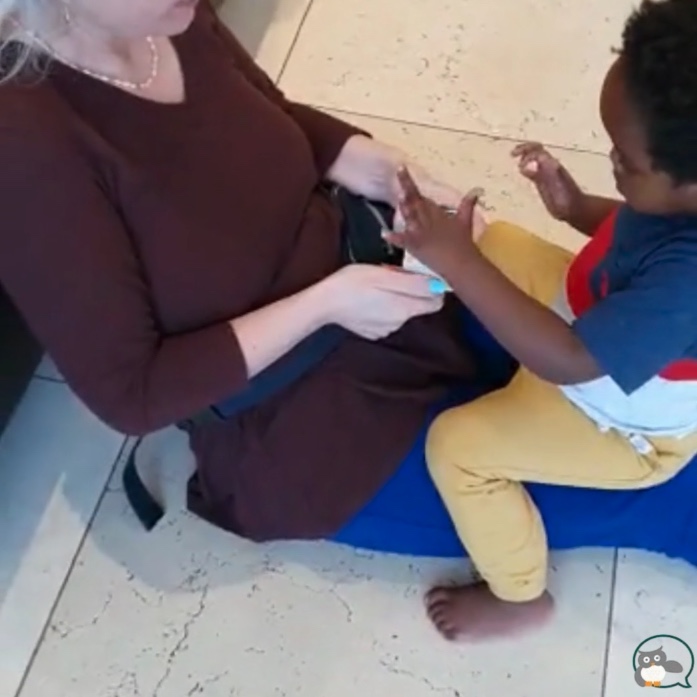
    1. Start with observing them. Take the time just to watch. You don’t need to make notes. Sit back and observe their actions, movements, and sounds they make.
    2. Wait for your child’s reaction when they realise you are copying their actions. Remember they may not notice, you don’t need to remind them, simply copy them again.
    3. Having the same set up as your child allows them to feel in control. So, you may have two sets of the same activity rather than copying using their set of toys.

    This may sound daunting, but it doesn’t have to be. Start with a ten-minute time frame where you choose to copy your child. This is where you can practise your imitation strategy. Ten minutes a day is far more effective than an hour every two weeks. You may feel self-conscious but trust the process. Build your confidence, whilst exposing your child’s to increased language and communication, enabling them to develop vital social communication skills.

    Look at the video above to watch the strategy in action!

    Support is only a click away. I’m here to help.


    Find a speech and language therapist for your child in London. Are you concerned about your child’s speech, feeding or communication skills and don’t know where to turn? Please contact me and we can discuss how I can help you or visit my services page.

    0
  • · ·

    The power of containment: A therapeutic approach for autistic children

    Photo by lemonlenz

    The practice of wrapping or swaddling children, often referred to as ‘containment,’ has been used for centuries to soothe and comfort infants. I use this therapeutic approach with autistic children at the London Speech and Feeding Practice. While it might seem counterintuitive, the act of being tightly wrapped can provide significant benefits for children who struggle with sensory processing, emotional regulation, and communication.

    Understanding sensory processing and autism

    Autistic persons often experience challenges with sensory processing, which is their brain’s ability to interpret and respond to sensory information. This can lead to sensory overload or under-responsivity. Containment can be a valuable tool in helping children regulate their sensory input.

    Photo by lemonlenz

    To summarise, here are some of the benefits of containment:

    • Sensory Regulation:
      • Provides deep pressure input: The tight, enveloping sensation of being wrapped can provide deep pressure input, which is calming and organising for many children.
      • Reduces sensory overload: By creating a controlled sensory environment, containment can help to reduce overstimulation and promote a sense of safety.
    • Emotional Regulation:
      • Containment creates a sense of security: Being wrapped tightly can mimic the feeling of being in the womb, providing a sense of security and comfort.
      • Facilitates calming: The deep pressure input can help to calm the nervous system and reduce anxiety.
    • Improved Body Awareness:
      • Enhances proprioception: Containment can improve the child’s awareness of their body in space, which is essential for motor development and sensory integration. I often provide extra pressure on a child’s arms and legs sticking out of the yoga mat; this helps my child understand where their limbs are in space: I can feel my legs and I can feel my arms and I can feel where they are right now, i.e. they are under Sonja’s hand, I can feel them.
    • Facilitates Communication – and this is obviously where I come in as a Speech and Language Therapist:
      • Swaddling creates a safe space: When a child feels calm and secure, they are more likely to engage in communication.
      • Enhances joint attention: The shared experience of being wrapped can foster joint attention, which is essential for language development. You can see this one in my highlights where I swaddle my student in the yoga mat (picture above). She absolutely loves it, and what is more she is calm and steady when usually this child likes to be on the move constantly. Here we have a wonderful moment of joint engagement. She looks at me, she can listen to what I say or sing, and she can tell me in her own way to carry on rolling her or to carry on singing or providing calming pressure to her legs and arms or to stop.

    A few pointers for when you try this at home: How to practise containment safely and effectively

    • Create a safe environment: Ensure the wrapping material is soft, breathable, and free from any hazards.
    • Observe your child’s cues: Pay attention to your child’s body language and verbal cues to determine their comfort level.
    • Respect your child’s boundaries: If your child shows signs of distress, stop the containment immediately – this might seem obvious but sometimes we adults get so carried away with some ‘great idea’ that we have seen work elsewhere. And so we can be a little too ‘determined’ sometimes to ‘make it happen’… perhaps this rings a bell with some of my readers.
    • MAKE IT FUN: Start carefully and take it step by step. See if the student is having a nice time. It is all about trust and therefore it might not work the very first time you do it.

    It’s important to remember that containment is not a one-size-fits-all approach. Some children may respond better to other sensory-based interventions. However, for many autistic children containment can be a valuable tool in their journey towards improved communication and emotional regulation.

    For more information follow me on Instagram, Facebook or LinkedIn.

    Sonja McGeachie

    Early Intervention Speech and Language Therapist

    Feeding and Dysphagia (Swallowing) Specialist The London Speech and Feeding Practice

    The London Speech and Feeding Practice


    Find a speech and language therapist for your child in London. Are you concerned about your child’s speech, feeding or communication skills and don’t know where to turn? Please contact me and we can discuss how I can help you or visit my services page.

    1
  • ·

    Tongue training: Why tongue placement matters for clear speech

    As speech and Language therapists (SLTs), we know that where your tongue goes, so goes your sound. This blog post will explore why tongue placement is so vital for speech correction and how we use tools and techniques to help our clients find their ‘sweet spot’ for sound production.

    Let me show you here a little video clip where I am using my dentist’s mouth/teeth model to help my clients navigate their tongue movements.

    The tongue: A tiny muscle with a big job

    The tongue is a small but mighty muscle. It’s incredibly versatile, playing a key role in eating, swallowing, and, of course, speaking. For each speech sound, the tongue, along with the lips and jaw, needs to move to a very specific spot. Think of it like a dance: every part of your mouth has a choreographed movement to produce the correct sound. If the tongue is out of sync, the sound comes out muffled, distorted, or just plain wrong.

    The trouble with our tongue movements is that most of us never think about how the tongue has to move and what it does to: swallow, chew, drink, suck and speak. Most parents when asked to think about their own tongue placement for say the /S/ sound are completely lost as to what their tongue is doing. Yet, of course, they produce a perfect /S/ and perfect speech in general. The same goes for swallowing. When did you last think about what happens in your mouth when you swallow? I bet you have not thought about it. We ‘just do it’, right?

    Why is tongue placement so important?

    Accurate tongue placement is the foundation of clear articulation. When a child struggles with a particular sound, it’s often because his or her tongue isn’t quite reaching the right spot or moving in the correct way. For example, the /S/ sound requires the tongue to be slightly raised and positioned behind the top teeth, creating a narrow channel for air to flow through. If the tongue is too far forward, you might get a /TH/ sound instead. If it’s too far back, the /S/ can sound muffled.

    Visual aids: Our secret weapon

    We SLTs love our visual aids! They’re incredibly helpful for showing clients exactly where their tongue needs to be. Here are some of our favourite tools:

    • Mirrors: Mirrors provide instant feedback. Clients can see their tongue’s position and make adjustments in real-time. We often use hand mirrors or even the mirror on a compact for quick checks.
    • Tongue depressors: These simple tools can gently guide the tongue to the correct position. We might use them to show where the tongue tip should rest for the /L/ sound or how the sides of the tongue should touch the molars for the /K/ and /G/ sounds.
    • Diagrams and models: Pictures and models of the mouth can help clients visualise the tongue’s movements. We might use a cross-section diagram of the mouth to show how the tongue forms different sounds.

    Beyond the tongue: The jaw’s role

    While the tongue takes centre stage, the jaw plays a supporting role. It provides a stable base for the tongue and helps control the opening and closing of the mouth. Sometimes, jaw stability is an issue, and we might use techniques to help clients find a comfortable and stable jaw position.

    Making it fun and engaging

    Learning correct tongue placement can be challenging, but we make it fun! We use games, stories, and playful activities to keep clients motivated. For younger children, we might use silly voices or pretend to be animals. For older children, we might incorporate their interests, like using a car analogy for tongue movements.

    The takeaway

    Correct tongue placement is essential for clear speech. By using visual aids, interactive techniques, and a bit of creativity, we can help our clients master their speech sounds and communicate with confidence.

    If you have any concerns about your child’s speech, don’t hesitate to reach out to a qualified speech and language therapist, we are here to help! Contact me via my contact form.

    Sonja McGeachie

    Early Intervention Speech and Language Therapist

    Feeding and Dysphagia (Swallowing) Specialist The London Speech and Feeding Practice

    The London Speech and Feeding Practice


    Find a speech and language therapist for your child in London. Are you concerned about your child’s speech, feeding or communication skills and don’t know where to turn? Please contact me and we can discuss how I can help you or visit my services page.
    2