Your baby’s communication journey: 3–6 months

| |

This is an exciting time for both you and your baby! Between 3 and 6 months, communication literally explodes. While your little one may not be saying words yet, he or she is actively learning to understand and express themselves. Here’s a glimpse into what you can expect:

Understanding:

Recognises familiar voices:

Your baby will likely turn his or her head towards the sound of your or other familiar adults’ voices.

Tips for supporting and expanding: Talk, sing and chant! Your baby will love and smile at hearing your talking voice, and he or she will not be judging your singing talent! You can sing to your hearts content, perhaps some lovely nursery rhymes you remember from your childhood, or festive songs like Jingle bells !. Or you can simply make up your own little songs and chants alongside all the daily activities you do with or for your baby. You could have a ‘nappy’ song, a ‘let’s get you ready for the park’ song, a ‘I’m hungry’ song or a ‘mummy’s cooking soup’ chant. It does not have to be beautiful but what does help is having little rhymes and rhythms to your singing. Your baby will love it and soak it all up.

Begins to understand ‘no’:

Your baby may pause or stop an action when you say ‘no’ and shake your head at the same time.

Tips for supporting and expanding: I don’t think that at this stage you will have much cause to say ‘no’ to be fair but you could do it playfully and bring it into a ‘no more’ situation so that your baby can make the connection between ‘no’ and ‘finished’ or ‘stop’ or ‘done’. Feeding might be a good opportunity for this one. You could also ask ‘who is it’ when someone is ringing the bell or coming down the stairs, e.g. ‘oh I hear footsteps! Is this daddy??…. no it’s not daddy no it’s grandma! daddy’s gone out!’

Responds to his or her name:

Your baby will start to show a reaction when you call his or her name.

Tips for supporting and expanding: Try calling your baby’s name a lot, and get different family members or visitors calling your baby by his or her name and calling his or her name before saying ‘look’ or ‘peek-a boo’ etc.

Use Baby Signing: You can introduce simple gestures and signs such as ‘milk’ ‘nappy’ ‘sleep’ ‘dog’ ‘cat’ etc to help your baby make the connection between what you are saying and what he or she is seeing.

Expressing:

Cooing, gurgling and babbling:

These sounds are more than just adorable! They are your baby’s way of experimenting with his or her voice and learning to control his or her vocal cords.

You might hear sounds like ‘ba-ba-ba’ or ‘ga-ga-ga’. This is a huge milestone!

Tips for Supporting and expanding: This is a wonderful time to copy your baby’s sounds, celebrate them and show your baby that you are listening to his or her sounds and you are understanding everything he or she is saying! This is also a brilliant time to start reading to your baby. You can read any children’s books you fancy. Again your baby will adore the sound of your voice but increasingly he or she will also look at the pages of a book and try and understand and make connections between the words you say and the pictures he or she sees.

When you hear your child babbling you can try and give it meaning where possible, for example your baby says: ‘ba ba ba’ you could fall into ‘Baa Baa black sheep have you any wool’ song or you could say ‘mmmh banana!’ And show a banana that’s lying on the table. Or you could just say: ‘baba baaaaah you are saying ba! That’s so great!’ Anything goes really at this stage!

Facial expressions:

Your baby uses smiles, frowns, and other facial expressions to communicate his or her emotions (happy, sad, angry).

Tips for supporting and expanding: Try and make interesting and exaggerated facial expressions yourself when you are talking to your baby! Try and be a little bit clowney and really practise showing ‘surprise’ ‘boo’ or a big grin, smile, purse your lips, blow raspberries, open and close your mouth and make funny faces. Copy your baby when you see his or her facial expression change. When your baby looks confused, say ’oh we don’t know what’s happening we are confused!’. When your baby looks happy, say ‘you look soo happy! What a lovely smile!’

Eye contact:

Your baby will start making more and more eye contact with you during interactions.

Tips for supporting and expanding: Try and get ‘face to face’ a lot with your baby. When cuddling your baby look at his or her face and often make sure that it is easy for your baby to see and look at you. If you can lower your position so that your face is in line with your baby that will make things easier for you both.

Good games to play:People-Games’ these are games where you do not need any toys to have a good time. All you need is the other person: Peek-a-boo, bumping your baby up and down on your lap with a song, Row Row Row your boat, tickling games, catch you games etc.

Now we are at 6 months another very exciting stage has arrived: feeding SOLIDS to our baby! More of this in my next post!

When to Seek Guidance:

If you have any concerns about your baby’s communication development, please don’t hesitate to consult with me. Early intervention can make a significant difference and really help your baby making progress.

Remember: Every baby develops at his or her own pace. These are general guidelines, and some babies may reach certain milestones earlier or later than others.

I look forward to seeing you! Get in touch with me via my contact form.

Sonja McGeachie

Early Intervention Speech and Language Therapist

Feeding and Dysphagia (Swallowing) Specialist The London Speech and Feeding Practice

The London Speech and Feeding Practice


Find a speech and language therapist for your child in London. Are you concerned about your child’s speech, feeding or communication skills and don’t know where to turn? Please contact me and we can discuss how I can help you or visit my services page.

1

Similar Posts

  • · ·

    Why ‘Prosody’ Matters in Childhood Apraxia of Speech (CAS)

    Prosody refers to the ‘music’ of speech — the rhythm, pitch, stress, and volume that convey meaning and emotion beyond the literal words themselves. Think about a monotone statement like ‘Really?’ compared to one with a rising inflection, expressing genuine curiosity.

    When I work with children on producing speech sound sequences, we focus on mastering individual sounds and then putting them together into target words. A crucial element that can significantly impact a child’s speech production is ‘prosody’.

    In CAS, where the difficulty lies in planning and executing the motor movements for speech, prosody can be a powerful tool for producing clearer words and phrases.

    Here’s why working on prosody is an essential tool in CAS speech therapy:

    1.  It aids Motor Learning:

    Apraxia of Speech means that the planning and execution of speech movements are impaired. When we use exaggerated intonation or stress patterns while modelling words, we are providing additional prosodic variation and, therefore, additional auditory cues. These cues often help my student to carry out the correct motor movements for a word or syllable sequence.

    For instance, I might say ‘ball’ with a high-pitched emphasis on the ‘b’ sound. This auditory cue might be more effective in guiding the child’s tongue placement than simply repeating the word without variation.

    In this little video clip I get my student to say the word ‘snuggle’ (since we were working on that particular sound sequence: snuggle, snout, snore and sneeze) with a high voice and then a lower voice ‘like a bear’ — again it provides that extra auditory cue, but, in addition, the fun aspect also helps to take away the intense focus on a tricky movement pattern.

    By now the new pathways have been laid through repeated practice and now automaticity takes over and without too much effort my student can suddenly produce a motor pattern. It’s magical when it happens and gives me such a thrill.

    2. It makes speech more engaging and natural sounding:

    Children with CAS often sound robotic or flat due to challenges with prosodic elements. By incorporating variations in pitch, volume, and rhythm during therapy, we can help achieve a more natural flow of speech

    3. It makes it easier to express our emotions:

    Children with CAS often struggle to express themselves emotionally; partly through the difficulty of producing clear words — period, but also in addition due to the difficulties or absence of musicality and rhythm in their speech.

    Therefore, it is so important to incorporate activities focused on practising different emotions with varied intonation patterns. This can really empower our students to put emotions into their words.

    Good words to practise are fun words like ‘Wow!’ or ‘Yeiih’ or power words and phrases like ‘No!’ or ‘Gimme that’ etc.

    Making Therapy Fun and Engaging:

    Speech therapy for CAS doesn’t have to be all drills and exercises (though to be fair sometimes we can’t quite get round to making each and every word huge fun though we try…).

    I aim to make all my sessions fun and have intrinsic rewards built into the speech practice where possible.

    Home practice tips:

    Therapy shouldn’t exist in a bubble. Working on prosody during sessions is crucial, but it’s equally important to integrate these skills into everyday interactions. Parents and caregivers can model appropriate prosody during playtime, story time, or even simple conversations. This consistent reinforcement helps our children to generalise their newfound skills and use them naturally in their daily lives.

    • Sing songs and rhymes: Songs naturally incorporate variations in pitch and rhythm. Singing familiar songs and creating silly rhymes can be a delightful way to practise prosody.
    • Use puppets and toys: Assign different voices and personalities to puppets or toys. This encourages children to experiment with pitch and volume to differentiate characters.
    • Read aloud with enthusiasm: Model expressive reading, varying your voice for different characters and emphasising key words. This makes reading time engaging and helps children understand the power of prosody.

    Please feel free to contact me if your child has speech sound difficulties. It is my passion. I love supporting children with apraxia.

    Sonja McGeachie

    Early Intervention Speech and Language Therapist

    Feeding and Dysphagia (Swallowing) Specialist The London Speech and Feeding Practice

    The London Speech and Feeding Practice


    Find a speech and language therapist for your child in London. Are you concerned about your child’s speech, feeding or communication skills and don’t know where to turn? Please contact me and we can discuss how I can help you or visit my services page.

    1
  • Submucous cleft palate: What is it and how does it impact on speech?

    Submucous cleft palate: What is it and how does it impact on speech?

    What exactly is a submucous cleft palate?

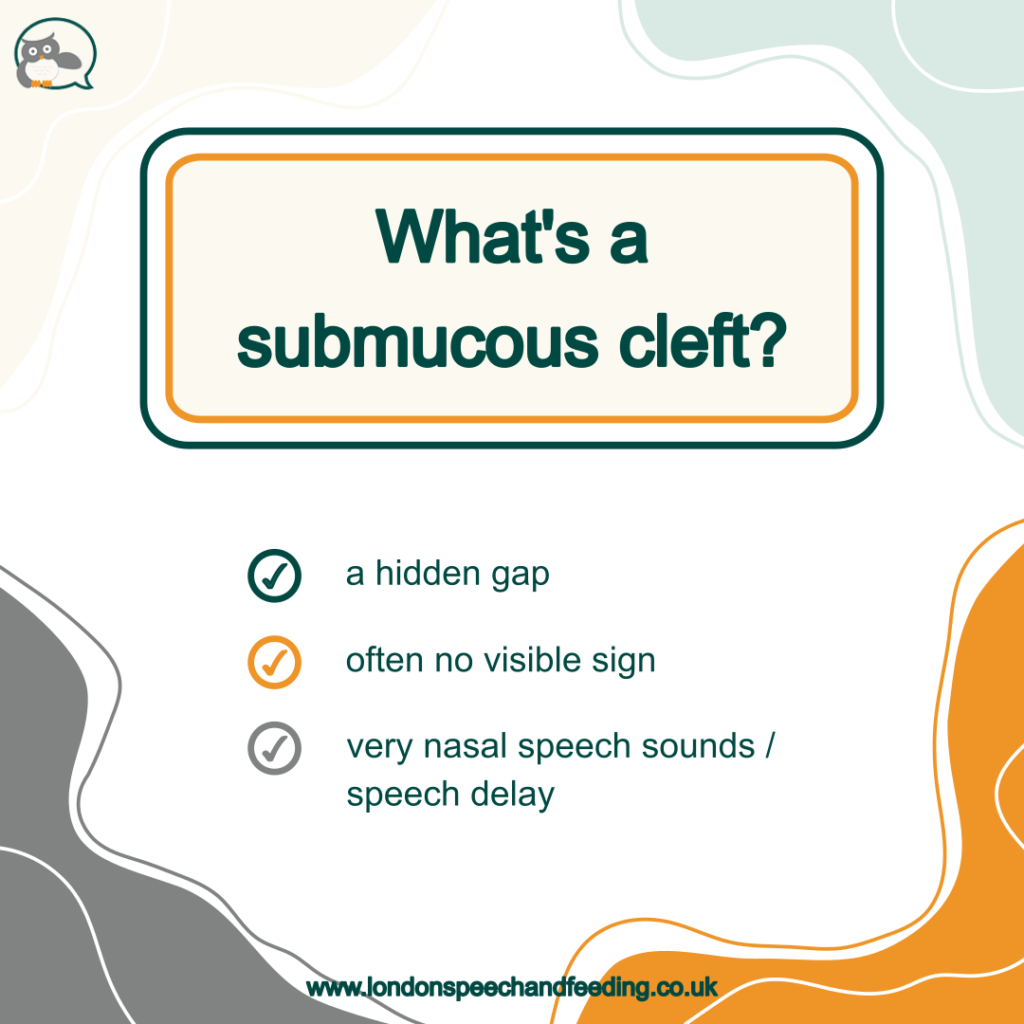
    A submucous cleft palate (SMCP) is much less obvious than its counterparts, cleft of lip and/or palate, and can profoundly impact a child’s speech development. It leads to often extreme hyper nasal speech and difficulty with producing many sounds (/K/ /G/ /T/ /D/ /P/ /B/ /S/ /Z/ /F/ /V/).

    In short, the muscles and bone of the soft palate, and sometimes the hard palate, do not fuse completely during foetal development and the mucous membrane that lines the roof of the mouth remains intact, effectively camouflaging the underlying muscular and bony deficit.

    So, while the surface of the palate appears normal, the essential muscle and functions responsible for sealing off the nasal cavity from the oral cavity during speech are compromised. This cleft (or lack of muscle) can be seen as a bluish midline discoloration of the soft palate, often a bifid (split) uvula, and at times a notch in the posterior border of the hard palate can be felt upon palpation. However, these signs aren’t always present or easily discernible, contributing to the difficulty arriving at a diagnosis.

    Diagnosing a submucous cleft palate is often akin to searching for a needle in a haystack, especially for the untrained eye. Unlike overt clefts that are visually apparent at birth, an SMCP can go undiagnosed for years, sometimes well into childhood or even adolescence. Paediatricians and even ENT surgeons have been known to miss it during routine checks due to the intact mucosal lining. Parents might notice their child’s speech sounds ‘different’ or ‘nasal’ but struggle to pinpoint the cause. Children might undergo extensive speech therapy without a proper diagnosis, as the underlying structural issue continues to hinder progress.

    My experience as a speech therapist in private practice:

    Over my years of practice, I have encountered several children presenting with persistent hyper-nasal speech and significant difficulties producing plosive and fricative sounds.

    It has been incredibly rewarding, though at times challenging, to successfully diagnose SMCP in a number of these children. My approach often involves:

    • a meticulous oral motor examination,
    • careful listening for the specific qualities of hypernasality,
    • and a deep understanding of the physiological requirements for clear speech sound production.

    When I suspect an SMCP, I refer these children to Great Ormond Street Hospital where a fantastic multidisciplinary team, typically including ENT surgeons and a specialist speech-language therapist can conduct more definitive assessments. These assessments often involve instrumental analyses such as videofluoroscopy or nasoendoscopy, which provide objective measures of velopharyngeal function and visual confirmation of the anatomical deficit.

    The path to resolution: surgery, therapy, and successful outcomes

    Surgery

    The journey for these children, once diagnosed, often involves surgical intervention. It’s not uncommon for children with SMCP to undergo multiple operations to achieve optimal velopharyngeal closure. These procedures aim to reconstruct or augment the velopharyngeal mechanism, enabling it to effectively separate the oral and nasal cavities during speech. The specific surgical approach depends on the individual child’s anatomy and the severity of the velopharyngeal insufficiency. It’s a testament to the skill of these specialised surgeons that such intricate repairs can be performed with remarkable success.

    Speech therapy

    Following surgery these children embark on the crucial phase of speech therapy. While surgery addresses the structural problem, speech therapy helps a child learn to utilise their newly improved anatomy. It involves intensive work on developing oral airflow, establishing correct articulatory placement, and reducing learned compensatory strategies that have developed due to the original structural deficit. It is immensely gratifying to witness the transformation. Children who once struggled to produce basic sounds, whose speech was difficult to understand, gradually develop clear speech.

    Next steps?

    If you’re a parent concerned about your child’s speech and feeding, you’re not alone. The journey can feel confusing, but professional guidance can make all the difference. Never hesitate to have a second opinion when you have that niggling feeling that there is something that has not yet been explored. At London Speech and Feeding I specialise in being thorough and thinking outside the box.

    I am here to provide the support you need. Reach out to schedule a consultation and take the first step towards helping your child communicate and thrive.

    Sonja McGeachie

    Highly Specialist Speech and Language Therapist

    Owner of The London Speech and Feeding Practice.


    Health Professions Council registered
    Royal College of Speech & Language Therapists Member
    Member of ASLTIP

    Find a speech and language therapist for your child in London. Are you concerned about your child’s speech, feeding or communication skills and don’t know where to turn? Please contact me and we can discuss how I can help you or visit my services page.
    1
  • ·

    Cued Articulation – using hand gestures to show how a sound is made

    Watch how cued articulation can transform your child’s speech and language skills!

    Cued Articulation involves using specific handshapes and placement cues to guide the speaker’s articulators, such as the tongue, lips, and teeth, to produce accurate sounds. It was originally conceptualised by Jane Passy, a speech-language pathologist. But it is important to know that we can, and often do, also use other speech cues which help our student visualise what they need to do. In other words, we can mix and match our cue pictures depending on what works best with each student.

    In the beginning of my speech therapy practice I would stick religiously to Jane Passy’s method but over the years I have learned and used many different visual hand cues which all have worked with individual students.

    It is important to remember that this is not an exact science, rather than an art! The art is to find the key to each individual student’s understanding and inspire motivation to try out a sound which they find hard to do.

    As an example, the hand signs used by Caroline Bowen’s method, an Australian Speech-Language Pathologist, are quite different to Jane Passy’s signs but they can equally work very well. Caroline Bowen’s visual for the /r/ sound is the ‘rowdy rooster’ — a crazed rooster on a motorbike — and the hand signal is that of revving up the motor bike engine with both hands whilst trying out the /r/ sound! I have a good handful of students who really loved this rooster image and were able to eventually produce a good /r/ using this cue.

    So, it is horses for courses with many things, and visual images and hand cues are no exception!

    Sound picture cards:

    Again, there are a host to choose from and I tend to collect a number of different images for each sound I want to practise with my student. As an example, below are a couple of different examples I use for the sound /p/:

    The Nuffield Programme suggests to use this popper card, which works well with a student who knows these poppers and perhaps has one on their trousers.

    As an alternative, and especially for younger students, I like using the Popper Pig Card – which I also have in my room so I can quickly show how it pops. Or we can have a popping game in between saying the /p/ sound at times. (The popper card is great as I can use the real toy to help with conveying the /p/ sound as it pops.)

    Each card has its own merit and I choose the right card for the individual student.

    How I use cued articulation and the visuals in Speech Therapy

    1. Cueing and practice: I introduce the appropriate card and handshapes for the targeted sounds. We then practise producing the sounds.
    2. Reinforcement and feedback: Positive reinforcement encourages progress and builds confidence.
    3. Fading out the cues: Once my student is able to say the sound more easily, we can gradually fade out the speech cues.

    Benefits and effectiveness

    Using Cued Articulation and Speech Image Cards has been shown to be effective in improving speech production for individuals with various speech and language disorders, including:

    • Articulation disorders: Difficulty producing specific sounds accurately.
    • Apraxia of speech: A motor planning disorder that affects the ability to sequence and coordinate movements involved in speech.
    • Phonology disorders or delays: Confusion and delays in how sounds are organised in categories to convey meaning, errors in sound patterns, for example front sounds are produced at the back, or long sounds are produced as stops.
    • Stuttering: A fluency disorder characterised by interruptions in speech, such as repetitions and prolongations.

    Tips for parents and student speech therapists

    Parents can play a crucial role in supporting the implementation of cued articulation at home and in therapy sessions. Here are some tips:

    • Collaborate with your SLT: Good feedback and communication with the Speech and Language Therapist creates consistency and progress..
    • Practise Regularly: Encourage consistent practice of cued articulation at home to reinforce learning.
    • Use Visual Aids: Use the same visuals that your therapist uses in the speech clinic to help your child at home with recall and practice.

    Feel free to contact me if you need help with your child.

    Sonja McGeachie

    Early Intervention Speech and Language Therapist

    Feeding and Dysphagia (Swallowing) Specialist The London Speech and Feeding Practice

    The London Speech and Feeding Practice


    Find a speech and language therapist for your child in London. Are you concerned about your child’s speech, feeding or communication skills and don’t know where to turn? Please contact me and we can discuss how I can help you or visit my services page.

    1
  • ·

    Let’s relax about making EYE CONTACT already…

    There’s been a long tradition with teaching staff and with Speech and Language Therapists working in schools that eye contact should be a goal. It is well known that Autistic individuals (whether that be children or adults) mostly avoid eye contact. Whilst it’s part of the way we communicate, it shouldn’t be used as a necessity for an individual who feels that it is uncomfortable. Whilst it does show that you’re listening and showing an interest, it’s not a fair expectation for neurodiverse children.

    Autistic children can find making and maintaining eye contact physically and emotionally uncomfortable as well as unnatural. It adds an extra layer of stress and has been reported to increase distractions rather than reduce them. Children who engage in conversations in their own way (i.e., with reduced eye contact) are not shown to suffer with schooling, work, or social interaction.

    By having fun through meaningful activities, I often experience that ‘BINGO’ moment (a phrase coined by Alex @meaningfulspeech) where the child is enjoying themselves and naturally makes eye contact. There is no demand on them, they are in a fun, engaging environment which suit their strengths and supports their needs.

    Following this, I often reflect on this question ‘Should we make eye contact as a goal?’

    It very much depends on the situation. If it places more demands on the child and becomes stressful. Then no. There are many strategies we can use which gain eye contact without placing extra demands on the child. We need to be mindful to adapt the environment and not place neurotypical expectations to meet the needs of neurodiverse children.

    How can you encourage eye contact without demand?

    • If you’re using toys, try holding them up to your eye level.
    • You can adjust your position, try sitting face to face during play.
    • Always get down to your child’s level. This might mean that you lay on the floor if your child is positioned in this way.
    • During play, waiting is extremely powerful. Before a key part of the activity, wait and see if your child looks at you. Remember silence is golden!
    • The best way I find is: do something unusual during play. It might be that you spray shaving foam with the lid still on. Or you bring out a wow toy and make it spin/light up or make a noise. A balloon can be good – see video clip. Use the excitement of the activity, and wait to see if you achieve that ‘BINGO’ moment.
    • Create opportunities when there are no toys involved such as during ‘tickles’ or ‘hide and seek’. Autistic children find it difficult to shift their attention between a toy and an adult. So by removing one option, you’re setting them up to succeed.

    Remember, it takes practice and time for you to develop these skills. Try one at a time and experiment, see which works best for your child. If you need speech, language or communication support or advice, I am always here to help.


    Find a speech and language therapist for your child in London. Are you concerned about your child’s speech, feeding or communication skills and don’t know where to turn? Please contact me and we can discuss how I can help you or visit my services page.

    0
  • · ·

    Feeding therapy: A guide for parents and caregivers

    Feeding therapy is a specialised form of therapy and support that helps children develop healthy eating habits and overcome challenges related to food. It’s often used for children with picky eating, feeding disorders, or sensory processing issues.

    What is feeding therapy?

    Feeding therapy involves a series of techniques designed to improve a child’s eating skills and attitudes towards food. In the UK it’s typically provided by speech and language therapists and dietitians. These professionals work closely with parents and caregivers to create a personalised treatment plan tailored to each child’s unique needs.

    How does feeding therapy work?

    Feeding therapy sessions are typically 30–60 minutes long and involve a variety of techniques, including:

    • Family counselling: Providing support and guidance to parents and caregivers. This can help address any practical, behavioural and emotional issues that may be impacting the child’s eating.
    • Play-based activities: Engaging children in fun activities while introducing new foods or textures. This can help alleviate anxiety and make mealtimes more enjoyable.
    • Sensory exploration: Helping children become more comfortable with different tastes, smells, and textures. This can be achieved through activities like touching, smelling, and tasting various foods.
    • Oral motor exercises: Improving chewing, swallowing, and lip coordination. These exercises can help children develop the necessary skills for eating independently.
    • Behavioural techniques: Using positive reinforcement to encourage healthy eating habits. This can involve rewarding children for trying new foods or eating a variety of meals.

    When is feeding therapy needed?

    Feeding therapy may be beneficial for children who:

    • Are picky eaters: Refuse to eat a variety of foods or have strong preferences.
    • Have feeding disorders: Experience difficulties with eating, such as swallowing or chewing.
    • Have sensory processing issues: Are sensitive to certain textures, smells, or tastes.
    • Have medical conditions: Such as autism, cerebral palsy, or gastrointestinal disorders.

    Feeding therapy strategies you can try at home

    While professional feeding therapy can be invaluable, there are several techniques you can try at home to support your child’s eating development:

    • Create a positive mealtime environment: Make mealtimes enjoyable and stress-free by avoiding distractions, limiting screen time, and creating a calm atmosphere.
    • Create regular mealtimes and mealtime routines: Introduce set ways of announcing meal times, including songs or short nursery rhymes, try and involve your child with table setting, even just carrying their spoon to the table and putting the beaker next to the plate and ensure that meal time finishes after about 30 minutes, again with a set routine so that the child always knows: this is how we do it in our home, now I am finished and meal time is over.
    • Introduce new foods gradually: Start with small amounts and gradually increase exposure. This can help reduce anxiety and make new foods less overwhelming.
    • Model healthy eating: Show your child how to enjoy a variety of foods by eating a balanced diet yourself.
    • Avoid forcing food: Allow your child to choose and explore foods at their own pace. Forcing them to eat can create negative associations with food.

    Seek professional help

    If you’re concerned about your child’s eating habits, consult with a feeding therapist. We can provide guidance and support.

    Remember, feeding therapy is a collaborative process between parents, caregivers, and professionals. With patience, understanding, and the right strategies, you can help your child develop healthy eating habits and enjoy meals.

    Would you like to know more about specific techniques or have any other questions about feeding therapy?

    Please feel free to contact me.

    Sonja McGeachie

    Early Intervention Speech and Language Therapist

    Feeding and Dysphagia (Swallowing) Specialist The London Speech and Feeding Practice

    The London Speech and Feeding Practice


    Find a speech and language therapist for your child in London. Are you concerned about your child’s speech, feeding or communication skills and don’t know where to turn? Please contact me and we can discuss how I can help you or visit my services page.

    1
  • ·

    Discover how Attention Autism can support your Autistic child’s communication

    “I’ve got something in my bag, in my bag, in my bag,

    I’ve got something in my bag,

    what it is”

    You might be wondering why your Speech and Language Therapist is singing this song and then presenting items from a zipped-up bag. Let me take you through stage one of this evidence-based approach.

    There are many aims of ‘bucket or bag time’. During stage one, you are simply engaging your child’s attention (whilst also exposing them to language). It’s important to remember that you are not forcing your child to say or do anything. The idea is that the items in the bag or bucket ‘offers an irresistible invitation to learn’ (Gina Davies, 2020).

    You don’t need ‘special’ expensive toys. Use what you have at home. It might be that you have some bubbles, a wind-up toy. You might have some foil that you can roll up into a ball, or a balloon. Keep these items for ‘bucket time’. This means that your child is likely to be excited and motivated for the activity. The only stipulation is that these items must be highly motivating and must be the most exciting thing in the room. You’ll want to cover up any distractions.

    So, you have your items and your opaque zipped bag, next you’ll want to put the items into the bag ensuring the zip is closed. The zip is important as it increases suspense and excitement as your child cannot see inside. You can also comment when unzipping ‘open bag’ using the signs ‘open’ + ‘bag’ to support your child’s understanding. Your Speech and Language Therapist can help with any Makaton signs that are unknown. The idea of this activity is that the item isn’t touched by your child. This can seem a little odd or feel “mean” but there is a reason for this: we want our child to look at us as well as the object or toy. As soon as we allow our child to touch and play with that toy their attention will go to the toy alone and we won’t get JOINT attention or engagement. This is the reason why we SHOW interesting things for a brief moment and then put these items back into the bag or bucket and out comes the next item. If your child wants to grab the toy and gets upset, then they may not be quite ready for this approach.

    Next, we sing the song (as above) and unzip the bag taking out one of the items. The use of pausing is important. Pause after the song: does your child try to use gesture or sound? You can also use this opportunity to model short phrases, ideally one or two words such “it’s a spinner! Wow… so many colours”. After a couple of turns, repeat the process and pull out a different item. We tend not to sing the song each time for the next item. Just sing it at the beginning and then get on with producing the amazing, wonderful things in your bag. No hard and fast rules though, apart from “don’t let the child touch the toys”.

    The biggest factor here is that you and your child enjoy the activity together. Have lots of fun!!

    Keep up to date with our latest blogs to explore more stages of Attention Autism.

    If you need speech, language or communication support or advice, I am always here to help.


    Find a speech and language therapist for your child in London. Are you concerned about your child’s speech, feeding or communication skills and don’t know where to turn? Please contact me and we can discuss how I can help you or visit my services page.

    0