The purpose and nature of a speech and language therapy assessment

| | |

If you have ever wondered what happens when you bring your child to a speech and language therapy assessment, then this blog will shed light on the ins and outs of it for you.

At its heart, a speech and language therapy assessment is a systematic and thorough evaluation of your child’s communication or eating/swallowing abilities. It’s more than just asking a few questions. It is a carefully constructed process designed to identify strengths, pinpoint challenges, and ultimately pave the way for effective intervention.

Establishing a detailed profile – a few bullet points:

  • Identification of communication and swallowing difficulties: I aim to determine if a communication or swallowing disorder exists. I will establish if the difficulty is a delay or a more complex disorder.
  • Diagnosis of the specific disorder/autism: The assessment delves deeper to pinpoint the specific type and nature of the difficulty. For instance, is your child’s language delay due to a specific learning disability, a developmental delay, or another underlying condition?
  • Knowing the aetiology or what is causing a difficulty is crucial for targeted intervention. And whilst we are on the topic let’s talk about an autism assessment: I am trained and experienced in assessing and diagnosing autism. However, when it comes to the diagnosis of autism I provide a preliminary ‘working hypothesis’ rather than giving a definite final diagnosis. The reason for this is that it is considered the ‘gold standard’ and ‘best practice’ to diagnose autism in a multi-disciplinary setting and context. Since I work on my own, I always refer to highly recommended multi-disciplinary clinics for the ultimate diagnostic assessment.
  • Determination of severity: Understanding the severity of the difficulty is essential for prioritising intervention and measuring progress. Is your child’s difficulty mild, moderate, or severe? This helps me choose a particular approach and then tailor it to suit each individual child.
  • Identification of underlying strengths and weaknesses: An assessment doesn’t just focus on what’s wrong. It also highlights your child’s strengths and areas of relative ease. This information is invaluable for building upon existing skills during therapy. Understanding weaknesses provides specific targets for intervention.
  • Guiding intervention planning: The assessment provides the crucial information I need to develop an individualised intervention plan. The findings directly inform the selection of therapy goals, strategies, and techniques. Without a thorough assessment, therapy would be a shot in the dark.

A multi-faceted approach

A speech and language therapy assessment is not a ‘one-size-fits-all’ procedure. The specific tools and techniques used will vary depending on a child’s age, the nature of the suspected difficulty, and other relevant factors. However, most comprehensive assessments incorporate several key components:

  • Case history: This involves gathering information about your child’s developmental, medical, social, and educational background. We will go through all the relevant milestones and throughout the process I will make notes which will help bring all the puzzle pieces together.
  • Observation: I will observe how parent and child play together and we also look at how the child plays by themselves. Additionally of interest is how a child plays with me, the therapist. Through discussion I will also endeavour to find out how your child plays with other children, be it at the nursery or within the family.
  • Standardised assessments: These are commercially available tests with specific administration and scoring procedures. They provide norm-referenced data, allowing to compare the individual child’s performance to that of his or her peers. Examples include articulation tests, language comprehension and production tests, and fluency assessments. I tend not to use these assessments a lot.
  • Instead, I use non-standardised assessments: These are more flexible and allow to probe specific areas of concern in more detail. This might include language samples (analysing spontaneous speech), dynamic assessment (testing and teaching to identify learning potential), and informal observation of play or interaction.
  • Immediate feedback and report writing: During and thenfollowing the assessment, I will bring all the gathered information together and I will discuss with the parents what my findings are and what my recommendations in the short term are. Parents always go home with a good handful of useful strategies that they can implement at home right away. In addition, I provide a comprehensive report outlining the findings, diagnosis (if applicable), severity, strengths and weaknesses, and recommendations for intervention.

In conclusion, a speech and language therapy assessment is a dynamic and essential process. It is a journey of discovery, aiming to understand a child and the child’s family and his or her unique communication or feeding profile. The assessment is usually the start of our wonderful learning journey together.

Below is a short video clip of an assessment where you see me in action explaining a particular therapy approach to a set of parents. It perhaps shows a tiny bit of how relaxed we are in our sessions and that assessment is not at all daunting, but a hugely informative event overall which will leave you feeling empowered and hopeful.

What happens after an assessment?

Please feel free to get in touch with me via my contact form if you wish to have an assessment for your child’s communication difficulties or feeding difficulties.

An assessment is always a stand-alone event and does not mean you need to automatically book follow up sessions at all. It will give a lot of information and based on this you can decide if you would like more therapy or follow up for you and your child. Many times ongoing therapy is not needed! I only recommend a course of therapy if it is really needed and where it would be immediately beneficial for your child.

Sonja McGeachie

Highly Specialist Speech and Language Therapist

Owner of The London Speech and Feeding Practice.


Health Professions Council registered
Royal College of Speech & Language Therapists Member
Member of ASLTIP

Find a speech and language therapist for your child in London. Are you concerned about your child’s speech, feeding or communication skills and don’t know where to turn? Please contact me and we can discuss how I can help you or visit my services page.

1

Similar Posts

  • The art of selective care: My journey as a semi-retired private therapist

    Welcome!

    Hello, and welcome. I’m writing this today to share a bit about my professional journey, a journey that has evolved over many years from a bustling, full-schedule practice to a more intentional, deeply fulfilling semi-retired life. This shift wasn’t born out of a desire to slow down, but rather an understanding of what truly matters: my time, your time, and the quality of the work we do together.

    For decades, I poured my energy into a full calendar, helping as many families as I possibly could. It was a wonderful, demanding, and rewarding time. I learned so much, grew immensely as a professional, and had the privilege of witnessing countless moments of breakthrough and success. But over recent months, I began to realise that the most impactful work wasn’t about quantity; it was about quality. It was about giving my whole, undivided attention to a select few, creating an environment where true progress could flourish.

    Change

    This realisation led to a significant change in my practice. I am now at a point in my career where my time is both valuable and precious. It is no longer a commodity to be filled, but a resource to be invested wisely. This doesn’t just apply to my personal life, but to my professional life as well. I’ve chosen to be more selective about the clients I see, and this selectivity is rooted in a single, powerful question: ‘Who can I truly, profoundly help?’

    I believe that successful therapy is a partnership. It requires commitment, trust, and a genuine connection between therapist and client. When I take on a new family, I am not just filling a slot in my schedule; I am making a deep commitment to them. I am dedicating a part of my precious time and decades of expertise to their child’s success. This is why I am now focusing on who I can really work with: families who are equally invested in the process, who understand that progress is a team effort, and who are ready to engage fully in the journey.

    My fees reflect this deep investment. You will find that my rates are higher than those of many other therapists, and I want to be transparent about why. It’s a reflection of the extensive experience I bring to the table. I have spent years honing my skills, navigating complex cases, and developing a unique, effective approach to speech, language and feeding challenges. This is not just a job for me. It is my life’s work, and I honour the value of that expertise and the time I dedicate to each family.

    I want to ensure that every minute you spend with me is productive, focused, and truly transformative. Therefore, I provide a ‘boutique style’ of care. Think of it as an exclusive, personalised experience where every detail is considered and your needs are at the forefront. You won’t feel like you’re just another appointment on a long list. You will feel that you have my full, undivided attention, as if you were my only client.

    This means less time spent on administrative tasks and more time dedicated to preparing for your sessions, reflecting on our progress, and providing you with the most thoughtful, tailored support possible. It means an environment of calm and focused expertise, where we can truly dive deep into the specific challenges and build a clear, effective path forward.

    New perspective

    For parents reading this, I hope this provides a new perspective. Choosing a therapist for your child is one of the most important decisions you can make. It’s about finding not just a professional, but a partner. I want you to feel that, if we choose to work together, you are entering into a unique partnership where your child’s growth is my singular focus.

    In this next chapter of my career, I am prioritising passion over pace, depth over breadth, and meaningful connections over a packed schedule. I am here to work with families who are ready for a truly collaborative and transformative experience. If you are seeking a level of care that goes beyond the standard, an approach that is both highly experienced and deeply personal, I would be honoured to speak with you.

    Sonja McGeachie

    Highly Specialist Speech and Language Therapist

    Owner of The London Speech and Feeding Practice.

    Health Professions Council registered
    Royal College of Speech & Language Therapists Member
    Member of ASLTIP

    Find a speech and language therapist for your child in London. Are you concerned about your child’s speech, feeding or communication skills and don’t know where to turn? Please contact me and we can discuss how I can help you or visit my services page.

    1
  • Submucous cleft palate: What is it and how does it impact on speech?

    Submucous cleft palate: What is it and how does it impact on speech?

    What exactly is a submucous cleft palate?

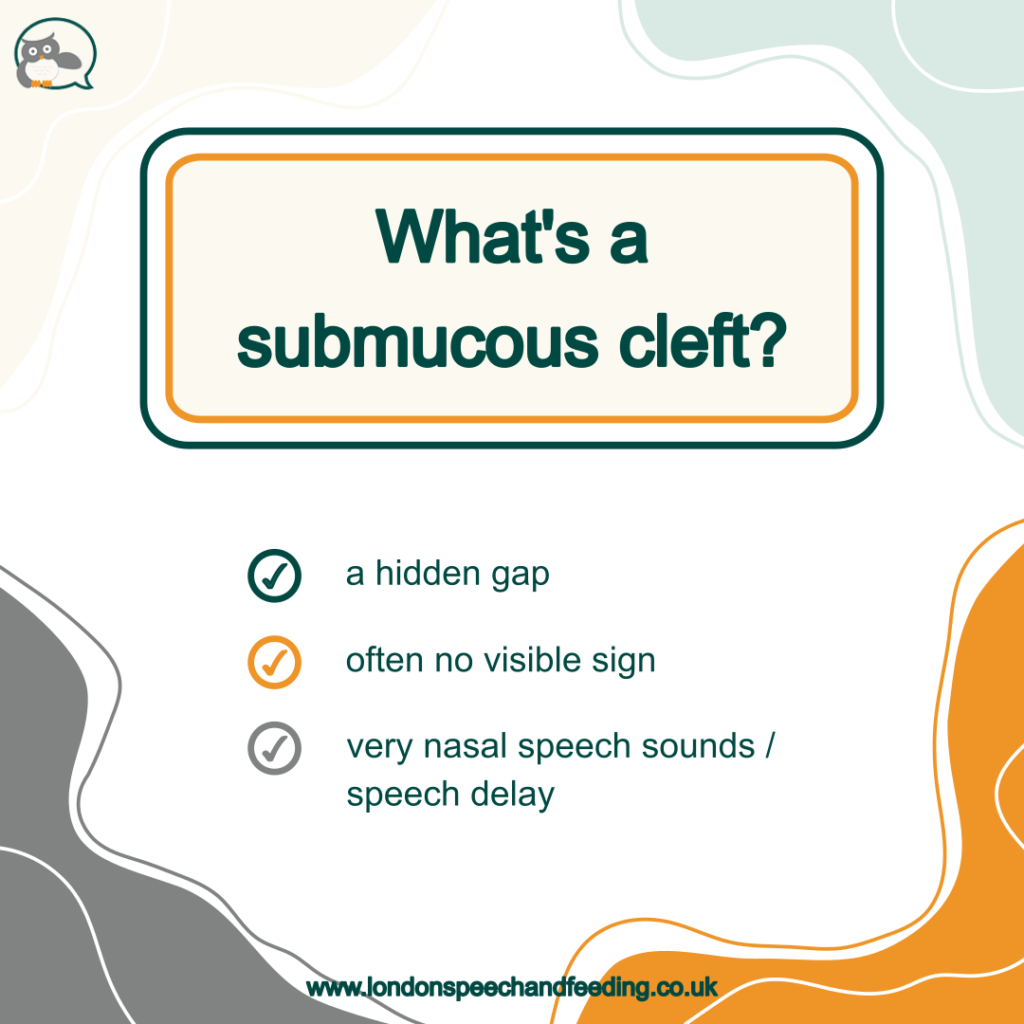
    A submucous cleft palate (SMCP) is much less obvious than its counterparts, cleft of lip and/or palate, and can profoundly impact a child’s speech development. It leads to often extreme hyper nasal speech and difficulty with producing many sounds (/K/ /G/ /T/ /D/ /P/ /B/ /S/ /Z/ /F/ /V/).

    In short, the muscles and bone of the soft palate, and sometimes the hard palate, do not fuse completely during foetal development and the mucous membrane that lines the roof of the mouth remains intact, effectively camouflaging the underlying muscular and bony deficit.

    So, while the surface of the palate appears normal, the essential muscle and functions responsible for sealing off the nasal cavity from the oral cavity during speech are compromised. This cleft (or lack of muscle) can be seen as a bluish midline discoloration of the soft palate, often a bifid (split) uvula, and at times a notch in the posterior border of the hard palate can be felt upon palpation. However, these signs aren’t always present or easily discernible, contributing to the difficulty arriving at a diagnosis.

    Diagnosing a submucous cleft palate is often akin to searching for a needle in a haystack, especially for the untrained eye. Unlike overt clefts that are visually apparent at birth, an SMCP can go undiagnosed for years, sometimes well into childhood or even adolescence. Paediatricians and even ENT surgeons have been known to miss it during routine checks due to the intact mucosal lining. Parents might notice their child’s speech sounds ‘different’ or ‘nasal’ but struggle to pinpoint the cause. Children might undergo extensive speech therapy without a proper diagnosis, as the underlying structural issue continues to hinder progress.

    My experience as a speech therapist in private practice:

    Over my years of practice, I have encountered several children presenting with persistent hyper-nasal speech and significant difficulties producing plosive and fricative sounds.

    It has been incredibly rewarding, though at times challenging, to successfully diagnose SMCP in a number of these children. My approach often involves:

    • a meticulous oral motor examination,
    • careful listening for the specific qualities of hypernasality,
    • and a deep understanding of the physiological requirements for clear speech sound production.

    When I suspect an SMCP, I refer these children to Great Ormond Street Hospital where a fantastic multidisciplinary team, typically including ENT surgeons and a specialist speech-language therapist can conduct more definitive assessments. These assessments often involve instrumental analyses such as videofluoroscopy or nasoendoscopy, which provide objective measures of velopharyngeal function and visual confirmation of the anatomical deficit.

    The path to resolution: surgery, therapy, and successful outcomes

    Surgery

    The journey for these children, once diagnosed, often involves surgical intervention. It’s not uncommon for children with SMCP to undergo multiple operations to achieve optimal velopharyngeal closure. These procedures aim to reconstruct or augment the velopharyngeal mechanism, enabling it to effectively separate the oral and nasal cavities during speech. The specific surgical approach depends on the individual child’s anatomy and the severity of the velopharyngeal insufficiency. It’s a testament to the skill of these specialised surgeons that such intricate repairs can be performed with remarkable success.

    Speech therapy

    Following surgery these children embark on the crucial phase of speech therapy. While surgery addresses the structural problem, speech therapy helps a child learn to utilise their newly improved anatomy. It involves intensive work on developing oral airflow, establishing correct articulatory placement, and reducing learned compensatory strategies that have developed due to the original structural deficit. It is immensely gratifying to witness the transformation. Children who once struggled to produce basic sounds, whose speech was difficult to understand, gradually develop clear speech.

    Next steps?

    If you’re a parent concerned about your child’s speech and feeding, you’re not alone. The journey can feel confusing, but professional guidance can make all the difference. Never hesitate to have a second opinion when you have that niggling feeling that there is something that has not yet been explored. At London Speech and Feeding I specialise in being thorough and thinking outside the box.

    I am here to provide the support you need. Reach out to schedule a consultation and take the first step towards helping your child communicate and thrive.

    Sonja McGeachie

    Highly Specialist Speech and Language Therapist

    Owner of The London Speech and Feeding Practice.


    Health Professions Council registered
    Royal College of Speech & Language Therapists Member
    Member of ASLTIP

    Find a speech and language therapist for your child in London. Are you concerned about your child’s speech, feeding or communication skills and don’t know where to turn? Please contact me and we can discuss how I can help you or visit my services page.


    1
  • ·

    Let’s live and breathe AAC

    We all have the right and want to express thoughts, feelings, and needs. For non-speaking or minimally speaking children, finding an avenue to communicate effectively can be a challenging journey. Parents are often at a loss as to where to start. Sometimes a little bit of Makaton signing has been used here and there but we mostly find that gradually signing fades as parents feel that it just doesn’t seem to get copied and used by the children.

    They live and breathe their system

    This is where we need to pick up the pieces and start again: because all successful families where children start using their boards or their electronic AAC (Augmentative and Alternative Communication) systems do this one thing: THEY LIVE AND BREATHE THEIR SYSTEM.

    • They have boards in every single room of the house;
    • They have a board in the car, attached to the side of car door so their child can point to it as they need to;
    • They have a smaller board in their handbag/rucksack when out and about;
    • They have a board for shopping and attach it to the shopping trolley;
    • They are never ever without their board.

    Because they realise that a child should never be without their mouths to speak, should never be without a means to speak. They use their own board to model and the child has always access to their board to model back or to just look.

    This is where success begins

    Success begins at consistent and joyful use of the board/AAC system throughout the entire day. If we think about it, doesn’t it make sense? Of course, it does! We talk to our child for the first two years of their life continuously wherever we are and our child is continuously encouraged to use their mouths for talking in all situations.

    Same goes for Signing: Makaton or any other sign system is a very powerful means to aid communication and I certainly advocate and use it in practice. Though much like words, signs are very elusive and temporary—as soon as the sign has been made it is gone and no longer present. Same with words of course. This can be difficult for people who need longer to process information.

    The beauty of symbols or photographs is that they are permanent: they don’t vanish, they stay and with the core board they stay in the same place! This is very reassuring. We can learn where a symbol is and we can be assured that it will still be there the next time we look at the board.

    AAC core board

    Here is a picture of a core board:

    AAC board

    You can download this and other boards for free on the Saltillo Word Power website.

    It has 48 cells and we can see the most frequently used core words on here, words that we use 80% of the day when talking with our non-speaking/minimally speaking children, younger children and children with cognitive delay. We keep our sentences short and we say phrases pertaining to their daily lives;

    • Let’s GET your toy
    • PUT it here, PUT it away, PUT it IN
    • Let’s READ a book
    • UP you get
    • WANT some MORE?
    • That’s GOOD isn’t it?
    • Let’s OPEN the box and LOOK

    And so on… All these phrases can be aided with the above board. Your child will learn OVER TIME and OVER CONTINUOUS USE where GET/PUT/MORE/WANT/IN—where these symbols are. For children who are slow to process this is so helpful, to have a visual representation of what has just been said. It aids understanding in the first place. Gradually as a child starts to copy they will point to powerful symbols themselves and if they want to speak they can also speak of course:

    A child might point to WANT + MORE and then say with their mouths: BANANA!

    Board examples

    Here are some other boards I have made specifically for daily situations and preferences of some of my students. Here is one for toileting:

    AAC toileting board

    And another one:

    These boards incorporate high-frequency and versatile words, enabling us to make little sentences.

    Building Language and Literacy Skills

    AAC Core Boards are not just tools for immediate communication. They also play a pivotal role in language and literacy development. By using these boards, non-speaking children engage with words and symbols, reinforcing their understanding of language structure and grammar.

    Over time they naturally absorb language patterns, laying the foundation for improved literacy skills.

    Customisation for Individual Needs

    Every non-speaking child is unique, and their communication needs can vary significantly. AAC Core Boards are designed with this diversity in mind. The boards can be adapted to include specific vocabulary relevant to the child’s daily life, interests, and activities. This personalisation ensures that the AAC Core Board is a true reflection of the child’s personality and needs, making communication more engaging and effective.

    Collaboration between AAC Core Boards and Speech Therapy

    While AAC Core Boards are an incredible tool, they are only used effectively by the non-speaking child when the board is used BY ALL COMMUNICATION PARTNERS around the child.

    Again, I know I am being repetitive here, but the board needs to be used and modelled by the adults constantly in the first place and for a period of time before we can expect our children to take an interest and use the boards themselves. Think how long it typically takes for a child to learn their first word: around a year! During that time the adults talk constantly to their child without hesitation or expectation! The same goes for introducing this new way of communicating.

    Collaborating with your child’s speech-language therapist (SLT) ensures that your child receives the right guidance in using the AAC system. SLTs can assess your child’s communication abilities, recommend appropriate boards and provide guidance on how to best implement them.

    Conclusion

    For non-speaking children, AAC Core Boards are bridges to their world.

    These boards foster language development, social interaction, and personal expression. AAC Core Boards offer a beacon of hope, helping non-speaking children break through communication barriers and thrive in a world that is waiting to hear their voices. Boards are simple for anyone to use and understand. Have a go! You will be surprised how lovely it is to use a board with ease and once your child sees you do this, you have a chance for your child to start copying you…and express something! HOW ABOUT THAT! I look forward to hearing your stories!

    The London Speech and Feeding Practice


    Find a speech and language therapist for your child in London. Are you concerned about your child’s speech, feeding or communication skills and don’t know where to turn? Please contact me and we can discuss how I can help you or visit my services page.
    1
  • The tricky /R/: Mastering tongue placement for clear speech

    The /R/ sound is notoriously challenging for many children (and even some adults!). It’s one of the most complex sounds in the English language, with various pronunciations depending on its position in a word. If your child is struggling with their /R/s, you’re not alone. As Speech and Language Therapists (SLTs), we frequently work on this sound, and a key component of our therapy is focusing on proper tongue placement.

    Why is the /R/ so difficult?

    The /R/ sound requires precise coordination of the tongue, jaw, and lips. Unlike sounds like /P/ or /B/ that involve simple lip movements, the /R/ involves intricate tongue movements and tension. There are also different ways to produce the /R/ sound, which adds to the complexity:

    • Retroflex /R/: The tongue tip curls up and back towards the roof of the mouth.
    • Bunched /R/: The body of the tongue bunches up towards the roof of the mouth, while the tongue tip remains down.

    The importance of tongue placement

    Regardless of which /R/ variation is being targeted, accurate tongue placement is crucial. Even a slight deviation can result in a distorted or inaccurate sound. That’s why SLTs dedicate significant time to teaching and practising tongue positioning.

    Speech therapy techniques: Focusing on the tongue

    Here’s a glimpse into how I address /R/ sound difficulties, with a focus on tongue placement:

    • Visual aids:
      • Mirrors: I use a mirror to help children see their tongue movements and make adjustments.
      • Tongue diagrams and models: These visual tools provide a clear representation of where the tongue should be positioned.
    • Tactile cues:
      • Tongue depressors: These can be used to gently guide the tongue into the correct position.
      • Food-grade tools: Sometimes, I use flavoured tongue depressors or other tools to provide tactile feedback and increase awareness of tongue placement.
    • Auditory discrimination:
      • I help children distinguish between correct and incorrect /R/ sounds.
      • I use auditory cues and verbal feedback to reinforce proper pronunciation.
    • Exercises and drills:
      • Tongue strengthening exercises: Strengthening the tongue muscles can improve control and coordination.
      • Tongue placement drills: We practise positioning the tongue in the desired location and holding it there.
      • Sound approximation techniques: Sometimes we use other sounds to help approximate the /R/ sound. For example, I use the /L/ sound, to help achieve the correct tongue placement. Once my child has found the /L/ sound it is then a matter of pulling back just slightly to get a good /R/.
    • Contextual practice:
      • Once the child can produce the /R/ sound in isolation, we gradually introduce it into syllables, words, phrases, and sentences.
      • We also practise the /R/ sound in different contexts, such as at the beginning, middle, and end of words.

    Tips for Parents:

    • Be patient and supportive: Learning the /R/ sound takes time and practice.
    • Practise regularly: Short, frequent practice sessions are more effective than long, infrequent ones.
    • Make it fun! Use games, stories, and other engaging activities to keep your child motivated.
    • Work with an SLT: A qualified SLT can provide personalised guidance and support.

    In conclusion:

    The /R/ sound can be challenging, but with targeted speech therapy and a focus on tongue placement, most children can achieve clear and accurate pronunciation.

    I hope this blog post is helpful!

    Get in touch with me via my contact form if you need support

    Sonja McGeachie

    Early Intervention Speech and Language Therapist

    Feeding and Dysphagia (Swallowing) Specialist The London Speech and Feeding Practice

    The London Speech and Feeding Practice


    Find a speech and language therapist for your child in London. Are you concerned about your child’s speech, feeding or communication skills and don’t know where to turn? Please contact me and we can discuss how I can help you or visit my services page.

    1
  • ·

    Transforming Mealtimes

    Speech Therpaist in London

    Transforming Mealtimes

    Below are two reviews I got from grateful clients over the past 4-6 weeks; this blog is more about how Feeding Therapy can help you than blowing my own trumpet…. though that said, it is always so nice and gratifying to hear when parents are happy and hopeful about their little one’s feeding journey. Feeding Therapy is a substantial part of my work as a Children’s Speech and Language Therapist. One of my specialist subjects is Autism and we find that many children on the Autism Spectrum are very specific about eating, and will often refuse a range of typical family foods in favour of a narrow range of foods/snacks.

    Mostly, feeding difficulties are a combination and complex cocktail of factors that have contributed to the current status quo: sure, there may have been some physical problems to start off with, such as reflux causing the baby discomfort, constipation, a very tight tongue tie or a swallowing problem caused by neurological difficulties and of course sensory processing difficulties are also very physical experiences. We always begin with a very thorough case history taking and information gathering, followed by an oral assessment and observation of the actual swallow to establish what might have been – or still might be – the cause for the feeding difficulties.

    In most of the cases I see in my practice, the original obvious cause is no longer present, especially with older children. So, if the swallowing is fine, the reflux is no longer present, the tongue was divided (twice!) why are they still not eating much, refusing to try new foods, only accept certain textures etc.

    The answer is extremely complex and multi-faceted and this little blog is not covering any factors in detail (we would be here all night) -I mentioned sensory processing difficulties earlier on. These are mostly still present but often not acknowledged or recognised by parents. And it is certainly the case that one of the contributors is parental anxiety; this tends to run very high and has been for many months, sometimes years. This in turn often leads to very tense and unpleasant, endlessly long meal times and many times children are force-fed several times a day in order to “get something down there” as otherwise they would probably starve themselves.

    Additionally, parents end up only offering a very narrow range of foods because that is all their child will eat. This ends up in a vicious cycle of children being fed porridge-style food for all meal times and of course they won’t progress to more mature foods if these mature foods are never on offer.

    In order to help address and disentangle some of the issues I often introduce the “Division of Responsibility in Feeding” as researched and recommended by Ellyn Satter (The Satter Feeding Dynamics Model)

    Here are the main points of her approach:

    Children have a natural ability with eating, they eat as much as they need and they grow in the way that is right for them and they learn to eat what their parents eat. (E Satter). The parent is responsible for WHAT the child eats, WHERE and WHEN the child eats. The child is responsible for HOW MUCH they eat or WHETHER to eat. Satter proposes that parents should guide their child’s transition from nipple feeding through semi-solids, then thick and lumpy foods to finger foods and then on to normal family meals.

    Please note: this model is only appropriate for children where the original physical cause is no longer present!

    Of course it’s not easy! It requires a huge shift in thinking about feeding and it requires to trust our children to know what is best for them. This is very big for most parents, as it is not how we were brought up and it is not commonly known that babies and children know what is good for them!

    However, it is certainly true that parents who follow this particular approach and make small, steady changes in the way the offer foods, and in the way they create family meal times differently, children make very nice, pleasing progress and over some months we often see remarkable positive changes.

    I like to work in a team and especially for this type of problem it is essential to have a multi-disciplinary approach. A knowledgeable dietician is an enormous plus in any feeding team as is of course a

    Paediatrician and/ or a Gastroenterologist and the most important people in the team are the parents!

    Feeding Therapy is all about collaboration and a ‘team around the child” approach. When we have this in place and there is trust amongst the team members then we make fantastic progress.

    Do get in touch with me if you would like some help with your tricky feeder.

    Lovely Reviews

    I visited London Speech and Feeding a couple of days ago with my 8-month-old granddaughter and her mother. Sonja made us feel comfortable and at ease from our first introductions. She was able to pinpoint my granddaughter’s mum’s anxiety around weaning very quickly. She not only gave her the tools to do this successfully, but also really encouraged my granddaughter’s mum and instilled confidence that she had everything she needed to make this sometimes-difficult transition without further anxiety.

    Sonja was very thorough in her initial assessment of my granddaughter’s physical milestones and her developing speech. My granddaughter felt very comfortable with Sonja and happily played along with her. Then came the big moment – trying out various foods! We were amazed to see just how easily my granddaughter, with Sonja’s expert encouragement, took to sampling the wonderful array of different delicious morsels Sonja had prepared for the session. My granddaughter even drank from a cup for the first time! Wonderful!

    Sonja then emailed a summary of the session and an extensive array of resources with suggestions for my granddaughter’s mum which she has now put into action. My granddaughter’s mum couldn’t thank Sonja enough for her caring attitude, extensive knowledge, and warm professionalism. I have no hesitation in recommending Sonja, she’s a fantastic Feeding Therapist!

    Sonja (and her lovely colleague, Sandra) were stupendous. I had brought my one-year-old son to see them as I was concerned that he wasn’t eating enough. They looked at his history and we ate together to make sure they had all the information they needed to give an accurate diagnosis. Whilst our outcome was that Henry was in fact doing brilliantly (and I just needed to chill out a bit!), I would imagine if there was something more serious going on, Sonja would make you feel just as supported and empowered as she did with us. Excellent follow-ups too. Money well spent for a bit of reassurance for a stressed out mama. Thank you, Sonja!


    Find a speech and language therapist for your child in London. Are you concerned about your child’s speech, feeding or communication skills and don’t know where to turn? Please contact me and we can discuss how I can help you or visit my services page.

  • · · ·

    Autism – Benefits of Early Assessment and Intervention

    I think my child might be autistic – how can we help?
    Image by macrovector on Freepik

    Consulting a Specialist Speech and Language Therapist can help you in several ways: assessment, informal and formal observation, discussion and advice, onward referrals, direct intervention, parent coaching, educational support and much more, all geared towards supporting you the parents, and helping your child to flourish and thrive.

    First up, we can help you with assessment and advice: with a wealth of expertise in observing childrens’ play and communication, as well as knowledge of the latest research we can see a child’s strengths and areas of struggle very quickly indeed.

    Within a short space of time, we can identify the areas we need to focus on and start guiding you towards helping your child to connect, respond, react and feel better.

    Early detection is key

    If autism is detected in infancy, then therapy can take full advantage of the brain’s plasticity. It is hard to diagnose Autism before 18 months but there are early signs we know to look out for. Let’s have a brief look at the sorts of things we look at.

    The earliest signs of Autism involve more of an absence of typical behaviours and not the presence of atypical ones.

    • Often the earliest signs are that a baby is very quiet and undemanding. Some babies don’t respond to being cuddled or spoken to. Baby is being described as a ‘good baby, so quiet, no trouble at all’.
    • Baby is very object focused: he/she may look for long periods of time at a red spot/twinkly item further away, at the corner of the room for example.
    • Baby does not make eye contact: we can often see that a baby looks at your glasses for example instead of ‘connecting’ with your eyes.
    • At around 4 months we should see a baby copying adults’ facial expressions and some body movements, gestures and then increasingly cooing sounds we make; babies who were later diagnosed with autism were not seen to be doing this.
    • Baby does not respond with smiles by about 6 months.
    • By about 9 months, baby does not share sounds in a back-and-forth fashion.
    • By about 12 months baby does not respond/turn their heads when their name is called.
    • By around 16 months we have no spoken words; perhaps we hear sounds that sound like ‘speech’ but we cannot make out what the sounds are.
    • By about 24 months we see no meaningful two-word combinations that are self-generated by the toddler. We might see some copying of single words.

    24 months plus:

    • Our child is not interested in other children or people and seems unaware of others in the same room/play area.
    • Our child prefers to play alone, and dislikes being touched, held or cuddled.
    • He/she does not share an interest or draw attention to their own achievements e.g., ‘daddy look I got a dog’.
    • We can see our child not being aware that others are talking to them.
    • We see very little creative pretend play.
    • In the nursery our child might be rough with other children, pushing, pinching or scratching, biting sometimes; or our child might simply not interact with others and be unable to sit in a circle when asked to.

    What sort of speech and language difficulties might we see?

    Our child might do any of the following:

    • have no speech at all, but uses body movements to request things, takes adults by the hand
    • repeat the same word or phrase over and over; sometimes straight away after we have said it or sometimes hours later
    • repeat phrases and songs from adverts or videos, nursery rhymes or what dad says every day when he gets back from work etc.
    • copy our way of intonation
    • not understand questions – and respond by repeating the question just asked:
      • adult: Do you want apple? child: do you want apple?
    • not understand directions or only high frequency directions in daily life
    • avoid eye contact or sometimes ‘stares’
    • lack of pointing or other gestures

    Common behaviours:

    • Hand flapping
    • Rocking back-and-forth
    • Finger flicking or wriggling/moving
    • Lining up items/toys
    • Wheel spinning, spinning around self
    • Flicking lights on and off, or other switches
    • Running back-and-forth in the room, needing to touch each wall/door
    • Loud screaming when excited
    • Bashing ears when frustrated or excited
    • Atypical postures or walking, tip toeing, can be falling over easily, uncoordinated
    • Can be hyper sensitive to noises, smells, textures, foods, clothing, hair cutting, washing etc.
    • Being rigid and inflexible, needing to stick to routines, unable to transition into new environments
    • Food sensitivity, food avoidance, food phobias

    I mentioned this to be a ‘brief’ look at the areas and it is: each topic is looked at very deeply and each area is multi-facetted therefore a diagnosis is rarely arrived at very quickly. We want to make sure we have covered all aspects and have got to know your child very well before coming to conclusions.

    Early detection is key, because we want to start helping your child to make progress as quickly as is possible. If you feel /know that your child is delayed in their speech and language development and you would like a professional opinion then please do contact me, I look forward to supporting you. It is important to know at this point, that if your child only has one or two of the above aspects it may mean that your child is simply delayed for reasons other than Autism and if that is the case, we will be able to help you iron out a few areas of need so that your child can go on thriving.

    If you need help with your child, please do not hesitate to contact me.


    Find a speech and language therapist for your child in London. Are you concerned about your child’s speech, feeding or communication skills and don’t know where to turn? Please contact me and we can discuss how I can help you or visit my services page.

    1